


ISO 13791:2004
(Main)Thermal performance of buildings — Calculation of internal temperatures of a room in summer without mechanical cooling — General criteria and validation procedures
Thermal performance of buildings — Calculation of internal temperatures of a room in summer without mechanical cooling — General criteria and validation procedures
ISO 13791:2004 specifies the assumptions, boundary conditions, equations and validation tests for a calculation procedure, under transient hourly conditions, of the internal temperatures (air and operative) during the warm period, of a single room without any cooling/heating equipment in operation. No specific numerical techniques are imposed by this standard. Validation tests are included. An example of a solution technique is given in Annex A. ISO 13791:2004 does not contain sufficient information for defining a procedure able to determine the internal conditions of special zones such as attached sun spaces, atria, indirect passive solar components (Trombe walls, solar panels) and zones in which the solar radiation may pass through the room. For such situations different assumptions and more detailed solution models are needed.
Performance thermique des bâtiments — Calcul des températures intérieures en été d'un local sans dispositif de refroidissement — Critères généraux et méthodes de calcul
L'ISO 13791:2004 spécifie les hypothèses, conditions aux limites, équations et essais de validation à adopter pour une méthode de calcul, en régime transitoire horaire, des températures intérieures (de l'air et de service) pendant les périodes chaudes, d'un seul local dépourvu d'installation de refroidissement/chauffage en service. L'ISO 13791:2004 n'impose aucune technique numérique particulière. Les essais de validation sont compris. Un exemple de technique de résolution est donné en Annexe A. L'ISO 13791:2004 ne renferme pas suffisamment d'information pour définir une procédure capable de déterminer les conditions internes de zones spéciales telles que: solariums, atriums, éléments solaires passifs indirects (murs capteurs à stockage thermique ou murs Trombe, panneaux solaires) et zones dans lesquelles le rayonnement solaire peut traverser le local. Dans de telles situations, il est nécessaire de disposer de diverses hypothèses et de modèles de résolution plus détaillés.
General Information
- Status
- Withdrawn
- Publication Date
- 26-Oct-2004
- Withdrawal Date
- 26-Oct-2004
- Technical Committee
- ISO/TC 163/SC 2 - Calculation methods
- Drafting Committee
- ISO/TC 163/SC 2 - Calculation methods
- Current Stage
- 9599 - Withdrawal of International Standard
- Start Date
- 15-Mar-2012
- Completion Date
- 12-Feb-2026
Relations
- Effective Date
- 12-Feb-2026
- Effective Date
- 12-May-2008


ISO 13791:2004 - Thermal performance of buildings -- Calculation of internal temperatures of a room in summer without mechanical cooling -- General criteria and validation procedures

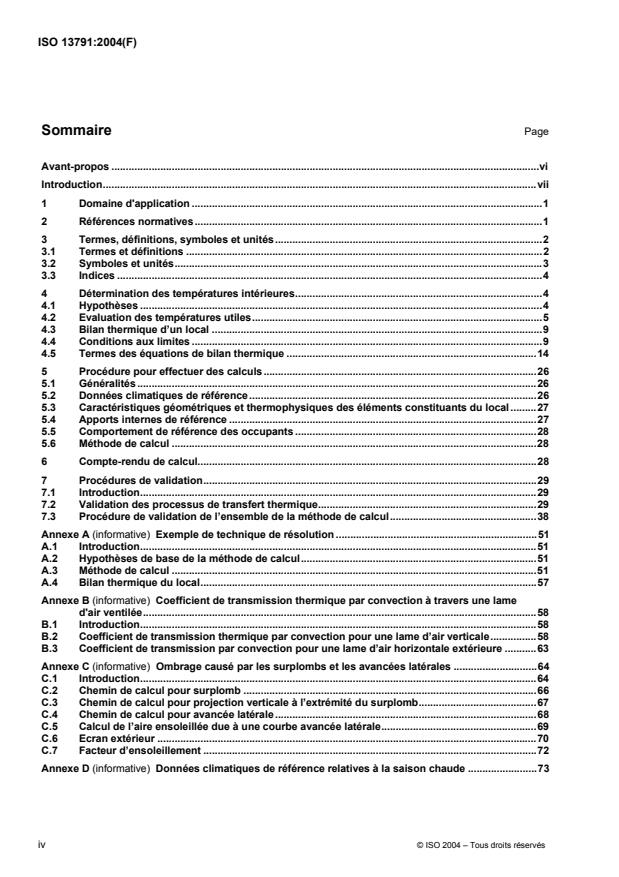
ISO 13791:2004 - Performance thermique des bâtiments -- Calcul des températures intérieures en été d'un local sans dispositif de refroidissement -- Criteres généraux et méthodes de calcul
Get Certified
Connect with accredited certification bodies for this standard

ICC Evaluation Service
Building products evaluation and certification.

QAI Laboratories
Building and construction product testing and certification.

Aboma Certification B.V.
Specialized in construction, metal, and transport sectors.
Sponsored listings
Frequently Asked Questions
ISO 13791:2004 is a standard published by the International Organization for Standardization (ISO). Its full title is "Thermal performance of buildings — Calculation of internal temperatures of a room in summer without mechanical cooling — General criteria and validation procedures". This standard covers: ISO 13791:2004 specifies the assumptions, boundary conditions, equations and validation tests for a calculation procedure, under transient hourly conditions, of the internal temperatures (air and operative) during the warm period, of a single room without any cooling/heating equipment in operation. No specific numerical techniques are imposed by this standard. Validation tests are included. An example of a solution technique is given in Annex A. ISO 13791:2004 does not contain sufficient information for defining a procedure able to determine the internal conditions of special zones such as attached sun spaces, atria, indirect passive solar components (Trombe walls, solar panels) and zones in which the solar radiation may pass through the room. For such situations different assumptions and more detailed solution models are needed.
ISO 13791:2004 specifies the assumptions, boundary conditions, equations and validation tests for a calculation procedure, under transient hourly conditions, of the internal temperatures (air and operative) during the warm period, of a single room without any cooling/heating equipment in operation. No specific numerical techniques are imposed by this standard. Validation tests are included. An example of a solution technique is given in Annex A. ISO 13791:2004 does not contain sufficient information for defining a procedure able to determine the internal conditions of special zones such as attached sun spaces, atria, indirect passive solar components (Trombe walls, solar panels) and zones in which the solar radiation may pass through the room. For such situations different assumptions and more detailed solution models are needed.
ISO 13791:2004 is classified under the following ICS (International Classification for Standards) categories: 91.120.10 - Thermal insulation of buildings. The ICS classification helps identify the subject area and facilitates finding related standards.
ISO 13791:2004 has the following relationships with other standards: It is inter standard links to EN ISO 13791:2004, ISO 13791:2012. Understanding these relationships helps ensure you are using the most current and applicable version of the standard.
ISO 13791:2004 is available in PDF format for immediate download after purchase. The document can be added to your cart and obtained through the secure checkout process. Digital delivery ensures instant access to the complete standard document.
Standards Content (Sample)
INTERNATIONAL ISO
STANDARD 13791
First edition
2004-11-01
Thermal performance of buildings —
Calculation of internal temperatures of a
room in summer without mechanical
cooling — General criteria and validation
procedures
Performance thermique des batiments — Calcul des températures
intérieures en été d'un local sans dispositif de refroidissement —
Critères généraux et méthodes de calcul
Reference number
©
ISO 2004
PDF disclaimer
This PDF file may contain embedded typefaces. In accordance with Adobe's licensing policy, this file may be printed or viewed but
shall not be edited unless the typefaces which are embedded are licensed to and installed on the computer performing the editing. In
downloading this file, parties accept therein the responsibility of not infringing Adobe's licensing policy. The ISO Central Secretariat
accepts no liability in this area.
Adobe is a trademark of Adobe Systems Incorporated.
Details of the software products used to create this PDF file can be found in the General Info relative to the file; the PDF-creation
parameters were optimized for printing. Every care has been taken to ensure that the file is suitable for use by ISO member bodies. In
the unlikely event that a problem relating to it is found, please inform the Central Secretariat at the address given below.
© ISO 2004
All rights reserved. Unless otherwise specified, no part of this publication may be reproduced or utilized in any form or by any means,
electronic or mechanical, including photocopying and microfilm, without permission in writing from either ISO at the address below or
ISO's member body in the country of the requester.
ISO copyright office
Case postale 56 • CH-1211 Geneva 20
Tel. + 41 22 749 01 11
Fax + 41 22 749 09 47
E-mail copyright@iso.org
Web www.iso.org
Published in Switzerland
ii © ISO 2004 – All rights reserved
Foreword
ISO (the International Organization for Standardization) is a worldwide federation of national standards bodies
(ISO member bodies). The work of preparing International Standards is normally carried out through ISO
technical committees. Each member body interested in a subject for which a technical committee has been
established has the right to be represented on that committee. International organizations, governmental and
non-governmental, in liaison with ISO, also take part in the work. ISO collaborates closely with the
International Electrotechnical Commission (IEC) on all matters of electrotechnical standardization.
International Standards are drafted in accordance with the rules given in the ISO/IEC Directives, Part 2.
The main task of technical committees is to prepare International Standards. Draft International Standards
adopted by the technical committees are circulated to the member bodies for voting. Publication as an
International Standard requires approval by at least 75 % of the member bodies casting a vote.
Attention is drawn to the possibility that some of the elements of this document may be the subject of patent
rights. ISO shall not be held responsible for identifying any or all such patent rights.
ISO 13791 was prepared by the European Committee for Standardization (CEN) in collaboration with
Technical Committee ISO/TC 163, Thermal performance and energy use in the built environment,
Subcommittee SC 2, Calculation methods, in accordance with the Agreement on technical cooperation
between ISO and CEN (Vienna Agreement).
Throughout the text of this document, read “.this European Standard.” to mean “.this International
Standard.”.
For the purposes of this International Standard, the CEN annex giving a list of EN documents corresponding
to the ISO documents mentioned as normative references has been removed.
Contents
Page
Foreword.vi
Introduction .vii
1 Scope.1
2 Normative references.1
3 Terms, definitions, symbols and units.1
3.1 Terms and definitions .1
3.2 Symbols and units .3
3.3 Subscripts.4
4 Determination of internal temperatures .4
4.1 Assumptions.4
4.2 Evaluation of the relevant temperatures.5
4.3 Room thermal balance.8
4.4 Boundary conditions .9
4.5 Terms in the thermal balance equations .13
5 Procedure for carrying out calculations .24
5.1 General.24
5.2 Design climatic data.24
5.3 Geometrical and thermophysical characteristics of room elements.25
5.4 Design internal gains .25
5.5 Design occupant behaviour .25
5.6 Calculation procedure .25
6 Report of the calculation .26
7 Validation procedures.26
7.1 Introduction.26
7.2 Validation of heat transfer processes .27
7.3 Validation procedure for the whole calculation method .34
Annex A (informative) Example of solution technique.46
A.1 Introduction.46
A.2 Basic assumptions for the calculation method .46
A.3 Calculation procedure .46
A.4 Room thermal balance.52
Annex B (informative) Convective heat transfer through ventilated air layer.53
B.1 Introduction.53
B.2 Convective heat transfer for a vertical air layer.53
B.3 Convective heat transfer for an external horizontal air layer .57
Annex C (informative) Shading due to overhangs and side fins.59
C.1 Introduction.59
C.2 Calculation path for overhang .60
C.3 Calculation path for vertical projection at the end of the overhang .61
C.4 Calculation path for side fin.62
C.5 Calculation of the sunlit area due to short side fin .63
C.6 External obstruction .63
iv © ISO 2004 – All rights reserved
C.7 Sunlit factor .65
Annex D (informative) Design climatic data in the warm season.66
Annex E (informative) Calculation of the internal long-wave radiation exchanges in buildings .67
E.1 Introduction .67
E.2 Limits of application .67
E.3 Calculation procedure .67
Annex F (informative) External radiative long-wave heat transfer coefficients.68
F.1 Introduction .68
F.2 Terms and calculation procedure.68
Annex G (informative) Solar factors .70
G.1 Introduction .70
G.2 Solar to air factor.70
G.3 Distribution factors .70
G.4 Solar loss factor .71
Annex H (informative) Internal gains.72
H.1 Introduction .72
H.2 Residential building .72
H.3 Non residential building .73
Annex J (informative) Air ventilation.75
J.1 Introduction .75
J.2 Calculation procedure .75
J.3 Example of calculation of natural ventilation rates for simple building.80
Annex K (informative) Detailed results of the validation tests considered in the “whole
validation model” procedure.82
Bibliography.84
Foreword
This document (EN ISO 13791:2004) has been prepared by Technical Committee CEN/TC 89 "Thermal
performance of buildings and building components", the secretariat of which is held by SIS, in collaboration with
Technical Committee ISO/TC 163, “Thermal performance and energy use in the built environment”, Subcommittee
SC 2, "Calculation methods".
This European Standard shall be given the status of a national standard, either by publication of an identical text or
by endorsement, at the latest by May 2005, and conflicting national standards shall be withdrawn at the latest by
May 2005.
This standard is one of a series of standards on calculation methods for the design and the evaluation of the
thermal performance of buildings and building components.
This document includes a Bibliography.
According to the CEN/CENELEC Internal Regulations, the national standards organizations of the following
countries are bound to implement this European Standard: Austria, Belgium, Cyprus, Czech Republic, Denmark,
Estonia, Finland, France, Germany, Greece, Hungary, Iceland, Ireland, Italy, Latvia, Lithuania, Luxembourg, Malta,
Netherlands, Norway, Poland, Portugal, Slovakia, Slovenia, Spain, Sweden, Switzerland and United Kingdom.
vi © ISO 2004 – All rights reserved
Introduction
This document is intended for use by specialists to develop and/or validate methods for the hourly calculation of the
internal temperatures of a single room.
Examples of application of such methods include:
a) assessing the risk of internal overheating;
b) optimizing aspects of building design (building thermal mass, solar protection, ventilation rate, etc.) to provide
thermal comfort conditions;
c) assessing whether a building requires mechanical cooling.
Criteria for building performance are not included. They can be considered at national level. This standard can also
be used as a reference to develop more simplified methods for the above and similar applications.
1 Scope
This document specifies the assumptions, boundary conditions, equations and validation tests for a calculation
procedure, under transient hourly conditions, of the internal temperatures (air and operative) during the warm
period, of a single room without any cooling/heating equipment in operation. No specific numerical techniques are
imposed by this document. Validation tests are included in Clause 7. An example of a solution technique is given in
Annex A.
This document does not contain sufficient information for defining a procedure able to determine the internal
conditions of special zones such as attached sun spaces, atria, indirect passive solar components (Trombe walls,
solar panels) and zones in which the solar radiation may pass through the room. For such situations different
assumptions and more detailed solution models are needed (see Bibliography).
2 Normative references
The following referenced documents are indispensable for the application of this document. For dated references,
only the edition cited applies. For undated references, the latest edition of the referenced document (including any
amendments) applies.
EN 410, Glass in building – Determination of luminous and solar characteristics of glazing.
EN ISO 6946, Building components and building elements – Thermal resistance and thermal transmittance –
Calculation method (ISO 6946:1996).
EN ISO 7345, Thermal insulation – Physical quantities and definitions (ISO 7345:1987).
EN ISO 9251, Thermal insulation – Heat transfer conditions and properties of materials – Vocabulary (ISO
9251:1987).
EN ISO 9288, Thermal insulation – Heat transfer by radiation – Physical quantities and definitions (ISO 9288:1989).
EN ISO 9346, Thermal insulation – Mass transfer – Physical quantities and definitions (ISO 9346:1987).
EN ISO 10077-1, Thermal performance of windows, doors and shutters – Calculation of thermal transmittance –
Part 1: Simplified method (ISO 10077-1:2000).
EN ISO 10077-2, Thermal performance of windows, doors and shutters – Calculation of thermal transmittance –
Part 2: Numerical method for frames (ISO 10077-2:2003).
EN ISO 13370, Thermal performance of buildings – Heat transfer via the ground – Calculation methods (ISO
13370:1998).
3 Terms, definitions, symbols and units
3.1 Terms and definitions
For the purposes of this document, the terms and definitions given in EN ISO 7345, EN ISO 9251, EN ISO 9288
and EN ISO 9346 and the following apply.
3.1.1
internal environment
closed space delimited from the external environment or adjacent spaces by the building fabric
3.1.2
room element
wall, roof, ceiling, floor, door or window that separates the internal environment from the external environment or an
adjacent space
3.1.3
room air
air of the internal environment
3.1.4
internal air temperature
temperature of the room air
3.1.5
internal surface temperature
temperature of the internal surface of a building element
3.1.6
mean radiant temperature
uniform surface temperature of an enclosure with which an occupant would exchange the same amount of radiant
heat as with the actual non-uniform enclosure
3.1.7
operative temperature
uniform temperature of an enclosure with which an occupant would exchange the same amount of heat by
radiation plus convection as with the actual non-uniform environment
2 © ISO 2004 – All rights reserved
3.2 Symbols and units
For the purposes of this document, the following terms and symbols apply.
Symbol Quantity Unit
A area m
A
sunlit area m
s
C heat capacity J/K
F view factor -
I intensity of solar radiation W/ m
R thermal resistance
m ⋅K/W
T thermodynamic temperature K
U thermal transmittance .
W/(m K)
V volume m
a thermal diffusivity m /s
c
specific heat capacity .
J/(kg K)
c coefficient of discharge -
d
c specific heat capacity of air at constant pressure .
p
J/(kg K)
d thickness m
f
solar distribution factor -
d
f internal convective factor -
ic
f sunlit factor -
s
f solar to air factor -
sa
f solar loss factor -
sl
g heat flow rate per volume W/m
h surface coefficient of heat transfer .
W/(m K)
l length m
m
mass kg
q mass air flow rate kg/s
a
p pressure Pa
q density of heat flow rate W/m
t
time s
v velocity m/s
x,y,z co-ordinates m
thermal conductance of air layer
Λ ⋅
W/(m K)
heat flow rate W
Φ
J total radiosity W/m
solar absorptance -
α
total hemispherical emissivity -
ε
Celsius temperature °C
θ
thermal conductivity
λ W/(m⋅K)
dynamic viscosity
µ kg/(m⋅s)
solar reflectance -
ρ
3.3 Subscripts
a air cd conduction
b building ec external ceiling
c convection ef external floor
D direct solar radiation eq equivalent
d diffuse solar radiation ic internal ceiling
e external if internal floor
g ground il inlet section
i internal lr long-wave radiation
l leaving the section mr mean radiant
n normal to surface op operative
r radiation sa solar to air
s surface sk sky
t time sr short wave radiation
v ventilation va ventilation through air cavity
4 Determination of internal temperatures
4.1 Assumptions
The evaluation of the internal temperature of a room involves the solution of a system of equations of the transient
heat and mass transfers between the external and internal environment through the opaque and transparent
elements bounding the room envelope. The procedures given in this document allow the user to determine the time
dependent temperature of each component, including the internal air. Accepted assumptions for the calculation of
the internal temperatures of a single room under transient conditions in absence of any cooling plant are:
— the air temperature is uniform throughout the room;
— the various surfaces of the room elements are isothermal;
— the thermophysical properties of the materials composing the room elements are time independent;
— the heat conduction through the room elements (excluding to the ground) is assumed to be one-dimensional;
— the heat conduction to the ground through room elements is treated by an equivalent one-dimensional heat flow
rate according to EN ISO 13370;
— the effect of thermal bridges are generally neglected, but if they are considered their heat storage contribution is
neglected;
— air spaces are treated as air layers bounded by two isothermal and parallel surfaces;
— convective heat transfer coefficients: at the external surface they depend on the wind velocity and direction, at
the internal surface they depend on the direction of the heat flow;
— the long-wave radiative heat flow rate at the external surfaces of the room elements is related to a time-
independent heat transfer coefficient;
— the external radiant environment (sky excluded) is at the external air temperature (see 4.5.4.1);
— the distribution of solar radiation within the room is time-independent;
— the dimensions of each element are measured inside the room;
— the mean radiant temperature is calculated by weighting the various internal surface temperatures according to
the relevant areas;
4 © ISO 2004 – All rights reserved
— the operative temperature is the average between the internal air temperature and the mean surface
temperature.
4.2 Evaluation of the relevant temperatures
4.2.1 Internal air temperature
The air temperature of a room, at any given time, is obtained by solving Equation (1), where heat flow rates to room
air are taken as positive:
N
∂ θ
a,i
(Aq ) + Φ + Φ + Φ + Φ = c m (1)
c,i j v i,c sa va a a,i
∑
∂ t
j =1
where
N is the number of internal surfaces delimiting the internal air;
A is the area of each building element;
q is the density of the heat flow rate by convection (see 4.5.2.2);
c,i
Φ is the heat flow rate by ventilation (see 4.5.6);
v
Φ is the convective part of heat flow rate due to internal sources (see 4.5.5);
i,c
Φ is the solar to air heat flow rate (see 4.5.3.4);
sa
Φ is the heat flow rate due to the air entering the room through air layers within the elements bounding the
va
room;
c is the specific heat capacity of air;
a
m is the mass of the internal air;
a,i
θ is the temperature of the internal air;
a,i
t is the time
NOTE Because of the very small value of the term (c m ) the right-hand side of Equation (1) can be assumed to be zero.
a a,i
4.2.2 Internal surface temperature
The internal surface temperature at element j is obtained by solving Equation (2), where heat flow rates to the
internal surface, except q , are taken as positive:
c,j
N
q + q + q + q +Φ /( A ) = 0 (2)
∑
lr, j sr,j c, j cd, j i,r j
j =1
where
q is the density of heat flow rate due to long-wave radiation exchanged with other internal surfaces (see
lr
4.5.4.2);
q is the density of heat flow rate due to the absorbed short-wave radiation (see 4.5.3.2);
sr
q is the density of heat flow rate released to room air by convection (see 4.5.2.2);
c
is the density of heat flow rate by conduction (see 4.5.1);
q
cd
Φ is the heat flow rate due to the radiative component of internal gains (see 4.5.5);
i,r
N is the number of surfaces delimiting the internal air;
A is the area of room element j.
j
4.2.3 Surface delimiting two solid layers
j-1 jj+1
q
sr,j
q q
cd,j-1 cd,j+1
Figure 1 - Surface delimiting two layers
The temperature at surface j delimiting two layers in an element (Figure 1) is obtained by solving Equation (3):
q + q + q = 0 (3)
cd, j −1 cd, j +1 sr,
j
where
q is the density of heat flow rate by conduction from the j-1 surface (see 4.5.1);
cd,,j-1
q is the density of heat flow rate by conduction from the j+1 surface (see 4.5.1);
cd,j+1
q is the density of heat flow rate due to the solar radiation absorbed by the surface j.
sr,j
4.2.4 Surface of an air layer
j
j-1
q
sr,j
q q
c,j cd,j
q
lr,j
Key
1 Air layer
Figure 2 - Surface delimiting an air layer
6 © ISO 2004 – All rights reserved
The temperature at surface j of an air layer (Figure 2) is obtained by solving Equation (4):
q + q + q + q = 0 (4)
c, j lr, j cd, j sr, j
where
q is the density of the total heat flow rate released to the air layer (see 4.5.2);
c
q is the density of the heat flow rate received by long-wave radiation across the air layer (see 4.5.4);
lr
q is the density of the heat flow by conduction (see 4.5.1);
cd
q is the density of heat flow rate absorbed due to an external source (e.g. solar radiation).
sr
4.2.5 External surface of a room element
j
q
sr,j
q
q
c,j
cd,j
q
lr,j
Figure 3 - External surface of an element
The temperature at surface j of a room element (Figure 3) is obtained by solving Equation (5):
q + q + q + q = 0 (5)
lr, j sr, j c, j cd, j
where
q is the density of heat flow rate by long-wave radiation at the surface (see 4.5.4.1);
lr
q is the density of heat flow rate due to the short-wave radiation absorbed by the surface (see 4.5.3.1);
sr
q is the density of heat flow rate by convection with the air (see 4.5.2.2);
c
q is the density of the conduction heat flow rate (see 4.5.1).
cd
4.2.6 Relevant temperatures for special construction elements
4.2.6.1 Ceiling below an attic
The ceiling, the air space and the roof are considered as a single horizontal element with one-dimensional heat
flow. The air space is considered as an air layer, treated in 4.5.2.3 and 4.5.2.4.
4.2.6.2 Floor on ground
The floor and the soil are considered as a single horizontal element with the heat flow treated according to
EN ISO 13370. Boundary conditions are specified in 4.4.4.
4.2.6.3 Floor over cellar
The cellar is treated as an unheated basement according to EN ISO 13370. Boundary conditions are specified
in 4.4.3.
4.2.6.4 Floor over crawl space
The floor, the crawl space and the soil are treated as a suspended floor according to EN ISO 13370. Boundary
conditions are specified in 4.4.5.
4.2.6.5 Glazed element
A glazed element is composed of a number of planes (glazing panes and possibly blinds) which are in thermal
equilibrium with one another. The evaluation of temperatures of each plane is made using the following
assumptions:
— the heat storage effects in the various planes are neglected;
— the heat flow by convection through the air layers between each pane is calculated according to 4.5.2.3 and
4.5.2.4;
— the density of heat flow rate due to the long-wave radiation between the various planes is calculated according
to 4.5.4.3;
— the density of heat flow rate due to the short-wave radiation absorbed by each plane is treated as a source term.
4.3 Room thermal balance
In each equation of 4.2, the time dependent heat flow rates shall be expressed in terms of operators which relate
the heat flow rate at the internal surface of each element to the temperature at the internal and external surface,
and that of the internal air, by using suitable mathematical models of the heat transfer processes. The temperature
of the internal air, together with the temperature of the different surfaces, shall be determined by solving the global
equation system at each time step considered. A general expression of the equation system is:
Π Π Π Π
θ Γ
1,1 1,2 1,N 1,N +1 is,1 1
Π Π Π Π
θ Γ
2,1 2,2 2,N 2,N +1 is,2 2
⋅ = (6)
Π Π Π Π
θ Γ
N,1 N,2 N,N N,N +1 is,N N
Π Π Π Π
θ Γ
N +1,1 N +1,2 N +1,N N +1,N+,1 a N +1
where
Ν is the number of elements bounding the room corresponding to the internal surfaces delimiting the
internal air;
Π are the coefficients of the unknown temperatures (θ) (from 1 to N relating to the internal surfaces, N + 1
relating to the internal air);
Γ are the coefficients of the known terms (from 1 to N relating to the internal surfaces, N +1 relating to the
internal air);
θ are the unknown temperatures (from 1 to N relating to the internal surfaces, N +1 relating to the internal
air).
The "Π " and "Γ" terms are obtained by rewriting Equation (1) and Equation (2) in order to separate the unknown
parameters (air temperature at the given time t for Equation (1) and the internal surface temperature for each
component at the given time t for Equation (2)) from the known parameters. The form of these equations depends
on the solution technique adopted.
8 © ISO 2004 – All rights reserved
4.4 Boundary conditions
4.4.1 Single room
A single room model requires the knowledge of the conditions of adjacent rooms. The two following situations are
considered:
— adjacent room with the same conditions (similar rooms);
— adjacent room with defined internal conditions.
If boundary conditions are very different from the above, the simple room model specified in this document shall not
be used and it is necessary to calculate the real boundary conditions by a multi-room model able to take account of
the heat transfer between the different rooms. This may be achieved by:
a) simultaneous solution of the global system equations for all rooms, or
b) iterative procedure by considering, as boundary conditions for each room, the temperatures determined at the
previous time step.
4.4.2 Similar rooms
4.4.2.1 Partition (vertical) wall
Referring to Figure 4, the following boundary conditions are considered:
ei
θ θ
a,e a,i
1 2
Key
1 Similar
2 Internal
Figure 4 - Partition vertical wall
θ = θ
a,e a,i
q = q
sr,e sr,i
q = q (7)
lr,e lr,i
h = h
c,e c,i
where
θ is the air temperature of the adjacent room;
a,e
θ
a,i is the air temperature of the room;
q is the density of heat flow rate due to absorbed short-wave radiation at the external surface of the wall;
sr,e
q is the density of the heat flow rate by long-wave radiation exchanged with the other surfaces of the
lr,e
adjacent room;
q is the density of heat flow rate due to absorbed short-wave radiation at the internal surface of the wall
sr,i
(see 4.5.3.2);
q is the density of the heat flow rate received by long-wave radiation at the internal surface of the wall from
lr,i
the other internal surfaces (see 4.5.4.2);
h is the convective heat transfer coefficient at the external surface;
c,e
h is the convective heat transfer coefficient at the internal surface (see Table 1).
c,i
4.4.2.2 Ceiling/floor
Referring to Figure 5, the following boundary conditions are considered:
θ
ec
a,e
ic
θ
a,i
if
ef
θ
a,e
Key
1 Similar room
2 Ceiling
3 Room
4 Floor
5 Similar room
Figure 5 - Ceiling/floor adjacent to similar rooms
10 © ISO 2004 – All rights reserved
θ = θ
a,e a,i
q = q
sr,ec sr,if
q = q
lr,ec lr,if
q = q (8)
sr,ef sr,ic
q = q
lr,ef lr,ic
h = h
c,ec c,if
h = h
c,ef c,ic
where
θ is the air temperature of the adjacent room;
a,e
θ is the air temperature of the room;
a,i
q is the density of heat flow rate due to absorbed short-wave radiation at the external surface of the
sr,ec
ceiling;
q is the density of heat flow rate due to absorbed short-wave radiation at the internal surface of the
sr,ic
ceiling (see 4.5.3.2);
q is the density of heat flow rate due to absorbed short-wave radiation at the external surface of the
sr,ef
floor;
q is the density of heat flow rate due to absorbed short-wave radiation at the internal surface of the floor
sr,if
(see 4.5.3.2);
q is the density of the heat flow rate by long-wave radiation by the external surface of the floor with the
lr,ef
other external surfaces;
q is the density of the heat flow rate by long-wave radiation by the internal surface of the floor with the
lr,if
other internal surfaces (see 4.5.4.2);
q is the density of the heat flow rate by long-wave radiation from the external surface of the ceiling to
lr,ec
the other external surfaces;
q is the density of the heat flow rate by long-wave radiation from the internal surface of the ceiling to the
lr,ic
other internal surfaces (see 4.5.4.2);
h is the convective heat transfer coefficient at the external surface of the ceiling;
c,ec
h is the convective heat transfer coefficient at the internal surface of the floor (see Table 1);
c,if
h is the convective heat transfer coefficient at the external surface of the floor;
c,ef
h is the convective heat transfer coefficient at the internal surface of the ceiling (see Table 1).
c,ic
4.4.3 Adjacent room with defined value of the air temperature
For each component of the envelope (see Figure 6) the following boundary conditions are considered:
e i
θ ec θ ef
a,e a,e
θ θ
a,e a,i
θ ic θ if
a,i a,i
Key
1 Wall
2 Ceiling
3 Floor
Figure 6 - Wall, ceiling and floor adjacent to room with defined internal conditions
θ = θ
a,e a,d
q = 0
sr,e
h = h
c,e c,i
h = h (9)
c,ec c,if
h = h
c,ef c,ic
where
θ is the air temperature of the adjacent room;
a,d
q is the density of heat flow rate due to absorbed short-wave radiation at the external surface;
sr,e
h is the convective heat transfer coefficient at the external surface of the vertical wall;
c,e
h is the convective heat transfer coefficient at the internal surface of the vertical wall (see Table 1);
c,i
h is the convective heat transfer coefficient at the external surface of the ceiling;
c,ec
h is the convective heat transfer coefficient at the internal surface of the floor (see Table 1);
c,if
h is the convective heat transfer coefficient at the external surface of the floor;
c,ef
h is the convective heat transfer coefficient at the internal surface of the ceiling (see Table 1).
c,ic
12 © ISO 2004 – All rights reserved
4.4.4 Floor on ground
The heat transfer between the room and the external environment through the ground is calculated as the sum of a
steady state component and a monthly variable component as specified in EN ISO 13370. The monthly variable
component is treated as one-dimensional and perpendicular to the floor surface. The calculation procedure shall
combine this heat flow rate with the thermal storage of the floor construction together with a 0,5 m thick layer of soil
beneath it.
NOTE One acceptable way is to introduce a monthly varying boundary temperature at a depth of 0,5 m beneath the floor
construction. This boundary temperature is defined so that the heat flow rate from the room air at its mean monthly temperature
to the boundary layer equals the heat flow rate to and through the ground calculated according to EN ISO 13370.
4.4.5 Cellar or crawl space
A cellar is treated as an unheated basement according to EN ISO 13370. Heat transfers are calculated as in 4.4.4,
including 0,5 m of soil at each side of the cellar and below the cellar. A crawl space is treated as a suspended floor
according to EN ISO 13370. Boundary conditions are as specified in 4.4.3.
4.4.6 Ceiling below attic
According to the assumptions of 4.2.6.1, the boundary conditions are represented by:
θ is the external air temperature;
a,e
q is defined by Equation (17) in 4.5.3.1;
sr,e
q is defined by Equation (24) in 4.5.4.1.
lr,e
4.5 Terms in the thermal balance equations
4.5.1 Heat conduction through components
For elements with constant thermal conductivity and specific heat capacity, the density of heat flow by conduction is
governed by the following equations:
∂θ
q = −λ( ) (10)
n
∂n
2 2 2
∂ θ ∂ θ ∂ θ ∂θ
λ( + + ) + g = cρ (11)
2 2 2
∂ t
∂ x ∂ y ∂ z
where
θ is the temperature of the component (in direction of the heat flow) at the time t;
q is the density of heat flow rate in direction n;
λ is the thermal conductivity of the medium;
c is the specific heat capacity of the medium;
ρ is the density of the medium;
g is the heat source term (heat flow rate per volume);
x,y,z are co-ordinates.
These equations may be solved by any appropriate procedure which provides results in accordance with the
validation procedure given in Clause 7.
NOTE A suitable procedure is described in Annex A.
4.5.2 Convective heat transfer
4.5.2.1 General
Convective heat transfer occurs at the boundary surfaces of each building element and through air layers.
4.5.2.2 Convective heat flow rate at the surfaces of an element
The density of convective heat flow rate at the internal and external surface of element is given by:
q = h (θ −θ ) (12)
c s a
c
where
h is the convective heat transfer coefficient of the surface;
c
θ is the surface temperature;
s
θ is the air temperature.
a
At the external surface the values of the convective heat transfer coefficient h , is given by:
c,e
h = 4 + 4v (13)
c,e
where
v is the wind velocity near the surface.
The wind velocity near the surface, v, depends on the climatic data of the locality and on the envelope
characteristics. Unless otherwise specified, the value of 1 m/s shall be used. The values of the convective heat
transfer coefficient at the internal surface, h , are given in Table 1.
c,i
Table 1 - Convective heat transfer coefficient at the internal surface
Vertical wall Heat flow upwards Heat flow downwards
2 2 2
W/(m ⋅K) W/(m ⋅K) W/(m ⋅K)
2,5 5,0 0,7
NOTE The values in Table 1 were determined using the equations given in EN ISO 6946 for
the following conditions:
- temperature difference (θ - θ ) < 10 K;
s,i a,i
- surface hydraulic diameter = 4,5 m (4 × area/perimeter).
The air temperature required in Equation (12) is:
— for internal surfaces: the room air temperature;
— for external surfaces: the conditions given in Table 2.
14 © ISO 2004 – All rights reserved
Table 2 - Air temperature
Buildings element Air temperature conditions
External wall, roof External air temperature
Partition wall, ceiling and roof to similar room Internal air temperature
Partition wall, ceiling and roof to adjacent Air temperature of the adjacent room
room with different conditions
Floor on ground Mean monthly external air temperature
Floor on cellar Temperature of the cellar
4.5.2.3 Convective heat transfer through unventilated air layers
The density of convective heat flow rate through an unventilated air layer, q , is given by:
c
q = Λ ∆θ (14)
c a
where
∆θ is the temperature difference between the surfaces delimiting the layer;
Λ is the thermal conductance of the air layer.
a
The thermal conductance of an unventilated air layer is calculated according to:
— EN ISO 6946 between opaque surfaces;
— EN ISO 10077-1 between transparent surfaces.
NOTE For transparent surfaces, the thermal conductance of an unventilated air layer can be calculated assuming the
following reference conditions:
— air density: 1,139 kg/m
-5
— dynamic viscosity: 1,861 × 10 kg/(m⋅s)
— thermal conductivity: 0,0264 W/(m·K)
— specific heat capacity: 1008 J/(kg·K)
— thermodynamic temperature: 300 K
— temperature difference: 5 K.
Table 3 gives some values of thermal conductance, Λ , for vertical and horizontal unventilated air layers between
a
transparent components. For other thicknesses, thermal conductances may be derived by interpolation.
Table 3 - Thermal convective conductance of unventilated air layers
Air layer thickness Vertical air layer Horizontal air layer
m Thermal Heat flow upwards Heat flow
conductance downwards
Λ
a
Λ
a
W/(m ·K)
W/(m ·K)
Thermal Thermal
conductance conductance
Λ Λ
a a
2 2
W/(m ·K) W/(m ·K)
0,01 2,65 2,06 2,06
0,05 1,16 1,71 0,41
0,10 1,29 1,50 0,21
0,20 1,42 1,48 0,10
4.5.2.4 Convective heat transfer through ventilated air layer
The convective heat flow rate through a ventilated air layer, Φ , depends on the air flow rate in the air layer. The
va
heat flow rates to be considered are:
a) the convective heat flow rate, Φ , due to air passing through the air layer and into the room, given by:
va
Φ = m c (θ −θ ) (15)
va a,v a l a,i
where
m is the mass air flow through the air layer;
a,v
θ is the temperature of the air leaving the layer;
l
b) the convective heat flow rate, Φ , between surfaces and air, given by:
c,j
Φ = h A (θ −θ )
c, j a c j eq
Φ = h A (θ −θ ) (16)
c, j +1 a c j +1 eq
where
A is the area of the surface in contact with the air layer;
c
h is the convective heat transfer coefficient for ventilated layers;
a
θ is the equivalent temperature of the air in the layer;
eq
j and j + 1 refer to the surfaces delimiting the air layer.
NOTE A procedure for determining the parameters in Equations (15) and (16) is given in Annex B.
16 © ISO 2004 – All rights reserved
----------------------
...
NORME ISO
INTERNATIONALE 13791
Première édition
2004-11-01
Performance thermique des bâtiments —
Calcul des températures intérieures en
été d'un local sans dispositif de
refroidissement — Critères généraux et
méthodes de calcul
Thermal performance of buildings — Calculation of internal
temperatures of a room in summer without mechanical cooling —
General criteria and validation procedures
Numéro de référence
©
ISO 2004
PDF – Exonération de responsabilité
Le présent fichier PDF peut contenir des polices de caractères intégrées. Conformément aux conditions de licence d'Adobe, ce fichier
peut être imprimé ou visualisé, mais ne doit pas être modifié à moins que l'ordinateur employé à cet effet ne bénéficie d'une licence
autorisant l'utilisation de ces polices et que celles-ci y soient installées. Lors du téléchargement de ce fichier, les parties concernées
acceptent de fait la responsabilité de ne pas enfreindre les conditions de licence d'Adobe. Le Secrétariat central de l'ISO décline toute
responsabilité en la matière.
Adobe est une marque déposée d'Adobe Systems Incorporated.
Les détails relatifs aux produits logiciels utilisés pour la création du présent fichier PDF sont disponibles dans la rubrique General Info
du fichier; les paramètres de création PDF ont été optimisés pour l'impression. Toutes les mesures ont été prises pour garantir
l'exploitation de ce fichier par les comités membres de l'ISO. Dans le cas peu probable où surviendrait un problème d'utilisation,
veuillez en informer le Secrétariat central à l'adresse donnée ci-dessous.
© ISO 2004
Droits de reproduction réservés. Sauf prescription différente, aucune partie de cette publication ne peut être reproduite ni utilisée sous
quelque forme que ce soit et par aucun procédé, électronique ou mécanique, y compris la photocopie et les microfilms, sans l'accord écrit
de l'ISO à l’adresse ci-après ou du comité membre de l'ISO dans le pays du demandeur.
ISO copyright office
Case postale 56 • CH-1211 Geneva 20
Tel. + 41 22 749 01 11
Fax. + 41 22 749 09 47
E-mail copyright@iso.org
Web www.iso.org
Version française parue en 2005
Publié en Suisse
ii © ISO 2004 – Tous droits réservés
Avant-propos
L'ISO (Organisation internationale de normalisation) est une fédération mondiale d'organismes nationaux de
normalisation (comités membres de l'ISO). L'élaboration des Normes internationales est en général confiée
aux comités techniques de l'ISO. Chaque comité membre intéressé par une étude a le droit de faire partie du
comité technique créé à cet effet. Les organisations internationales, gouvernementales et non
gouvernementales, en liaison avec l'ISO participent également aux travaux. L'ISO collabore étroitement avec
la Commission électrotechnique internationale (CEI) en ce qui concerne la normalisation électrotechnique.
Les Normes internationales sont rédigées conformément aux règles données dans les Directives ISO/CEI,
Partie 2.
La tâche principale des comités techniques est d'élaborer les Normes internationales. Les projets de Normes
internationales adoptés par les comités techniques sont soumis aux comités membres pour vote. Leur
publication comme Normes internationales requiert l'approbation de 75 % au moins des comités membres
votants.
L'attention est appelée sur le fait que certains des éléments du présent document peuvent faire l'objet de
droits de propriété intellectuelle ou de droits analogues. L'ISO ne saurait être tenue pour responsable de ne
pas avoir identifié de tels droits de propriété et averti de leur existence.
L'ISO 13791 a été élaborée par le Comité européen de normalisation (CEN) en collaboration avec le comité
technique ISO/TC 163, Performance thermique et utilisation de l'énergie en environnement bâti, sous-comité
SC 2, Méthodes de calcul, conformément à l'Accord de coopération technique entre l'ISO et le CEN (Accord
de Vienne).
Tout au long du texte du présent document, lire «… la présente Norme européenne …» avec le sens de
«… la présente Norme internationale …».
Pour les besoins de la présente Norme internationale, l'annexe CEN fournissant une liste des documents EN
correspondants aux documents ISO mentionnés comme références normatives, a été supprimée.
Sommaire Page
Avant-propos .vi
Introduction.vii
1 Domaine d'application .1
2 Références normatives.1
3 Termes, définitions, symboles et unités.2
3.1 Termes et définitions .2
3.2 Symboles et unités.3
3.3 Indices .4
4 Détermination des températures intérieures.4
4.1 Hypothèses .4
4.2 Evaluation des températures utiles.5
4.3 Bilan thermique d’un local .9
4.4 Conditions aux limites .9
4.5 Termes des équations de bilan thermique .14
5 Procédure pour effectuer des calculs.26
5.1 Généralités .26
5.2 Données climatiques de référence.26
5.3 Caractéristiques géométriques et thermophysiques des éléments constituants du local.27
5.4 Apports internes de référence .27
5.5 Comportement de référence des occupants .28
5.6 Méthode de calcul .28
6 Compte-rendu de calcul.28
7 Procédures de validation.29
7.1 Introduction.29
7.2 Validation des processus de transfert thermique.29
7.3 Procédure de validation de l’ensemble de la méthode de calcul.38
Annexe A (informative) Exemple de technique de résolution .51
A.1 Introduction.51
A.2 Hypothèses de base de la méthode de calcul.51
A.3 Méthode de calcul .51
A.4 Bilan thermique du local.57
Annexe B (informative) Coefficient de transmission thermique par convection à travers une lame
d'air ventilée.58
B.1 Introduction.58
B.2 Coefficient de transmission thermique par convection pour une lame d’air verticale.58
B.3 Coefficient de transmission par convection pour une lame d’air horizontale extérieure .63
Annexe C (informative) Ombrage causé par les surplombs et les avancées latérales .64
C.1 Introduction.64
C.2 Chemin de calcul pour surplomb .66
C.3 Chemin de calcul pour projection verticale à l’extrémité du surplomb.67
C.4 Chemin de calcul pour avancée latérale.68
C.5 Calcul de l’aire ensoleillée due à une courbe avancée latérale.69
C.6 Ecran extérieur .70
C.7 Facteur d’ensoleillement .72
Annexe D (informative) Données climatiques de référence relatives à la saison chaude .73
iv © ISO 2004 – Tous droits réservés
Anne xe E (informative) Calcul des échanges radiatifs intérieurs en grande longueur d'onde dans
les bâtiments. 74
E.1 Introduction. 74
E.2 Limites d’application . 74
E.3 Méthode de calcul. 74
Annexe F (informative) Coefficients d'échanges thermiques radiatifs extérieurs en grande
longueur d'onde. 76
F.1 Introduction. 76
F.2 Termes et méthode de calcul . 76
Annexe G (informative) Facteurs solaires . 78
G.1 Introduction. 78
G.2 Facteur d’apport solaire sur l’air. 78
G.3 Facteurs de répartition. 78
G.4 Facteur d’affaiblissement solaire. 79
Annexe H (informative) Apports internes . 81
H.1 Introduction. 81
H.2 Bâtiments résidentiels . 81
H.3 Bâtiments non résidentiels. 82
Annexe I (informative) Renouvellement d'air. 83
I.1 Introduction. 83
I.2 Méthode de calcul. 83
I.3 Exemple de calcul de taux de renouvellement d’air naturel pour un bâtiment simple . 87
Annexe J (informative) Résultats détaillés des essais de validation pris en compte dans
"l'ensemble de la procédure de modèle de validation" . 90
Bibliographie. 92
Avant-propos
Le présent document (EN ISO 13791:2004) a été élaboré par le Comité Technique CEN/TC 89 "Performance
thermique des bâtiments et des composants du bâtiment" dont le secrétariat est tenu par le SIS, en
collaboration avec le Comité Technique ISO/TC 163 "Performance thermique et utilisation de l'énergie en
environnement bâti", sous-comité SC 2, "Méthodes de calcul".
Cette norme européenne devra recevoir le statut de norme nationale, soit par publication d'un texte identique,
soit par entérinement, au plus tard en mai 2005, et toutes les normes nationales en contradiction devront être
retirées au plus tard en mai 2005.
La présente norme fait partie d'une série de normes portant sur les méthodes de calcul pour la conception et
l'évaluation de la performance thermique des bâtiments et des composants du bâtiment.
Le présent document comporte une Bibliographie.
Selon le Règlement Intérieur du CEN/CENELEC, les instituts de normalisation nationaux des pays suivants
sont tenus de mettre cette norme européenne en application: Allemagne, Autriche, Belgique, Chypre,
Danemark, Espagne, Estonie, Finlande, France, Grèce, Hongrie, Irlande, Islande, Italie, Lettonie, Lituanie,
Luxembourg, Malte, Norvège, Pays-Bas, Portugal, Pologne, République Tchèque, Royaume-Uni, Slovaquie,
Slovénie, Suède et Suisse.
vi © ISO 2004 – Tous droits réservés
Introduction
Le présent document est destiné aux spécialistes pour leur permettre de développer et/ou valider des
méthodes de calcul horaire des températures intérieures d’un seul local.
Les exemples d’application de telles méthodes comprennent :
a) l’évaluation du risque de surchauffage intérieur ;
b) l’optimisation des aspects de conception d’un bâtiment (masse thermique d’un bâtiment, protection solaire,
taux de renouvellement d’air, etc.) pour obtenir des conditions de confort thermique ;
c) l’évaluation afin de déterminer si un bâtiment nécessite un dispositif mécanique de refroidissement.
Les critères de performance d’un bâtiment ne sont pas compris. Ils peuvent être pris en considération au
niveau national. La présente norme peut également être utilisée comme référence pour la mise au point de
méthodes plus simplifiées pour les applications susmentionnées ou applications similaires.
Performance thermique des bâtiments — Calcul des températures
intérieures en été d'un local sans dispositif de refroidissement —
Critères généraux et méthodes de calculs
1 Domaine d'application
Le présent document spécifie les hypothèses, conditions aux limites, équations et essais de validation à
adopter pour une méthode de calcul, en régime transitoire horaire, des températures intérieures (de l’air et de
service) pendant les périodes chaudes, d’un seul local dépourvu d’installation de refroidissement/chauffage
en service. Le présent document n’impose aucune technique numérique particulière. Les essais de validation
sont compris dans l’Article 7. Un exemple de technique de résolution est donné en Annexe A.
Le présent document ne renferme pas suffisamment d’information pour définir une procédure capable de
déterminer les conditions internes de zones spéciales telles que : solariums, atriums, éléments solaires
passifs indirects (murs capteurs à stockage thermique ou murs Trombe, panneaux solaires) et zones dans
lesquelles le rayonnement solaire peut traverser le local. Dans de telles situations, il est nécessaire de
disposer de diverses hypothèses et de modèles de résolution plus détaillés (voir Bibliographie).
2 Références normatives
Les documents de référence suivants sont indispensables pour l'application du présent document. Pour les
références datées, seule l'édition citée s'applique. Pour les références non datées, la dernière édition du
document de référence s'applique (y compris les éventuels amendements).
EN 410, Verre dans la construction – Détermination des caractéristiques lumineuses et solaires des vitrages.
EN ISO 6946, Composants et parois de bâtiments – Résistance thermique et coefficient de transmission
thermique – Méthode de calcul (ISO 6946:1996).
EN ISO 7345, Isolation thermique – Grandeurs physiques et définitions (ISO 7345:1987).
EN ISO 9251, Isolation thermique – Conditions de transfert thermique et propriétés des matériaux –
Vocabulaire (ISO 9251:1987).
EN ISO 9288, Isolation thermique – Transfert de chaleur par rayonnement – Grandeurs physiques et
définitions (ISO 9288:1989).
EN ISO 9346, Isolation thermique – Transfert de masse – Grandeurs physiques et définitions
(ISO 9346:1987).
EN ISO 10077-1, Performance thermique des fenêtres, portes et fermetures – Calcul du coefficient de
transmission thermique – Partie 1 : Méthode simplifiée (ISO 10077-1:2000).
EN ISO 10077-2, Performance thermique des fenêtres, portes et fermetures – Calcul du coefficient de
transmission thermique – Partie 2 : Méthode numérique pour les encadrements (ISO 10077-2:2003).
EN ISO 13370, Performance thermique des bâtiments – Transfert de chaleur par le sol – Méthodes de calcul
(ISO 13370:1998).
3 Termes, définitions, symboles et unités
3.1 Termes et définitions
Pour les besoins du présent document, les termes et définitions donnés dans l’EN ISO 7345, EN ISO 9251,
EN ISO 9288 et EN ISO 9346 ainsi que les suivants s'appliquent.
3.1.1
espace intérieur
espace clos, séparé de l’environnement extérieur ou d’espaces adjacents par un ouvrage de bâtiment
3.1.2
élément constituant d’un local
mur, toit, plafond, plancher, porte ou fenêtre séparant l’espace intérieur de l’environnement extérieur ou d’un
espace adjacent
3.1.3
air ambiant
air de l’espace intérieur
3.1.4
température de l’air intérieur
température de l’air ambiant
3.1.5
température superficielle intérieure
température de la surface intérieure d’un élément de construction
3.1.6
température radiante moyenne
température superficielle uniforme d’une enceinte avec laquelle un occupant échangerait la même quantité de
chaleur rayonnante qu’avec l’enceinte non uniforme réelle
3.1.7
température de service
température uniforme d’une enceinte avec laquelle un occupant échangerait la même quantité de chaleur par
rayonnement plus convection qu’avec l’espace non uniforme réel
2 © ISO 2004 – Tous droits réservés
3.2 Symboles et unités
Pour les besoins de la présente Norme Européenne, les termes et symboles suivants s’appliquent.
Symbole Grandeur Unité
A aire
m
A aire ensoleillée
m
s
C capacité thermique J/K
F facteur de forme -
I intensité de rayonnement solaire
W/ m
R résistance thermique
m ⋅K/W
T température thermodynamique K
U coefficient de transmission thermique 2.
W/(m K)
V volume
m
a diffusivité thermique
m /s
c capacité thermique massique .
J/(kg K)
c coefficient de décharge -
d
c capacité thermique massique de l’air à pression constante .
p J/(kg K)
d épaisseur m
f facteur de répartition solaire -
d
f facteur interne de convection -
ic
f facteur d’ensoleillement -
s
f facteur d’apport solaire sur l’air -
sa
f facteur d’affaiblissement solaire -
sl
g flux thermique par volume
W/m
h coefficient de transfert thermique surfacique 2.
W/(m K)
l longueur m
m masse kg
q vitesse d’écoulement d’air massique kg/s
a
p pression Pa
q densité de flux thermique
W/m
t temps s
v vitesse m/s
x,y,z coordonnées m
conductance thermique de la lame d’air
Λ 2⋅
W/(m K)
flux thermique W
Φ
J flux de rayonnement effectif total
W/m
absorptance solaire -
α
ε émissivité hémisphérique totale -
θ température Celsius °C
conductivité thermique
λ W/(m⋅K)
viscosité dynamique
µ kg/(m⋅s)
ρ réflectance solaire -
3.3 Indices
a air cd conduction
b bâtiment ec plafond extérieur
c convection ef plancher extérieur
D rayonnement solaire direct eq équivalent
d rayonnement solaire diffus ic plafond intérieur
e extérieur if plancher intérieur
g sol il section d’entrée
i intérieur lr rayonnement de grande longueur d’onde
l quittant la section mr radiant moyen
n normal par rapport à la surface op de fonctionnement
r rayonnement sa apport solaire sur l’air
s surface sk ciel
t temps sr rayonnement de courte longueur d’onde
v ventilation va ventilation à travers une lame d’air
4 Détermination des températures intérieures
4.1 Hypothèses
L’évaluation de la température intérieure d’un local demande la résolution d’un système d’équations de
transfert thermique et de transfert de masse en régime transitoire entre les ambiances extérieure et intérieure,
à travers les parois opaques et transparentes constituant l’enveloppe du local. Les méthodes définies dans le
présent document permettent à l’utilisateur de déterminer la température en fonction du temps de chaque
élément, y compris l’air intérieur. Les hypothèses admises pour le calcul des températures intérieures d’un
seul local en régime transitoire, en l’absence de tout dispositif de refroidissement, sont les suivantes :
⎯ la température de l’air est uniforme dans tout le local ;
⎯ les différentes surfaces des éléments constituants du local sont isothermes ;
⎯ les propriétés thermophysiques des matériaux constituant les éléments du local sont indépendantes du
temps ;
⎯ la conduction thermique à travers les éléments du local (à l’exclusion du sol) est supposée
unidimensionnelle ;
⎯ la conduction thermique vers le sol à travers les éléments constituants du local est traitée par un flux
thermique unidimensionnel équivalent, conformément à la norme EN ISO 13370 ;
⎯ on ne tient généralement pas compte des effets des ponts thermiques, mais s’ils sont pris en
considération, leur participation au stockage thermique est ignorée ;
4 © ISO 2004 – Tous droits réservés
⎯ les volumes d’air sont considérés comme des lames d’air délimitées par deux surfaces isothermes et
parallèles ;
⎯ les coefficients de transfert thermique convectif : sur la face extérieure, ils dépendent de la vitesse et de
la direction du vent, et sur la face intérieure, ils dépendent de la direction du flux thermique ;
⎯ le flux thermique radiatif en grande longueur d’onde sur les faces extérieures des éléments du local est
lié au coefficient d’échange thermique non fonction du temps ;
⎯ l’environnement radiant extérieur (à l’exception du ciel) est à la température d’air extérieur (voir 4.5.4.1) ;
⎯ la répartition du rayonnement solaire au sein du local est indépendante du temps ;
⎯ les dimensions de chaque élément sont mesurées à l’intérieur du local ;
⎯ la température radiante moyenne est obtenue en calculant par pondération des différentes températures
superficielles intérieures selon les aires utiles ;
⎯ la température de service est la moyenne entre la température de l’air intérieur et la température
superficielle moyenne.
4.2 Evaluation des températures utiles
4.2.1 Température d’air intérieur
La température d’air d’un local, à chaque instant, est obtenue en résolvant l’Équation (1), où les flux
thermiques vers l’air du local sont considérés comme positifs :
N
∂ θ
a,i
(Aq ) + Φ + Φ + Φ + Φ = c m (1)
c,i j v i,c sa va a a,i
∑
∂ t
j =1
où
N est le nombre de surfaces intérieures délimitant le volume d’air intérieur ;
A est l’aire de chaque élément de l’enveloppe ;
q est la densité du flux thermique par convection (voir 4.5.2.1) ;
c,i
Φ est le flux thermique par renouvellement d’air (voir 4.5.6) ;
v
Φ est la partie convective du flux thermique dû à des sources internes (voir 4.5.5) ;
i,c
Φ est le flux thermique sur l’air dû aux apports solaires (voir 4.5.3.4) ;
sa
Φ est le flux thermique dû à l’air pénétrant dans le local à travers des lames d’air au sein des éléments
va
délimitant ce local ;
c est la capacité thermique massique de l’air ;
a
m est la masse de l’air intérieur ;
a,i
θ est la température de l’air intérieur ;
a,i
t est le temps.
NOTE En raison de la très faible valeur du terme (c m ), la partie droite de l’Équation (1) peut être supposée égale
a a,i
à zéro.
4.2.2 Température superficielle intérieure
La température superficielle intérieure à l’élément j est obtenue en résolvant l’Équation (2), où les flux
thermiques vers la surface intérieure, à l’exception de q , sont considérés comme positifs :
c,j
N
q + q + q + q + Φ /( A ) = 0 (2)
∑
lr, j sr, j c, j cd, j i,r j
j=1
où
q est la densité du flux thermique dû aux échanges radiatifs en grande longueur d’onde avec d’autres
lr
surfaces intérieures (voir 4.5.4.2) ;
q est la densité du flux thermique dû au rayonnement absorbé en courte longueur d’onde (voir
sr
4.5.3.2) ;
q est la densité du flux thermique émis vers l’air du local par convection (voir 4.5.2.1) ;
c
q est la densité du flux thermique conductif (voir 4.5.1) ;
cd
Φ est le flux thermique dû à la composante radiative des apports internes (voir 4.5.5) ;
i,r
N est le nombre de surfaces délimitant l’air intérieur ;
A est l’aire de l’élément du local j.
j
4.2.3 Surface délimitant deux couches solides
Figure 1 — Surface délimitant deux couches
La température à la surface j délimitant deux couches d’un élément (Figure 1) est obtenue en résolvant
l’Équation (3) :
q + q + q = 0 (3)
cd, j −1 cd, j +1 sr,
j
6 © ISO 2004 – Tous droits réservés
où
q est la densité de flux thermique conductif provenant de la surface j-1 (voir 4.5.1) ;
cd,,j-1
q est la densité de flux thermique conductif provenant de la surface j+1 (voir 4.5.1) ;
cd,j+1
q est la densité du flux thermique dû au rayonnement solaire absorbé par la surface j.
sr,j
4.2.4 Surface d’une lame d’air
Légende
1 Lame d’air
Figure 2 — Surface délimitant une lame d'air
La température à la surface j d’une lame d’air (Figure 2) est obtenue en résolvant l’Équation (4) :
q + q + q + q = 0 (4)
c, j lr, j cd, j sr, j
où
q est la densité de flux thermique total provenant de la lame d’air (voir 4.5.2) ;
c
q est la densité de flux thermique reçu par rayonnement de grande longueur d’onde à travers la lame
lr
d’air (voir 4.5.4) ;
q est la densité de flux thermique conductif (voir 4.5.1) ;
cd
q est la densité de flux thermique absorbé dû à une source extérieure (exemple : rayonnement solaire).
sr
4.2.5 Surface extérieure d’un élément du local
Figure 3 — Surface extérieure d'un élément
La température à la surface j d’un élément du local (Figure 3) est obtenue en résolvant l’Équation (5) :
q + q + q + q = 0 (5)
lr, j sr, j c, j cd, j
où
q est la densité de flux thermique par rayonnement de grande longueur d’onde à la surface (voir
lr
4.5.4.1) ;
q est la densité de flux thermique dû au rayonnement de courte longueur d’onde absorbé par la
sr
surface (voir 4.5.3.1) ;
q est la densité de flux thermique par convection avec l’air (voir 4.5.2.2) ;
c
q est la densité de flux thermique conductif (voir 4.5.1).
cd
4.2.6 Températures utiles relatives à des parois particulières
4.2.6.1 Plafond sous comble
Le plafond, le volume d’air et la toiture sont considérés comme étant un élément horizontal unique avec flux
thermique unidimensionnel. Le volume d’air est assimilé à une lame d’air ; il est traité aux articles 4.5.2.3
et 4.5.2.4.
4.2.6.2 Plancher sur terre-plein
Le plancher et le sol sont considérés comme étant un élément horizontal unique avec flux thermique traité
conformément à la norme EN ISO 13370. Les conditions aux limites sont spécifiées à l’article 4.4.4.
4.2.6.3 Plancher sur sous-sol
Le sous-sol est traité comme étant un sous-sol non chauffé conformément à la norme EN ISO 13370. Les
conditions aux limites sont spécifiées à l’article 4.4.3.
4.2.6.4 Plancher sur vide sanitaire
Le plancher, le vide sanitaire et le sol sont considérés comme étant un plancher sur vide sanitaire
conformément à la norme EN ISO 13370. Les conditions aux limites sont spécifiées à l’article 4.4.5.
8 © ISO 2004 – Tous droits réservés
4.2.6.5 Elément vitré
Un élément vitré se compose d’un certain nombre de plans (vitres et, éventuellement, stores) qui sont en
équilibre thermique les uns par rapport aux autres. L’évaluation des températures de chaque plan est
effectuée en adoptant les hypothèses suivantes :
⎯ on ne tient pas compte des effets de la capacité thermique des différents plans ;
⎯ le flux thermique convectif à travers les lames d’air entre chaque vitre est calculé selon les articles 4.5.2.3
et 4.5.2.4 ;
⎯ la densité de flux thermique dû au rayonnement de grande longueur d’onde entre les différents plans est
calculée selon l’article 4.5.4.3 ;
⎯ la densité de flux thermique dû au rayonnement de courte longueur d’onde absorbé par chaque plan est
traitée comme un terme source.
4.3 Bilan thermique d’un local
Dans chaque équation de l’article 4.2, les flux thermiques fonction du temps doivent être exprimés sous forme
d’opérateurs qui rapportent le flux thermique à la surface intérieure de chaque élément, à la température à la
surface intérieure et extérieure, et celui de l’air intérieur, grâce à l’utilisation de modèles mathématiques
appropriés des phénomènes de transfert thermique. La température de l’air intérieur, ainsi que la température
des différentes surfaces, doivent être déterminées par résolution du système global d’équations, à chaque
pas de temps considéré. Une expression générale du système d’équations est :
⎛ Π Π Π Π ⎞ θ Γ
⎛ ⎞ ⎛ ⎞
1,1 1,2 1,N 1,N +1
is,1 1
⎜ ⎟ ⎜ ⎟ ⎜ ⎟
Π Π Π Π θ Γ
⎜ ⎟
2,1 2,2 2,N 2,N +1 ⎜ ⎟ ⎜ ⎟
is,2 2
⋅ = (6)
⎜ ⎟ ⎜ ⎟ ⎜ ⎟
Π Π Π Π θ Γ
N,1 N,2 N,N N,N +1
is,N N
⎜ ⎟
⎜ ⎟ ⎜ ⎟
⎜ ⎟ ⎜ ⎟ ⎜ ⎟
Π Π Π Π θ Γ
N +1,1 N +1,2 N +1,N N +1,N+,1
⎝ a ⎠ ⎝ N +1⎠
⎝ ⎠
où
Ν est le nombre d’éléments délimitant le local correspondant aux surfaces intérieures délimitant l’air
intérieur ;
Π désigne les coefficients relatifs aux températures non connues (θ) (de 1 à N pour les surfaces
intérieures, N + 1 pour l’air intérieur) ;
Γ désigne les coefficients relatifs aux membres connus (de 1 à N pour les surfaces intérieures, N +1
pour l’air intérieur) ;
θ désigne les températures non connues (de 1 à N pour les surfaces intérieures, N +1 pour l’air
intérieur).
Les termes "Π " et "Γ" sont obtenus en réécrivant l’Équation (1) et l’Équation (2) afin de séparer les
paramètres inconnus (température de l’air au temps t pour l’Équation (1) et température superficielle intérieure
de chaque composant au temps t pour l’Équation (2)) des paramètres connus. La forme de ces équations
dépend de la technique de résolution adoptée.
4.4 Conditions aux limites
4.4.1 Local unique
Le modèle d’un local unique demande que soient connues les conditions au sein des locaux adjacents. Les
deux situations suivantes sont prises en considération :
⎯ local adjacent avec conditions analogues (locaux identiques) ;
⎯ local adjacent avec conditions intérieures définies.
Si les conditions aux limites sont très différentes de celles énoncées ci-dessus, le modèle de local simple
spécifié dans la présente norme ne doit pas être utilisé ; de plus, il est nécessaire de calculer les conditions
aux limites réelles grâce à un modèle multi-locaux conçu pour tenir compte des échanges thermiques entre
les différents locaux. Ce calcul peut être accompli par :
a) résolution simultanée du système global d’équations pour tous les locaux ; ou
b) adoption d’une procédure itérative, en considérant comme conditions aux limites pour chaque local, les
températures déterminées à l’étape précédente.
4.4.2 Locaux identiques
4.4.2.1 Paroi séparative (verticale)
En se référant à la Figure 4, les conditions aux limites suivantes sont prises en considération :
Légende
1 Identique
2 Intérieur
Figure 4 — Paroi séparative verticale
θa,e = θa,i
qsr,e = qsr,i
qlr,e = qlr,i (7)
hc,e = hc,i
où
θ est la température de l’air du local adjacent ;
a,e
θ est la température de l’air du local ;
a,i
q est la densité de flux thermique dû au rayonnement de courte longueur d’onde absorbé à la surface
sr,e
extérieure de la paroi ;
10 © ISO 2004 – Tous droits réservés
q est la densité de flux thermique par rayonnement de grande longueur d’onde échangé avec les
lr,e
autres surfaces du local adjacent ;
q est la densité de flux thermique dû au rayonnement de courte longueur d’onde absorbé à la surface
sr,i
intérieure de la paroi (voir 4.5.3.2) ;
q est la densité de flux thermique reçu par rayonnement de grande longueur d’onde à la surface
lr,i
intérieure de la paroi, à partir des autres surfaces intérieures (voir 4.5.4.2) ;
h est le coefficient de transmission thermique par convection à la surface extérieure ;
c,e
h est le coefficient de transmission thermique par convection à la surface intérieure (voir Tableau 1).
c,i
4.4.2.2 Plafond/plancher
En se référant à la Figure 5, les conditions aux limites suivantes sont prises en considération :
Légende
1 Local identique
2 Plafond
3 Local
4 Plancher
5 Local identique
Figure 5 — Plafond/plancher adjacent aux locaux identiques
θ = θ
a,e a,i
q = q
sr,ec sr,if
q = q
lr,ec lr,if
q = q (8)
sr,ef sr,ic
q = q
lr,ef lr,ic
h = h
c,ec c,if
h = h
c,ef c,ic
où
θ est la température de l’air du local adjacent ;
a,e
θ est la température de l’air du local ;
a,i
q est la densité de flux thermique dû au rayonnement de courte longueur d’onde absorbé à la
sr,ec
surface extérieure du plafond ;
q est la densité de flux thermique dû au rayonnement de courte longueur d’onde absorbé à la
sr,ic
surface intérieure du plafond (voir 4.5.3.2) ;
q est la densité de flux thermique dû au rayonnement de courte longueur d’onde absorbé à la
sr,ef
surface extérieure du plancher ;
q est la densité de flux thermique dû au rayonnement de courte longueur d’onde absorbé à la
sr,if
surface intérieure du plancher (voir 4.5.3.2) ;
q est la densité de flux thermique dû aux échanges radiatifs en grande longueur d’onde de la surface
lr,ef
externe du plancher avec les autres surfaces côté extérieur ;
q est la densité de flux thermique dû au rayonnement en grande longueur d’onde de la surface
lr,if
intérieure du plancher avec les autres surfaces intérieures (voir 4.5.4.2) ;
q est la densité de flux thermique dû aux échanges radiatifs en grande longueur d’onde de la
lr,ec
surface externe du plafond aux autres surfaces côté extérieur ;
q est la densité de flux thermique dû aux échanges radiatifs en grande longueur d’onde de la
lr,ic
surface intérieure du plafond aux autres surfaces intérieures (voir 4.5.4.2) ;
h est le coefficient de transmission thermique par convection à la surface extérieure du plafond ;
c,ec
h est le coefficient de transmission thermique par convection à la surface intérieure du plancher (voir
c,if
Tableau 1) ;
h est le coefficient de transmission thermique par convection à la surface extérieure du plancher ;
c,ef
h est le coefficient de transmission thermique par convection à la surface intérieure du plafond (voir
c,ic
Tableau 1).
4.4.3 Local adjacent avec valeur de la température d’air définie
Pour chaque élément d’enveloppe (voir Figure 6), les conditions aux limites suivantes sont prises en
considération :
12 © ISO 2004 – Tous droits réservés
Légende
1 Mur
2 Plafond
3 Plancher
Figure 6 — Mur, plafond et plancher adjacents au local avec conditions intérieures définies
θ = θ
a,e a,d
q = 0
sr,e
h = h
c,e c,i
h = h (9)
c,ec c,if
h = h
c,ef c,ic
où
θ est la température de l’air du local adjacent ;
a,d
q est la densité de flux thermique dû au rayonnement de courte longueur d’onde absorbé à la surface
sr,e
extérieure ;
h est le coefficient de transmission thermique par convection à la surface extérieure du mur vertical ;
c,e
h est le coefficient de transmission thermique par convection à la surface intérieure du mur vertical
c,i
(voir Tableau 1) ;
h est le coefficient de transmission thermique par convection à la surface extérieure du plafond ;
c,ec
h est le coefficient de transmission thermique par convection à la surface intérieure du plancher (voir
c,if
Tableau 1) ;
h est le coefficient de transmission thermique par convection à la surface extérieure du plancher ;
c,ef
h est le coefficient de transmission thermique par convection à la surface intérieure du plafond
c,ic
(voir Tableau 1).
4.4.4 Plancher sur terre-plein
Le transfert thermique entre le local et l’espace extérieur à travers le sol est calculé comme étant la somme
d’une composante en régime stationnaire et d’une composante mensuelle en régime variable, tel que spécifié
dans la norme EN ISO 13370. La composante mensuelle en régime variable est traitée comme étant
unidimensionnelle et perpendiculaire à la surface du plancher. La méthode de calcul doit associer ce flux
thermique avec le stockage thermique du plancher, avec couche de terre de 0,5 m d’épaisseur sous ce
plancher.
NOTE Une solution envisageable est d’introduire une température limite mensuelle variable à une profondeur
de 0,5 m sous la structure du plancher. Cette température limite est définie de telle manière que le flux thermique de l’air
du local, à sa température mensuelle moyenne, à la couche limite soit égal au flux thermique vers le sol et à travers celui-
ci, calculé conformément à la norme EN ISO 13370.
4.4.5 Sous-sol ou vide sanitaire
Un sous-sol est considéré comme un sous-sol non chauffé conformément à la norme EN ISO 13370. Des
transferts thermiques sont calculés selon 4.4.4, en incluant la bande de 0.5 m de sol comprise de chaque côté
et au-dessous du sous-sol. Un vide sanitaire est traité comme un plancher sur vide sanitaire, conformément à
la norme EN ISO 13370. Les conditions aux limites sont spécifiées à l’article 4.4.3.
4.4.6 Plancher sous comble
Selon les hypothèses de l’article 4.2.6.1, les conditions aux limites sont représentées ainsi :
θ est la température d’air extérieur ;
a,e
q est défini par l’Équation (17) en 4.5.3.1 ;
sr,e
q est défini par l’Equation (24) en 4.5.4.1.
lr,e
4.5 Termes des équations de bilan thermique
4.5.1 Conduction thermique à travers des éléments
Pour les éléments dont la conductivité thermique et la capacité thermique massique sont constantes, la
densité de flux thermique conductif est régie par les équations suivantes :
∂θ
q = −λ( ) (10)
n
∂n
2 2 2
∂ θ ∂ θ ∂ θ ∂θ
λ( + + ) + g = cρ (11)
2 2 2
∂ t
∂ x ∂ y ∂ z
où
θ est la température de l’élément (dans la direction du flux thermique) au temps t ;
q est la densité de flux thermique dans la direction n ;
λ est la conductivité thermique du milieu ;
c est la capacité thermique massique du milieu ;
ρ est la densité du milieu ;
14 © ISO 2004 – Tous droits réservés
g est le terme source de chaleur (flux thermique par volume) ;
x,y,z sont les coordonnées.
Ces équations peuvent être résolues par toute méthode appropriée permettant d’obtenir des résultats
concordant avec la procédure de validation donnée à l’Article 7.
NOTE L’Annexe A propose une méthode appropriée.
4.5.2 Transfert thermique convectif
4.5.2.1 Généralités
Les transferts thermiques convectifs se produisent aux surfaces limites de chaque élément du bâtiment et à
travers les lames d’air.
4.5.2.2 Flux thermique convectif aux surfaces d’un élément
La densité de flux thermique convectif aux surfaces intérieure et extérieure d’un élément s’écrit :
q = h (θ −θ ) (12)
c s a
c
où
h est le coefficient de transfert thermique convectif de la surface ;
c
θ est la température superficielle ;
s
θ est la température de l’air.
a
À la surface extérieure, les valeurs du coefficient de transfert thermique convectif, h , s’écrivent :
c,e
h = 4 + 4v (13)
c,e
où
v est la vitesse du vent à proximité de la surface.
La vitesse du vent à proximité de la surface, v, dépend des données climatiques relatives au site, ainsi que
des caractéristiques de l’enveloppe. Sauf indication contraire, la valeur de 1 m/s doit être utilisée. Les valeurs
du coefficient de transfert thermique convectif à la surface intérieure, h , sont données au Tableau 1.
c,i
Tableau 1 — Coefficient de transfert thermique convectif à la surface intérieure
Paroi verticale Flux thermique ascendant Flux thermique descendant
2 2 2
W/(m ⋅K) W/(m ⋅K) W/(m ⋅K)
2,5 5,0 0,7
NOTE Les valeurs indiquées au Tableau 1 ont été déterminées à l’aide des équations figurant dans la norme
EN ISO 6946 pour les conditions suivantes :
⎯ écart de température (θ - θ ) < 10 K ;
s,i a,i
⎯ diamètre hydraulique de surface = 4,5 m (4 × aire/périmètre).
La température de l’air requise dans l’Equation (12) est :
⎯ pour les surfaces intérieures : la température d’air du local ;
⎯ pour les surfaces extérieures : les conditions indiquées au Tableau 2.
Tableau 2 — Température de l'air
Éléments des bâtiments Conditions de température de l’air
Mur extérieur, toiture Température de l’air exté
...
Questions, Comments and Discussion
Ask us and Technical Secretary will try to provide an answer. You can facilitate discussion about the standard in here.
Loading comments...