

ISO 10653:1993
(Main)Light-gauge metal containers — Round open-top cans — Cans defined by their nominal gross lidded capacities
General Information
- Abstract
Specifies the nominal gross lidded capacities and related nominal diameters of the cans. Gross lidded capacities and tolerances shall be determined in accordance with ISO 90-1.
- Status
- Published
- Publication Date
- 14-Apr-1993
- Technical Committee
- ISO/TC 52 - Light gauge metal containers
- Drafting Committee
- ISO/TC 52 - Light gauge metal containers
- Current Stage
- 9093 - International Standard confirmed
- Start Date
- 16-Mar-2023
- Completion Date
- 29-Aug-2026
Buy Documents



ISO 10653:1993 - Light-gauge metal containers — Round open-top cans — Cans defined by their nominal gross lidded capacities Released:4/15/1993



ISO 10653:1993 - Emballages métalliques légers — Boîtes rondes serties — Boîtes définies par leur capacité totale nominale Released:4/15/1993



ISO 10653:1993 - Emballages métalliques légers — Boîtes rondes serties — Boîtes définies par leur capacité totale nominale Released:4/15/1993
Overview
ISO 10653:1993 - Light-gauge metal containers: Round open-top cans (defined by nominal gross lidded capacities) specifies the standardized nominal gross lidded capacities and the corresponding nominal diameters for round open-top cans. The standard consolidates and replaces earlier parts of ISO 3004 to reduce the number of standardized sizes while aligning with common production and industry requirements. Gross lidded capacities and tolerances are to be determined in accordance with ISO 90-1.
Key topics and requirements
- Nominal gross lidded capacities: The standard lists the approved nominal capacities for round open-top cans; each capacity is paired with the related nominal diameters.
- Nominal diameters: Diameters referenced in the standard correspond to those listed in ISO 1361 (internal diameters for round open-top cans).
- Measurement and tolerances: Capacity tolerances and the method for determining gross lidded capacity follow ISO 90-1.
- Selection criteria: The capacities included were chosen to simplify the range of standardized sizes based on industry usage and consensus (e.g., production volume, listing in ISO 1361, and support from multiple ISO member bodies).
- Informative material: Annex A is informative and additional classification of can sizes by construction type is referenced in ISO/TR 11761.
- Scope limitation: Cans for liquid products with added gas are treated separately (see ISO 10654).
Applications and who uses this standard
ISO 10653 is relevant to organizations and roles involved in metal can packaging:
- Container manufacturers - for design, tooling, and production planning using standardized capacities and diameters.
- Packaging engineers and product designers - to select appropriate can sizes compatible with industry norms.
- Quality assurance and test laboratories - for capacity verification and conformity checks per ISO 90-1.
- Procurement and supply chain teams - to specify standard sizes for sourcing and compatibility with filling lines.
- Regulatory and standards bodies - for alignment of national and international packaging requirements. Common application sectors include food preservation, beverage packaging (non-pressurized), industrial products, and any supply chain relying on light-gauge metal containers.
Related standards
- ISO 90-1: Definitions and determination methods for dimensions and capacities (Part 1: Open-top cans)
- ISO 1361: Internal diameters for round open-top cans
- ISO 10654: Round open-top cans for liquid products with added gas (defined by filling volume)
- ISO/TR 11761: Classification of can sizes by construction type
- (Replaces earlier parts of) ISO 3004 series
Keywords: ISO 10653:1993, light-gauge metal containers, round open-top cans, nominal gross lidded capacity, nominal diameter, ISO 90-1, packaging standards, metal can sizes.
Relations
- Effective Date
- 15-Apr-2008
- Effective Date
- 15-Apr-2008
- Effective Date
- 15-Apr-2008
- Effective Date
- 15-Apr-2008
- Effective Date
- 15-Apr-2008
Buy Documents
ISO 10653:1993 - Light-gauge metal containers — Round open-top cans — Cans defined by their nominal gross lidded capacities Released:4/15/1993
ISO 10653:1993 - Emballages métalliques légers — Boîtes rondes serties — Boîtes définies par leur capacité totale nominale Released:4/15/1993
ISO 10653:1993 - Emballages métalliques légers — Boîtes rondes serties — Boîtes définies par leur capacité totale nominale Released:4/15/1993
Get Certified
Connect with accredited certification bodies for this standard

BRCGS (Brand Reputation Compliance Global Standards)
Global food safety and quality standards owner.
Sponsored listings
Frequently Asked Questions
ISO 10653:1993 is a standard published by the International Organization for Standardization (ISO). Its full title is "Light-gauge metal containers — Round open-top cans — Cans defined by their nominal gross lidded capacities". This standard covers: Specifies the nominal gross lidded capacities and related nominal diameters of the cans. Gross lidded capacities and tolerances shall be determined in accordance with ISO 90-1.
Specifies the nominal gross lidded capacities and related nominal diameters of the cans. Gross lidded capacities and tolerances shall be determined in accordance with ISO 90-1.
ISO 10653:1993 is classified under the following ICS (International Classification for Standards) categories: 55.120 - Cans. Tins. Tubes. The ICS classification helps identify the subject area and facilitates finding related standards.
ISO 10653:1993 has the following relationships with other standards: It is inter standard links to ISO 3004-4:1986, ISO 3004-5:1988, ISO 3004-6:1986, ISO 3004-3:1986, ISO 3004-2:1989. Understanding these relationships helps ensure you are using the most current and applicable version of the standard.
ISO 10653:1993 is available in PDF format for immediate download after purchase. The document can be added to your cart and obtained through the secure checkout process. Digital delivery ensures instant access to the complete standard document.
Standards Content (Sample)
INTERNATIONAL
ISO
STANDARD
First edition
1993-04-15
Light-gauge metal Containers - Round
open-top cans - Cans defined by their
nominal gross lidded capacities
Emballages mktalliques Iegers - BoTtes rondes serties - BoTtes defhies
par leur capacitk totale nominale
Reference number
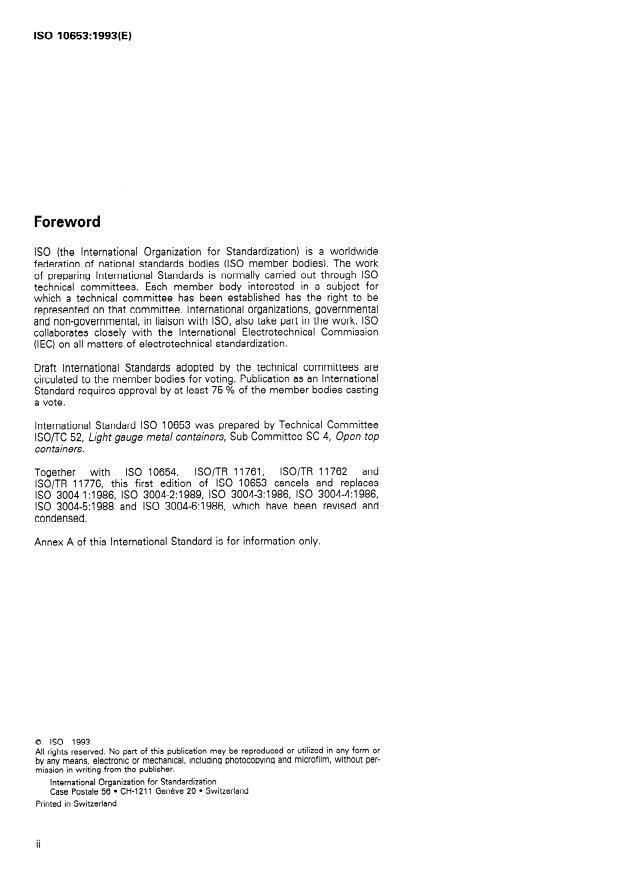
Foreword
ISO (the International Organization for Standardization) is a worldwide
federation of national Standards bodies (ISO member bodies). The work
of preparing International Standards is normally carried out through ISO
technical committees. Esch member body interested in a subject for
which a technical committee has been established has the right to be
represented on that committee. International organizations, governmental
and non-governmental, in liaison with ISO, also take patt in the work. ISO
collaborates closely with the International Electrotechnical Commission
(IEC) on all matters of electrotechnical standardization.
Draft International Standards adopted by the technical committees are
circulated to the member bodies for voting. Publication as an International
Standard requires approval by at least 75 % of the member bodies casting
a vote.
International Standard ISO 10653 was prepared by Technical Committee
ISO/rC 52, Light gauge metal Containers, Sub-Committee SC 4, Open top
con tainers.
Together with
ISO 10654, ISO/TR 11761, ISO/TR 11762 and
ISO/TR 11776, this first edition of ISO 10653 cancels and replaces
ISO 3004-1 :i 986, ISO 3004-2: 1989, ISO 3004-3: 1986, ISO 3004-4:1986,
ISO 3004-5:1988 and ISO 3004-6:1986, which have been revised and
condensed.
Annex A of this International Standard is for information only.
@3 ISO 1993
All rights reserved. No part of this publication may be reproduced or utilized in any form or
by any means, electronie or mechanical, including photocopying and microfilm, without per-
mission in writing from the publisher.
International Organization for Standardization
Case Postale 56 l CH-l 21 1 Geneve 20 l Switzerl
Printed in Switzerland
ii
Introduction
This International Standard replaces Parts 1 to 6 of ISO 3004 for round
open-top cans. Round open-top cans for liquid products with added gas
defined by their nominal filling volume, previously listed in ISO 3004-3, are
dealt with in ISO 10654.
The nominal gross lidded capacities given in this International Standard
have been Chosen to meet criteria retained in Order to reduce the number
of standardized capacities in relation to the former International Standard
.
(ISO 3004)
These criteria are the following:
a) the tan size is produced in a quantity of at least 100 million cans per
annum or, in the case of capacities 2 1 062 ml, 25 million cans per
annum;
b) the tan diameter is listed in ISO 1361 and the tan size was previously
listed in ISO 3004;
c) the inclusion of the tan size has been supported by at least three
member bodie
...
NORME
INTERNATIONALE
Première édition
1993-04-I 5
Emballages métalliques légers - Boîtes
rondes serties - Boîtes définies par leur
capacité totale nominale
Light-gauge metal containers - Round open-top tans - Cans defined
by their nominal gross lidded capacities
Numéro de référence
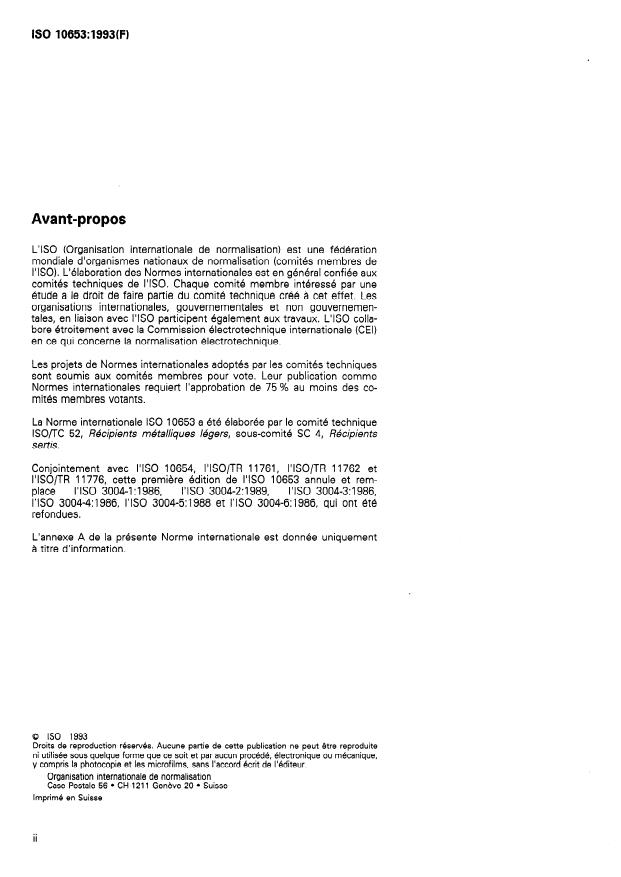
Avant-propos
L’ISO (Organisation internationale de normalisation) est une féderation
mondiale d’organismes nationaux de normalisation (comités membres de
I’ISO). L’elaboration des Normes internationales est en général confiée aux
comités techniques de I’ISO. Chaque comité membre interessé par une
étude a le droit de faire partie du comite technique créé a cet effet. Les
organisations internationales, gouvernementales et non gouvernemen-
tales, en liaison avec I’ISO participent également aux travaux. L’ISO colla-
bore étroitement avec la Commission électrotechnique internationale (CEI)
en ce qui concerne la normalisation électrotechnique.
Les projets de Normes internationales adoptes par les comités techniques
sont soumis aux comités membres pour vote. Leur publication comme
Normes internationales requiert l’approbation de 75 % au moins des co-
mites membres votants.
La Norme internationale ISO 10653 a eté élaboree par le comité technique
lSO/TC 52, Récipients métalliques Mgers, sous-comité SC 4, Récipients
sertis.
Conjointement avec I’ISO 10654, l’lSO/TR 11761, I’ISO/TR 11762 et
I’ISO/TR 11776, cette première édition de I’ISO 10653 annule et rem-
I’ISO 3004-2:1989, I’ISO 3004-3:1986,
place I ’ ISO 3004-I : 1986,
I’ISO 3004-4:1986, I’ISO 3004.5:1988 et I’ISO 3004-6:1986, qui ont Até
refondues.
L’annexe A de la présente Norme internationale est donnee uniquement
a titre d’information.
0 ISO 1993
Droits de reproduction réserves. Aucune partie de cette publication ne peut être reproduite
ni utilisee sous quelque forme que ce soit et par aucun procédé, électronique ou mécanique,
y compris la photocopie et les microfilms, sans l’accord écrit de l’editeur.
Organisation internationale de normalisation
Case Postale 56 l CH-l 211 Genéve 20 l Suisse
Imprime en Suisse
ii
Introduction
La présente Norme internationale remplace les parties 1 à 6 de I’ISO 3004
en ce qui concerne les boîtes rondes serties. Les boîtes rondes serties
pour produits liquides avec addition de gaz, definies par leur volume no-
minal de remplissage, anciennement normalisées dans I’ISO 3004-3 font
l’objet de I’ISO 10654.
Les capacités totales nominales données dans la présente Norme inter-
nationale ont été sblectionnées en fonction de critères retenus pour ré-
duire le nombre de capacités normalisées par rapport à la précédente
Norme internationale (ISO 3004). Ces criMes sont les suivants:
a) le format de la boîte est produit à une quantité minimale de 100 mil-
lions de boîtes par an ou, dans le cas de capacités supérieures ou
égales à 1 062 ml, à 25 millions de boîtes par an;
b) le diamétre de la boîte figure dans I’ISO 1361 et le format de la boîte
6tait anciennement normalisé dans I’ISO 3004;
c) l’introduction d’un format de boîte a 6tb supportée par trois comités
membres du TC 52.
NOTE 1 Les formats mentionnés dans la présente
...
NORME
INTERNATIONALE
Première édition
1993-04-I 5
Emballages métalliques légers - Boîtes
rondes serties - Boîtes définies par leur
capacité totale nominale
Light-gauge metal containers - Round open-top tans - Cans defined
by their nominal gross lidded capacities
Numéro de référence
Avant-propos
L’ISO (Organisation internationale de normalisation) est une féderation
mondiale d’organismes nationaux de normalisation (comités membres de
I’ISO). L’elaboration des Normes internationales est en général confiée aux
comités techniques de I’ISO. Chaque comité membre interessé par une
étude a le droit de faire partie du comite technique créé a cet effet. Les
organisations internationales, gouvernementales et non gouvernemen-
tales, en liaison avec I’ISO participent également aux travaux. L’ISO colla-
bore étroitement avec la Commission électrotechnique internationale (CEI)
en ce qui concerne la normalisation électrotechnique.
Les projets de Normes internationales adoptes par les comités techniques
sont soumis aux comités membres pour vote. Leur publication comme
Normes internationales requiert l’approbation de 75 % au moins des co-
mites membres votants.
La Norme internationale ISO 10653 a eté élaboree par le comité technique
lSO/TC 52, Récipients métalliques Mgers, sous-comité SC 4, Récipients
sertis.
Conjointement avec I’ISO 10654, l’lSO/TR 11761, I’ISO/TR 11762 et
I’ISO/TR 11776, cette première édition de I’ISO 10653 annule et rem-
I’ISO 3004-2:1989, I’ISO 3004-3:1986,
place I ’ ISO 3004-I : 1986,
I’ISO 3004-4:1986, I’ISO 3004.5:1988 et I’ISO 3004-6:1986, qui ont Até
refondues.
L’annexe A de la présente Norme internationale est donnee uniquement
a titre d’information.
0 ISO 1993
Droits de reproduction réserves. Aucune partie de cette publication ne peut être reproduite
ni utilisee sous quelque forme que ce soit et par aucun procédé, électronique ou mécanique,
y compris la photocopie et les microfilms, sans l’accord écrit de l’editeur.
Organisation internationale de normalisation
Case Postale 56 l CH-l 211 Genéve 20 l Suisse
Imprime en Suisse
ii
Introduction
La présente Norme internationale remplace les parties 1 à 6 de I’ISO 3004
en ce qui concerne les boîtes rondes serties. Les boîtes rondes serties
pour produits liquides avec addition de gaz, definies par leur volume no-
minal de remplissage, anciennement normalisées dans I’ISO 3004-3 font
l’objet de I’ISO 10654.
Les capacités totales nominales données dans la présente Norme inter-
nationale ont été sblectionnées en fonction de critères retenus pour ré-
duire le nombre de capacités normalisées par rapport à la précédente
Norme internationale (ISO 3004). Ces criMes sont les suivants:
a) le format de la boîte est produit à une quantité minimale de 100 mil-
lions de boîtes par an ou, dans le cas de capacités supérieures ou
égales à 1 062 ml, à 25 millions de boîtes par an;
b) le diamétre de la boîte figure dans I’ISO 1361 et le format de la boîte
6tait anciennement normalisé dans I’ISO 3004;
c) l’introduction d’un format de boîte a 6tb supportée par trois comités
membres du TC 52.
NOTE 1 Les formats mentionnés dans la présente
...