

ISO/TR 27918:2018
(Main)Lifecycle risk management for integrated CCS projects
General Information
- Abstract
ISO/TR 27918:2018 is designed to be an information resource for the potential future development of a standard for overall risk management for CCS projects. The risks associated with any one stage of the CCS process (capture, transportation, or storage) are assumed to be covered by specific standard(s) within ISO/TC 265 and other national and/or international standards. For example, the risks associated with CO2 transport by pipelines are covered in ISO 27913. The scope of this document is intended to address more broadly applicable lifecycle risk management issues for integrated CCS projects. Specifically, the focus of this document is on risks that affect the overarching CCS project or risks that cut across capture, transportation, and storage affecting multiple stages. It needs to be noted that environmental risks, and risks to health and safety should be very low for CCS projects provided the project is carefully designed and executed. Risk identification and management is part of the due diligence process. A list of acronyms is included in Annex A. Clause 5 includes an analysis of how a CCS standard could address aspects of risk analysis that apply to all elements of the CCS chain, such as: - risk identification (identifying the source of risk, event, and target of impact)[1]; - risk evaluation and rating; - risk treatment; - risk management strategy and reporting. Clause 6 comprises an inventory of the overarching and crosscutting risks. These include issues such as: - environmental impact assessment; - risk communication and public engagement; - integration risks between capture, storage, and transportation operators, such as risk of non-conformance of CO2 stream to required specifications; - integration risks associated with shared infrastructure (hubs of sources, common pipelines, hubs of storage sites); - risks resulting from interruption or intermittency of CO2 supply and/or CO2 in-take; - risks associated with policy uncertainty; - incidental risks from activities related to the capture, transportation or storage processes without being specifically covered in the respective standards (e.g. management or disposal of water produced as a by-product of CO2 storage). Clause 7 describes implications and considerations for a potential standard on lifecycle risks for integrated CCS projects. [1]As defined in ISO 31000.
- Status
- Published
- Publication Date
- 17-Apr-2018
- Technical Committee
- ISO/TC 265 - Carbon dioxide capture, transportation, and geological storage
- Drafting Committee
- ISO/TC 265/WG 5 - Cross Cutting Issues
- Current Stage
- 6060 - International Standard published
- Start Date
- 18-Apr-2018
- Completion Date
- 29-Aug-2026
Buy Documents

ISO/TR 27918:2018 - Lifecycle risk management for integrated CCS projects

ISO/TR 27918:2018 - Lifecycle risk management for integrated CCS projects/18/2018
Overview
ISO/TR 27918:2018 is a Technical Report from ISO/TC 265 providing an information resource for lifecycle risk management of integrated Carbon Capture and Storage (CCS) projects. It is intended to inform the potential development of a future formal standard addressing overarching and crosscutting risks that affect the whole CCS chain (capture, transportation, storage). The report does not replace stage-specific standards (those risks are assumed covered by ISO/TC 265 or other national/international documents), but focuses on risks that span multiple project stages and the full project lifecycle.
Key Topics
- Lifecycle scope and benefits: defines lifecycle considerations for integrated CCS projects and the value of a lifecycle risk management plan.
- Risk identification (Clause 5): guidance on identifying sources, events and targets of impact in line with ISO 31000 concepts.
- Risk evaluation and rating: approaches to risk assessment, risk tolerance, scales and expert judgment for overarching risks.
- Risk treatment and management strategy: options for treatment, reporting and integration of risk controls across capture, transport and storage.
- Inventory of overarching and crosscutting risks (Clause 6): examples include environmental impact assessment, risk communication and public engagement, integration risks (e.g., CO2 stream non‑conformance), shared infrastructure/hubs, CO2 supply intermittency, policy and financial uncertainty, incidental issues (e.g., produced water management).
- Considerations for a future standard (Clause 7): implications and practical considerations for harmonizing lifecycle risk management across CCS projects.
- Use of analysis and simulation: iterative risk analysis and numerical simulation to support monitoring, verification, design optimization and remediation planning.
Applications / Who Uses It
ISO/TR 27918:2018 is practical for:
- Project owners/operators designing integrated CCS projects and preparing risk management plans.
- Risk managers, engineers and consultants conducting due diligence, lifecycle risk assessments and cross‑discipline integration reviews.
- Regulators and permitting authorities seeking frameworks for oversight of integrated CCS risks.
- Investors and insurers evaluating systemic and crosscutting project risks.
- Standard developers and policy makers using the report to inform future normative standards or regulatory guidance.
Practical uses include decision support, integration risk mitigation (e.g., coordinating CO2 specifications between capture and storage), stakeholder engagement planning, and informing monitoring/contingency strategies.
Related Standards (if applicable)
- ISO 27913 (CO2 transport by pipelines)
- ISO 31000 (risk management framework referenced)
- CSA Z741-12; EU Directive 2009/31/EC; US EPA regulations; IEA and WRI CCS guidance (listed in the report as relevant references)
- Other ISO/TC 265 standards covering stage‑specific CCS risks
Keywords: ISO/TR 27918:2018, lifecycle risk management, integrated CCS projects, carbon capture and storage, CCS risk, ISO/TC 265, CO2 transport, risk identification, risk treatment.
Buy Documents
ISO/TR 27918:2018 - Lifecycle risk management for integrated CCS projects
ISO/TR 27918:2018 - Lifecycle risk management for integrated CCS projects/18/2018
Get Certified
Connect with accredited certification bodies for this standard

BSI Group
BSI (British Standards Institution) is the business standards company that helps organizations make excellence a habit.

Bureau Veritas
Bureau Veritas is a world leader in laboratory testing, inspection and certification services.

DNV
DNV is an independent assurance and risk management provider.
Sponsored listings
Frequently Asked Questions
ISO/TR 27918:2018 is a technical report published by the International Organization for Standardization (ISO). Its full title is "Lifecycle risk management for integrated CCS projects". This standard covers: ISO/TR 27918:2018 is designed to be an information resource for the potential future development of a standard for overall risk management for CCS projects. The risks associated with any one stage of the CCS process (capture, transportation, or storage) are assumed to be covered by specific standard(s) within ISO/TC 265 and other national and/or international standards. For example, the risks associated with CO2 transport by pipelines are covered in ISO 27913. The scope of this document is intended to address more broadly applicable lifecycle risk management issues for integrated CCS projects. Specifically, the focus of this document is on risks that affect the overarching CCS project or risks that cut across capture, transportation, and storage affecting multiple stages. It needs to be noted that environmental risks, and risks to health and safety should be very low for CCS projects provided the project is carefully designed and executed. Risk identification and management is part of the due diligence process. A list of acronyms is included in Annex A. Clause 5 includes an analysis of how a CCS standard could address aspects of risk analysis that apply to all elements of the CCS chain, such as: - risk identification (identifying the source of risk, event, and target of impact)[1]; - risk evaluation and rating; - risk treatment; - risk management strategy and reporting. Clause 6 comprises an inventory of the overarching and crosscutting risks. These include issues such as: - environmental impact assessment; - risk communication and public engagement; - integration risks between capture, storage, and transportation operators, such as risk of non-conformance of CO2 stream to required specifications; - integration risks associated with shared infrastructure (hubs of sources, common pipelines, hubs of storage sites); - risks resulting from interruption or intermittency of CO2 supply and/or CO2 in-take; - risks associated with policy uncertainty; - incidental risks from activities related to the capture, transportation or storage processes without being specifically covered in the respective standards (e.g. management or disposal of water produced as a by-product of CO2 storage). Clause 7 describes implications and considerations for a potential standard on lifecycle risks for integrated CCS projects. [1]As defined in ISO 31000.
ISO/TR 27918:2018 is designed to be an information resource for the potential future development of a standard for overall risk management for CCS projects. The risks associated with any one stage of the CCS process (capture, transportation, or storage) are assumed to be covered by specific standard(s) within ISO/TC 265 and other national and/or international standards. For example, the risks associated with CO2 transport by pipelines are covered in ISO 27913. The scope of this document is intended to address more broadly applicable lifecycle risk management issues for integrated CCS projects. Specifically, the focus of this document is on risks that affect the overarching CCS project or risks that cut across capture, transportation, and storage affecting multiple stages. It needs to be noted that environmental risks, and risks to health and safety should be very low for CCS projects provided the project is carefully designed and executed. Risk identification and management is part of the due diligence process. A list of acronyms is included in Annex A. Clause 5 includes an analysis of how a CCS standard could address aspects of risk analysis that apply to all elements of the CCS chain, such as: - risk identification (identifying the source of risk, event, and target of impact)[1]; - risk evaluation and rating; - risk treatment; - risk management strategy and reporting. Clause 6 comprises an inventory of the overarching and crosscutting risks. These include issues such as: - environmental impact assessment; - risk communication and public engagement; - integration risks between capture, storage, and transportation operators, such as risk of non-conformance of CO2 stream to required specifications; - integration risks associated with shared infrastructure (hubs of sources, common pipelines, hubs of storage sites); - risks resulting from interruption or intermittency of CO2 supply and/or CO2 in-take; - risks associated with policy uncertainty; - incidental risks from activities related to the capture, transportation or storage processes without being specifically covered in the respective standards (e.g. management or disposal of water produced as a by-product of CO2 storage). Clause 7 describes implications and considerations for a potential standard on lifecycle risks for integrated CCS projects. [1]As defined in ISO 31000.
ISO/TR 27918:2018 is classified under the following ICS (International Classification for Standards) categories: 13.020.40 - Pollution, pollution control and conservation. The ICS classification helps identify the subject area and facilitates finding related standards.
ISO/TR 27918:2018 is available in PDF format for immediate download after purchase. The document can be added to your cart and obtained through the secure checkout process. Digital delivery ensures instant access to the complete standard document.
Standards Content (Sample)
TECHNICAL ISO/TR
REPORT 27918
First edition
2018-04
Lifecycle risk management for
integrated CCS projects
Gestion du risque du cycle de vie des projets CSC intégrés
Reference number
©
ISO 2018
© ISO 2018
All rights reserved. Unless otherwise specified, or required in the context of its implementation, no part of this publication may
be reproduced or utilized otherwise in any form or by any means, electronic or mechanical, including photocopying, or posting
on the internet or an intranet, without prior written permission. Permission can be requested from either ISO at the address
below or ISO’s member body in the country of the requester.
ISO copyright office
CP 401 • Ch. de Blandonnet 8
CH-1214 Vernier, Geneva
Phone: +41 22 749 01 11
Fax: +41 22 749 09 47
Email: copyright@iso.org
Website: www.iso.org
Published in Switzerland
ii © ISO 2018 – All rights reserved
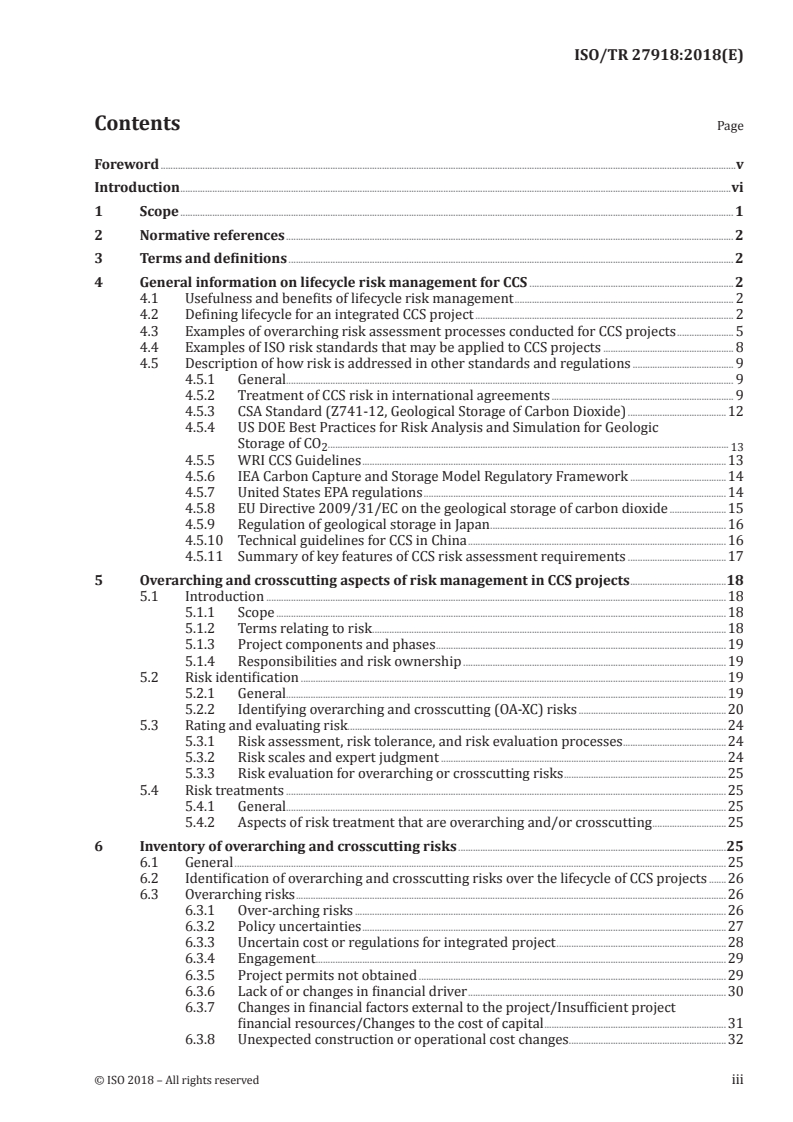
Contents Page
Foreword .v
Introduction .vi
1 Scope . 1
2 Normative references . 2
3 Terms and definitions . 2
4 General information on lifecycle risk management for CCS . 2
4.1 Usefulness and benefits of lifecycle risk management . 2
4.2 Defining lifecycle for an integrated CCS project . 2
4.3 Examples of overarching risk assessment processes conducted for CCS projects . 5
4.4 Examples of ISO risk standards that may be applied to CCS projects . 8
4.5 Description of how risk is addressed in other standards and regulations . 9
4.5.1 General. 9
4.5.2 Treatment of CCS risk in international agreements . 9
4.5.3 CSA Standard (Z741-12, Geological Storage of Carbon Dioxide) .12
4.5.4 US DOE Best Practices for Risk Analysis and Simulation for Geologic
Storage of CO .
2 13
4.5.5 WRI CCS Guidelines .13
4.5.6 IEA Carbon Capture and Storage Model Regulatory Framework .14
4.5.7 United States EPA regulations .14
4.5.8 EU Directive 2009/31/EC on the geological storage of carbon dioxide .15
4.5.9 Regulation of geological storage in Japan .16
4.5.10 Technical guidelines for CCS in China .16
4.5.11 Summary of key features of CCS risk assessment requirements .17
5 Overarching and crosscutting aspects of risk management in CCS projects .18
5.1 Introduction .18
5.1.1 Scope .18
5.1.2 Terms relating to risk . .18
5.1.3 Project components and phases .19
5.1.4 Responsibilities and risk ownership .19
5.2 Risk identification .19
5.2.1 General.19
5.2.2 Identifying overarching and crosscutting (OA-XC) risks .20
5.3 Rating and evaluating risk.24
5.3.1 Risk assessment, risk tolerance, and risk evaluation processes .24
5.3.2 Risk scales and expert judgment .24
5.3.3 Risk evaluation for overarching or crosscutting risks .25
5.4 Risk treatments .25
5.4.1 General.25
5.4.2 Aspects of risk treatment that are overarching and/or crosscutting .25
6 Inventory of overarching and crosscutting risks .25
6.1 General .25
6.2 Identification of overarching and crosscutting risks over the lifecycle of CCS projects .26
6.3 Overarching risks .26
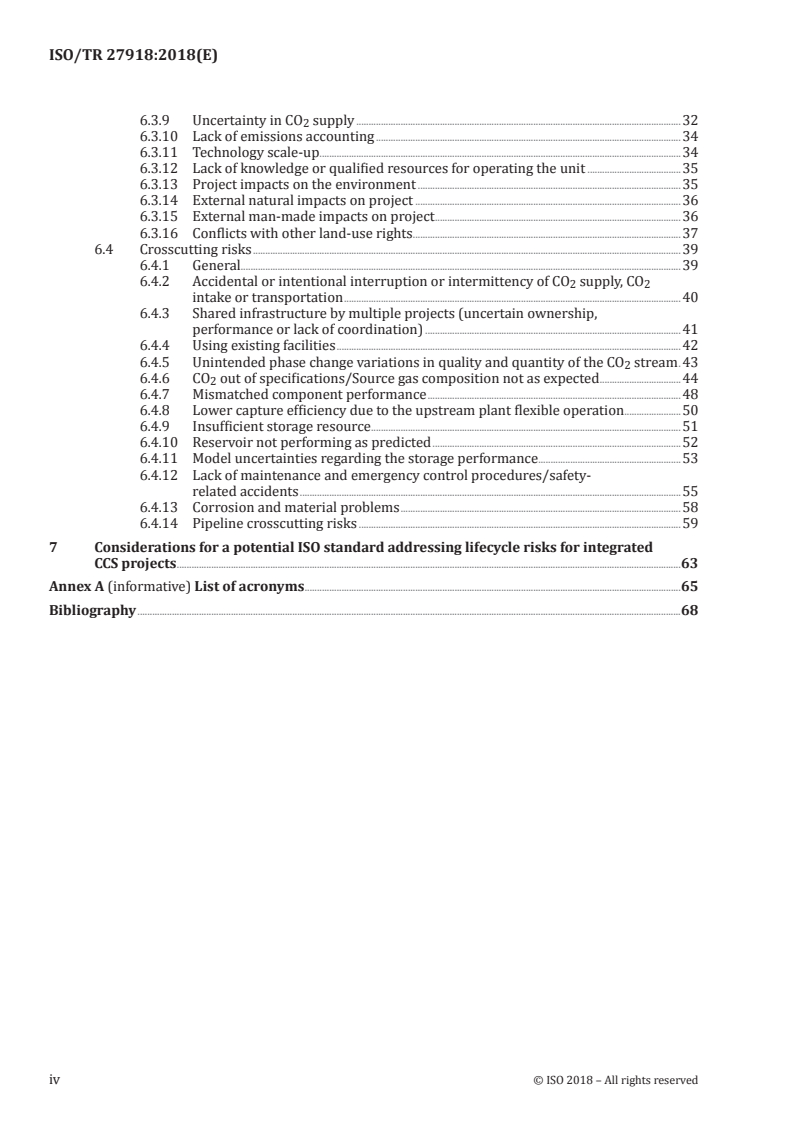
6.3.1 Over-arching risks .26
6.3.2 Policy uncertainties .27
6.3.3 Uncertain cost or regulations for integrated project .28
6.3.4 Engagement . .29
6.3.5 Project permits not obtained .29
6.3.6 Lack of or changes in financial driver .30
6.3.7 Changes in financial factors external to the project/Insufficient project
financial resources/Changes to the cost of capital .31
6.3.8 Unexpected construction or operational cost changes.32
6.3.9 Uncertainty in CO supply .32
6.3.10 Lack of emissions accounting .34
6.3.11 Technology scale-up . .34
6.3.12 Lack of knowledge or qualified resources for operating the unit .35
6.3.13 Project impacts on the environment .35
6.3.14 External natural impacts on project .36
6.3.15 External man-made impacts on project .36
6.3.16 Conflicts with other land-use rights .37
6.4 Crosscutting risks .39
6.4.1 General.39
6.4.2 Accidental or intentional interruption or intermittency of CO supply, CO
2 2
intake or transportation .40
6.4.3 Shared infrastructure by multiple projects (uncertain ownership,
performance or lack of coordination) .41
6.4.4 Using existing facilities .42
6.4.5 Unintended phase change variations in quality and quantity of the CO stream .43
6.4.6 CO out of specifications/Source gas composition not as expected .44
6.4.7 Mismatched component performance .48
6.4.8 Lower capture efficiency due to the upstream plant flexible operation .50
6.4.9 Insufficient storage resource .51
6.4.10 Reservoir not performing as predicted .52
6.4.11 Model uncertainties regarding the storage performance .53
6.4.12 Lack of maintenance and emergency control procedures/safety-
related accidents .55
6.4.13 Corrosion and material problems .58
6.4.14 Pipeline crosscutting risks .59
7 Considerations for a potential ISO standard addressing lifecycle risks for integrated
CCS projects .63
Annex A (informative) List of acronyms .65
Bibliography .68
iv © ISO 2018 – All rights reserved
Foreword
ISO (the International Organization for Standardization) is a worldwide federation of national standards
bodies (ISO member bodies). The work of preparing International Standards is normally carried out
through ISO technical committees. Each member body interested in a subject for which a technical
committee has been established has the right to be represented on that committee. International
organizations, governmental and non-governmental, in liaison with ISO, also take part in the work.
ISO collaborates closely with the International Electrotechnical Commission (IEC) on all matters of
electrotechnical standardization.
The procedures used to develop this document and those intended for its further maintenance are
described in the ISO/IEC Directives, Part 1. In particular the different approval criteria needed for the
different types of ISO documents should be noted. This document was drafted in accordance with the
editorial rules of the ISO/IEC Directives, Part 2 (see www .iso .org/ directives).
Attention is drawn to the possibility that some of the elements of this document may be the subject of
patent rights. ISO shall not be held responsible for identifying any or all such patent rights. Details of
any patent rights identified during the development of the document will be in the Introduction and/or
on the ISO list of patent declarations received (see www .iso .org/ patents).
Any trade name used in this document is information given for the convenience of users and does not
constitute an endorsement.
For an explanation on the voluntary nature of standards, the meaning of ISO specific terms and
expressions related to conformity assessment, as well as information about ISO's adherence to the
World Trade Organization (WTO) principles in the Technical Barriers to Trade (TBT) see the following
URL: www .iso .org/ iso/ foreword .html.
This document was prepared by Technical Committee ISO/TC 265, Carbon dioxide capture,
transportation, and geological storage.
Introduction
Carbon Capture and Storage (CCS) is a process that can mitigate the CO emissions from power plants and
other industrial sources of CO . CCS draws on many decades of experience in the electricity generation,
industrial gas separation, chemical and manufacturing industries, and oil and gas industries, including
substantial experience with subsurface injection techniques.
Many of the individual processes (or project phases) that are linked together to comprise a CCS chain
have been proven for some time, albeit often in different contexts. Others are still being developed or
adapted to this new application. Additionally, bringing them together in a CCS configuration represents
a new application, with which there is limited global experience to date. As a result, there is an important
need for knowledge development as real experience is gained in the comprehensive application of these
technologies.
As with most technologies, CCS has inherent risks which need to be analysed and managed. Integrated
projects, given their especially long-term and multi-component aspects, impose particular importance
and challenge upon comprehensive risk identification. Risk assessment (detailed risk description and
quantification) is completed using all available data, and assessment refreshed with updated numerical
simulations which enable comprehensive risk analysis throughout the project lifecycle. The project
lifecycle extends across all project phases from business development to site selection through post-
closure. Together, risk identification, assessment, analysis, evaluation, management, and treatment
are integrated into a risk management plan. The risk management plan aids in decision-making by the
owner/operator and, to the extent the results of planning are communicated, aids other stakeholders in
evaluating the project.
Keys to the success of the risk management plan are the integration and iterative application of risk
assessment, risk data, and risk analysis. Risk analysis and numerical simulation help to identify,
estimate and mitigate risks that may arise from CCS projects. These tools are also useful to optimize
the design and operation of the monitoring, verification, and accounting aspects of the projects and can
serve to inform and facilitate more effective site characterization and model improvement. Importantly,
risk tools can be used to shape the design and operation of preventive and remediation options at every
stage in the project lifecycle. Effective risk management communication to stakeholders who may be
affected is crucial to the success of the project. The risk management plan can serve as a key component
of the information handled through the public outreach and communication plan.
vi © ISO 2018 – All rights reserved
TECHNICAL REPORT ISO/TR 27918:2018(E)
Lifecycle risk management for integrated CCS projects
1 Scope
This document is designed to be an information resource for the potential future development of a
standard for overall risk management for CCS projects. The risks associated with any one stage of the
CCS process (capture, transportation, or storage) are assumed to be covered by specific standard(s)
within ISO/TC 265 and other national and/or international standards. For example, the risks
associated with CO transport by pipelines are covered in ISO 27913. The scope of this document is
intended to address more broadly applicable lifecycle risk management issues for integrated CCS
projects. Specifically, the focus of this document is on risks that affect the overarching CCS project or
risks that cut across capture, transportation, and storage affecting multiple stages. It needs to be noted
that environmental risks, and risks to health and safety should be very low for CCS projects provided
the project is carefully designed and executed. Risk identification and management is part of the due
diligence process.
A list of acronyms is included in Annex A.
Clause 5 includes an analysis of how a CCS standard could address aspects of risk analysis that apply to
all elements of the CCS chain, such as:
1)
— risk identification (identifying the source of risk, event, and target of impact) ;
— risk evaluation and rating;
— risk treatment;
— risk management strategy and reporting.
Clause 6 comprises an inventory of the overarching and crosscutting risks. These include issues such as:
— environmental impact assessment;
— risk communication and public engagement;
— integration risks between capture, storage, and transportation operators, such as risk of non-
conformance of CO stream to required specifications;
— integration risks associated with shared infrastructure (hubs of sources, common pipelines, hubs of
storage sites);
— risks resulting from interruption or intermittency of CO supply and/or CO in-take;
2 2
— risks associated with policy uncertainty;
— incidental risks from activities related to the capture, transportation or storage processes without
being specifically covered in the respective standards (e.g. management or disposal of water
produced as a by-product of CO storage).
Clause 7 describes implications and considerations for a potential standard on lifecycle risks for
integrated CCS projects.
1) As defined in ISO 31000.
2 Normative references
The following referenced documents are referred to in the text in such a way that some or all of their
content constitutes requirements of this document. For dated references, only the edition cited applies.
For undated references, the latest edition of the referenced document (including any amendments)
applies.
ISO 27917, Carbon dioxide capture, transportation and geological storage — Vocabulary —
Crosscutting terms
3 Terms and definitions
For the purposes of this document, the terms and definitions given in ISO 27917 apply.
ISO and IEC maintain terminological databases for use in standardization at the following addresses:
— ISO Online browsing platform: available at https:// www .iso .org/ obp
— IEC Electropedia: available at http:// www .electropedia .org/
4 General information on lifecycle risk management for CCS
4.1 Usefulness and benefits of lifecycle risk management
Overarching, or crosscutting risk management may help inform future investment and regulatory
decisions regarding the risks associated with a CCS project lifecycle. Such evaluations of overarching
lifecycle risk already have been performed for previous CCS projects, either as part of an Environmental
Impact Assessment [Gorgon (Chevron) and Shengli Dongying (SINOPEC)] or as a requirement of the
regulatory or permitting process.
A future International Standard that builds on previous requirements in relevant industries could help
future project developers in meeting permitting requirements and help ensure that risks associated
with a CCS project are comprehensively identified, evaluated, and managed. In addition, it may promote
an appropriate management of risks to health, safety and the environment in areas where regulatory
frameworks are less comprehensive, and it may inform future regulatory developments.
4.2 Defining lifecycle for an integrated CCS project
Most of the organizations that have previously published guidelines or standards for CCS risks have
focused on the lifecycle of the storage component of a CCS project. Figure 1 to Figure 6 present various
lifecycle descriptions from published sources.
Figure 1 — Timeline for a CCS project defined in the WRI guidelines for carbon dioxide capture,
transport, and storage (Forbes et al., 2008)
2 © ISO 2018 – All rights reserved
Figure 2 — The project Lifecycle Model of a CCS project developed by the Global CCS Institute
(GCCSI, 2015)
Figure 3 — CO storage lifecycle phases and milestones described in the guidance document of
2)
the implementation of Directive 2009/31/EC (European Communities, 2011)
2) The EU storage project lifecycle definition includes “transfer of responsibility” which might not apply to all
jurisdictions.
Figure 4 — Carbon dioxide geological storage project lifecycle and associated qualification
statements, relevant permits and project milestones defined by DNV (DET NORSKE VERITAS AS,
2012; Det Norske Veritas, 2009)
Figure 5 — Lifecycle of a CCS project as defined in Z741 (Canadian Standards Association, 2012)
4 © ISO 2018 – All rights reserved
Figure 6 — Lifecycle of a CCS project as defined in in the International Standard for Carbon
Dioxide Capture, Transportation, and Storage—Geologic Storage (ISO DIS/27914)
Figure 7 presents the CCS project lifecycle from the point of risk management responsibility and
oversight to elucidate the risk source and interaction effect. It was developed based on the Global CCS
Institute’s (Figure 2) and Canadian Standard Association’s (CSA) definitions of lifecycle (Figure 5). As
described in Figure 7, the CCS project lifecycle includes all phases of a CCS project from start-up through
operation and closure and into the post-closure period. Figure 7 also includes the components of a CCS
project, the disposition of the CO stream and the risk management responsibility.
A CCS project lifecycle includes the subsystems (capture, transportation, and storage) as well as
temporal elements (project design and initiation, operation, closure, and post-closure). Figure 5 was
used in the Canadian Standard’s Association’s “Z741-12 Geological storage of carbon dioxide” (Canadian
Standards Association, 2012) to describe the project lifecycle for a CCS storage project and limitations
to the applicability of the standard.
Figure 7 — Proposed CCS project lifecycle from a risk management viewpoint
For the purposes of this document, the lifecycle of a CCS project is defined as having a start-up
phase which includes opportunity, planning, engineering and construction; an operational phase
which includes capture, transportation and injection; a closure phase; and a post-closure phase. The
“decommissioning” stage referenced in Figures 2 and 4 has been omitted because of differences in
timing and interpretation across various industries and countries.
4.3 Examples of overarching risk assessment processes conducted for CCS projects
While many tools exist to plan, prepare, and execute risk assessment, analysis, and planning, the
following is a brief discussion of the major processes used in the planning and execution (where
applicable) of a number of CCS projects. This list includes the risk assessment tools and approaches
considered or used by the following projects (operators in parentheses): Weyburn (Cenovus), Gorgon
(Chevron), FutureGen 1.0 (FutureGen Alliance), Peterhead (Shell) and White Rose (National Grid
Carbon), In Salah (BP), K12-B (GDF Suez), Lacq-Rousse (Total), Snøhvit (Statoil), Otway (CO2CRC),
PurGen (SCS), Cemex CCS (Cemex), Aquistore (Petroleum Technology Research Centre, or PTRC), and
the Regional Carbon Sequestration Partnerships (RCSP, US DOE).
— Features, Events, and Processes (FEP) database [Quintessa]: This is an online database tool
developed by Quintessa, a scientific and mathematical consulting firm. The database covers
technical, operational, and programmatic risks and is used as a qualitative screening tool for health,
safety, and environment (HSE), causalities, and environmental (water and air) impacts. Expert
input is required both to describe chains of events by which impacts could occur (scenarios) and to
describe and quantify the associated risks. This tool has been employed at the Weyburn (Cenovus)
and In Salah (BP) projects (Quintessa, 2013).
— Performance Assessment (PA) Framework for CO [Quintessa]: In addition to the FEP database,
Quintessa has also developed an evidence-based qualitative and quantitative tool which covers
technical, operational, and programmatic FEPs. PA allows for the stakeholder assessment of
decisions and uncertainty of a project. This tool has been employed at the In Salah (BP) and Quest
(Shell) (Quintessa, 2008).
— Risk Assessment Methodology [TNO] The TNO methodology covers technical and programmatic
risks, focusing on human causality, environmental and groundwater risks. Expert input is required
to establish the probability and consequential matrices that can demonstrate long-term safety
performance of the underground storage of CO (TNO, 2016). TNO has also developed Carbon
Storage Scenario Identification Framework (CASSIF) (Sijacic et al., 2014) which is a qualitative tool
requiring expert scenario input to identify storage performance and multiple-site screening.
— CO QUALSTORE [DNV]: This product provides guidance on the process and third-party verification
for full geologic storage life-cycle risk assessment and analysis as both a qualitative and quantitative
tool, using multiple category inputs (VERITAS, 2010). This tool has been used to actively inform
discussions between project developers and regulators, including Schwarze Pumpe (Vattenfall) and
Quest (Shell). The tool also provided a basis for the DNV-RP-J203 (DET NORSKE VERITAS AS, 2012)
certification which has been used for certification by the CarbonNet project (Victorian Department
of Economic Development, Jobs, Transport and Resources).
— URS Risk Identification and Strategy using Quantitative Evaluation (RISQUE) [URS]: This
semiquantitative tool focuses on technical and community impacts using key performance
indicators. This tool has been employed at Weyburn (Cenovus), Otway (CO2CRC), Gorgon (Chevron),
and In Salah (BP) (GCCSI, 2010a) (Dodds et al., 2010).
— Screening and Ranking Framework (SRF) [Oldenberg]: This Microsoft Excel based tool uses
technical data to allow for expert assessment and assignment of certainties (Oldenberg, 2005). The
tool focuses on technical and community HSE aspects and is employed at Ventura oil field and Rio
Vista gas field. The definitions of primary containment, secondary containment and attenuation
potentially increase data requirements, and the primary and secondary containment are difficult to
define for some sites, such as the Ordos basin which has multiple layers. The modified SRF applied
to Shenhua CCS pilot project in China discusses these problems, but does not fully overcome them.
— Vulnerability Evaluation Framework (VEF) [US EPA]: This qualitative tool addresses HSE,
ecosystem, and underground source of drinking water (USDW) impacts to the geosphere utilizing
technical input data. The tool can be applied across all aspects of a GS project (US EPA, 2008).
— Carbon Work Flow [Schlumberger]: This tool uses expert input to quantify technical and
programmatic risks of the project and project goals. The tool requires expert and lay input and
is employed at the RCSPs (US DOE), PurGen (SCS), Cemex CCS (Cemex), and Aquistore (PTRC) (US
EPA, 2008).
— Performance and Risk Methodology (P&R) [Oxand and Schlumberger]: This tool combines
qualitative and quantitative risk evaluation in a matrix fashion, focusing on public acceptance,
financial, technological, HSE, and USDW impacts(Guen et al., 2009). The tool is employed by the
RCSPs (US DOE).
6 © ISO 2018 – All rights reserved
— CO-PENS [LANL]: This tool developed by Los Alamos National Laboratory (LANL) uses evidence-
based input to consider technical, economic, and community risks. The tool focuses on the full
geological sequestration (GS) lifecycle and is employed by the RCSPs (US DOE). It was also used for
a risk assessment of the Rock Springs Uplift in Wyoming.
— MANAUS approach [BRGM]: BRGM has developed in the framework of the MANAUS project
a practical approach for performing a preliminary quantitative risk assessment in an uncertain
context. This approach follows the risk assessment principles from the international standards
(ISO 31000:2009), which are adapted to account for the specificities and challenges of subsurface
operations. In particular the relatively high level of uncertainties expected at early stages of a
storage project is accounted for, enabling fully informed decision-making while evaluating risk
acceptability (de Lary et al., 2015).
— CORISKEYE [IRSM-CAS]: This is an assessment prototype for environmental risk assessment of
CO geological storage that is being developed by Li, et al. (Institute of Rock and Soil Mechanics,
Chinese Academy of Sciences, IRSM-CAS), which corresponds to the related regulations and
guidelines in China. It combines different assessment methods for different purposes, including
a modified version of Oldenburg’s SRF, Bachu’s site-screening method, a fuzzy Analytic Hierarchy
Process (AHP) method, and others (Li and Liu, 2016; Liu et al., 2016).
— National Risk Assessment Partnership (NRAP) [US DOE]: This performance quantification
approach relies on reduced-order models to probe uncertainty in the system. Toolset was built to
address key questions about potential impacts related to release of CO or brine from the storage
reservoir, and potential ground-motion impacts due to injection of CO (see Table 1). Eight NRAP
tools are available for beta testing, e.g. Integrated Assessment Model-Carbon Storage (NRAP-IAM-
CS), Natural Seal ROM (NSealR), Reservoir Evaluation and Visualization (REV), Wellbore Leakage
Analysis Tool (WLAT), Aquifer Impact Model (AIM), Design for Risk Evaluation and Monitoring
(DREAM), Short Term Seismic Forecasting (STSF), and Integrated Assessment Model for Carbon
Storage and Reservoir ROM Generation (RROM-Gen). Hypothetical cases have been applied to the
tools for demonstration purposes.
Table 1 — Key features of risk assessment tools
Start-up Operation
Post-
Cons
Clo
Tran
Tool Application clo
Opport Plan Engine truct Cap Injec
sure
sport
sure
unity ning ering ion ture tion
ation
Features, Events, Weyburn
and Processes (Cenovus), In x x x x x x x x x
(FEP) [Quintessa] Salah (BP)
Performance
Assessment (PA) In Salah (BP),
x x x x x x x x x
Framework for Quest (Shell)
CO [Quintessa]
Risk Assessment
Methodology n/a x x x x x
[TNO]
Schwarze
CO QUALSTORE Pumpe
x x x x x x x
[DNV] (Vattenfall),
Quest (Shell)
Weyburn
Risk Identifica- (Cenovus),
tion and Strategy Otway
using Quantita- (CO2CRC), x x x x x x x x x
tive Evaluation Gorgon
(RISQUE) [URS] (Chevron), In
Salah (BP)
Table 1 (continued)
Start-up Operation
Post-
Cons
Clo
Tran
Tool Application clo
Opport Plan Engine truct Cap Injec
sure
sport
sure
unity ning ering ion ture tion
ation
SRF: Ventura
Screening and
oil field,
Ranking Frame-
Rio Vista
work (SRF) and
gas field; x x x x x x x
Certification
modified for
Framework (CF)
Shenhua. CF:
[Oldenburg]
In Salah (BP)
Vulnerabili-
ty Evaluation
n/a x x x x x x x
Framework
(VEF) [US EPA]
RCSPs (US
DOE), Pur-
Carbon Work Gen (SCS),
Flow [Schlum- Cemex CCS x x x x x x x x x
berger] (Cemex),
Aquistore
(PTRC)
Performance and
Risk Methodology RCSPs (US
x x x x x x x
(P&R) [Oxand and DOE)
Schlumberger]
RCSPs (US
DOE), Wyo-
CO -PENS [LANL] x x x x x x x x x
ming Rock
Springs Uplift
MANAUS ap-
n/a x x x x x x x
proach [BRGM]
CO RISKEYE
n/a x x x x x x x
[IRSM-CAS]
National Risk
Assessment Part-
n/a x x x x x x x
nership (NRAP)
[US DOE]
4.4 Examples of ISO risk standards that may be applied to CCS projects
There is a globally accepted ISO 31000:2018, Risk management approach — Guidelines, which may be
applied to CCS risk management, including:
— ISO Guide 73:2009, Risk management — Vocabulary;
— IEC 31010:2009, Risk management — Risk assessment techniques.
Annex of IEC 31010 contains almost all well used risk assessment techniques, including Delphi, fault
tree analysis (FTA), event tree analysis (ETA), bowtie diagrams, health risk assessment (HRA), hazard
and operability study (HAZOP), and risk matrices.
For CCS specifically, an eventual ISO Standard addressing the CO storage aspects of CCS may include a
risk management clause that addresses the following steps:
— establishing the context;
8 © ISO 2018 – All rights reserved
— risk assessment:
— risk identification;
— risk analysis;
— risk evaluation;
— risk treatment;
— monitoring and review;
— communication and consultations;
4.5 Description of how risk is addressed in other standards and regulations
4.5.1 General
The risks associated with CCS are addressed at the national and international level in agreements and
regulations. Previous standards and best-practice guidelines have also addressed risk. However, many
of these existing standards and regulations focus exclusively on geological storage of CO and therefore
may not adequately address the crosscutting and overarching risks identified and described in this
document. 4.5 provides a brief overview of the treatment of CCS risk in international agreements,
regional and national regulations, and best-practice manuals.
This subclause focuses on CCS-specific risk assessment provisions which would be applied to
integrated CCS projects, however capture and transportation risk assessments are sometimes required
for a capture unit or pipeline as a separate measure. For example, in the United States a capture
plant would need to comply with the following laws in the Code of Federal Regulations (CFR): 29 CFR
§1910.38 (Emergency Action Plans), 29 CFR §1910.119 (Process Hazardous Analysis and Hazardous
and Operability Analysis) and 40 CFR Part 68 (Risk Management Plans). These laws ensure that risk
management planning is conducted during the design, project management, and construction, pre-
start-up and operations life of a facility or part thereof (such as a capture unit).
4.5.2 Treatment of CCS risk in international agreements
4.5.2.1 London Convention and London Protocol
The Convention on the Prevention of Marine Pollution by Dumping of Wastes and Other Matter 1972
(London Convention) and the Protocol of 1996 (London Protocol) have been amended to allow and
manage sub-seabed geological storage (Annex 6). The amendments developed and adopted a framework
for risk assessment and management of geological storage projects and guidelines for managing
geological storage projects. The Annex 6 amendments allow sub-seabed injection of CO when the
injected gas or liquid consists “overwhelmingly of CO ” (it is permissible for it to contain incidental
associated substancees derived from the source material, and the capture and sequestration processes
used). Additionally, no wastes or other matter are to be added to the CO for the purpose of disposing
of those wastes or other matter. In other words, the Protocol’s amendment adopts a non-quantitative
standard for the CO content and non-waste quality of the injected CO streams and requires monitoring
2 2
and controls to maintain that quality. The Annex 6 amendments allowing for sub-seabed storage came
into force in February 2007. In 2012, the London Convention adopted “Specific Guidelines for the
Assessment of Carbon Dioxide for Disposal into Sub-Seabed Geological Formations (LC34/15, Annex
8) (IMO, 2012). The Guidelines require that the risk assessment describes the risks in terms of the
likelihood of exposure and the associated effects on habitats, processes, species communities and uses.
The Guidelines also reference mitigation measures, using the risk assessment to inform monitoring
programs, and updating the risk assessment at various stages in project to account for short-term and
long-term risks. The assessment “should” also take leak mitigation into account.
4.5.2.2 OSPAR’s Guidelines for Risk Assessment and Management of Storage of CO Streams in
Geological Formations (Reference Number 2007-12)
Parties to the Convention for the Protection of the Marine Environment of the North-East Atlantic
(OSPAR) include the European Union, the 15 governments of the Western European coast, and
governments of additional countries located within catchment areas of rivers that flow to the North Sea.
OSPAR adopted amendments in 2007 to allow CCS and also adopted guidelines for risk assessment and
management. The OSPAR Guidelines incorporate a more detailed Framework for Risk Assessment and
Management of storage of CO streams in geological formations (FRAM). These Guidelines have been in
force since January 2008. Exact text from the OSPAR Guidelines is included in Box 1 (Dixon, 2007).
The OSPAR Guidelines limit the scope to the injection and storage aspects of a CCS project, with
the caveat that capture and transportation should be covered by other national and international
regulations. The OSPAR Guidelines cover the full lifecycle of a storage project: planning, construction,
operation, site-closure, and post-closure, and emphasize an iterative nature to risk assessment and
management throughout this project lifecycle. They provide specific criteria for reporting according
to performance criteria at each stage of the project. Stakeholder engagement in the process of risk
assessment and management is also required.
10 © ISO 2018 – All rights reserved
Box 1. The following text is from section VI of the OSPAR Guidelines:
In accordance with paragraph 3 of OSPAR Decision 2007/2:
a) the storage in geological formations of carbon dioxide streams from carbon dioxide capture
processes shall not be permitted by Contracting Parties without authorization or regulation
by their competent authorities. Any authorization or regulation shall be in accordance with the
OSPAR Guidelines for Risk Assessment and Management of Storage of CO Streams in Geological
Formations, as updated from time to time. A decision to grant a permit or approval shall only be
made if a full risk assessment and management process has been completed to the satisfaction of
the competent authority and that the storage will not lead to significant adverse consequences
for the marine environment, human health and other legitimate uses of the maritime area;
b) the provisions of the permit or approval shall ensure the avoidance of significant adverse
effects on the marine environment, bearing in mind that the ultimate objective is permanent
containment of CO streams in geological formations. Any permit or approval issued shall
contain at least:
i) a description of the operation, including injection rates;
ii) the planned types, amounts and sources of the CO streams, including incidental associated
substances, to be stored in the geological formation;
iii) the location of the injection facility;
iv) characteristics of the geological formations;
v) the methods of transportation of the CO stream;
vi) a risk management plan that includes:
1) monitoring and reporting requirements;
2) mitigation and remediation options including the pre-closure phases; and
3) a requirement for a site closure plan, including a description of post-closure monitoring
and mitigation and remediation options; monitoring shall continue until there is
confirmation that the probability of any future adverse environmental effects has been
reduced to an insignificant level.
c) permits or approvals shall be reviewed at regular intervals, taking into account the results of
monitoring programmes and their objectives.
4.5.2.3 United Nations Framework Convention for Climate Change (UNFCCC): Modalities and
Procedures for CCS in the Clean Development Mechanism (CDM): FCCC/KP/CMP/2011/10/Add.2
The modalities and procedures for CCS in the CDM were adopted in December 2011 and published in
March 2012. A risk and safety assessment is required. As outlined in the modalities and procedures,
CDM risk assessment “shall”:
— cover the full chain of CCS (including capture and transportation);
— provide assurance of operational integrity regarding the containment of CO in the geological
storage site;
— be used in determining the
...
TECHNICAL ISO/TR
REPORT 27918
First edition
2018-04
Lifecycle risk management for
integrated CCS projects
Gestion du risque du cycle de vie des projets CSC intégrés
Reference number
©
ISO 2018
© ISO 2018
All rights reserved. Unless otherwise specified, or required in the context of its implementation, no part of this publication may
be reproduced or utilized otherwise in any form or by any means, electronic or mechanical, including photocopying, or posting
on the internet or an intranet, without prior written permission. Permission can be requested from either ISO at the address
below or ISO’s member body in the country of the requester.
ISO copyright office
CP 401 • Ch. de Blandonnet 8
CH-1214 Vernier, Geneva
Phone: +41 22 749 01 11
Fax: +41 22 749 09 47
Email: copyright@iso.org
Website: www.iso.org
Published in Switzerland
ii © ISO 2018 – All rights reserved
Contents Page
Foreword .v
Introduction .vi
1 Scope . 1
2 Normative references . 2
3 Terms and definitions . 2
4 General information on lifecycle risk management for CCS . 2
4.1 Usefulness and benefits of lifecycle risk management . 2
4.2 Defining lifecycle for an integrated CCS project . 2
4.3 Examples of overarching risk assessment processes conducted for CCS projects . 5
4.4 Examples of ISO risk standards that may be applied to CCS projects . 8
4.5 Description of how risk is addressed in other standards and regulations . 9
4.5.1 General. 9
4.5.2 Treatment of CCS risk in international agreements . 9
4.5.3 CSA Standard (Z741-12, Geological Storage of Carbon Dioxide) .12
4.5.4 US DOE Best Practices for Risk Analysis and Simulation for Geologic
Storage of CO .
2 13
4.5.5 WRI CCS Guidelines .13
4.5.6 IEA Carbon Capture and Storage Model Regulatory Framework .14
4.5.7 United States EPA regulations .14
4.5.8 EU Directive 2009/31/EC on the geological storage of carbon dioxide .15
4.5.9 Regulation of geological storage in Japan .16
4.5.10 Technical guidelines for CCS in China .16
4.5.11 Summary of key features of CCS risk assessment requirements .17
5 Overarching and crosscutting aspects of risk management in CCS projects .18
5.1 Introduction .18
5.1.1 Scope .18
5.1.2 Terms relating to risk . .18
5.1.3 Project components and phases .19
5.1.4 Responsibilities and risk ownership .19
5.2 Risk identification .19
5.2.1 General.19
5.2.2 Identifying overarching and crosscutting (OA-XC) risks .20
5.3 Rating and evaluating risk.24
5.3.1 Risk assessment, risk tolerance, and risk evaluation processes .24
5.3.2 Risk scales and expert judgment .24
5.3.3 Risk evaluation for overarching or crosscutting risks .25
5.4 Risk treatments .25
5.4.1 General.25
5.4.2 Aspects of risk treatment that are overarching and/or crosscutting .25
6 Inventory of overarching and crosscutting risks .25
6.1 General .25
6.2 Identification of overarching and crosscutting risks over the lifecycle of CCS projects .26
6.3 Overarching risks .26
6.3.1 Over-arching risks .26
6.3.2 Policy uncertainties .27
6.3.3 Uncertain cost or regulations for integrated project .28
6.3.4 Engagement . .29
6.3.5 Project permits not obtained .29
6.3.6 Lack of or changes in financial driver .30
6.3.7 Changes in financial factors external to the project/Insufficient project
financial resources/Changes to the cost of capital .31
6.3.8 Unexpected construction or operational cost changes.32
6.3.9 Uncertainty in CO supply .32
6.3.10 Lack of emissions accounting .34
6.3.11 Technology scale-up . .34
6.3.12 Lack of knowledge or qualified resources for operating the unit .35
6.3.13 Project impacts on the environment .35
6.3.14 External natural impacts on project .36
6.3.15 External man-made impacts on project .36
6.3.16 Conflicts with other land-use rights .37
6.4 Crosscutting risks .39
6.4.1 General.39
6.4.2 Accidental or intentional interruption or intermittency of CO supply, CO
2 2
intake or transportation .40
6.4.3 Shared infrastructure by multiple projects (uncertain ownership,
performance or lack of coordination) .41
6.4.4 Using existing facilities .42
6.4.5 Unintended phase change variations in quality and quantity of the CO stream .43
6.4.6 CO out of specifications/Source gas composition not as expected .44
6.4.7 Mismatched component performance .48
6.4.8 Lower capture efficiency due to the upstream plant flexible operation .50
6.4.9 Insufficient storage resource .51
6.4.10 Reservoir not performing as predicted .52
6.4.11 Model uncertainties regarding the storage performance .53
6.4.12 Lack of maintenance and emergency control procedures/safety-
related accidents .55
6.4.13 Corrosion and material problems .58
6.4.14 Pipeline crosscutting risks .59
7 Considerations for a potential ISO standard addressing lifecycle risks for integrated
CCS projects .63
Annex A (informative) List of acronyms .65
Bibliography .68
iv © ISO 2018 – All rights reserved
Foreword
ISO (the International Organization for Standardization) is a worldwide federation of national standards
bodies (ISO member bodies). The work of preparing International Standards is normally carried out
through ISO technical committees. Each member body interested in a subject for which a technical
committee has been established has the right to be represented on that committee. International
organizations, governmental and non-governmental, in liaison with ISO, also take part in the work.
ISO collaborates closely with the International Electrotechnical Commission (IEC) on all matters of
electrotechnical standardization.
The procedures used to develop this document and those intended for its further maintenance are
described in the ISO/IEC Directives, Part 1. In particular the different approval criteria needed for the
different types of ISO documents should be noted. This document was drafted in accordance with the
editorial rules of the ISO/IEC Directives, Part 2 (see www .iso .org/ directives).
Attention is drawn to the possibility that some of the elements of this document may be the subject of
patent rights. ISO shall not be held responsible for identifying any or all such patent rights. Details of
any patent rights identified during the development of the document will be in the Introduction and/or
on the ISO list of patent declarations received (see www .iso .org/ patents).
Any trade name used in this document is information given for the convenience of users and does not
constitute an endorsement.
For an explanation on the voluntary nature of standards, the meaning of ISO specific terms and
expressions related to conformity assessment, as well as information about ISO's adherence to the
World Trade Organization (WTO) principles in the Technical Barriers to Trade (TBT) see the following
URL: www .iso .org/ iso/ foreword .html.
This document was prepared by Technical Committee ISO/TC 265, Carbon dioxide capture,
transportation, and geological storage.
Introduction
Carbon Capture and Storage (CCS) is a process that can mitigate the CO emissions from power plants and
other industrial sources of CO . CCS draws on many decades of experience in the electricity generation,
industrial gas separation, chemical and manufacturing industries, and oil and gas industries, including
substantial experience with subsurface injection techniques.
Many of the individual processes (or project phases) that are linked together to comprise a CCS chain
have been proven for some time, albeit often in different contexts. Others are still being developed or
adapted to this new application. Additionally, bringing them together in a CCS configuration represents
a new application, with which there is limited global experience to date. As a result, there is an important
need for knowledge development as real experience is gained in the comprehensive application of these
technologies.
As with most technologies, CCS has inherent risks which need to be analysed and managed. Integrated
projects, given their especially long-term and multi-component aspects, impose particular importance
and challenge upon comprehensive risk identification. Risk assessment (detailed risk description and
quantification) is completed using all available data, and assessment refreshed with updated numerical
simulations which enable comprehensive risk analysis throughout the project lifecycle. The project
lifecycle extends across all project phases from business development to site selection through post-
closure. Together, risk identification, assessment, analysis, evaluation, management, and treatment
are integrated into a risk management plan. The risk management plan aids in decision-making by the
owner/operator and, to the extent the results of planning are communicated, aids other stakeholders in
evaluating the project.
Keys to the success of the risk management plan are the integration and iterative application of risk
assessment, risk data, and risk analysis. Risk analysis and numerical simulation help to identify,
estimate and mitigate risks that may arise from CCS projects. These tools are also useful to optimize
the design and operation of the monitoring, verification, and accounting aspects of the projects and can
serve to inform and facilitate more effective site characterization and model improvement. Importantly,
risk tools can be used to shape the design and operation of preventive and remediation options at every
stage in the project lifecycle. Effective risk management communication to stakeholders who may be
affected is crucial to the success of the project. The risk management plan can serve as a key component
of the information handled through the public outreach and communication plan.
vi © ISO 2018 – All rights reserved
TECHNICAL REPORT ISO/TR 27918:2018(E)
Lifecycle risk management for integrated CCS projects
1 Scope
This document is designed to be an information resource for the potential future development of a
standard for overall risk management for CCS projects. The risks associated with any one stage of the
CCS process (capture, transportation, or storage) are assumed to be covered by specific standard(s)
within ISO/TC 265 and other national and/or international standards. For example, the risks
associated with CO transport by pipelines are covered in ISO 27913. The scope of this document is
intended to address more broadly applicable lifecycle risk management issues for integrated CCS
projects. Specifically, the focus of this document is on risks that affect the overarching CCS project or
risks that cut across capture, transportation, and storage affecting multiple stages. It needs to be noted
that environmental risks, and risks to health and safety should be very low for CCS projects provided
the project is carefully designed and executed. Risk identification and management is part of the due
diligence process.
A list of acronyms is included in Annex A.
Clause 5 includes an analysis of how a CCS standard could address aspects of risk analysis that apply to
all elements of the CCS chain, such as:
1)
— risk identification (identifying the source of risk, event, and target of impact) ;
— risk evaluation and rating;
— risk treatment;
— risk management strategy and reporting.
Clause 6 comprises an inventory of the overarching and crosscutting risks. These include issues such as:
— environmental impact assessment;
— risk communication and public engagement;
— integration risks between capture, storage, and transportation operators, such as risk of non-
conformance of CO stream to required specifications;
— integration risks associated with shared infrastructure (hubs of sources, common pipelines, hubs of
storage sites);
— risks resulting from interruption or intermittency of CO supply and/or CO in-take;
2 2
— risks associated with policy uncertainty;
— incidental risks from activities related to the capture, transportation or storage processes without
being specifically covered in the respective standards (e.g. management or disposal of water
produced as a by-product of CO storage).
Clause 7 describes implications and considerations for a potential standard on lifecycle risks for
integrated CCS projects.
1) As defined in ISO 31000.
2 Normative references
The following referenced documents are referred to in the text in such a way that some or all of their
content constitutes requirements of this document. For dated references, only the edition cited applies.
For undated references, the latest edition of the referenced document (including any amendments)
applies.
ISO 27917, Carbon dioxide capture, transportation and geological storage — Vocabulary —
Crosscutting terms
3 Terms and definitions
For the purposes of this document, the terms and definitions given in ISO 27917 apply.
ISO and IEC maintain terminological databases for use in standardization at the following addresses:
— ISO Online browsing platform: available at https:// www .iso .org/ obp
— IEC Electropedia: available at http:// www .electropedia .org/
4 General information on lifecycle risk management for CCS
4.1 Usefulness and benefits of lifecycle risk management
Overarching, or crosscutting risk management may help inform future investment and regulatory
decisions regarding the risks associated with a CCS project lifecycle. Such evaluations of overarching
lifecycle risk already have been performed for previous CCS projects, either as part of an Environmental
Impact Assessment [Gorgon (Chevron) and Shengli Dongying (SINOPEC)] or as a requirement of the
regulatory or permitting process.
A future International Standard that builds on previous requirements in relevant industries could help
future project developers in meeting permitting requirements and help ensure that risks associated
with a CCS project are comprehensively identified, evaluated, and managed. In addition, it may promote
an appropriate management of risks to health, safety and the environment in areas where regulatory
frameworks are less comprehensive, and it may inform future regulatory developments.
4.2 Defining lifecycle for an integrated CCS project
Most of the organizations that have previously published guidelines or standards for CCS risks have
focused on the lifecycle of the storage component of a CCS project. Figure 1 to Figure 6 present various
lifecycle descriptions from published sources.
Figure 1 — Timeline for a CCS project defined in the WRI guidelines for carbon dioxide capture,
transport, and storage (Forbes et al., 2008)
2 © ISO 2018 – All rights reserved
Figure 2 — The project Lifecycle Model of a CCS project developed by the Global CCS Institute
(GCCSI, 2015)
Figure 3 — CO storage lifecycle phases and milestones described in the guidance document of
2)
the implementation of Directive 2009/31/EC (European Communities, 2011)
2) The EU storage project lifecycle definition includes “transfer of responsibility” which might not apply to all
jurisdictions.
Figure 4 — Carbon dioxide geological storage project lifecycle and associated qualification
statements, relevant permits and project milestones defined by DNV (DET NORSKE VERITAS AS,
2012; Det Norske Veritas, 2009)
Figure 5 — Lifecycle of a CCS project as defined in Z741 (Canadian Standards Association, 2012)
4 © ISO 2018 – All rights reserved
Figure 6 — Lifecycle of a CCS project as defined in in the International Standard for Carbon
Dioxide Capture, Transportation, and Storage—Geologic Storage (ISO DIS/27914)
Figure 7 presents the CCS project lifecycle from the point of risk management responsibility and
oversight to elucidate the risk source and interaction effect. It was developed based on the Global CCS
Institute’s (Figure 2) and Canadian Standard Association’s (CSA) definitions of lifecycle (Figure 5). As
described in Figure 7, the CCS project lifecycle includes all phases of a CCS project from start-up through
operation and closure and into the post-closure period. Figure 7 also includes the components of a CCS
project, the disposition of the CO stream and the risk management responsibility.
A CCS project lifecycle includes the subsystems (capture, transportation, and storage) as well as
temporal elements (project design and initiation, operation, closure, and post-closure). Figure 5 was
used in the Canadian Standard’s Association’s “Z741-12 Geological storage of carbon dioxide” (Canadian
Standards Association, 2012) to describe the project lifecycle for a CCS storage project and limitations
to the applicability of the standard.
Figure 7 — Proposed CCS project lifecycle from a risk management viewpoint
For the purposes of this document, the lifecycle of a CCS project is defined as having a start-up
phase which includes opportunity, planning, engineering and construction; an operational phase
which includes capture, transportation and injection; a closure phase; and a post-closure phase. The
“decommissioning” stage referenced in Figures 2 and 4 has been omitted because of differences in
timing and interpretation across various industries and countries.
4.3 Examples of overarching risk assessment processes conducted for CCS projects
While many tools exist to plan, prepare, and execute risk assessment, analysis, and planning, the
following is a brief discussion of the major processes used in the planning and execution (where
applicable) of a number of CCS projects. This list includes the risk assessment tools and approaches
considered or used by the following projects (operators in parentheses): Weyburn (Cenovus), Gorgon
(Chevron), FutureGen 1.0 (FutureGen Alliance), Peterhead (Shell) and White Rose (National Grid
Carbon), In Salah (BP), K12-B (GDF Suez), Lacq-Rousse (Total), Snøhvit (Statoil), Otway (CO2CRC),
PurGen (SCS), Cemex CCS (Cemex), Aquistore (Petroleum Technology Research Centre, or PTRC), and
the Regional Carbon Sequestration Partnerships (RCSP, US DOE).
— Features, Events, and Processes (FEP) database [Quintessa]: This is an online database tool
developed by Quintessa, a scientific and mathematical consulting firm. The database covers
technical, operational, and programmatic risks and is used as a qualitative screening tool for health,
safety, and environment (HSE), causalities, and environmental (water and air) impacts. Expert
input is required both to describe chains of events by which impacts could occur (scenarios) and to
describe and quantify the associated risks. This tool has been employed at the Weyburn (Cenovus)
and In Salah (BP) projects (Quintessa, 2013).
— Performance Assessment (PA) Framework for CO [Quintessa]: In addition to the FEP database,
Quintessa has also developed an evidence-based qualitative and quantitative tool which covers
technical, operational, and programmatic FEPs. PA allows for the stakeholder assessment of
decisions and uncertainty of a project. This tool has been employed at the In Salah (BP) and Quest
(Shell) (Quintessa, 2008).
— Risk Assessment Methodology [TNO] The TNO methodology covers technical and programmatic
risks, focusing on human causality, environmental and groundwater risks. Expert input is required
to establish the probability and consequential matrices that can demonstrate long-term safety
performance of the underground storage of CO (TNO, 2016). TNO has also developed Carbon
Storage Scenario Identification Framework (CASSIF) (Sijacic et al., 2014) which is a qualitative tool
requiring expert scenario input to identify storage performance and multiple-site screening.
— CO QUALSTORE [DNV]: This product provides guidance on the process and third-party verification
for full geologic storage life-cycle risk assessment and analysis as both a qualitative and quantitative
tool, using multiple category inputs (VERITAS, 2010). This tool has been used to actively inform
discussions between project developers and regulators, including Schwarze Pumpe (Vattenfall) and
Quest (Shell). The tool also provided a basis for the DNV-RP-J203 (DET NORSKE VERITAS AS, 2012)
certification which has been used for certification by the CarbonNet project (Victorian Department
of Economic Development, Jobs, Transport and Resources).
— URS Risk Identification and Strategy using Quantitative Evaluation (RISQUE) [URS]: This
semiquantitative tool focuses on technical and community impacts using key performance
indicators. This tool has been employed at Weyburn (Cenovus), Otway (CO2CRC), Gorgon (Chevron),
and In Salah (BP) (GCCSI, 2010a) (Dodds et al., 2010).
— Screening and Ranking Framework (SRF) [Oldenberg]: This Microsoft Excel based tool uses
technical data to allow for expert assessment and assignment of certainties (Oldenberg, 2005). The
tool focuses on technical and community HSE aspects and is employed at Ventura oil field and Rio
Vista gas field. The definitions of primary containment, secondary containment and attenuation
potentially increase data requirements, and the primary and secondary containment are difficult to
define for some sites, such as the Ordos basin which has multiple layers. The modified SRF applied
to Shenhua CCS pilot project in China discusses these problems, but does not fully overcome them.
— Vulnerability Evaluation Framework (VEF) [US EPA]: This qualitative tool addresses HSE,
ecosystem, and underground source of drinking water (USDW) impacts to the geosphere utilizing
technical input data. The tool can be applied across all aspects of a GS project (US EPA, 2008).
— Carbon Work Flow [Schlumberger]: This tool uses expert input to quantify technical and
programmatic risks of the project and project goals. The tool requires expert and lay input and
is employed at the RCSPs (US DOE), PurGen (SCS), Cemex CCS (Cemex), and Aquistore (PTRC) (US
EPA, 2008).
— Performance and Risk Methodology (P&R) [Oxand and Schlumberger]: This tool combines
qualitative and quantitative risk evaluation in a matrix fashion, focusing on public acceptance,
financial, technological, HSE, and USDW impacts(Guen et al., 2009). The tool is employed by the
RCSPs (US DOE).
6 © ISO 2018 – All rights reserved
— CO-PENS [LANL]: This tool developed by Los Alamos National Laboratory (LANL) uses evidence-
based input to consider technical, economic, and community risks. The tool focuses on the full
geological sequestration (GS) lifecycle and is employed by the RCSPs (US DOE). It was also used for
a risk assessment of the Rock Springs Uplift in Wyoming.
— MANAUS approach [BRGM]: BRGM has developed in the framework of the MANAUS project
a practical approach for performing a preliminary quantitative risk assessment in an uncertain
context. This approach follows the risk assessment principles from the international standards
(ISO 31000:2009), which are adapted to account for the specificities and challenges of subsurface
operations. In particular the relatively high level of uncertainties expected at early stages of a
storage project is accounted for, enabling fully informed decision-making while evaluating risk
acceptability (de Lary et al., 2015).
— CORISKEYE [IRSM-CAS]: This is an assessment prototype for environmental risk assessment of
CO geological storage that is being developed by Li, et al. (Institute of Rock and Soil Mechanics,
Chinese Academy of Sciences, IRSM-CAS), which corresponds to the related regulations and
guidelines in China. It combines different assessment methods for different purposes, including
a modified version of Oldenburg’s SRF, Bachu’s site-screening method, a fuzzy Analytic Hierarchy
Process (AHP) method, and others (Li and Liu, 2016; Liu et al., 2016).
— National Risk Assessment Partnership (NRAP) [US DOE]: This performance quantification
approach relies on reduced-order models to probe uncertainty in the system. Toolset was built to
address key questions about potential impacts related to release of CO or brine from the storage
reservoir, and potential ground-motion impacts due to injection of CO (see Table 1). Eight NRAP
tools are available for beta testing, e.g. Integrated Assessment Model-Carbon Storage (NRAP-IAM-
CS), Natural Seal ROM (NSealR), Reservoir Evaluation and Visualization (REV), Wellbore Leakage
Analysis Tool (WLAT), Aquifer Impact Model (AIM), Design for Risk Evaluation and Monitoring
(DREAM), Short Term Seismic Forecasting (STSF), and Integrated Assessment Model for Carbon
Storage and Reservoir ROM Generation (RROM-Gen). Hypothetical cases have been applied to the
tools for demonstration purposes.
Table 1 — Key features of risk assessment tools
Start-up Operation
Post-
Cons
Clo
Tran
Tool Application clo
Opport Plan Engine truct Cap Injec
sure
sport
sure
unity ning ering ion ture tion
ation
Features, Events, Weyburn
and Processes (Cenovus), In x x x x x x x x x
(FEP) [Quintessa] Salah (BP)
Performance
Assessment (PA) In Salah (BP),
x x x x x x x x x
Framework for Quest (Shell)
CO [Quintessa]
Risk Assessment
Methodology n/a x x x x x
[TNO]
Schwarze
CO QUALSTORE Pumpe
x x x x x x x
[DNV] (Vattenfall),
Quest (Shell)
Weyburn
Risk Identifica- (Cenovus),
tion and Strategy Otway
using Quantita- (CO2CRC), x x x x x x x x x
tive Evaluation Gorgon
(RISQUE) [URS] (Chevron), In
Salah (BP)
Table 1 (continued)
Start-up Operation
Post-
Cons
Clo
Tran
Tool Application clo
Opport Plan Engine truct Cap Injec
sure
sport
sure
unity ning ering ion ture tion
ation
SRF: Ventura
Screening and
oil field,
Ranking Frame-
Rio Vista
work (SRF) and
gas field; x x x x x x x
Certification
modified for
Framework (CF)
Shenhua. CF:
[Oldenburg]
In Salah (BP)
Vulnerabili-
ty Evaluation
n/a x x x x x x x
Framework
(VEF) [US EPA]
RCSPs (US
DOE), Pur-
Carbon Work Gen (SCS),
Flow [Schlum- Cemex CCS x x x x x x x x x
berger] (Cemex),
Aquistore
(PTRC)
Performance and
Risk Methodology RCSPs (US
x x x x x x x
(P&R) [Oxand and DOE)
Schlumberger]
RCSPs (US
DOE), Wyo-
CO -PENS [LANL] x x x x x x x x x
ming Rock
Springs Uplift
MANAUS ap-
n/a x x x x x x x
proach [BRGM]
CO RISKEYE
n/a x x x x x x x
[IRSM-CAS]
National Risk
Assessment Part-
n/a x x x x x x x
nership (NRAP)
[US DOE]
4.4 Examples of ISO risk standards that may be applied to CCS projects
There is a globally accepted ISO 31000:2018, Risk management approach — Guidelines, which may be
applied to CCS risk management, including:
— ISO Guide 73:2009, Risk management — Vocabulary;
— IEC 31010:2009, Risk management — Risk assessment techniques.
Annex of IEC 31010 contains almost all well used risk assessment techniques, including Delphi, fault
tree analysis (FTA), event tree analysis (ETA), bowtie diagrams, health risk assessment (HRA), hazard
and operability study (HAZOP), and risk matrices.
For CCS specifically, an eventual ISO Standard addressing the CO storage aspects of CCS may include a
risk management clause that addresses the following steps:
— establishing the context;
8 © ISO 2018 – All rights reserved
— risk assessment:
— risk identification;
— risk analysis;
— risk evaluation;
— risk treatment;
— monitoring and review;
— communication and consultations;
4.5 Description of how risk is addressed in other standards and regulations
4.5.1 General
The risks associated with CCS are addressed at the national and international level in agreements and
regulations. Previous standards and best-practice guidelines have also addressed risk. However, many
of these existing standards and regulations focus exclusively on geological storage of CO and therefore
may not adequately address the crosscutting and overarching risks identified and described in this
document. 4.5 provides a brief overview of the treatment of CCS risk in international agreements,
regional and national regulations, and best-practice manuals.
This subclause focuses on CCS-specific risk assessment provisions which would be applied to
integrated CCS projects, however capture and transportation risk assessments are sometimes required
for a capture unit or pipeline as a separate measure. For example, in the United States a capture
plant would need to comply with the following laws in the Code of Federal Regulations (CFR): 29 CFR
§1910.38 (Emergency Action Plans), 29 CFR §1910.119 (Process Hazardous Analysis and Hazardous
and Operability Analysis) and 40 CFR Part 68 (Risk Management Plans). These laws ensure that risk
management planning is conducted during the design, project management, and construction, pre-
start-up and operations life of a facility or part thereof (such as a capture unit).
4.5.2 Treatment of CCS risk in international agreements
4.5.2.1 London Convention and London Protocol
The Convention on the Prevention of Marine Pollution by Dumping of Wastes and Other Matter 1972
(London Convention) and the Protocol of 1996 (London Protocol) have been amended to allow and
manage sub-seabed geological storage (Annex 6). The amendments developed and adopted a framework
for risk assessment and management of geological storage projects and guidelines for managing
geological storage projects. The Annex 6 amendments allow sub-seabed injection of CO when the
injected gas or liquid consists “overwhelmingly of CO ” (it is permissible for it to contain incidental
associated substancees derived from the source material, and the capture and sequestration processes
used). Additionally, no wastes or other matter are to be added to the CO for the purpose of disposing
of those wastes or other matter. In other words, the Protocol’s amendment adopts a non-quantitative
standard for the CO content and non-waste quality of the injected CO streams and requires monitoring
2 2
and controls to maintain that quality. The Annex 6 amendments allowing for sub-seabed storage came
into force in February 2007. In 2012, the London Convention adopted “Specific Guidelines for the
Assessment of Carbon Dioxide for Disposal into Sub-Seabed Geological Formations (LC34/15, Annex
8) (IMO, 2012). The Guidelines require that the risk assessment describes the risks in terms of the
likelihood of exposure and the associated effects on habitats, processes, species communities and uses.
The Guidelines also reference mitigation measures, using the risk assessment to inform monitoring
programs, and updating the risk assessment at various stages in project to account for short-term and
long-term risks. The assessment “should” also take leak mitigation into account.
4.5.2.2 OSPAR’s Guidelines for Risk Assessment and Management of Storage of CO Streams in
Geological Formations (Reference Number 2007-12)
Parties to the Convention for the Protection of the Marine Environment of the North-East Atlantic
(OSPAR) include the European Union, the 15 governments of the Western European coast, and
governments of additional countries located within catchment areas of rivers that flow to the North Sea.
OSPAR adopted amendments in 2007 to allow CCS and also adopted guidelines for risk assessment and
management. The OSPAR Guidelines incorporate a more detailed Framework for Risk Assessment and
Management of storage of CO streams in geological formations (FRAM). These Guidelines have been in
force since January 2008. Exact text from the OSPAR Guidelines is included in Box 1 (Dixon, 2007).
The OSPAR Guidelines limit the scope to the injection and storage aspects of a CCS project, with
the caveat that capture and transportation should be covered by other national and international
regulations. The OSPAR Guidelines cover the full lifecycle of a storage project: planning, construction,
operation, site-closure, and post-closure, and emphasize an iterative nature to risk assessment and
management throughout this project lifecycle. They provide specific criteria for reporting according
to performance criteria at each stage of the project. Stakeholder engagement in the process of risk
assessment and management is also required.
10 © ISO 2018 – All rights reserved
Box 1. The following text is from section VI of the OSPAR Guidelines:
In accordance with paragraph 3 of OSPAR Decision 2007/2:
a) the storage in geological formations of carbon dioxide streams from carbon dioxide capture
processes shall not be permitted by Contracting Parties without authorization or regulation
by their competent authorities. Any authorization or regulation shall be in accordance with the
OSPAR Guidelines for Risk Assessment and Management of Storage of CO Streams in Geological
Formations, as updated from time to time. A decision to grant a permit or approval shall only be
made if a full risk assessment and management process has been completed to the satisfaction of
the competent authority and that the storage will not lead to significant adverse consequences
for the marine environment, human health and other legitimate uses of the maritime area;
b) the provisions of the permit or approval shall ensure the avoidance of significant adverse
effects on the marine environment, bearing in mind that the ultimate objective is permanent
containment of CO streams in geological formations. Any permit or approval issued shall
contain at least:
i) a description of the operation, including injection rates;
ii) the planned types, amounts and sources of the CO streams, including incidental associated
substances, to be stored in the geological formation;
iii) the location of the injection facility;
iv) characteristics of the geological formations;
v) the methods of transportation of the CO stream;
vi) a risk management plan that includes:
1) monitoring and reporting requirements;
2) mitigation and remediation options including the pre-closure phases; and
3) a requirement for a site closure plan, including a description of post-closure monitoring
and mitigation and remediation options; monitoring shall continue until there is
confirmation that the probability of any future adverse environmental effects has been
reduced to an insignificant level.
c) permits or approvals shall be reviewed at regular intervals, taking into account the results of
monitoring programmes and their objectives.
4.5.2.3 United Nations Framework Convention for Climate Change (UNFCCC): Modalities and
Procedures for CCS in the Clean Development Mechanism (CDM): FCCC/KP/CMP/2011/10/Add.2
The modalities and procedures for CCS in the CDM were adopted in December 2011 and published in
March 2012. A risk and safety assessment is required. As outlined in the modalities and procedures,
CDM risk assessment “shall”:
— cover the full chain of CCS (including capture and transportation);
— provide assurance of operational integrity regarding the containment of CO in the geological
storage site;
— be used in determining the
...