


ISO/TR 27925:2023
(Main)Carbon dioxide capture, transportation and geological storage — Cross cutting issues — Flow assurance
Carbon dioxide capture, transportation and geological storage — Cross cutting issues — Flow assurance
This document describes and explains the physical and chemical phenomena, and the technical issues associated with flow assurance in the various components of a carbon dioxide capture and storage (CCS) system and provides information on how to achieve and manage flow assurance. The gaps in technical knowledge, limitations of the tools available and preventative and corrective measures that can be taken are also described. This document addresses flow assurance of CO2 streams in a CCS project, from CO2 capture via transport by pipeline and injection well through to geological storage. It does not specifically address upstream issues associated with CO2 sources and capture, although flow assurance will inform CO2 capture design and operation, for example, on constraints on the presence of impurities in CO2 streams, as there are too many different capture technologies to be treated in detail in this document. Vessel transport and buffer storage that are considered in integrated CCS projects under development, are not covered in this document. Flow of material in the supply chain of a CO2 source, even if delivered by a pipeline (e.g. blue hydrogen generation), and flow of gas streams within facilities generating and feeding these into a capture facility can impact flow assurance in CCS projects and networks. These are out of the scope of this document as well. This document also examines the impact of impurities on the phase behaviour and physical properties of the CO2 stream which in turn can ultimately affect the continuous supply of the CO2 stream from the capture plant, through the transportation system and into the geological reservoir via injection wells. Flow of fluids in oil reservoirs for the purpose of enhanced oil recovery is not within the scope of this document.
Captage, transport et stockage géologique du dioxyde de carbone — Questions transversales — Maintien de l'écoulement
General Information
- Status
- Published
- Publication Date
- 30-Jul-2023
- Technical Committee
- ISO/TC 265 - Carbon dioxide capture, transportation, and geological storage
- Current Stage
- 6060 - International Standard published
- Start Date
- 31-Jul-2023
- Completion Date
- 31-Jul-2023
Relations
- Effective Date
- 09-Feb-2026
Overview
ISO/TR 27925:2023 provides a comprehensive technical report on flow assurance for carbon dioxide capture, transportation and geological storage (CCS). It explains the physical and chemical phenomena that affect the flow of CO2 streams across capture plants, pipelines and injection wells into geological reservoirs. The document outlines technical issues, modelling approaches, preventative and corrective measures, and knowledge gaps to help achieve and manage continuous, safe CO2 delivery through CCS systems.
Key points:
- Focuses on flow assurance of CO2 streams from capture → pipeline transport → injection → storage.
- Describes impacts of impurities, phase behaviour, thermophysical properties and reactive chemistry.
- Identifies limitations of tools, modelling needs and operational controls.
- Explicitly excludes vessel/buffer storage, detailed upstream capture technology designs and EOR reservoir flows.
Key topics
- CO2 phase behaviour and thermophysical properties: how pressure, temperature and impurities change density, viscosity and phase envelopes.
- Impurity effects: influence of water, hydrocarbons, H2S, O2, N2, ammonia, amines, particulates and VOCs on phase stability, corrosion and clogging.
- Reactive chemistry and corrosion: formation of corrosive aqueous phases, monitoring and mitigation strategies.
- Pipeline and well flow assurance: single- and two‑phase flow, start-up/shutdown, depressurization, cavitation, dry ice and hydrate formation, leak detection and emergency scenarios.
- Modelling and simulation: use and limitations of commercial flow assurance tools, Joule‑Thomson cooling, viscosity modelling and two‑phase flow simulation.
- Storage reservoir flow: behaviour in depleted gas reservoirs and saline aquifers; implications for injection strategy and long‑term containment.
- Operational and project controls: design measures, procedures, monitoring and overarching project management to maintain flow.
Applications and users
ISO/TR 27925:2023 is intended for professionals involved in CCS project design, operation and regulation, including:
- Flow assurance and pipeline engineers
- CCS project managers and system integrators
- Capture plant designers (for specifying CO2 quality constraints)
- Reservoir and injection well engineers
- Integrity, safety and corrosion specialists
- Regulators, auditors and technical consultants
Practical uses:
- Define CO2 stream quality specifications and impurity limits
- Select modelling approaches and interpret simulation results
- Design operational procedures for pipeline and well start/stop, depressurization and emergency response
- Inform monitoring strategies for corrosion, particulates and two‑phase detection
Related standards
- Prepared by ISO/TC 265 (Carbon dioxide capture, transportation and geological storage). Users should consult other ISO/TC 265 publications and national pipeline or pressure‑equipment standards for complementary normative requirements.
Keywords: ISO/TR 27925:2023, flow assurance, CCS, carbon dioxide capture transportation geological storage, CO2 pipeline, injection wells, impurities, phase behaviour, corrosion, flow assurance simulation.

Get Certified
Connect with accredited certification bodies for this standard

BSI Group
BSI (British Standards Institution) is the business standards company that helps organizations make excellence a habit.

Bureau Veritas
Bureau Veritas is a world leader in laboratory testing, inspection and certification services.

DNV
DNV is an independent assurance and risk management provider.
Sponsored listings
Frequently Asked Questions
ISO/TR 27925:2023 is a technical report published by the International Organization for Standardization (ISO). Its full title is "Carbon dioxide capture, transportation and geological storage — Cross cutting issues — Flow assurance". This standard covers: This document describes and explains the physical and chemical phenomena, and the technical issues associated with flow assurance in the various components of a carbon dioxide capture and storage (CCS) system and provides information on how to achieve and manage flow assurance. The gaps in technical knowledge, limitations of the tools available and preventative and corrective measures that can be taken are also described. This document addresses flow assurance of CO2 streams in a CCS project, from CO2 capture via transport by pipeline and injection well through to geological storage. It does not specifically address upstream issues associated with CO2 sources and capture, although flow assurance will inform CO2 capture design and operation, for example, on constraints on the presence of impurities in CO2 streams, as there are too many different capture technologies to be treated in detail in this document. Vessel transport and buffer storage that are considered in integrated CCS projects under development, are not covered in this document. Flow of material in the supply chain of a CO2 source, even if delivered by a pipeline (e.g. blue hydrogen generation), and flow of gas streams within facilities generating and feeding these into a capture facility can impact flow assurance in CCS projects and networks. These are out of the scope of this document as well. This document also examines the impact of impurities on the phase behaviour and physical properties of the CO2 stream which in turn can ultimately affect the continuous supply of the CO2 stream from the capture plant, through the transportation system and into the geological reservoir via injection wells. Flow of fluids in oil reservoirs for the purpose of enhanced oil recovery is not within the scope of this document.
This document describes and explains the physical and chemical phenomena, and the technical issues associated with flow assurance in the various components of a carbon dioxide capture and storage (CCS) system and provides information on how to achieve and manage flow assurance. The gaps in technical knowledge, limitations of the tools available and preventative and corrective measures that can be taken are also described. This document addresses flow assurance of CO2 streams in a CCS project, from CO2 capture via transport by pipeline and injection well through to geological storage. It does not specifically address upstream issues associated with CO2 sources and capture, although flow assurance will inform CO2 capture design and operation, for example, on constraints on the presence of impurities in CO2 streams, as there are too many different capture technologies to be treated in detail in this document. Vessel transport and buffer storage that are considered in integrated CCS projects under development, are not covered in this document. Flow of material in the supply chain of a CO2 source, even if delivered by a pipeline (e.g. blue hydrogen generation), and flow of gas streams within facilities generating and feeding these into a capture facility can impact flow assurance in CCS projects and networks. These are out of the scope of this document as well. This document also examines the impact of impurities on the phase behaviour and physical properties of the CO2 stream which in turn can ultimately affect the continuous supply of the CO2 stream from the capture plant, through the transportation system and into the geological reservoir via injection wells. Flow of fluids in oil reservoirs for the purpose of enhanced oil recovery is not within the scope of this document.
ISO/TR 27925:2023 is classified under the following ICS (International Classification for Standards) categories: 13.020.40 - Pollution, pollution control and conservation. The ICS classification helps identify the subject area and facilitates finding related standards.
ISO/TR 27925:2023 has the following relationships with other standards: It is inter standard links to EN ISO 27913:2025. Understanding these relationships helps ensure you are using the most current and applicable version of the standard.
ISO/TR 27925:2023 is available in PDF format for immediate download after purchase. The document can be added to your cart and obtained through the secure checkout process. Digital delivery ensures instant access to the complete standard document.
Standards Content (Sample)
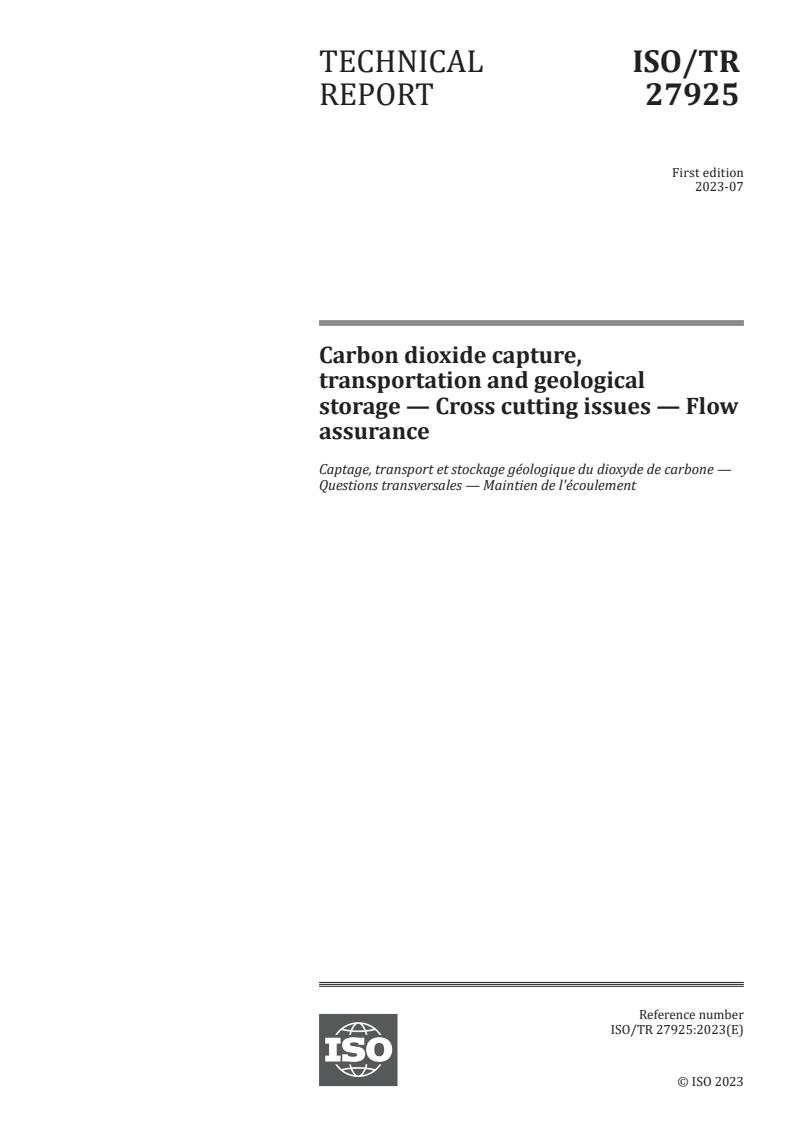
TECHNICAL ISO/TR
REPORT 27925
First edition
2023-07
Carbon dioxide capture,
transportation and geological
storage — Cross cutting issues — Flow
assurance
Captage, transport et stockage géologique du dioxyde de carbone —
Questions transversales — Maintien de l'écoulement
Reference number
© ISO 2023
All rights reserved. Unless otherwise specified, or required in the context of its implementation, no part of this publication may
be reproduced or utilized otherwise in any form or by any means, electronic or mechanical, including photocopying, or posting on
the internet or an intranet, without prior written permission. Permission can be requested from either ISO at the address below
or ISO’s member body in the country of the requester.
ISO copyright office
CP 401 • Ch. de Blandonnet 8
CH-1214 Vernier, Geneva
Phone: +41 22 749 01 11
Email: copyright@iso.org
Website: www.iso.org
Published in Switzerland
ii
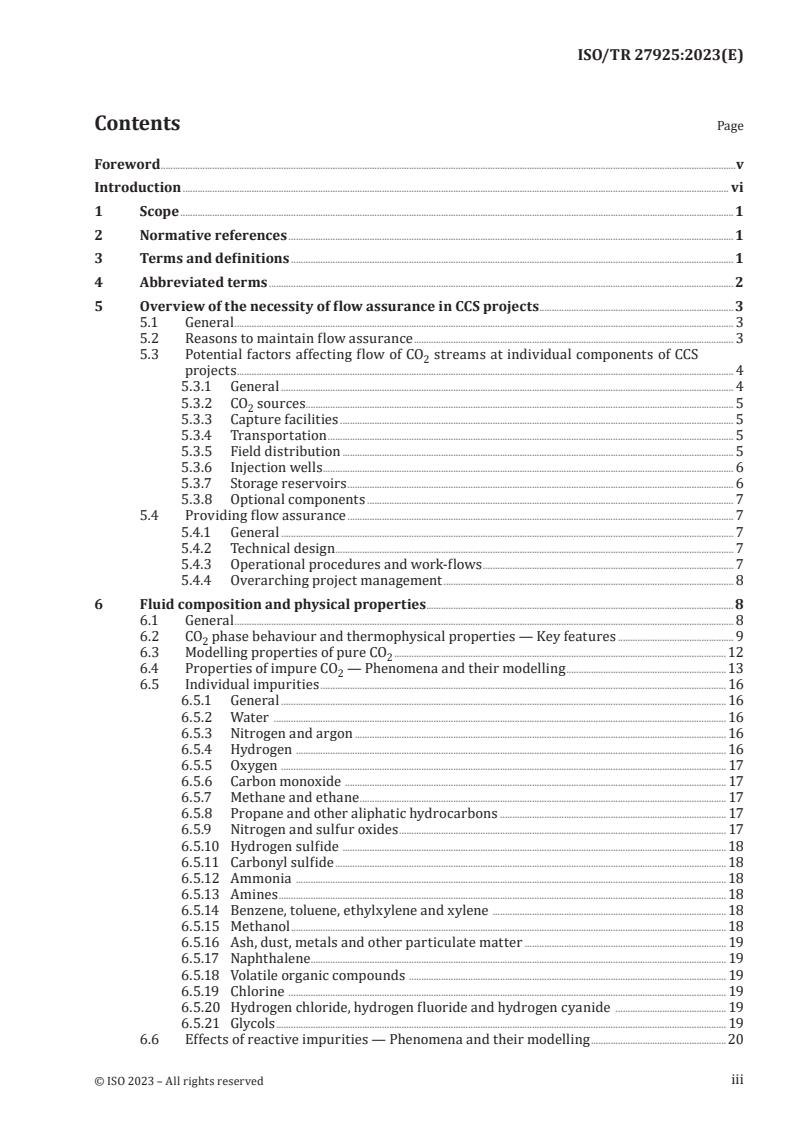
Contents Page
Foreword .v
Introduction . vi
1 Scope . 1
2 Normative references . 1
3 Terms and definitions . 1
4 Abbreviated terms . 2
5 Overview of the necessity of flow assurance in CCS projects . 3
5.1 General . 3
5.2 Reasons to maintain flow assurance . 3
5.3 Potential factors affecting flow of CO streams at individual components of CCS
projects . 4
5.3.1 General . 4
5.3.2 CO sources . . . 5
5.3.3 Capture facilities . 5
5.3.4 Transportation . 5
5.3.5 Field distribution . 5
5.3.6 Injection wells . 6
5.3.7 Storage reservoirs . 6
5.3.8 Optional components . 7
5.4 Providing flow assurance . 7
5.4.1 General . 7
5.4.2 Technical design. 7
5.4.3 Operational procedures and work-flows . 7
5.4.4 Overarching project management . 8
6 Fluid composition and physical properties . 8
6.1 General . 8
6.2 CO phase behaviour and thermophysical properties — Key features . 9
6.3 Modelling properties of pure CO .12
6.4 Properties of impure CO — Phenomena and their modelling .13
6.5 Individual impurities . 16
6.5.1 General . 16
6.5.2 Water . 16
6.5.3 Nitrogen and argon . 16
6.5.4 Hydrogen . 16
6.5.5 Oxygen . 17
6.5.6 Carbon monoxide . 17
6.5.7 Methane and ethane . 17
6.5.8 Propane and other aliphatic hydrocarbons . 17
6.5.9 Nitrogen and sulfur oxides . 17
6.5.10 Hydrogen sulfide . 18
6.5.11 Carbonyl sulfide . 18
6.5.12 Ammonia . 18
6.5.13 Amines . 18
6.5.14 Benzene, toluene, ethylxylene and xylene . 18
6.5.15 Methanol . 18
6.5.16 Ash, dust, metals and other particulate matter . 19
6.5.17 Naphthalene . 19
6.5.18 Volatile organic compounds . 19
6.5.19 Chlorine . 19
6.5.20 Hydrogen chloride, hydrogen fluoride and hydrogen cyanide . 19
6.5.21 Glycols . 19
6.6 Effects of reactive impurities — Phenomena and their modelling . 20
iii
6.6.1 General .20
6.6.2 Formation of corrosive aqueous phases . 20
6.6.3 CO specifications . 22
6.6.4 Modelling of formation of corrosive aqueous phases .22
6.6.5 Depressurisation and impact of reactive impurities .23
6.6.6 Corrosion issues in CO injection wells . 23
6.6.7 Monitoring reactive impurities in the CO stream .23
6.6.8 Particle, wear and clogging . 24
6.7 Modelling of CO stream properties in commercial flow assurance tools . 24
6.7.1 General . 24
6.7.2 Joule-Thomson effect .25
6.7.3 Viscosity . 26
6.7.4 Flow assurance simulation for CO transportation in pipes .28
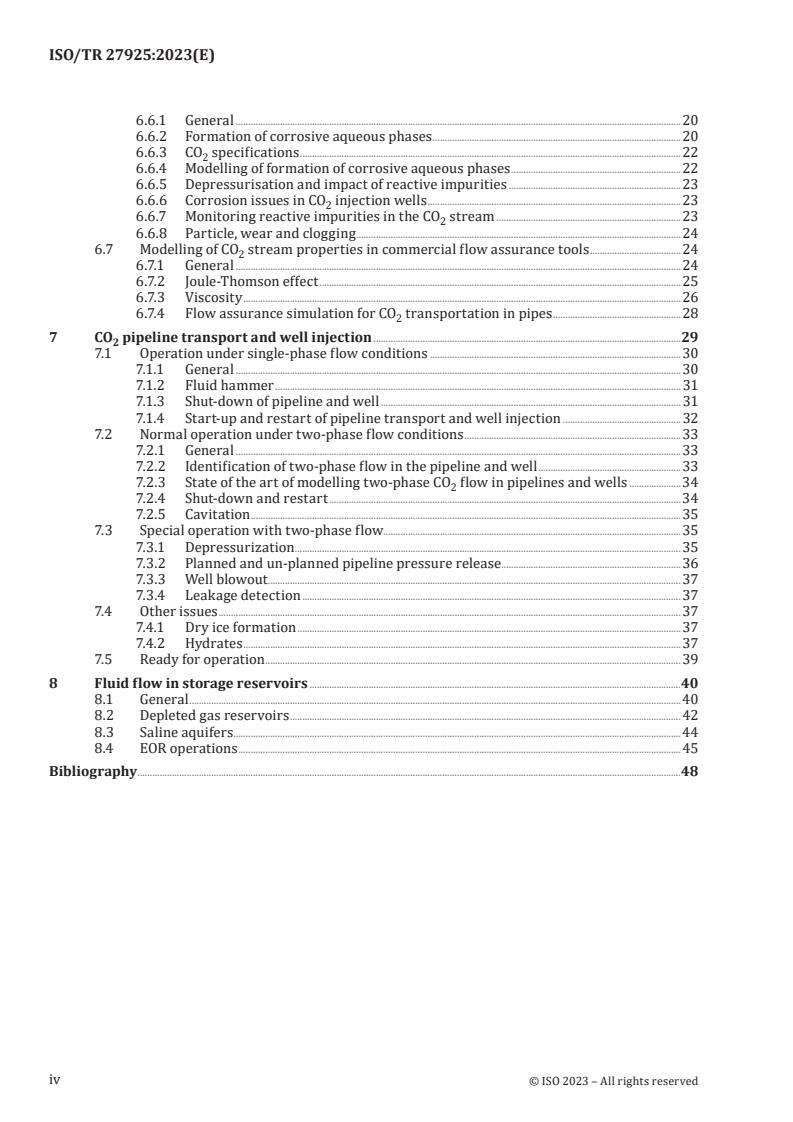
7 CO pipeline transport and well injection .29
7.1 Operation under single-phase flow conditions .30
7.1.1 General .30
7.1.2 Fluid hammer . 31
7.1.3 Shut-down of pipeline and well . 31
7.1.4 Start-up and restart of pipeline transport and well injection . 32
7.2 Normal operation under two-phase flow conditions . 33
7.2.1 General . 33
7.2.2 Identification of two-phase flow in the pipeline and well .33
7.2.3 State of the art of modelling two-phase CO flow in pipelines and wells .34
7.2.4 Shut-down and restart .34
7.2.5 Cavitation . 35
7.3 Special operation with two-phase flow . . 35
7.3.1 Depressurization . 35
7.3.2 Planned and un-planned pipeline pressure release .36
7.3.3 Well blowout . 37
7.3.4 Leakage detection . 37
7.4 Other issues . 37
7.4.1 Dry ice formation . 37
7.4.2 Hydrates . 37
7.5 Ready for operation . 39
8 Fluid flow in storage reservoirs .40
8.1 General .40
8.2 Depleted gas reservoirs . 42
8.3 Saline aquifers .44
8.4 EOR operations . 45
Bibliography .48
iv
Foreword
ISO (the International Organization for Standardization) is a worldwide federation of national standards
bodies (ISO member bodies). The work of preparing International Standards is normally carried out
through ISO technical committees. Each member body interested in a subject for which a technical
committee has been established has the right to be represented on that committee. International
organizations, governmental and non-governmental, in liaison with ISO, also take part in the work.
ISO collaborates closely with the International Electrotechnical Commission (IEC) on all matters of
electrotechnical standardization.
The procedures used to develop this document and those intended for its further maintenance are
described in the ISO/IEC Directives, Part 1. In particular, the different approval criteria needed for the
different types of ISO documents should be noted. This document was drafted in accordance with the
editorial rules of the ISO/IEC Directives, Part 2 (see www.iso.org/directives).
Attention is drawn to the possibility that some of the elements of this document may be the subject of
patent rights. ISO shall not be held responsible for identifying any or all such patent rights. Details of
any patent rights identified during the development of the document will be in the Introduction and/or
on the ISO list of patent declarations received (see www.iso.org/patents).
Any trade name used in this document is information given for the convenience of users and does not
constitute an endorsement.
For an explanation of the voluntary nature of standards, the meaning of ISO specific terms and
expressions related to conformity assessment, as well as information about ISO's adherence to
the World Trade Organization (WTO) principles in the Technical Barriers to Trade (TBT), see
www.iso.org/iso/foreword.html.
This document was prepared by Technical Committee ISO/TC 265, Carbon dioxide capture,
transportation, and geological storage.
Any feedback or questions on this document should be directed to the user’s national standards body. A
complete listing of these bodies can be found at www.iso.org/members.html.
v
Introduction
Flow assurance can be defined as an engineering discipline that is required to understand the
behaviour of fluids inside vessels, pipes or porous media at flowing and at static conditions. Flow
assurance provides input to design activities, such as pipeline design or risk analysis. It emerged as an
engineering discipline in the oil and gas industry in the 1990s. Flow assurance analysis is delivered in
the oil and gas industry by methodical numerical simulation of each pipeline and injection/production
well operating case, often using flow assurance software to facilitate the analysis.
In relation to carbon dioxide capture and storage (CCS), flow assurance seeks to maintain the
continuous supply of the CO stream from the capture plant, through the transportation system and
into the geological reservoir via injection wells. Flow assurance is required to demonstrate that all
foreseeable operating modes of all components of CCS projects, planned and unplanned, are predictable,
reliable and safe. It achieves this through analysis of the CO stream flowing as a fluid in the various
components of a CCS project’s systems, from capture through to geological storage (capture, transport,
injection and storage).
Some of the key issues of interest addressed by flow assurance analysis include:
— the total network or project hydraulic capacity requirements necessary for determining pipeline,
injection well and reservoir operating parameters;
— management of transient operations, such as those caused by varying injection rates, varying CO
stream supply and during slugging, surging and start-up and shut-down operations;
— thermal management under various operational scenarios to ensure that the variations of fluid
temperature are within the operating constraints of the system;
— fluid phase behaviour and physical properties as a function of CO stream composition;
— hydrate management and control, resulting from Joule-Thomson effects such as pressure drop
across pressure reducing valves, orifice plates and flow metering devices; and
— planned and unplanned de-pressurization of systems, such as that resulting from a pipeline rupture,
well blowout or controlled venting of pipeline and equipment during maintenance activities.
Most of the above issues can be addressed by dedicated flow assurance modelling software and tools,
in which both thermodynamic and hydrodynamic behaviours of fluids in technical components such as
pipelines or wells are modelled. The thermodynamic properties and transport properties of fluids are
closely related to their chemical composition and their associated amount or concentration. Significant
differences in thermodynamic behaviour of fluid of different compositions can be observed and these
differences can lead to different hydrodynamic behaviour of the flow. Therefore, fluid thermodynamic
properties are a critical input to the dynamic flow models.
Existing CCS system modelling of technical components has mainly been limited to single phase CO .
Given significant storage capacity suitable for permanent CO storage exists in depleted hydrocarbon
reservoirs, which can be initially at pressures where CO can be subject to two-phase flow conditions,
the CO stream in the pipeline and injection well can be subject to two-phase flow conditions, i.e. a
combination of two CO phases, gas and liquid. Two-phase flow can also occur during transient
operations such as opening up, closing in or depressurization of pipelines or wells. Within underground
reservoirs two-phase flow is generally expected involving the injected CO stream as well as formation
fluids that will have to be mobilized. Facilitating unhindered flow of the CO streams in CCS projects
requires the inclusion of reservoir fluids (natural gas, water or crude oil) and relevant processes in
the storage reservoir in the flow assurance analysis. Two-phase flow cases, such as in the examples
mentioned, are a more complex challenge for flow assurance modelling compared to flow assurance in
oil and gas transportation and injection/production well infrastructure.
Existing commercial software tools for flow assurance analysis are utilized for modelling the planned
and unplanned operation modes for the various components of the CCS system, including the reservoir
management component. These tools predict fluid behaviour and properties in the operating system. As
vi
input, this modelling requires input data such as the CO stream composition, the physical geometry of
relevant infrastructure such as pipelines, injection wells and the receiving reservoir, and the operating
conditions which include:
— steady-state and transient processes;
— single-phase and multiphase flow;
— pressure, temperature, phase fraction, velocity, etc., and their distribution in space and time; and
— distribution of fluid phase compositions in both time and space.
vii
TECHNICAL REPORT ISO/TR 27925:2023(E)
Carbon dioxide capture, transportation and geological
storage — Cross cutting issues — Flow assurance
1 Scope
This document describes and explains the physical and chemical phenomena, and the technical issues
associated with flow assurance in the various components of a carbon dioxide capture and storage
(CCS) system and provides information on how to achieve and manage flow assurance. The gaps in
technical knowledge, limitations of the tools available and preventative and corrective measures that
can be taken are also described.
This document addresses flow assurance of CO streams in a CCS project, from CO capture via
2 2
transport by pipeline and injection well through to geological storage. It does not specifically address
upstream issues associated with CO sources and capture, although flow assurance will inform CO
2 2
capture design and operation, for example, on constraints on the presence of impurities in CO streams,
as there are too many different capture technologies to be treated in detail in this document.
Vessel transport and buffer storage that are considered in integrated CCS projects under development,
are not covered in this document. Flow of material in the supply chain of a CO source, even if delivered
by a pipeline (e.g. blue hydrogen generation), and flow of gas streams within facilities generating and
feeding these into a capture facility can impact flow assurance in CCS projects and networks. These are
out of the scope of this document as well.
This document also examines the impact of impurities on the phase behaviour and physical properties
of the CO stream which in turn can ultimately affect the continuous supply of the CO stream from the
2 2
capture plant, through the transportation system and into the geological reservoir via injection wells.
Flow of fluids in oil reservoirs for the purpose of enhanced oil recovery is not within the scope of this
document.
2 Normative references
The following documents are referred to in the text in such a way that some or all of their content
constitutes requirements of this document. For dated references, only the edition cited applies. For
undated references, the latest edition of the referenced document (including any amendments) applies.
ISO 27917, Carbon dioxide capture, transportation and geological storage — Vocabulary — Cross cutting
terms
3 Terms and definitions
For the purposes of this document, the terms and definitions given in ISO 27917 and the following apply.
ISO and IEC maintain terminology databases for use in standardization at the following addresses:
— ISO Online browsing platform: available at https:// www .iso .org/ obp
— IEC Electropedia: available at https:// www .electropedia .org/
3.1
carbon dioxide capture and storage network
CCS network
connections of multiple CO sources and storage sites
3.2
carbon dioxide capture and storage project
CCS project
either single capture-transportation-storage systems or multiple systems (networks) consisting of CO
capture systems, CO transportation systems, and CO geological storage systems
2 2
Note 1 to entry: In this document, the facilities generating a CO stream are included in the considerations of
flow assurance, as part of any decision or event at these facilities affecting the amount of CO stream sent to the
capture system, and will impact flow assurance within the CCS project.
Note 2 to entry: For more information on
— CO capture systems, see ISO/TR 27912,
— CO transportation systems, see ISO 27913, and
— CO geological storage systems, see ISO 27914.
3.3
carbon dioxide capture and storage system
CCS system
combination of the capture, transportation and storage components considered as a single entity
3.4
component
assemblage of technical or geotechnical installations and natural features of subsurface geological
systems that are separate in terms of physical space, technical disciplines, industrial practice and
dominating physico-chemical processes
3.5
flow regime
type of flow pattern developed by fluid flowing through pipes
Note 1 to entry: Flow regimes depend on pressure and temperature dependent fluid properties, the diameter
of the pipe, flow rates, fractions of each phase and the inclination of the pipe. Flow regimes can change with
distance along a pipeline. In single phase flow, the regimes laminar and turbulent flow are distinguished.
3.6
hydraulic capacity
maximum flow rate achievable in a system for a given pressure loss
4 Abbreviated terms
BHP bottom hole pressure
BHT bottom hole temperature
CCS carbon dioxide capture and storage
DHSV down-hole safety valve
EoS equation of state
EOR enhanced oil recovery
HET hydrate equilibrium temperature
MEG mono-ethylene glycol
RFO ready for operation
SSSV subsurface safety valve
THMC thermal, hydraulic, mechanical and chemical
WAG water alternating gas
5 Overview of the necessity of flow assurance in CCS projects
5.1 General
During normal operations, CCS projects are generally designed to deliver an uninterrupted supply of a
CO stream:
a) to and from the capture plant;
b) through the transportation system, such as pipelines;
c) into the geological storage reservoir including the injection wells and surface infrastructure; and
d) within the storage reservoir.
Most CCS projects will be associated with fluctuating operating characteristics and conditions, i.e.
varying inflow and outflow behaviours. Detailed consideration of these characteristics during the
design and planning of the individual components of CCS projects need to be coupled in a way that
can minimize the risk of flow interruptions of the CO streams through the entire CCS project to as
low as practicable. To best achieve this, the overall system fluctuations of pressure, temperature, fluid
velocities and flow rates of CO streams and their gradients are kept within the predefined operational
ranges for these parameters at each CCS component as determined from the flow assurance modelling
during the design phase of the project. The design of technical components can include means to
facilitate preventive and corrective measures to achieve these operational ranges.
Notwithstanding that it would be ideal to maintain uninterrupted flow, in reality, like all industrial
processes, interruptions caused by planned or unplanned events are inevitable, for example,
maintenance work or unexpected equipment failure or in EOR operations injecting water and CO (WAG
schemes) intermittency is inherent to normal operations. Therefore, flow assurance requirements need
to make provision for such fluctuations and events.
5.2 Reasons to maintain flow assurance
There are several reasons for ensuring uninterrupted flow along the entire CCS chain including:
— Technical and safety: Flow interruptions or excessive fluctuations of CO stream properties
(including mass flow rate, pressure and composition) increase wear of equipment and the risk
of early failure due to physical or chemical effects. Chemical effects can include the formation of
hydrates that can block pipes or reservoir rocks and corrode the equipment. Physical effects include
vibrations, temperature effects on material integrity or mobilization of fine particles and blocking
of pore throats in porous reservoir rocks. Rather sudden fluctuations of physical properties in CO
streams can result from phase changes or fluid dynamic effects (e.g. hydraulic hammer) that can
damage infrastructure.
— Economic: Maintenance and replacement of equipment is a cost factor. A smaller than forseen
amount of CO stored will reduce the income of CCS projects, e.g. from emission trading or tax
credit generation as well as for transport and storage service providers. Excess CO that cannot be
captured, transported or stored and thus will be released to the atmosphere can result in payments
for emissions. Furthermore, releasing captured CO downstream is associated with unnecessary
costs for the capture operation.
— Environmental: Venting of CO will be counter to the purpose of climate mitigation by CCS projects
and can release substances into the environment that are harmful to the human health or the
environment. The nature and concentrations of such substances depend on the capture technology.
Lower than anticipated amounts of CO captured, transported and stored will reduce the overall
energy, resources and environmental balances of CCS projects.
5.3 Potential factors affecting flow of CO streams at individual components of CCS
projects
5.3.1 General
As illustrated in Figure 1, the essential components of a CCS project that can impact flow of CO streams
are CO sources, capture facilities (including purification and conditioning units), transportation
infrastructure, manifolds for field distribution, injection wells and storage reservoirs.
Key
components for handling excess flows and interruptions
essential components of CCS projects
optional components of CCS projects
non-technical components of CCS projects
Figure 1 — Schematic overview of the components of CCS projects — CCS systems or networks
Essential components for a single source-to-sink scenario are connected by brown arrows in Figure 1.
Optional components and devices, that are not needed in every project, can be included at various
locations within CCS projects, including trans-shipment facilities, pumps, compressors, heaters, coolers
and buffer storage. Further technical components for managing flow interruptions or excess streams,
likely to be installed in any CCS project, include venting or shut-in devices, e.g. safety valves along a
pipeline.
Besides the technical components that impact flow assurance, management procedures will determine
the overarching flow assurance within CCS projects. Flow assurance becomes a more complex issue for
the overarching layout and management, for example when transportation networks connect multiple
sources and sinks and facilitate alternative routing and means for transportation.
The continuous flow of CO streams in CCS projects can be disturbed by flow rates above or below
limits of normal operations. Counter measures can be the venting of a part of the gas streams (exhaust
gas, process gas or CO stream) or shut-in of equipment. Provisions for venting or shut-in can be located
at multiple sites within CCS projects or within the essential components. Extraction of fluids, CO
stream or other formation fluids, from a storage reservoir can also be used to maintain continuous
flow. For example, in the case of storage in saline aquifers, production of brine and its reinjection into
other formations can be utilized for the purpose of pressure management.
Other than malperformance and failure of components, threats to flow assurance within each of the
various CCS components are described in 5.3.2 to 5.3.8.
5.3.2 CO sources
The CO generation at the sources can vary or change for different reasons and at different timescales.
The production of goods can be subject to market fluctuations that will be associated with equivalent
fluctuations of industrial plants’ CO output. Some fluctuations can be foreseeable, such as seasonal
fluctuations or planned maintenance and shut-downs. Other changes can occur on a timeline that is
difficult to predict, for example, the generation of process heat can switch from coal to natural gas or
hydrogen which can result in future that can lead to a permanent decrease in the generation of CO .
This decrease and associated changes of the CO concentrations in the process or flue gas stream can
require changes to the capture technologies deployed. In networks of multiple sources, changes at
individual sources can be levelled-out and the effects on the flow of the combined CO streams can be
compatible with the foreseen operational window for downstream infrastructure (see ISO/TR 27918).
It is therefore necessary for the design of the various CCS components to accommodate a wide operating
envelope including situations of turndown.
5.3.3 Capture facilities
The capture technologies including gas conditioning processes, determine the concentrations
of impurities in CO streams. The efficiency of capture processes depends on the mass flow and
composition of gas streams – and their variations in time. Capture facilities and their equipment are
designed to work in an optimal way within the design window of operation. Excess fluctuations of gas
streams both in terms of composition and mass flow rates can lead to sub-optimal operation outside of
the design window and to a reduced capture efficiency. Combining CO streams from different sources
and thus containing a different set of impurities can cause reactions between impurities that can result
in products that can increase risks for flow assurance in downstream infrastructure, e.g. by increasing
corrosion, friction, wear or deposition of products in pipelines. Thus, effort in the removal of impurities
from the CO stream can be required before transportation, or else combining of CO streams can be
2 2
prevented, if the mixture is incompatible with downstream components; see Reference [2].
5.3.4 Transportation
While the transportation of CO in pipelines aims at achieving uninterrupted flow of CO in a single
2 2
dense phase (see ISO 27917) at ambient temperatures and high pressure, transport in vessels (road,
rail, ship) are expected to be in a liquid phase at very low temperatures and moderate pressure. If
physical properties of CO streams in upstream and downstream infrastructure are different from that
in the transportation system, installations have to be provided at either end of the transportation chain
to adjust physical conditions. This equipment includes compressors, pumps, heaters and coolers. The
impact of these on flow assurance depends on the technology utilized, the location of such equipment
within the CCS project, and the designed range of flow rates (and CO stream compositions) that these
can handle.
Furthermore, the transport in vessels is inherently discontinuous, i.e. leads to intermittent
transportation that requires some sort of buffering. Buffering can be achieved by pressure changes
in pipelines (line packing), use of temporary stores (engineered or geological) or switching between
a suitable number of vessels to ensure continuous filling and discharge of vessels, so that up- and
downstream CO can flow in a continuous manner. Overall, vessel transportation is more sensitive to
external impacts than pipeline transportation, e.g. due to road or rail blockings, extreme water levels
in rivers or off-shore storms that can interrupt shipping. Thus, additional dedicated buffers can be
prudent in order to avoid interruptions, shut-ins and venting of CO .
5.3.5 Field distribution
In large scale storage projects, usage of several wells can facilitate CO injection into reservoirs.
Natural gas and oil reservoirs are usually exploited by a considerable number of wells, which can be
used in active or depleted fields for CO injection. A CO stream arriving from distant sources has to be
2 2
distributed within the hydrocarbon fields through manifolds to the individual wells in order to fill the
reservoir in an effective manner. In particular, the CO demand of wells in EOR projects will be variable
according to the oil production operation. For example, in WAG schemes, CO is injected intermittently
in individual wells. Trade-offs between optimum oil recovery and maximum CO storage can be made
in CO EOR projects, that will be influenced by the revenues or savings from CO storage and oil sale.
2 2
Additional fluxes of CO streams are associated with technical components for the separation of CO
2 2
from crude oil and formation water and recycling it to the injection wells.
Also, in aquifer storage, manifolds can be used for distributing CO streams between injection wells
in one or more reservoirs. Wells can be laterally spaced in one storage formation, as in the case of
the Krechba storage site (Algeria), or tap reservoirs at different depths, such as in the Snøhvit field
(Norwegian Continental Shelf). Benefits of using more than one well for injection into saline aquifers
include the possibility to react in the case of injectivity or containment problems, the ability for
switching between wells in the case of maintenance or logging in a well, or the options for pressure
management and plume steering in the storage reservoir. This flexibility suits the flow assurance in the
upstream components of CCS projects.
5.3.6 Injection wells
Similar to pipelines, injection wells need to maintain flow of CO streams at rather constant conditions.
However, the physical conditions of CO streams can differ considerably from top to bottom of a well,
especially if reservoir pressures are much lower, e.g. in depleted natural gas reservoirs than at the end
of transportation pipelines or temperatures are much higher in the reservoirs compared to the low
temperatures of liquid CO in ships. Such contrasting conditions hold technical challenges for design
and operation of injection infrastructure. Technical challenges include avoiding the formations of
hydrates that can block flows and phase changes or thermal and/or hydraulic stresses that can impair
well integrity. Corrosion or mechanical wear can lead into situations that can require monitoring (using
logging), maintenance or work-overs on one or more injection wells. Wells can be out of service because
of such operations for a while. Therefore, avoiding of early well workover is one of the aims for flow
insurance in injection wells.
In particular, offshore CO -injection wells sometimes have to be operated under transient or
intermittent conditions. In case of pipeline transportation, this can be due to varying CO supply, and
in the case of ship transportation, it can be due to the arrival of ships and the lack of buffer storages.
From a study into the effect of thermal cycling in the well due to intermittent injection from ships (see
Reference [3]), it was found that long intervals, low CO temperatures and high injection rates lead
to the highest thermal stresses in the well. Depending on the well materials and construction, those
stress levels can impact well integrity showing the importance of considering thermal and mechanical
stresses in the well design for cyclic injection operation.
5.3.7 Storage reservoirs
Natural rocks are heterogeneous at different scales. Sedimentary structures in the centimetre to
decimetre range and beyond affect bulk hydraulic properties, such as permeability. Tectonic structures
and variations of the sedimentary depositional environment in the scale of tens to thousands of metres
can result in the compartmentalization of reservoirs, impacting plume migration, brine displacement,
pressure build-up and injectivity of wells. The resolution of seismic images is low compared to the size
of sedimentary or tectonic structures affecting fluid flow and roc
...
Questions, Comments and Discussion
Ask us and Technical Secretary will try to provide an answer. You can facilitate discussion about the standard in here.
Loading comments...