

ISO 8106:2004
(Main)Glass containers — Determination of capacity by gravimetric method — Test method
General Information
- Abstract
ISO 8106:2004 specifies a gravimetric method for determining the capacity of glass containers and their compliance with specification limits.
- Status
- Published
- Publication Date
- 25-Oct-2004
- Technical Committee
- ISO/TC 63 - Glass containers
- Drafting Committee
- ISO/TC 63 - Glass containers
- Current Stage
- 9060 - Close of review
- Completion Date
- 02-Sep-2030
Overview - ISO 8106:2004 (Glass containers - Capacity by gravimetric method)
ISO 8106:2004 specifies a laboratory gravimetric test method to determine the capacity of glass containers (brimful or specified fill level) and to assess compliance with specification limits. The method calculates volume from the mass of water filling the container adjusted by a volume correction factor (VCF) for water density at the test temperature (reference 20 °C). This standard is used for quality control, acceptance testing and regulatory compliance of bottles, jars and other glass packaging.
Key topics and technical requirements
- Principle: Capacity = mass of water × VCF (ml/g). Measure mass difference between filled and empty container and apply temperature correction.
- Reference temperature: 20 °C; tests typically corrected to this reference using VCF values for water.
- Sampling: Test on a predetermined, representative sample of the consignment.
- Apparatus:
- Calibrated thermometer (graduated ≥ 1 °C)
- Balance with specified accuracy depending on container capacity (e.g., ±0.1 g for up to 10 ml; increasing tolerances for larger volumes)
- Strike plate for brimful determination of wide-mouth containers
- Depth gauge for defined filling level measurements
- Procedure highlights:
- Maintain water and container temperatures within ±1 °C of measured values during the test.
- Keep outer container surfaces dry; fill on a flat horizontal surface.
- For brimful capacity, top up to the rim meniscus (or use strike plate for wide mouths).
- For filling-level capacity, use a depth gauge so the meniscus meets the gauge tip.
- Weigh empty and filled containers to prescribed balance accuracy.
- Expression of results:
- Use the VCF table to convert mass (g) to volume (ml). The standard provides VCFs for distilled water at 16–28 °C and notes that tap water requires an additional density correction.
- Report individual capacities, bulk/average capacity if required, and identify non‑conforming units.
- Test report requirements: reference to ISO 8106, container description, sample size and sampling method, individual capacities, acceptance calculation, date, location, and responsible signature.
Applications and typical users
- Who uses it: glass-container manufacturers, packaging engineers, laboratory technicians, quality control and QA/QC departments, filling equipment manufacturers, beverage and pharmaceutical packaging teams, and regulatory/inspection bodies.
- Practical uses:
- Production acceptance testing and lot verification
- Calibration/validation of filling machines and lines
- Compliance with customer or legal specification limits (e.g., measuring bottles used as measuring containers)
- Product development and dimensional inspection of glass packaging
Related standards
- ISO 7458 (Internal pressure resistance)
- ISO 7459 (Thermal shock resistance)
- ISO 8113 (Resistance to vertical load)
- ISO 7348 (Glass containers - Vocabulary)
- Cites Directive 75/107/EEC for correction to 20 °C
Keywords: ISO 8106:2004, glass containers, gravimetric method, capacity determination, brimful capacity, filling level capacity, VCF, test method, packaging quality control.
Relations
- Effective Date
- 12-Feb-2026
- Effective Date
- 06-Jun-2022
- Revises
ISO 8106:1985 - Glass containers — Determination of capacity by gravimetric method — Test method - Effective Date
- 15-Apr-2008
Get Certified
Connect with accredited certification bodies for this standard

BRCGS (Brand Reputation Compliance Global Standards)
Global food safety and quality standards owner.
Sponsored listings
Frequently Asked Questions
ISO 8106:2004 is a standard published by the International Organization for Standardization (ISO). Its full title is "Glass containers — Determination of capacity by gravimetric method — Test method". This standard covers: ISO 8106:2004 specifies a gravimetric method for determining the capacity of glass containers and their compliance with specification limits.
ISO 8106:2004 specifies a gravimetric method for determining the capacity of glass containers and their compliance with specification limits.
ISO 8106:2004 is classified under the following ICS (International Classification for Standards) categories: 55.100 - Bottles. Pots. Jars. The ICS classification helps identify the subject area and facilitates finding related standards.
ISO 8106:2004 has the following relationships with other standards: It is inter standard links to EN ISO 8106:2004, ISO 6678:1981, ISO 8106:1985. Understanding these relationships helps ensure you are using the most current and applicable version of the standard.
ISO 8106:2004 is available in PDF format for immediate download after purchase. The document can be added to your cart and obtained through the secure checkout process. Digital delivery ensures instant access to the complete standard document.
Standards Content (Sample)
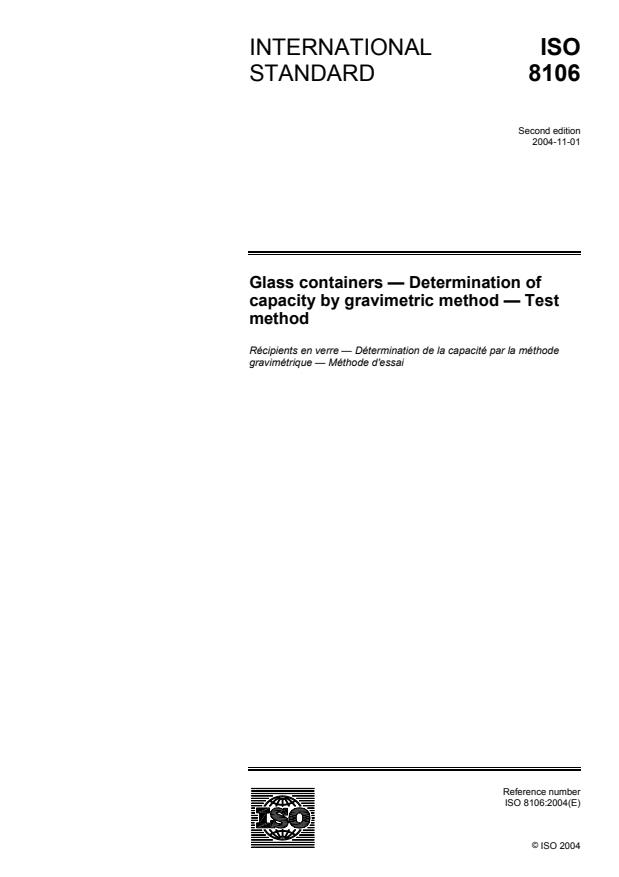
INTERNATIONAL ISO
STANDARD 8106
Second edition
2004-11-01
Glass containers — Determination of
capacity by gravimetric method — Test
method
Récipients en verre — Détermination de la capacité par la méthode
gravimétrique — Méthode d'essai
Reference number
©
ISO 2004
PDF disclaimer
This PDF file may contain embedded typefaces. In accordance with Adobe's licensing policy, this file may be printed or viewed but
shall not be edited unless the typefaces which are embedded are licensed to and installed on the computer performing the editing. In
downloading this file, parties accept therein the responsibility of not infringing Adobe's licensing policy. The ISO Central Secretariat
accepts no liability in this area.
Adobe is a trademark of Adobe Systems Incorporated.
Details of the software products used to create this PDF file can be found in the General Info relative to the file; the PDF-creation
parameters were optimized for printing. Every care has been taken to ensure that the file is suitable for use by ISO member bodies. In
the unlikely event that a problem relating to it is found, please inform the Central Secretariat at the address given below.
© ISO 2004
All rights reserved. Unless otherwise specified, no part of this publication may be reproduced or utilized in any form or by any means,
electronic or mechanical, including photocopying and microfilm, without permission in writing from either ISO at the address below or
ISO's member body in the country of the requester.
ISO copyright office
Case postale 56 • CH-1211 Geneva 20
Tel. + 41 22 749 01 11
Fax + 41 22 749 09 47
E-mail copyright@iso.org
Web www.iso.org
Published in Switzerland
ii © ISO 2004 – All rights reserved
Foreword
ISO (the International Organization for Standardization) is a worldwide federation of national standards bodies
(ISO member bodies). The work of preparing International Standards is normally carried out through ISO
technical committees. Each member body interested in a subject for which a technical committee has been
established has the right to be represented on that committee. International organizations, governmental and
non-governmental, in liaison with ISO, also take part in the work. ISO collaborates closely with the
International Electrotechnical Commission (IEC) on all matters of electrotechnical standardization.
International Standards are drafted in accordance with the rules given in the ISO/IEC Directives, Part 2.
The main task of technical committees is to prepare International Standards. Draft International Standards
adopted by the technical committees are circulated to the member bodies for voting. Publication as an
International Standard requires approval by at least 75 % of the member bodies casting a vote.
Attention is drawn to the possibility that some of the elements of this document may be the subject of patent
rights. ISO shall not be held responsible for identifying any or all such patent rights.
ISO 8106 was prepared by the European Committee for Standardization (CEN) in collaboration with Technical
Committee ISO/TC 63, Glass containers, in accordance with the Agreement on technical cooperation between
ISO and CEN (Vienna Agreement).
Throughout the text of this document, read ".this European Standard." to mean ".this International
Standard.".
This second edition cancels and replaces the first edition (ISO 8106:1985), which has been technically
revised.
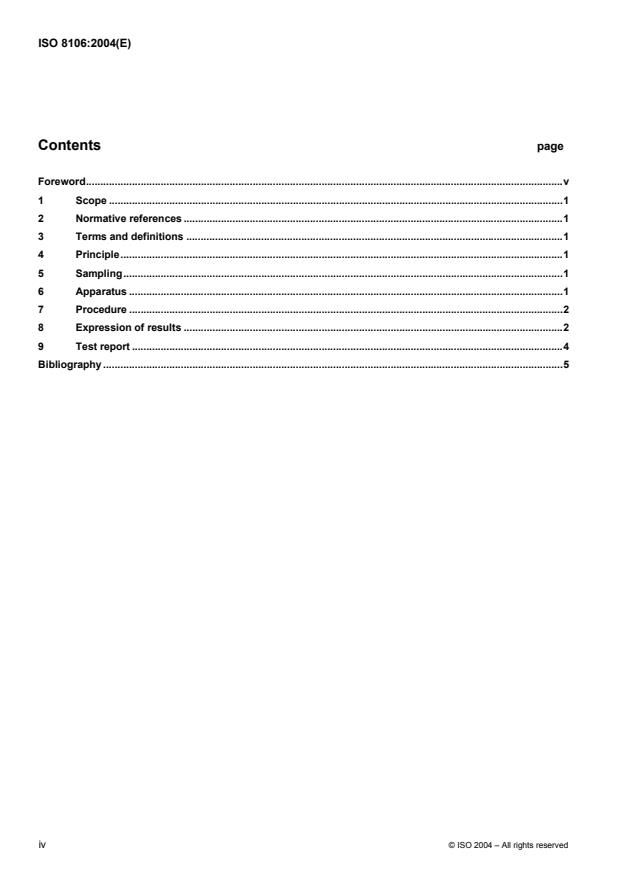
Contents page
Foreword.v
1 Scope .1
2 Normative references .1
3 Terms and definitions .1
4 Principle.1
5 Sampling.1
6 Apparatus .1
7 Procedure .2
8 Expression of results .2
9 Test report .4
Bibliography .5
iv © ISO 2004 – All rights reserved
Foreword
This document (EN ISO 8106:2004) has been prepared by Technical Committee CEN /TC 261, "Packaging", the
secretariat of which is held by AFNOR, in collaboration with Technical Committee ISO/TC 63 "Glass containers".
This European Standard shall be given the status of a national standard, either by publication of an identical text or
by endorsement, at the latest by May 2005, and conflicting national standards shall be withdrawn at the latest by
May 2005.
This document includes a Bibliography.
Efficient packaging is of great importance for the distribution and the protection of goods and the environment.
Insufficient or inappropriate packaging can lead to damage or wastage of the contents of the pack.
This standard is part of a series of standards for "Glass containers - Test methods":
EN ISO 7458, Glass containers — Internal pressure resistance — Test methods (ISO 7458:2004)
EN ISO 7459, Glass containers — Thermal shock resistance and thermal shock endurance — Test methods
(ISO 7459:2004)
EN ISO 8106, Glass containers — Determination of capacity by gravimetric method — Test method
(ISO 8106:2004)
EN ISO 8113, Glass containers — Resistance to vertical load — Test method (ISO 811
...