

ISO 2797:2017
(Main)Textile glass — Rovings — Basis for a specification
General Information
- Abstract
ISO 2797:2017 establishes a basis for a specification for textile glass rovings, whether direct rovings or assembled rovings.
- Status
- Published
- Publication Date
- 29-Nov-2017
- Technical Committee
- ISO/TC 61/SC 13 - Composites and reinforcement fibres
- Drafting Committee
- ISO/TC 61/SC 13/WG 1 - Reinforcements and reinforcement products
- Current Stage
- 9093 - International Standard confirmed
- Start Date
- 28-Jul-2022
- Completion Date
- 29-Aug-2026
Buy Documents


ISO 2797:2017 - Textile glass -- Rovings -- Basis for a specification
ISO 2797:2017 - Textile glass — Rovings — Basis for a specification/30/2017
Overview
ISO 2797:2017 - "Textile glass - Rovings - Basis for a specification" provides a structured framework for writing technical specifications for textile glass rovings, covering both direct and assembled rovings. Intended as a guide for producers, suppliers, purchasers and standards bodies, this third edition (2017) enumerates the points to be addressed when defining material, testing and delivery requirements for rovings used in composite manufacturing.
Key topics and technical requirements
The standard defines the scope of a roving specification and references established test methods. Key topics include:
- Designation: Use ISO 2078 rules to indicate glass type, filament reference diameter and roving linear density; supplier codes may include strand linear density for chop-type rovings.
- Sampling and batch acceptance: Apply ISO 2859-1 and ISO 3951-1 sampling procedures; the specification must state sampling conditions and specimen quantities.
- Conditioning: Refer to ISO 291 and ISO 139 for standard atmospheres and conditioning before testing.
- Properties and methods of test:
- Filament diameter - ISO 1888
- Linear density (tex) - ISO 1889
- Moisture content - ISO 3344
- Size and size content - supplier to indicate size type and determine content per ISO 1887
- Stiffness - ISO 3375
- Mechanical properties - flexural and compressive tests on rods (ISO 3597-2, ISO 3597-3), flexural of sheets (ISO 178), shear (ISO 14130), tensile of impregnated rovings (ISO 9163)
- Visual properties, catenary, abrasion resistance, strand integrity - where no standardized method exists, purchaser and supplier must agree on criteria and append test methods.
- Delivery, packaging and labelling: Specify winding, packaging systems and mandatory label information (supplier, roving designation, winding/packaging codes, net mass, manufacture date).
- Storage: Include storage conditions relevant to preserving roving quality.
Practical applications and users
ISO 2797 is practical for:
- Manufacturers and converters of textile glass rovings defining product specifications
- Composite fabricators (winding, weaving, pultrusion, spray-up, SMC) selecting appropriate rovings
- Quality and procurement engineers establishing acceptance criteria and testing regimes
- Standards committees and regulatory bodies referencing harmonized roving requirements
This standard helps ensure consistent material quality and compatibility of rovings with downstream processes (chopping vs. continuous use), improving reliability in reinforced plastics and composite applications.
Related standards (selection)
ISO 2078, ISO 1888, ISO 1889, ISO 1887, ISO 291, ISO 139, ISO 3344, ISO 3375, ISO 3597-2, ISO 3597-3, ISO 9163, ISO 14130, ISO 2859-1, ISO 3951-1.
Keywords: ISO 2797:2017, textile glass rovings, rovings specification, filament diameter, linear density, size content, sampling and batch acceptance, conditioning and testing, packaging and labelling.
Relations
- Effective Date
- 09-Feb-2026
- Effective Date
- 17-Jun-2017
Buy Documents
ISO 2797:2017 - Textile glass -- Rovings -- Basis for a specification
ISO 2797:2017 - Textile glass — Rovings — Basis for a specification/30/2017
Get Certified
Connect with accredited certification bodies for this standard

Control Union Certifications
Global certification for agriculture and sustainability.

Hohenstein Institut
Textile testing and certification.

Bureau Veritas Bangladesh
Bureau Veritas certification services in Bangladesh.
Sponsored listings
Frequently Asked Questions
ISO 2797:2017 is a standard published by the International Organization for Standardization (ISO). Its full title is "Textile glass — Rovings — Basis for a specification". This standard covers: ISO 2797:2017 establishes a basis for a specification for textile glass rovings, whether direct rovings or assembled rovings.
ISO 2797:2017 establishes a basis for a specification for textile glass rovings, whether direct rovings or assembled rovings.
ISO 2797:2017 is classified under the following ICS (International Classification for Standards) categories: 59.100.10 - Textile glass materials. The ICS classification helps identify the subject area and facilitates finding related standards.
ISO 2797:2017 has the following relationships with other standards: It is inter standard links to EN 13121-1:2021, ISO 2797:1986. Understanding these relationships helps ensure you are using the most current and applicable version of the standard.
ISO 2797:2017 is available in PDF format for immediate download after purchase. The document can be added to your cart and obtained through the secure checkout process. Digital delivery ensures instant access to the complete standard document.
Standards Content (Sample)
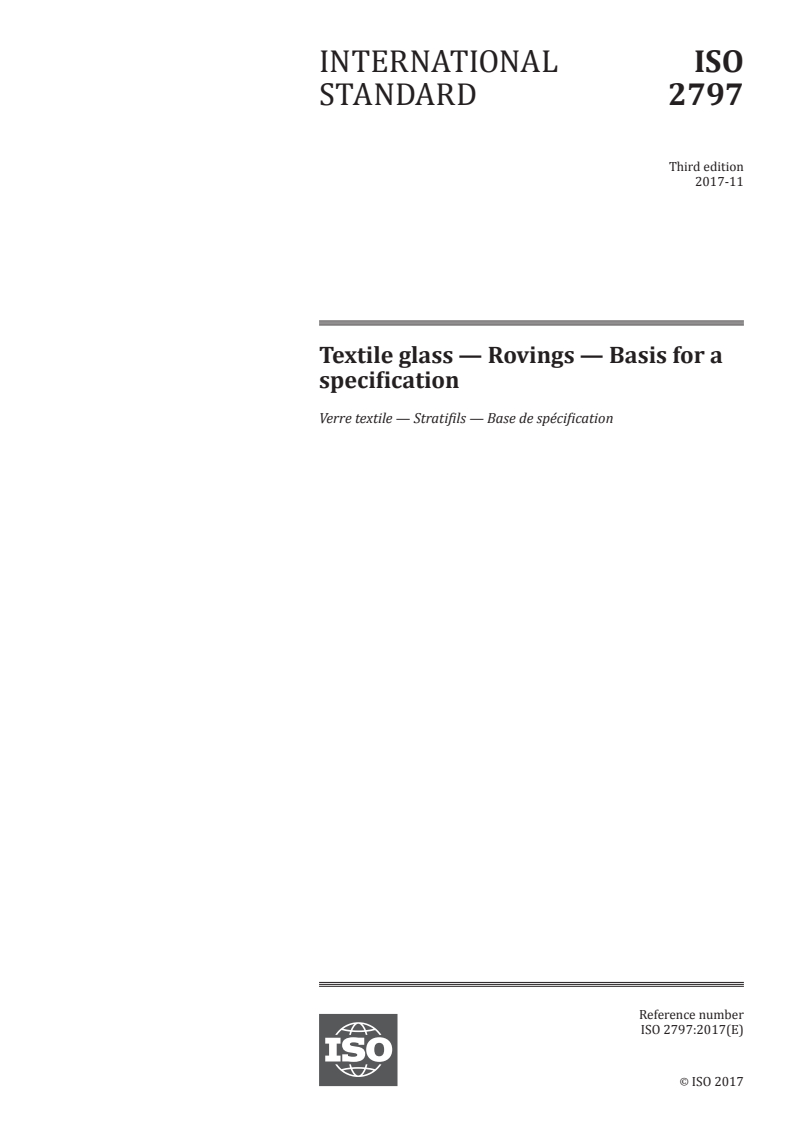
INTERNATIONAL ISO
STANDARD 2797
Third edition
2017-11
Textile glass — Rovings — Basis for a
specification
Verre textile — Stratifils — Base de spécification
Reference number
©
ISO 2017
© ISO 2017, Published in Switzerland
All rights reserved. Unless otherwise specified, no part of this publication may be reproduced or utilized otherwise in any form
or by any means, electronic or mechanical, including photocopying, or posting on the internet or an intranet, without prior
written permission. Permission can be requested from either ISO at the address below or ISO’s member body in the country of
the requester.
ISO copyright office
Ch. de Blandonnet 8 • CP 401
CH-1214 Vernier, Geneva, Switzerland
Tel. +41 22 749 01 11
Fax +41 22 749 09 47
copyright@iso.org
www.iso.org
ii © ISO 2017 – All rights reserved
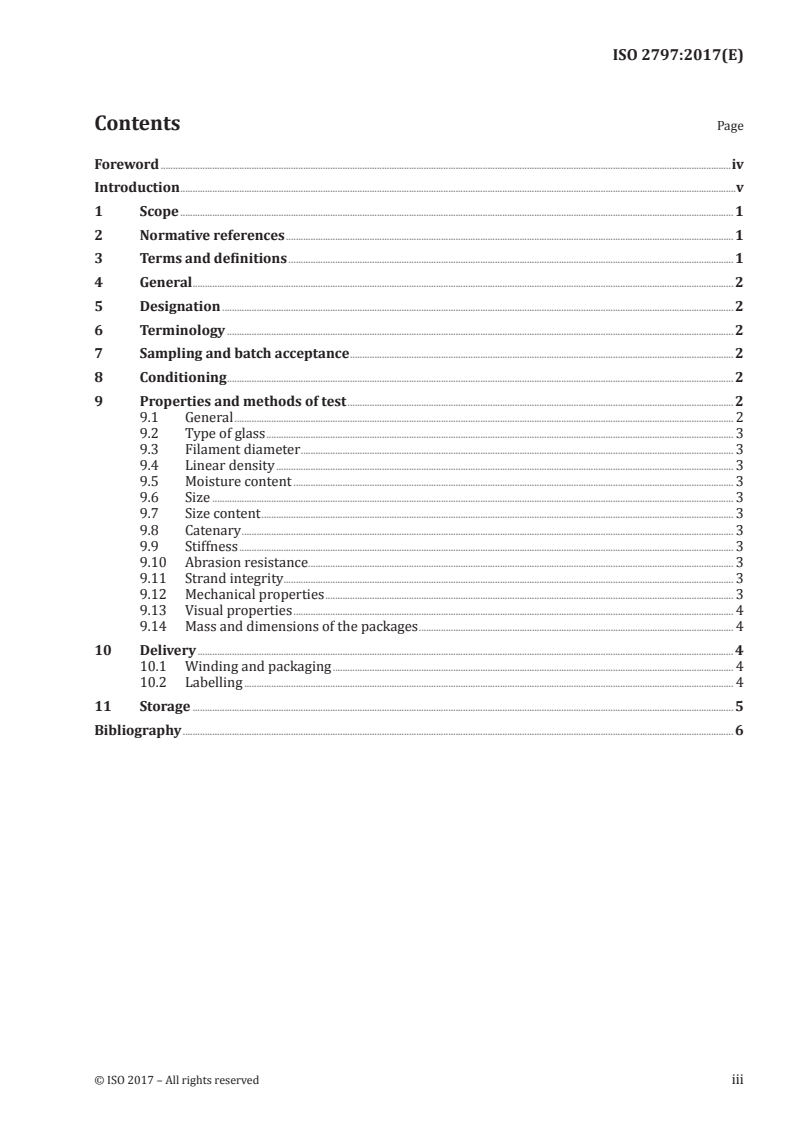
Contents Page
Foreword .iv
Introduction .v
1 Scope . 1
2 Normative references . 1
3 Terms and definitions . 1
4 General . 2
5 Designation . 2
6 Terminology . 2
7 Sampling and batch acceptance . 2
8 Conditioning . 2
9 Properties and methods of test . 2
9.1 General . 2
9.2 Type of glass . 3
9.3 Filament diameter . 3
9.4 Linear density . 3
9.5 Moisture content . 3
9.6 Size . 3
9.7 Size content . 3
9.8 Catenary . 3
9.9 Stiffness . 3
9.10 Abrasion resistance . 3
9.11 Strand integrity . 3
9.12 Mechanical properties . 3
9.13 Visual properties . 4
9.14 Mass and dimensions of the packages . 4
10 Delivery . 4
10.1 Winding and packaging . 4
10.2 Labelling . 4
11 Storage . 5
Bibliography . 6
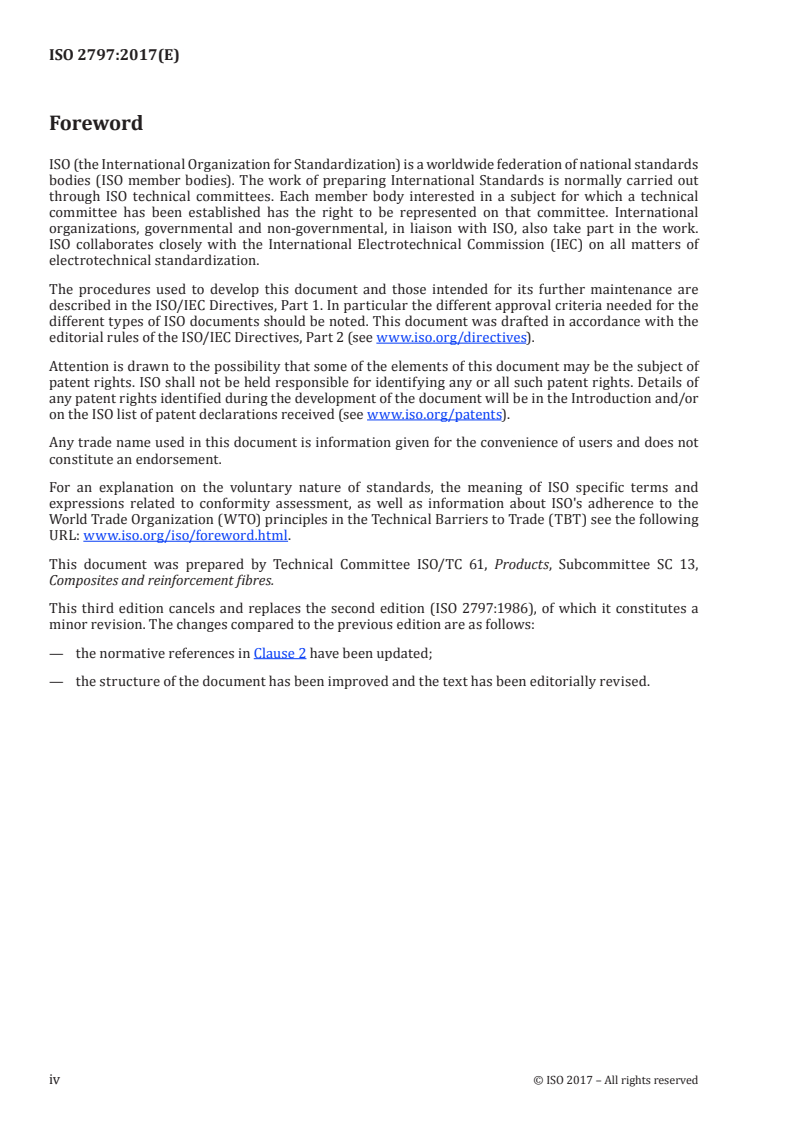
Foreword
ISO (the International Organization for Standardization) is a worldwide federation of national standards
bodies (ISO member bodies). The work of preparing International Standards is normally carried out
through ISO technical committees. Each member body interested in a subject for which a technical
committee has been established has the right to be represented on that committee. International
organizations, governmental and non-governmental, in liaison with ISO, also take part in the work.
ISO collaborates closely with the International Electrotechnical Commission (IEC) on all matters of
electrotechnical standardization.
The procedures used to develop this document and those intended for its further maintenance are
described in the ISO/IEC Directives, Part 1. In particular the different approval criteria needed for the
different types of ISO documents should be noted. This document was drafted in accordance with the
editorial rules of the ISO/IEC Directives, Part 2 (see www.iso.org/directives).
Attention is drawn to the possibility that some of the elements of this document may be the subject of
patent rights. ISO shall not be held responsible for identifying any or all such patent rights. Details of
any patent rights identified during the development of the document will be in the Introduction and/or
on the ISO list of patent declarations received (see www.iso.org/patents).
Any trade name used in this document is information given for the convenience of users and does not
constitute an endorsement.
For an explanation on the voluntary nature of standards, the meaning of ISO specific terms and
expressions related to conformity assessment, as well as information about ISO's adherence to the
World Trade Organization (WTO) principles in the Technical Barriers to Trade (TBT) see the following
URL: www.iso.org/iso/foreword.html.
This document was prepared by Technical Committee ISO/TC 61, Products, Subcommittee SC 13,
Composites and reinforcement fibres.
This third edition cancels and replaces the second edition (ISO 2797:1986), of which it constitutes a
minor revision. The changes compared to the previous edition are as follows:
— the normative references in Clause 2 have been updated;
— the structure of the document has been improved and the text has been editorially revised.
iv © ISO 2017 – All rights reserved
Introduction
A basis for a specification is intended to serve as a guide for the establishment of technical specifications
for products of given type.
It is designed to enumerate as completely as possible the points that should be considered at the time
of writing the specifications that will apply to a particular product or a family of products who
...
INTERNATIONAL ISO
STANDARD 2797
Third edition
2017-11
Textile glass — Rovings — Basis for a
specification
Verre textile — Stratifils — Base de spécification
Reference number
©
ISO 2017
© ISO 2017, Published in Switzerland
All rights reserved. Unless otherwise specified, no part of this publication may be reproduced or utilized otherwise in any form
or by any means, electronic or mechanical, including photocopying, or posting on the internet or an intranet, without prior
written permission. Permission can be requested from either ISO at the address below or ISO’s member body in the country of
the requester.
ISO copyright office
Ch. de Blandonnet 8 • CP 401
CH-1214 Vernier, Geneva, Switzerland
Tel. +41 22 749 01 11
Fax +41 22 749 09 47
copyright@iso.org
www.iso.org
ii © ISO 2017 – All rights reserved
Contents Page
Foreword .iv
Introduction .v
1 Scope . 1
2 Normative references . 1
3 Terms and definitions . 1
4 General . 2
5 Designation . 2
6 Terminology . 2
7 Sampling and batch acceptance . 2
8 Conditioning . 2
9 Properties and methods of test . 2
9.1 General . 2
9.2 Type of glass . 3
9.3 Filament diameter . 3
9.4 Linear density . 3
9.5 Moisture content . 3
9.6 Size . 3
9.7 Size content . 3
9.8 Catenary . 3
9.9 Stiffness . 3
9.10 Abrasion resistance . 3
9.11 Strand integrity . 3
9.12 Mechanical properties . 3
9.13 Visual properties . 4
9.14 Mass and dimensions of the packages . 4
10 Delivery . 4
10.1 Winding and packaging . 4
10.2 Labelling . 4
11 Storage . 5
Bibliography . 6
Foreword
ISO (the International Organization for Standardization) is a worldwide federation of national standards
bodies (ISO member bodies). The work of preparing International Standards is normally carried out
through ISO technical committees. Each member body interested in a subject for which a technical
committee has been established has the right to be represented on that committee. International
organizations, governmental and non-governmental, in liaison with ISO, also take part in the work.
ISO collaborates closely with the International Electrotechnical Commission (IEC) on all matters of
electrotechnical standardization.
The procedures used to develop this document and those intended for its further maintenance are
described in the ISO/IEC Directives, Part 1. In particular the different approval criteria needed for the
different types of ISO documents should be noted. This document was drafted in accordance with the
editorial rules of the ISO/IEC Directives, Part 2 (see www.iso.org/directives).
Attention is drawn to the possibility that some of the elements of this document may be the subject of
patent rights. ISO shall not be held responsible for identifying any or all such patent rights. Details of
any patent rights identified during the development of the document will be in the Introduction and/or
on the ISO list of patent declarations received (see www.iso.org/patents).
Any trade name used in this document is information given for the convenience of users and does not
constitute an endorsement.
For an explanation on the voluntary nature of standards, the meaning of ISO specific terms and
expressions related to conformity assessment, as well as information about ISO's adherence to the
World Trade Organization (WTO) principles in the Technical Barriers to Trade (TBT) see the following
URL: www.iso.org/iso/foreword.html.
This document was prepared by Technical Committee ISO/TC 61, Products, Subcommittee SC 13,
Composites and reinforcement fibres.
This third edition cancels and replaces the second edition (ISO 2797:1986), of which it constitutes a
minor revision. The changes compared to the previous edition are as follows:
— the normative references in Clause 2 have been updated;
— the structure of the document has been improved and the text has been editorially revised.
iv © ISO 2017 – All rights reserved
Introduction
A basis for a specification is intended to serve as a guide for the establishment of technical specifications
for products of given type.
It is designed to enumerate as completely as possible the points that should be considered at the time
of writing the specifications that will apply to a particular product or a family of products who
...