

ISO 7240-24:2016
(Main)Fire detection and fire alarm systems — Part 24: Fire alarm loudspeakers
General Information
- Abstract
ISO 7240-24:2016 specifies requirements, test methods and performance criteria for loudspeakers intended to broadcast a warning of fire between a fire detection and alarm system and the occupants of a building (see ISO 7240‑1:2014, Figure 1, item C). ISO 7240-24:2016 specifies loudspeakers for two types of application environment: type A, generally for indoor use, and type B, generally for outdoor use. ISO 7240-24:2016 does not cover loudspeakers for special applications, for example, loudspeakers for use in hazardous applications, if such applications require additional or other requirements or tests other than those given in this part of ISO 7240. ISO 7240-24:2016 is not intended to cover addressable loudspeakers or loudspeakers with active components. Audible alarm indicators are covered in ISO 7240‑3.
- Status
- Published
- Publication Date
- 07-Apr-2016
- Technical Committee
- ISO/TC 21/SC 3 - Fire detection and alarm systems
- Drafting Committee
- ISO/TC 21/SC 3/WG 15 - Sound systems and alarm devices
- Current Stage
- 9093 - International Standard confirmed
- Start Date
- 08-Nov-2021
- Completion Date
- 29-Aug-2026
Buy Documents

ISO 7240-24:2016 - Fire detection and fire alarm systems

ISO 7240-24:2016 - Fire detection and fire alarm systems — Part 24: Fire alarm loudspeakers/8/2016
Overview
ISO 7240-24:2016 - "Fire detection and fire alarm systems - Part 24: Fire alarm loudspeakers" defines the requirements, test methods and performance criteria for loudspeakers used to broadcast fire warnings from a fire detection and alarm system to building occupants. The standard covers two application environments: Type A (generally indoor) and Type B (generally outdoor) loudspeakers. It excludes special hazardous-area loudspeakers, addressable loudspeakers and loudspeakers with active electronic components; audible alarm indicators are addressed in ISO 7240-3.
Key Topics and Requirements
ISO 7240-24:2016 organizes requirements and tests to ensure audibility, reliability and durability of fire alarm loudspeakers. Key technical topics include:
- Scope and definitions - terminology for loudspeaker types, rated impedance, sensitivity and coverage angles.
- Acoustic performance - frequency response limits, sensitivity (sound pressure level), maximum sound pressure level (SPL) and horizontal/vertical coverage angles.
- Durability and electrical characteristics - rated impedance, rated noise power testing and long-term endurance.
- Environmental and mechanical tests - dry heat, cold, damp heat (cyclic and steady-state), sulfur dioxide corrosion, shock, impact, vibration (operational and endurance).
- Ingress protection and construction - enclosure integrity, materials, provisions for external conductors and access for maintenance (IP testing and requirements).
- Test methods and tolerances - atmospheric/operating conditions for tests, mounting arrangements, reproducibility, test schedule and detailed measurement procedures (acoustical annexes).
- Documentation and marking - required data, test reports, and marking information to demonstrate compliance.
Applications and Who Uses It
ISO 7240-24:2016 is used by professionals involved in design, manufacture, installation and certification of fire alarm voice evacuation and public address interfaces:
- Loudspeaker and system manufacturers - to design products that meet fire safety performance and environmental durability criteria.
- Fire alarm system designers and integrators - to select loudspeakers with appropriate SPL, coverage and environmental ratings (Type A/Type B) for buildings.
- Testing laboratories and certification bodies - to apply standardized test methods and produce compliance reports.
- Specifiers, consultants and building owners - to ensure installed voice alarm components meet recognized safety standards and achieve intelligible evacuation messaging.
Related Standards
- ISO 7240-1:2014 - general requirements for fire detection and alarm systems (reference figure for loudspeaker role).
- ISO 7240-3 - audible alarm indicators.
- Other parts of the ISO 7240 series covering detectors, control and indicating equipment, and system performance.
Keywords: ISO 7240-24:2016, fire alarm loudspeakers, fire detection and fire alarm systems, loudspeaker requirements, test methods, performance criteria, indoor/outdoor Type A Type B, ingress protection, acoustic performance.
Relations
- Effective Date
- 05-Nov-2015
- Revises
ISO 7240-24:2010 - Fire detection and fire alarm systems — Part 24: Sound-system loudspeakers - Effective Date
- 05-Nov-2015
Buy Documents
ISO 7240-24:2016 - Fire detection and fire alarm systems
ISO 7240-24:2016 - Fire detection and fire alarm systems — Part 24: Fire alarm loudspeakers/8/2016
Get Certified
Connect with accredited certification bodies for this standard

CIS Institut d.o.o.
Personal Protective Equipment (PPE) certification body. Notified Body NB-2890 for EU Regulation 2016/425 PPE.

Kiwa BDA Testing
Building and construction product certification.
Kmetijski inštitut Slovenije
Agricultural Institute of Slovenia. Soil testing, plant health, agricultural product analysis.
Sponsored listings
Frequently Asked Questions
ISO 7240-24:2016 is a standard published by the International Organization for Standardization (ISO). Its full title is "Fire detection and fire alarm systems — Part 24: Fire alarm loudspeakers". This standard covers: ISO 7240-24:2016 specifies requirements, test methods and performance criteria for loudspeakers intended to broadcast a warning of fire between a fire detection and alarm system and the occupants of a building (see ISO 7240‑1:2014, Figure 1, item C). ISO 7240-24:2016 specifies loudspeakers for two types of application environment: type A, generally for indoor use, and type B, generally for outdoor use. ISO 7240-24:2016 does not cover loudspeakers for special applications, for example, loudspeakers for use in hazardous applications, if such applications require additional or other requirements or tests other than those given in this part of ISO 7240. ISO 7240-24:2016 is not intended to cover addressable loudspeakers or loudspeakers with active components. Audible alarm indicators are covered in ISO 7240‑3.
ISO 7240-24:2016 specifies requirements, test methods and performance criteria for loudspeakers intended to broadcast a warning of fire between a fire detection and alarm system and the occupants of a building (see ISO 7240‑1:2014, Figure 1, item C). ISO 7240-24:2016 specifies loudspeakers for two types of application environment: type A, generally for indoor use, and type B, generally for outdoor use. ISO 7240-24:2016 does not cover loudspeakers for special applications, for example, loudspeakers for use in hazardous applications, if such applications require additional or other requirements or tests other than those given in this part of ISO 7240. ISO 7240-24:2016 is not intended to cover addressable loudspeakers or loudspeakers with active components. Audible alarm indicators are covered in ISO 7240‑3.
ISO 7240-24:2016 is classified under the following ICS (International Classification for Standards) categories: 13.220.20 - Fire protection. The ICS classification helps identify the subject area and facilitates finding related standards.
ISO 7240-24:2016 has the following relationships with other standards: It is inter standard links to ISO 7240-24:2010/Amd 1:2013, ISO 7240-24:2010. Understanding these relationships helps ensure you are using the most current and applicable version of the standard.
ISO 7240-24:2016 is available in PDF format for immediate download after purchase. The document can be added to your cart and obtained through the secure checkout process. Digital delivery ensures instant access to the complete standard document.
Standards Content (Sample)
INTERNATIONAL ISO
STANDARD 7240-24
Second edition
2016-04-15
Fire detection and fire alarm
systems —
Part 24:
Fire alarm loudspeakers
Systèmes de détection d’incendie et d’alarme —
Partie 24: Haut-parleurs pour systèmes d’alarme vocale
Reference number
©
ISO 2016
© ISO 2016, Published in Switzerland
All rights reserved. Unless otherwise specified, no part of this publication may be reproduced or utilized otherwise in any form
or by any means, electronic or mechanical, including photocopying, or posting on the internet or an intranet, without prior
written permission. Permission can be requested from either ISO at the address below or ISO’s member body in the country of
the requester.
ISO copyright office
Ch. de Blandonnet 8 • CP 401
CH-1214 Vernier, Geneva, Switzerland
Tel. +41 22 749 01 11
Fax +41 22 749 09 47
copyright@iso.org
www.iso.org
ii © ISO 2016 – All rights reserved
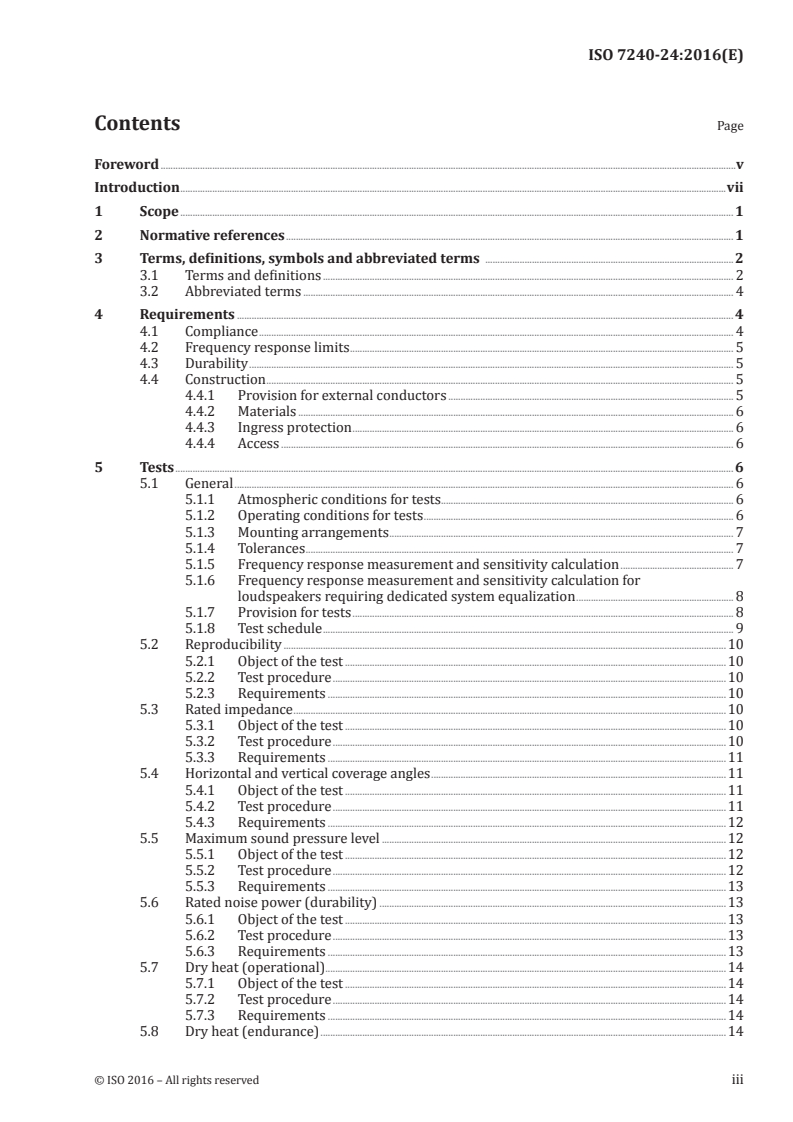
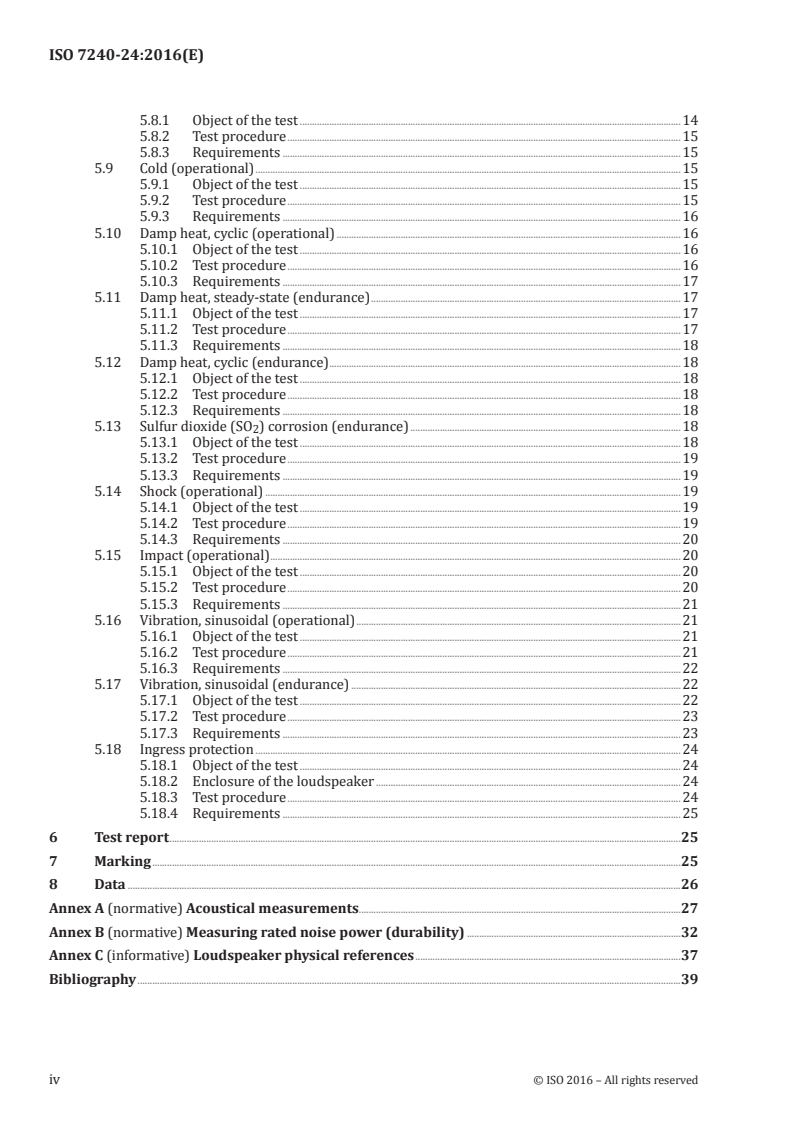
Contents Page
Foreword .v
Introduction .vii
1 Scope . 1
2 Normative references . 1
3 Terms, definitions, symbols and abbreviated terms . 2
3.1 Terms and definitions . 2
3.2 Abbreviated terms . 4
4 Requirements . 4
4.1 Compliance . 4
4.2 Frequency response limits . 5
4.3 Durability . 5
4.4 Construction . 5
4.4.1 Provision for external conductors . 5
4.4.2 Materials . 6
4.4.3 Ingress protection . 6
4.4.4 Access . 6
5 Tests . 6
5.1 General . 6
5.1.1 Atmospheric conditions for tests. 6
5.1.2 Operating conditions for tests . 6
5.1.3 Mounting arrangements . 7
5.1.4 Tolerances . 7
5.1.5 Frequency response measurement and sensitivity calculation . 7
5.1.6 Frequency response measurement and sensitivity calculation for
loudspeakers requiring dedicated system equalization . 8
5.1.7 Provision for tests . 8
5.1.8 Test schedule . 9
5.2 Reproducibility .10
5.2.1 Object of the test .10
5.2.2 Test procedure .10
5.2.3 Requirements .10
5.3 Rated impedance .10
5.3.1 Object of the test .10
5.3.2 Test procedure .10
5.3.3 Requirements .11
5.4 Horizontal and vertical coverage angles .11
5.4.1 Object of the test .11
5.4.2 Test procedure .11
5.4.3 Requirements .12
5.5 Maximum sound pressure level .12
5.5.1 Object of the test .12
5.5.2 Test procedure .12
5.5.3 Requirements .13
5.6 Rated noise power (durability) .13
5.6.1 Object of the test .13
5.6.2 Test procedure .13
5.6.3 Requirements .13
5.7 Dry heat (operational) .14
5.7.1 Object of the test .14
5.7.2 Test procedure .14
5.7.3 Requirements .14
5.8 Dry heat (endurance) .14
5.8.1 Object of the test .14
5.8.2 Test procedure .15
5.8.3 Requirements .15
5.9 Cold (operational) .15
5.9.1 Object of the test .15
5.9.2 Test procedure .15
5.9.3 Requirements .16
5.10 Damp heat, cyclic (operational) .16
5.10.1 Object of the test .16
5.10.2 Test procedure .16
5.10.3 Requirements .17
5.11 Damp heat, steady-state (endurance) .17
5.11.1 Object of the test .17
5.11.2 Test procedure .17
5.11.3 Requirements .18
5.12 Damp heat, cyclic (endurance) .18
5.12.1 Object of the test .18
5.12.2 Test procedure .18
5.12.3 Requirements .18
5.13 Sulfur dioxide (SO ) corrosion (endurance) .18
5.13.1 Object of the test .18
5.13.2 Test procedure .19
5.13.3 Requirements .19
5.14 Shock (operational) .19
5.14.1 Object of the test .19
5.14.2 Test procedure .19
5.14.3 Requirements .20
5.15 Impact (operational) .20
5.15.1 Object of the test .20
5.15.2 Test procedure .20
5.15.3 Requirements .21
5.16 Vibration, sinusoidal (operational) .21
5.16.1 Object of the test .21
5.16.2 Test procedure .21
5.16.3 Requirements .22
5.17 Vibration, sinusoidal (endurance) .22
5.17.1 Object of the test .22
5.17.2 Test procedure .23
5.17.3 Requirements .23
5.18 Ingress protection .24
5.18.1 Object of the test .24
5.18.2 Enclosure of the loudspeaker .24
5.18.3 Test procedure .24
5.18.4 Requirements .25
6 Test report .25
7 Marking .25
8 Data .26
Annex A (normative) Acoustical measurements .27
Annex B (normative) Measuring rated noise power (durability) .32
Annex C (informative) Loudspeaker physical references .37
Bibliography .39
iv © ISO 2016 – All rights reserved
Foreword
ISO (the International Organization for Standardization) is a worldwide federation of national standards
bodies (ISO member bodies). The work of preparing International Standards is normally carried out
through ISO technical committees. Each member body interested in a subject for which a technical
committee has been established has the right to be represented on that committee. International
organizations, governmental and non-governmental, in liaison with ISO, also take part in the work.
ISO collaborates closely with the International Electrotechnical Commission (IEC) on all matters of
electrotechnical standardization.
The procedures used to develop this document and those intended for its further maintenance are
described in the ISO/IEC Directives, Part 1. In particular the different approval criteria needed for the
different types of ISO documents should be noted. This document was drafted in accordance with the
editorial rules of the ISO/IEC Directives, Part 2 (see www.iso.org/directives).
Attention is drawn to the possibility that some of the elements of this document may be the subject of
patent rights. ISO shall not be held responsible for identifying any or all such patent rights. Details of
any patent rights identified during the development of the document will be in the Introduction and/or
on the ISO list of patent declarations received (see www.iso.org/patents).
Any trade name used in this document is information given for the convenience of users and does not
constitute an endorsement.
For an explanation on the meaning of ISO specific terms and expressions related to conformity
assessment, as well as information about ISO’s adherence to the WTO principles in the Technical
Barriers to Trade (TBT) see the following URL: Foreword - Supplementary information
The committee responsible for this document is ISO/TC 21, Equipment for fire protection and fire fighting,
Subcommittee SC 3, Fire detection and alarm systems.
This second edition cancels and replaces the first edition (ISO 7240-24:2010), of which it constitutes a
minor revision.
It also incorporates the Amendment ISO 7240-24:2010/Amd, 1:2013.
ISO 7240 consists of the following parts, under the general title Fire detection and fire alarm systems:
— Part 1: General and definitions
— Part 2: Control and indicating equipment
— Part 3: Audible alarm devices
— Part 4: Power supply equipment
— Part 5: Point-type heat detectors
— Part 6: Carbon monoxide fire detectors using electro-chemical cells
— Part 7: Point-type smoke detectors using scattered light, transmitted light or ionization
— Part 8: Point-type fire detectors using a carbon monoxide sensor in combination with a heat sensor
— Part 9: Test fires for fire detectors [Technical Specification]
— Part 10: Point-type flame detectors
— Part 11: Manual call points
— Part 12: Line type smoke detectors using a transmitted optical beam
— Part 13: Compatibility assessment of system components
— Part 14: Design, installation, commissioning and service of fire detection and fire alarm systems in and
around buildings
— Part 15: Point-type fire detectors using smoke and heat sensors
— Part 16: Sound system control and indicating equipment
— Part 17: Short-circuit isolators
— Part 18: Input/output devices
— Part 19: Design, installation, commissioning and service of sound systems for emergency purposes
— Part 20: Aspirating smoke detectors
— Part 21: Routing equipment
— Part 22: Smoke-detection equipment for ducts
— Part 23: Visual alarm devices
— Part 24: Fire alarm loudspeakers
— Part 25: Components using radio transmission paths
— Part 27: Point-type fire detectors using a scattered-light, transmitted-light or ionization smoke sensor,
an electrochemical-cell carbon-monoxide sensor and a heat sensor
— Part 28: Fire protection control equipment
The following part is under preparation:
— Part 29: Video fire detectors
vi © ISO 2016 – All rights reserved
Introduction
The purpose of a fire alarm loudspeaker as a component of a fire alarm system (see ISO 7240-19) is to
provide intelligible warning to people in or within the vicinity of a building in which a fire emergency
has occurred and to enable such person(s) to take appropriate measures in accordance with a
predetermined evacuation plan.
The primary reason for using a fire alarm system, instead of coded warnings given by aural alarm
indicators (see ISO 7240-3), is to reduce the time taken for those at risk to recognize that an emergency
exists and to give clear instructions about what to do next. This means that fire alarm loudspeakers are
required to achieve a minimum acoustical performance, as well as constructional and environmental
requirements, to be suitable for use in a fire alarm system.
This part of ISO 7240 recognizes that the exact nature of the acoustical requirements for fire alarm
loudspeakers varies according to the nature of the space into which they are installed. It therefore
specifies the minimum requirements that apply to fire alarm loudspeakers and a common method for
testing their operational performance against parameters specified by the manufacturers.
This part of ISO 7240 gives common requirements for the construction and robustness of fire alarm
loudspeakers as well as their performance under climatic and mechanical conditions that are likely
to occur in the service environment. As the types of loudspeaker considered in this part of ISO 7240
are passive electromechanical devices not involving sensitive electronic circuits, electromagnetic
compatibility (EMC) tests have not been included. The loudspeakers have been classified for either an
indoor or an outdoor application environment category.
This part of ISO 7240 requires that manufacturers specify certain characteristics in a consistent manner
so that designers can make objective decisions about which loudspeaker to use in specific applications.
INTERNATIONAL STANDARD ISO 7240-24:2016(E)
Fire detection and fire alarm systems —
Part 24:
Fire alarm loudspeakers
1 Scope
This part of ISO 7240 specifies requirements, test methods and performance criteria for loudspeakers
intended to broadcast a warning of fire between a fire detection and alarm system and the occupants of
a building (see ISO 7240-1:2014, Figure 1, item C).
This part of ISO 7240 specifies loudspeakers for two types of application environment: type A, generally
for indoor use, and type B, generally for outdoor use.
This part of ISO 7240 does not cover loudspeakers for special applications, for example, loudspeakers
for use in hazardous applications, if such applications require additional or other requirements or tests
other than those given in this part of ISO 7240.
This part of ISO 7240 is not intended to cover addressable loudspeakers or loudspeakers with active
components.
Audible alarm indicators are covered in ISO 7240-3.
2 Normative references
The following documents, in whole or in part, are normatively referenced in this document and are
indispensable for its application. For dated references, only the edition cited applies. For undated
references, the latest edition of the referenced document (including any amendments) applies.
ISO 7240-1, Fire detection and alarm systems — Part 1: General and definitions
IEC 60068-1, Environmental testing — Part 1: General and guidance
IEC 60068-2-1, Environmental testing — Part 2-1: Tests — Test A: Cold
IEC 60068-2-2, Environmental testing — Part 2-2: Tests — Test B: Dry heat
IEC 60068-2-6, Environmental testing — Part 2-6: Tests — Test Fc: Vibration (sinusoidal)
IEC 60068-2-27, Environmental testing — Part 2-27: Tests — Test Ea and guidance: Shock
IEC 60068-2-30, Environmental testing — Part 2-30: Tests — Test Db: Damp heat, cyclic (12 h + 12 h cycle)
IEC 60068-2-42, Environmental testing — Part 2-42: Tests — Test Kc: Sulphur dioxide test for contacts and
connections
IEC 60068-2-75, Environmental testing — Part 2-75: Tests — Test Eh: Hammer tests
IEC 60068-2-78, Environmental testing — Part 2-78: Tests — Test Cab: Damp heat, steady state
IEC 60268-1, Sound system equipment — Part 1: General
IEC 60529:1989, Degrees of protection provided by enclosures (IP code)
IEC 60695-11-10, Fire hazard testing — Part 11-10: Test flames — 50 W horizontal and vertical flame
test methods
IEC 60695-11-20, Fire hazard testing — Part 11-20: Test flames — 500 W flame test methods
IEC 61260, Electroacoustics — Octave-band and fractional-octave-band filters
IEC 61672-1, Electroacoustics — Sound level meters — Part 1: Specifications
3 Terms, definitions, symbols and abbreviated terms
For the purposes of this document, the terms, definitions and symbols given in ISO 7240-1 and the
following apply.
3.1 Terms and definitions
3.1.1
1/3 octave
frequency band as defined in IEC 61260
3.1.2
coverage angle
smallest angle between two directions on either side of the reference axis at which the sound pressure
level is 6 dB less than the sound pressure level on the reference axis
Note 1 to entry: This angle is measured in the vertical and horizontal planes.
3.1.3
free-field condition
acoustical environment in which the sound pressure decreases with the distance, r, from a point source
according to a 1/r law, with an accuracy of ±10 %, in the region that is occupied by the sound field
between the loudspeaker system and the microphone during the measurements
EXAMPLE An anechoic room, a quiet outdoor space.
3.1.4
frequency response
sound pressure level at a distance of 4 m from the reference point on the reference axis, produced at
1/3 octave frequency bands, from 100 Hz to 10 kHz (centre frequencies)
Note 1 to entry: This is also referred to as magnitude or amplitude response.
3.1.5
ground plane measurement
measurement under half-space free-field conditions used to simulate a free-field condition in which the
loudspeaker is mounted above an acoustically totally reflective boundary surface and aimed so that its
reference axis points towards a measurement microphone that is placed directly on the boundary surface
Note 1 to entry: In order to achieve measurement results that are comparable with a free-field condition, ground-
plane measurements need to be corrected by −6 dB at all frequencies.
3.1.6
half-space free-field condition
acoustical environment that is confined by a plane of sufficient size and in which the free-field exists
in a hemisphere, so that the sound pressure from a point source mounted in the surface of that plane
decreases in the manner defined in the free-field condition
EXAMPLE A half-space anechoic room.
3.1.7
horizontal plane
virtual plane of the loudspeaker containing the reference axis, as specified by the manufacturer
Note 1 to entry: There may be several horizontal planes corresponding to several reference axes.
2 © ISO 2016 – All rights reserved
EXAMPLE See Annex C.
3.1.8
loudspeaker enclosure
any parts of the outer physical envelope of the loudspeaker that prevents or restricts access of solid
foreign objects to the sound transducer, internal components and cable termination block
3.1.9
maximum sound pressure level
total sound pressure level at 4 m from the reference point on the reference axis of a loudspeaker
supplied with a simulated program signal at the rated noise power
3.1.10
measuring distance
distance between the reference point and the measuring microphone
3.1.11
pink noise
random noise signal with a spectral density that decreases by 3 dB per octave, giving constant energy
per octave
3.1.12
rated impedance
value of pure resistance, stated by the manufacturer, that is substituted for the loudspeaker when
defining the required power of the source
3.1.13
rated noise power
electrical power calculated from the formula UR/, where U is the rated noise voltage and R is the
n
n
rated impedance
Note 1 to entry: For transformer-coupled loudspeakers, the rated noise power is the highest power setting
specified by the manufacturer.
Note 2 to entry: The rated noise power is also called power-handling capacity.
3.1.14
rated noise voltage
RMS voltage, as specified by the manufacturer, of the simulated program signal that the loudspeaker
can sustain without thermal or mechanical damage
Note 1 to entry: See Annex B.
Note 2 to entry: For transformer-coupled loudspeakers, the rated noise voltage typically equals 50 V, 70 V or 100 V.
3.1.15
reference axis
virtual axis of the loudspeaker as specified by the manufacturer
Note 1 to entry: There may be several reference axes.
EXAMPLE See Annex C.
3.1.16
reference plane
virtual plane perpendicular to the reference axis as specified by the manufacturer
EXAMPLE See Annex C.
3.1.17
reference point
point at the intersection of the reference plane and the reference axis
EXAMPLE See Annex C.
3.1.18
sensitivity
sound pressure level, S, of a loudspeaker supplied with a 1 W pink noise signal from 100 Hz to 10 kHz
measured at a distance of 4 m from the reference point on the reference axis
3.1.19
simulated program signal
signal whose mean power spectral density closely resembles the average of the mean power spectral
densities of a wide range of audio signals
EXAMPLE See Annex B.
3.1.20
type A loudspeaker
loudspeaker that is primarily intended for indoor applications
Note 1 to entry: Type A loudspeakers may be suitable for some protected outdoor situations.
3.1.21
type B loudspeaker
loudspeaker that is primarily intended for outdoor applications
Note 1 to entry: Type B loudspeakers may be more suitable than type A for some indoor situations where high
temperature or humidity is present.
3.1.22
vertical plane
virtual plane of the loudspeaker perpendicular to the horizontal plane and containing the reference axis
EXAMPLE See Annex C.
3.2 Abbreviated terms
DC direct current
RMS root mean square
4 Requirements
4.1 Compliance
In order to conform to this part of ISO 7240, loudspeakers shall:
a) meet the requirements of Clause 4, which shall be verified by visual inspection or engineering
assessment;
b) be tested as specified in Clause 5, and shall meet the requirements of the tests;
c) meet the requirements of Clauses 7 and 8, which shall be verified by visual inspection.
4 © ISO 2016 – All rights reserved
4.2 Frequency response limits
The loudspeaker frequency response shall fit within the unshaded area shown in Figure 1.
NOTE If the frequency response shown in Figure 1 can be achieved only by means of a frequency equalizer
that is specified by the manufacturer for normal use [see Clause 8 h)], it is acceptable to insert a dedicated
equalizer in the measurement setup (see 5.1.6).
Key
X 1/3 octave band centre frequency, expressed in hertz
Y relative level, expressed in decibels
Figure 1 — Frequency response limit
4.3 Durability
The loudspeaker shall be rated for at least 100 h operation at the rated noise power specified by the
manufacturer (refer to the test procedure described in 5.6).
4.4 Construction
4.4.1 Provision for external conductors
4.4.1.1 The loudspeaker shall provide space within its enclosure for entry and termination of external
conductors. Entry holes for conductors or cables shall be provided or the location where such holes can
be made shall be indicated by providing a template or some other suitable means.
4.4.1.2 Terminals for connecting external conductors shall be designed so that they are clamped
between metal surfaces without being damaged.
4.4.2 Materials
The loudspeaker shall be constructed of material(s) capable of withstanding the tests specified in
Clause 5. In addition, the material(s) of plastic enclosures shall conform to the following flammability
requirements:
a) IEC 60695-11-10 Class V-2 or HB75 for devices operating from a voltage source less than or equal to
30 V RMS or 42,4 V DC and dissipating less than 15 W;
b) IEC 60695-11-20 Class 5VB for devices operating from a voltage source greater than 30 V RMS or
42,4 V DC and dissipating more than 15 W.
4.4.3 Ingress protection
The degree of protection provided by the enclosure of loudspeakers shall conform to the following
requirements:
— for type A, indoor applications: Code IP21C of IEC 60529;
— for type B, outdoor applications: Code IP33C of IEC 60529.
4.4.4 Access
Means shall be provided to limit access for removal of parts of or the whole device and to make
adjustment to the mode of operation, e.g. special tool, codes, hidden screws, seals.
5 Tests
5.1 General
5.1.1 Atmospheric conditions for tests
5.1.1.1 Unless otherwise stated in a test procedure, carry out the testing after the test specimen has
been allowed to stabilize in the standard atmospheric conditions for testing described in IEC 60068-1 as
follows:
temperature: (15 to 35) °C;
relative humidity: (25 to 75) %;
air pressure: (86 to 106) kPa.
5.1.1.2 The temperature and humidity shall be substantially constant for each environmental test
where the standard atmospheric conditions are applied.
5.1.2 Operating conditions for tests
5.1.2.1 Unless otherwise stated in a test procedure, the test specimen shall be
a) set to its highest power setting,
b) preconditioned in accordance with Annex A, and
c) mounted in the acoustical environment as described in Annex A and as specified by the
manufacturer [see Clause 8 j)].
6 © ISO 2016 – All rights reserved
5.1.2.2 If different settings, except power settings, are available on the loudspeaker, such as tone
control or adjustable parts (excluding external mounting bracket), the manufacturer shall specify the
configuration(s) to be tested.
5.1.2.3 The details of the settings shall be given in the test report (see Clause 6).
5.1.3 Mounting arrangements
5.1.3.1 For environmental conditioning tests, unless otherwise specified, the specimen shall be
mounted by its normal means of attachment in accordance with the manufacturer’s instructions.
If these instructions describe more than one method of mounting, the method considered as the most
unfavourable shall be chosen for each test.
5.1.3.2 For some loudspeakers, due to their size, it might not be practical to conduct all of the
environmental tests.
In such cases, testing may be carried out on a smaller representative specimen, where this is deemed to
produce a valid result for a given test.
5.1.4 Tolerances
5.1.4.1 The tolerances for the environmental test parameters shall be given in the basic reference
standards for the test (e.g. the relevant part of IEC 60068).
5.1.4.2 If a specific tolerance or deviation limit is not specified in a requirement or test procedure, then
a deviation limit of ±5 % shall be applied.
5.1.5 Frequency response measurement and sensitivity calculation
5.1.5.1 Measuring arrangement
Measurements shall be made in accordance with Annex A.
5.1.5.2 Measurements
5.1.5.2.1 Measure the sound pressure level, L , in 1/3 octave bands from 100 Hz to 10 kHz, at the
m,i
measuring distance on the reference axis, when the loudspeaker is supplied with a band-filtered noise
signal of constant voltage.
5.1.5.2.2 Levels, L , shall be the average true RMS values over a period of at least
m,i
— 10 s for 1/3 octave bands from 100 Hz to 400 Hz,
— 3 s for 1/3 octave bands from 500 Hz to 1,6 kHz, and
— 1 s for 1/3 octave bands from 2 kHz to 10 kHz.
5.1.5.2.3 Perform the measurement by supplying the loudspeaker
a) either sequentially with a 1/3 octave band filtered pink noise signal such that the square of the
RMS voltage divided by the rated impedance equals 1 W. In this case, the measured sound pressure
levels in each 1/3 octave band (L ) shall be corrected (L ) as given in Formula (1):
m,i c,i
LL=−10×log ()21 (1)
ci,,mi 10
b) or with a pink noise signal such that the square of the RMS voltage divided by the rated impedance
equals 1 W spread over the full range of frequencies (from 100 Hz to 10 kHz, 1/3 octave bands) and
analysing the microphone output signal by means of 1/3 octave filters as given in Formula (2):
LL= (2)
ci,,mi
NOTE The method described in a) is better suited for loudspeakers with low power drive unit(s), typically
1 W or less. The method described in b) is preferred for loudspeakers with higher power drive unit(s).
5.1.5.2.4 For loudspeakers with a rated noise power of less than 1 W, a pink noise signal of less than
1 W may be used providing L is corrected accordingly.
c,i
5.1.5.2.5 Plot the frequency response with the sound pressure levels, L , as a function of frequency in
c,i
1/3 octave bands. Adjust the 0 dB reference of the tolerance field (see Figure 1) to give the best fit with
the frequency response curve.
5.1.5.3 Sensitivity calculation
The sensitivity, S, expressed in decibels, shall be given by Formula (3):
L
ci,
21
()
S =×10 log 10 (3)
∑
i=1
where L to L are the 1/3 octave sound pressure levels from 100 Hz to 10 kHz from the frequency
c,1 c,21
response curve.
5.1.6 Frequency response measurement and sensitivity calculation for loudspeakers requiring
dedicated system equalization
5.1.6.1 General
This test method shall be used for loudspeakers that have been designed to operate with an associated
active equalization network.
NOTE Testing of active equalizers is not covered by this part of ISO 7240.
5.1.6.2 Measuring arrangement
5.1.6.2.1 Make the measurements in accordance with Annex A.
5.1.6.2.2 An active equalizer inserted between the clipping network and the power amplifier shall be
used in the measurements.
5.1.6.3 Measurements
Perform the measurement described in 5.1.5.2.
5.1.7 Provision for tests
5.1.7.1 The following shall be provided for testing compliance with this part of ISO 7240:
a) seven specimens of type A or nine specimens of type B loudspeaker with any mounting,
accessories, etc.;
b) data required in Clause 8.
8 © ISO 2016 – All rights reserved
5.1.7.2 The specimens submitted shall be representative of the manufacturer’s normal production
with regard to their construction and settings.
5.1.8 Test schedule
5.1.8.1 The specimens shall be tested and inspected in accordance with the schedule given in Table 1.
5.1.8.2 All the specimens shall first be submitted to the reproducibility test described in 5.2.
On completion of the reproducibility test, the specimen with the least sensitivity shall be numbered 1
and the rest arbitrarily numbered from 2 to 7 for type A or 2 to 9 for type B.
5.1.8.3 Unless otherwise specified in the test procedure, the loudspeaker setting(s) selected for
conducting the reproducibility test shall be used for the other tests.
Table 1 — Schedule of tests
abcd
Test Subclause Specimen number
Type A Type B
Rated impedance 5.3 1 1
Horizontal and vertical coverage angles 5.4 1 1
Maximum sound pressure level 5.5 1 1
Rated noise power (durability) 5.6 2 2
Dry heat (operational) 5.7 3 3
Dry heat (endurance) 5.8 — 8
Cold (operational) 5.9 3 3
Damp heat, cyclic (operational) 5.10 3 3
Damp heat, steady-state (endurance) 5.11 3 3
Damp heat, cyclic (endurance) 5.12 — 9
SO corrosion (endurance) 5.13 4 4
Shock (operational) 5.14 5 5
Impact (operational) 5.15 6 6
Vibration, sinusoidal (operational) 5.16 7 7
Vibration, sinusoidal (endurance) 5.17 7 7
Enclosure protection 5.18 1, 2 1, 2
a
Where after one of the tests specified in 5.7 to 5.18, the curve obtained differs from the one measured before the test
by more than ±3 dB and differs with the frequency response performance requirement in 4.2, a new specimen shall
...
INTERNATIONAL ISO
STANDARD 7240-24
Second edition
2016-04-15
Fire detection and fire alarm
systems —
Part 24:
Fire alarm loudspeakers
Systèmes de détection d’incendie et d’alarme —
Partie 24: Haut-parleurs pour systèmes d’alarme vocale
Reference number
©
ISO 2016
© ISO 2016, Published in Switzerland
All rights reserved. Unless otherwise specified, no part of this publication may be reproduced or utilized otherwise in any form
or by any means, electronic or mechanical, including photocopying, or posting on the internet or an intranet, without prior
written permission. Permission can be requested from either ISO at the address below or ISO’s member body in the country of
the requester.
ISO copyright office
Ch. de Blandonnet 8 • CP 401
CH-1214 Vernier, Geneva, Switzerland
Tel. +41 22 749 01 11
Fax +41 22 749 09 47
copyright@iso.org
www.iso.org
ii © ISO 2016 – All rights reserved
Contents Page
Foreword .v
Introduction .vii
1 Scope . 1
2 Normative references . 1
3 Terms, definitions, symbols and abbreviated terms . 2
3.1 Terms and definitions . 2
3.2 Abbreviated terms . 4
4 Requirements . 4
4.1 Compliance . 4
4.2 Frequency response limits . 5
4.3 Durability . 5
4.4 Construction . 5
4.4.1 Provision for external conductors . 5
4.4.2 Materials . 6
4.4.3 Ingress protection . 6
4.4.4 Access . 6
5 Tests . 6
5.1 General . 6
5.1.1 Atmospheric conditions for tests. 6
5.1.2 Operating conditions for tests . 6
5.1.3 Mounting arrangements . 7
5.1.4 Tolerances . 7
5.1.5 Frequency response measurement and sensitivity calculation . 7
5.1.6 Frequency response measurement and sensitivity calculation for
loudspeakers requiring dedicated system equalization . 8
5.1.7 Provision for tests . 8
5.1.8 Test schedule . 9
5.2 Reproducibility .10
5.2.1 Object of the test .10
5.2.2 Test procedure .10
5.2.3 Requirements .10
5.3 Rated impedance .10
5.3.1 Object of the test .10
5.3.2 Test procedure .10
5.3.3 Requirements .11
5.4 Horizontal and vertical coverage angles .11
5.4.1 Object of the test .11
5.4.2 Test procedure .11
5.4.3 Requirements .12
5.5 Maximum sound pressure level .12
5.5.1 Object of the test .12
5.5.2 Test procedure .12
5.5.3 Requirements .13
5.6 Rated noise power (durability) .13
5.6.1 Object of the test .13
5.6.2 Test procedure .13
5.6.3 Requirements .13
5.7 Dry heat (operational) .14
5.7.1 Object of the test .14
5.7.2 Test procedure .14
5.7.3 Requirements .14
5.8 Dry heat (endurance) .14
5.8.1 Object of the test .14
5.8.2 Test procedure .15
5.8.3 Requirements .15
5.9 Cold (operational) .15
5.9.1 Object of the test .15
5.9.2 Test procedure .15
5.9.3 Requirements .16
5.10 Damp heat, cyclic (operational) .16
5.10.1 Object of the test .16
5.10.2 Test procedure .16
5.10.3 Requirements .17
5.11 Damp heat, steady-state (endurance) .17
5.11.1 Object of the test .17
5.11.2 Test procedure .17
5.11.3 Requirements .18
5.12 Damp heat, cyclic (endurance) .18
5.12.1 Object of the test .18
5.12.2 Test procedure .18
5.12.3 Requirements .18
5.13 Sulfur dioxide (SO ) corrosion (endurance) .18
5.13.1 Object of the test .18
5.13.2 Test procedure .19
5.13.3 Requirements .19
5.14 Shock (operational) .19
5.14.1 Object of the test .19
5.14.2 Test procedure .19
5.14.3 Requirements .20
5.15 Impact (operational) .20
5.15.1 Object of the test .20
5.15.2 Test procedure .20
5.15.3 Requirements .21
5.16 Vibration, sinusoidal (operational) .21
5.16.1 Object of the test .21
5.16.2 Test procedure .21
5.16.3 Requirements .22
5.17 Vibration, sinusoidal (endurance) .22
5.17.1 Object of the test .22
5.17.2 Test procedure .23
5.17.3 Requirements .23
5.18 Ingress protection .24
5.18.1 Object of the test .24
5.18.2 Enclosure of the loudspeaker .24
5.18.3 Test procedure .24
5.18.4 Requirements .25
6 Test report .25
7 Marking .25
8 Data .26
Annex A (normative) Acoustical measurements .27
Annex B (normative) Measuring rated noise power (durability) .32
Annex C (informative) Loudspeaker physical references .37
Bibliography .39
iv © ISO 2016 – All rights reserved
Foreword
ISO (the International Organization for Standardization) is a worldwide federation of national standards
bodies (ISO member bodies). The work of preparing International Standards is normally carried out
through ISO technical committees. Each member body interested in a subject for which a technical
committee has been established has the right to be represented on that committee. International
organizations, governmental and non-governmental, in liaison with ISO, also take part in the work.
ISO collaborates closely with the International Electrotechnical Commission (IEC) on all matters of
electrotechnical standardization.
The procedures used to develop this document and those intended for its further maintenance are
described in the ISO/IEC Directives, Part 1. In particular the different approval criteria needed for the
different types of ISO documents should be noted. This document was drafted in accordance with the
editorial rules of the ISO/IEC Directives, Part 2 (see www.iso.org/directives).
Attention is drawn to the possibility that some of the elements of this document may be the subject of
patent rights. ISO shall not be held responsible for identifying any or all such patent rights. Details of
any patent rights identified during the development of the document will be in the Introduction and/or
on the ISO list of patent declarations received (see www.iso.org/patents).
Any trade name used in this document is information given for the convenience of users and does not
constitute an endorsement.
For an explanation on the meaning of ISO specific terms and expressions related to conformity
assessment, as well as information about ISO’s adherence to the WTO principles in the Technical
Barriers to Trade (TBT) see the following URL: Foreword - Supplementary information
The committee responsible for this document is ISO/TC 21, Equipment for fire protection and fire fighting,
Subcommittee SC 3, Fire detection and alarm systems.
This second edition cancels and replaces the first edition (ISO 7240-24:2010), of which it constitutes a
minor revision.
It also incorporates the Amendment ISO 7240-24:2010/Amd, 1:2013.
ISO 7240 consists of the following parts, under the general title Fire detection and fire alarm systems:
— Part 1: General and definitions
— Part 2: Control and indicating equipment
— Part 3: Audible alarm devices
— Part 4: Power supply equipment
— Part 5: Point-type heat detectors
— Part 6: Carbon monoxide fire detectors using electro-chemical cells
— Part 7: Point-type smoke detectors using scattered light, transmitted light or ionization
— Part 8: Point-type fire detectors using a carbon monoxide sensor in combination with a heat sensor
— Part 9: Test fires for fire detectors [Technical Specification]
— Part 10: Point-type flame detectors
— Part 11: Manual call points
— Part 12: Line type smoke detectors using a transmitted optical beam
— Part 13: Compatibility assessment of system components
— Part 14: Design, installation, commissioning and service of fire detection and fire alarm systems in and
around buildings
— Part 15: Point-type fire detectors using smoke and heat sensors
— Part 16: Sound system control and indicating equipment
— Part 17: Short-circuit isolators
— Part 18: Input/output devices
— Part 19: Design, installation, commissioning and service of sound systems for emergency purposes
— Part 20: Aspirating smoke detectors
— Part 21: Routing equipment
— Part 22: Smoke-detection equipment for ducts
— Part 23: Visual alarm devices
— Part 24: Fire alarm loudspeakers
— Part 25: Components using radio transmission paths
— Part 27: Point-type fire detectors using a scattered-light, transmitted-light or ionization smoke sensor,
an electrochemical-cell carbon-monoxide sensor and a heat sensor
— Part 28: Fire protection control equipment
The following part is under preparation:
— Part 29: Video fire detectors
vi © ISO 2016 – All rights reserved
Introduction
The purpose of a fire alarm loudspeaker as a component of a fire alarm system (see ISO 7240-19) is to
provide intelligible warning to people in or within the vicinity of a building in which a fire emergency
has occurred and to enable such person(s) to take appropriate measures in accordance with a
predetermined evacuation plan.
The primary reason for using a fire alarm system, instead of coded warnings given by aural alarm
indicators (see ISO 7240-3), is to reduce the time taken for those at risk to recognize that an emergency
exists and to give clear instructions about what to do next. This means that fire alarm loudspeakers are
required to achieve a minimum acoustical performance, as well as constructional and environmental
requirements, to be suitable for use in a fire alarm system.
This part of ISO 7240 recognizes that the exact nature of the acoustical requirements for fire alarm
loudspeakers varies according to the nature of the space into which they are installed. It therefore
specifies the minimum requirements that apply to fire alarm loudspeakers and a common method for
testing their operational performance against parameters specified by the manufacturers.
This part of ISO 7240 gives common requirements for the construction and robustness of fire alarm
loudspeakers as well as their performance under climatic and mechanical conditions that are likely
to occur in the service environment. As the types of loudspeaker considered in this part of ISO 7240
are passive electromechanical devices not involving sensitive electronic circuits, electromagnetic
compatibility (EMC) tests have not been included. The loudspeakers have been classified for either an
indoor or an outdoor application environment category.
This part of ISO 7240 requires that manufacturers specify certain characteristics in a consistent manner
so that designers can make objective decisions about which loudspeaker to use in specific applications.
INTERNATIONAL STANDARD ISO 7240-24:2016(E)
Fire detection and fire alarm systems —
Part 24:
Fire alarm loudspeakers
1 Scope
This part of ISO 7240 specifies requirements, test methods and performance criteria for loudspeakers
intended to broadcast a warning of fire between a fire detection and alarm system and the occupants of
a building (see ISO 7240-1:2014, Figure 1, item C).
This part of ISO 7240 specifies loudspeakers for two types of application environment: type A, generally
for indoor use, and type B, generally for outdoor use.
This part of ISO 7240 does not cover loudspeakers for special applications, for example, loudspeakers
for use in hazardous applications, if such applications require additional or other requirements or tests
other than those given in this part of ISO 7240.
This part of ISO 7240 is not intended to cover addressable loudspeakers or loudspeakers with active
components.
Audible alarm indicators are covered in ISO 7240-3.
2 Normative references
The following documents, in whole or in part, are normatively referenced in this document and are
indispensable for its application. For dated references, only the edition cited applies. For undated
references, the latest edition of the referenced document (including any amendments) applies.
ISO 7240-1, Fire detection and alarm systems — Part 1: General and definitions
IEC 60068-1, Environmental testing — Part 1: General and guidance
IEC 60068-2-1, Environmental testing — Part 2-1: Tests — Test A: Cold
IEC 60068-2-2, Environmental testing — Part 2-2: Tests — Test B: Dry heat
IEC 60068-2-6, Environmental testing — Part 2-6: Tests — Test Fc: Vibration (sinusoidal)
IEC 60068-2-27, Environmental testing — Part 2-27: Tests — Test Ea and guidance: Shock
IEC 60068-2-30, Environmental testing — Part 2-30: Tests — Test Db: Damp heat, cyclic (12 h + 12 h cycle)
IEC 60068-2-42, Environmental testing — Part 2-42: Tests — Test Kc: Sulphur dioxide test for contacts and
connections
IEC 60068-2-75, Environmental testing — Part 2-75: Tests — Test Eh: Hammer tests
IEC 60068-2-78, Environmental testing — Part 2-78: Tests — Test Cab: Damp heat, steady state
IEC 60268-1, Sound system equipment — Part 1: General
IEC 60529:1989, Degrees of protection provided by enclosures (IP code)
IEC 60695-11-10, Fire hazard testing — Part 11-10: Test flames — 50 W horizontal and vertical flame
test methods
IEC 60695-11-20, Fire hazard testing — Part 11-20: Test flames — 500 W flame test methods
IEC 61260, Electroacoustics — Octave-band and fractional-octave-band filters
IEC 61672-1, Electroacoustics — Sound level meters — Part 1: Specifications
3 Terms, definitions, symbols and abbreviated terms
For the purposes of this document, the terms, definitions and symbols given in ISO 7240-1 and the
following apply.
3.1 Terms and definitions
3.1.1
1/3 octave
frequency band as defined in IEC 61260
3.1.2
coverage angle
smallest angle between two directions on either side of the reference axis at which the sound pressure
level is 6 dB less than the sound pressure level on the reference axis
Note 1 to entry: This angle is measured in the vertical and horizontal planes.
3.1.3
free-field condition
acoustical environment in which the sound pressure decreases with the distance, r, from a point source
according to a 1/r law, with an accuracy of ±10 %, in the region that is occupied by the sound field
between the loudspeaker system and the microphone during the measurements
EXAMPLE An anechoic room, a quiet outdoor space.
3.1.4
frequency response
sound pressure level at a distance of 4 m from the reference point on the reference axis, produced at
1/3 octave frequency bands, from 100 Hz to 10 kHz (centre frequencies)
Note 1 to entry: This is also referred to as magnitude or amplitude response.
3.1.5
ground plane measurement
measurement under half-space free-field conditions used to simulate a free-field condition in which the
loudspeaker is mounted above an acoustically totally reflective boundary surface and aimed so that its
reference axis points towards a measurement microphone that is placed directly on the boundary surface
Note 1 to entry: In order to achieve measurement results that are comparable with a free-field condition, ground-
plane measurements need to be corrected by −6 dB at all frequencies.
3.1.6
half-space free-field condition
acoustical environment that is confined by a plane of sufficient size and in which the free-field exists
in a hemisphere, so that the sound pressure from a point source mounted in the surface of that plane
decreases in the manner defined in the free-field condition
EXAMPLE A half-space anechoic room.
3.1.7
horizontal plane
virtual plane of the loudspeaker containing the reference axis, as specified by the manufacturer
Note 1 to entry: There may be several horizontal planes corresponding to several reference axes.
2 © ISO 2016 – All rights reserved
EXAMPLE See Annex C.
3.1.8
loudspeaker enclosure
any parts of the outer physical envelope of the loudspeaker that prevents or restricts access of solid
foreign objects to the sound transducer, internal components and cable termination block
3.1.9
maximum sound pressure level
total sound pressure level at 4 m from the reference point on the reference axis of a loudspeaker
supplied with a simulated program signal at the rated noise power
3.1.10
measuring distance
distance between the reference point and the measuring microphone
3.1.11
pink noise
random noise signal with a spectral density that decreases by 3 dB per octave, giving constant energy
per octave
3.1.12
rated impedance
value of pure resistance, stated by the manufacturer, that is substituted for the loudspeaker when
defining the required power of the source
3.1.13
rated noise power
electrical power calculated from the formula UR/, where U is the rated noise voltage and R is the
n
n
rated impedance
Note 1 to entry: For transformer-coupled loudspeakers, the rated noise power is the highest power setting
specified by the manufacturer.
Note 2 to entry: The rated noise power is also called power-handling capacity.
3.1.14
rated noise voltage
RMS voltage, as specified by the manufacturer, of the simulated program signal that the loudspeaker
can sustain without thermal or mechanical damage
Note 1 to entry: See Annex B.
Note 2 to entry: For transformer-coupled loudspeakers, the rated noise voltage typically equals 50 V, 70 V or 100 V.
3.1.15
reference axis
virtual axis of the loudspeaker as specified by the manufacturer
Note 1 to entry: There may be several reference axes.
EXAMPLE See Annex C.
3.1.16
reference plane
virtual plane perpendicular to the reference axis as specified by the manufacturer
EXAMPLE See Annex C.
3.1.17
reference point
point at the intersection of the reference plane and the reference axis
EXAMPLE See Annex C.
3.1.18
sensitivity
sound pressure level, S, of a loudspeaker supplied with a 1 W pink noise signal from 100 Hz to 10 kHz
measured at a distance of 4 m from the reference point on the reference axis
3.1.19
simulated program signal
signal whose mean power spectral density closely resembles the average of the mean power spectral
densities of a wide range of audio signals
EXAMPLE See Annex B.
3.1.20
type A loudspeaker
loudspeaker that is primarily intended for indoor applications
Note 1 to entry: Type A loudspeakers may be suitable for some protected outdoor situations.
3.1.21
type B loudspeaker
loudspeaker that is primarily intended for outdoor applications
Note 1 to entry: Type B loudspeakers may be more suitable than type A for some indoor situations where high
temperature or humidity is present.
3.1.22
vertical plane
virtual plane of the loudspeaker perpendicular to the horizontal plane and containing the reference axis
EXAMPLE See Annex C.
3.2 Abbreviated terms
DC direct current
RMS root mean square
4 Requirements
4.1 Compliance
In order to conform to this part of ISO 7240, loudspeakers shall:
a) meet the requirements of Clause 4, which shall be verified by visual inspection or engineering
assessment;
b) be tested as specified in Clause 5, and shall meet the requirements of the tests;
c) meet the requirements of Clauses 7 and 8, which shall be verified by visual inspection.
4 © ISO 2016 – All rights reserved
4.2 Frequency response limits
The loudspeaker frequency response shall fit within the unshaded area shown in Figure 1.
NOTE If the frequency response shown in Figure 1 can be achieved only by means of a frequency equalizer
that is specified by the manufacturer for normal use [see Clause 8 h)], it is acceptable to insert a dedicated
equalizer in the measurement setup (see 5.1.6).
Key
X 1/3 octave band centre frequency, expressed in hertz
Y relative level, expressed in decibels
Figure 1 — Frequency response limit
4.3 Durability
The loudspeaker shall be rated for at least 100 h operation at the rated noise power specified by the
manufacturer (refer to the test procedure described in 5.6).
4.4 Construction
4.4.1 Provision for external conductors
4.4.1.1 The loudspeaker shall provide space within its enclosure for entry and termination of external
conductors. Entry holes for conductors or cables shall be provided or the location where such holes can
be made shall be indicated by providing a template or some other suitable means.
4.4.1.2 Terminals for connecting external conductors shall be designed so that they are clamped
between metal surfaces without being damaged.
4.4.2 Materials
The loudspeaker shall be constructed of material(s) capable of withstanding the tests specified in
Clause 5. In addition, the material(s) of plastic enclosures shall conform to the following flammability
requirements:
a) IEC 60695-11-10 Class V-2 or HB75 for devices operating from a voltage source less than or equal to
30 V RMS or 42,4 V DC and dissipating less than 15 W;
b) IEC 60695-11-20 Class 5VB for devices operating from a voltage source greater than 30 V RMS or
42,4 V DC and dissipating more than 15 W.
4.4.3 Ingress protection
The degree of protection provided by the enclosure of loudspeakers shall conform to the following
requirements:
— for type A, indoor applications: Code IP21C of IEC 60529;
— for type B, outdoor applications: Code IP33C of IEC 60529.
4.4.4 Access
Means shall be provided to limit access for removal of parts of or the whole device and to make
adjustment to the mode of operation, e.g. special tool, codes, hidden screws, seals.
5 Tests
5.1 General
5.1.1 Atmospheric conditions for tests
5.1.1.1 Unless otherwise stated in a test procedure, carry out the testing after the test specimen has
been allowed to stabilize in the standard atmospheric conditions for testing described in IEC 60068-1 as
follows:
temperature: (15 to 35) °C;
relative humidity: (25 to 75) %;
air pressure: (86 to 106) kPa.
5.1.1.2 The temperature and humidity shall be substantially constant for each environmental test
where the standard atmospheric conditions are applied.
5.1.2 Operating conditions for tests
5.1.2.1 Unless otherwise stated in a test procedure, the test specimen shall be
a) set to its highest power setting,
b) preconditioned in accordance with Annex A, and
c) mounted in the acoustical environment as described in Annex A and as specified by the
manufacturer [see Clause 8 j)].
6 © ISO 2016 – All rights reserved
5.1.2.2 If different settings, except power settings, are available on the loudspeaker, such as tone
control or adjustable parts (excluding external mounting bracket), the manufacturer shall specify the
configuration(s) to be tested.
5.1.2.3 The details of the settings shall be given in the test report (see Clause 6).
5.1.3 Mounting arrangements
5.1.3.1 For environmental conditioning tests, unless otherwise specified, the specimen shall be
mounted by its normal means of attachment in accordance with the manufacturer’s instructions.
If these instructions describe more than one method of mounting, the method considered as the most
unfavourable shall be chosen for each test.
5.1.3.2 For some loudspeakers, due to their size, it might not be practical to conduct all of the
environmental tests.
In such cases, testing may be carried out on a smaller representative specimen, where this is deemed to
produce a valid result for a given test.
5.1.4 Tolerances
5.1.4.1 The tolerances for the environmental test parameters shall be given in the basic reference
standards for the test (e.g. the relevant part of IEC 60068).
5.1.4.2 If a specific tolerance or deviation limit is not specified in a requirement or test procedure, then
a deviation limit of ±5 % shall be applied.
5.1.5 Frequency response measurement and sensitivity calculation
5.1.5.1 Measuring arrangement
Measurements shall be made in accordance with Annex A.
5.1.5.2 Measurements
5.1.5.2.1 Measure the sound pressure level, L , in 1/3 octave bands from 100 Hz to 10 kHz, at the
m,i
measuring distance on the reference axis, when the loudspeaker is supplied with a band-filtered noise
signal of constant voltage.
5.1.5.2.2 Levels, L , shall be the average true RMS values over a period of at least
m,i
— 10 s for 1/3 octave bands from 100 Hz to 400 Hz,
— 3 s for 1/3 octave bands from 500 Hz to 1,6 kHz, and
— 1 s for 1/3 octave bands from 2 kHz to 10 kHz.
5.1.5.2.3 Perform the measurement by supplying the loudspeaker
a) either sequentially with a 1/3 octave band filtered pink noise signal such that the square of the
RMS voltage divided by the rated impedance equals 1 W. In this case, the measured sound pressure
levels in each 1/3 octave band (L ) shall be corrected (L ) as given in Formula (1):
m,i c,i
LL=−10×log ()21 (1)
ci,,mi 10
b) or with a pink noise signal such that the square of the RMS voltage divided by the rated impedance
equals 1 W spread over the full range of frequencies (from 100 Hz to 10 kHz, 1/3 octave bands) and
analysing the microphone output signal by means of 1/3 octave filters as given in Formula (2):
LL= (2)
ci,,mi
NOTE The method described in a) is better suited for loudspeakers with low power drive unit(s), typically
1 W or less. The method described in b) is preferred for loudspeakers with higher power drive unit(s).
5.1.5.2.4 For loudspeakers with a rated noise power of less than 1 W, a pink noise signal of less than
1 W may be used providing L is corrected accordingly.
c,i
5.1.5.2.5 Plot the frequency response with the sound pressure levels, L , as a function of frequency in
c,i
1/3 octave bands. Adjust the 0 dB reference of the tolerance field (see Figure 1) to give the best fit with
the frequency response curve.
5.1.5.3 Sensitivity calculation
The sensitivity, S, expressed in decibels, shall be given by Formula (3):
L
ci,
21
()
S =×10 log 10 (3)
∑
i=1
where L to L are the 1/3 octave sound pressure levels from 100 Hz to 10 kHz from the frequency
c,1 c,21
response curve.
5.1.6 Frequency response measurement and sensitivity calculation for loudspeakers requiring
dedicated system equalization
5.1.6.1 General
This test method shall be used for loudspeakers that have been designed to operate with an associated
active equalization network.
NOTE Testing of active equalizers is not covered by this part of ISO 7240.
5.1.6.2 Measuring arrangement
5.1.6.2.1 Make the measurements in accordance with Annex A.
5.1.6.2.2 An active equalizer inserted between the clipping network and the power amplifier shall be
used in the measurements.
5.1.6.3 Measurements
Perform the measurement described in 5.1.5.2.
5.1.7 Provision for tests
5.1.7.1 The following shall be provided for testing compliance with this part of ISO 7240:
a) seven specimens of type A or nine specimens of type B loudspeaker with any mounting,
accessories, etc.;
b) data required in Clause 8.
8 © ISO 2016 – All rights reserved
5.1.7.2 The specimens submitted shall be representative of the manufacturer’s normal production
with regard to their construction and settings.
5.1.8 Test schedule
5.1.8.1 The specimens shall be tested and inspected in accordance with the schedule given in Table 1.
5.1.8.2 All the specimens shall first be submitted to the reproducibility test described in 5.2.
On completion of the reproducibility test, the specimen with the least sensitivity shall be numbered 1
and the rest arbitrarily numbered from 2 to 7 for type A or 2 to 9 for type B.
5.1.8.3 Unless otherwise specified in the test procedure, the loudspeaker setting(s) selected for
conducting the reproducibility test shall be used for the other tests.
Table 1 — Schedule of tests
abcd
Test Subclause Specimen number
Type A Type B
Rated impedance 5.3 1 1
Horizontal and vertical coverage angles 5.4 1 1
Maximum sound pressure level 5.5 1 1
Rated noise power (durability) 5.6 2 2
Dry heat (operational) 5.7 3 3
Dry heat (endurance) 5.8 — 8
Cold (operational) 5.9 3 3
Damp heat, cyclic (operational) 5.10 3 3
Damp heat, steady-state (endurance) 5.11 3 3
Damp heat, cyclic (endurance) 5.12 — 9
SO corrosion (endurance) 5.13 4 4
Shock (operational) 5.14 5 5
Impact (operational) 5.15 6 6
Vibration, sinusoidal (operational) 5.16 7 7
Vibration, sinusoidal (endurance) 5.17 7 7
Enclosure protection 5.18 1, 2 1, 2
a
Where after one of the tests specified in 5.7 to 5.18, the curve obtained differs from the one measured before the test
by more than ±3 dB and differs with the frequency response performance requirement in 4.2, a new specimen shall
...