

ISO/IEC 20006-1:2014
(Main)Information technology for learning, education and training — Information model for competency — Part 1: Competency general framework and information model
General Information
- Abstract
ISO/IEC 20006-1:2014 provides: a general framework for dealing with competency information in information technology for learning, education, and training (ITLET) contexts; a system architecture for managing and exchanging competency information and its related objects; an information model for expressing competency and its related objects that includes an introduction to the composition of competency; use cases used to support the development of the general framework and competency information model. ISO/IEC 20006-1:2014 is for those who design and use learning systems and human resources systems to support management and exchange of competency information using ITLET systems. ISO/IEC 20006-1:2014 is related to the Conceptual Reference Model developed in ISO/IEC TR 24763. Information regarding the relationships between the ISO/IEC 20006 and ISO/IEC TR 24763 is provided.
- Status
- Published
- Publication Date
- 02-Jul-2014
- Technical Committee
- ISO/IEC JTC 1/SC 36 - Information technology for learning, education and training
- Drafting Committee
- ISO/IEC JTC 1/SC 36/WG 3 - Learner information
- Current Stage
- 9093 - International Standard confirmed
- Start Date
- 02-Oct-2025
- Completion Date
- 29-Aug-2026
Overview
ISO/IEC 20006-1:2014 - "Information technology for learning, education and training - Information model for competency - Part 1: Competency general framework and information model" defines a general framework, system architecture and information model for representing, managing and exchanging competency information in IT for learning, education and training (ITLET) contexts. The standard provides conceptual building blocks, use cases and semantic approaches to express competencies (knowledge, skills, ability, attitudes and educational objectives) so different learning management, HR and related systems can interoperate.
Key topics and technical requirements
- General framework and system architecture for managing and exchanging competency information across ITLET systems.
- Information model for expressing competency and related objects, including an introduction to the composition of competency (see sections on elements and semantic elements).
- Competency semantic information model and architecture (sections cover types such as competency meaning information and competency situation information).
- Competency organization and elements: guidance on structuring competency sets, semantic expressions and relationship patterns.
- Use cases and applicability: practical scenarios used to develop and validate the model (annexes include example mappings and implementations).
- Conformance guidance to promote interoperability and consistent structuring of competency data.
Exclusions and non-addressed areas (explicit): adaptability to culture/language, security, authentication, privacy, accessibility, e‑profiles, evidence information, and assessment methods/metrics.
Practical applications and target users
Who uses ISO/IEC 20006-1:
- Software developers and system architects building LMS, HRIS, competency registries or skills exchange services.
- Instructional designers and assessment/test designers mapping learning outcomes to competencies.
- HR professionals and workforce planners aligning job profiles with learning pathways and national occupational classifications.
- Standards bodies and integrators working on competency interoperability and analytics.
Practical uses:
- Enable interoperability of competency data between learning systems and HR platforms.
- Support competency mapping and aggregation for career pathways, skills gap analysis and workforce planning.
- Provide a common semantic model to improve portability of learning records, credentialing and competency-based reporting.
- Facilitate data-driven analytics across disparate ITLET systems.
Related standards
- ISO/IEC TR 24763 - Conceptual Reference Model for Competency Information and Related Objects (CRM) - foundational relationship.
- ISO/IEC 20006-2 - Proficiency level information model (companion part).
- ISO/IEC 20006-3 (TS) - Guidelines for aggregation of competency information and data.
Keywords: ISO/IEC 20006-1:2014, competency information, information model for competency, ITLET, interoperability, learning management, HR systems, competency framework, proficiency levels, competency aggregation.
Get Certified
Connect with accredited certification bodies for this standard

BSI Group
BSI (British Standards Institution) is the business standards company that helps organizations make excellence a habit.

Bureau Veritas
Bureau Veritas is a world leader in laboratory testing, inspection and certification services.

DNV
DNV is an independent assurance and risk management provider.
Sponsored listings
Frequently Asked Questions
ISO/IEC 20006-1:2014 is a standard published by the International Organization for Standardization (ISO). Its full title is "Information technology for learning, education and training — Information model for competency — Part 1: Competency general framework and information model". This standard covers: ISO/IEC 20006-1:2014 provides: a general framework for dealing with competency information in information technology for learning, education, and training (ITLET) contexts; a system architecture for managing and exchanging competency information and its related objects; an information model for expressing competency and its related objects that includes an introduction to the composition of competency; use cases used to support the development of the general framework and competency information model. ISO/IEC 20006-1:2014 is for those who design and use learning systems and human resources systems to support management and exchange of competency information using ITLET systems. ISO/IEC 20006-1:2014 is related to the Conceptual Reference Model developed in ISO/IEC TR 24763. Information regarding the relationships between the ISO/IEC 20006 and ISO/IEC TR 24763 is provided.
ISO/IEC 20006-1:2014 provides: a general framework for dealing with competency information in information technology for learning, education, and training (ITLET) contexts; a system architecture for managing and exchanging competency information and its related objects; an information model for expressing competency and its related objects that includes an introduction to the composition of competency; use cases used to support the development of the general framework and competency information model. ISO/IEC 20006-1:2014 is for those who design and use learning systems and human resources systems to support management and exchange of competency information using ITLET systems. ISO/IEC 20006-1:2014 is related to the Conceptual Reference Model developed in ISO/IEC TR 24763. Information regarding the relationships between the ISO/IEC 20006 and ISO/IEC TR 24763 is provided.
ISO/IEC 20006-1:2014 is classified under the following ICS (International Classification for Standards) categories: 03.100.30 - Management of human resources; 35.240.90 - IT applications in education; 35.240.99 - IT applications in other fields. The ICS classification helps identify the subject area and facilitates finding related standards.
ISO/IEC 20006-1:2014 is available in PDF format for immediate download after purchase. The document can be added to your cart and obtained through the secure checkout process. Digital delivery ensures instant access to the complete standard document.
Standards Content (Sample)
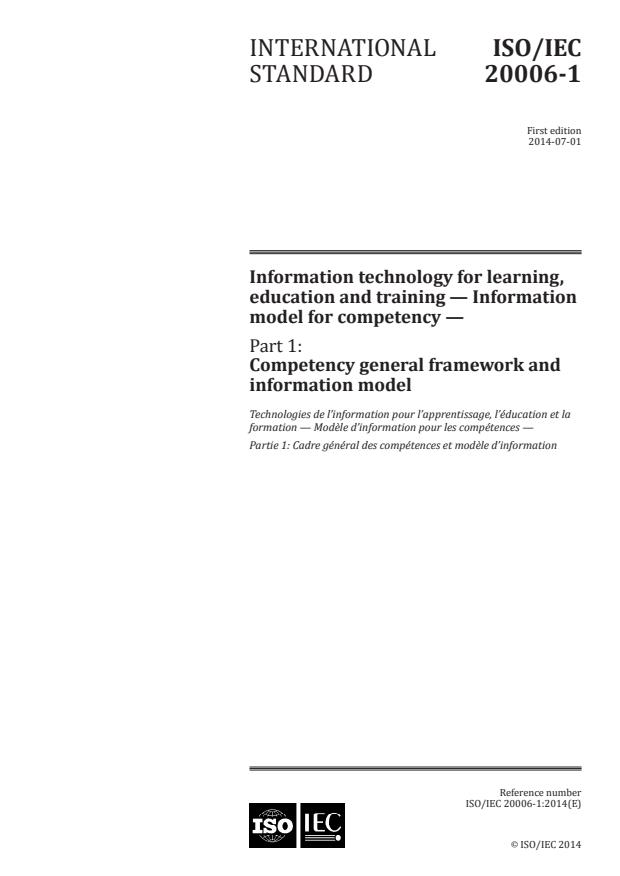
INTERNATIONAL ISO/IEC
STANDARD 20006-1
First edition
2014-07-01
Information technology for learning,
education and training — Information
model for competency —
Part 1:
Competency general framework and
information model
Technologies de l’information pour l’apprentissage, l’éducation et la
formation — Modèle d’information pour les compétences —
Partie 1: Cadre général des compétences et modèle d’information
Reference number
©
ISO/IEC 2014
© ISO/IEC 2014
All rights reserved. Unless otherwise specified, no part of this publication may be reproduced or utilized otherwise in any form
or by any means, electronic or mechanical, including photocopying, or posting on the internet or an intranet, without prior
written permission. Permission can be requested from either ISO at the address below or ISO’s member body in the country of
the requester.
ISO copyright office
Case postale 56 • CH-1211 Geneva 20
Tel. + 41 22 749 01 11
Fax + 41 22 749 09 47
E-mail copyright@iso.org
Web www.iso.org
Published in Switzerland
ii © ISO/IEC 2014 – All rights reserved
Contents Page
Foreword .iv
Introduction .v
1 Scope . 1
1.1 General . 1
1.2 Exclusions . 2
1.3 Areas not addressed . 2
2 Conformance . 2
3 Normative references . 3
4 Terms and definitions . 3
5 Symbols and abbreviated terms . 5
6 Competency general framework . 6
6.1 Introduction . 6
6.2 Information architecture view to support the management and exchange of
competency information . 7
6.3 Competency organization . 9
6.4 Elements of competency . 9
6.5 Semantic elements in competency expressions .10
7 Competency Semantic Information .11
7.1 Architecture of competency information .11
7.2 Competency semantic information model .12
7.3 Types of Competency Semantic information - Competency Meaning Information .15
7.4 Types of Competency Semantic Information - Competency Situation Information .20
Annex A (informative) Cases and relationships between ISO/IEC 20006 and ISO/IEC TR 24763 .23
Annex B (informative) Examples for competency information architectures .26
Annex C (informative) Patterns of competency organization by HRMLs .29
Annex D (informative) Previous use case on Japanese National Skills Standard (ETSS) .31
Annex E (informative) Application to Japanese National Skills Standard (ITSS)
................................................32
Annex F (informative) Application to Canadian Learning Management System Desire2Learn .34
Annex G (informative) Application to Canadian National Occupational Classification
(NOC) and Canadian Nurses Association Canadian Nurse Practitioner Core
Competency Framework.40
Bibliography .43
© ISO/IEC 2014 – All rights reserved iii
Foreword
ISO (the International Organization for Standardization) and IEC (the International Electrotechnical
Commission) form the specialized system for worldwide standardization. National bodies that are
members of ISO or IEC participate in the development of International Standards through technical
committees established by the respective organization to deal with particular fields of technical
activity. ISO and IEC technical committees collaborate in fields of mutual interest. Other international
organizations, governmental and non-governmental, in liaison with ISO and IEC, also take part in the
work. In the field of information technology, ISO and IEC have established a joint technical committee,
ISO/IEC JTC 1.
The procedures used to develop this document and those intended for its further maintenance are
described in the ISO/IEC Directives, Part 1. In particular the different approval criteria needed for
the different types of document should be noted. This document was drafted in accordance with the
editorial rules of the ISO/IEC Directives, Part 2 (see www.iso.org/directives).
Attention is drawn to the possibility that some of the elements of this document may be the subject
of patent rights. ISO and IEC shall not be held responsible for identifying any or all such patent rights.
Details of any patent rights identified during the development of the document will be in the Introduction
and/or on the ISO list of patent declarations received (see www.iso.org/patents).
Any trade name used in this document is information given for the convenience of users and does not
constitute an endorsement.
For an explanation on the meaning of ISO specific terms and expressions related to conformity
assessment, as well as information about ISO’s adherence to the WTO principles in the Technical Barriers
to Trade (TBT) see the following URL: Foreword - Supplementary information
The committee responsible for this document is ISO/IEC JTC 1, Information technology, Subcommittee
SC 36, Information technology for learning, education and training.
ISO/IEC 20006 consists of the following parts, under the general title Information technology for learning,
education and training — Information model for competency:
— Part 1: Competency general framework and information model
— Part 2: Proficiency level information model
— Part 3: Guidelines for aggregation of competency information and data
iv © ISO/IEC 2014 – All rights reserved
Introduction
From the late 1990s, some industrial and academic organizations have developed information technology
standards in the skills and competency domain, such as human resources, on a global level to address
the interoperability requirements and environmental complexities of management and sharing of
competency information amongst different organizations. Some examples include work spearheaded by
the following organizations: the IMS Global Learning Consortium Inc., HR-XML Consortium, IEEE-LTSC,
OMG, CEN TC353 and also ISO/IEC JTC 1/SC 36 itself. Some typical problems encountered by stakeholders
as well as ITLET systems dedicated to the management and exchange of competency information and
[2]
where these issues may be encountered are provided in examples below:
Example 1: Technical - Competency and associated information cannot always be selected and shared
between different ITLET systems (e.g. learning management, HR, and other related platforms);
Example 2: Organizational - Competency and associated information is not easily used in human
development activities, because skills and competency information may be detailed or expressed
differently in various ITLET systems (e.g. learning management, HR, national occupational classification,
and other related systems);
Example 3: Information exchange - Skills and competency proficiency information, such as individual
status or degrees acquired, cannot be shared easily amongst different ITLET systems (e.g. HR, learning
management, national occupational classification, and other related systems);
Example 4: Individual learner - Individual developmental learning, education, and training paths
cannot easily migrate or be exchanged amongst ITLET systems;
Example 5: Systems perspective (where systems include individuals, organizations, and the
technologies that support them) - Individuals and organizations cannot easily design and integrate
informal and formal learning, education, and training opportunities to support life goals, career
strategies, and career paths using existing common dimensions within ITLET systems;
Example 6: Practical analytics - The ability to access, extract, and analyse competency and associated
information can provide evidence as to whether learning, education and training information needs
are being met in order to analyse lifelong learning, thus where competency information must be drawn
from different systems and where non-interoperable format and definitions are used;
Example 7: Assessment and evaluation - ITLET systems (e.g. acknowledgement and consideration
are needed regarding evaluation biases in human assessment, the use of varying methods and metrics
to evaluate human performance, and the need to conduct accurate skill gap analysis), where ITLET
systems that use different competency digital schema are involved; and,
Example 8: Overarching goals and outcomes - Human assessment and support for the development of
human potential requires ITLET systems that provide a more flexible, holistic integration and exchange of
competency and associated information beyond individual learning opportunities, everyday operation,
and work performance. Competency data must be generated.
Some of these identified problems have been addressed on a limited basis by the standards and
specifications produced by the organizations mentioned above. Not only is it difficult to use these
standards and specifications, however, but also the unsolved problems are still critical. It is still confusing
for stakeholders to implement and use these standards and specifications. Also, various problems
associated with ITLET related systems, which should be solved by or supported with information
technology, still remain.
Currently, organizations, such as schools, universities, institutes, and companies, use different ITLET
systems to support the use of learning content, to enable and enhance various learning activities, and
to provide other services. To meet their mission and goals, such organizations may rely on in-house
developers, others such as ITLET vendors or suppliers, or a combination of both to provide and operate
IT systems to support LET. This means ITLET operations and other organizational systems that deal
with skills and competency information, such as interrelated human resources (HR) information
© ISO/IEC 2014 – All rights reserved v
systems, need to be interoperable to allow for communication between organizations, their employees,
and outsourcing ITLET providers or suppliers.
The purpose of this multi-part International Standard is to provide a framework, models, system
architecture used for competency and proficiency information, and a way to aggregate competency
information. This standard will provide a general framework and information model to manage and
exchange information about knowledge, skills, ability, attitude, and educational objectives. Especially
this International Standard will focus on extending the concepts contained within ISO/IEC TR 24763 by
providing more detailed information regarding competency information and its information aggregation.
This multi-part standard may be used by software developers and implementers, instructional designers
and test designers, and others to ensure that learning, education and training environments satisfy
learners’ and organizations’ competency needs. In addition, this International Standard will provide
definitions of several types of competency information aggregation, which will provide guidance for
all stakeholders to better understand and support the development of interoperable systems that will
enable competency information exchange.
vi © ISO/IEC 2014 – All rights reserved
INTERNATIONAL STANDARD ISO/IEC 20006-1:2014(E)
Information technology for learning, education and
training — Information model for competency —
Part 1:
Competency general framework and information model
1 Scope
1.1 General
This part of ISO/IEC 20006 provides:
— a general framework for dealing with competency information in information technology for
learning, education, and training (ITLET) contexts;
— a system architecture for managing and exchanging competency information and its related objects;
— an information model for expressing competency and its related objects that includes an introduction
to the composition of competency;
— use cases used to support the development of the general framework and competency information
model.
This standard is for those who design and use learning systems and human resources systems to support
management and exchange of competency information using ITLET systems.
NOTE This International Standard is related to the Conceptual Reference Model developed in ISO/IEC TR 24763.
Information regarding the relationships between the ISO/IEC 20006 and ISO/IEC TR 24763 is provided in this
standard.
This multi-part International Standard also includes the following parts:
ISO/IEC 20006-2:—, Information technology for learning, education and training – Information model for
competency – Part 2: Proficiency level information model, which provides
— information model for expressing semantics of competency proficiency and its levels, and
— use cases used to support the development of the competency proficiency level information model;
ISO/IEC TS 20006-3:—, Information technology for learning, education and training – Information model
for competency – Part 3: Guidelines for aggregation of competency information and data, which provides
— guidelines and a data driven architecture for the development of specific data models managing
aggregation of competency information and related objects,
— ways to aggregate competency information and its related object data, and
— use cases used to support the development of the guidelines for aggregation of competency
1)
information and competency data.
1) The terms competency information and competency data will be defined in ISO/IEC TS 20006-3.
© ISO/IEC 2014 – All rights reserved 1
1.2 Exclusions
The scope of this International Standard does not include an in-depth technical review of issues related
to:
— adaptability to culture, language, and human functions;
— security;
— authentication;
— privacy;
— accessibility.
1.3 Areas not addressed
This International Standard currently does not address the following items:
— e-Profiles, which are a set of records that pertain to an individual (e.g. personnel records, student
information system records);
— evidence information;
— assessment methods and metrics information
— ISO/IEC 20006 has been developed to support competency information and data management and
exchange based on IT systems that are currently in use in Asia, Europe and North America. It is
based on standardization that has occurred at transnational, national and regional levels in IT
systems that are used to support human development including but not limited to:
— university, college, secondary school curricula development;
— learning activities supported by IT systems such as LMSs;
— IT systems that support LET and Human Resources that are based on a National Occupational
Classification system (e.g. learning activity development, job banks, etc.);
— sector specific standardization in the area of IT and embedded skills;
— IT systems that support LET and human resource quality management and development
activities.
Further work may be needed to ensure that these standards support deeper IT integrations across
various sectors and in other regions of the world.
It is anticipated that some or all of these requirements will be addressed in future editions of
ISO/IEC 20006, or in companion International Standards, Technical Specifications and Technical Reports.
2 Conformance
The objective of this part of ISO/IEC 20006 is to support the management and exchange of competency
information in a way that will promote interoperability and integration. To support competency
management and development, competency information needs to be structured and described
consistently to promote understanding, mutual communication and agreement.
The general framework and information model are based on the Conceptual Reference Model for
Competency Information and Related Objects (CRM) (defined by ISO/IEC TR 24763). The CRM provides
a toolkit that can be used to abstract and identify concepts used within IT systems to support the
management and exchange of competency information across different HR, learning and training
contexts. ISO/IEC 20006 builds upon the conceptual and abstract focus of ISO/IEC TR 24763 to
2 © ISO/IEC 2014 – All rights reserved
provide a general framework, information architecture, competency information model and additional
components.
Competency information should be detailed in a way that is semantically robust and extensible. For the
purposes of this standard, competency information is conformant with this International Standard if it
adopts the information model and the element notations specified in this International Standard. (The
element notations are defined in Clauses 6.4 – 6.5 and Clause 7).
A conforming notation may contain descriptions of meaning and context of competency information.
In other words, it is intended to be extensible and may contain additional information elements of
ISO/IEC TR 24763. For conformance to ISO/IEC TR 24763, classes for defining a competency in CRM
competency are indicated with the following notation [En] where n is a number that refers to a class
defined in ISO/IEC TR 24763 to assist with understanding the linkages and relationships between
the CRM and this standard. For example, as noted in ISO/IEC TR 24763, E1 = Action, E2 = Actor,
E3 = Competency, and so on).
3 Normative references
The following documents, in whole or in part, are normatively referenced in this document and are
indispensable for its application. For dated references, only the edition cited applies. For undated
references, the latest edition of the referenced document (including any amendments) applies.
ISO/IEC 2382-36 (E/F), Information technology — Vocabulary — Part 36: Learning, education and training
4 Terms and definitions
For the purposes of this document, the terms and definitions given in ISO/IEC 2382-36 and the following
apply.
4.1
competency
ability of an actor to perform (a) necessary action(s) in (a) given context(s) to achieve (a) specific
outcome(s)
[SOURCE: ISO/IEC TR 24763:2011, 2.2, modified — the words “observable or measurable” were deleted
to allow for more general usage and application.]
4.2
competency aggregation
collection of competency expressions (4.4) that is in any structure
4.3
competency composition
unit and one of aggregation type that consists of definition and/or structured relationships of elements
and attributes used to define contents of competency (4.1) as competency expression (4.4)
Note 1 to entry: For example, this may include information related to competency such as identification, semantics,
context, and supplemental.
4.4
competency expression
any form of digitalized information regarding competency representation (4.7)
© ISO/IEC 2014 – All rights reserved 3
4.5
competency organization
digitized expression or map of aggregation type(s), that defines a designated unit as a set of competencies
(4.1)
Note 1 to entry: This may include structured sub-competencies (e.g. competency information expressed as
parent-child relationships). The form of competency organization structure is formulated as a tree structure or
network structure with competencies.
Note 2 to entry: Competencies may be organized as competency definitions, competency frameworks, maps of
aggregation type(s), and other forms of digitalized competency expressions.
4.6
competency package
standardized way to identify and exchange a set of data regarding competency (4.1) among different
systems or application tools
Note 1 to entry: This standardized way may involve one of many aggregation types such as information regarding
job, task, role and so on, in order to implement into LMS, HRIS, e-Profile, SIS and so on - because a competency may
not only be expressed by competency content in practice, it also may be used with or by other information such
as job, task, or role.
4.7
competency representation
image and idea of competency (4.1) that occurs in a human mind
Note 1 to entry: This is the real-world or portrayal or image or idea of competency as it is perceived by the human
mind; whereas, the competency expression is the actual digital manifestation, notation, statement of competency.
Representations include many different expressions.
4.8
conceptual reference model
common structure and definitions for describing the concepts and relationships within a system
[SOURCE: ISO/IEC TR 24763:2011, 2.8, modified.]
4.9
data model
graphical or lexical representation of data, specifying their properties, structure and inter-relationships
[SOURCE: ISO/IEC 11179-3:2003, 3.2.11, modified.]
4.10
framework
structure composed of related parts that are designed to support something
4.11
information model
expression of concepts, relationships, constraints, rules, and operations to specify data semantics (4.16)
for a chosen domain of discourse
Note 1 to entry: An information model can provide sharable, stable, and organized structure of information
requirements for the domain context.
4.12
information technology for learning, education and training system
ITLET system
set of one or more computers, devices, associated software, peripherals, terminals, human operations,
physical processes, personal needs and preferences profiles, information transfer means, that form an
autonomous whole, capable of performing information processing or information transfer to support
learning, education or training
[SOURCE: ISO/IEC 14662:2010, 3.13, modified.]
4 © ISO/IEC 2014 – All rights reserved
4.13
method for competency assessment
instrument or tool to judge and/or to assess an acquired or demonstrated competency (4.1)
Note 1 to entry: Methods include physical methods and abstract or conceptual methods. There are various types
of methods from the subjects of management science, pedagogy, psychology, engineering, statistics, biology and
others.
Note 2 to entry: “Measurement method” is a generic description of a logical sequence of operations used in a
measurement [ISO/IEC Guide 99:2007].
Note 3 to entry: This definition is associated with ISO/IEC 19796-3 [ISO/IEC 19796-3:2009].
4.14
metrics for competency assessment
material measure used to determine the value of specific aspects or characteristics of competency (4.1)
Note 1 to entry: In other words, it is done as a way of assigning a certain value using methods of measuring or
testing in order to quantify a quality object from the standpoint of quality characteristics, such as scale, criterion,
degree, weight, magnitude, interval, ratio, standard rate, or others.
Note 2 to entry: “Material measure” is defined as device reproducing or supplying, in a permanent manner during
its use, quantities of given kinds, each with an assigned value [ISO/IEC Guide 99:2007].
Note 3 to entry: In ISO/IEC 15939:2002, the metric is defined as “the defined measurement methods and the
measurement scale”. However metric shall be clearly divided between the terms of method and scale to support
implementation for audit assessment and evaluation.
Note 4 to entry: This definition is associated with ISO/IEC 19796-3 [ISO/IEC 19796-3:2009].
4.15
proficiency
level or degree of a competency (4.1) by judgment or measurement
Note 1 to entry: Proficiency can be used to ascertain or to identify progress, advancement or improvement in a
competency, such as skill, knowledge, and other competency-related concepts.
4.16
semantics
branch of linguistic science that deals with the meanings of words
[SOURCE: ISO/IEC 11179-5:2005, 3.13]
5 Symbols and abbreviated terms
CIDA Information Model for Competency – Guidelines for Competency Information and Data
Aggregations
CMS Content Management System
communi. communication
HR Human Resources
HRD Human Resources Development
HRM Human Resources Management
HRIS Human Resources Information System
HRMLs The Society for Human Resource – Markup Language
© ISO/IEC 2014 – All rights reserved 5
HR-XML Human Resources - eXtensible Markup Language
IEEE Institute of Electrical and Electronics Engineers, Inc.
IMS IMS Global Learning Consortium, Inc.
info Information
IT Information technology
ITLET Information technology for learning, education and training
LET Learning, Education and Training
LMS Learning Management System
MLR Metadata for Learning Resources
PLIM Information Model for Competency – Proficiency Level Information Model
RCD Reusable Competency Definition
RDCEO Reusable Definition of Competency or Educational Objective
SIS Student Information System
6 Competency general framework
6.1 Introduction
This international standard provides a general framework that supports the construction and
management of information architectures, systems and database implementations for ITLET systems
that are used to support the management and exchange competency information. This international
standard enables the management and exchange of competency information by various types ITLET
systems (e.g. learning management systems (LMS) and human resource management (HRM) systems
(also known as personnel management systems), and planning for quality management of ITLET).
There are several aspects for implementation of competency information, this clause focuses on four
aspects as noted below.
a) Information architecture view: There are many different types of information architecture that
are used in these types of systems (see Clause 6.2). As noted in this clause, various information
architectures are used not only in competency management applications, but also in other ITLET
systems (e.g. learning management, HRM systems).
b) Hierarchical and structural view: Competency organization of this type of information also
varies from system to system (see Clause 6.3). A competency may be structured in various ways and
may have relationships to other competencies. A competency can be designed in a self-contained
competency structure or as a part of a larger more complex competency structure.
c) Element view: For the element view within a competency (provided in Clause 6.4), competency
information can be defined and specified by several compositions of standardized elements. This
third aspect is the main target of this standard.
d) Semantic view: This is a detailed view of element view focusing on competency semantics. For
the semantic view within a competency (provided in Clause 6.5), competency information has to
include two semantic elements in competency expressions: the “competency meaning information”
and the “competency situation information”.
6 © ISO/IEC 2014 – All rights reserved
6.2 Information architecture view to support the management and exchange of compe-
tency information
Competency information within IT systems may be configured in various ways and express many
different relationships and concepts. Competency information either only title or detailed explanation
is used in variety systems and application tools, such as e-Profile, LMS, HRIS, CMS and others (Figure 1).
Depended on each system, competency information is implemented with variety ways and with other
information into these systems. Simplest packaging way is to implement directly its system using only
competency title label. The second simplest way is to implement directly its system using competency
title label and some related information (see Appendix C case 1). Information regarding competency is
implemented more and more, competency information may be managed with its specific data table or
database system. Furthermore competency database system and/or competency management system
are needed for complex information. These aggregation patterns to implement a set of competency
information into systems and application tools are called competency package. It may be included
data interface, URL or SQL in order to refer to other data table or database system using. It should be
expressed to use competency information interoperability.
ITLET systems (such as LMSs and HRM systems) have to deal with competency label data. Whether the
definition of a skill is clear or not, and also whether the definition exists or not, the data may need to
be exchanged among many stakeholders, organizations and the other ITLET systems and applications.
This competency related information should be consistent and well formed in implementations being
used for managing and exchanging data. For the purpose of managing and exchanging, identifiable
information elements, such as identifier, name, creator, etc. are indispensable to identify and exchange
competency information amongst ITLET systems.
For these requirements, some industrial standard organizations were developed specifications
for express competency information such like HR-XML competencies, RDCEO, RDC and so on. These
packaged information are called sharable competency core information in this standard.
Some stakeholders and organizations require access to more detailed competency semantics, especially
the individuals who want to use and produce further development of competency semantics, such as
teachers, learners, instructional designers, HRD staff, learning content developers, and so on. More
detailed information about competency semantics is useful to refer to and to understand what a
competency is, not only to support and develop human understanding but also for intelligent information
systems. Competency related objects as semantic entities can provide meaning and contextual
information. These entities were indicated in ISO/IEC TR 24763.
© ISO/IEC 2014 – All rights reserved 7
Figure 1 — Competency information amongst different systems
However these specifications did not guide the ways of expressing more detailed or more specific
information with exchangeable and interoperability. Two more information entities for competency are
needed, semantic information as extensions and competency proficiency level information as different
conceptions (Figure 2).
Figure 2 — Extensible expressions for competency information
Information architecture view includes a basic outline and data flows that need to be adaptable and
flexible to accommodate connections to various IT systems in ways that make sense for the particular
context. information architectures includes a basic outline and data flows. These are adaptable and
flexible and can be changed in various IT systems for particular contexts. For example, in some systems
connecting relationships designated by arrows may be present and in others some may be absent. Specific
instances of the architecture including data flows may differ to accommodate specific requirements and
contexts. The system architecture including data flows can be flexibly adapted to enable data transfer
or integration of data flows into other systems, such as those used for job markets, resumes, learner
assessment, etc.”
8 © ISO/IEC 2014 – All rights reserved
This part of ISO/IEC 20006 mainly addresses and provides guidance regarding competency information
and how it is organized (Clause 6.3), and the entity of “competency semantic information” (see Clause 6.5).
In addition, an introduction to the relationships between this standard and the competency CRM
(ISO/IEC TR 24763) is provided in sub Clause 6.4. It should be noted that ISO/IEC 20006-2 addresses the
entity of “proficiency level information”.
Additionally, in Clause 7 the difference between sharable competency core information and competency
semantic information is clarified. Although the representation of competency concepts can be
ambiguous in human communications, due to the way people view and construct competencies within
ITLET systems, a certain competency information may exist in real systems as a particular type of data
and may be labelled as something else. For example, a certain company set “communication skill” as one
critical assessment dimension (factor) or as complex or composite learning objectives, then the term of
“communication skill” may be used as a label that exists within the ITLET system and can be exchanged
with other ITLET systems in the real world.
Annex A below presents examples for these cases that can be differentiated to describe how competency
semantics might be implemented in and used by ITLET systems.
6.3 Competency organization
A set of competency, such as competency dictionaries, skills standards, or assessment dimensions can
have different competency organization forms, such as a hierarchal structure (taxonomy), a natural
language statement, and others. A structural complex or an organized competency can include multiple
child or sub-competencies. For example, in the case of 21st. Century skills (The partnership for 21st
century skills; US National organization)”, the root competency title is “21st. Century skills” itself.
Competencies on the second layer are “life and career skills”, “learning and innovation skills” and so on.
Then these second layers consist of the third levelled competencies at the lowest layer levels.
Lower level competencies in a hierarchy are sometimes defined by sub-competencies or other organized
competencies. These parent-children relations and other relations among competencies are indicated
within the semantics of each competency. These relationships provide rich context and meaning that is
far more descriptive than a single competency label.
Parent-Children relationship may be organized several patterns, General-Specific relation, Whole-
Parts relation, Universal-Particular relation. Abstract-Concrete relation, Level relation and others.
Explanations for these patterns are indicated in Annex C, so this standard focuses on expressing
competency information, not expressing competency organization directly. This standard is useful
for building and using a competency information database or exchanging and managing competency
information. This standard can be used to support a shared vocabulary regarding the types of relations
that exist in the way that competency information is organized and to assist in efforts to exchange and
manage this type of information.
6.4 Elements of competency
The main classes of this standard (based on the classes of the ITLET Conceptual Reference Model for
Competency Information and Related Objects from the technical report ISO/IEC TR 24763) are provided
below. Examples of subclasses for each class are given in the form of {a list}.
E1: [Action] {action related to learning, action related to teaching/training, action related to HR
management, action related to HR administration, action related to LET administration…}
E2: [Actor] {person, group, automated agent…}
E3: [Competency] {simple competency, complex competency.}
E4: [Criteria and method] {performance criteria, method of measurement.}
E5: [Environment] {location description, duration, date and time, equipment…}
E6: [Evaluation, assessment process] {jury, exam, test…}
© ISO/IEC 2014 – All rights reserved 9
E7: [LET institution] {school, university, training department…}
E8: [Outcome] {observable result, measurable result…}
E9: [Role] {learner, tutor, teacher, trainer, support, administrator, staff…}
The following three cases have to be differentiated that describe how competency semantics might be
implemented in and used by ITLET systems.
Case 1: Directly used by other systems:
Competency information provided in a competency system or database is identified and extracted to be
used by another ITLET system, such as an LMS (learning objective attained), an e-Profile system (such
as a grade residing in a student information system), metadata for learning resources (which indicates
competencies for which a learning resource is intended). For example, ITLET systems are harvesting
and using information contained in learning course descriptions, job profiles, personal learning records,
and so on. In these cases, competency information as it resides in a system is used through a variety of
methods (e.g. database query) by another ITLET system is used for a different purpose than what was
originally intended.
Case 2: Referring to competency database or competency information from other systems:
Competency information is referred to through specific competency system or database. In this case,
other systems refer to competency information in a competency database or competency object file
to support analysis and action. For example, learning objectives in an LMS could refer to an already
established competency ontology developed by a professional organization; an HRIS could refer to a
national occupational classification system. For these cases competency information is referred to from
within another ITLET system.
Case 3: Building a competency system or database:
National, industrial and also company common competency are informed and their meaning is
described, in order to promote correct understanding among users. In this case, competency database
or specific system should be developed, then competency information is implemented with its meaning
and detailed information.
6.5 Semantic elements in competency expressions
For example using an approach such as the one suggested in ISO/IEC TR 24763, competency meaning
information can be composed as a set of elements with attributes and properties for representation
of competency semantics, especially having direct relationship with the ITLET Conceptual Reference
Model “competency [E3] class. In this example, activity and outcome are also elements that are essential
in expressing the meaning of competency. Competency situation information is composed of a set of
elements with attribution and properties for representation of competency semantics, especially having
indirect relationships amongst the “competency [E3]” class and other classes such as “environment
[E5]”, “criteria and method [E4”, “LET institution [E7]”. Typically competency organization information
may be structured or organized as a taxonomy or it may be expressed in another manner.”
As mentioned above, competency information objects should be divided into two objects: the
competency information (as the sharable competency core information) and the competency semantics
information. The two objects will be developed and are managed according to different purposes and
usages in practice. Additionally, elements in competency expressions for semantics should follow the
standardization rule of simplicity.
The figure below shows the relationship that exists between competency information, which is typically
core competency information that is shared and competency semantic information. Competency
information is extended using semantic information that includes competency meaning information and
competency situation information. Reviewing competency expressions as descriptions or definitions of
competency content, competency semantic information might consist of two types of elements in general,
and are composed of the aspects of meaning expression (the “competency meaning information”) and
10 © ISO/IEC 2014 – All rights reserved
situation information expression (the “competency situation information”) (Figure 3). Competency
meaning information is composed of a set of elements with attributes and properties for representation
of competency semantics, especially having direct relationship with the “competency [E3]” class.
For example, activity and outcome are also elements that are essential in expressing the meaning of
competency.
Competency situation information is composed of a set of elements with attribution and properties for
representation of competency semantics, especially having indirect relationship between “competency
[E3]” class and other classes such as “environment [E5]”, “criteria and method [E4]”, “LET institution
[E7]”. Typically competency organization information may be structured or organized as a taxonomy or
in another manner.
Figure 3 — Conceptual diagram for competency semantic information
7 Competency Semantic Information
7.1 Architecture of competency information
There are currently many different ways to compose competency information using various models
and approaches. A model may be used to d
...