

ISO/IEC/IEEE 15939:2017
(Main)Systems and software engineering — Measurement process
General Information
- Abstract
ISO/IEC/IEEE 15939:2017 provides an elaboration of the measurement process from ISO/IEC 15288 and ISO/IEC 12207. The measurement process is applicable to system and software engineering and management disciplines. The process is described through a model that defines the activities of the measurement process that are required to adequately specify what measurement information is required, how the measures and analysis results are to be applied, and how to determine if the analysis results are valid. The measurement process is flexible, tailorable, and adaptable to the needs of different users. ISO/IEC/IEEE 15939:2017 identifies a process that supports defining a suitable set of measures that address specific information needs. It identifies the activities and tasks that are necessary to successfully identify, define, select, apply, and improve measurement within an overall project or organizational measurement structure. It also provides definitions for commonly used measurement terms.
- Status
- Published
- Publication Date
- 17-May-2017
- Technical Committee
- ISO/IEC JTC 1/SC 7 - Software and systems engineering
- Drafting Committee
- ISO/IEC JTC 1/SC 7/WG 7 - Life cycle management
- Current Stage
- 9092 - International Standard to be revised
- Start Date
- 05-Aug-2026
- Completion Date
- 29-Aug-2026
Buy Documents

ISO/IEC/IEEE 15939:2017 - Systems and software engineering -- Measurement process

ISO/IEC/IEEE 15939:2017 - Systems and software engineering — Measurement process/18/2017
Overview
ISO/IEC/IEEE 15939:2017 - Systems and software engineering - Measurement process - defines a common, tailorable framework for measurement in systems and software engineering. Aligned with ISO/IEC/IEEE 15288 and ISO/IEC 12207, the standard describes a measurement process model and related terminology that help organizations and projects specify what measurement information is required, how to create and apply measures and analysis results, and how to validate those results. The standard is flexible and adaptable; it does not prescribe specific metrics, methods or tools but shows how to identify, define, select, apply and improve measures.
Key topics and requirements
- Measurement process model and activities: Establish and sustain measurement commitment; prepare for measurement; perform measurement; evaluate measurement.
- Measurement information model (Annex A): Concepts such as entity, attribute, base measures, derived measures, indicators and measurable concepts to structure metrics and indicators.
- Planning and records: Guidance on measurement planning elements, information items and records (Annexes B, F, G).
- Evaluation criteria: Example criteria for selecting measures, evaluating information products and assessing process performance (Annexes C–E).
- Conformance and tailoring: Rules for intended usage, full and tailored conformance to outcomes and tasks.
- Definitions and terminology: Standardized measurement vocabulary for consistent interpretation across projects and organizations.
Practical applications
- Implementing an organizational or project-level measurement program for software development, systems engineering, integration and maintenance.
- Supporting project management decisions: progress tracking, schedule and cost assessment, feasibility analysis.
- Enabling quality assurance and process capability assessment through structured indicators and measures.
- Defining measurable acceptance criteria and metrics in supplier–acquirer contracts or procurement.
- Providing a basis for continuous improvement: selecting measures that drive actionable insights rather than data accumulation.
Who uses this standard
- Project managers, measurement program managers and process-improvement teams.
- Quality assurance, metrics engineers, systems and software engineers.
- Acquirers, suppliers and third-party assessors evaluating measurement processes and results.
- Organizations implementing lifecycle governance aligned with ISO/IEC/IEEE systems and software standards.
Related standards
- ISO/IEC/IEEE 15288 (Systems life cycle processes)
- ISO/IEC/12207 (Software life cycle processes)
- ISO/IEC/IEEE 15289 (Life cycle documentation - referenced for information item content)
ISO/IEC/IEEE 15939:2017 is essential for organizations that want a repeatable, auditable measurement framework for systems and software engineering without being locked into specific metrics or tools. Keywords: ISO/IEC/IEEE 15939:2017, measurement process, software measurement, systems engineering measurement, measurement information model, metrics, indicators, measurement planning.
Relations
- Effective Date
- 23-Apr-2016
Buy Documents
ISO/IEC/IEEE 15939:2017 - Systems and software engineering -- Measurement process
ISO/IEC/IEEE 15939:2017 - Systems and software engineering — Measurement process/18/2017
Get Certified
Connect with accredited certification bodies for this standard

BSI Group
BSI (British Standards Institution) is the business standards company that helps organizations make excellence a habit.

BSCIC Certifications Pvt. Ltd.
Established 2006, accredited by NABCB, JAS-ANZ, EIAC, IAS. CDSCO Notified Body.

Intertek India Pvt. Ltd.
Delivers Assurance, Testing, Inspection & Certification since 1993 with 26 labs and 32 offices.
Sponsored listings
Frequently Asked Questions
ISO/IEC/IEEE 15939:2017 is a standard published by the International Organization for Standardization (ISO). Its full title is "Systems and software engineering — Measurement process". This standard covers: ISO/IEC/IEEE 15939:2017 provides an elaboration of the measurement process from ISO/IEC 15288 and ISO/IEC 12207. The measurement process is applicable to system and software engineering and management disciplines. The process is described through a model that defines the activities of the measurement process that are required to adequately specify what measurement information is required, how the measures and analysis results are to be applied, and how to determine if the analysis results are valid. The measurement process is flexible, tailorable, and adaptable to the needs of different users. ISO/IEC/IEEE 15939:2017 identifies a process that supports defining a suitable set of measures that address specific information needs. It identifies the activities and tasks that are necessary to successfully identify, define, select, apply, and improve measurement within an overall project or organizational measurement structure. It also provides definitions for commonly used measurement terms.
ISO/IEC/IEEE 15939:2017 provides an elaboration of the measurement process from ISO/IEC 15288 and ISO/IEC 12207. The measurement process is applicable to system and software engineering and management disciplines. The process is described through a model that defines the activities of the measurement process that are required to adequately specify what measurement information is required, how the measures and analysis results are to be applied, and how to determine if the analysis results are valid. The measurement process is flexible, tailorable, and adaptable to the needs of different users. ISO/IEC/IEEE 15939:2017 identifies a process that supports defining a suitable set of measures that address specific information needs. It identifies the activities and tasks that are necessary to successfully identify, define, select, apply, and improve measurement within an overall project or organizational measurement structure. It also provides definitions for commonly used measurement terms.
ISO/IEC/IEEE 15939:2017 is classified under the following ICS (International Classification for Standards) categories: 35.080 - Software. The ICS classification helps identify the subject area and facilitates finding related standards.
ISO/IEC/IEEE 15939:2017 has the following relationships with other standards: It is inter standard links to ISO/IEC 15939:2007. Understanding these relationships helps ensure you are using the most current and applicable version of the standard.
ISO/IEC/IEEE 15939:2017 is available in PDF format for immediate download after purchase. The document can be added to your cart and obtained through the secure checkout process. Digital delivery ensures instant access to the complete standard document.
Standards Content (Sample)
INTERNATIONAL ISO/IEC/
STANDARD IEEE
First edition
2017-05
Systems and software engineering —
Measurement process
Ingénierie des systèmes et du logiciel — Processus de mesure
Reference number
©
ISO/IEC 2017
©
IEEE 2017
© ISO/IEC 2017, Published in Switzerland
© IEEE 2017
All rights reserved. Unless otherwise specified, no part of this publication may be reproduced or utilized otherwise in any form or
by any means, electronic or mechanical, including photocopying, or posting on the internet or an intranet, without prior written
permission. Permission can be requested from either ISO or IEEE at the address below or ISO’s member body in the country of
the requester.
ISO copyright office Institute of Electrical and Electronics Engineers, Inc
Ch. de Blandonnet 8 • CP 401 3 Park Avenue, New York
CH-1214 Vernier, Geneva, Switzerland NY 10016-5997, USA
Tel. +41 22 749 01 11
Fax +41 22 749 09 47
copyright@iso.org stds.ipr@ieee.org
www.iso.org www.ieee.org
ii
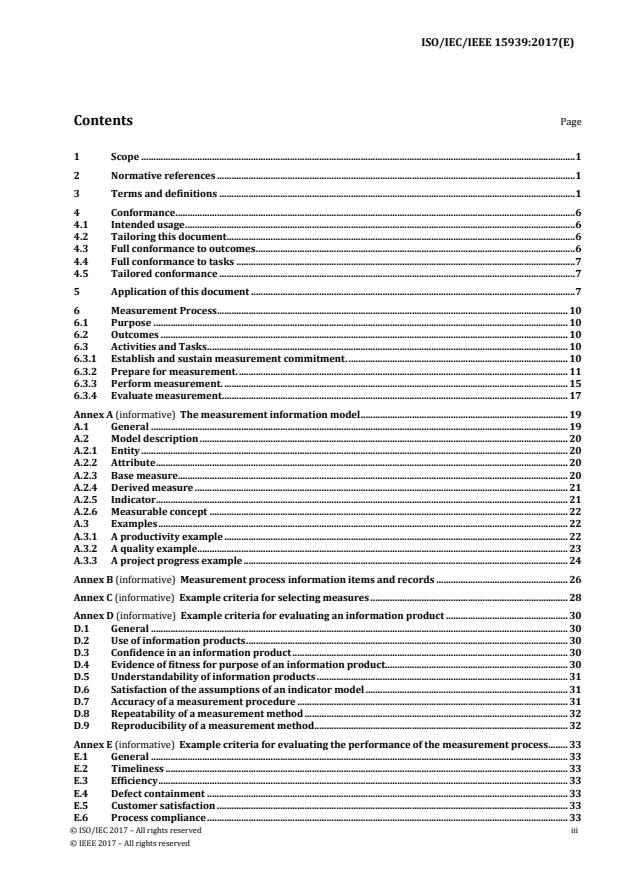
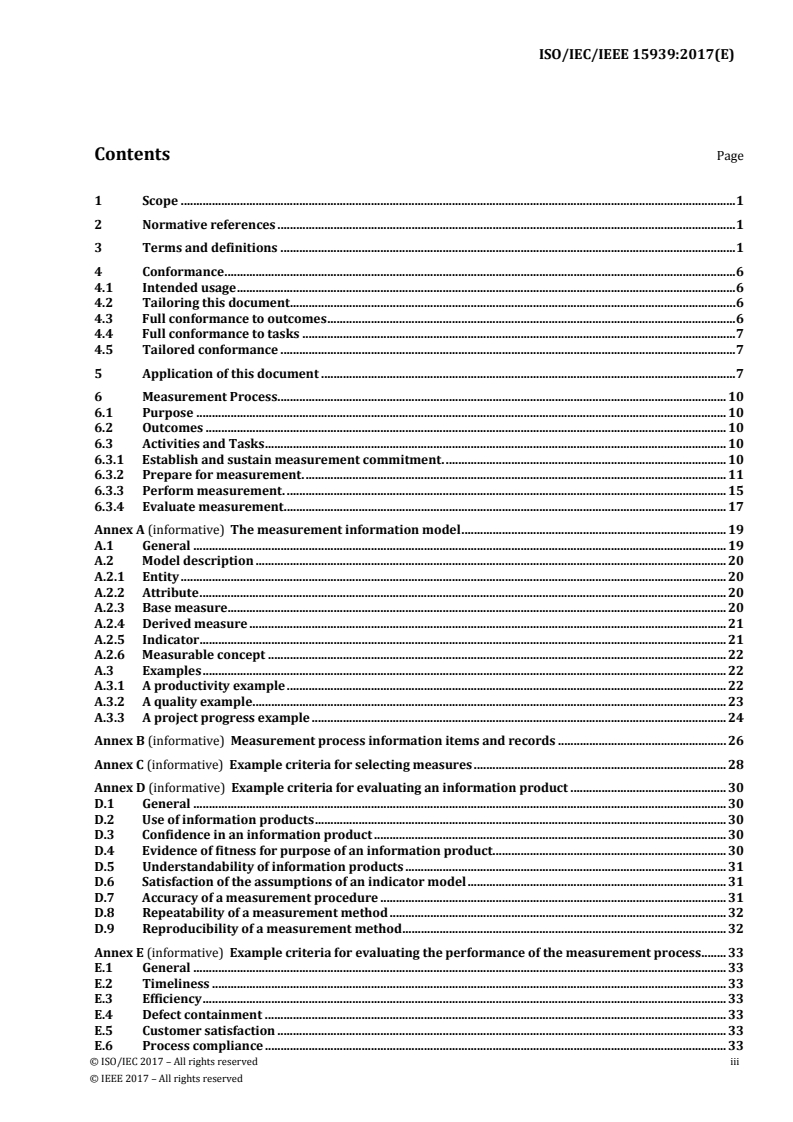
Contents Page
1 Scope . 1
2 Normative references . 1
3 Terms and definitions . 1
4 Conformance . 6
4.1 Intended usage . 6
4.2 Tailoring this document . 6
4.3 Full conformance to outcomes . 6
4.4 Full conformance to tasks . 7
4.5 Tailored conformance . 7
5 Application of this document . 7
6 Measurement Process . 10
6.1 Purpose . 10
6.2 Outcomes . 10
6.3 Activities and Tasks . 10
6.3.1 Establish and sustain measurement commitment. . 10
6.3.2 Prepare for measurement. . 11
6.3.3 Perform measurement. . 15
6.3.4 Evaluate measurement. . 17
Annex A (informative) The measurement information model . 19
A.1 General . 19
A.2 Model description . 20
A.2.1 Entity . 20
A.2.2 Attribute . 20
A.2.3 Base measure. 20
A.2.4 Derived measure . 21
A.2.5 Indicator . 21
A.2.6 Measurable concept . 22
A.3 Examples . 22
A.3.1 A productivity example . 22
A.3.2 A quality example . 23
A.3.3 A project progress example . 24
Annex B (informative) Measurement process information items and records . 26
Annex C (informative) Example criteria for selecting measures . 28
Annex D (informative) Example criteria for evaluating an information product . 30
D.1 General . 30
D.2 Use of information products . 30
D.3 Confidence in an information product . 30
D.4 Evidence of fitness for purpose of an information product . 30
D.5 Understandability of information products . 31
D.6 Satisfaction of the assumptions of an indicator model . 31
D.7 Accuracy of a measurement procedure . 31
D.8 Repeatability of a measurement method . 32
D.9 Reproducibility of a measurement method . 32
Annex E (informative) Example criteria for evaluating the performance of the measurement process . 33
E.1 General . 33
E.2 Timeliness . 33
E.3 Efficiency . 33
E.4 Defect containment . 33
E.5 Customer satisfaction . 33
E.6 Process compliance . 33
© ISO/IEC 2017 – All rights reserved iii
© IEEE 2017 – All rights reserved
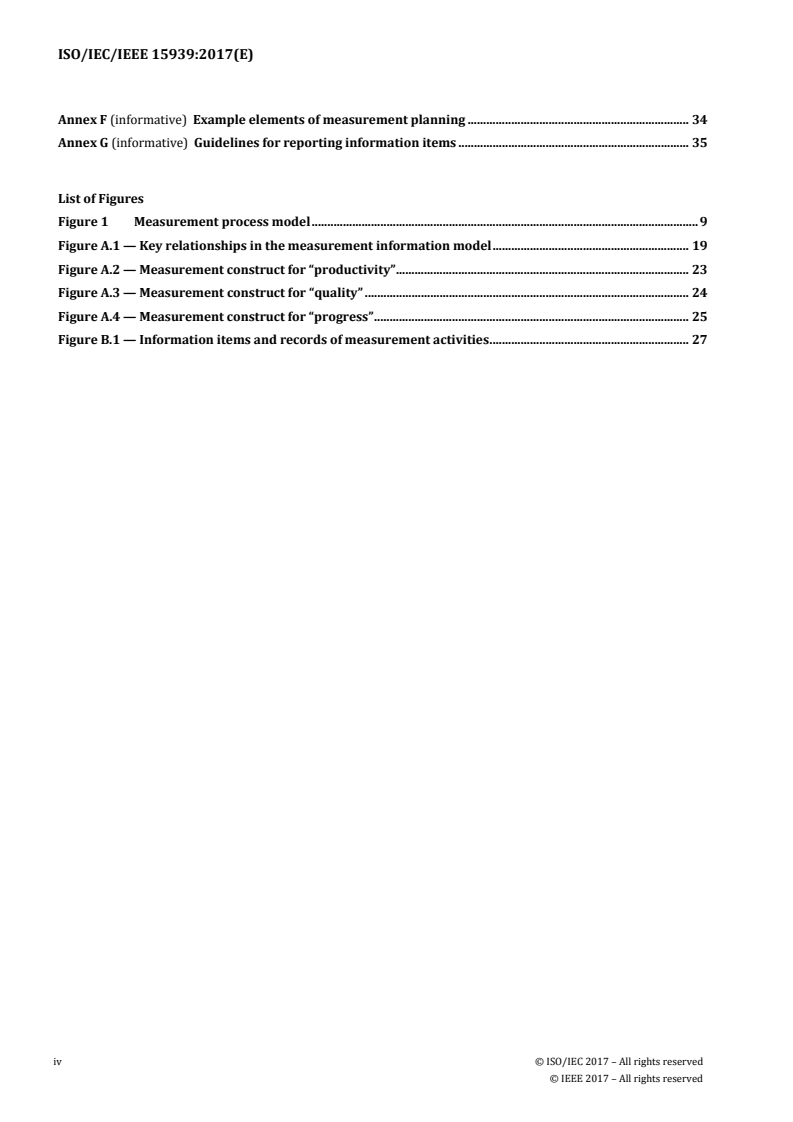
Annex F (informative) Example elements of measurement planning . 34
Annex G (informative) Guidelines for reporting information items . 35
List of Figures
Figure 1 Measurement process model . 9
Figure A.1 — Key relationships in the measurement information model . 19
Figure A.2 — Measurement construct for “productivity” . 23
Figure A.3 — Measurement construct for “quality” . 24
Figure A.4 — Measurement construct for “progress” . 25
Figure B.1 — Information items and records of measurement activities . 27
iv © ISO/IEC 2017 – All rights reserved
© IEEE 2017 – All rights reserved
Foreword
ISO (the International Organization for Standardization) and IEC (the International Electrotechnical
Commission) form the specialized system for worldwide standardization. National bodies that are members of
ISO or IEC participate in the development of International Standards through technical committees established
by the respective organization to deal with particular fields of technical activity. ISO and IEC technical
committees collaborate in fields of mutual interest. Other international organizations, governmental and non‐
governmental, in liaison with ISO and IEC, also take part in the work. In the field of information technology, ISO
and IEC have established a joint technical committee, ISO/IEC JTC 1.
IEEE Standards documents are developed within the IEEE Societies and the Standards Coordinating Committees
of the IEEE Standards Association (IEEE‐SA) Standards Board. The IEEE develops its standards through a
consensus development process, approved by the American National Standards Institute, which brings together
volunteers representing varied viewpoints and interests to achieve the final product. Volunteers are not
necessarily members of the Institute and serve without compensation. While the IEEE administers the process
and establishes rules to promote fairness in the consensus development process, the IEEE does not
independently evaluate, test, or verify the accuracy of any of the information contained in its standards.
International Standards are drafted in accordance with the rules given in the ISO/IEC Directives, Part 2.
Attention is called to the possibility that implementation of this standard may require the use of subject matter
covered by patent rights. By publication of this standard, no position is taken with respect to the existence or
validity of any patent rights in connection therewith. ISO/IEC and IEEE are not responsible for identifying
essential patents or patent claims for which a license may be required, for conducting inquiries into the legal
validity or scope of patents or patent claims or determining whether any licensing terms or conditions provided
in connection with submission of a Letter of Assurance or a Patent Statement and Licensing Declaration Form, if
any, or in any licensing agreements are reasonable or non‐discriminatory. Users of this standard are expressly
advised that determination of the validity of any patent rights, and the risk of infringement of such rights, is
entirely their own responsibility. Further information may be obtained from ISO or the IEEE Standards
Association.
ISO/IEC 15939 was prepared by Joint Technical Committee ISO/IEC JTC 1, Information technology,
Subcommittee SC 7, Systems and software engineering, in cooperation with the Software & Systems Engineering
Standards Committee of the IEEE Computer Society, under the Partner Standards Development Organization
cooperation agreement between ISO and IEEE.
This first edition cancels and replaces ISO/IEC 15939:2007, which has been revised to align with revisions of
ISO/IEC/IEEE 15288:2015.
© ISO/IEC 2017 – All rights reserved v
© IEEE 2017 – All rights reserved
Introduction
Measurement supports the management and improvement of processes and products. Measurement is a
primary tool for managing system and software life cycle activities, assessing the feasibility of project plans, and
monitoring the adherence of project activities to those plans. System and software measurement is also a key
discipline in evaluating the quality of products and the capability of organizational processes. It is becoming
increasingly important in two‐party business agreements, where it provides a basis for specification,
management, and acceptance criteria.
Continual improvement requires change within the organization. Evaluation of change requires measurement.
Measurement itself does not initiate change. Measurement should lead to action and not be employed purely to
accumulate data. Measurements should have a clearly defined purpose.
This document defines a measurement process applicable to system and software engineering and management
disciplines. The process is described through a model that defines the activities of the measurement process that
are required to adequately specify what measurement information is required, how the measures and analysis
results are to be applied, and how to determine if the analysis results are valid. The measurement process is
flexible, tailorable, and adaptable to the needs of different users.
The measurement process defined in this document, while written for system and software domains, can be
applied in other domains.
The purpose of this document is to describe the activities and tasks that are necessary to successfully identify,
define, select, apply and improve measurement within an overall project or organizational measurement
structure. It also provides definitions for measurement terms commonly used within the system and software
disciplines.
This document does not catalog measures, nor does it provide a recommended set of measures to apply on
projects. It does identify a process that supports defining a suitable set of measures that addresses specific
information needs.
This document is intended to be used by suppliers and acquirers. Suppliers include personnel performing
management, technical and quality management functions in system and software development, maintenance,
integration and product support organizations. Acquirers include personnel performing management, technical
and quality management functions in procurement and user organizations.
The following are examples of how this document can be used:
— by a supplier to implement a measurement process to address specific project or organizational information
requirements;
— by an acquirer (or third‐party agents) for evaluating conformance of the supplier’s measurement process to
this document;
— by an acquirer (or third‐party agents) to implement a measurement process to address specific technical
and project management information requirements related to the acquisition;
— in a contract between an acquirer and a supplier as a method for defining the process and product
measurement information to be exchanged.
vi © ISO/IEC 2017 – All rights reserved
© IEEE 2017 – All rights reserved
INTERNATIONAL STANDARD ISO/IEC/IEEE 15989:2017(E)
Systems and software engineering — Measurement process
1 Scope
This document establishes a common process and framework for measurement of systems and software. It
defines a process and associated terminology from an engineering viewpoint. The process can be applied to the
project and products across the life cycle. The measurement process can be applied throughout the life cycle to aid
the planning, managing, assessing, and decision‐making in all stages of a system or software life cycle.
This document also provides activities that support the definition, control and improvement of the measurement
process used within an organization or a project.
This document does not assume or prescribe an organizational model for measurement. The user of this
document decides, for example, whether a separate measurement function is necessary within the organization
and whether the measurement function should be integrated within individual projects or across projects, based
on the current organizational structure, culture and prevailing constraints.
This document does not prescribe a specific set of measures, method, model or technique. The users of this
document are responsible for selecting a set of measures for the project and defining the application of those
measures across the process, products, and other elements of the life cycle. The parties are also responsible for
selecting and applying appropriate methods, models, tools and techniques suitable for the project.
This document is not intended to prescribe the name, format, explicit content, or recording media of the
information items to be produced. This document does not imply that documents be packaged or combined in
some fashion. These decisions are left to the user of this document. ISO/IEC/IEEE 15289 addresses the content for
life cycle process information items (documentation).
The measurement process is supposed to be appropriately integrated with the organizational quality system. Not
all aspects of internal audits and non‐compliance reporting are covered explicitly in this document as they are
assumed to be in the domain of the quality system.
This document is not intended to conflict with any organizational policies, standards or procedures that are
already in place. However, any conflict should be resolved and any overriding conditions and situations need to be
cited in writing as exceptions to the application of this document.
2 Normative references
There are no normative references in this document.
3 Terms and definitions
For the purposes of this document, the following terms and definitions apply.
ISO, IEC and IEEE maintain terminological databases for use in standardization at the following addresses:
— IEC Electropedia: available at http://www.electropedia.org/
— ISO Online browsing platform: available at http://www.iso.org/obp
— IEEE Standards Dictionary Online: available at http://ieeexplore.ieee.org/xpls/dictionary.jsp
© ISO/IEC 2017 – All rights reserved
© IEEE 2017 – All rights reserved
NOTE Definitions for other terms typically can be found in ISO/IEC/IEEE 24765, available at
.
3.1
acquirer
stakeholder that acquires or procures a product or service from a supplier
Note 1 to entry: Other terms commonly used for an acquirer are buyer, customer, owner, purchaser or
internal/organizational sponsor.
[SOURCE: ISO/IEC/IEEE 15288:2015]
3.2
attribute
property or characteristic of an entity that can be distinguished quantitatively or qualitatively by human or
automated means
3.3
base measure
measure defined in terms of an attribute and the method for quantifying it
Note 1 to entry: A base measure is functionally independent of other measures.
Note 2 to entry: Based on the definition of “base quantity” in the International Vocabulary of Metrology – Basic and
General Concepts and Associated Terms, 2012.
3.4
data
collection of values assigned to base measures, derived measures or indicators
3.5
data provider
individual or organization that is a source of data
3.6
data store
organized and persistent collection of data and information that allows for its retrieval
3.7
decision criteria
thresholds, targets, or patterns used to determine the need for action or further investigation, or to describe the
level of confidence in a given result
3.8
derived measure
measure that is defined as a function of two or more values of base measures
Note 1 to entry: Adapted from the definition of “derived quantity” in the International Vocabulary of Metrology – Basic and
General Concepts and Associated Terms, 2012.
3.9
entity
object that is to be characterized by measuring its attributes
Note 1 to entry: An entity can be a process, product, project or resource.
3.10
indicator
measure that provides an estimate or evaluation of specified attributes derived from a model with respect to
defined information needs
© ISO/IEC 2017 – All rights reserved
© IEEE 2017 – All rights reserved
3.11
indicator value
numerical or categorical result assigned to an indicator
3.12
information need
insight necessary to manage objectives, goals, risks and problems
3.13
information product
one or more indicators and their associated interpretations that address an information need
EXAMPLE A comparison of a measured defect rate to planned defect rate along with an assessment of whether or not
the difference indicates a problem.
3.14
measurable concept
abstract relationship between attributes of entities and information needs
3.15
measure, noun
variable to which a value is assigned as the result of measurement
Note 1 to entry: The plural form “measures” is used to refer collectively to base measures, derived measures and
indicators.
3.16
measure, verb
make a measurement
[SOURCE: ISO/IEC 25000:2014]
3.17
measurement
set of operations having the object of determining a value of a measure
Note 1 to entry: Adapted from the International Vocabulary of Metrology – Basic and General Concepts and Associated
Terms, 2012.
3.18
measurement analyst
individual or organization that is responsible for the planning, performance, evaluation and improvement of
measurement
3.19
measurement experience base
data store that contains the evaluation of the information products and the measurement process as well as any
lessons learned during the measurement process
3.20
measurement function
algorithm or calculation performed to combine two or more base measures
3.21
measurement method
logical sequence of operations, described generically, used in quantifying an attribute with respect to a specified
scale
Note 1 to entry: The type of measurement method depends on the nature of the operations used to quantify an attribute.
Two types can be distinguished:
© ISO/IEC 2017 – All rights reserved
© IEEE 2017 – All rights reserved
subjective: quantification involving human judgment; and
objective: quantification based on numerical rules.
Note 2 to entry : Based on the definition of “method of measurement” in the International Vocabulary of Metrology – Basic
and General Concepts and Associated Terms, 2012.
3.22
measurement procedure
set of operations, described specifically, used in the performance of a particular measurement according to a given
method
[SOURCE: International Vocabulary of Metrology – Basic and General Concepts and Associated Terms, 2012,
Modified, editorially revised.]
3.23
measurement process
process for establishing, planning, performing and evaluating measurement within an overall project or
organizational measurement structure
3.24
measurement process owner
individual or organization responsible for the measurement process
3.25
measurement sponsor
individual or organization that authorizes and supports the establishment of the measurement process
3.26
measurement user
individual or organization that uses the measurement information products
3.27
model
algorithm or calculation combining one or more base or derived measures with associated decision criteria
3.28
observation
instance of applying a measurement procedure to produce a value for a base measure
3.29
operator
entity that performs the operation of a system
3.30
organizational unit
part of an organization that is the subject of measurement
3.31
process
set of interrelated or interacting activities that use inputs to deliver an intended result
[SOURCE: ISO 9000:2015 Modified, Notes to entry 1, 2, 3, 4, 5 and 6 have been removed.]
3.32
product
result of a process
Note 1 to entry: Adapted from the definition of “Output” in ISO 9001:2015.
© ISO/IEC 2017 – All rights reserved
© IEEE 2017 – All rights reserved
3.33
project
endeavor with defined start and finish criteria undertaken to create a product or service in accordance with
specified resources and requirements
Note 1 to entry : A project is sometimes viewed as a unique process comprising coordinated and controlled activities and
composed of activities from the Technical Management Processes and Technical Processes defined in ISO/IEC/IEEE
15288:2015.
[SOURCE: ISO/IEC/IEEE 15288:2015, Modified, Note 1 to entry editorially revised.]
3.34
scale
ordered set of values, continuous or discrete, or a set of categories to which the attribute is mapped
Note 1 to entry: The type of scale depends on the nature of the relationship between values on the scale. Four types of
scale are commonly defined:
nominal: the measurement values are categorical;
ordinal: the measurement values are rankings;
interval: the measurement values have equal distances corresponding to equal quantities of the attribute; and
ratio: the measurement values have equal distances corresponding to equal quantities of the attribute, where the value of
zero corresponds to none of the attribute.
These are just examples of the types of scale. Roberts [ ] defines more types of scale. Annex A contains examples of each type
of scale.
Note 2 to entry: Based on the definition of “scale (of a measuring instrument)” in the International Vocabulary of
Metrology – Basic and General Concepts and Associated Terms, 2012.
3.35
service
performance of activities, work or duties
[SOURCE: ISO/IEC/IEEE 15288:2015, Modified, Notes 1 and 2 to entry have been removed.]
3.36
stakeholder
individual or organization having a right, share, claim or interest in a system or in its possession of characteristics
that meet their needs and expectations
Note 1 to entry: Within this document, an individual or organization that sponsors measurement, provides data, is a user
of the measurement results or otherwise participates in the measurement process.
[SOURCE: ISO/IEC/IEEE 15288:2015, Modified, EXAMPLE has been removed and Note 1 to entry has been
editorially revised.]
3.37
supplier
organization or an individual that enters into an agreement with the acquirer for the supply of a product or
service
Note 1 to entry: Other terms commonly used for supplier are contractor, producer, seller or vendor.
Note 2 to entry: The acquirer and the supplier sometimes are part of the same organization.
[SOURCE: ISO/IEC/IEEE 15288:2015]
3.38
system
combination of interacting elements organized to achieve one or more stated purposes
© ISO/IEC 2017 – All rights reserved
© IEEE 2017 – All rights reserved
Note 1 to entry: A system is sometimes considered as a product or as the services it provides.
[SOURCE: ISO/IEC/IEEE 15288:2015, Modified, Notes 2 and 3 to entry have been removed.]
3.39
unit of measurement
particular quantity, defined and adopted by convention, with which other quantities of the same kind are
compared in order to express their magnitude relative to that quantity
[SOURCE: International Vocabulary of Metrology – Basic and General Concepts and Associated Terms, 2012]
3.40
user
individual or group that interacts with a system or benefits from a system during its utilization
[SOURCE: ISO/IEC/IEEE 15288:2015, Modified, Note 1 to entry has been removed.]
3.41
value
numerical or categorical result assigned to a base measure, derived measure or indicator
4 Conformance
4.1 Intended usage
The requirements in this document are contained in Clause 6. There are two ways that an implementation can be
claimed to conform to the provisions of this document – full conformance and tailored conformance.
There are two criteria for claiming full conformance. Achieving either criterion suffices for conformance, although
the chosen criterion (or criteria) is to be stated in the claim. Claiming “full conformance to tasks” asserts that all of
the requirements of the activities and tasks of the measurement process are achieved. Alternatively, claiming “full
conformance to outcomes” asserts that all of the required outcomes of the measurement process are achieved.
It is the responsibility of the organization to maintain appropriate evidence of satisfaction of the normative
clauses for the purposes of demonstrating conformance.
NOTE The process has a set of objectives (phrased as “outcomes”) and a set of activities and tasks that represent one way
to achieve the objectives. Users who implement the activities and tasks can assert full conformance to tasks. Some users,
however, might have innovative process variants that achieve the objectives (i.e., the outcomes) of the declared set of
processes without implementing all of the activities and tasks. These users can assert full conformance to the outcomes. The
two criteria—conformance to task and conformance to outcome—are not necessarily equivalent since specific performance of
activities and tasks may require, in some cases, a higher level of capability than just the achievement of outcomes.
4.2 Tailoring this document
This document contains a set of activities and tasks that comprise a measurement process that meets the specific
needs of organizations and projects. An organization tailoring this document may delete content that is not
applicable, and may also add new activities and tasks.
4.3 Full conformance to outcomes
Full conformance to outcomes is achieved by demonstrating that all of the outcomes have been achieved. In this
situation, the provisions for activities and tasks are guidance rather than requirements, regardless of the verb
form that is used in the provision.
© ISO/IEC 2017 – All rights reserved
© IEEE 2017 – All rights reserved
4.4 Full conformance to tasks
Full conformance to tasks is achieved by demonstrating that all of the requirements of the activities and tasks
have been achieved. In this situation, the provisions for the outcomes are guidance rather than requirements,
regardless of the verb form that is used in the provision.
4.5 Tailored conformance
When this document is tailored per 4.2, the tailored text, for which tailored conformance is claimed, is declared.
Tailored conformance is achieved by demonstrating that the outcomes, activities, and tasks, as tailored, have been
achieved.
5 Application of this document
This clause presents an overview of the measurement process. The objective is to orient the users of this
document so that they can apply it properly within context.
This document defines the activities and tasks necessary to implement a measurement process. An activity is a set
of related tasks that contributes towards achieving the purpose and outcomes of the measurement process (see
6.1 and 6.2). A task is a well‐defined segment of work. Each activity is comprised of one or more tasks. This
document does not specify the details of how to perform the tasks included in the activities.
The properties of the activities of the measurement process that are defined in this document are the same
properties defined in ISO/IEC/IEEE 15288 and ISO/IEC/IEEE 12207. This means that other properties such as
entry and exit criteria for each of the activities are not defined in this document.
NOTE 1 This measurement process supports the measurement requirement defined in ISO 9001:2015, 8.2.
NOTE 2 This document provides an elaboration of the measurement process from ISO/IEC/IEEE 15288 and
ISO/IEC/IEEE 12207. More detail is provided via additional activities and tasks. As part of this elaboration, one additional
outcome (commitment is established and sustained) is added, with associated activities and tasks. This outcome is addressed
in ISO/IEC/IEEE 15288 and ISO/IEC/IEEE 12207 at the organization level.
The measurement process consists of four activities as illustrated in the process model in Figure 1. The activities
are sequenced in an iterative cycle allowing for continuous feedback and improvement of the measurement
process. The measurement process model in Figure 1 is an adaptation of the Plan‐Do‐Check‐Act cycle commonly
used as the basis for quality improvement. Within activities, the tasks are also iterative.
The “Technical and Management Processes” of an organizational unit or project are not within the scope of this
document, although they are an important external interface to the measurement activities that are included in
this document.
Two activities are considered to be the Core Measurement Process: Prepare the Measurement Process, and
Perform the Measurement Process. These activities are included in the Measurement process in ISO/IEC/IEEE
15288 and ISO/IEC/IEEE 12207 and mainly address the concerns of the measurement user. The other two
activities, Establish and Sustain Measurement Commitment and Evaluate Measurement, provide a foundation for
the Core Measurement Process and provide feedback to it. These latter two activities address the concerns of the
measurement process owner. They are included in the set of life cycle processes as activities in the Project
Planning process and the Quality Assurance process, respectively. At the organization level, this is handled by the
Life Cycle Model Management process, which evaluates and improves the organization’s processes.
© ISO/IEC 2017 – All rights reserved
© IEEE 2017 – All rights reserved
Figure 1 shows that the Core Measurement Process is driven by the information needs of the organization. For
each information need, the Core Measurement Process produces an information product that satisfies the
information need. The information product is conveyed to the organization as a basis for decision‐making. The
link between measures and an information need is described as the Measurement Information Model in Annex A.
This annex also includes examples.
Performance of the normative activities and tasks defined in this document satisfies at least the Capability Level 1
requirements in ISO/IEC 33020. However, the guidance included in this document provides the basis for
implementing the measurement process at progressively higher levels of capability.
The process defined in this document includes an evaluation activity, as shown in Figure 1. The intent is to
emphasize that evaluation and feedback are an essential component of the measurement process, and should lead
to improvements of the measurement process and measures. Evaluation can be simple, and performed in an ad
hoc manner when capability is low, or it can be quantitative with sophisticated statistical techniques to evaluate
the quality of the measurement process and its outputs when capability is high. Measures should be evaluated in
terms of the added value they provide for the organization, and only deployed where the benefit can be identified.
Included in the cycle is the “Measurement Experience Base”. This is intended to capture information products
from past iterations of the cycle, previous evaluations of information products, and evaluations of previous
iterations of the measurement process. This would include the measures that have been found to be useful in the
organizational unit. No assumptions are made about the nature or technology of this “Measurement Experience
Base”, only that it be a persistent storage. Artefacts (for example, information products, historical data, and
lessons learned) stored in the “Measurement Experience Base” are intended to be reused in future iterations of
the measurement process.
Since the process model is cyclical, subsequent iterations may only update measurement products and practices.
This document does not imply that measurement products and practices need to be developed and implemented
for each iteration of the process. The wording used in this document adopts the convention that one is
implementing the measurement process for the first time (i.e., the first iteration). During subsequent iterations,
this wording should be interpreted as updating or changing documentation and current practices.
The typical functional roles mentioned in this document are: stakeholder, sponsor, measurement user,
measurement analyst, data provider, and measurement process owner. These are defined in Clause 4 of this
document.
A number of work products are produced during the performance of the measurement process. The work
products are described in Annex B, and mapped to the tasks that produce them.
This document includes a set of activities and tasks. Tasks are sometimes broken into lower‐level tasks. These are
described in the order in which they typically are performed. However, iteration from one activity or task to a
preceding or following one frequently occurs. The order in which these are presented does not necessarily imply
an order of implementation. For each task, one or more normative requirements on the implementation are
defined. There is also informative guidance to help with the interpretation of the normative requirements and the
implementation in practice. This guidance is presented in italics.
The informative lists within the tasks in the annexes are not presumed to be exhaustive — they are intended only
as examples.
In implementing a measurement process in conformance with this document, the organizational unit shall
perform the activities described below. The “Requirements for Measurement” from the Technical and
Management processes trigger the measurement process.
© ISO/IEC 2017 – All rights reserved
© IEEE 2017 – All rights reserved
Figure 1 - Measurement process model
© ISO/IEC 2017 – All rights reserved
© IEEE 2017 – All rights reserved
6 Measurement process
6.1 Purpose
The purpose of the Measurement process is to collect, analyze, and report objective data and information to
support effective management and demonstrate the quality of the products, services, and processes.
[ISO/IEC/IEEE 15288:2015, 6.3.7.1 and ISO/IEC/IEEE 12207]
6.2 Outcomes
As a result of successful implementation of the Measurement process:
a) Information needs are identified.
b) An appropriate set of measures, based on the information needs are identified or developed.
c) Required data is collected, verified, and stored.
d) The data is analyzed and the results interpreted.
e) Information items provide objective information that support decisions.
f) Organizational commitment for measurement is sustained.
g) Identified measurement activities are planned.
h) The measurement process and measures are evaluated.
i) Improvements are communicated to the measurement process owner.
[ISO/IEC/IEEE 15288:2015, 6.3.7.2 and ISO/IEC/IEEE 12207]
6.3 Activities and tasks
The project shall implement the following activities and tasks in accordance with the applicable organization
policies and procedures with respect to the measurement process.
NOTE 1 This document provides an elaboration of the measurement process in ISO/IEC/IEEE 15288 and ISO/IEC/IEEE
12207. It provides a more detailed set of activities and tasks that are aligned with those in 15288 and 12207. Through the rest
of this document, only the references to 15288 are included, since the clause numbering is the same in both documents.
NOTE 2 Clause 9 of ISO 9001:2015 specifies Quality Management System requirements for measurement and monitoring of
processes and products.
6.3.1 Establish and sustain measurement commitment
In ISO/IEC/IEEE 15288, measurement commitment is established and sustained as part of the Project Planning
and Project Assessment and Control processes.
6.3.1.1 Accept the requirements for measurement
6.3.1.1.1 Identify the scope of measurement
The scope of measurement defines an organizational unit for purposes of this document. This can be a single project,
a functional area, the whole organization, a single site, or a multi-site organization. This consists of projects or
supporting processes, or both.
© ISO/IEC 2017 – All rights reserved
© IEEE 2017 – All rights reserved
The scope of the organizational unit can be identified through interviews and the inspection of documentation, such
as organizational charts.
In addition, all stakeholders need to be identified. For example, these can include project managers, the Information
Systems manager, or the head of Quality Management. The stakeholders can be internal or external to the
organizational unit.
The purpose and information needs for measurement are identified by the stakeholders.
6.3.1.1.2 Establish commitment of management
Commitment is established when “Requirements for Measurement” are defined (see Figure 1).
This includes the commitment of resources to the measurement process and the willingness to maintain this
commitment. For example, one way the organizational unit establishes its commitment is through a measurement
policy for the organizational unit, allocation of responsibility and duties, training, and the allocation of budget and
other resources. Commitment often comes in the form of a contract with an acquirer requiring measurement.
6.3.1.1.3 Communicate commitment to the organizational unit
This can be achieved, for example, through organizational unit-wide announcements or newsletters.
6.3.1.2 Assign resources
6.3.1.2.1 Assign responsibility for measurement
The sponsor of measurement assigns this responsibility to competent individuals. Competence includes knowledge of
the principles of measurement, how
...
INTERNATIONAL ISO/IEC/
STANDARD IEEE
First edition
2017-05
Systems and software engineering —
Measurement process
Ingénierie des systèmes et du logiciel — Processus de mesure
Reference number
©
ISO/IEC 2017
©
IEEE 2017
© ISO/IEC 2017, Published in Switzerland
© IEEE 2017
All rights reserved. Unless otherwise specified, no part of this publication may be reproduced or utilized otherwise in any form or
by any means, electronic or mechanical, including photocopying, or posting on the internet or an intranet, without prior written
permission. Permission can be requested from either ISO or IEEE at the address below or ISO’s member body in the country of
the requester.
ISO copyright office Institute of Electrical and Electronics Engineers, Inc
Ch. de Blandonnet 8 • CP 401 3 Park Avenue, New York
CH-1214 Vernier, Geneva, Switzerland NY 10016-5997, USA
Tel. +41 22 749 01 11
Fax +41 22 749 09 47
copyright@iso.org stds.ipr@ieee.org
www.iso.org www.ieee.org
ii
Contents Page
1 Scope . 1
2 Normative references . 1
3 Terms and definitions . 1
4 Conformance . 6
4.1 Intended usage . 6
4.2 Tailoring this document . 6
4.3 Full conformance to outcomes . 6
4.4 Full conformance to tasks . 7
4.5 Tailored conformance . 7
5 Application of this document . 7
6 Measurement Process . 10
6.1 Purpose . 10
6.2 Outcomes . 10
6.3 Activities and Tasks . 10
6.3.1 Establish and sustain measurement commitment. . 10
6.3.2 Prepare for measurement. . 11
6.3.3 Perform measurement. . 15
6.3.4 Evaluate measurement. . 17
Annex A (informative) The measurement information model . 19
A.1 General . 19
A.2 Model description . 20
A.2.1 Entity . 20
A.2.2 Attribute . 20
A.2.3 Base measure. 20
A.2.4 Derived measure . 21
A.2.5 Indicator . 21
A.2.6 Measurable concept . 22
A.3 Examples . 22
A.3.1 A productivity example . 22
A.3.2 A quality example . 23
A.3.3 A project progress example . 24
Annex B (informative) Measurement process information items and records . 26
Annex C (informative) Example criteria for selecting measures . 28
Annex D (informative) Example criteria for evaluating an information product . 30
D.1 General . 30
D.2 Use of information products . 30
D.3 Confidence in an information product . 30
D.4 Evidence of fitness for purpose of an information product . 30
D.5 Understandability of information products . 31
D.6 Satisfaction of the assumptions of an indicator model . 31
D.7 Accuracy of a measurement procedure . 31
D.8 Repeatability of a measurement method . 32
D.9 Reproducibility of a measurement method . 32
Annex E (informative) Example criteria for evaluating the performance of the measurement process . 33
E.1 General . 33
E.2 Timeliness . 33
E.3 Efficiency . 33
E.4 Defect containment . 33
E.5 Customer satisfaction . 33
E.6 Process compliance . 33
© ISO/IEC 2017 – All rights reserved iii
© IEEE 2017 – All rights reserved
Annex F (informative) Example elements of measurement planning . 34
Annex G (informative) Guidelines for reporting information items . 35
List of Figures
Figure 1 Measurement process model . 9
Figure A.1 — Key relationships in the measurement information model . 19
Figure A.2 — Measurement construct for “productivity” . 23
Figure A.3 — Measurement construct for “quality” . 24
Figure A.4 — Measurement construct for “progress” . 25
Figure B.1 — Information items and records of measurement activities . 27
iv © ISO/IEC 2017 – All rights reserved
© IEEE 2017 – All rights reserved
Foreword
ISO (the International Organization for Standardization) and IEC (the International Electrotechnical
Commission) form the specialized system for worldwide standardization. National bodies that are members of
ISO or IEC participate in the development of International Standards through technical committees established
by the respective organization to deal with particular fields of technical activity. ISO and IEC technical
committees collaborate in fields of mutual interest. Other international organizations, governmental and non‐
governmental, in liaison with ISO and IEC, also take part in the work. In the field of information technology, ISO
and IEC have established a joint technical committee, ISO/IEC JTC 1.
IEEE Standards documents are developed within the IEEE Societies and the Standards Coordinating Committees
of the IEEE Standards Association (IEEE‐SA) Standards Board. The IEEE develops its standards through a
consensus development process, approved by the American National Standards Institute, which brings together
volunteers representing varied viewpoints and interests to achieve the final product. Volunteers are not
necessarily members of the Institute and serve without compensation. While the IEEE administers the process
and establishes rules to promote fairness in the consensus development process, the IEEE does not
independently evaluate, test, or verify the accuracy of any of the information contained in its standards.
International Standards are drafted in accordance with the rules given in the ISO/IEC Directives, Part 2.
Attention is called to the possibility that implementation of this standard may require the use of subject matter
covered by patent rights. By publication of this standard, no position is taken with respect to the existence or
validity of any patent rights in connection therewith. ISO/IEC and IEEE are not responsible for identifying
essential patents or patent claims for which a license may be required, for conducting inquiries into the legal
validity or scope of patents or patent claims or determining whether any licensing terms or conditions provided
in connection with submission of a Letter of Assurance or a Patent Statement and Licensing Declaration Form, if
any, or in any licensing agreements are reasonable or non‐discriminatory. Users of this standard are expressly
advised that determination of the validity of any patent rights, and the risk of infringement of such rights, is
entirely their own responsibility. Further information may be obtained from ISO or the IEEE Standards
Association.
ISO/IEC 15939 was prepared by Joint Technical Committee ISO/IEC JTC 1, Information technology,
Subcommittee SC 7, Systems and software engineering, in cooperation with the Software & Systems Engineering
Standards Committee of the IEEE Computer Society, under the Partner Standards Development Organization
cooperation agreement between ISO and IEEE.
This first edition cancels and replaces ISO/IEC 15939:2007, which has been revised to align with revisions of
ISO/IEC/IEEE 15288:2015.
© ISO/IEC 2017 – All rights reserved v
© IEEE 2017 – All rights reserved
Introduction
Measurement supports the management and improvement of processes and products. Measurement is a
primary tool for managing system and software life cycle activities, assessing the feasibility of project plans, and
monitoring the adherence of project activities to those plans. System and software measurement is also a key
discipline in evaluating the quality of products and the capability of organizational processes. It is becoming
increasingly important in two‐party business agreements, where it provides a basis for specification,
management, and acceptance criteria.
Continual improvement requires change within the organization. Evaluation of change requires measurement.
Measurement itself does not initiate change. Measurement should lead to action and not be employed purely to
accumulate data. Measurements should have a clearly defined purpose.
This document defines a measurement process applicable to system and software engineering and management
disciplines. The process is described through a model that defines the activities of the measurement process that
are required to adequately specify what measurement information is required, how the measures and analysis
results are to be applied, and how to determine if the analysis results are valid. The measurement process is
flexible, tailorable, and adaptable to the needs of different users.
The measurement process defined in this document, while written for system and software domains, can be
applied in other domains.
The purpose of this document is to describe the activities and tasks that are necessary to successfully identify,
define, select, apply and improve measurement within an overall project or organizational measurement
structure. It also provides definitions for measurement terms commonly used within the system and software
disciplines.
This document does not catalog measures, nor does it provide a recommended set of measures to apply on
projects. It does identify a process that supports defining a suitable set of measures that addresses specific
information needs.
This document is intended to be used by suppliers and acquirers. Suppliers include personnel performing
management, technical and quality management functions in system and software development, maintenance,
integration and product support organizations. Acquirers include personnel performing management, technical
and quality management functions in procurement and user organizations.
The following are examples of how this document can be used:
— by a supplier to implement a measurement process to address specific project or organizational information
requirements;
— by an acquirer (or third‐party agents) for evaluating conformance of the supplier’s measurement process to
this document;
— by an acquirer (or third‐party agents) to implement a measurement process to address specific technical
and project management information requirements related to the acquisition;
— in a contract between an acquirer and a supplier as a method for defining the process and product
measurement information to be exchanged.
vi © ISO/IEC 2017 – All rights reserved
© IEEE 2017 – All rights reserved
INTERNATIONAL STANDARD ISO/IEC/IEEE 15989:2017(E)
Systems and software engineering — Measurement process
1 Scope
This document establishes a common process and framework for measurement of systems and software. It
defines a process and associated terminology from an engineering viewpoint. The process can be applied to the
project and products across the life cycle. The measurement process can be applied throughout the life cycle to aid
the planning, managing, assessing, and decision‐making in all stages of a system or software life cycle.
This document also provides activities that support the definition, control and improvement of the measurement
process used within an organization or a project.
This document does not assume or prescribe an organizational model for measurement. The user of this
document decides, for example, whether a separate measurement function is necessary within the organization
and whether the measurement function should be integrated within individual projects or across projects, based
on the current organizational structure, culture and prevailing constraints.
This document does not prescribe a specific set of measures, method, model or technique. The users of this
document are responsible for selecting a set of measures for the project and defining the application of those
measures across the process, products, and other elements of the life cycle. The parties are also responsible for
selecting and applying appropriate methods, models, tools and techniques suitable for the project.
This document is not intended to prescribe the name, format, explicit content, or recording media of the
information items to be produced. This document does not imply that documents be packaged or combined in
some fashion. These decisions are left to the user of this document. ISO/IEC/IEEE 15289 addresses the content for
life cycle process information items (documentation).
The measurement process is supposed to be appropriately integrated with the organizational quality system. Not
all aspects of internal audits and non‐compliance reporting are covered explicitly in this document as they are
assumed to be in the domain of the quality system.
This document is not intended to conflict with any organizational policies, standards or procedures that are
already in place. However, any conflict should be resolved and any overriding conditions and situations need to be
cited in writing as exceptions to the application of this document.
2 Normative references
There are no normative references in this document.
3 Terms and definitions
For the purposes of this document, the following terms and definitions apply.
ISO, IEC and IEEE maintain terminological databases for use in standardization at the following addresses:
— IEC Electropedia: available at http://www.electropedia.org/
— ISO Online browsing platform: available at http://www.iso.org/obp
— IEEE Standards Dictionary Online: available at http://ieeexplore.ieee.org/xpls/dictionary.jsp
© ISO/IEC 2017 – All rights reserved
© IEEE 2017 – All rights reserved
NOTE Definitions for other terms typically can be found in ISO/IEC/IEEE 24765, available at
.
3.1
acquirer
stakeholder that acquires or procures a product or service from a supplier
Note 1 to entry: Other terms commonly used for an acquirer are buyer, customer, owner, purchaser or
internal/organizational sponsor.
[SOURCE: ISO/IEC/IEEE 15288:2015]
3.2
attribute
property or characteristic of an entity that can be distinguished quantitatively or qualitatively by human or
automated means
3.3
base measure
measure defined in terms of an attribute and the method for quantifying it
Note 1 to entry: A base measure is functionally independent of other measures.
Note 2 to entry: Based on the definition of “base quantity” in the International Vocabulary of Metrology – Basic and
General Concepts and Associated Terms, 2012.
3.4
data
collection of values assigned to base measures, derived measures or indicators
3.5
data provider
individual or organization that is a source of data
3.6
data store
organized and persistent collection of data and information that allows for its retrieval
3.7
decision criteria
thresholds, targets, or patterns used to determine the need for action or further investigation, or to describe the
level of confidence in a given result
3.8
derived measure
measure that is defined as a function of two or more values of base measures
Note 1 to entry: Adapted from the definition of “derived quantity” in the International Vocabulary of Metrology – Basic and
General Concepts and Associated Terms, 2012.
3.9
entity
object that is to be characterized by measuring its attributes
Note 1 to entry: An entity can be a process, product, project or resource.
3.10
indicator
measure that provides an estimate or evaluation of specified attributes derived from a model with respect to
defined information needs
© ISO/IEC 2017 – All rights reserved
© IEEE 2017 – All rights reserved
3.11
indicator value
numerical or categorical result assigned to an indicator
3.12
information need
insight necessary to manage objectives, goals, risks and problems
3.13
information product
one or more indicators and their associated interpretations that address an information need
EXAMPLE A comparison of a measured defect rate to planned defect rate along with an assessment of whether or not
the difference indicates a problem.
3.14
measurable concept
abstract relationship between attributes of entities and information needs
3.15
measure, noun
variable to which a value is assigned as the result of measurement
Note 1 to entry: The plural form “measures” is used to refer collectively to base measures, derived measures and
indicators.
3.16
measure, verb
make a measurement
[SOURCE: ISO/IEC 25000:2014]
3.17
measurement
set of operations having the object of determining a value of a measure
Note 1 to entry: Adapted from the International Vocabulary of Metrology – Basic and General Concepts and Associated
Terms, 2012.
3.18
measurement analyst
individual or organization that is responsible for the planning, performance, evaluation and improvement of
measurement
3.19
measurement experience base
data store that contains the evaluation of the information products and the measurement process as well as any
lessons learned during the measurement process
3.20
measurement function
algorithm or calculation performed to combine two or more base measures
3.21
measurement method
logical sequence of operations, described generically, used in quantifying an attribute with respect to a specified
scale
Note 1 to entry: The type of measurement method depends on the nature of the operations used to quantify an attribute.
Two types can be distinguished:
© ISO/IEC 2017 – All rights reserved
© IEEE 2017 – All rights reserved
subjective: quantification involving human judgment; and
objective: quantification based on numerical rules.
Note 2 to entry : Based on the definition of “method of measurement” in the International Vocabulary of Metrology – Basic
and General Concepts and Associated Terms, 2012.
3.22
measurement procedure
set of operations, described specifically, used in the performance of a particular measurement according to a given
method
[SOURCE: International Vocabulary of Metrology – Basic and General Concepts and Associated Terms, 2012,
Modified, editorially revised.]
3.23
measurement process
process for establishing, planning, performing and evaluating measurement within an overall project or
organizational measurement structure
3.24
measurement process owner
individual or organization responsible for the measurement process
3.25
measurement sponsor
individual or organization that authorizes and supports the establishment of the measurement process
3.26
measurement user
individual or organization that uses the measurement information products
3.27
model
algorithm or calculation combining one or more base or derived measures with associated decision criteria
3.28
observation
instance of applying a measurement procedure to produce a value for a base measure
3.29
operator
entity that performs the operation of a system
3.30
organizational unit
part of an organization that is the subject of measurement
3.31
process
set of interrelated or interacting activities that use inputs to deliver an intended result
[SOURCE: ISO 9000:2015 Modified, Notes to entry 1, 2, 3, 4, 5 and 6 have been removed.]
3.32
product
result of a process
Note 1 to entry: Adapted from the definition of “Output” in ISO 9001:2015.
© ISO/IEC 2017 – All rights reserved
© IEEE 2017 – All rights reserved
3.33
project
endeavor with defined start and finish criteria undertaken to create a product or service in accordance with
specified resources and requirements
Note 1 to entry : A project is sometimes viewed as a unique process comprising coordinated and controlled activities and
composed of activities from the Technical Management Processes and Technical Processes defined in ISO/IEC/IEEE
15288:2015.
[SOURCE: ISO/IEC/IEEE 15288:2015, Modified, Note 1 to entry editorially revised.]
3.34
scale
ordered set of values, continuous or discrete, or a set of categories to which the attribute is mapped
Note 1 to entry: The type of scale depends on the nature of the relationship between values on the scale. Four types of
scale are commonly defined:
nominal: the measurement values are categorical;
ordinal: the measurement values are rankings;
interval: the measurement values have equal distances corresponding to equal quantities of the attribute; and
ratio: the measurement values have equal distances corresponding to equal quantities of the attribute, where the value of
zero corresponds to none of the attribute.
These are just examples of the types of scale. Roberts [ ] defines more types of scale. Annex A contains examples of each type
of scale.
Note 2 to entry: Based on the definition of “scale (of a measuring instrument)” in the International Vocabulary of
Metrology – Basic and General Concepts and Associated Terms, 2012.
3.35
service
performance of activities, work or duties
[SOURCE: ISO/IEC/IEEE 15288:2015, Modified, Notes 1 and 2 to entry have been removed.]
3.36
stakeholder
individual or organization having a right, share, claim or interest in a system or in its possession of characteristics
that meet their needs and expectations
Note 1 to entry: Within this document, an individual or organization that sponsors measurement, provides data, is a user
of the measurement results or otherwise participates in the measurement process.
[SOURCE: ISO/IEC/IEEE 15288:2015, Modified, EXAMPLE has been removed and Note 1 to entry has been
editorially revised.]
3.37
supplier
organization or an individual that enters into an agreement with the acquirer for the supply of a product or
service
Note 1 to entry: Other terms commonly used for supplier are contractor, producer, seller or vendor.
Note 2 to entry: The acquirer and the supplier sometimes are part of the same organization.
[SOURCE: ISO/IEC/IEEE 15288:2015]
3.38
system
combination of interacting elements organized to achieve one or more stated purposes
© ISO/IEC 2017 – All rights reserved
© IEEE 2017 – All rights reserved
Note 1 to entry: A system is sometimes considered as a product or as the services it provides.
[SOURCE: ISO/IEC/IEEE 15288:2015, Modified, Notes 2 and 3 to entry have been removed.]
3.39
unit of measurement
particular quantity, defined and adopted by convention, with which other quantities of the same kind are
compared in order to express their magnitude relative to that quantity
[SOURCE: International Vocabulary of Metrology – Basic and General Concepts and Associated Terms, 2012]
3.40
user
individual or group that interacts with a system or benefits from a system during its utilization
[SOURCE: ISO/IEC/IEEE 15288:2015, Modified, Note 1 to entry has been removed.]
3.41
value
numerical or categorical result assigned to a base measure, derived measure or indicator
4 Conformance
4.1 Intended usage
The requirements in this document are contained in Clause 6. There are two ways that an implementation can be
claimed to conform to the provisions of this document – full conformance and tailored conformance.
There are two criteria for claiming full conformance. Achieving either criterion suffices for conformance, although
the chosen criterion (or criteria) is to be stated in the claim. Claiming “full conformance to tasks” asserts that all of
the requirements of the activities and tasks of the measurement process are achieved. Alternatively, claiming “full
conformance to outcomes” asserts that all of the required outcomes of the measurement process are achieved.
It is the responsibility of the organization to maintain appropriate evidence of satisfaction of the normative
clauses for the purposes of demonstrating conformance.
NOTE The process has a set of objectives (phrased as “outcomes”) and a set of activities and tasks that represent one way
to achieve the objectives. Users who implement the activities and tasks can assert full conformance to tasks. Some users,
however, might have innovative process variants that achieve the objectives (i.e., the outcomes) of the declared set of
processes without implementing all of the activities and tasks. These users can assert full conformance to the outcomes. The
two criteria—conformance to task and conformance to outcome—are not necessarily equivalent since specific performance of
activities and tasks may require, in some cases, a higher level of capability than just the achievement of outcomes.
4.2 Tailoring this document
This document contains a set of activities and tasks that comprise a measurement process that meets the specific
needs of organizations and projects. An organization tailoring this document may delete content that is not
applicable, and may also add new activities and tasks.
4.3 Full conformance to outcomes
Full conformance to outcomes is achieved by demonstrating that all of the outcomes have been achieved. In this
situation, the provisions for activities and tasks are guidance rather than requirements, regardless of the verb
form that is used in the provision.
© ISO/IEC 2017 – All rights reserved
© IEEE 2017 – All rights reserved
4.4 Full conformance to tasks
Full conformance to tasks is achieved by demonstrating that all of the requirements of the activities and tasks
have been achieved. In this situation, the provisions for the outcomes are guidance rather than requirements,
regardless of the verb form that is used in the provision.
4.5 Tailored conformance
When this document is tailored per 4.2, the tailored text, for which tailored conformance is claimed, is declared.
Tailored conformance is achieved by demonstrating that the outcomes, activities, and tasks, as tailored, have been
achieved.
5 Application of this document
This clause presents an overview of the measurement process. The objective is to orient the users of this
document so that they can apply it properly within context.
This document defines the activities and tasks necessary to implement a measurement process. An activity is a set
of related tasks that contributes towards achieving the purpose and outcomes of the measurement process (see
6.1 and 6.2). A task is a well‐defined segment of work. Each activity is comprised of one or more tasks. This
document does not specify the details of how to perform the tasks included in the activities.
The properties of the activities of the measurement process that are defined in this document are the same
properties defined in ISO/IEC/IEEE 15288 and ISO/IEC/IEEE 12207. This means that other properties such as
entry and exit criteria for each of the activities are not defined in this document.
NOTE 1 This measurement process supports the measurement requirement defined in ISO 9001:2015, 8.2.
NOTE 2 This document provides an elaboration of the measurement process from ISO/IEC/IEEE 15288 and
ISO/IEC/IEEE 12207. More detail is provided via additional activities and tasks. As part of this elaboration, one additional
outcome (commitment is established and sustained) is added, with associated activities and tasks. This outcome is addressed
in ISO/IEC/IEEE 15288 and ISO/IEC/IEEE 12207 at the organization level.
The measurement process consists of four activities as illustrated in the process model in Figure 1. The activities
are sequenced in an iterative cycle allowing for continuous feedback and improvement of the measurement
process. The measurement process model in Figure 1 is an adaptation of the Plan‐Do‐Check‐Act cycle commonly
used as the basis for quality improvement. Within activities, the tasks are also iterative.
The “Technical and Management Processes” of an organizational unit or project are not within the scope of this
document, although they are an important external interface to the measurement activities that are included in
this document.
Two activities are considered to be the Core Measurement Process: Prepare the Measurement Process, and
Perform the Measurement Process. These activities are included in the Measurement process in ISO/IEC/IEEE
15288 and ISO/IEC/IEEE 12207 and mainly address the concerns of the measurement user. The other two
activities, Establish and Sustain Measurement Commitment and Evaluate Measurement, provide a foundation for
the Core Measurement Process and provide feedback to it. These latter two activities address the concerns of the
measurement process owner. They are included in the set of life cycle processes as activities in the Project
Planning process and the Quality Assurance process, respectively. At the organization level, this is handled by the
Life Cycle Model Management process, which evaluates and improves the organization’s processes.
© ISO/IEC 2017 – All rights reserved
© IEEE 2017 – All rights reserved
Figure 1 shows that the Core Measurement Process is driven by the information needs of the organization. For
each information need, the Core Measurement Process produces an information product that satisfies the
information need. The information product is conveyed to the organization as a basis for decision‐making. The
link between measures and an information need is described as the Measurement Information Model in Annex A.
This annex also includes examples.
Performance of the normative activities and tasks defined in this document satisfies at least the Capability Level 1
requirements in ISO/IEC 33020. However, the guidance included in this document provides the basis for
implementing the measurement process at progressively higher levels of capability.
The process defined in this document includes an evaluation activity, as shown in Figure 1. The intent is to
emphasize that evaluation and feedback are an essential component of the measurement process, and should lead
to improvements of the measurement process and measures. Evaluation can be simple, and performed in an ad
hoc manner when capability is low, or it can be quantitative with sophisticated statistical techniques to evaluate
the quality of the measurement process and its outputs when capability is high. Measures should be evaluated in
terms of the added value they provide for the organization, and only deployed where the benefit can be identified.
Included in the cycle is the “Measurement Experience Base”. This is intended to capture information products
from past iterations of the cycle, previous evaluations of information products, and evaluations of previous
iterations of the measurement process. This would include the measures that have been found to be useful in the
organizational unit. No assumptions are made about the nature or technology of this “Measurement Experience
Base”, only that it be a persistent storage. Artefacts (for example, information products, historical data, and
lessons learned) stored in the “Measurement Experience Base” are intended to be reused in future iterations of
the measurement process.
Since the process model is cyclical, subsequent iterations may only update measurement products and practices.
This document does not imply that measurement products and practices need to be developed and implemented
for each iteration of the process. The wording used in this document adopts the convention that one is
implementing the measurement process for the first time (i.e., the first iteration). During subsequent iterations,
this wording should be interpreted as updating or changing documentation and current practices.
The typical functional roles mentioned in this document are: stakeholder, sponsor, measurement user,
measurement analyst, data provider, and measurement process owner. These are defined in Clause 4 of this
document.
A number of work products are produced during the performance of the measurement process. The work
products are described in Annex B, and mapped to the tasks that produce them.
This document includes a set of activities and tasks. Tasks are sometimes broken into lower‐level tasks. These are
described in the order in which they typically are performed. However, iteration from one activity or task to a
preceding or following one frequently occurs. The order in which these are presented does not necessarily imply
an order of implementation. For each task, one or more normative requirements on the implementation are
defined. There is also informative guidance to help with the interpretation of the normative requirements and the
implementation in practice. This guidance is presented in italics.
The informative lists within the tasks in the annexes are not presumed to be exhaustive — they are intended only
as examples.
In implementing a measurement process in conformance with this document, the organizational unit shall
perform the activities described below. The “Requirements for Measurement” from the Technical and
Management processes trigger the measurement process.
© ISO/IEC 2017 – All rights reserved
© IEEE 2017 – All rights reserved
Figure 1 - Measurement process model
© ISO/IEC 2017 – All rights reserved
© IEEE 2017 – All rights reserved
6 Measurement process
6.1 Purpose
The purpose of the Measurement process is to collect, analyze, and report objective data and information to
support effective management and demonstrate the quality of the products, services, and processes.
[ISO/IEC/IEEE 15288:2015, 6.3.7.1 and ISO/IEC/IEEE 12207]
6.2 Outcomes
As a result of successful implementation of the Measurement process:
a) Information needs are identified.
b) An appropriate set of measures, based on the information needs are identified or developed.
c) Required data is collected, verified, and stored.
d) The data is analyzed and the results interpreted.
e) Information items provide objective information that support decisions.
f) Organizational commitment for measurement is sustained.
g) Identified measurement activities are planned.
h) The measurement process and measures are evaluated.
i) Improvements are communicated to the measurement process owner.
[ISO/IEC/IEEE 15288:2015, 6.3.7.2 and ISO/IEC/IEEE 12207]
6.3 Activities and tasks
The project shall implement the following activities and tasks in accordance with the applicable organization
policies and procedures with respect to the measurement process.
NOTE 1 This document provides an elaboration of the measurement process in ISO/IEC/IEEE 15288 and ISO/IEC/IEEE
12207. It provides a more detailed set of activities and tasks that are aligned with those in 15288 and 12207. Through the rest
of this document, only the references to 15288 are included, since the clause numbering is the same in both documents.
NOTE 2 Clause 9 of ISO 9001:2015 specifies Quality Management System requirements for measurement and monitoring of
processes and products.
6.3.1 Establish and sustain measurement commitment
In ISO/IEC/IEEE 15288, measurement commitment is established and sustained as part of the Project Planning
and Project Assessment and Control processes.
6.3.1.1 Accept the requirements for measurement
6.3.1.1.1 Identify the scope of measurement
The scope of measurement defines an organizational unit for purposes of this document. This can be a single project,
a functional area, the whole organization, a single site, or a multi-site organization. This consists of projects or
supporting processes, or both.
© ISO/IEC 2017 – All rights reserved
© IEEE 2017 – All rights reserved
The scope of the organizational unit can be identified through interviews and the inspection of documentation, such
as organizational charts.
In addition, all stakeholders need to be identified. For example, these can include project managers, the Information
Systems manager, or the head of Quality Management. The stakeholders can be internal or external to the
organizational unit.
The purpose and information needs for measurement are identified by the stakeholders.
6.3.1.1.2 Establish commitment of management
Commitment is established when “Requirements for Measurement” are defined (see Figure 1).
This includes the commitment of resources to the measurement process and the willingness to maintain this
commitment. For example, one way the organizational unit establishes its commitment is through a measurement
policy for the organizational unit, allocation of responsibility and duties, training, and the allocation of budget and
other resources. Commitment often comes in the form of a contract with an acquirer requiring measurement.
6.3.1.1.3 Communicate commitment to the organizational unit
This can be achieved, for example, through organizational unit-wide announcements or newsletters.
6.3.1.2 Assign resources
6.3.1.2.1 Assign responsibility for measurement
The sponsor of measurement assigns this responsibility to competent individuals. Competence includes knowledge of
the principles of measurement, how
...