


ISO/IEC 15939:2007
(Main)Systems and software engineering — Measurement process
Systems and software engineering — Measurement process
ISO/IEC 15939:2007 defines a measurement process applicable to system and software engineering and management disciplines. The process is described through a model that defines the activities of the measurement process that are required to adequately specify what measurement information is required, how the measures and analysis results are to be applied, and how to determine if the analysis results are valid. The measurement process is flexible, tailorable, and adaptable to the needs of different users. ISO/IEC 15939:2007 identifies a process that supports defining a suitable set of measures that address specific information needs. It identifies the activities and tasks that are necessary to successfully identify, define, select, apply and improve measurement within an overall project or organizational measurement structure. It also provides definitions for measurement terms commonly used within the system and software industries.
Ingénierie des systèmes et du logiciel — Processus de mesure
General Information
- Status
- Withdrawn
- Publication Date
- 22-Jul-2007
- Withdrawal Date
- 22-Jul-2007
- Technical Committee
- ISO/IEC JTC 1/SC 7 - Software and systems engineering
- Drafting Committee
- ISO/IEC JTC 1/SC 7 - Software and systems engineering
- Current Stage
- 9599 - Withdrawal of International Standard
- Start Date
- 18-May-2017
- Completion Date
- 12-Feb-2026
Relations
- Effective Date
- 09-Feb-2026
- Effective Date
- 23-Apr-2016
- Effective Date
- 15-Apr-2008

Get Certified
Connect with accredited certification bodies for this standard

BSI Group
BSI (British Standards Institution) is the business standards company that helps organizations make excellence a habit.

BSCIC Certifications Pvt. Ltd.
Established 2006, accredited by NABCB, JAS-ANZ, EIAC, IAS. CDSCO Notified Body.

Intertek India Pvt. Ltd.
Delivers Assurance, Testing, Inspection & Certification since 1993 with 26 labs and 32 offices.
Sponsored listings
Frequently Asked Questions
ISO/IEC 15939:2007 is a standard published by the International Organization for Standardization (ISO). Its full title is "Systems and software engineering — Measurement process". This standard covers: ISO/IEC 15939:2007 defines a measurement process applicable to system and software engineering and management disciplines. The process is described through a model that defines the activities of the measurement process that are required to adequately specify what measurement information is required, how the measures and analysis results are to be applied, and how to determine if the analysis results are valid. The measurement process is flexible, tailorable, and adaptable to the needs of different users. ISO/IEC 15939:2007 identifies a process that supports defining a suitable set of measures that address specific information needs. It identifies the activities and tasks that are necessary to successfully identify, define, select, apply and improve measurement within an overall project or organizational measurement structure. It also provides definitions for measurement terms commonly used within the system and software industries.
ISO/IEC 15939:2007 defines a measurement process applicable to system and software engineering and management disciplines. The process is described through a model that defines the activities of the measurement process that are required to adequately specify what measurement information is required, how the measures and analysis results are to be applied, and how to determine if the analysis results are valid. The measurement process is flexible, tailorable, and adaptable to the needs of different users. ISO/IEC 15939:2007 identifies a process that supports defining a suitable set of measures that address specific information needs. It identifies the activities and tasks that are necessary to successfully identify, define, select, apply and improve measurement within an overall project or organizational measurement structure. It also provides definitions for measurement terms commonly used within the system and software industries.
ISO/IEC 15939:2007 is classified under the following ICS (International Classification for Standards) categories: 35.080 - Software. The ICS classification helps identify the subject area and facilitates finding related standards.
ISO/IEC 15939:2007 has the following relationships with other standards: It is inter standard links to CEN/CLC/TR 17602-80-04:2021, ISO/IEC/IEEE 15939:2017, ISO/IEC 15939:2002. Understanding these relationships helps ensure you are using the most current and applicable version of the standard.
ISO/IEC 15939:2007 is available in PDF format for immediate download after purchase. The document can be added to your cart and obtained through the secure checkout process. Digital delivery ensures instant access to the complete standard document.
Standards Content (Sample)
INTERNATIONAL ISO/IEC
STANDARD 15939
Second edition
2007-08-01
Corrected version
2008-10-01
Systems and software engineering —
Measurement process
Ingénierie des systèmes et du logiciel — Processus de mesure
Reference number
©
ISO/IEC 2007
PDF disclaimer
This PDF file may contain embedded typefaces. In accordance with Adobe's licensing policy, this file may be printed or viewed but
shall not be edited unless the typefaces which are embedded are licensed to and installed on the computer performing the editing. In
downloading this file, parties accept therein the responsibility of not infringing Adobe's licensing policy. The ISO Central Secretariat
accepts no liability in this area.
Adobe is a trademark of Adobe Systems Incorporated.
Details of the software products used to create this PDF file can be found in the General Info relative to the file; the PDF-creation
parameters were optimized for printing. Every care has been taken to ensure that the file is suitable for use by ISO member bodies. In
the unlikely event that a problem relating to it is found, please inform the Central Secretariat at the address given below.
© ISO/IEC 2007
All rights reserved. Unless otherwise specified, no part of this publication may be reproduced or utilized in any form or by any means,
electronic or mechanical, including photocopying and microfilm, without permission in writing from either ISO at the address below or
ISO's member body in the country of the requester.
ISO copyright office
Case postale 56 • CH-1211 Geneva 20
Tel. + 41 22 749 01 11
Fax + 41 22 749 09 47
E-mail copyright@iso.org
Web www.iso.org
Published in Switzerland
ii © ISO/IEC 2007 – All rights reserved
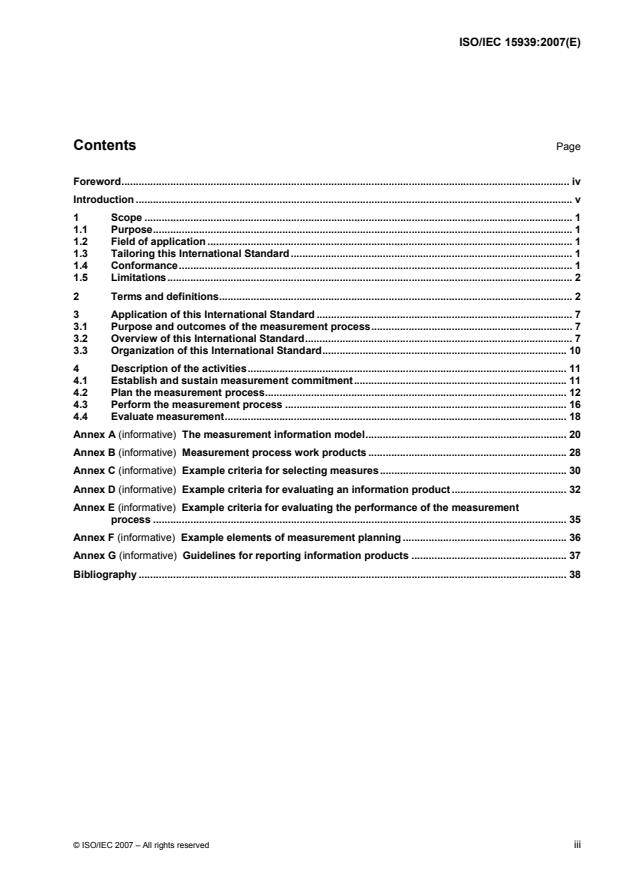
Contents Page
Foreword. iv
Introduction . v
1 Scope . 1
1.1 Purpose. 1
1.2 Field of application . 1
1.3 Tailoring this International Standard. 1
1.4 Conformance. 1
1.5 Limitations. 2
2 Terms and definitions. 2
3 Application of this International Standard . 7
3.1 Purpose and outcomes of the measurement process. 7
3.2 Overview of this International Standard. 7
3.3 Organization of this International Standard.10
4 Description of the activities. 11
4.1 Establish and sustain measurement commitment. 11
4.2 Plan the measurement process. 12
4.3 Perform the measurement process . 16
4.4 Evaluate measurement. 18
Annex A (informative) The measurement information model. 20
Annex B (informative) Measurement process work products . 28
Annex C (informative) Example criteria for selecting measures. 30
Annex D (informative) Example criteria for evaluating an information product. 32
Annex E (informative) Example criteria for evaluating the performance of the measurement
process . 35
Annex F (informative) Example elements of measurement planning . 36
Annex G (informative) Guidelines for reporting information products . 37
Bibliography . 38
© ISO/IEC 2007 – All rights reserved iii
Foreword
ISO (the International Organization for Standardization) and IEC (the International Electrotechnical
Commission) form the specialized system for worldwide standardization. National bodies that are members of
ISO or IEC participate in the development of International Standards through technical committees
established by the respective organization to deal with particular fields of technical activity. ISO and IEC
technical committees collaborate in fields of mutual interest. Other international organizations, governmental
and non-governmental, in liaison with ISO and IEC, also take part in the work. In the field of information
technology, ISO and IEC have established a joint technical committee, ISO/IEC JTC 1.
International Standards are drafted in accordance with the rules given in the ISO/IEC Directives, Part 2.
The main task of the joint technical committee is to prepare International Standards. Draft International
Standards adopted by the joint technical committee are circulated to national bodies for voting. Publication as
an International Standard requires approval by at least 75 % of the national bodies casting a vote.
Attention is drawn to the possibility that some of the elements of this document may be the subject of patent
rights. ISO and IEC shall not be held responsible for identifying any or all such patent rights.
ISO/IEC 15939 was prepared by Joint Technical Committee ISO/IEC JTC 1, Information technology,
Subcommittee SC 7, Software and systems engineering.
This second edition cancels and replaces the first edition (ISO/IEC 15939:2002), which has been technically
revised.
This corrected version of ISO/IEC 15939:2007 contains new cross-reference numbering in Figure 1, 3.3 and
Figure B.1, which was incorrect in the original version. It also updates all references to ISO/IEC 15288 and
ISO/IEC 12207 to the second editions, which have now been published.
iv © ISO/IEC 2007 – All rights reserved
Introduction
Measurement supports the management and improvement of processes and products. Measurement is a
primary tool for managing system and software life cycle activities, assessing the feasibility of project plans,
and monitoring the adherence of project activities to those plans. System and software measurement is also a
key discipline in evaluating the quality of products and the capability of organizational processes. It is
becoming increasingly important in two-party business agreements, where it provides a basis for specification,
management, and acceptance criteria.
Continual improvement requires change within the organization. Evaluation of change requires measurement.
Measurement itself does not initiate change. Measurement should lead to action and not be employed purely
to accumulate data. Measurements should have a clearly defined purpose.
This International Standard defines a measurement process applicable to system and software engineering
and management disciplines. The process is described through a model that defines the activities of the
measurement process that are required to adequately specify what measurement information is required, how
the measures and analysis results are to be applied, and how to determine if the analysis results are valid.
The measurement process is flexible, tailorable, and adaptable to the needs of different users.
The measurement process defined in this International Standard, while written for system and software
domains, can be applied in other domains.
© ISO/IEC 2007 – All rights reserved v
INTERNATIONAL STANDARD ISO/IEC 15939:2007(E)
Systems and software engineering — Measurement process
1 Scope
1.1 Purpose
This International Standard identifies the activities and tasks that are necessary to successfully identify, define,
select, apply and improve measurement within an overall project or organizational measurement structure. It
also provides definitions for measurement terms commonly used within the system and software industries.
This International Standard does not catalogue measures, nor does it provide a recommended set of
measures to apply on projects. It does identify a process that supports defining a suitable set of measures that
address specific information needs.
1.2 Field of application
This International Standard is intended to be used by suppliers and acquirers. Suppliers include personnel
performing management, technical and quality management functions in system and software development,
maintenance, integration and product support organizations. Acquirers include personnel performing
management, technical and quality management functions in procurement and user organizations.
The following are examples of how this International Standard can be used:
• by a supplier to implement a measurement process to address specific project or organizational
information requirements;
• by an acquirer (or third-party agents) for evaluating conformance of the supplier’s measurement process
to this International Standard;
• by an acquirer (or third-party agents) to implement a measurement process to address specific technical
and project management information requirements related to the acquisition;
• in a contract between an acquirer and a supplier as a method for defining the process and product
measurement information to be exchanged.
1.3 Tailoring this International Standard
This International Standard contains a set of activities and tasks that comprise a measurement process that
meets the specific needs of organizations, enterprises and projects. The tailoring process consists of
modifying the non-normative descriptions of the tasks to achieve the purpose and outcomes of the
measurement process. All normative clauses need to be satisfied. New activities and tasks not defined in this
International Standard may be added as part of tailoring.
1.4 Conformance
Conformance to this International Standard is defined as satisfying the purpose and outcomes of the
measurement process and all of the normative clauses within the tasks in Clause 4. Any organization
imposing this International Standard as a condition of trade is responsible for specifying and making public all
task-specific criteria to be imposed in conjunction with this International Standard.
© ISO/IEC 2007 – All rights reserved 1
Throughout this International Standard, “shall” is used to express a provision that is binding on the party that is
applying this International Standard, “should” to express a recommendation among other possibilities, and
“may” to indicate a course of action permissible within the limits of the International Standard.
It is the responsibility of the organization to maintain appropriate evidence of satisfaction of the normative
clauses for the purposes of demonstrating conformance.
1.5 Limitations
This International Standard does not assume or prescribe an organizational model for measurement. The user
of this International Standard should decide, for example, whether a separate measurement function is
necessary within the organization and whether the measurement function should be integrated within
individual projects or across projects, based on the current organizational structure, culture and prevailing
constraints.
This International Standard is not intended to prescribe the name, format or explicit content of the
documentation to be produced. This International Standard does not imply that documents be packaged or
combined in some fashion. These decisions are left to the user of this International Standard.
The measurement process should be appropriately integrated with the organizational quality system. Not all
aspects of internal audits and non-compliance reporting are covered explicitly in this International Standard as
they are assumed to be in the domain of the quality system.
This International Standard is not intended to conflict with any organizational policies, standards or procedures
that are already in place. However, any conflict should be resolved and any overriding conditions and
situations need to be cited in writing as exceptions to the application of this International Standard.
2 Terms and definitions
For the purposes of this document, the following terms and definitions apply.
2.1
acquirer
stakeholder that acquires or procures a product or service from a supplier
[ISO/IEC 15288:2008]
NOTE Other terms commonly used for an acquirer are buyer, customer, owner and purchaser.
2.2
attribute
property or characteristic of an entity that can be distinguished quantitatively or qualitatively by human or
automated means
2.3
base measure
measure defined in terms of an attribute and the method for quantifying it
NOTE 1 A base measure is functionally independent of other measures.
NOTE 2 Based on the definition of “base quantity” in the International Vocabulary of Basic and General Terms in
Metrology, 1993.
2.4
data
collection of values assigned to base measures, derived measures and/or indicators
2 © ISO/IEC 2007 – All rights reserved
2.5
data provider
individual or organization that is a source of data
2.6
data store
organized and persistent collection of data and information that allows for its retrieval
2.7
decision criteria
thresholds, targets, or patterns used to determine the need for action or further investigation, or to describe
the level of confidence in a given result
2.8
derived measure
measure that is defined as a function of two or more values of base measures
NOTE Adapted from the definition of “derived quantity” in the International Vocabulary of Basic and General Terms in
Metrology, 1993.
2.9
entity
object that is to be characterized by measuring its attributes
NOTE An entity can be a process, product, project or resource.
2.10
indicator
measure that provides an estimate or evaluation of specified attributes derived from a model with respect to
defined information needs
2.11
indicator value
numerical or categorical result assigned to an indicator
2.12
information need
insight necessary to manage objectives, goals, risks and problems
2.13
information product
one or more indicators and their associated interpretations that address an information need
EXAMPLE A comparison of a measured defect rate to planned defect rate along with an assessment of whether or
not the difference indicates a problem.
2.14
measurable concept
abstract relationship between attributes of entities and information needs
2.15
measure, noun
variable to which a value is assigned as the result of measurement
NOTE The plural form “measures” is used to refer collectively to base measures, derived measures and indicators.
2.16
measure, verb
make a measurement
[ISO/IEC 14598-1:1999]
© ISO/IEC 2007 – All rights reserved 3
2.17
measurement
set of operations having the object of determining a value of a measure
NOTE Adapted from the International Vocabulary of Basic and General Terms in Metrology, 1993.
2.18
measurement analyst
individual or organization that is responsible for the planning, performance, evaluation and improvement of
measurement
2.19
measurement experience base
data store that contains the evaluation of the information products and the measurement process as well as
any lessons learned during the measurement process
2.20
measurement function
algorithm or calculation performed to combine two or more base measures
2.21
measurement librarian
individual or organization that is responsible for managing the measurement data store(s)
2.22
measurement method
logical sequence of operations, described generically, used in quantifying an attribute with respect to a
specified scale
NOTE 1 The type of measurement method depends on the nature of the operations used to quantify an attribute. Two
types can be distinguished:
⎯ subjective: quantification involving human judgment;
⎯ objective: quantification based on numerical rules.
NOTE 2 Based on the definition of “method of measurement” in the International Vocabulary of Basic and General
Terms in Metrology, 1993.
2.23
measurement procedure
set of operations, described specifically, used in the performance of a particular measurement according to a
given method
[International Vocabulary of Basic and General Terms in Metrology, 1993]
2.24
measurement process
process for establishing, planning, performing and evaluating measurement within an overall project,
enterprise or organizational measurement structure
2.25
measurement process owner
individual or organization responsible for the measurement process
2.26
measurement sponsor
individual or organization that authorizes and supports the establishment of the measurement process
4 © ISO/IEC 2007 – All rights reserved
2.27
measurement user
individual or organization that uses the information products
2.28
model
algorithm or calculation combining one or more base and/or derived measures with associated decision
criteria
2.29
observation
instance of applying a measurement procedure to produce a value for a base measure
2.30
operator
entity that performs the operation of a system
2.31
organizational unit
part of an organization that is the subject of measurement
NOTE Adapted from ISO/IEC 15504-1:2004.
2.32
process
set of interrelated or interacting activities which transforms inputs into outputs
[ISO 9000:2005]
2.33
product
result of a process
[ISO 9000:2005]
NOTE There are four agreed generic product categories: hardware (e.g. engine mechanical part), software (e.g.
computer program), services (e.g. transport), and processed materials (e.g. lubricant). Hardware and processed materials
are generally tangible products, while software or services are generally intangible. Most products comprise elements
belonging to different generic product categories. Whether the product is then called hardware, processed material,
software or service depends on the dominant element.
2.34
project
endeavour with defined start and finish dates undertaken to create a product or service in accordance with
specified resources and requirements
NOTE 1 Adapted from ISO 9000:2005.
NOTE 2 A project may be viewed as a unique process comprising coordinated and controlled activities and may be
composed of activities from the Project Processes and Technical Processes defined in this International Standard.
2.35
scale
ordered set of values, continuous or discrete, or a set of categories to which the attribute is mapped
NOTE 1 The type of scale depends on the nature of the relationship between values on the scale. Four types of scale
are commonly defined:
⎯ nominal: the measurement values are categorical;
⎯ ordinal: the measurement values are rankings;
© ISO/IEC 2007 – All rights reserved 5
⎯ interval: the measurement values have equal distances corresponding to equal quantities of the attribute;
⎯ ratio: the measurement values have equal distances corresponding to equal quantities of the attribute, where the
value of zero corresponds to none of the attribute.
These are just examples of the types of scale. Roberts [15] defines more types of scale. Annex A contains examples of
each type of scale.
NOTE 2 Based on the definition of “scale (of a measuring instrument)” in the International Vocabulary of Basic and
General Terms in Metrology, 1993.
2.36
service
performance of activities, work or duties associated with a product
2.37
stakeholder
individual or organization having a right, share, claim or interest in a system or in its possession of characteristics
that meet their needs and expectations
NOTE Within this International Standard, an individual or organization that sponsors measurement, provides data, is
a user of the measurement results or otherwise participates in the measurement process.
2.38
supplier
organization or individual that enters into an agreement with the acquirer for the supply of a product or service
NOTE 1 Other terms commonly used for supplier are contractor, producer, seller and vendor.
NOTE 2 The acquirer and the supplier may be part of the same organization.
2.39
system
combination of interacting elements organized to achieve one or more stated purposes
NOTE A system may be considered as a product or as the services it provides.
2.40
unit of measurement
particular quantity, defined and adopted by convention, with which other quantities of the same kind are
compared in order to express their magnitude relative to that quantity
[International Vocabulary of Basic and General Terms in Metrology, 1993]
2.41
user
individual or group that benefits from a system during its utilization
2.42
value
numerical or categorical result assigned to a base measure, derived measure or indicator
6 © ISO/IEC 2007 – All rights reserved
3 Application of this International Standard
This clause presents an overview of the measurement process. The objective is to orient the users of this
International Standard so that they can apply it properly within context.
3.1 Purpose and outcomes of the measurement process
The purpose of the measurement process defined in this International Standard is to collect, analyze, and
report data relating to the products developed and processes implemented within the organizational unit, to
support effective management of the processes, and to objectively demonstrate the quality of the products. As
a result of successful implementation of the measurement process:
• organizational commitment for measurement is established and sustained;
• the information needs of technical and management processes are identified;
• an appropriate set of measures, driven by the information needs are identified and/or developed;
• measurement activities are identified;
• identified measurement activities are planned;
• the required data is collected, stored, analyzed, and the results interpreted;
• information products are used to support decisions and provide an objective basis for communication;
• the measurement process and measures are evaluated; and
• improvements are communicated to the measurement process owner.
3.2 Overview of this International Standard
This International Standard defines the activities and tasks necessary to implement a measurement process.
An activity is a set of related tasks that contributes towards achieving the purpose and outcomes of the
measurement process (see Clause 3.1). A task is a well-defined segment of work. Each activity is comprised
of one or more tasks. This International Standard does not specify the details of how to perform the tasks
included in the activities.
The properties of the activities of the measurement process that are defined in this International Standard are
the same properties defined in ISO/IEC 15288:2008 and ISO/IEC 12207:2008. This means that other
properties such as entry and exit criteria for each of the activities are not defined in this International Standard.
NOTE 1 This measurement process supports the measurement requirement defined in ISO 9001:2000, 8.2.
NOTE 2 This International Standard provides an elaboration of the measurement process from ISO/IEC 15288:2008
and ISO/IEC 12207:2008. More detail is provided via additional activities and tasks. As part of this elaboration, one
additional outcome (commitment is established and sustained) is added, with associated activities and tasks. This
outcome is addressed in ISO/IEC 15288:2008 and ISO/IEC 12207:2008 at the enterprise level.
The measurement process consists of four activities as illustrated in the process model in Figure 1. The
activities are sequenced in an iterative cycle allowing for continuous feedback and improvement of the
measurement process. The measurement process model in Figure 1 is an adaptation of the Plan-Do-Check-
Act cycle commonly used as the basis for quality improvement. Within activities, the tasks are also iterative.
The “Technical and Management Processes” of an organizational unit or project are not within the scope of
this International Standard, although they are an important external interface to the measurement activities
that are included in this International Standard.
© ISO/IEC 2007 – All rights reserved 7
Two activities are considered to be the Core Measurement Process: Plan the Measurement Process, and
Perform the Measurement Process. These activities mainly address the concerns of the measurement user.
The other two activities, Establish and Sustain Measurement Commitment and Evaluate Measurement,
provide a foundation for the Core Measurement Process and provide feedback to it. These latter two activities
address the concerns of the measurement process owner.
Figure 1 shows that the Core Measurement Process is driven by the information needs of the organization.
For each information need, the Core Measurement Process produces an information product that satisfies the
information need. The information product is conveyed to the organization as a basis for decision-making. The
link between measures and an information need is described as the Measurement Information Model in
Annex A. This annex also includes examples.
Performance of the normative activities and tasks defined in this International Standard satisfies at least the
Capability Level 1 requirements in ISO/IEC 15504-2:2003. However, the guidance included in this
International Standard provides the basis for implementing the measurement process at progressively higher
levels of capability.
The process defined in this International Standard includes an evaluation activity, as shown in Figure 1. The
intent is to emphasize that evaluation and feedback are an essential component of the measurement process,
and should lead to improvements of the measurement process and measures. Evaluation can be simple, and
performed in an ad hoc manner when capability is low, or it can be quantitative with sophisticated statistical
techniques to evaluate the quality of the measurement process and its outputs when capability is high.
Measures should be evaluated in terms of the added value they provide for the organization, and only
deployed where the benefit can be identified.
Included in the cycle is the “Measurement Experience Base”. This is intended to capture information products
from past iterations of the cycle, previous evaluations of information products, and evaluations of previous
iterations of the measurement process. This would include the measures that have been found to be useful in
the organizational unit. No assumptions are made about the nature or technology of this “Measurement
Experience Base”, only that it be a persistent storage. Artefacts (for example, information products, historical
data, and lessons learned) stored in the “Measurement Experience Base” are intended to be reused in future
iterations of the measurement process.
Since the process model is cyclical, subsequent iterations may only update measurement products and
practices. This International Standard does not imply that measurement products and practices need to be
developed and implemented for each iteration of the process. The wording used in this International Standard
adopts the convention that one is implementing the measurement process for the first time (i.e., the first
iteration). During subsequent iterations, this wording should be interpreted as updating or changing
documentation and current practices.
The typical functional roles mentioned in this International Standard are: stakeholder, sponsor, measurement
user, measurement analyst, measurement librarian, data provider, and measurement process owner. These
are defined in Clause 2 of this International Standard.
A number of work products are produced during the performance of the measurement process. The work
products are described in Annex B, and mapped to the tasks that produce them.
8 © ISO/IEC 2007 – All rights reserved
© ISO/IEC 2007 – All rights reserved 9
3.3 Organization of this International Standard
In this International Standard, clauses “4.a” denotes an activity, and “4.a.b” a task. Clauses labelled “4.a.b.c”
are normative for the particular task. The outline structure of the activities and their constituent tasks is as
follows:
4.1: Establish and sustain measurement commitment
4.1.1: Accept the requirements for measurement
4.1.1.1: The scope of measurement shall be identified.
4.1.1.2: Commitment of management and staff to measurement shall be established.
4.1.1.3: Commitment shall be communicated to the organizational unit.
4.1.2: Assign resources
4.1.2.1: Individuals shall be assigned responsibility for the measurement process
within the organizational unit.
4.1.2.2: The assigned individuals shall be provided with resources to plan the
measurement process.
4.2: Plan the measurement process
4.2.1: Characterize organizational unit
4.2.1.1: Characteristics of the organizational unit that are relevant to selecting
measures and interpreting the information products shall be explicitly
described.
4.2.2: Identify information needs
4.2.2.1: Information needs for measurement shall be identified.
4.2.2.2: The identified information needs shall be prioritized.
4.2.2.3: Information needs to be addressed shall be selected.
4.2.2.4: Selected information needs shall be documented and communicated.
4.2.3: Select measures
4.2.3.1: Candidate measures that satisfy the selected information needs shall be
identified.
4.2.3.2: Measures shall be selected from the candidate measures.
4.2.3.3: Selected measures shall be documented by their name, the unit of
measurement, their formal definition, the method of data collection, and their
link to the information needs.
4.2.4: Define data collection, analysis, and reporting procedures
4.2.4.1: Procedures for data collection, including storage and verification shall be
defined.
4.2.4.2: Procedures for data analysis and reporting of information products shall be
defined.
4.2.4.3: Configuration management procedures shall be defined.
4.2.5: Define criteria for evaluating the information products and the measurement process
4.2.5.1: Criteria for evaluating information products shall be defined.
4.2.5.2: Criteria for evaluating the measurement process shall be defined.
4.2.6: Review, approve, and provide resources for measurement tasks
4.2.6.1: The results of measurement planning shall be reviewed and approved.
4.2.6.2: Resources shall be made available for implementing the planned
measurement tasks.
4.2.7: Acquire and deploy supporting technologies
4.2.7.1: Available supporting technologies shall be evaluated and appropriate ones
selected.
4.2.7.2: The selected supporting technologies shall be acquired and deployed
10 © ISO/IEC 2007 – All rights reserved
4.3: Perform the measurement process
4.3.1: Integrate procedures
4.3.1.1: Data generation and collection shall be integrated into the relevant processes.
4.3.1.2: The integrated data collection procedures shall be communicated to the data
providers.
4.3.1.3: Data analysis and reporting shall be integrated into the relevant processes.
4.3.2: Collect data
4.3.2.1: Data shall be collected.
4.3.2.2: The collected data shall be stored, including any context information
necessary to verify, understand, or evaluate the data.
4.3.2.3: The collected data shall be verified.
4.3.3: Analyze data and develop information products
4.3.3.1: The collected data shall be analyzed.
4.3.3.2: The data analysis results shall be interpreted.
4.3.3.3: The information products shall be reviewed.
4.3.4: Communicate results
4.3.4.1: The information products shall be documented.
4.3.4.2: The information products shall be communicated to the measurement users.
4.4: Evaluate measurement
4.4.1: Evaluate information products and the measurement process
4.4.1.1: The information products shall be evaluated against the specified evaluation
criteria and conclusions on strengths and weaknesses of the information
products drawn.
4.4.1.2: The measurement process shall be evaluated against the specified
evaluation criteria and conclusions on strengths and weaknesses of the
measurement process drawn.
4.4.1.3: Lessons learned from the evaluation shall be stored in the “Measurement
Experience Base”.
4.4.2: Identify potential improvements
4.4.2.1: Potential improvements to the information products shall be identified.
4.4.2.2: Potential improvements to the measurement process shall be identified.
4.4.2.3: Potential improvements shall be communicated.
The activities are described in the order in which they usually are performed. However, iteration from one
activity to the preceding activity frequently occurs. The order in which the tasks for each activity are presented
does not necessarily imply an order of implementation of the tasks. For each task, one or more normative
requirements on the implementation of the task are defined. For many tasks there is also informative guidance
to help with the interpretation of the normative requirements and the tasks’ implementation in practice. This
guidance is presented in italics.
The informative lists within the task definitions and in the annexes are not presumed to be exhaustive — they
are intended only as examples.
4 Description of the activities
In implementing a measurement process in compliance with this International Standard, the organizational
unit shall perform the activities described below. The “Requirements for Measurement” from the Technical and
Management processes trigger the measurement process.
4.1 Establish and sustain measurement commitment
This activity consists of the following tasks:
1) Accept the requirements for measurement.
2) Assign resources.
© ISO/IEC 2007 – All rights reserved 11
4.1.1 Accept the requirements for measurement
4.1.1.1 The scope of measurement shall be identified.
The scope of measurement defines an organizational unit for purposes of this standard. This may be a single project, a
functional area, the whole enterprise, a single site, or a multi-site organization. This may consist of projects or supporting
processes, or both. All subsequent measurement tasks should be within the defined scope.
The scope of the organizational unit can be identified through interviews and the inspection of documentation, such as
organizational charts.
In addition, all stakeholders should be identified. For example, these may be project managers, the Information Systems
manager, or the head of Quality Management. The stakeholders may be internal or external to the organizational unit.
The purpose for measurement should be identified by the stakeholders.
4.1.1.2 Commitment of management and staff to measurement shall be established.
Commitment should be established when “Requirements for Measurement” are defined (see Figure 1).
This includes the commitment of resources to the measurement process and the willingness to maintain this commitment.
The organizational unit should demonstrate its commitment through, for example, a measurement policy for the
organizational unit, allocation of responsibility and duties, training, and the allocation of budget and other resources.
Commitment may also come in the form of a contract with an acquirer requiring measurement.
4.1.1.3 Commitment shall be communicated to the organizational unit.
This can be achieved, for example, through organizational unit-wide announcements or newsletters.
4.1.2 Assign resources
4.1.2.1 Individuals shall be assigned responsibility for the measurement process within the organizational
unit.
The sponsor of measurement should ensure that this responsibility is assigned to competent individuals. Competent
individuals may be acquired through transfer, coaching, training, sub-contracting and/or hiring. Competence includes
knowledge of the principles of measurement, how to collect data, perform data analysis, and communicate the information
products. At a minimum, individuals should be assigned the responsibility for the following typical roles:
• measurement user;
• measurement analyst;
• measurement librarian.
The number of roles shown above does not imply the specific number of people needed to perform the roles. The number
of people is dependent on the size and structure of the organizational unit. These roles could be performed by as few as
one person for a small project.
4.1.2.2 The assigned individuals shall be provided with resources to plan the measurement process.
The sponsor of measurement should be responsible for ensuring that resources are provided. Resources include funding
and staff. Resource allocations may be updated in the course of activity 4.2.
4.2 Plan the measurement process
This activity consists of the following tasks:
1) Characterize organizational unit.
2) Identify information needs.
3) Select measures.
12 © ISO/IEC 2007 – All rights reserved
4) Define data collection, analysis, and reporting procedures.
5) Define criteria for evaluating the information products and the measurement process.
6) Review, approve, and provide resources for measurement tasks.
7) Acquire and deploy supporting technologies.
Information products and evaluation results in the “Measurement Experience Base” should be consulted
during the performance of this activity.
Examples of the measurement planning details that need to be addressed during this activity are described in
Annex F.
4.2.1 Characterize organizational unit
4.2.1.1 Characteristics of the organizational unit that are relevant to selecting measures and interpreting
the information products shall be explicitly described.
The organizational unit provides the context for measurement, and therefore it is important to make explicit this context
and the assumptions that it embodies and constraints that it imposes. Characterization can be in terms of organizational
processes, application domains, technology, interfaces amongst divisions/departments and organizational structure.
Processes may be characterized in the form of a descriptive process model.
This task is similar in nature to task 4.1.1.1. However, this task produces more detailed information than the scoping
performed in task 4.1.1.1.
The organizational unit characterization should be taken into account in all subsequent activities and tasks.
4.2.2 Identify information needs
4.2.2.1 Information needs for measurement shall be identified.
Information needs originate from the technical and management processes. Information needs are based on: goals,
constraints, risks, and problems of the organizational unit. The information needs may be derived from the business,
organizational, regulatory (such as legal or governmental), product and/or project objectives.
Information needs may address questions such as: “how do I estimate the productivity of a future project?”, “how do I
evaluate the product quality during design?”, and “how do I know the status of the coding activity?”.
Useful guidance on risks that may be a source for information needs can be found in ISO/IEC 16085:2006.
4.2.2.2 The identified information needs shall be prioritized.
This prioritization is normally accomplished by, or in conjunction with, the stakeholders. Only a subset of the initial
information needs may be pursued further. This is particularly relevant if measurement is being tried for the first time within
an organizational unit, where it is preferable to start small.
An example of a simple and concrete prioritization approach is to ask a group of stakeholders to rank the information
needs. For each information need calculate the average rank. Then order the average ranks. This ordering provides a
prioritization of the information needs.
4.2.2.3 Information needs to be addressed shall be selected.
From the prioritized information needs, a subset is selected to be addressed during the measurement process. This
selection is likely driven by a trade-off among resource constraints, and criticality/urgency of information needs.
In large development efforts, information that is needed later may be identified, but not fully defined nor implemented until
it is required by the measurement users.
© ISO/IEC 2007 – All rights reserved 13
4.2.2.4 Selected information needs shall be documented and communicated.
No assumptions are made about the type of documentation. It can be paper or electronic. It is only necessary that the
documentation is retrievable.
The selected information needs should be communicated to all stakeholders. This is to ensure that they understand why
certain data are to be collected and how they are to be used.
4.2.3 Select measures
4.2.3.1 Candidate measures that satisfy the selected information needs shall be identified.
There should be a clear link between the information needs and the candidate measures. Such a link can be made using
the measurement information model described in Annex A.
New measures should be defined in sufficient detail to allow for a selection decision (task 4.2.3.2). Other International
Standards, see the Bibliography, describe some commonly used measures and requirements for their definition.
A new measure may involve an adaptation of an existing measure.
4.2.3.2 Measures shall be selected from the candidate measures.
The selected measures should reflect the priority of the information needs. Further example criteria that may be used for
the selection of measures are included in Annex C.
Context information necessary to interpret or normalize measures also should be considered. For example, when
comparing “lines of code” from different sources, the programming language has to be specified or when comparing
requirements information from differe
...
Questions, Comments and Discussion
Ask us and Technical Secretary will try to provide an answer. You can facilitate discussion about the standard in here.
Loading comments...