

ISO 11999-6:2024
(Main)PPE for firefighters — Test methods and requirements for PPE used by firefighters who are at risk of exposure to high levels of heat and/or flame while fighting fires occurring in structures — Part 6: Footwear
General Information
- Abstract
This document specifies the minimum design and performance requirements for footwear as part of personal protective equipment [PPE] to be used by firefighters, primarily but not solely to protect against flame and high thermal loads while fighting fires occurring in structures.
- Status
- Published
- Publication Date
- 13-Aug-2024
- Technical Committee
- ISO/TC 94/SC 14 - Firefighters' personal equipment
- Drafting Committee
- ISO/TC 94/SC 14 - Firefighters' personal equipment
- Current Stage
- 6060 - International Standard published
- Start Date
- 14-Aug-2024
- Due Date
- 15-Aug-2025
- Completion Date
- 14-Aug-2024
Buy Documents


ISO 11999-6:2024 - PPE for firefighters — Test methods and requirements for PPE used by firefighters who are at risk of exposure to high levels of heat and/or flame while fighting fires occurring in structures — Part 6: Footwear Released:14. 08. 2024
Overview
ISO 11999-6:2024 - part of the ISO 11999 series - defines minimum design and performance requirements and associated test methods for firefighting footwear used by firefighters at risk of exposure to high heat and flame in structural fires. This second edition updates the 2016 edition, consolidates performance levels, and aligns footwear testing and classification with current ISO and EN footwear standards.
Key topics and technical requirements
The standard addresses both design and performance elements of firefighter boots and shoes, including:
- Classification: Footwear is classified by construction type (e.g., leather/combined materials versus all-polymeric/all-rubber footwear).
- General requirements: Material selection, sizing, innocuousness (absence of harmful substances), and overall construction expectations.
- Thermal behaviour:
- Insulation against heat (requirements and test methods)
- Radiant heat resistance testing (reference to ISO 6942)
- Flame resistance (methodology aligned with flame spread tests)
- Chemical resistance:
- Degradation and permeation resistance testing
- Requirements for limited-contact chemical exposures
- Electrical properties:
- Criteria for electrically insulating footwear
- Antistatic footwear provisions
- Water resistance: Performance expectations for exposure to moisture
- Outsole design: Cleat geometry, cleat height, waist and heel features that affect traction and stability
- Zippers and fasteners: Construction, puller attachment strength and lateral strength tests
- Sampling and conditioning: Procedures for preparing test specimens
- Marking and user information: Required labeling and supplied documentation for end users
The document also references established footwear test standards (ISO 20344/20345 and EN 13832) and includes normative and informative annexes on laboratory and wearer assessment, performance evaluation, and slip resistance.
Applications and who uses it
ISO 11999-6:2024 is used by:
- PPE and footwear manufacturers for design, specification and compliance testing of firefighting boots
- Testing laboratories and certification bodies to perform standardized thermal, flame, chemical and mechanical tests
- Fire services and procurement officers to specify compliant footwear for structural firefighting
- Occupational safety professionals, designers and standards developers** seeking harmonized requirements for firefighter PPE
Related standards
- ISO 11999-1 (General)
- ISO 20344 / ISO 20345 (+ Amendment 1:2024) - footwear test methods and safety footwear
- ISO 6942 - radiant heat testing
- ISO 15025 - flame spread testing
- EN 13832 - chemical-resistant footwear
Keywords: ISO 11999-6:2024, PPE for firefighters, firefighting footwear, thermal protection, flame resistant footwear, chemical resistant footwear, electrically insulating footwear, antistatic, test methods, safety standards.
Relations
- Effective Date
- 06-Jun-2022
Buy Documents
ISO 11999-6:2024 - PPE for firefighters — Test methods and requirements for PPE used by firefighters who are at risk of exposure to high levels of heat and/or flame while fighting fires occurring in structures — Part 6: Footwear Released:14. 08. 2024
Get Certified
Connect with accredited certification bodies for this standard

CIS Institut d.o.o.
Personal Protective Equipment (PPE) certification body. Notified Body NB-2890 for EU Regulation 2016/425 PPE.

Kiwa BDA Testing
Building and construction product certification.
Kmetijski inštitut Slovenije
Agricultural Institute of Slovenia. Soil testing, plant health, agricultural product analysis.
Sponsored listings
Frequently Asked Questions
ISO 11999-6:2024 is a standard published by the International Organization for Standardization (ISO). Its full title is "PPE for firefighters — Test methods and requirements for PPE used by firefighters who are at risk of exposure to high levels of heat and/or flame while fighting fires occurring in structures — Part 6: Footwear". This standard covers: This document specifies the minimum design and performance requirements for footwear as part of personal protective equipment [PPE] to be used by firefighters, primarily but not solely to protect against flame and high thermal loads while fighting fires occurring in structures.
This document specifies the minimum design and performance requirements for footwear as part of personal protective equipment [PPE] to be used by firefighters, primarily but not solely to protect against flame and high thermal loads while fighting fires occurring in structures.
ISO 11999-6:2024 is classified under the following ICS (International Classification for Standards) categories: 13.340.50 - Leg and foot protection. The ICS classification helps identify the subject area and facilitates finding related standards.
ISO 11999-6:2024 has the following relationships with other standards: It is inter standard links to ISO 11999-6:2016. Understanding these relationships helps ensure you are using the most current and applicable version of the standard.
ISO 11999-6:2024 is available in PDF format for immediate download after purchase. The document can be added to your cart and obtained through the secure checkout process. Digital delivery ensures instant access to the complete standard document.
Standards Content (Sample)
International
Standard
ISO 11999-6
Second edition
PPE for firefighters — Test methods
2024-08
and requirements for PPE used
by firefighters who are at risk of
exposure to high levels of heat
and/or flame while fighting fires
occurring in structures —
Part 6:
Footwear
Équipement de protection individuelle pour pompiers —
Méthodes d'essai et exigences pour les équipements de protection
individuelle utilisés par les pompiers qui risquent d'être exposés
à des niveaux élevés de chaleur et/ou de flamme lorsqu'ils
combattent des incendies dans des structures —
Partie 6: Chaussures
Reference number
© ISO 2024
All rights reserved. Unless otherwise specified, or required in the context of its implementation, no part of this publication may
be reproduced or utilized otherwise in any form or by any means, electronic or mechanical, including photocopying, or posting on
the internet or an intranet, without prior written permission. Permission can be requested from either ISO at the address below
or ISO’s member body in the country of the requester.
ISO copyright office
CP 401 • Ch. de Blandonnet 8
CH-1214 Vernier, Geneva
Phone: +41 22 749 01 11
Email: copyright@iso.org
Website: www.iso.org
Published in Switzerland
ii
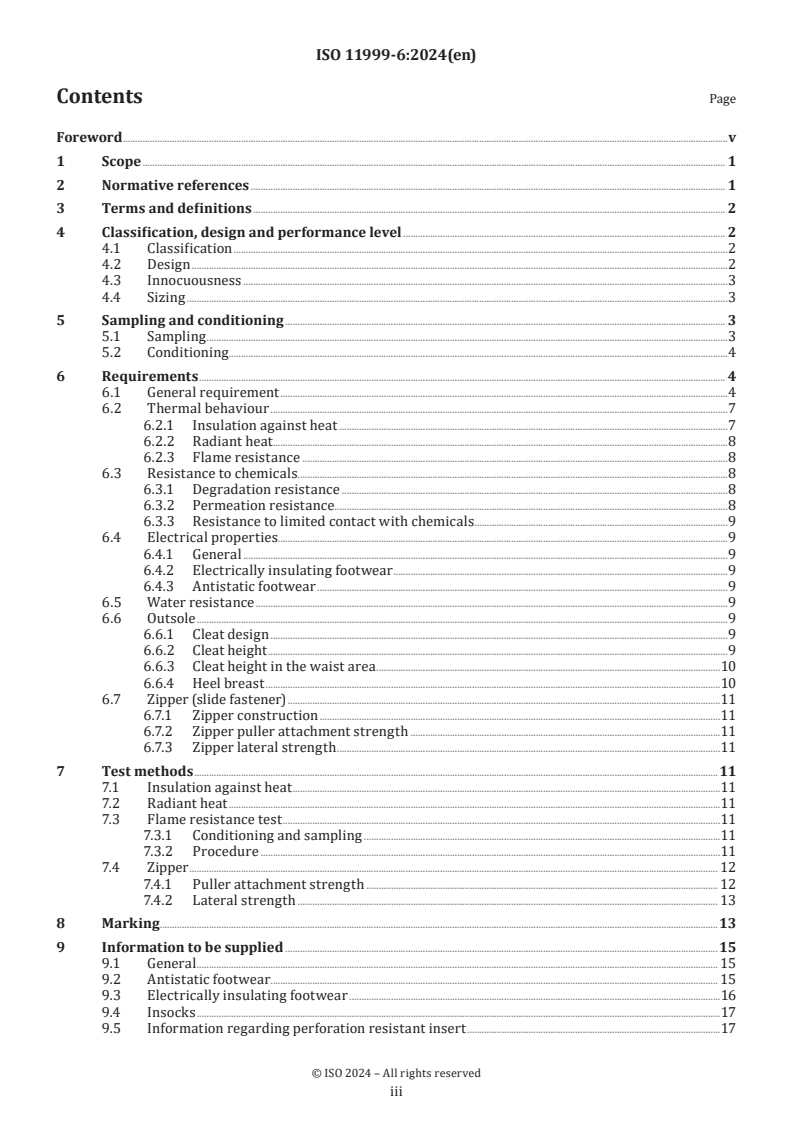
Contents Page
Foreword .v
1 Scope . 1
2 Normative references . 1
3 Terms and definitions . 2
4 Classification, design and performance level . 2
4.1 Classification .2
4.2 Design .2
4.3 Innocuousness .3
4.4 Sizing .3
5 Sampling and conditioning . 3
5.1 Sampling .3
5.2 Conditioning.4
6 Requirements . 4
6.1 General requirement .4
6.2 Thermal behaviour .7
6.2.1 Insulation against heat .7
6.2.2 Radiant heat .8
6.2.3 Flame resistance .8
6.3 Resistance to chemicals.8
6.3.1 Degradation resistance .8
6.3.2 Permeation resistance.8
6.3.3 Resistance to limited contact with chemicals .9
6.4 Electrical properties.9
6.4.1 General .9
6.4.2 Electrically insulating footwear .9
6.4.3 Antistatic footwear .9
6.5 Water resistance .9
6.6 Outsole .9
6.6.1 Cleat design .9
6.6.2 Cleat height .9
6.6.3 Cleat height in the waist area .10
6.6.4 Heel breast .10
6.7 Zipper (slide fastener) .11
6.7.1 Zipper construction .11
6.7.2 Zipper puller attachment strength .11
6.7.3 Zipper lateral strength .11
7 Test methods .11
7.1 Insulation against heat .11
7.2 Radiant heat .11
7.3 Flame resistance test .11
7.3.1 Conditioning and sampling .11
7.3.2 Procedure .11
7.4 Zipper . 12
7.4.1 Puller attachment strength . 12
7.4.2 Lateral strength . 13
8 Marking . .13
9 Information to be supplied .15
9.1 General . 15
9.2 Antistatic footwear. 15
9.3 Electrically insulating footwear .16
9.4 Insocks .17
9.5 Information regarding perforation resistant insert .17
iii
Annex A (normative) Assessment of the footwear by the laboratory during testing for resistance
to heat and flame .18
Annex B (informative) Assessment of the footwear by the wearer .20
Annex C (Normative) Assessment of the performance of the footwear .22
Annex D (informative) Slip resistance .23
Bibliography .26
iv
Foreword
ISO (the International Organization for Standardization) is a worldwide federation of national standards
bodies (ISO member bodies). The work of preparing International Standards is normally carried out through
ISO technical committees. Each member body interested in a subject for which a technical committee
has been established has the right to be represented on that committee. International organizations,
governmental and non-governmental, in liaison with ISO, also take part in the work. ISO collaborates closely
with the International Electrotechnical Commission (IEC) on all matters of electrotechnical standardization.
The procedures used to develop this document and those intended for its further maintenance are described
in the ISO/IEC Directives, Part 1. In particular, the different approval criteria needed for the different types
of ISO document should be noted. This document was drafted in accordance with the editorial rules of the
ISO/IEC Directives, Part 2 (see www.iso.org/directives).
ISO draws attention to the possibility that the implementation of this document may involve the use of (a)
patent(s). ISO takes no position concerning the evidence, validity or applicability of any claimed patent
rights in respect thereof. As of the date of publication of this document, ISO had not received notice of (a)
patent(s) which may be required to implement this document. However, implementers are cautioned that
this may not represent the latest information, which may be obtained from the patent database available at
www.iso.org/patents. ISO shall not be held responsible for identifying any or all such patent rights.
Any trade name used in this document is information given for the convenience of users and does not
constitute an endorsement.
For an explanation of the voluntary nature of standards, the meaning of ISO specific terms and expressions
related to conformity assessment, as well as information about ISO's adherence to the World Trade
Organization (WTO) principles in the Technical Barriers to Trade (TBT), see www.iso.org/iso/foreword.html.
This document was prepared by Technical Committee ISO/TC 94, Personal safety — Protective clothing and
equipment, Subcommittee SC 14, Firefighters' personal equipment.
This second edition of ISO 11999-6 cancels and replaces the first edition (ISO 11999-6:2016), which has
been technically revised.
The main changes are as follows:
— Level A1 and A2 deleted to provide a single level of performance;
— insertion of updated ISO 20345:2021/Amd 1:2024 references;
— references to ISO 20344:2011 and ISO 20345:2011 have been deleted;
— chemical resistant footwear requirements and method updated.
— flame resistance requirements and method updated.
— insulation against Heat requirements updated.
— Tables 2 and 3 have been updated.
A list of all parts in the ISO 11999 series can be found on the ISO website.
Any feedback or questions on this document should be directed to the user’s national standards body. A
complete listing of these bodies can be found at www.iso.org/members.html.
v
International Standard ISO 11999-6:2024(en)
PPE for firefighters — Test methods and requirements for
PPE used by firefighters who are at risk of exposure to high
levels of heat and/or flame while fighting fires occurring in
structures —
Part 6:
Footwear
1 Scope
This document specifies the minimum design and performance requirements for footwear as part of
personal protective equipment [PPE] to be used by firefighters, primarily but not solely to protect against
flame and high thermal loads while fighting fires occurring in structures.
2 Normative references
The following documents are referred to in the text in such a way that some or all of their content constitutes
requirements of this document. For dated references, only the edition cited applies. For undated references,
the latest edition of the referenced document (including any amendments) applies.
ISO 868, Plastics and ebonite — Determination of indentation hardness by means of a durometer (Shore
hardness)
ISO 6942:2022, Protective clothing — Protection against heat and fire — Method of test: Evaluation of materials
and material assemblies when exposed to a source of radiant heat
ISO 15025, Protective clothing — Protection against flame — Method of test for limited flame spread
ISO 11999-1, PPE for firefighters — Test methods and requirements for PPE used by firefighters who are at risk
of exposure to high levels of heat and/or flame while fighting fires occurring in structures — Part 1: General
ISO 20344:2021, Personal protective equipment — Test methods for footwear
ISO 20344:2021/Amd 1:2024, Personal protective equipment — Test methods for footwear — Amendment 1
ISO 20345:2021, Personal protective equipment — Safety footwear
ISO 20345:2021/Amd 1:2024, Personal protective equipment — Safety footwear — Amendment 1
EN 13832-1:2018, Footwear protecting against chemicals — Part 1: Terminology and test methods
EN 13832-3:2018, Footwear protecting against chemicals — Part 3: Requirements for footwear highly resistant
to chemicals under laboratory conditions
ISO 13994, Clothing for protection against liquid chemicals — Determination of the resistance of protective
clothing materials to penetration by liquids under pressure
EN 50321-1:2018, Live Working – Footwear for Electrical protection – Insulating footwear and overboots
3 Terms and definitions
For the purposes of this document, the terms and definitions given in ISO 20344, ISO 11999-1 and EN 13832-
1 apply.
ISO and IEC maintain terminology databases for use in standardization at the following addresses:
— ISO Online browsing platform: available at https:// www .iso .org/ obp
— IEC Electropedia: available at https:// www .electropedia .org/
4 Classification, design and performance level
4.1 Classification
Footwear shall be classified in accordance with Table 1.
Table 1 — Classification of footwear
Classification Description
Class I Footwear made from leather and other materials, excluding
all-rubber or all-polymeric footwear
Class II All-polymeric (i.e. entirely moulded) including all-rubber (i.e. en-
tirely vulcanized) footwear
4.2 Design
Footwear shall conform to one of the designs C to E given in Figure 1.
Key
A low shoe
B ankle boot
C half-knee boot
D knee-height boot
E thigh boot
a
Variable extension which can be adapted to the wearer.
NOTE Design E can be a knee-height boot (design D) equipped with a thin impermeable material which extends
the upper and which can be cut to adapt the boot to the wearer.
Figure 1 — Design of footwear
4.3 Innocuousness
Refer to ISO 20345:2021 and ISO 20345:2021/Amd 1:2024, 5.3.6.
4.4 Sizing
Manufacturers shall develop a sizing range of footwear based on anthropometric data.
5 Sampling and conditioning
5.1 Sampling
The minimum number of samples shall be that specified in ISO 20344:2021 and ISO 20344:2021/Amd 1:2024,
Clause 4, together with the minimum number of test pieces taken from each sample, as given in Table 2,
unless otherwise stated within this standard.
Wherever possible, test pieces shall be taken from the whole footwear unless otherwise stated in this
document or in ISO 20344.
If it is not possible to obtain a large enough test piece from the footwear, then a sample of the material or
material combination from which the component has been manufactured can be used instead and this shall
be noted in the test report.
Where samples are required from each of three sizes, these shall comprise of the largest, smallest and a
middle size of the footwear under test.
5.2 Conditioning
All test pieces shall be conditioned in a standard atmosphere of (23 ± 2) °C and (50 ± 5) % relative humidity
for a minimum of 24 hours before testing, unless otherwise stated in the test method.
The maximum time which shall elapse between removal from the conditioning atmosphere and the start of
testing shall be not greater than 10 min, unless otherwise stated in the test method.
Each test piece shall individually satisfy the specific requirement, unless otherwise stated in the test method.
The uncertainty of measurement for each test method described in the present standard can be assessed.
One of the following approaches should be used:
— a statistical method, e.g. as given in ISO 5725-2;
— a mathematical method, e.g. as given in ISO/IEC Guide 98-1;
— Uncertainty and conformity assessments given in ISO/IEC Guide 98-4;
— JCGM 100:2008.
Table 2 — Minimum number of samples and test pieces
Property to be Number of Number of test pieces Test only on the
Reference
a
determined samples from each sample final footwear
Insulation against heat 6.2.1 one pair See 7.1 Yes
Radiant heat 6.2.2 one pair See 7.2 Yes
Flame resistance 6.2.3 one pair See 7.3 Yes
ISO 20345:2021,
Scuff cap abrasion one scuff cap Two test pieces No
6.2.9
Zipper puller attachment strength 6.7.2 three zippers No
Zipper lateral strength 6.7.3 three zippers No
a
ISO 20344:2021 and ISO 20344:2021/Amd 1:2024, Table 1, applies.
6 Requirements
6.1 General requirement
Footwear for firefighters shall conform to the requirements specified in Table 3.
Customized safety footwear shall conform to the requirements given in ISO 20345:2021, Table 3 and
Annex A.
Table 3 — General requirement
Requirement Reference Classification of footwear Marking
symbol
ISO This document Class I Class II
20345:2021 and ISO
20345:2021/Amd
1:2024
a a
General Footwear con- Type and classifi- 4.1
struction cation
a a
Height of upper 5.2.2
a a
Specific ergonomic 5.3.4
feature
a
Leakproofness 5.3.3 N/A
a
Water resistance 6.5 N/A WR
a a
Heel Area Design C, D and E 5.2.3
a
Whole foot- Constructional Construction 5.3.1.1 N/A
wear performance
a
Upper/outsole bond 5.3.1.2 N/A
strength
Insulation against 6.2.1 a a
heat
a a
Slip resistance 5.3.5.2 See
6.2.10 Annex D
a a
Energy absorption 6.2.4 E
of seat region
a a
Flame resistance 6.2.3
a a
Perforation resist- 6.2.1 P
ance
PL
PS
a a
Toe protection General 5.3.2.1
a a
Internal length of 5.3.2.2
toe caps
a a
Width of Toecap 5.3.2.3
Flange
a a
Impact resistance 5.3.2.6
a a
Compression resist- 5.3.2.7
ance
a a
Corrosion resist- 5.3.2.4
ance of metal toe
caps
a a
Behaviour of Toe- 5.3.2.5
caps
(Thermal and
Chemical)
N/A a
Electrical property Electrically insulat- 6.4.2 EN 50321 -1
d
ing footwear : 2018
d a N/A
Antistatic footwear 6.4.3 A
c c
Resistance to Cold insulation of 6.2.3.2 CI
inimical sole complex
environment
c
Resistance to chem- 6.3.1/6.3.2 N/A CH
icals
c N/A
6.3.3 CH
The applicability of requirement to a particular classification is indicated in this table by the following:
a
Means that the requirement shall be met. In some cases, the requirement relates only to particular materials within the classification,. This does not mean
that other materials are precluded from use.
b
Means that if the component parts exists, the requirement shall be met.
c
Means that if the property is claimed, the requirement given in the appropriate clause shall be met.
d
One of the Two shall be chosen
N/A means the requirement is not applicable.
TTaabblle 3 e 3 ((ccoonnttiinnueuedd))
Requirement Reference Classification of footwear Marking
symbol
ISO This document Class I Class II
20345:2021 and ISO
20345:2021/Amd
1:2024
b b
Zipper 6.7
c c
Metatarsal protec- 6.2.6 M
Accessories
tion
c c
Ankle protection 6.2.7 AN
a a
Innocuousness 5.3.6
Requirement
a
Upper Thickness 5.4.2 N/A
a
Tear strength 5.4.3 N/A
a a
Tensile properties 5.4.4
a
Flexing resistance 5.4.5 N/A
a
Water vapour 5.4.6 N/A
permeability &coef-
ficient
a
Hydrolysis 5.4.7 N/A
a
Water penetration 6.3.1 N/A WPA
Water absorption
a a
Radiant heat 6.2.2
a a
Flame resistance 6.2.3
c c
Cut resistance 6.2.8 CR
b b
Scuff cap abrasion 6.2.9 SC
a
Lining Vamp Tear strength 5.5.2 N/A
a
Abrasion resistance 5.5.3 N/A
a
Water vapour 5.5.4 N/A
permeability &coef-
ficient
b
Quarter Tear strength 5.5.2 N/A
b
Abrasion resistance 5.5.3 N/A
b
Water vapour 5.5.4 N/A
permeability &coef-
ficient
b
Tongue Tear strength 5.6.2 N/A
a b
Insole/insocks See Table 4
a a
Outsole Tear strength 5.8.3
a a
Abrasion resistance 5.8.4
a a
Flexing resistance 5.8.5
a a
Hydrolysis 5.8.6
b b
Interlayer bond 5.8.7
strength
a a
Resistance to fuel oil 6.4.2
a a
Cleated area 5.8.2.2
a a
Thickness 5.8.2.1
a a
Cleat design 6.6.1
The applicability of requirement to a particular classification is indicated in this table by the following:
a
Means that the requirement shall be met. In some cases, the requirement relates only to particular materials within the classification,. This does not mean
that other materials are precluded from use.
b
Means that if the component parts exists, the requirement shall be met.
c
Means that if the property is claimed, the requirement given in the appropriate clause shall be met.
d
One of the Two shall be chosen
N/A means the requirement is not applicable.
TTaabblle 3 e 3 ((ccoonnttiinnueuedd))
Requirement Reference Classification of footwear Marking
symbol
ISO This document Class I Class II
20345:2021 and ISO
20345:2021/Amd
1:2024
a a
Cleat height 6.6.2
a a
Cleat height in the 6.6.3
waist area
a a
Heel breast 6.6.4 LG
a a
Resistance to hot 6.4.1
contact
The applicability of requirement to a particular classification is indicated in this table by the following:
a
Means that the requirement shall be met. In some cases, the requirement relates only to particular materials within the classification,. This does not mean
that other materials are precluded from use.
b
Means that if the component parts exists, the requirement shall be met.
c
Means that if the property is claimed, the requirement given in the appropriate clause shall be met.
d
One of the Two shall be chosen
N/A means the requirement is not applicable.
Table 4 — Basic requirements for insoles and/or insocks
Options Component to Requirements to fulfill in ISO 20345:2021/Amd 1:2024
be assessed
Thickness Water absorption Abrasion
desorption
Insole Insock
a a a
1 No insole or Non-removable Insock N/A
if present not insock
fulfilling the
requirements
a a a
2 Insole present No insock Insole N/A
a
Seat sock pres- Seat sock N/A N/A N/A
ent
a a
3 Full insock, Insock and N/A N/A
non-removable insole
a
Insock N/A N/A N/A
a a a
4 Full insock, Insole N/A
removable and
a
Insock N/A N/A N/A
water perme-
able
a a a
5 Full insock, Insole N/A
removable not
a a
Insock N/A N/A
water perme-
able
NOTE 1 For removable insocks, see 9.4.
a
Means that the requirement shall be met.
N/A means the requirement is not applicable.
6.2 Thermal behaviour
6.2.1 Insulation against heat
When tested in accordance with the method described in 7.1, the footwear shall meet the respective
requirements for performance in Table 5 and Table 6.
Table 5 — Insulation against heat: requirements for the temperature inside the footwear
Level of performance for each Performance requirement
requirements
Sand bath temperature (°C)
+5
250 ( )
Inside temperature of the footwear
+05,
<42 after (10 ) min
(°C)
Table 6 — Insulation against heat: requirements for footwear degradation
Level of performance for each re- Performance requirement
quirements
Sand bath temperature (°C)
+5
250 ( )
Total duration of the test
+05,
40 ( ) min
Assessment After testing, the footwear shall conform to A.2.1.
6.2.2 Radiant heat
When tested in accordance with the method described in 7.2, the temperature increase for each material
combination (final temperature T − initial temperature T ) shall be equal or less than 24 °C. After testing,
, 1
the footwear shall conform to A.2.2.
6.2.3 Flame resistance
When tested in accordance with the method described in 7.3, the footwear shall neither flame for more than 2 s
(after-flame time) nor glow more than 2 s (after-glow time). After testing, the footwear shall conform to A.2.3.
6.3 Resistance to chemicals
6.3.1 Degradation resistance
When tested in accordance with EN 13832-3:2018, 6.2.1.2, footwear with resistance to chemicals shall
meet the degradation requirement with at least three chemicals. Other chemicals can be used additionally
according to the intended use.
The sole and upper shall both be tested with the same chemicals. After degradation, the test pieces shall be
tested according to EN 13832-3:2018, Table 8.
Samples that are too strongly affected by the degradation test do not need to be tested and shall be
considered to fail the test. For example, when the test pieces
— have holes,
— are swollen and distorted, or
— become brittle.
6.3.2 Permeation resistance
When tested in accordance with EN 13832-3:2018, 6.2.1.2, footwear uppers shall achieve a permeation
resistance at or above 121 min with at least three of the chemicals. The same chemicals as used in 6.3.1 shall
be used.
6.3.3 Resistance to limited contact with chemicals
Tested ac
...