


ISO 17299-3:2014
(Main)Textiles — Determination of deodorant property — Part 3: Gas chromatography method
Textiles — Determination of deodorant property — Part 3: Gas chromatography method
ISO 17299-3:2014 specifies a gas chromatography test method for the deodorant testing of all textile products. This method applies to the odour component chemicals, such as indole, isovaleric acid, nonenal, and acetic acid with added sodium chloride (NaCl). Two preparation methods are described.
Textiles — Détermination des propriétés de neutralisation d'odeurs — Partie 3: Méthode par chromatographie en phase gazeuse
l'ISO 17299-3:2014 spécifie une méthode d'essai par chromatographie en phase gazeuse utilisée pour l'essai de neutralisation d'odeurs de tous les produits textiles. Cette méthode s'applique aux produits chimiques odorants que sont l'indole, l'acide isovalérique, le nonénal et un mélange d'acide acétique et de NaCl. Deux méthodes de préparation sont décrites pour la présente méthode d'essai: ? dans la méthode A, un produit chimique odorant est introduit dans un récipient en évitant tout contact avec l'éprouvette. Chaque produit chimique est soumis à l'essai séparément; ? dans la méthode B, un produit chimique odorant est injecté directement sur l'éprouvette placée dans un récipient. Les produits chimiques utilisés pour cette méthode sont un mélange d'acide acétique et de chlorure de sodium (NaCl).
General Information
- Status
- Published
- Publication Date
- 12-Mar-2014
- Technical Committee
- ISO/TC 38 - Textiles
- Drafting Committee
- ISO/TC 38/WG 23 - Biological properties of textiles
- Current Stage
- 9093 - International Standard confirmed
Relations
- Consolidated By
ISO/TS 14907-1:2015 - Electronic fee collection — Test procedures for user and fixed equipment — Part 1: Description of test procedures - Effective Date
- 06-Jun-2022
Overview
ISO 17299-3:2014 - Textiles - Determination of deodorant property - Part 3: Gas chromatography method specifies a laboratory gas chromatography (GC) procedure to quantify odour-component chemicals in textile deodorant testing. The method targets common odour molecules such as indole, isovaleric acid, 2‑nonenal, and acetic acid (with NaCl) and describes two sample preparation approaches (Method A and Method B). Results are reported as an odour reduction rate (ORR) calculated from GC peak areas.
Key topics and technical requirements
- Scope: GC measurement of gaseous odour components in containers with and without textile specimens to determine deodorant performance.
- Target chemicals: indole, isovaleric acid, 2‑nonenal, acetic acid (with NaCl).
- Two preparation methods:
- Method A - odour chemical applied in the container without direct contact with the specimen (each chemical tested separately); small-volume application (e.g., 5 µl).
- Method B - odour solution injected directly onto the specimen (used for acetic acid + NaCl); larger injection volumes (e.g., 850 µl) and heat incubation.
- Sampling and analysis:
- Headspace sampling with gastight syringes after defined contacting times.
- GC detection using FID (flame ionization detector) or MSD; Annex A gives example GC parameters (capillary DB‑5 column, injector temp ~250 °C, carrier gas).
- Environmental control: conditioning and testing atmosphere per ISO 139 (standard lab temperature and humidity).
- Calculation: ORR (%) = (Sb − Sm) / Sb × 100, where Sb = average GC peak area without specimen (control) and Sm = average peak area with specimen.
Applications and practical value
- Provides a repeatable, quantitative method for evaluating deodorant/anti‑odour treatments on textiles (fabrics, yarns, fibres).
- Useful for quality control, product development, and comparative testing of finishing chemistries and technologies.
- Enables manufacturers, testing laboratories, and research teams to measure reduction of specific odour chemicals rather than relying solely on sensory panels.
- Supports R&D for deodorizing finishes, performance claims, and troubleshooting odour issues in apparel, home textiles, PPE, and technical textiles.
Who would use this standard
- Textile testing laboratories and QC teams
- Textile chemists and R&D scientists developing deodorant finishes
- Third‑party certification bodies and contract testing services
- Manufacturers validating product performance and marketing claims
Related standards
- ISO 17299‑1 - General principle
- ISO 17299‑2 - Detector tube method
- ISO 17299‑4 - Condensation sampling analysis
- ISO 17299‑5 - Metal‑oxide semiconductor sensors method
Keywords: ISO 17299-3:2014, deodorant property, textiles, gas chromatography, GC method, odour reduction rate, indole, isovaleric acid, nonenal, acetic acid, deodorant testing, FID, textile testing.
Buy Documents
ISO 17299-3:2014 - Textiles -- Determination of deodorant property
ISO 17299-3:2014 - Textiles -- Détermination des propriétés de neutralisation d'odeurs
Get Certified
Connect with accredited certification bodies for this standard

Control Union Certifications
Global certification for agriculture and sustainability.

Bureau Veritas Bangladesh
Bureau Veritas certification services in Bangladesh.

ECOCERT France
Leader in organic and sustainability certification worldwide.
Sponsored listings
Frequently Asked Questions
ISO 17299-3:2014 is a standard published by the International Organization for Standardization (ISO). Its full title is "Textiles — Determination of deodorant property — Part 3: Gas chromatography method". This standard covers: ISO 17299-3:2014 specifies a gas chromatography test method for the deodorant testing of all textile products. This method applies to the odour component chemicals, such as indole, isovaleric acid, nonenal, and acetic acid with added sodium chloride (NaCl). Two preparation methods are described.
ISO 17299-3:2014 specifies a gas chromatography test method for the deodorant testing of all textile products. This method applies to the odour component chemicals, such as indole, isovaleric acid, nonenal, and acetic acid with added sodium chloride (NaCl). Two preparation methods are described.
ISO 17299-3:2014 is classified under the following ICS (International Classification for Standards) categories: 59.080.01 - Textiles in general. The ICS classification helps identify the subject area and facilitates finding related standards.
ISO 17299-3:2014 has the following relationships with other standards: It is inter standard links to ISO/TS 14907-1:2015. Understanding these relationships helps ensure you are using the most current and applicable version of the standard.
ISO 17299-3:2014 is available in PDF format for immediate download after purchase. The document can be added to your cart and obtained through the secure checkout process. Digital delivery ensures instant access to the complete standard document.
Standards Content (Sample)
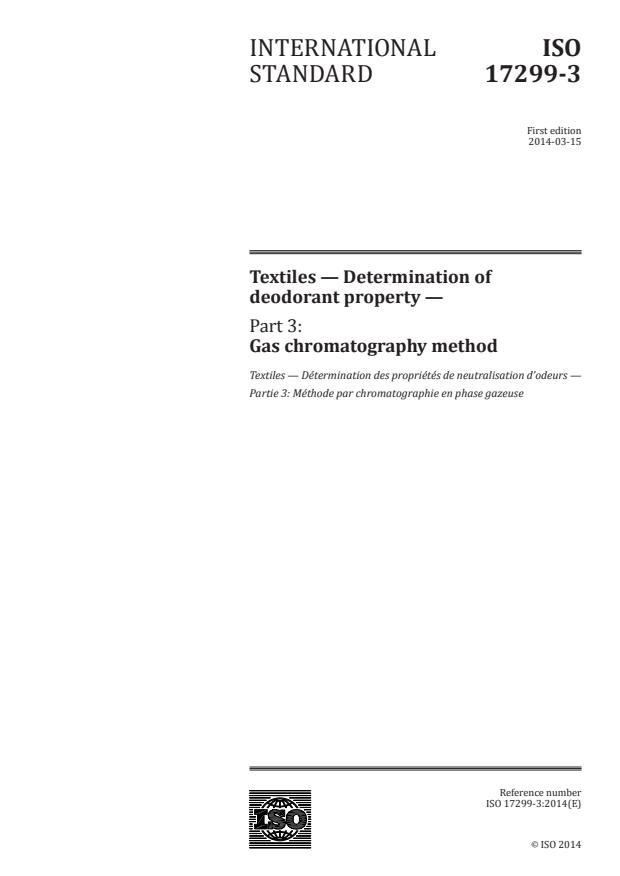
INTERNATIONAL ISO
STANDARD 17299-3
First edition
2014-03-15
Textiles — Determination of
deodorant property —
Part 3:
Gas chromatography method
Textiles — Détermination des propriétés de neutralisation d’odeurs —
Partie 3: Méthode par chromatographie en phase gazeuse
Reference number
©
ISO 2014
© ISO 2014
All rights reserved. Unless otherwise specified, no part of this publication may be reproduced or utilized otherwise in any form
or by any means, electronic or mechanical, including photocopying, or posting on the internet or an intranet, without prior
written permission. Permission can be requested from either ISO at the address below or ISO’s member body in the country of
the requester.
ISO copyright office
Case postale 56 • CH-1211 Geneva 20
Tel. + 41 22 749 01 11
Fax + 41 22 749 09 47
E-mail copyright@iso.org
Web www.iso.org
Published in Switzerland
ii © ISO 2014 – All rights reserved
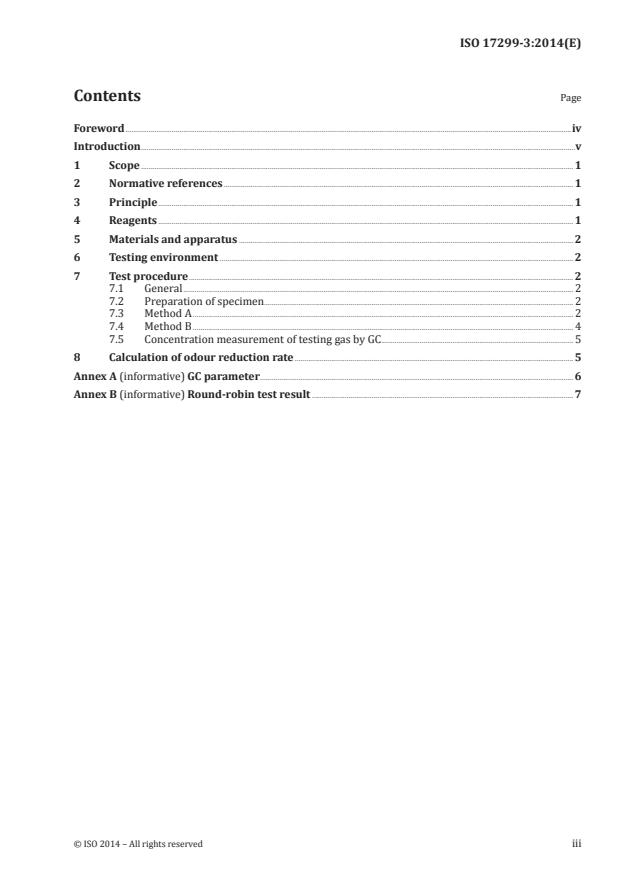
Contents Page
Foreword .iv
Introduction .v
1 Scope . 1
2 Normative references . 1
3 Principle . 1
4 Reagents . 1
5 Materials and apparatus . 2
6 Testing environment . 2
7 Test procedure . 2
7.1 General . 2
7.2 Preparation of specimen. 2
7.3 Method A . 2
7.4 Method B . 4
7.5 Concentration measurement of testing gas by GC . 5
8 Calculation of odour reduction rate . 5
Annex A (informative) GC parameter . 6
Annex B (informative) Round-robin test result . 7
Foreword
ISO (the International Organization for Standardization) is a worldwide federation of national standards
bodies (ISO member bodies). The work of preparing International Standards is normally carried out
through ISO technical committees. Each member body interested in a subject for which a technical
committee has been established has the right to be represented on that committee. International
organizations, governmental and non-governmental, in liaison with ISO, also take part in the work.
ISO collaborates closely with the International Electrotechnical Commission (IEC) on all matters of
electrotechnical standardization.
The procedures used to develop this document and those intended for its further maintenance are
described in the ISO/IEC Directives, Part 1. In particular the different approval criteria needed for the
different types of ISO documents should be noted. This document was drafted in accordance with the
editorial rules of the ISO/IEC Directives, Part 2 (see www.iso.org/directives).
Attention is drawn to the possibility that some of the elements of this document may be the subject of
patent rights. ISO shall not be held responsible for identifying any or all such patent rights. Details of
any patent rights identified during the development of the document will be in the Introduction and/or
on the ISO list of patent declarations received (see www.iso.org/patents).
Any trade name used in this document is information given for the convenience of users and does not
constitute an endorsement.
For an explanation on the meaning of ISO specific terms and expressions related to conformity
assessment, as well as information about ISO’s adherence to the WTO principles in the Technical Barriers
to Trade (TBT) see the following URL: Foreword - Supplementary information
The committee responsible for this document is ISO/TC 38, Textiles.
ISO 17299 consists of the following parts, under the general title Textiles — Determination of deodorant
property:
— Part 1: General principle
— Part 2: Detector tube method
— Part 3: Gas chromatography method
— Part 4: Condensation sampling analysis
— Part 5: Metal-oxide semiconductor sensors method
iv © ISO 2014 – All rights reserved
Introduction
This part of ISO 17299 describes a gas chromatography testing method for concentration measurement
of odour chemicals in deodorant testing. This is the most general testing method that could be carried
out in many testing laboratories globally if they have gas chromatography.
To avoid duplication, the major stream of the testing procedure is described in ISO 17299-1. This part of
ISO 17299 describes a specific procedure for the gas chromatography testing method.
INTERNATIONAL STANDARD ISO 17299-3:2014(E)
Textiles — Determination of deodorant property —
Part 3:
Gas chromatography method
1 Scope
This part of ISO 17299 specifies a gas chromatography test method for the deodorant testing of all
textile products. This method applies to the odour component chemicals, such as indole, isovaleric acid,
nonenal, and acetic acid with added sodium chloride (NaCl). Two preparation methods are described in
this test method:
— an odour chemical is applied in a container avoiding contact with a specimen in method A. Each
chemical is tested separately;
— an odour chemical is injected directly on to the specimen in a container in method B. The chemicals
tested in this method are a mixture of acetic acid and sodium chloride (NaCl).
2 Normative references
The following documents, in whole or in part, are normatively referenced in this document and are
indispensable for its application. For dated references, only the edition cited applies. For undated
references, the latest edition of the referenced document (including any amendments) applies.
ISO 139, Textiles — Standard atmospheres for conditioning and testing
ISO 3696, Water for analytical laboratory use — Specification and test methods
3 Principle
Concentration of the gaseous odour component chemicals of the gas in containers with or without a test
specimen after a designated contacting time is measured by gas chromatography (GC). The reduction
rate of concentration of odour chemicals in the container is calculated from the concentration data with
a specimen and without a specimen.
4 Reagents
Unless otherwise specified, analytical grades shall be used.
4.1 Acetic acid (CH COOH), reagent with a purity of 99,7 %.
4.2 Indole (C H N), reagent.
8 7
4.3 Isovaleric acid, reagent with a purity of 98,0 %.
4.4 2-Nonenal (C H O), reagent with a purity of 95,0 %.
9 16
4.5 Diluent gas, nitrogen gas from a nitrogen gas cylinder with a purity of at least 99,99 %.
4.6 NaCl, reagent grade.
4.7 Ethanol, reagent grade.
4.8 Water, grade 3 of ISO 3696.
5 Materials and apparatus
5.1 Conical flask, with a capacity of 500 ml, made of glass.
1)
5.2 Sealing film, capable of expanding with no air permeability [e.g. Parafilm ].
5.3 Injection vial, with a capacity of 22 ml, with a rubber stopper and aluminium cap.
5.4 Injection syringe, capable of injecting at 8 μl and 850 μl in volume.
5.5 Gastight syringe.
5.6 Heating oven, capable of heating at 80 °C ± 2 °C for 30 min.
5.7 Gas chromatography (GC) apparatus, with a flame ionization detector (FID) or mass selective
detector (MSD).
5.8 Rubber stopper and aluminium cap.
6 Testing environment
The testing environment used in this test is a room temperature of 20 °C and a relative humidity of 65 %
in accordance with ISO 139.
7 Test procedure
7.1 General
Two preparation methods are described in this clause as method A and method B. One method shall be
selected with the consent of the concerned parties.
7.2 Preparation of specimen
The dimension or mass of specimen for the textile products is shown in Table 1.
Table 1 — Dimension or mass of specimen
Dimension or mass of specimen
Kind of specimen
Method A Method B
Fabrics (woven, knit,
2 2 2 2
50 cm ± 2,5 cm 25 cm ± 1,25 cm
nonwoven, and tapes)
Yarns, fibres, and feather 0,5 g ± 0,025 g —
NOTE In the case of multi-layer products, the edge and non-treated layer (or not concerned layer) can be
covered with aluminium sheets to avoid contact with the odorous atmosphere, or the product can be folded in two
with the layer that is not concerned inside, in method A.
7.3 Method A
7.3.1 Prepare six conical flasks (5.1) with 500 ml: three conical flasks are used for testing with a
specimen and three conical flasks are used for testing without a specimen as a control test.
7.3.2 Cl
...
NORME ISO
INTERNATIONALE 17299-3
Première édition
2014-03-15
Textiles — Détermination des
propriétés de neutralisation
d’odeurs —
Partie 3:
Méthode par chromatographie en
phase gazeuse
Textiles — Determination of deodorant property —
Part 3: Gas chromatography method
Numéro de référence
©
ISO 2014
DOCUMENT PROTÉGÉ PAR COPYRIGHT
© ISO 2014
Droits de reproduction réservés. Sauf indication contraire, aucune partie de cette publication ne peut être reproduite ni utilisée
sous quelque forme que ce soit et par aucun procédé, électronique ou mécanique, y compris la photocopie, l’affichage sur
l’internet ou sur un Intranet, sans autorisation écrite préalable. Les demandes d’autorisation peuvent être adressées à l’ISO à
l’adresse ci-après ou au comité membre de l’ISO dans le pays du demandeur.
ISO copyright office
Case postale 56 • CH-1211 Geneva 20
Tel. + 41 22 749 01 11
Fax + 41 22 749 09 47
E-mail copyright@iso.org
Web www.iso.org
Publié en Suisse
ii © ISO 2014 – Tous droits réservés
Sommaire Page
Avant-propos .iv
Introduction .v
1 Domaine d’application . 1
2 Références normatives . 1
3 Principe . 1
4 Réactifs . 1
5 Matériaux et appareillage . 2
6 Environnement d’essai . 2
7 Mode opératoire d’essai. 2
7.1 Généralités . 2
7.2 Préparation des éprouvettes . 2
7.3 Méthode A . 3
7.4 Méthode B . 4
7.5 Mesure de la concentration du gaz d’essai par GC . 5
8 Calcul du taux de réduction des odeurs . 6
Annexe A (informative) Paramètres de GC . 7
Annexe B (informative) Résultats de l’essai interlaboratoires . 8
Avant-propos
L’ISO (Organisation internationale de normalisation) est une fédération mondiale d’organismes
nationaux de normalisation (comités membres de l’ISO). L’élaboration des Normes internationales est
en général confiée aux comités techniques de l’ISO. Chaque comité membre intéressé par une étude
a le droit de faire partie du comité technique créé à cet effet. Les organisations internationales,
gouvernementales et non gouvernementales, en liaison avec l’ISO participent également aux travaux.
L’ISO collabore étroitement avec la Commission électrotechnique internationale (IEC) en ce qui concerne
la normalisation électrotechnique.
Les procédures utilisées pour élaborer le présent document et celles destinées à sa mise à jour sont
décrites dans les Directives ISO/IEC, Partie 1. Il convient, en particulier de prendre note des différents
critères d’approbation requis pour les différents types de documents ISO. Le présent document a été
rédigé conformément aux règles de rédaction données dans les Directives ISO/IEC, Partie 2 (voir www.
iso.org/directives).
L’attention est appelée sur le fait que certains des éléments du présent document peuvent faire l’objet de
droits de propriété intellectuelle ou de droits analogues. L’ISO ne saurait être tenue pour responsable
de ne pas avoir identifié de tels droits de propriété et averti de leur existence. Les détails concernant les
références aux droits de propriété intellectuelle ou autres droits analogues identifiés lors de l’élaboration
du document sont indiqués dans l’Introduction et/ou dans la liste des déclarations de brevets reçues par
l’ISO (voir www.iso.org/brevets).
Les appellations commerciales éventuellement mentionnées dans le présent document sont données
pour information, par souci de commodité, à l’intention des utilisateurs et ne sauraient constituer un
engagement.
Pour une explication de la signification des termes et expressions spécifiques de l’ISO liés à l’évaluation de
la conformité, ou pour toute information au sujet de l’adhésion de l’ISO aux principes de l’OMC concernant
les obstacles techniques au commerce (OTC), voir le lien suivant: Avant-propos — Informations
supplémentaires.
Le comité chargé de l’élaboration du présent document est l’ISO/TC 38, Textiles.
L’ISO 17299 comprend les parties suivantes, présentées sous le titre général Textiles — Détermination
des propriétés de neutralisation d’odeurs:
— Partie 1: Principe général
— Partie 2: Méthode du tube détecteur
— Partie 3: Méthode par chromatographie en phase gazeuse
— Partie 4: Analyse par condensation de l’échantillon
— Partie 5: Méthode du capteur semi-conducteur en oxyde métallique
iv © ISO 2014 – Tous droits réservés
Introduction
Laprésente partie de l’ISO 17299 décrit une méthode utilisant un chromatographe en phase gazeuse
pour mesurer la concentration des produits chimiques odorants dans le cadre de l’essai de neutralisation
d’odeurs. Il s’agit de la méthode d’essai la plus courante, qui peut être réalisée dans tout laboratoire
d’essai disposant d’un chromatographe en phase gazeuse.
Pour éviter toute redondance, la description générale du mode opératoire d’essai est fournie dans
l’ISO 17299-1. La présente partie de l’ISO 17299 décrit le mode opératoire spécifique à la méthode d’essai
par chromatographie en phase gazeuse.
NORME INTERNATIONALE ISO 17299-3:2014(F)
Textiles — Détermination des propriétés de neutralisation
d’odeurs —
Partie 3:
Méthode par chromatographie en phase gazeuse
1 Domaine d’application
La présente partie de l’ISO 17299 spécifie une méthode d’essai par chromatographie en phase gazeuse
utilisée pour l’essai de neutralisation d’odeurs de tous les produits textiles. Cette méthode s’applique
aux produits chimiques odorants que sont l’indole, l’acide isovalérique, le nonénal et un mélange d’acide
acétique et de NaCl. Deux méthodes de préparation sont décrites pour la présente méthode d’essai:
— dans la méthode A, un produit chimique odorant est introduit dans un récipient en évitant tout
contact avec l’éprouvette. Chaque produit chimique est soumis à l’essai séparément;
— dans la méthode B, un produit chimique odorant est injecté directement sur l’éprouvette placée dans
un récipient. Les produits chimiques utilisés pour cette méthode sont un mélange d’acide acétique
et de chlorure de sodium (NaCl).
2 Références normatives
Les documents suivants, en totalité ou en partie, sont référencés de façon normative dans le présent
document et sont indispensables pour son application. Pour les références datées, seule l’édition citée
s’applique. Pour les références non datées, la dernière édition du document de référence s’applique (y
compris les éventuels amendements).
ISO 17299-1, Textiles — Détermination des propriétés de neutralisation d’odeurs – Partie 1: Principe général
3 Principe
La concentration des produits chimiques odorants gazeux est mesurée dans des récipients contenant
l’éprouvette et sans éprouvette, par chromatographie en phase gazeuse (GC), après le temps de contact
spécifié. Le taux de réduction de la concentration des produits chimiques odorants dans le récipient est
calculé à partir des données de concentration obtenues avec et sans l’éprouvette.
4 Réactifs
4.1 Acide acétique (CH COOH), réactif d’une pureté de 99,7 %.
4.2 Indole (C H N), réactif.
8 7
4.3 Acide isovalérique, réactif d’une pureté de 98,0 %.
4.4 2-Nonénal (C H O), réactif d’une pureté de 95,0 %.
9 16
4.5 Gaz de dilution, constitué d’azote gazeux d’une pureté d’au moins 99,99 %.
4.6 NaCl, de qualité pour réactif.
4.7 Éthanol, de qualité pour réactif.
4.8 Eau.
5 Matériaux et appareillage
5.1 Fiole conique, en verre, d’une contenance de 500 ml.
5.2 Film d’étanchéité, pouvant se dilater sans aucune perméabilité à l’air [par exemple film
1)
protecteur ].
5.3 Flacon d’injection, d’une contenance de 22 ml, avec bouchon en caoutchouc et couvercle en
aluminium.
5.4 Seringue d’injection, permettant d’injecter un volume de 8 µl ou 850 µl.
5.5 Seringue étanche aux gaz.
5.6 Étuve, pouvant fonctionner à 80 °C ± 2 °C pendant 30 min.
5.7 Chromatographe en phase gazeuse (GC), avec détecteur à ionisation de flamme (FID) ou détecteur
sélectif de masse (MSD).
5.8 Bouchon en caoutchouc et couvercle en aluminium.
6 Environnement d’essai
L’environnement d’essai utilisé ici correspond à une température ambiante de 20 °C et à une humidité
relative de 65 % conformément à l’ISO 17299-1.
7 Mode opératoire d’essai
7.1 Généralités
Deux méthodes de préparation sont décrites dans le présent article: la méthode A et la méthode B. L’une
des méthodes doit être choisie avec l’accord des parties concernées.
7.2 Préparation des éprouvettes
La dimension ou la masse des éprouvettes de produits textiles est indiquée dans le Tableau 1.
1) Le film protecteur est un exemple de produit adapté disponible dans le commerce. Cette information est donnée
par souci de commodité à l’intention des utilisateurs du présent document et ne saurait constituer un engagement
de l’ISO à l’égard de ce produit.
2 © ISO 2014 – Tous droits réservés
Tableau 1 — Dimension ou masse des éprouvettes
Dimension ou masse des éprouvettes
Type d’éprouvette
Méthode A Méthode B
Étoffe (tissu, tricot, nontissé et
2 2 2 2
50 cm ± 2,5 cm 25 cm ± 1,25 cm
rubans)
Fils, fibres et plume 0,5 g ± 0,025 g —
NOTE Si le produit est multicouches, le bord et la couche non traitée (ou la couche non concernée) peuvent
être recouverts de feuilles d’aluminium pour éviter tout contact avec le gaz odorant, ou le produit peut être plié
en deux en plaçant la couche non concernée à l’intérieur, pour l
...
Questions, Comments and Discussion
Ask us and Technical Secretary will try to provide an answer. You can facilitate discussion about the standard in here.
Loading comments...