


ISO 1577:1987
(Main)Tea — Determination of acid-insoluble ash
Tea — Determination of acid-insoluble ash
The method consists in treating of the total ash (obtained as described in ISO 1575) with hydrochloric acid solution, filtrating, igniting and weighing of the residue.
Thé — Détermination des cendres insolubles dans l'acide
La présente Norme internationale spécifie une méthode de détermination, dans le thé, des cendres insolubles dans l'acide.
General Information
- Status
- Published
- Publication Date
- 09-Sep-1987
- Technical Committee
- ISO/TC 34/SC 8 - Tea
- Drafting Committee
- ISO/TC 34/SC 8 - Tea
- Current Stage
- 9093 - International Standard confirmed
- Start Date
- 19-Dec-2025
- Completion Date
- 14-Feb-2026
Relations
- Effective Date
- 15-Apr-2008
Overview
ISO 1577:1987 - Tea - Determination of acid‑insoluble ash specifies a laboratory method to quantify the fraction of tea ash that is insoluble in hydrochloric acid. The procedure starts from the total ash generated according to ISO 1575, treats that ash with HCl, filters, ignites and weighs the remaining residue. Results are reported as a percentage of the sample on a dry‑matter basis.
Keywords: ISO 1577:1987, tea testing, acid‑insoluble ash, ash determination, laboratory method, ISO tea standards
Key topics and technical requirements
- Scope: Determination of acid‑insoluble ash in tea samples using the total ash from ISO 1575 as the starting material.
- Primary reagents:
- Hydrochloric acid solution (dilute by mixing 1 volume concentrated HCl [ρ20 ≈ 1.16–1.18 g/mL] with 2.5 volumes water).
- Silver nitrate solution (~17 g/L) for testing absence of chloride in washings.
- Apparatus: 50–100 mL capsules (platinum, porcelain or inert material), adjustable furnace (525 ± 25 °C), boiling water bath, ashless filter paper, desiccator, analytical balance.
- Procedure summary:
- Add 25 mL HCl to total ash in capsule; gently boil 10 min; cool and filter.
- Wash until no chloride is detected (AgNO3 test). Return filter and residue to capsule, evaporate, and ignite at 525 ± 25 °C until residue is free of char.
- Cool in desiccator and weigh; reheat 30 min and repeat until consecutive weights differ by ≤ 0.001 g.
- Replicates and repeatability: Two independent determinations are required; the arithmetic mean is taken if repeatability criteria are met. The difference between paired determinations must not exceed 0.02 g of acid‑insoluble ash per 100 g of ground sample.
- Calculation: Results are expressed as % (m/m) of acid‑insoluble ash relative to dry matter; dry matter content is determined per ISO 1572.
Applications and users
- Quality control and specification testing in tea production and blending operations.
- Analytical laboratories performing food safety, trade and conformity testing for tea imports/exports.
- Regulatory agencies evaluating contamination or mineral residue levels (acid‑insoluble ash indicates siliceous or mineral contaminants such as sand).
- Research labs studying tea composition and processing impacts on inorganic residues.
Related standards
- ISO 1575 - Tea - Determination of total ash (starting point for this method).
- ISO 1572 - Tea - Preparation of a ground sample for determination of known dry matter (used for sample prep and dry‑matter reporting).
This standard is essential for consistent, reproducible measurement of acid‑insoluble ash in tea and for harmonized quality and compliance testing across laboratories.
Buy Documents

ISO 1577:1987 - Tea -- Determination of acid-insoluble ash

ISO 1577:1987 - Thé -- Détermination des cendres insolubles dans l'acide
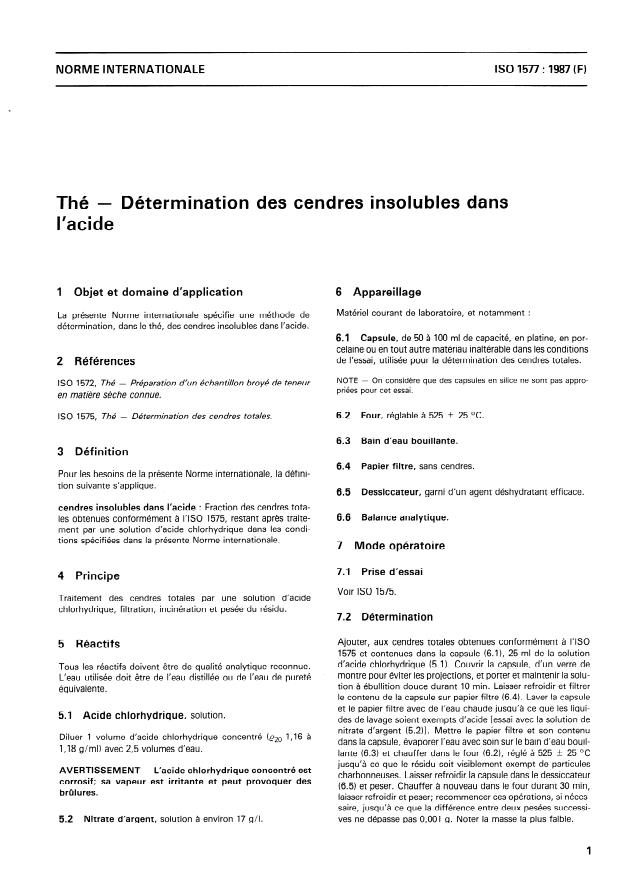

ISO 1577:1987 - Thé -- Détermination des cendres insolubles dans l'acide
Get Certified
Connect with accredited certification bodies for this standard

BSI Group
BSI (British Standards Institution) is the business standards company that helps organizations make excellence a habit.

Bureau Veritas
Bureau Veritas is a world leader in laboratory testing, inspection and certification services.

DNV
DNV is an independent assurance and risk management provider.
Sponsored listings
Frequently Asked Questions
ISO 1577:1987 is a standard published by the International Organization for Standardization (ISO). Its full title is "Tea — Determination of acid-insoluble ash". This standard covers: The method consists in treating of the total ash (obtained as described in ISO 1575) with hydrochloric acid solution, filtrating, igniting and weighing of the residue.
The method consists in treating of the total ash (obtained as described in ISO 1575) with hydrochloric acid solution, filtrating, igniting and weighing of the residue.
ISO 1577:1987 is classified under the following ICS (International Classification for Standards) categories: 67.140.10 - Tea. The ICS classification helps identify the subject area and facilitates finding related standards.
ISO 1577:1987 has the following relationships with other standards: It is inter standard links to ISO 1577:1980. Understanding these relationships helps ensure you are using the most current and applicable version of the standard.
ISO 1577:1987 is available in PDF format for immediate download after purchase. The document can be added to your cart and obtained through the secure checkout process. Digital delivery ensures instant access to the complete standard document.
Standards Content (Sample)
ISO
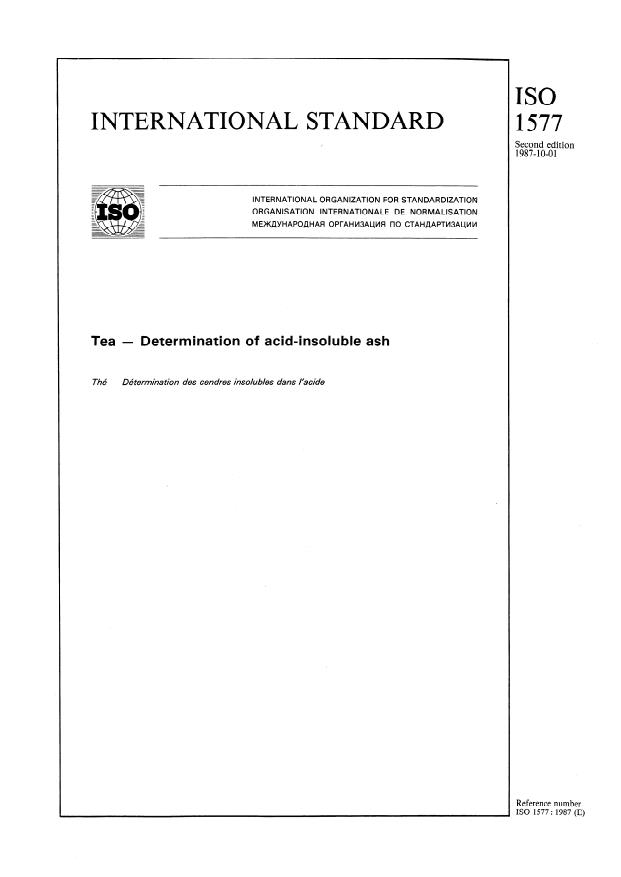
INTERNATIONAL STANDARD
Second edition
1987-10-01
INTERNATIONAL ORGANIZATION FOR STANDARDIZATION
ORGANISATION INTERNATIONALE DE NORMALISATION
MEX,lJYHAPOAHAFi OPTAHM3A~MR l-l0 CTAHAAPTM3AuMM
Determination of acid-insoluble ash
Tea -
Thh - Dhermina tion des cendres insolubles dans l’acide
Reference num ber
ISO 1577 : 1987 (E)
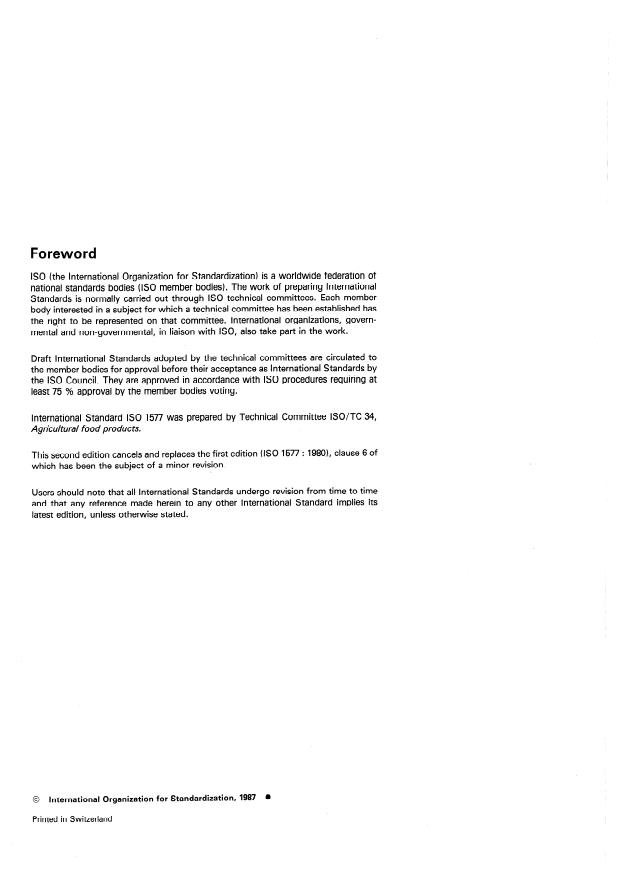
Foreword
ISO (the International Organization for Standardization) is a worldwide federation of
national Standards bodies (ISO member bodies). The work of preparing International
Standards is normally carried out through ISO technical committees. Esch member
body interested in a subject for which a technical committee has been established has
the right to be represented on that committee. International organizations, govern-
mental and non-governmental, in liaison with ISO, also take patt in the work.
Draft International Standards adopted by the technical committees are circulated to
the member bodies for approval before their acceptance as International Standards by
the ISO Council. They are approved in accordance with ISO procedures requiring at
least 75 % approval by the member bodies voting.
International Standard ISO 1577 was prepared by Technical Committee ISO/TC 34,
Agricultural food products.
This second edition cancels and replaces the first edition (ISO 1577 : 19801, clause 6 of
which has been the subject of a minor revision.
Users should note that all International Standards undergo revision from time to time
and that any reference made herein to any other International Standard implies its
latest edition, unless otherwise stated.
0 International Organization for Standardization, 1987
Printed in Switzerland
ISO 1577 : 1987 (E)
INTERNATIONAL STANDARD
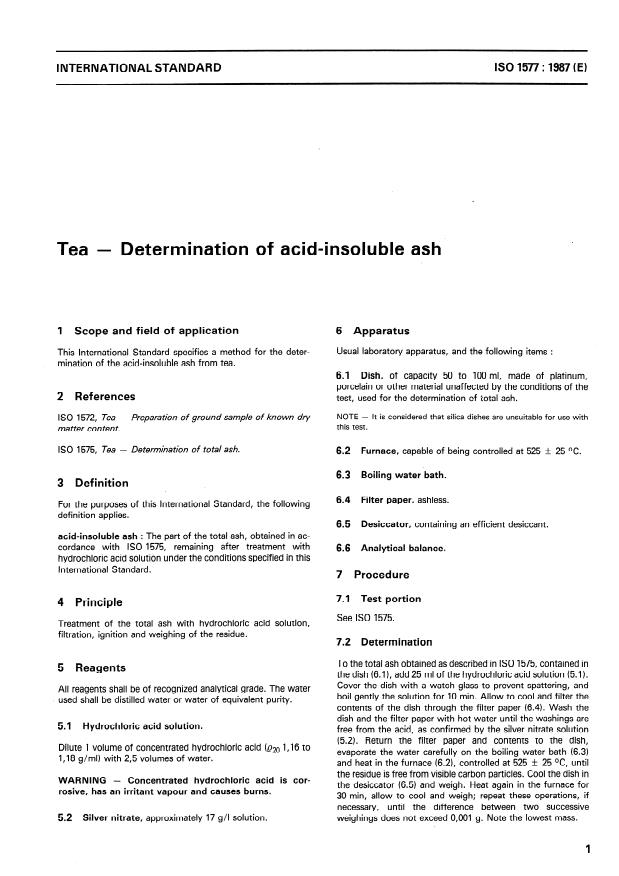
Tea - Determination of acid-insoluble ash
1 Scope and field of application 6 Apparatus
Usual laboratory apparatus, and the following items :
This International Standard specifies a method for the deter-
mination of the acid-insoluble ash from tea.
6.1 Dish, of capacity 50 to 100 ml, made of platinum,
porcelain or other material unaffected by the conditions of the
2 References
test, used for the determination of total ash.
NOTE - lt is considered that silica dishes are unsuitable for use with
ISO 1572, Tea - Reparation of ground Sample of known dry
this test.
matter content.
ISO 1575, Tea - Determination of total asb.
6.2 Furnace, capable of being controlled at 525 + 25 OC.
6.3 Boiling water bath.
3 Definition
6.4 Filter Paper, ashless.
For the purposes of this International Standard, the following
definition applies.
6.5 Desiccator, containing an efficient desiccant.
acid-insoluble ash : The part of the total ash, obtained in ac-
cordante with ISO 1575, remaining after treatment with
6.6 Analytical balance-
hydrochloric acid Solution under the conditions specified in this
International Standard.
7 Procedure
7.1 Test Portion
4 Principle
See ISO 1575.
Treatment of the total ash with hydrochloric aci
...
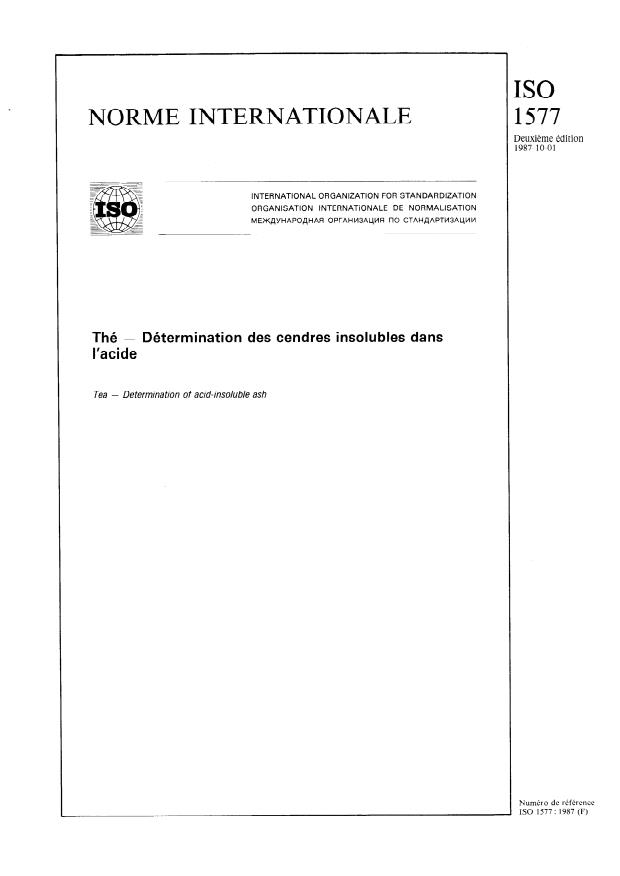
NORME INTERNATIONALE
INTERNATIONAL ORGANIZATION FOR STANDARDIZATION
ORGANISATION INTERNATiONALE DE NORMALISATION
MEXflYHAPOflHAFl OPI-AHM3AL(Mfl Il0 CTAH~APTM3A~MM
Thé - Détermination des cendres insolubles dans
l’acide
Tea - De termina tion of acid-insoluble ash
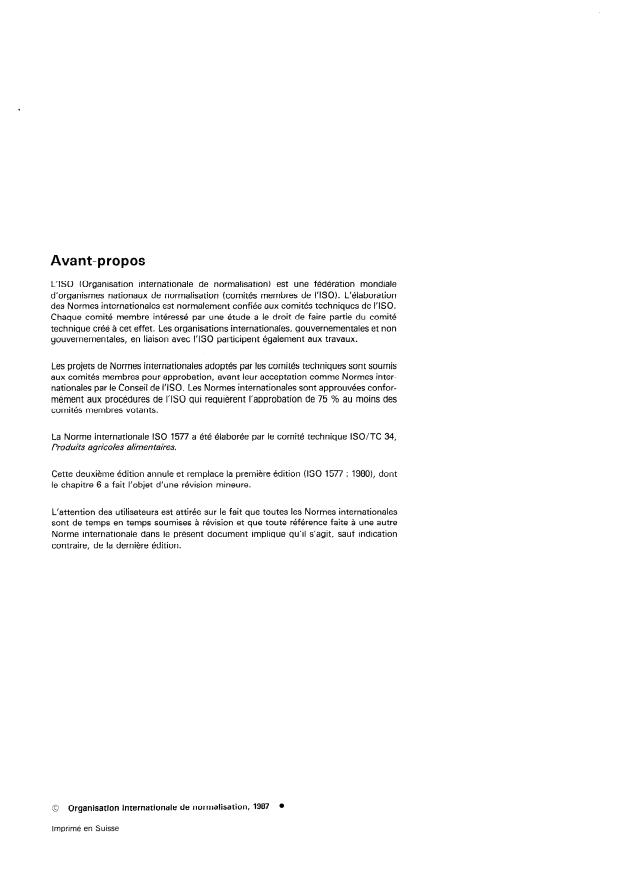
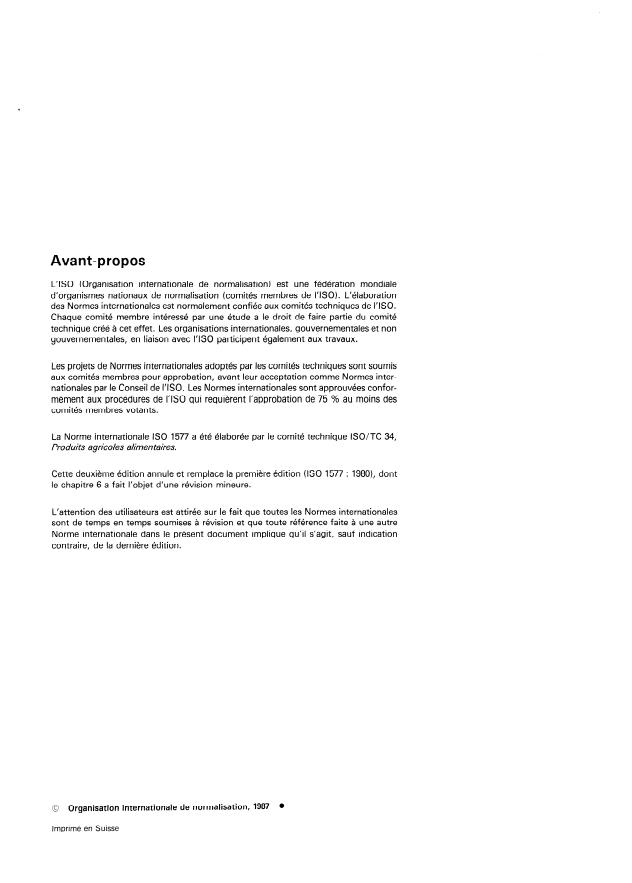
Avant-propos
L’ISO (Organisation internationale de normalisation) est une fédération mondiale
d’organismes nationaux de normalisation (comités membres de I’ISO). L’élaboration
des Normes internationales est normalement confiée aux comités techniques de I’ISO.
Chaque comité membre intéressé par une étude a le droit de faire partie du comité
technique créé à cet effet. Les organisations internationales, gouvernementales et non
gouvernementales, en liaison avec I’ISO participent également aux travaux.
Les projets de Normes internationales adoptés par les comités techniques sont soumis
aux comités membres pour approbation, avant leur acceptation comme Normes inter-
nationales par le Conseil de I’ISO. Les Normes internationales sont approuvées confor-
mément aux procédures de I’ISO qui requièrent l’approbation de 75 % au moins des
comités membres votants.
La Norme internationale ISO 1577 a été élaborée par le comité technique ISO/TC 34,
Produits agricoles afimen taires.
Cette deuxième édition annule et remplace la première édition (ISO 1577 : 1980), dont
le chapitre 6 a fait l’objet d’une révision mineure.
L’attention des utilisateurs est attirée sur le fait que toutes les Normes internationales
sont de temps en temps soumises à révision et que toute référence faite à une autre
Norme internationale dans le présent document implique qu’il s’agit, sauf indication
contraire, de la dernière édition.
63 Organisation internationale de normalisation, 1987 l
Imprimé en Suisse
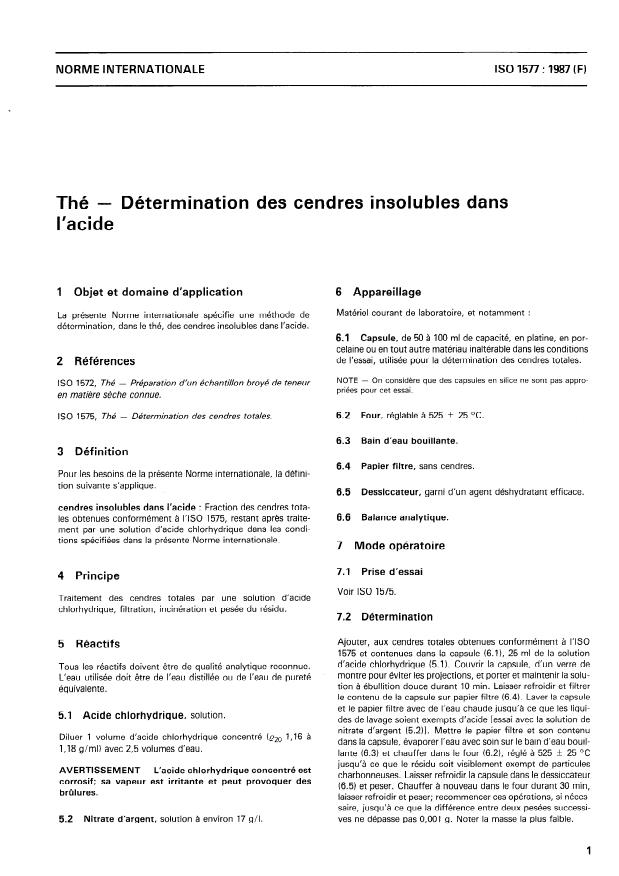
NORME INTERNATIONALE ISO 1577: 1987 (F)
Thé - Détermination des cendres insolubles dans
l’acide
1 Objet et domaine d’application 6 Appareillage
Matériel courant de laboratoire, et notamment :
La présente Norme internationale spécifie une méthode de
détermination, dans le thé, des cendres insolubles dans l’acide.
6.1 Capsule, de 50 à 100 ml de capacité, en platine, en por-
celaine ou en tout autre matériau inaltérable dans les conditions
de l’essai, utilisée pour la détermination des cendres totales.
2 Références
NOTE - On considère que des capsules en silice ne sont pas appro-
I SO 1572, Thé - Préparation d’un échantil/on broyé de teneur
priées pour cet essai.
en matière sèche connue.
6.2 Four, réglable à 525 + 25 OC.
I SO 1575, Thé - Détermination des cendres totales.
Bain d’eau bouillante.
6.3
3 Définition
Papier filtre, sans cendres.
6.4
Pour les besoins de la présente Norme internationale, la défini-
tion suivante s’applique.
6.5 Dessiccateur, garni d’un agent déshydratant efficace.
cendres insolubles dans l’acide : Fraction des cendres tota-
. Balance analytique.
les obtenues conformément à I’ISO 1575, restant après traite-
ment par une solution d’acide chlorhydrique dans les condi-
tions spécifiées dans la présente Norme internationale.
7 Mode opératoire
7.1 Prise d’essai
4 Principe
Voir ISO 1575.
Traitement des cendres totales par une solution d’acide
chlorhydrique, filtration, incinération et pesée du résidu.
7.2 Dé
...
NORME INTERNATIONALE
INTERNATIONAL ORGANIZATION FOR STANDARDIZATION
ORGANISATION INTERNATiONALE DE NORMALISATION
MEXflYHAPOflHAFl OPI-AHM3AL(Mfl Il0 CTAH~APTM3A~MM
Thé - Détermination des cendres insolubles dans
l’acide
Tea - De termina tion of acid-insoluble ash
Avant-propos
L’ISO (Organisation internationale de normalisation) est une fédération mondiale
d’organismes nationaux de normalisation (comités membres de I’ISO). L’élaboration
des Normes internationales est normalement confiée aux comités techniques de I’ISO.
Chaque comité membre intéressé par une étude a le droit de faire partie du comité
technique créé à cet effet. Les organisations internationales, gouvernementales et non
gouvernementales, en liaison avec I’ISO participent également aux travaux.
Les projets de Normes internationales adoptés par les comités techniques sont soumis
aux comités membres pour approbation, avant leur acceptation comme Normes inter-
nationales par le Conseil de I’ISO. Les Normes internationales sont approuvées confor-
mément aux procédures de I’ISO qui requièrent l’approbation de 75 % au moins des
comités membres votants.
La Norme internationale ISO 1577 a été élaborée par le comité technique ISO/TC 34,
Produits agricoles afimen taires.
Cette deuxième édition annule et remplace la première édition (ISO 1577 : 1980), dont
le chapitre 6 a fait l’objet d’une révision mineure.
L’attention des utilisateurs est attirée sur le fait que toutes les Normes internationales
sont de temps en temps soumises à révision et que toute référence faite à une autre
Norme internationale dans le présent document implique qu’il s’agit, sauf indication
contraire, de la dernière édition.
63 Organisation internationale de normalisation, 1987 l
Imprimé en Suisse
NORME INTERNATIONALE ISO 1577: 1987 (F)
Thé - Détermination des cendres insolubles dans
l’acide
1 Objet et domaine d’application 6 Appareillage
Matériel courant de laboratoire, et notamment :
La présente Norme internationale spécifie une méthode de
détermination, dans le thé, des cendres insolubles dans l’acide.
6.1 Capsule, de 50 à 100 ml de capacité, en platine, en por-
celaine ou en tout autre matériau inaltérable dans les conditions
de l’essai, utilisée pour la détermination des cendres totales.
2 Références
NOTE - On considère que des capsules en silice ne sont pas appro-
I SO 1572, Thé - Préparation d’un échantil/on broyé de teneur
priées pour cet essai.
en matière sèche connue.
6.2 Four, réglable à 525 + 25 OC.
I SO 1575, Thé - Détermination des cendres totales.
Bain d’eau bouillante.
6.3
3 Définition
Papier filtre, sans cendres.
6.4
Pour les besoins de la présente Norme internationale, la défini-
tion suivante s’applique.
6.5 Dessiccateur, garni d’un agent déshydratant efficace.
cendres insolubles dans l’acide : Fraction des cendres tota-
. Balance analytique.
les obtenues conformément à I’ISO 1575, restant après traite-
ment par une solution d’acide chlorhydrique dans les condi-
tions spécifiées dans la présente Norme internationale.
7 Mode opératoire
7.1 Prise d’essai
4 Principe
Voir ISO 1575.
Traitement des cendres totales par une solution d’acide
chlorhydrique, filtration, incinération et pesée du résidu.
7.2 Dé
...
Questions, Comments and Discussion
Ask us and Technical Secretary will try to provide an answer. You can facilitate discussion about the standard in here.
Loading comments...