

ISO/FDIS 80601-2-56
(Main)Medical electrical equipment — Part 2-56: Particular requirements for basic safety and essential performance of clinical thermometers for body temperature measurement
- Abstract
ISO 80601-2-56:2017 applies to the basic safety and essential performance of a clinical thermometer in combination with its accessories, hereafter referred to as me equipment. This document specifies the general and technical requirements for electrical clinical thermometers. This document applies to all electrical clinical thermometers that are used for measuring the body temperature of patients. Clinical thermometers can be equipped with interfaces to accommodate secondary indicators, printing equipment, and other auxiliary equipment to create me systems. This document does not apply to auxiliary equipment. Me equipment that measures a body temperature is inside the scope of this document. ISO 80601-2-56:2017 does not specify the requirements for screening thermographs intended to be used for the individual non-invasive human febrile temperature screening of groups of individual humans under indoor environmental conditions, which are given in IEC 80601‑2‑59[4]. If a clause or subclause is specifically intended to be applicable to me equipment only, or to me systems only, the title and content of that clause or subclause will say so. If that is not the case, the clause or subclause applies both to me equipment and to me systems, as relevant. Hazards inherent in the intended physiological function of me equipment or me systems within the scope of this document are not covered by specific requirements in this document except in IEC 60601‑1:2005+A1:2012, 7.2.13 and 8.4.1. NOTE Additional information can be found in IEC 60601?1:2005+A1:2012, 4.2.
- Status
- Not Published
- Current Stage
- 5020 - FDIS ballot initiated: 2 months. Proof sent to secretariat
- Start Date
- 11-Nov-2026
- Completion Date
- 11-Nov-2026
Buy Documents

ISO/FDIS 80601-2-56 - Medical electrical equipment — Part 2-56: Particular requirements for basic safety and essential performance of clinical thermometers for body temperature measurement

REDLINE ISO/FDIS 80601-2-56 - Medical electrical equipment — Part 2-56: Particular requirements for basic safety and essential performance of clinical thermometers for body temperature measurement
ISO/FDIS 80601-2-56 is an ISO particular standard for the basic safety and essential performance of clinical thermometers for body temperature measurement. It applies to electrical clinical thermometers used on patients, together with accessories that can affect safety or performance. The document tells manufacturers, test laboratories and conformity assessors what the thermometer, its marking, instructions and verification testing need to cover.
What does ISO/FDIS 80601-2-56 specify?
ISO/FDIS 80601-2-56 specifies requirements for clinical thermometers in combination with their accessories, and it applies to both ME equipment and ME systems where relevant. It is organized as a particular standard built on IEC 60601-1, with clauses 201.1 to 201.17 plus modified collateral-standard clauses 202, 206, 208, 211 and 212.
The scope covers electrical clinical thermometers used to measure patients, including accessories intended by the manufacturer to be connected when those accessories can affect basic safety or essential performance. Auxiliary equipment is outside the document, and screening thermographs for febrile temperature screening are handled by IEC 80601-2-59.
| Annex | What it covers |
|---|---|
| Annex AA | Guidance and rationale for selected clauses |
| Annex BB | Reference temperature source for laboratory testing |
| Annex CC | Mapping to IMDRF essential principles and labelling guidances |
| Annex DD | Alphabetized index of defined terms |
What are the key requirements of ISO/FDIS 80601-2-56?
ISO/FDIS 80601-2-56 focuses on four practical areas: performance when the device cannot give a valid reading, user information and marking, cleaning and disinfection, and laboratory and clinical verification. It also adds requirements for accessories, EMC, usability and use in home healthcare and emergency medical services (EMS) environments.
Safety, performance and failure handling
Clause 201.4.3.101 requires the clinical thermometer to treat loss of valid temperature indication as an essential-performance issue. If it cannot indicate a temperature within laboratory accuracy, it shall either generate a technical alarm condition or not provide an output temperature. In practice, a device should not quietly give a misleading reading.
The same area sets a minimum rated output range from 35.5 °C to 42.0 °C. That matters because the thermometer has to cover the body-temperature range that its intended use relies on.
Marking and instructions for use
Clause 201.7 requires the packaging, markings and instructions for use (IFU) to tell the user how the device is to be used. The packaging shall disclose the application site and the indicated site, and the thermometer shall show the temperature units as °C, °F or both.
The device markings also have to identify the application site, indicate when a new probe cover is needed, and show the required measurement distance for non-contact clinical thermometers unless the device confirms distance itself. If the thermometer is intended for magnetic resonance (MR) use, the MR Safe, MR Conditional or MR Unsafe marking rules apply, and MR Conditional conditions of acceptability must be disclosed in the IFU.
Clause 201.7.9.2.101 and 201.7.9.2.2.101 require the IFU to state the application site, indicated site, rated output range, laboratory accuracy, direct or indirect measurement mode, probe-cover instructions, battery replacement information where relevant, and non-contact use conditions such as indoor use, ambient stabilization, alignment and required distance. A warning is also required if lack of environmental equilibration can make the measurement inaccurate.
Cleaning, disinfection and reprocessing
Clause 201.11.6.6 addresses reprocessing of the clinical thermometer, probe and accessories. Enclosures intended for single-patient or multiple-patient use and that can contact mucous membranes or be contaminated with body fluids shall be designed so they can be cleaned and disinfected, or cleaned and sterilized, as appropriate.
The processing instructions for those enclosures shall follow ISO 17664-1:2021 or ISO 17664-2:2021, and ISO 14937:2009 where applicable, and the instructions shall appear in the IFU. The document also calls for inspection of the risk management file, processing for the number of cycles expected over service life, and confirmation that basic safety and essential performance remain intact after processing. In practice, manufacturers have to validate reprocessing, not just describe it.
Laboratory accuracy and time response
Clause 201.12.1.102 requires laboratory accuracy to be checked in direct measurement mode or test mode, and probe covers are tested as used in normal operation. The laboratory accuracy limit is ±0.3 °C in the rated output range and ±0.4 °C in the rated extended output range.
The test uses a fluid bath or blackbody reference source, a climatic chamber, five ambient temperature and humidity combinations, and repeated measurements at the midpoint and near the range limits. The reference temperature source must have an expanded measurement uncertainty of not greater than 0.07 °C. In practice, the thermometer is verified across temperature and environment, not at a single point.
Clause 201.12.1.102.3 requires a direct measurement mode thermometer to have its transient response characterized and disclosed in the IFU. The heating and cooling transient times are measured by moving the probe between two reference sources, and the values have to stay below the minimum measurement time stated by the manufacturer.
Clinical performance, accessories and use environments
Clause 201.12.1.103 requires indirect measurement mode clinical thermometers intended for human patients to undergo clinical performance verification in accordance with ISO 12487:2026, and the accompanying documents must say that this has been done. Clause 201.101 requires probes, probe cable extenders and probe covers to be verified with each referenced thermometer model and for their processing methods to be validated.
Clauses 202, 206, 208, 211 and 212 add EMC, usability, alarm, home healthcare and EMS environment requirements. For EMC, the thermometer must not suffer allowed degradations such as parameter resets or mode changes that affect safety or performance unless it gives a technical alarm or an equivalent warning. For usability, the document treats starting, pre-use checking, positioning, observing the output and turning off as primary operating functions.
What terms does ISO/FDIS 80601-2-56 define?
- Application site - the body location where the probe directly interacts with the patient.
- Indicated site - the body site that the output temperature is meant to represent, which may differ from the application site.
- Direct measurement mode - a mode where the output temperature represents the temperature of the application site in thermal equilibrium with the probe.
- Indirect measurement mode - a mode where the output temperature is adjusted or predicted rather than taken directly from thermal equilibrium at the application site.
- Laboratory accuracy - the closeness of agreement between the thermometer output and a reference thermometer when measuring a reference temperature source under laboratory conditions.
- Reference thermometer - a contact equilibrium thermometer for laboratory use with calibration traceable to a national temperature standard.
- Technical alarm condition - an alarm condition that arises from a monitored equipment-related or alarm-system-related variable.
Who uses ISO/FDIS 80601-2-56?
ISO/FDIS 80601-2-56 is used by manufacturers of clinical thermometers, probe accessories and connected ME systems. It is also used by test laboratories, quality and regulatory teams, and conformity assessors who need to check safety, accuracy, labelling, EMC, usability and reprocessing claims.
Buyers and procurement teams use it to compare products on a common technical basis, especially when accessories, MR use, home healthcare use or EMS use are in scope. Clinical engineering teams use it when verifying how a thermometer should be installed, used, cleaned and maintained.
What changed in ISO/FDIS 80601-2-56 from the previous edition?
ISO/FDIS 80601-2-56 is the third edition and it cancels and replaces ISO 80601-2-56:2017, including ISO 80601-2-56:2017/Amd 1:2018. The stated changes are harmonization with IEC 60601-1:2005+AMD1:2012+AMD2:2020, harmonization with ISO 20417, and deletion of clinical performance verification requirements with replacement by conformity to ISO 12487.
Which standards are used with ISO/FDIS 80601-2-56?
| Standard | What it contributes |
|---|---|
| IEC 60601-1:2005+AMD1:2012+AMD2:2020 | General basic safety and essential performance framework |
| ISO 14937:2009 | Sterilization process characterization and validation |
| ISO 17664-1:2021 | Manufacturer information for processing critical and semi-critical devices |
| ISO 17664-2:2021 | Manufacturer information for processing non-critical devices |
| ISO 12487:2026 | Clinical performance evaluation of clinical thermometers |
| ISO 20417:2026 | Information supplied by the manufacturer |
| IEC 62366-1:2015+AMD2:2020 | Usability engineering |
| IEC 62570:2025 | MR marking and safety symbols |
The document also modifies the collateral standards IEC 60601-1-2, IEC 60601-1-6, IEC 60601-1-8, IEC 60601-1-11 and IEC 60601-1-12 through clauses 202, 206, 208, 211 and 212.
What does the ISO/FDIS 80601-2-56 document contain?
The document contains detailed marking and IFU requirements, test descriptions, and annexes that support laboratory verification and regulatory review. Clause 201.12.1.102.2 gives the laboratory accuracy test sequence, including the reference source setup, environmental conditioning, repeated measurements and error calculation.
Clause 201.12.1.102.3 gives the transient-response test for direct measurement mode thermometers. Annex BB describes fluid bath and blackbody reference temperature sources and the uncertainty terms used to assess them.
Annex C and Annex D provide guidance on marking and symbols, including the MR Safe, MR Conditional and MR Unsafe symbols. Annex CC maps the clauses to IMDRF essential principles and labelling guidances, while Annex DD gives an alphabetical index of defined terms for use across the document.
Relations
- Effective Date
- 12-Feb-2026
- Effective Date
- 08-Jul-2024
- Effective Date
- 06-Jun-2022
- Effective Date
- 06-Jun-2022
Buy Documents
ISO/FDIS 80601-2-56 - Medical electrical equipment — Part 2-56: Particular requirements for basic safety and essential performance of clinical thermometers for body temperature measurement
REDLINE ISO/FDIS 80601-2-56 - Medical electrical equipment — Part 2-56: Particular requirements for basic safety and essential performance of clinical thermometers for body temperature measurement
Get Certified
Connect with accredited certification bodies for this standard

BSI Group
BSI (British Standards Institution) is the business standards company that helps organizations make excellence a habit.

TÜV Rheinland
TÜV Rheinland is a leading international provider of technical services.

TÜV SÜD
TÜV SÜD is a trusted partner of choice for safety, security and sustainability solutions.
Sponsored listings
Frequently Asked Questions
ISO/FDIS 80601-2-56 is a draft published by the International Organization for Standardization (ISO). Its full title is "Medical electrical equipment — Part 2-56: Particular requirements for basic safety and essential performance of clinical thermometers for body temperature measurement". This standard covers: ISO 80601-2-56:2017 applies to the basic safety and essential performance of a clinical thermometer in combination with its accessories, hereafter referred to as me equipment. This document specifies the general and technical requirements for electrical clinical thermometers. This document applies to all electrical clinical thermometers that are used for measuring the body temperature of patients. Clinical thermometers can be equipped with interfaces to accommodate secondary indicators, printing equipment, and other auxiliary equipment to create me systems. This document does not apply to auxiliary equipment. Me equipment that measures a body temperature is inside the scope of this document. ISO 80601-2-56:2017 does not specify the requirements for screening thermographs intended to be used for the individual non-invasive human febrile temperature screening of groups of individual humans under indoor environmental conditions, which are given in IEC 80601‑2‑59[4]. If a clause or subclause is specifically intended to be applicable to me equipment only, or to me systems only, the title and content of that clause or subclause will say so. If that is not the case, the clause or subclause applies both to me equipment and to me systems, as relevant. Hazards inherent in the intended physiological function of me equipment or me systems within the scope of this document are not covered by specific requirements in this document except in IEC 60601‑1:2005+A1:2012, 7.2.13 and 8.4.1. NOTE Additional information can be found in IEC 60601?1:2005+A1:2012, 4.2.
ISO 80601-2-56:2017 applies to the basic safety and essential performance of a clinical thermometer in combination with its accessories, hereafter referred to as me equipment. This document specifies the general and technical requirements for electrical clinical thermometers. This document applies to all electrical clinical thermometers that are used for measuring the body temperature of patients. Clinical thermometers can be equipped with interfaces to accommodate secondary indicators, printing equipment, and other auxiliary equipment to create me systems. This document does not apply to auxiliary equipment. Me equipment that measures a body temperature is inside the scope of this document. ISO 80601-2-56:2017 does not specify the requirements for screening thermographs intended to be used for the individual non-invasive human febrile temperature screening of groups of individual humans under indoor environmental conditions, which are given in IEC 80601‑2‑59[4]. If a clause or subclause is specifically intended to be applicable to me equipment only, or to me systems only, the title and content of that clause or subclause will say so. If that is not the case, the clause or subclause applies both to me equipment and to me systems, as relevant. Hazards inherent in the intended physiological function of me equipment or me systems within the scope of this document are not covered by specific requirements in this document except in IEC 60601‑1:2005+A1:2012, 7.2.13 and 8.4.1. NOTE Additional information can be found in IEC 60601?1:2005+A1:2012, 4.2.
ISO/FDIS 80601-2-56 is classified under the following ICS (International Classification for Standards) categories: 11.040.55 - Diagnostic equipment. The ICS classification helps identify the subject area and facilitates finding related standards.
ISO/FDIS 80601-2-56 has the following relationships with other standards: It is inter standard links to FprEN ISO 80601-2-56, ISO/TR 23016-3:2021, ISO 80601-2-56:2017, ISO 80601-2-56:2017/Amd 1:2018. Understanding these relationships helps ensure you are using the most current and applicable version of the standard.
ISO/FDIS 80601-2-56 is available in PDF format for immediate download after purchase. The document can be added to your cart and obtained through the secure checkout process. Digital delivery ensures instant access to the complete standard document.
Standards Content (Sample)
FINAL DRAFT
International
Standard
ISO/FDIS
80601-2-56
ISO/TC 121/SC 3
Medical electrical equipment —
Secretariat: ANSI
Part 2-56:
Voting begins on:
2026-11-11
Particular requirements for basic
safety and essential performance
Voting terminates on:
2026-12-23
of clinical thermometers for body
temperature measurement
Appareils électromédicaux —
Partie 2-56: Exigences particulières relatives à la sécurité
fondamentale et aux performances essentielles des thermomètres
médicaux pour mesurer la température de corps
RECIPIENTS OF THIS DRAFT ARE INVITED TO SUBMIT,
This draft is submitted to a parallel vote in ISO and in IEC.
WITH THEIR COMMENTS, NOTIFICATION OF ANY
RELEVANT PATENT RIGHTS OF WHICH THEY ARE AWARE
AND TO PROVIDE SUPPOR TING DOCUMENTATION.
IN ADDITION TO THEIR EVALUATION AS
BEING ACCEPTABLE FOR INDUSTRIAL, TECHNO-
ISO/CEN PARALLEL PROCESSING LOGICAL, COMMERCIAL AND USER PURPOSES, DRAFT
INTERNATIONAL STANDARDS MAY ON OCCASION HAVE
TO BE CONSIDERED IN THE LIGHT OF THEIR POTENTIAL
TO BECOME STAN DARDS TO WHICH REFERENCE MAY BE
MADE IN NATIONAL REGULATIONS.
Reference number
FINAL DRAFT
International
Standard
ISO/FDIS
80601-2-56
ISO/TC 121/SC 3
Medical electrical equipment —
Secretariat: ANSI
Part 2-56:
Voting begins on:
Particular requirements for basic
safety and essential performance
Voting terminates on:
of clinical thermometers for body
temperature measurement
Appareils électromédicaux —
Partie 2-56: Exigences particulières relatives à la sécurité
fondamentale et aux performances essentielles des thermomètres
médicaux pour mesurer la température de corps
© ISO 2026
All rights reserved.
RECIPIENTS OF THIS DRAFT ARE INVITED TO SUBMIT,
This draft is submitted to a parallel vote in ISO and in IEC.
WITH THEIR COMMENTS, NOTIFICATION OF ANY
This ISO publication is protected by copyright and is owned by ISO and/or its licensors.
RELEVANT PATENT RIGHTS OF WHICH THEY ARE AWARE
The content of this ISO publication is provided under licence, not sold. Use is subject to the applicable licence terms issued by ISO,
AND TO PROVIDE SUPPOR TING DOCUMENTATION.
an ISO member body, or an authorized third-party distributor.
IN ADDITION TO THEIR EVALUATION AS
BEING ACCEPTABLE FOR INDUSTRIAL, TECHNO-
Except as required for implementation or expressly permitted by a separate licence, no part of this ISO publication may be
ISO/CEN PARALLEL PROCESSING
LOGICAL, COMMERCIAL AND USER PURPOSES, DRAFT
reproduced, distributed, modified, used, or made available in any form or by any means – electronic or mechanical, including
INTERNATIONAL STANDARDS MAY ON OCCASION HAVE
photocopying, scanning, recording, or posting on internal or external digital platforms. TO BE CONSIDERED IN THE LIGHT OF THEIR POTENTIAL
TO BECOME STAN DARDS TO WHICH REFERENCE MAY BE
Any use beyond the scope of the granted rights is prohibited and may result in legal action.
MADE IN NATIONAL REGULATIONS.
ISO copyright office
CP 401 • CH-1214 Vernier, Geneva
Phone: +41 22 749 01 11
Email: copyright@iso.org
Website: www.iso.org
Published in Switzerland
Reference number
ii
Contents Page
Foreword . iv
Introduction . vi
201.1 Scope, object and related standards . 1
201.2 Normative references . 3
201.3 Terms and definitions . 4
201.4 General requirements . 11
201.5 General requirements for testing of ME equipment . 12
201.6 Classification of ME equipment and ME systems . 12
201.7 ME equipment identification, marking and documents. 12
201.8 Protection against electrical hazards from ME equipment . 14
201.9 Protection against mechanical hazards of ME equipment and ME systems . 15
201.10 Protection against unwanted and excessive radiation hazards . 15
201.11 Protection against excessive temperatures and other hazards . 15
201.12 Accuracy of controls and instruments and protection against hazardous outputs . 16
201.13 Hazardous situations and fault conditions . 20
201.14 Programmable electrical medical systems (PEMS) . 20
201.15 Construction of ME equipment . 20
201.16 Me systems . 20
201.17 Electromagnetic disturbances . 20
202 Electromagnetic disturbances — Requirements and tests . 21
206 Usability . 21
208 General requirements, tests and guidance for alarm systems in medical electrical
equipment and medical electrical systems . 22
211 Requirements for medical electrical equipment and medical electrical systems used
in the home healthcare environment . 22
212 Requirements for medical electrical equipment and medical electrical systems
intended for use in the emergency medical services environment . 23
Annex C (informative) Guide to marking and labelling requirements for ME equipment
and ME systems . 24
Annex D (informative) Symbols on marking . 27
Annex AA (informative) Particular guidance and rationale . 28
Annex BB (informative) Reference temperature source . 34
Annex CC (informative) Reference to the IMDRF essential principles and labelling guidances . 36
Annex DD (informative) Terminology — Alphabetized index of defined terms . 38
Bibliography . 41
iii
Foreword
ISO (the International Organization for Standardization) and IEC (the International Electrotechnical
Commission) form the specialized system for worldwide standardization. National bodies that are members
of ISO or IEC participate in the development of International Standards through technical committees
established by the respective organization to deal with particular fields of technical activity. ISO and IEC
technical committees collaborate in fields of mutual interest. Other international organizations, governmental
and non-governmental, in liaison with ISO and IEC, also take part in the work.
The procedures used to develop this document and those intended for its further maintenance are described
in the ISO/IEC Directives, Part 1. In particular, the different approval criteria needed for the different types of
document should be noted. This document was drafted in accordance with the editorial rules of the ISO/IEC
Directives, Part 2 (see www.iso.org/directives or www.iec.ch/members_experts/refdocs).
ISO and IEC draw attention to the possibility that the implementation of this document may involve the use of
(a) patent(s). ISO and IEC take no position concerning the evidence, validity or applicability of any claimed
patent rights in respect thereof. As of the date of publication of this document, ISO and IEC had not received
notice of (a) patent(s) which may be required to implement this document. However, implementers are
cautioned that this may not represent the latest information, which may be obtained from the patent database
available at www.iso.org/patents and https://patents.iec.ch. ISO and IEC shall not be held responsible for
identifying any or all such patent rights.
Any trade name used in this document is information given for the convenience of users and does not
constitute an endorsement.
For an explanation of the voluntary nature of standards, the meaning of ISO specific terms and expressions
related to conformity assessment, as well as information about ISO's adherence to the World Trade
Organization (WTO) principles in the Technical Barriers to Trade (TBT) see www.iso.org/iso/foreword.html.
In the IEC, see www.iec.ch/understanding-standards.
This document was prepared by ISO/TC 121, Anaesthetic and respiratory equipment, Subcommittee SC 3, Lung
ventilators and related equipment, and Technical Committee IEC/TC 62, Electrical equipment in medical
practice, Subcommittee SC D, Electrical equipment.
This document was prepared by Technical Committee ISO/TC 121, Anaesthetic and respiratory equipment,
Subcommittee SC 3, Respiratory devices and related equipment used for patient care and Technical Committee
IEC/TC 62, Medical equipment, software, and systems, Subcommittee SC 62D, Particular medical equipment,
software, and systems, in collaboration with the European Committee for Standardization (CEN) Technical
Committee CEN/TC 205, Non-active medical devices, in accordance with the Agreement on technical
cooperation between ISO and CEN (Vienna Agreement)
This third edition cancels and replaces the second edition (ISO 80601-2-56:2017), which has been technically
revised. It also incorporates the Amendment ISO 80601-2-56:2017/Amd 1:2018.
The main changes are as follows:
— harmonization with IEC 60601-1:2005+AMD1:2012+AMD2:2020;
— harmonization with ISO 20417;
iv
— deletion of the clinical performance verification requirements and replacement by the requirement to
conform with ISO 12487.
Any feedback or questions on this document should be directed to the user’s national standards body. A
complete listing of these bodies can be found at www.iso.org/members.html and www.iec.ch/national-
committees
v
Introduction
This document deals with electrical clinical thermometers, either already available or that will come available
in the future.
The purpose of a clinical thermometer is to assess the true temperature of a indicated site. The temperature of
the patient's body is an important vital sign in assessing overall health, typically in combination with blood
pressure and pulse rate. Determining whether a patient is afebrile, febrile or hypothermic is an important
purpose of a clinical thermometer.
There are different temperatures at each indicated site according to the balance between the production,
[22] 1
transfer, and loss of heat .
The intention of this document is to specify the requirements and the test procedures for the verification of the
laboratory accuracy for all types of electrical clinical thermometers.
This document has been drafted in accordance with the ISO/IEC Directives, Part 2.
In this document, the following print types are used.
— Requirements and definitions: roman type.
— Test specifications: italic type.
— Informative material appearing outside of tables, such as notes, examples and references: in smaller type. Normative
text of tables is also in a smaller type.
— Terms defined in Clause 3 of the general standard, in this document or as noted: small capitals.
In referring to the structure of this document, the term
— “clause” means one of the numbered divisions within the table of contents, inclusive of all subdivisions
(e.g. Clause 7 includes subclauses 7.1, 7.2, etc.), and
— “subclause” means a numbered subdivision of a clause (e.g. 7.1, 7.2 and 7.2.1 are all subclauses of
Clause 7).
References to clauses within this document are preceded by the term “Clause” followed by the clause number.
References to subclauses within this document are by number only.
In this document, the conjunctive “or” is used as an “inclusive or” so a statement is true if any combination of
the conditions is true.
The verbal forms used in this document conform to usage described in Annex H of the ISO/IEC Directives,
Part 2. For the purposes of this document, the auxiliary verb:
Figures in square brackets refer to the Bibliography.
vi
— “shall” means that conformance with a requirement or a test is mandatory for conformance with this
document;
— “should” means that conformance with a requirement or a test is recommended but is not mandatory for
conformance with this document;
— “may” is used to describe a permissible way to achieve conformance with a requirement or test.
vii
FINAL DRAFT International Standard ISO/FDIS 80601-2-56:2026(en)
Medical electrical equipment —
Part 2-56:
Particular requirements for basic safety and essential
performance of clinical thermometers for human
temperature measurement
201.1 Scope, object and related standards
NOTE 1 There is guidance or rationale for this Clause contained in Clause AA.2.1.
IEC 60601-1:2005+AMD1:2012+AMD2:2020, Clause 1 applies, except as follows:
NOTE 2 The general standard is IEC 60601-1:2005+AMD1:2012+AMD2:2020.
201.1.1 Scope
IEC 60601-1:2005+AMD1:2012+AMD2:2020, 1.1 is replaced by:
This document applies to the basic safety and essential performance of a clinical thermometer in combination
with its accessories, hereafter referred to as ME equipment. This document specifies the general and technical
requirements for electrical clinical thermometers. This document only applies to all electrical clinical
thermometers that are used for measuring the temperature of patients.
This document is also applicable to those accessories intended by their manufacturer to be connected to the
clinical thermometer, where the characteristics of those accessories can affect the basic safety or essential
performance of the clinical thermometer.
EXAMPLE 1 Probes, probe cable extenders and probe covers.
Clinical thermometers can be equipped with interfaces to accommodate secondary indicators, printing
equipment, and other auxiliary equipment to create ME systems. This document does not apply to auxiliary
equipment.
ME equipment that measures the temperature of a patient is within the scope of this document.
EXAMPLE 2 ME equipment using accessories such as a pulmonary artery catheter for the determination of cardiac
output by thermodilution is in the scope of this document if it displays a temperature.
EXAMPLE 3 ME equipment using accessories such as a Foley catheter that includes a temperature probe is in the scope
of this document.
This document does not specify requirements for screening thermographs intended to be used for the
individual non-invasive human febrile temperature screening of humans under indoor environmental
[4]
conditions, whose laboratory accuracy requirements are described in IEC 80601-2-59 .
If a clause or subclause is specifically intended to be applicable to ME equipment only, or to ME systems only,
the title and content of that clause or subclause will say so. If that is not the case, the clause or subclause applies
both to ME equipment and to ME systems, as relevant.
Hazards inherent in the intended physiological function of ME equipment or ME systems within the scope of
this document are not covered by specific requirements in this document except in
IEC 60601-1:2005+AMD1:2012+AMD2:2020, 7.2.13 and 8.4.1.
NOTE Additional information can be found in IEC 60601–1:2005+AMD1:2012+AMD2:2020, 4.2.
201.1.2 Object
Replacement:
The object of this particular document is to establish particular basic safety and essential performance
requirements for a clinical thermometer, as defined in 201.3.207, and its accessories.
NOTE Accessories are included because the combination of the clinical thermometer and the accessories needs to
be safe and effective. Accessories can have a significant impact on the basic safety and essential performance of a clinical
thermometer.
201.1.3 Collateral standards
IEC 60601-1:2005+AMD1:2012+AMD2:2020, 1.3 applies with the following addition:
Addition (add after existing text):
This document refers to those applicable collateral standards that are listed in general standard, as well as
201.2 of this document.
IEC 60601-1-2:2014+AMD1:2020, IEC 60601-1-6:2010+AMD1:2013+AMD2:2020,
IEC 60601-1-8:2006+AMD1:2012+AMD2:2020, IEC 60601-1-11:2015+AMD1:2020 and
IEC 60601-1-12:2014+AMD1:2020 apply as modified in Clauses 202, 206, 208, 211 and 212, respectively.
[5]
IEC 60601-1-3 does not apply. All other published collateral standards in the IEC 60601-1 series apply as
published.
201.1.4 Particular standards
Replacement:
In the IEC 60601 series, particular standards define basic safety and essential performance requirements, and
may modify, replace or delete requirements contained in the general standard as appropriate for the
particular ME equipment under consideration.
A requirement of a document takes priority over the general standard and its collateral standards.
For brevity, IEC 60601-1:2005+AMD1:2012+AMD2:2020 is referred to in this document as the general
standard. Collateral standards are referred to by their document number.
The numbering of clauses and subclauses of this document corresponds to that of the general standard with
the prefix “201” (e.g. 201.1 in this document addresses the content of Clause 1 of the general standard) or
applicable collateral standard with the prefix “20x” where x is the final digit(s) of the collateral standard
document number (e.g. 202.4 in this document addresses the content of Clause 4 of the 60601-1-2 collateral
standard, 206.4 in this document addresses the content of Clause 4 of the 60601-1-6 collateral standard, etc.).
The changes to the text of the general standard are specified by the use of the following words:
“Replacement” means that the clause or subclause of the general standard or applicable collateral standard is
replaced completely by the text of this particular document.
“Addition” means that the text of this document is additional to the requirements of the general standard or
applicable collateral standard.
“Amendment” means that the clause or subclause of the general standard or applicable collateral standard is
amended as indicated by the text of this document.
Clauses, subclauses or figures which are additional to those of the general standard are numbered starting
from 201.101, Additional annexes are lettered AA, BB, etc., and additional items aa), bb), etc.
Clauses, subclauses or figures which are additional to those of a collateral standard are numbered starting
from 20x, where “x” is the number of the collateral standard, e.g. 202 for IEC 60601-1-2, 206 for
IEC 60601-1-6, etc.
The term “this document” is used to make reference to the general standard, any applicable collateral
standards and this document taken together.
Where there is no corresponding section, clause or subclause in this document, the section, clause or subclause
of the general standard or applicable collateral standard, although possibly not relevant, applies without
modification; where it is intended that any part of the general standard or applicable collateral standard,
although possibly relevant, is not to be applied, a statement to that effect is given in this document.
201.2 Normative references
The following documents are referred to in the text in such a way that some or all of their content constitutes
requirements of this document. For dated references, only the edition cited applies. For undated references,
the latest edition of the referenced document (including any amendments) applies.
IEC 60601-1:2005+AMD1:2012+AMD2:2020, Clause 2 applies, except as follows:
Addition:
ISO 14937:2009, Sterilization of health care products — General requirements for characterization of a
sterilizing agent and the development, validation and routine control of a sterilization process for medical devices
ISO 17664-1:2021, Processing of health care products — Information to be provided by the medical device
manufacturer for the processing of medical devices — Part 1: Critical and semi-critical medical devices
ISO 17664-2:2021, Processing of health care products — Information to be provided by the medical device
manufacturer for the processing of medical devices — Part 2: Non-critical medical devices
ISO 12487:2026, Medical electrical equipment — Clinical performance evaluation of clinical thermometers
IEC 60601-1:2005+AMD1:2012+AMD2:2020, Medical electrical equipment — Part 1: General requirements for
basic safety and essential performance
ISO 20417:2026, Medical devices — Information to be supplied by the manufacturer
IEC 62366-1:2015+AMD2:2020, Medical devices — Part 1: Application of usability engineering to medical
devices
IEC 62570:2025, Standard practice for marking medical devices and other items for safety in the magnetic
resonance environment
201.3 Terms and definitions
For the purposes of this document, the terms and definitions given in
IEC 60601-1:2005+AMD1:2012+AMD2:2020 and the following apply.
ISO and IEC maintain terminological databases for use in standardization at the following addresses:
— IEC Electropedia: available at http://www.electropedia.org/
— ISO Online browsing platform: available at http://www.iso.org/obp
NOTE An alphabetized index of defined terms is found beginning in Annex DD.
201.3.201
accompanying information
information supplied by the manufacturer with or marked on a medical device or accessory for the user or
responsible organization, particularly regarding safe use
Note 1 to entry: The accompanying information is regarded as part of the medical device or accessory.
Note 2 to entry: The accompanying information can consist of the label, marking, instructions for use, technical description,
information shown on the packaging or graphical user interface (GUI), installation manual, quick reference guide, etc and
can address the installation, use, processing, maintenance and disposal of the medical device or accessory.
Note 3 to entry: Accompanying information is not necessarily a written or printed document but can involve auditory,
visual, or tactile materials and multiple media types (e.g. CD-ROM, DVD-ROM, USB stick, website).
[SOURCE: ISO 20417:2026, 3.2, modified — deleted figure, notes 4 and 5.]
201.3.202
alarm limit
threshold used by an alarm system to determine an alarm condition
[SOURCE: IEC 60601-1-8:2006+AMD1:2012+AMD2:2020, 3.3]
201.3.203
application site
measuring site
body location of a patient that the probe directly interacts with
EXAMPLE Pulmonary artery, distal oesophagus, sublingual space in the mouth, rectum, ear canal, axilla (armpit),
forehead skin.
Note 1 to entry: Measurement at the application site is either contact or non-contact (e.g. infrared).
201.3.204
blackbody
reference temperature source of infrared radiation characterized by precisely known temperature and having
an effective emissivity close to one
201.3.205
cleaning
removal of contaminants to the extent necessary for further processing or for intended use
Note 1 to entry: Cleaning consists of the removal of adherent soil (e.g. blood, protein substances, and other debris) from
the surfaces, crevices, serrations, joints, and lumens of a medical device by a manual or automated process that prepares
the items for safe handling or further processing.
[SOURCE: ISO 17664-2:2021, 3.1, modified — replaced “and/or” with “or”.]
201.3.206
clinical accuracy
closeness of agreement between the output temperature of a clinical thermometer and the reference value of
the temperature of the reference site that the clinical thermometer purports to represent
201.3.207
clinical thermometer
ME equipment used for measuring at the application site and indicating the temperature at the indicated site
Note 1 to entry: The application site can be the same as the indicated site.
Note 2 to entry: There is guidance or rationale for this definition contained in AA.2.2.
201.3.208
direct measurement mode
operating mode of a clinical thermometer where the output temperature represents the temperature of the
application site with which the probe is in thermal equilibrium
Note 1 to entry: There is guidance or rationale for this definition contained in AA.2.3.
201.3.209
disinfection
process to reduce the number of viable microorganisms to a level previously specified as being appropriate
for a defined purpose
[SOURCE: ISO 17664-1:2021, 3.3]
201.3.210
essential principles
essential principles of safety and performance
fundamental high-level requirements that when conformed with ensure a medical device or accessory is safe
and performs as intended
[SOURCE: ISO 20417:2026, 3.10]
201.3.211
extended output range
output temperature range having one or both limits that are outside of the rated output range
201.3.212
fluid bath
reference temperature source containing fluid at a uniform temperature
EXAMPLE Water, oil and air.
201.3.213
home healthcare environment
dwelling place in which a patient lives or other places where patients are present, excluding the professional
healthcare environment and the EMS environment
EXAMPLE Other places include in a car, bus, train, boat or plane, in a wheelchair or walking outdoors.
Note 1 to entry: Nursing homes are considered home healthcare environments.
Note 2 to entry: In some countries, nursing homes are considered professional healthcare facilities.
[SOURCE: IEC 60601-1-11:2015+AMD1:2020, 3.1, modified — replaced “professional healthcare facility
environments where operators with medical training are continually available when patients are present”
with ”the professional healthcare environment and the EMS environment”, deleted notes 1 and 3, modified
note 2 as new note 1, added note 2 and added to the example “Other places include”.]
201.3.214
immunity
ability of ME equipment or an ME system to perform without degradation in the presence of an electromagnetic
disturbance
[SOURCE: IEC 60601-1-2:2014+AMD1:2020, 3.8]
201.3.215
indicated site
indicated body site
body site to which the output temperature of the clinical thermometer refers
EXAMPLE 1 Ear canal, oral (sublingual pocket), axilla, rectum, core body.
Note 1 to entry: The indicated site may differ from the application site.
EXAMPLE 2 Site conversion clinical thermometers.
Note 2 to entry: There is guidance or rationale for this definition contained in AA.2.5.
201.3.216
indirect measurement mode
operating mode of a clinical thermometer where the output temperature represents the temperature of an
application site with which the probe is not in thermal equilibrium or where the application site is not the
indicated site
Note 1 to entry: Infrared clinical thermometers are not typically in thermal equilibrium with the application site and are
therefore typically in indirect measurement mode.
Note 2 to entry: Clinical thermometers with claimed measurement time shorter than 60 seconds (for methods such as
oral or rectal measurement), or shorter than 5 minutes (for methods such as axillary measurement) are considered in
indirect measurement mode.
Note 3 to entry: There is guidance or rationale for this definition contained in AA.2.4.
201.3.217
information supplied by the manufacturer
information related to the identification and use of a medical device or accessory, in whatever form provided,
intended to ensure the safe and effective use of the medical device or accessory
Note 1 to entry: e-documentation is included in the information supplied by the manufacturer.
Note 2 to entry: Shipping documents (e.g. packing list and customs documents) and promotional material are excluded
from information supplied by the manufacturer. However, some authorities having jurisdiction can consider such
supplemental information as information supplied by the manufacturer.
Note 3 to entry: The primary purpose of information supplied by the manufacturer is to identify the medical device or
accessory and its manufacturer, and provide essential information about its safety, performance, and appropriate use.
[SOURCE: ISO 20417:2026, 3.15, modified — deleted note 4.]
201.3.218
instructions for use
IFU
package insert
portion of the accompanying information that is
- directed to the user;
- essential for the safe and effective use of a medical device or accessory
Note 1 to entry: A user can be either a lay user or professional user with relevant specialized training.
Note 2 to entry: Instructions for the professional processing between uses of a medical device or accessory can be
included in the instructions for use.
Note 3 to entry: The instructions for use, or portions thereof, can be located on the display of a medical device or accessory.
Note 4 to entry: Medical devices or accessories that can be used safely and effectively without instructions for use are
exempted from having instructions for use by some authorities having jurisdiction.
[SOURCE: ISO 20417:2026, 3.16, modified — deleted note 5.]
201.3.219
laboratory accuracy
closeness of agreement between the output temperature of a clinical thermometer and a reference thermometer
when measuring a reference temperature source (e.g. water bath or black body) under laboratory conditions
Note 1 to entry: Laboratory accuracy is sometimes referred to as maximum permissible error.
201.3.220
lay, adj
lay person, adj
not having formal education in a relevant field of healthcare or medical discipline and, if appropriate, not
having relevant specialized training on the use of the specific medical device
EXAMPLE Lay operator, lay responsible organization.
[SOURCE: ISO 20417:2026, 3.19]
201.3.221
marking
information, in text or graphical format, durably affixed, printed, etched or by equivalent means to a product
Note 1 to entry: The word marked is used to designate the corresponding act.
Note 2 to entry: Marking is different from ‘direct marking’ as commonly described in unique device identification (UDI)
standards and regulations. A UDI ‘direct marking’ is a type of marking.
[SOURCE: ISO 20417:2026, 3.22, modified — deleted note 3 and 4.]
201.3.222
operating mode
state of a clinical thermometer that gives an output temperature of an intended indicated site
201.3.223
output range
span between the lowest and highest limits of output temperature where a clinical thermometer indicates
output temperature within the specified characteristics of laboratory accuracy
201.3.224
output temperature
temperature indicated by a clinical thermometer
Note 1 to entry: Methods of indication can include printed, spoken, displayed and remotely displayed.
201.3.225
physiological alarm condition
alarm condition arising from a monitored patient-related variable
EXAMPLE 1 High exhaled anaesthetic agent concentration.
EXAMPLE 2 Low exhaled tidal volume.
EXAMPLE 3 Low oxygen saturation measured by pulse oximetry.
EXAMPLE 4 High arterial pressure.
EXAMPLE 5 High heart rate.
[SOURCE: IEC 60601-1-8:2006+AMD1:2012+AMD2:2020, 3.31]
201.3.226
probe
part of a clinical thermometer that provides a thermal coupling between the sensor and the patient
Note 1 to entry: Thermal coupling can be contact or non-contact.
201.3.227
probe cable extender
cable that connects a clinical thermometer to a probe
Note 1 to entry: Not every clinical thermometer utilizes a probe cable extender.
Note 2 to entry: A probe cable extender can be an applied part.
201.3.228
probe cover
disposable or reusable accessory of a clinical thermometer that provides a sanitary barrier between the probe
and the patient
201.3.229
processing
processes to prepare a new or used healthcare product for its
intended use
Note 1 to entry: Processing includes cleaning, disinfection and sterilization, as appropriate.
[SOURCE: ISO 20417:2026, 3.31]
201.3.230
reference site
reference body site
body site where the reference thermometer measures temperature as the reference value for clinical
investigation
EXAMPLE Ear canal, oral (sublingual pocket), axilla, rectum, bladder.
201.3.231
reference thermometer
equilibrium thermometer of a contact type for laboratory application whose calibration is traceable to a
national standard of temperature, with a specified accuracy and associated uncertainty
EXAMPLE Platinum resistance thermometer with calibration traceable to a national standard of temperature.
201.3.232
sensor
part of the clinical thermometer that converts thermal energy into an electrical signal
201.3.233
site conversion
process of measuring temperature at a measurement site and converting the value to another site
201.3.234
skin temperature
temperature of the skin of the patient at the point on which the sensing device is intended to measure the
temperature
[7]
[SOURCE: IEC 60601-2-19:2020+AMD1:2023 , 201.3.210, modified — replaced “infant” with “patient”, "at a
point" with "at the point", and “skin temperature sensor is placed” with “sensing device is intended to measure
the temperature”]
201.3.235
single use
do not reuse
use only once
intended by the manufacturer to be used on an individual patient or an individual specimen during a single
procedure and then disposed of
Note 1 to entry: A single use medical device or accessory is not intended by its manufacturer to be further processed and
used again.
[SOURCE: ISO 20417:2026, 3.39, modified — deleted note 2.]
201.3.236
sterilization
process used to render product free from viable microorganisms
Note 1 to entry: In a sterilization process, the nature of microbial inactivation is exponential and thus the survival of a
microorganism on an individual item can be expressed in terms of probability. While this probability can be reduced to
a very low number, it can never be reduced to zero.
[SOURCE: ISO 17664-1:2021, 3.17]
201.3.237
symbol
graphical representation appearing on the label or in accompanying information of a product that
communicates characteristic information without the need for the supplier or receiver of the information to
have knowledge of the language of a particular nation or people
Note 1 to entry: The symbol can be an abstract representation or a graphical representation, or one that uses familiar
objects, including alphanumeric characters (with sufficient justification).
[SOURCE: ISO 20417:2026, 3.42]
201.3.238
technical alarm condition
alarm condition arising from a monitored equipment-related or alarm system-related variable
EXAMPLE 1 An electrical, mechanical or other failure.
EXAMPLE 2 A failure of a sensor or component (unsafe voltage, high impedance, signal impedance, artefact, noisy
signal, disconnection, calibration error, tubing obstruction, etc.).
EXAMPLE 3 An algorithm that cannot classify or resolve the available data.
[SOURCE: IEC 60601-1-8:2006+AMD1:2012+AMD2:2020, 3.36]
201.3.239
technical description
portion of the accompanying information that is:
- directed to the responsible organization and service personnel;
- and essential for preparation for the first use and safe use, maintenance or repair as well as processing
transport or storage for the expected lifetime including decommissioning or disposal of a medical device or
accessory
Note 1 to entry: The technical description can be included in the instructions for use.
[SOURCE: ISO 20417:2026, 3.43, modified — deleted note 2.]
201.3.240
test mode
state of a clinical thermometer where the output temperature represents the temperature measured by the
sensor and does not include site conversion or time prediction
Note 1 to entry: The test mode is used for the determination of the laboratory accuracy of the clinical thermometer.
Note 2 to entry: The test mode does not necessarily need to be an additional mode and may be the direct measurement
mode of the clinical thermometer.
201.3.241
time prediction
process of predicting the temperature of a measurement site before thermal equilibrium has been reached
201.3.242
transit-operable
term referring to transportable equipment whose intended use includes operation while it is being moved
EXAMPLE Transportable ME equipment that is body-worn, hand-held, attached to a wheelchair, or used in a car, bus,
train, boat or plane.
Note 1 to entry: Transit-operable use in the home healthcare environment can include use indoors, outdoors and in
vehicles.
[SOURCE: IEC 60601-1-11:2015+AMD1:2020, 3.4, modified deleted “For the purpose of this document, ”.]
201.3.243
validation
confirmation, through the provision of objective evidence, that the requirements for a specific intended use or
application have been fulfilled
Note 1 to entry: The term “validated” is used to designate the corresponding status.
Note 2 to entry: The use conditions for validation can be real or simulated.
[1]
[SOURCE: ISO 9000:2015 , 3.8.13]
201.4 General requirements
IEC 60601-1:2005+AMD1:2012+AMD2:2020, Clause 4 applies, except as follows:
Additional subclause:
201.4.3.101 Additional requirements for essential performance
NOTE There is guidance or rationale for this subclause contained in AA.2.6.
Additional essential performance requirements are found in the subclauses listed in Table 201.101.
Table 201.101 — Distributed essential performance requirements
Requirement Subclause
Accuracy of the clinical thermometer or at least one of the following: 201.12.1.102.2
— generation of a technical alarm condition; 201.101.2
— not providing an output temperature. 201.12.1.101
201.5 General requirements for testing of ME equipment
IEC 60601-1:2005+AMD1:2012+AMD2:2020, Clause 5 applies.
201.6 Classification of ME equipment and ME systems
IEC 60601-1:2005+AMD1:2012+AMD2:2020, Clause 6 applies.
201.7 ME equipment identification, marking and documents
IEC 60601-1:2005+AMD1:2012+AMD2:2020, Clause 7 applies, except as follows:
Additional subclauses:
201.7.1.101 Information to be supplied by the manufacturer
a) The information supplied by the manufacturer of a clinical thermometer and its accessories shall conform
with ISO 20417:2026.
b) In applying ISO 20417:2026, the terms in this document and those in
IEC 60601-1:2005+AMD1:2012+AMD2:2020 shall be used as follows.
1) The term "accompanying information" shall assume the same meaning as accompanying documents.
2) The term "medical device" shall assume the same meaning as ME equipment.
3) The term "user" shall assume the same meaning as operator.
c) Check conformity by application of ISO 20417:2026.
201.7.2.1.101 Additional requirements for information on the packaging
a) The packaging of a clinical thermometer shall disclose:
1) the application site; and
2) the indicated site.
b) Check conformity by inspection.
201.7.2.101 Additional requirements for marking on the outside of ME equipment or ME
equipment parts
a) A clinical thermometer shall have clearly legible markings of the following information:
1) the symbol “°C” or “°F” adjacent to the output temperature, if not indicated at the display.
i) If switching between degrees Fahrenheit and degrees Celsius is possible, the respective units of
measurement of the output temperature shall be indicated unambiguously.
2) the application site;
3) that a new probe cover shall be used prior to next measurement, if necessary, to maintain essential
performance; and
4) the required measurement distance for non-contact clinical thermometers except tympanic clinical
thermometers, unless the non-contact clinical thermometer is able to confirm the correct
measurement distance.
EXAMPLE 1 Infrared clinical thermometers are a typical non-contact clinical thermometer.
b) For a clinical thermometer intended to be used in the magnetic resonance (MR) environment, the clinical
thermometer, its parts and accessories shall have clearly legible markings in accordance with:
1) either of the symbols 6.3.1 of IEC 62570:2025 (Table 201.D.2.101, symbol 1 or symbol 2) if ‘MR Safe’;
or
2) symbol 6.3.2 of IEC 62570:2025 (Table 201.D.2.101, symbol 3) if ‘MR Conditional’.
i) The MR Conditional conditions of acceptability shall be disclosed in the instructions for use.
c) For a clinical thermometer not intended to be used in the magnetic resonance (MR) environment, the
clinical thermometer, its parts and accessories shall have clearly legible markings in accordance with
symbol 6.3.3 of IEC 62570:2025 (Table 201.D.2.101, symbol 4) if ‘MR Unsafe’.
d) Check conformity by inspection.
NOTE Additional information is found in ISO 20417:2026, 6.1.1, for cases where the size or nature of the outer surfaces
does not allow the fixation of the marking.
201.7.4.3.101 Additional requirements for units of measurement
a) A clinical thermometer shall express the temperature in either degrees Celsius, °C, or degrees Fahrenheit,
°F, or both.
b) The units of measurement shall be cle
...
IEC/62D-ISO/TC 121/SC 3/
IEC/62D-ISO/TC 121/SC 3/JWG 8
2026-10-28
Secretariat: ANSI
Medical electrical equipment — Part 2-56: Particular requirements for basic safety
and essential performance of clinical thermometers for body temperature
measurement
Appareils électromédicaux — Partie 2-56: Exigences particulières relatives à la sécurité fondamentale et aux
performances essentielles des thermomètres médicaux pour mesurer la température de corps
All rights reserved. Unless otherwise specified, no part of this publication may be reproduced or utilized
otherwise in any form or by any means, electronic or mechanical, including photocopying, or posting on
the internet or an intranet, without prior written permission. Permission can be requested from either
ISO at the address below or ISO's member body in the country of the requester.
ISO copyright office
Case postale 56 • CH-1211 Geneva 20
Tel. + 41 22 749 01 11
Fax + 41 22 749 09 47
E-mail copyright@iso.org
Web www.iso.org
Published in Switzerland.
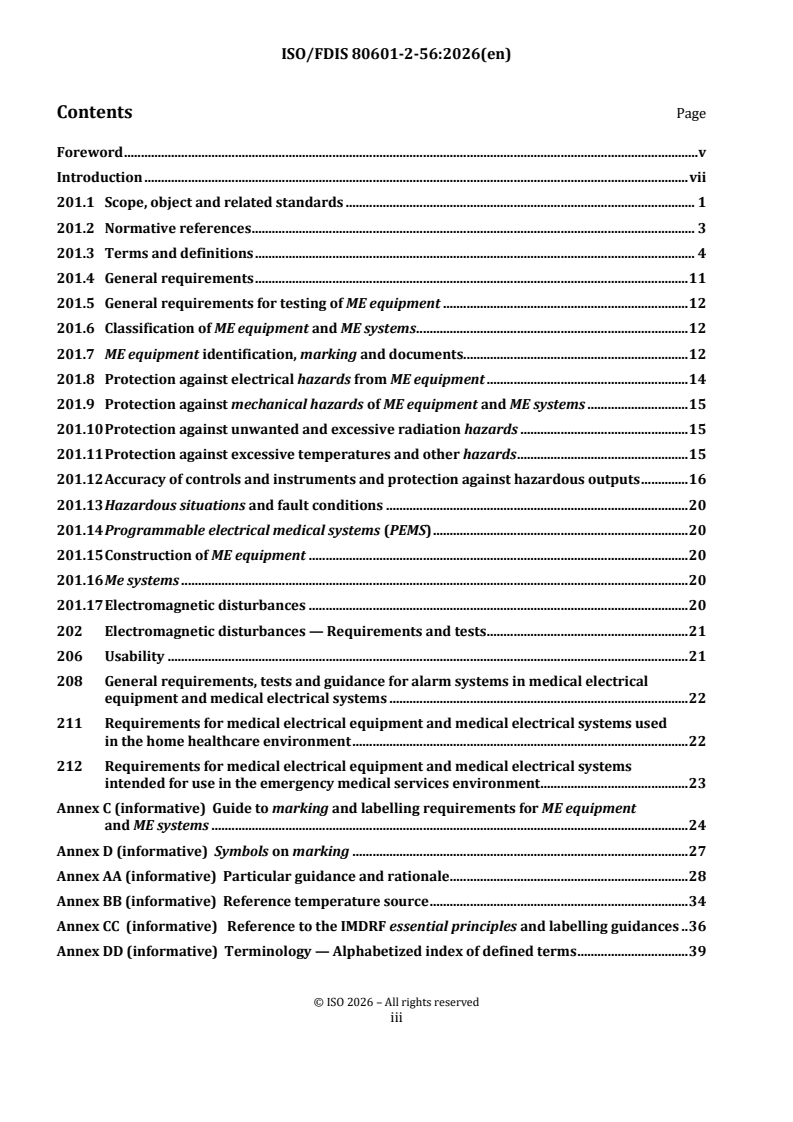
Contents Page
Foreword . v
Introduction . vii
201.1 Scope, object and related standards . 1
201.2 Normative references . 3
201.3 Terms and definitions . 4
201.4 General requirements . 11
201.5 General requirements for testing of ME equipment . 12
201.6 Classification of ME equipment and ME systems . 12
201.7 ME equipment identification, marking and documents. 12
201.8 Protection against electrical hazards from ME equipment . 14
201.9 Protection against mechanical hazards of ME equipment and ME systems . 15
201.10 Protection against unwanted and excessive radiation hazards . 15
201.11 Protection against excessive temperatures and other hazards . 15
201.12 Accuracy of controls and instruments and protection against hazardous outputs . 16
201.13 Hazardous situations and fault conditions . 20
201.14 Programmable electrical medical systems (PEMS) . 20
201.15 Construction of ME equipment . 20
201.16 Me systems . 20
201.17 Electromagnetic disturbances . 20
202 Electromagnetic disturbances — Requirements and tests . 21
206 Usability . 21
208 General requirements, tests and guidance for alarm systems in medical electrical
equipment and medical electrical systems . 22
211 Requirements for medical electrical equipment and medical electrical systems used
in the home healthcare environment . 22
212 Requirements for medical electrical equipment and medical electrical systems
intended for use in the emergency medical services environment . 23
Annex C (informative) Guide to marking and labelling requirements for ME equipment
and ME systems . 24
Annex D (informative) Symbols on marking . 27
Annex AA (informative) Particular guidance and rationale . 28
Annex BB (informative) Reference temperature source . 34
Annex CC (informative) Reference to the IMDRF essential principles and labelling guidances . 36
Annex DD (informative) Terminology — Alphabetized index of defined terms . 39
iii
Bibliography . 42
Foreword
ISO (the International Organization for Standardization) and IEC (the International Electrotechnical
Commission) form the specialized system for worldwide standardization. National bodies that are members
of ISO or IEC participate in the development of International Standards through technical committees
established by the respective organization to deal with particular fields of technical activity. ISO and IEC
technical committees collaborate in fields of mutual interest. Other international organizations, governmental
and non-governmental, in liaison with ISO and IEC, also take part in the work.
The procedures used to develop this document and those intended for its further maintenance are described
in the ISO/IEC Directives, Part 1. In particular, the different approval criteria needed for the different types of
document should be noted. This document was drafted in accordance with the editorial rules of the ISO/IEC
Directives, Part 2 (see www.iso.org/directives or www.iec.ch/members_experts/refdocs).
ISO and IEC draw attention to the possibility that the implementation of this document may involve the use of
(a) patent(s). ISO and IEC take no position concerning the evidence, validity or applicability of any claimed
patent rights in respect thereof. As of the date of publication of this document, ISO and IEC had not received
notice of (a) patent(s) which may be required to implement this document. However, implementers are
cautioned that this may not represent the latest information, which may be obtained from the patent database
available at www.iso.org/patents and https://patents.iec.ch. ISO and IEC shall not be held responsible for
identifying any or all such patent rights.
Any trade name used in this document is information given for the convenience of users and does not
constitute an endorsement.
For an explanation of the voluntary nature of standards, the meaning of ISO specific terms and expressions
related to conformity assessment, as well as information about ISO's adherence to the World Trade
Organization (WTO) principles in the Technical Barriers to Trade (TBT) see www.iso.org/iso/foreword.html.
In the IEC, see www.iec.ch/understanding-standards.
This document was prepared by ISO/TC 121, Anaesthetic and respiratory equipment, Subcommittee SC 3, Lung
ventilators and related equipment, and Technical Committee IEC/TC 62, Electrical equipment in medical
practice, Subcommittee SC D, Electrical equipment.
This document was prepared by Technical Committee ISO/TC 121, Anaesthetic and respiratory equipment,
Subcommittee SC 3, Respiratory devices and related equipment used for patient care and Technical Committee
IEC/TC 62, Medical equipment, software, and systems, Subcommittee SC 62D, Particular medical equipment,
software, and systems, in collaboration with the European Committee for Standardization (CEN) Technical
Committee CEN/TC 205, Non-active medical devices, in accordance with the Agreement on technical
cooperation between ISO and CEN (Vienna Agreement)
This third edition cancels and replaces the second edition (ISO 80601-2-56:2017), which has been technically
revised. It also incorporates the Amendment ISO 80601-2-56:2017/Amd 1:2018.
The main changes are as follows:
— harmonization with IEC 60601-1:2005+AMD1:2012+AMD2:2020;
— harmonization with ISO 20417;
v
— deletion of the clinical performance verification requirements and replacement by the requirement to
conform with ISO 12487.
Any feedback or questions on this document should be directed to the user’s national standards body. A
complete listing of these bodies can be found at www.iso.org/members.html and www.iec.ch/national-
committees
Introduction
This document deals with electrical clinical thermometers, either already available or that will come available
in the future.
The purpose of a clinical thermometer is to assess the true temperature of a indicated site. The temperature of
the patient's body is an important vital sign in assessing overall health, typically in combination with blood
pressure and pulse rate. Determining whether a patient is afebrile, febrile or hypothermic is an important
purpose of a clinical thermometer.
There are different temperatures at each indicated site according to the balance between the production,
[22] 1
transfer, and loss of heat .
The intention of this document is to specify the requirements and the test procedures for the verification of the
laboratory accuracy for all types of electrical clinical thermometers.
This document has been drafted in accordance with the ISO/IEC Directives, Part 2.
In this document, the following print types are used.
— Requirements and definitions: roman type.
— Test specifications: italic type.
— Informative material appearing outside of tables, such as notes, examples and references: in smaller type. Normative
text of tables is also in a smaller type.
— Terms defined in Clause 3 of the general standard, in this document or as noted: small capitals.
In referring to the structure of this document, the term
— “clause” means one of the numbered divisions within the table of contents, inclusive of all subdivisions
(e.g. Clause 7 includes subclauses 7.1, 7.2, etc.), and
— “subclause” means a numbered subdivision of a clause (e.g. 7.1, 7.2 and 7.2.1 are all subclauses of
Clause 7).
References to clauses within this document are preceded by the term “Clause” followed by the clause number.
References to subclauses within this document are by number only.
In this document, the conjunctive “or” is used as an “inclusive or” so a statement is true if any combination of
the conditions is true.
The verbal forms used in this document conform to usage described in Annex H of the ISO/IEC Directives,
Part 2. For the purposes of this document, the auxiliary verb:
Figures in square brackets refer to the Bibliography.
vii
— “shall” means that conformance with a requirement or a test is mandatory for conformance with this
document;
— “should” means that conformance with a requirement or a test is recommended but is not mandatory for
conformance with this document;
— “may” is used to describe a permissible way to achieve conformance with a requirement or test.
FINAL DRAFT International Standard ISO/FDIS 80601-2-56:2026(en)
Medical electrical equipment —
Part 2-56:
Particular requirements for basic safety and essential
performance of clinical thermometers for human
temperature measurement
201.1 Scope, object and related standards
NOTE 1 There is guidance or rationale for this Clause contained in Clause AA.2.1.
IEC 60601-1:2005+AMD1:2012+AMD2:2020, Clause 1 applies, except as follows:
NOTE 2 The general standard is IEC 60601-1:2005+AMD1:2012+AMD2:2020.
201.1.1 Scope
IEC 60601-1:2005+AMD1:2012+AMD2:2020, 1.1 is replaced by:
This document applies to the basic safety and essential performance of a clinical thermometer in combination
with its accessories, hereafter referred to as ME equipment. This document specifies the general and technical
requirements for electrical clinical thermometers. This document only applies to all electrical clinical
thermometers that are used for measuring the temperature of patients.
This document is also applicable to those accessories intended by their manufacturer to be connected to the
clinical thermometer, where the characteristics of those accessories can affect the basic safety or essential
performance of the clinical thermometer.
EXAMPLE 1 Probes, probe cable extenders and probe covers.
Clinical thermometers can be equipped with interfaces to accommodate secondary indicators, printing
equipment, and other auxiliary equipment to create ME systems. This document does not apply to auxiliary
equipment.
ME equipment that measures the temperature of a patient is within the scope of this document.
EXAMPLE 2 ME equipment using accessories such as a pulmonary artery catheter for the determination of cardiac
output by thermodilution is in the scope of this document if it displays a temperature.
EXAMPLE 3 ME equipment using accessories such as a Foley catheter that includes a temperature probe is in the scope
of this document.
This document does not specify requirements for screening thermographs intended to be used for the
individual non-invasive human febrile temperature screening of humans under indoor environmental
[4]
conditions, whose laboratory accuracy requirements are described in IEC 80601-2-59 .
If a clause or subclause is specifically intended to be applicable to ME equipment only, or to ME systems only,
the title and content of that clause or subclause will say so. If that is not the case, the clause or subclause applies
both to ME equipment and to ME systems, as relevant.
Hazards inherent in the intended physiological function of ME equipment or ME systems within the scope of
this document are not covered by specific requirements in this document except in
IEC 60601-1:2005+AMD1:2012+AMD2:2020, 7.2.13 and 8.4.1.
NOTE Additional information can be found in IEC 60601–1:2005+AMD1:2012+AMD2:2020, 4.2.
201.1.2 Object
Replacement:
The object of this particular document is to establish particular basic safety and essential performance
requirements for a clinical thermometer, as defined in 201.3.207, and its accessories.
NOTE Accessories are included because the combination of the clinical thermometer and the accessories needs to
be safe and effective. Accessories can have a significant impact on the basic safety and essential performance of a clinical
thermometer.
201.1.3 Collateral standards
IEC 60601-1:2005+AMD1:2012+AMD2:2020, 1.3 applies with the following addition:
Addition (add after existing text):
This document refers to those applicable collateral standards that are listed in general standard, as well as
201.2 of this document.
IEC 60601-1-2:2014+AMD1:2020, IEC 60601-1-6:2010+AMD1:2013+AMD2:2020,
IEC 60601-1-8:2006+AMD1:2012+AMD2:2020, IEC 60601-1-11:2015+AMD1:2020 and
IEC 60601-1-12:2014+AMD1:2020 apply as modified in Clauses 202, 206, 208, 211 and 212, respectively.
[5]
IEC 60601-1-3 does not apply. All other published collateral standards in the IEC 60601-1 series apply as
published.
201.1.4 Particular standards
Replacement:
In the IEC 60601 series, particular standards define basic safety and essential performance requirements, and
may modify, replace or delete requirements contained in the general standard as appropriate for the
particular ME equipment under consideration.
A requirement of a document takes priority over the general standard and its collateral standards.
For brevity, IEC 60601-1:2005+AMD1:2012+AMD2:2020 is referred to in this document as the general
standard. Collateral standards are referred to by their document number.
The numbering of clauses and subclauses of this document corresponds to that of the general standard with
the prefix “201” (e.g. 201.1 in this document addresses the content of Clause 1 of the general standard) or
applicable collateral standard with the prefix “20x” where x is the final digit(s) of the collateral standard
document number (e.g. 202.4 in this document addresses the content of Clause 4 of the 60601-1-2 collateral
standard, 206.4 in this document addresses the content of Clause 4 of the 60601-1-6 collateral standard, etc.).
The changes to the text of the general standard are specified by the use of the following words:
“Replacement” means that the clause or subclause of the general standard or applicable collateral standard is
replaced completely by the text of this particular document.
“Addition” means that the text of this document is additional to the requirements of the general standard or
applicable collateral standard.
“Amendment” means that the clause or subclause of the general standard or applicable collateral standard is
amended as indicated by the text of this document.
Clauses, subclauses or figures which are additional to those of the general standard are numbered starting
from 201.101, Additional annexes are lettered AA, BB, etc., and additional items aa), bb), etc.
Clauses, subclauses or figures which are additional to those of a collateral standard are numbered starting
from 20x, where “x” is the number of the collateral standard, e.g. 202 for IEC 60601-1-2, 206 for
IEC 60601-1-6, etc.
The term “this document” is used to make reference to the general standard, any applicable collateral
standards and this document taken together.
Where there is no corresponding section, clause or subclause in this document, the section, clause or subclause
of the general standard or applicable collateral standard, although possibly not relevant, applies without
modification; where it is intended that any part of the general standard or applicable collateral standard,
although possibly relevant, is not to be applied, a statement to that effect is given in this document.
201.2 Normative references
The following documents are referred to in the text in such a way that some or all of their content constitutes
requirements of this document. For dated references, only the edition cited applies. For undated references,
the latest edition of the referenced document (including any amendments) applies.
IEC 60601-1:2005+AMD1:2012+AMD2:2020, Clause 2 applies, except as follows:
Addition:
ISO 14937:2009, Sterilization of health care products — General requirements for characterization of a
sterilizing agent and the development, validation and routine control of a sterilization process for medical devices
ISO 17664-1:2021, Processing of health care products — Information to be provided by the medical device
manufacturer for the processing of medical devices — Part 1: Critical and semi-critical medical devices
ISO 17664-2:2021, Processing of health care products — Information to be provided by the medical device
manufacturer for the processing of medical devices — Part 2: Non-critical medical devices
ISO 12487:2026, Medical electrical equipment — Clinical performance evaluation of clinical thermometers
IEC 60601-1:2005+AMD1:2012+AMD2:2020, Medical electrical equipment — Part 1: General requirements for
basic safety and essential performance
ISO 20417:2026, Medical devices — Information to be supplied by the manufacturer
IEC 62366-1:2015+AMD2:2020, Medical devices — Part 1: Application of usability engineering to medical
devices
IEC 62570:2025, Standard practice for marking medical devices and other items for safety in the magnetic
resonance environment
201.3 Terms and definitions
For the purposes of this document, the terms and definitions given in
IEC 60601-1:2005+AMD1:2012+AMD2:2020 and the following apply.
ISO and IEC maintain terminological databases for use in standardization at the following addresses:
— IEC Electropedia: available at http://www.electropedia.org/
— ISO Online browsing platform: available at http://www.iso.org/obp
NOTE An alphabetized index of defined terms is found beginning in Annex DD.
201.3.201
accompanying information
information supplied by the manufacturer with or marked on a medical device or accessory for the user or
responsible organization, particularly regarding safe use
Note 1 to entry: The accompanying information is regarded as part of the medical device or accessory.
Note 2 to entry: The accompanying information can consist of the label, marking, instructions for use, technical description,
information shown on the packaging or graphical user interface (GUI), installation manual, quick reference guide, etc and
can address the installation, use, processing, maintenance and disposal of the medical device or accessory.
Note 3 to entry: Accompanying information is not necessarily a written or printed document but can involve auditory,
visual, or tactile materials and multiple media types (e.g. CD-ROM, DVD-ROM, USB stick, website).
[SOURCE: ISO 20417:2026, 3.2, modified — deleted figure, notes 4 and 5.]
201.3.202
alarm limit
threshold used by an alarm system to determine an alarm condition
[SOURCE: IEC 60601-1-8:2006+AMD1:2012+AMD2:2020, 3.3]
201.3.203
application site
measuring site
body location of a patient that the probe directly interacts with
EXAMPLE Pulmonary artery, distal oesophagus, sublingual space in the mouth, rectum, ear canal, axilla (armpit),
forehead skin.
Note 1 to entry: Measurement at the application site is either contact or non-contact (e.g. infrared).
201.3.204
blackbody
reference temperature source of infrared radiation characterized by precisely known temperature and having
an effective emissivity close to one
201.3.205
cleaning
removal of contaminants to the extent necessary for further processing or for intended use
Note 1 to entry: Cleaning consists of the removal of adherent soil (e.g. blood, protein substances, and other debris) from
the surfaces, crevices, serrations, joints, and lumens of a medical device by a manual or automated process that prepares
the items for safe handling or further processing.
[SOURCE: ISO 17664-2:2021, 3.1, modified — replaced “and/or” with “or”.]
201.3.206
clinical accuracy
closeness of agreement between the output temperature of a clinical thermometer and the reference value of
the temperature of the reference site that the clinical thermometer purports to represent
201.3.207
clinical thermometer
ME equipment used for measuring at the application site and indicating the temperature at the indicated site
Note 1 to entry: The application site can be the same as the indicated site.
Note 2 to entry: There is guidance or rationale for this definition contained in AA.2.2.
201.3.208
direct measurement mode
operating mode of a clinical thermometer where the output temperature represents the temperature of the
application site with which the probe is in thermal equilibrium
Note 1 to entry: There is guidance or rationale for this definition contained in AA.2.3.
201.3.209
disinfection
process to reduce the number of viable microorganisms to a level previously specified as being appropriate
for a defined purpose
[SOURCE: ISO 17664-1:2021, 3.3]
201.3.210
essential principles
essential principles of safety and performance
fundamental high-level requirements that when conformed with ensure a medical device or accessory is safe
and performs as intended
[SOURCE: ISO 20417:2026, 3.10]
201.3.211
extended output range
output temperature range having one or both limits that are outside of the rated output range
201.3.212
fluid bath
reference temperature source containing fluid at a uniform temperature
EXAMPLE Water, oil and air.
201.3.213
home healthcare environment
dwelling place in which a patient lives or other places where patients are present, excluding the professional
healthcare environment and the EMS environment
EXAMPLE Other places include in a car, bus, train, boat or plane, in a wheelchair or walking outdoors.
Note 1 to entry: Nursing homes are considered home healthcare environments.
Note 2 to entry: In some countries, nursing homes are considered professional healthcare facilities.
[SOURCE: IEC 60601-1-11:2015+AMD1:2020, 3.1, modified — replaced “professional healthcare facility
environments where operators with medical training are continually available when patients are present”
with ”the professional healthcare environment and the EMS environment”, deleted notes 1 and 3, modified
note 2 as new note 1, added note 2 and added to the example “Other places include”.]
201.3.214
immunity
ability of ME equipment or an ME system to perform without degradation in the presence of an electromagnetic
disturbance
[SOURCE: IEC 60601-1-2:2014+AMD1:2020, 3.8]
201.3.215
indicated site
indicated body site
body site to which the output temperature of the clinical thermometer refers
EXAMPLE 1 Ear canal, oral (sublingual pocket), axilla, rectum, core body.
Note 1 to entry: The indicated site may differ from the application site.
EXAMPLE 2 Site conversion clinical thermometers.
Note 2 to entry: There is guidance or rationale for this definition contained in AA.2.5.
201.3.216
indirect measurement mode
operating mode of a clinical thermometer where the output temperature represents the temperature of an
application site with which the probe is not in thermal equilibrium or where the application site is not the
indicated site
Note 1 to entry: Infrared clinical thermometers are not typically in thermal equilibrium with the application site and are
therefore typically in indirect measurement mode.
Note 2 to entry: Clinical thermometers with claimed measurement time shorter than 60 seconds (for methods such as
oral or rectal measurement), or shorter than 5 minutes (for methods such as axillary measurement) are considered in
indirect measurement mode.
Note 3 to entry: There is guidance or rationale for this definition contained in AA.2.4.
201.3.217
information supplied by the manufacturer
information related to the identification and use of a medical device or accessory, in whatever form provided,
intended to ensure the safe and effective use of the medical device or accessory
Note 1 to entry: e-documentation is included in the information supplied by the manufacturer.
Note 2 to entry: Shipping documents (e.g. packing list and customs documents) and promotional material are excluded
from information supplied by the manufacturer. However, some authorities having jurisdiction can consider such
supplemental information as information supplied by the manufacturer.
Note 3 to entry: The primary purpose of information supplied by the manufacturer is to identify the medical device or
accessory and its manufacturer, and provide essential information about its safety, performance, and appropriate use.
[SOURCE: ISO 20417:2026, 3.15, modified — deleted note 4.]
201.3.218
instructions for use
IFU
package insert
portion of the accompanying information that is
- directed to the user;
- essential for the safe and effective use of a medical device or accessory
Note 1 to entry: A user can be either a lay user or professional user with relevant specialized training.
Note 2 to entry: Instructions for the professional processing between uses of a medical device or accessory can be
included in the instructions for use.
Note 3 to entry: The instructions for use, or portions thereof, can be located on the display of a medical device or accessory.
Note 4 to entry: Medical devices or accessories that can be used safely and effectively without instructions for use are
exempted from having instructions for use by some authorities having jurisdiction.
[SOURCE: ISO 20417:2026, 3.16, modified — deleted note 5.]
201.3.219
laboratory accuracy
closeness of agreement between the output temperature of a clinical thermometer and a reference thermometer
when measuring a reference temperature source (e.g. water bath or black body) under laboratory conditions
Note 1 to entry: Laboratory accuracy is sometimes referred to as maximum permissible error.
201.3.220
lay, adj
lay person, adj
not having formal education in a relevant field of healthcare or medical discipline and, if appropriate, not
having relevant specialized training on the use of the specific medical device
EXAMPLE Lay operator, lay responsible organization.
[SOURCE: ISO 20417:2026, 3.19]
201.3.221
marking
information, in text or graphical format, durably affixed, printed, etched or by equivalent means to a product
Note 1 to entry: The word marked is used to designate the corresponding act.
Note 2 to entry: Marking is different from ‘direct marking’ as commonly described in unique device identification (UDI)
standards and regulations. A UDI ‘direct marking’ is a type of marking.
[SOURCE: ISO 20417:2026, 3.22, modified — deleted note 3 and 4.]
201.3.222
operating mode
state of a clinical thermometer that gives an output temperature of an intended indicated site
201.3.223
output range
span between the lowest and highest limits of output temperature where a clinical thermometer indicates
output temperature within the specified characteristics of laboratory accuracy
201.3.224
output temperature
temperature indicated by a clinical thermometer
Note 1 to entry: Methods of indication can include printed, spoken, displayed and remotely displayed.
201.3.225
physiological alarm condition
alarm condition arising from a monitored patient-related variable
EXAMPLE 1 High exhaled anaesthetic agent concentration.
EXAMPLE 2 Low exhaled tidal volume.
EXAMPLE 3 Low oxygen saturation measured by pulse oximetry.
EXAMPLE 4 High arterial pressure.
EXAMPLE 5 High heart rate.
[SOURCE: IEC 60601-1-8:2006+AMD1:2012+AMD2:2020, 3.31]
201.3.226
probe
part of a clinical thermometer that provides a thermal coupling between the sensor and the patient
Note 1 to entry: Thermal coupling can be contact or non-contact.
201.3.227
probe cable extender
cable that connects a clinical thermometer to a probe
Note 1 to entry: Not every clinical thermometer utilizes a probe cable extender.
Note 2 to entry: A probe cable extender can be an applied part.
201.3.228
probe cover
disposable or reusable accessory of a clinical thermometer that provides a sanitary barrier between the probe
and the patient
201.3.229
processing
processes to prepare a new or used healthcare product for its
intended use
Note 1 to entry: Processing includes cleaning, disinfection and sterilization, as appropriate.
[SOURCE: ISO 20417:2026, 3.31]
201.3.230
reference site
reference body site
body site where the reference thermometer measures temperature as the reference value for clinical
investigation
EXAMPLE Ear canal, oral (sublingual pocket), axilla, rectum, bladder.
201.3.231
reference thermometer
equilibrium thermometer of a contact type for laboratory application whose calibration is traceable to a
national standard of temperature, with a specified accuracy and associated uncertainty
EXAMPLE Platinum resistance thermometer with calibration traceable to a national standard of temperature.
201.3.232
sensor
part of the clinical thermometer that converts thermal energy into an electrical signal
201.3.233
site conversion
process of measuring temperature at a measurement site and converting the value to another site
201.3.234
skin temperature
temperature of the skin of the patient at the point on which the sensing device is intended to measure the
temperature
[7]
[SOURCE: IEC 60601-2-19:2020+AMD1:2023 , 201.3.210, modified — replaced “infant” with “patient”, "at a
point" with "at the point", and “skin temperature sensor is placed” with “sensing device is intended to measure
the temperature”]
201.3.235
single use
do not reuse
use only once
intended by the manufacturer to be used on an individual patient or an individual specimen during a single
procedure and then disposed of
Note 1 to entry: A single use medical device or accessory is not intended by its manufacturer to be further processed and
used again.
[SOURCE: ISO 20417:2026, 3.39, modified — deleted note 2.]
201.3.236
sterilization
process used to render product free from viable microorganisms
Note 1 to entry: In a sterilization process, the nature of microbial inactivation is exponential and thus the survival of a
microorganism on an individual item can be expressed in terms of probability. While this probability can be reduced to
a very low number, it can never be reduced to zero.
[SOURCE: ISO 17664-1:2021, 3.17]
201.3.237
symbol
graphical representation appearing on the label or in accompanying information of a product that
communicates characteristic information without the need for the supplier or receiver of the information to
have knowledge of the language of a particular nation or people
Note 1 to entry: The symbol can be an abstract representation or a graphical representation, or one that uses familiar
objects, including alphanumeric characters (with sufficient justification).
[SOURCE: ISO 20417:2026, 3.42]
201.3.238
technical alarm condition
alarm condition arising from a monitored equipment-related or alarm system-related variable
EXAMPLE 1 An electrical, mechanical or other failure.
EXAMPLE 2 A failure of a sensor or component (unsafe voltage, high impedance, signal impedance, artefact, noisy
signal, disconnection, calibration error, tubing obstruction, etc.).
EXAMPLE 3 An algorithm that cannot classify or resolve the available data.
[SOURCE: IEC 60601-1-8:2006+AMD1:2012+AMD2:2020, 3.36]
201.3.239
technical description
portion of the accompanying information that is:
- directed to the responsible organization and service personnel;
- and essential for preparation for the first use and safe use, maintenance or repair as well as processing
transport or storage for the expected lifetime including decommissioning or disposal of a medical device or
accessory
Note 1 to entry: The technical description can be included in the instructions for use.
[SOURCE: ISO 20417:2026, 3.43, modified — deleted note 2.]
201.3.240
test mode
state of a clinical thermometer where the output temperature represents the temperature measured by the
sensor and does not include site conversion or time prediction
Note 1 to entry: The test mode is used for the determination of the laboratory accuracy of the clinical thermometer.
Note 2 to entry: The test mode does not necessarily need to be an additional mode and may be the direct measurement
mode of the clinical thermometer.
201.3.241
time prediction
process of predicting the temperature of a measurement site before thermal equilibrium has been reached
201.3.242
transit-operable
term referring to transportable equipment whose intended use includes operation while it is being moved
EXAMPLE Transportable ME equipment that is body-worn, hand-held, attached to a wheelchair, or used in a car, bus,
train, boat or plane.
Note 1 to entry: Transit-operable use in the home healthcare environment can include use indoors, outdoors and in
vehicles.
[SOURCE: IEC 60601-1-11:2015+AMD1:2020, 3.4, modified deleted “For the purpose of this document, ”.]
201.3.243
validation
confirmation, through the provision of objective evidence, that the requirements for a specific intended use or
application have been fulfilled
Note 1 to entry: The term “validated” is used to designate the corresponding status.
Note 2 to entry: The use conditions for validation can be real or simulated.
[1]
[SOURCE: ISO 9000:2015 , 3.8.13]
201.4 General requirements
IEC 60601-1:2005+AMD1:2012+AMD2:2020, Clause 4 applies, except as follows:
Additional subclause:
201.4.3.101 Additional requirements for essential performance
NOTE There is guidance or rationale for this subclause contained in AA.2.6.
Additional essential performance requirements are found in the subclauses listed in Table 201.101.
Table 201.101 — Distributed essential performance requirements
Requirement Subclause
Accuracy of the clinical thermometer or at least one of the following: 201.12.1.102.2
— generation of a technical alarm condition; 201.101.2
— not providing an output temperature. 201.12.1.101
201.5 General requirements for testing of ME equipment
IEC 60601-1:2005+AMD1:2012+AMD2:2020, Clause 5 applies.
201.6 Classification of ME equipment and ME systems
IEC 60601-1:2005+AMD1:2012+AMD2:2020, Clause 6 applies.
201.7 ME equipment identification, marking and documents
IEC 60601-1:2005+AMD1:2012+AMD2:2020, Clause 7 applies, except as follows:
Additional subclauses:
201.7.1.101 Information to be supplied by the manufacturer
a) The information supplied by the manufacturer of a clinical thermometer and its accessories shall conform
with ISO 20417:2026.
b) In applying ISO 20417:2026, the terms in this document and those in
IEC 60601-1:2005+AMD1:2012+AMD2:2020 shall be used as follows.
1) The term "accompanying information" shall assume the same meaning as accompanying documents.
2) The term "medical device" shall assume the same meaning as ME equipment.
3) The term "user" shall assume the same meaning as operator.
c) Check conformity by application of ISO 20417:2026.
201.7.2.1.101 Additional requirements for information on the packaging
a) The packaging of a clinical thermometer shall disclose:
1) the application site; and
2) the indicated site.
b) Check conformity by inspection.
201.7.2.101 Additional requirements for marking on the outside of ME equipment or ME
equipment parts
a) A clinical thermometer shall have clearly legible markings of the following information:
1) the symbol “°C” or “°F” adjacent to the output temperature, if not indicated at the display.
i) If switching between degrees Fahrenheit and degrees Celsius is possible, the respective units of
measurement of the output temperature shall be indicated unambiguously.
2) the application site;
3) that a new probe cover shall be used prior to next measurement, if necessary, to maintain essential
performance; and
4) the required measurement distance for non-contact clinical thermometers except tympanic clinical
thermometers, unless the non-contact clinical thermometer is able to confirm the correct
measurement distance.
EXAMPLE 1 Infrared clinical thermometers are a typical non-contact clinical thermometer.
b) For a clinical thermometer intended to be used in the magnetic resonance (MR) environment, the clinical
thermometer, its parts and accessories shall have clearly legible markings in accordance with:
1) either of the symbols 6.3.1 of IEC 62570:2025 (Table 201.D.2.101, symbol 1 or symbol 2) if ‘MR Safe’;
or
2) symbol 6.3.2 of IEC 62570:2025 (Table 201.D.2.101, symbol 3) if ‘MR Conditional’.
i) The MR Conditional conditions of acceptability shall be disclosed in the instructions for use.
c) For a clinical thermometer not intended to be used in the magnetic resonance (MR) environment, the
clinical thermometer, its parts and accessories shall have clearly legible markings in accordance with
symbol 6.3.3 of IEC 62570:2025 (Table 201.D.2.101, symbol 4) if ‘MR Unsafe’.
d) Check conformity by inspection.
NOTE Additional information is found in ISO 20417:2026, 6.1.1, for cases where the size or nature of the outer surfaces
does not allow the fixation of the marking.
201.7.4.3.101 Additional requirements for units of measurement
a) A clinical thermometer shall express the temperature in either degrees Celsius, °C, or degrees Fahrenheit,
°F, or both.
b) The units of measurement shall be clearly legible.
c) Check conformity by inspection and the tests of 7.1.2 of IEC 60601-1:2005+AMD1:2012+AMD2:2020.
201.7.9.2.2.101 Warning and safety notices
Addition, following the note:
The instructions for use shall include:
a) a warning to the effect that if the patient is not equilibrated to the environment, the measurement can be
inaccurate.
NOTE Infrared clinical thermometers measuring the skin temperature (e. g. forehead clinical thermometers) can
be particularly affected by this.
201.7.9.2.101 Instructions for use
a) The instructions for use shall include the following:
1) the application site;
2) the indicated site;
3) if applicable, the recommended minimum measuring time and minimum time between
measurements for each application site;
4) the rated output range for each indicated site;
5) the laboratory accuracy
i) in the rated output range and,
ii) if equipped, in the rated extended output range;
6) for clinical thermometers intended to be used with a probe cover:
i) instructions for the application of a probe cover;
ii) information about the behaviour of the clinical thermometer when used without the probe cover;
7) the information whether the clinical thermometer is a direct measurement mode or an indirect
measurement mode clinical thermometer;
8) if applicable, instructions for selection and replacement of the internal electrical power source; and
EXAMPLE Battery replacement.
9) for non-contact clinical thermometers:
i) information if the clinical thermometer is only for use indoors, away from sunlight and radiant
heat sources, or away from drafts;
ii) the required time to stabilize the clinical thermometer with the ambient environment;
iii) information if it is necessary for the application site to be free of obstructions, perspiration, and
cosmetics;
iv) the proper alignment; and
v) the required measurement distance for non-contact clinical thermometers except tympanic
clinical thermometers, unless the non-contact clinical thermometer is able to confirm the correct
measurement distance.
b) Check conformity by inspection.
201.8 Protection against electrical hazards from ME equipment
IEC 60601-1:2005+AMD1:2012+AMD2:2020, Clause 8
...