


ISO/IEC 19757-3:2006
(Main)Information technology — Document Schema Definition Languages (DSDL) — Part 3: Rule-based validation — Schematron
Information technology — Document Schema Definition Languages (DSDL) — Part 3: Rule-based validation — Schematron
ISO/IEC 19757 defines a set of Document Schema Definition Languages (DSDL) that can be used to specify one or more validation processes performed against Extensible Markup Language (XML) or Standard Generalized Markup Language (SGML) documents. (XML is an application profile SGML, ISO 8879:1986.) ISO/IEC 19757-3:2006 specifies Schematron, a rules-based schema language for XML. It establishes requirements for Schematron schemas and specifies when an XML document matches the patterns specified by a Schematron schema.
Technologies de l'information — Langages de définition de schéma de documents (DSDL) — Partie 3: Validation de règles orientées — Schematron
General Information
- Status
- Withdrawn
- Publication Date
- 23-May-2006
- Withdrawal Date
- 23-May-2006
- Technical Committee
- ISO/IEC JTC 1/SC 34 - Document description and processing languages
- Drafting Committee
- ISO/IEC JTC 1/SC 34 - Document description and processing languages
- Current Stage
- 9599 - Withdrawal of International Standard
- Start Date
- 14-Jan-2016
- Completion Date
- 14-Feb-2026
Relations
- Effective Date
- 06-Feb-2010
Get Certified
Connect with accredited certification bodies for this standard

BSI Group
BSI (British Standards Institution) is the business standards company that helps organizations make excellence a habit.

NYCE
Mexican standards and certification body.
Sponsored listings
Frequently Asked Questions
ISO/IEC 19757-3:2006 is a standard published by the International Organization for Standardization (ISO). Its full title is "Information technology — Document Schema Definition Languages (DSDL) — Part 3: Rule-based validation — Schematron". This standard covers: ISO/IEC 19757 defines a set of Document Schema Definition Languages (DSDL) that can be used to specify one or more validation processes performed against Extensible Markup Language (XML) or Standard Generalized Markup Language (SGML) documents. (XML is an application profile SGML, ISO 8879:1986.) ISO/IEC 19757-3:2006 specifies Schematron, a rules-based schema language for XML. It establishes requirements for Schematron schemas and specifies when an XML document matches the patterns specified by a Schematron schema.
ISO/IEC 19757 defines a set of Document Schema Definition Languages (DSDL) that can be used to specify one or more validation processes performed against Extensible Markup Language (XML) or Standard Generalized Markup Language (SGML) documents. (XML is an application profile SGML, ISO 8879:1986.) ISO/IEC 19757-3:2006 specifies Schematron, a rules-based schema language for XML. It establishes requirements for Schematron schemas and specifies when an XML document matches the patterns specified by a Schematron schema.
ISO/IEC 19757-3:2006 is classified under the following ICS (International Classification for Standards) categories: 35.240.30 - IT applications in information, documentation and publishing. The ICS classification helps identify the subject area and facilitates finding related standards.
ISO/IEC 19757-3:2006 has the following relationships with other standards: It is inter standard links to ISO/IEC 19757-3:2016. Understanding these relationships helps ensure you are using the most current and applicable version of the standard.
ISO/IEC 19757-3:2006 is available in PDF format for immediate download after purchase. The document can be added to your cart and obtained through the secure checkout process. Digital delivery ensures instant access to the complete standard document.
Standards Content (Sample)
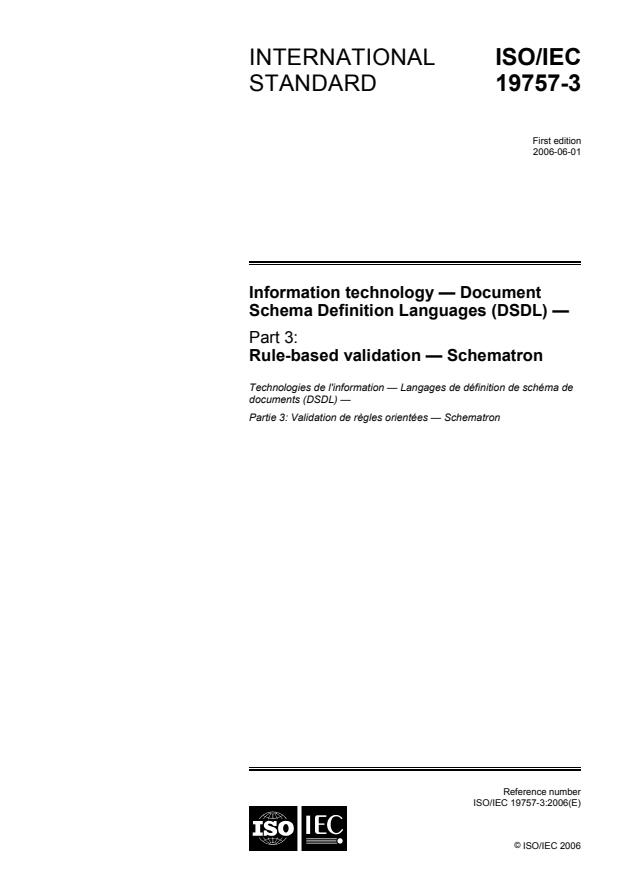
INTERNATIONAL ISO/IEC
STANDARD 19757-3
First edition
2006-06-01
Information technology — Document
Schema Definition Languages (DSDL) —
Part 3:
Rule-based validation — Schematron
Technologies de l'information — Langages de définition de schéma de
documents (DSDL) —
Partie 3: Validation de règles orientées — Schematron
Reference number
©
ISO/IEC 2006
PDF disclaimer
This PDF file may contain embedded typefaces. In accordance with Adobe's licensing policy, this file may be printed or viewed but
shall not be edited unless the typefaces which are embedded are licensed to and installed on the computer performing the editing. In
downloading this file, parties accept therein the responsibility of not infringing Adobe's licensing policy. The ISO Central Secretariat
accepts no liability in this area.
Adobe is a trademark of Adobe Systems Incorporated.
Details of the software products used to create this PDF file can be found in the General Info relative to the file; the PDF-creation
parameters were optimized for printing. Every care has been taken to ensure that the file is suitable for use by ISO member bodies. In
the unlikely event that a problem relating to it is found, please inform the Central Secretariat at the address given below.
© ISO/IEC 2006
All rights reserved. Unless otherwise specified, no part of this publication may be reproduced or utilized in any form or by any means,
electronic or mechanical, including photocopying and microfilm, without permission in writing from either ISO at the address below or
ISO's member body in the country of the requester.
ISO copyright office
Case postale 56 • CH-1211 Geneva 20
Tel. + 41 22 749 01 11
Fax + 41 22 749 09 47
E-mail copyright@iso.org
Web www.iso.org
Published in Switzerland
ii © ISO/IEC 2006 – All rights reserved
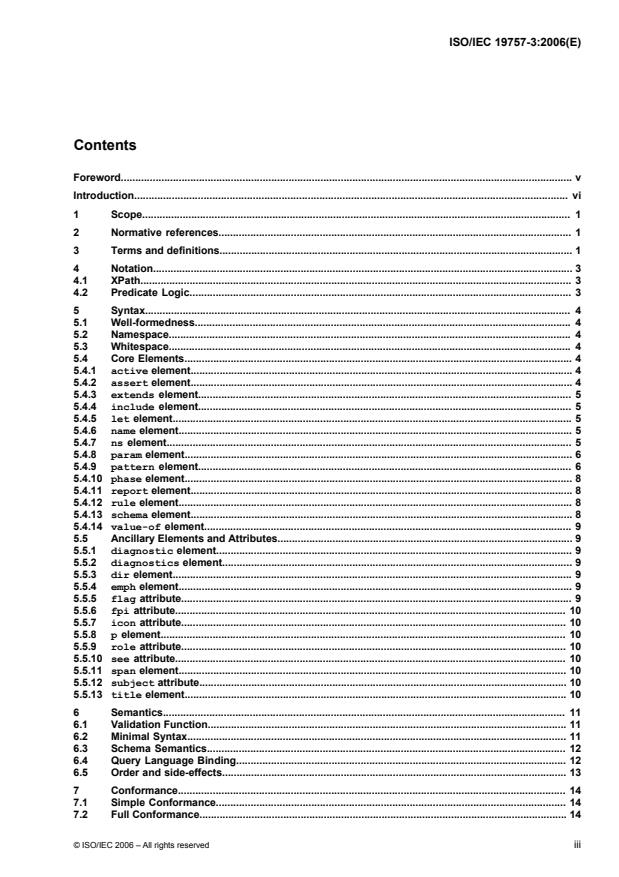
Contents
Foreword. v
Introduction. vi
1 Scope. 1
2 Normative references. 1
3 Terms and definitions. 1
4 Notation. 3
4.1 XPath. 3
4.2 Predicate Logic. 3
5 Syntax. 4
5.1 Well-formedness. 4
5.2 Namespace. 4
5.3 Whitespace. 4
5.4 Core Elements. 4
5.4.1 active element. 4
5.4.2 assert element. 4
5.4.3 extends element. 5
5.4.4 include element. 5
5.4.5 let element. 5
5.4.6 name element. 5
5.4.7 ns element. 5
5.4.8 param element. 6
5.4.9 pattern element. 6
5.4.10 phase element. 8
5.4.11 report element. 8
5.4.12 rule element. 8
5.4.13 schema element. 8
5.4.14 value-of element. 9
5.5 Ancillary Elements and Attributes. 9
5.5.1 diagnostic element. 9
5.5.2 diagnostics element. 9
5.5.3 dir element. 9
5.5.4 emph element. 9
5.5.5 flag attribute. 9
5.5.6 fpi attribute. 10
5.5.7 icon attribute. 10
5.5.8 p element. 10
5.5.9 role attribute. 10
5.5.10 see attribute. 10
5.5.11 span element. 10
5.5.12 subject attribute. 10
5.5.13 title element. 10
6 Semantics. 11
6.1 Validation Function. 11
6.2 Minimal Syntax. 11
6.3 Schema Semantics. 12
6.4 Query Language Binding. 12
6.5 Order and side-effects. 13
7 Conformance. 14
7.1 Simple Conformance. 14
7.2 Full Conformance. 14
© ISO/IEC 2006 – All rights reserved iii
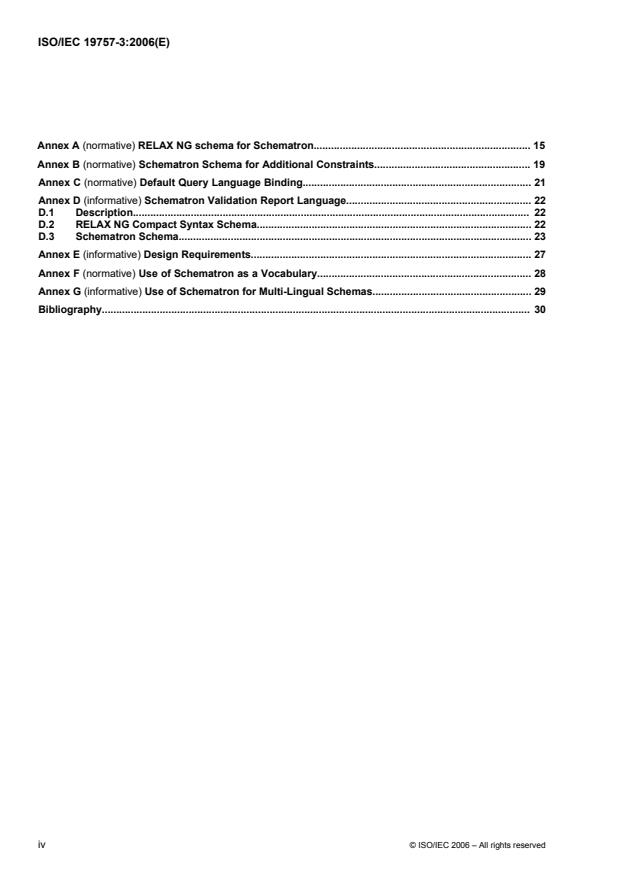
Annex A (normative) RELAX NG schema for Schematron. 15
Annex B (normative) Schematron Schema for Additional Constraints. 19
Annex C (normative) Default Query Language Binding. 21
Annex D (informative) Schematron Validation Report Language. 22
D.1 Description. 22
D.2 RELAX NG Compact Syntax Schema. 22
D.3 Schematron Schema. 23
Annex E (informative) Design Requirements. 27
Annex F (normative) Use of Schematron as a Vocabulary. 28
Annex G (informative) Use of Schematron for Multi-Lingual Schemas. 29
Bibliography. 30
iv © ISO/IEC 2006 – All rights reserved
Foreword
ISO (the International Organization for Standardization) and IEC (the International Electrotechnical
Commission) form the specialized system for worldwide standardization. National bodies that are members of
ISO or IEC participate in the development of International Standards through technical committees
established by the respective organization to deal with particular fields of technical activity. ISO and IEC
technical committees collaborate in fields of mutual interest. Other international organizations, governmental
and non-governmental, in liaison with ISO and IEC, also take part in the work. In the field of information
technology, ISO and IEC have established a joint technical committee, ISO/IEC JTC 1.
International Standards are drafted in accordance with the rules given in the ISO/IEC Directives, Part 2.
The main task of the joint technical committee is to prepare International Standards. Draft International
Standards adopted by the joint technical committee are circulated to national bodies for voting. Publication as
an International Standard requires approval by at least 75 % of the national bodies casting a vote.
Attention is drawn to the possibility that some of the elements of this document may be the subject of patent
rights. ISO and IEC shall not be held responsible for identifying any or all such patent rights.
ISO/IEC 19757-3 was prepared by Joint Technical Committee ISO/IEC JTC 1, Information technology,
Subcommittee SC 34, Document description and processing languages.
ISO/IEC 19757 consists of the following parts, under the general title Information technology — Document
Schema Definition Languages (DSDL):
⎯ Part 1: Overview
⎯ Part 2: Regular-grammar-based validation — RELAX NG
⎯ Part 3: Rule-based validation — Schematron
⎯ Part 4: Namespace-based Validation Dispatching Language — NVDL
The following parts are under preparation:
⎯ Part 5: Datatypes
⎯ Part 6: Path-based integrity constraints
⎯ Part 7: Character repertoire description language — CRDL
⎯ Part 8: Document schema renaming language — DSRL
⎯ Part 9: Datatype- and namespace-aware DTDs
⎯ Part 10: Validation management
© ISO/IEC 2006 – All rights reserved v
Introduction
ISO/IEC 19757 defines a set of Document Schema Definition Languages (DSDL) that can be used to specify one or
more validation processes performed against Extensible Markup Language (XML) or Standard Generalized Markup
Language (SGML) documents. (XML is an application profile SGML, ISO 8879:1986.)
A document model is an expression of the constraints to be placed on the structure and content of documents to be
validated with the model. A number of technologies have been developed through various formal and informal consortia
since the development of Document Type Definitions (DTD) as part of ISO 8879, notably by the World Wide Web
Consortium (W3C) and the Organization for the Advancement of Structured Information Standards (OASIS). A number
of validation technologies are standardized in DSDL to complement those already available as standards or from
industry.
To validate that a structured document conforms to specified constraints in structure and content relieves the potentially
many applications acting on the document from having to duplicate the task of confirming that such requirements
have been met. Historically, such tasks and expressions have been developed and utilized in isolation, without
consideration of how the features and functionality available in other technologies might enhance validation objectives.
The main objective of ISO/IEC 19757 is to bring together different validation-related tasks and expressions to form a
single extensible framework that allows technologies to work in series or in parallel to produce a single or a set of
validation results. The extensibility of DSDL accommodates validation technologies not yet designed or specified.
In the past, different design and use criteria have led users to choose different validation technologies for different
portions of their information. Bringing together information within a single XML document sometimes prevents existing
document models from being used to validate sections of data. By providing an integrated suite of constraint description
languages that can be applied to different subsets of a single XML document, ISO/IEC 19757 allows different validation
technologies to be integrated under a well-defined validation policy.
[1] [2]
This part of ISO/IEC 19757 is based on the Schematron assertion language. The let element is based on XCSL .
Other features arise from the half-dozen early Open Source implementations of Schematron in diverse programming
languages and from discussions in electronic forums by Schematron users and implementers.
The structure of this part of ISO/IEC 19757 is as follows. Clause 5 describes the syntax of an ISO Schematron schema.
Clause 6 describes the semantics of a correct ISO Schematron schema; the semantics specify when a document is
valid with respect to an ISO Schematron schema. Clause 7 describes conformance requirements for implementations
of ISO Schematron validators. Annex A is a normative annex providing the ISO/IEC 19757-2 (RELAX NG) schema
for ISO Schematron. Annex B is a normative annex providing the ISO Schematron schema for constraints in ISO
Schematron that cannot be expressed by the schema of Annex A. Annex C is a normative annex providing the default
query language binding to XSLT. Annex D is an informative annex providing a ISO/IEC 19757-2 (RELAX NG
compact syntax) schema and corresponding ISO Schematron schema for a simple XML language Schematron
Validation Report Language. Annex E is an informative annex providing motivating design requirements for ISO
Schematron. Annex F is a normative annex allowing certain Schematron elements to be used in external
vocabularies. Annex G is an informative annex with a simple example of a multi-lingual schema.
Considered as a document type, a Schematron schema contains natural-language assertions concerning a set of
documents, marked up with various elements and attributes for testing these natural-language assertions, and for
simplifying and grouping assertions.
Considered theoretically, a Schematron schema reduces to a non-chaining rule system whose terms are Boolean
functions invoking an external query language on the instance and other visible XML documents, with syntactic
features to reduce specification size and to allow efficient implementation.
Considered analytically, Schematron has two characteristic high-level abstractions: the pattern and the phase. These
allow the representation of non-regular, non-sequential constraints that ISO/IEC 19757-2 cannot specify, and
various dynamic or contingent constraints.
vi © ISO/IEC 2006 – All rights reserved
INTERNATIONAL STANDARD ISO/IEC 19757-3:2006(E)
Information technology — Document Schema Definition
Languages (DSDL) —
Part 3:
Rule-based validation — Schematron
1 Scope
This part of ISO/IEC 19757 specifies Schematron, a schema language for XML. This part of ISO/IEC 19757 establishes
requirements for Schematron schemas and specifies when an XML document matches the patterns specified by a
Schematron schema.
2 Normative references
The following referenced documents are indispensable for the application of this document. For dated references,
only the edition cited applies. For undated references, the latest edition of the referenced document (including any
amendments) applies.
NOTE Each of the following documents has a unique identifier that is used to cite the document in the text. The
unique identifier consists of the part of the reference up to the first comma.
W3C XML 1.0, Extensible Markup Language (XML) 1.0 (Third Edition), W3C Recommendation, 04 February 2004
XPath, XML Path Language (XPath) Version 1.0, W3C Recommendation, 16 November 1999
XSLT, XSL Transformations (XSLT) Version 1.0, W3C Recommendation, 16 November 1999
3 Terms and definitions
For the purposes of this document, the following terms and definitions apply.
3.1 abstract pattern
pattern in a rule that has been parameterized to enable reuse
3.2 abstract rule
collection of assertions which can be included in other rules but which does not fire itself
3.3 active pattern
pattern belonging to the active phase
3.4 active phase
one particular phase, whose patterns are used for validation
3.5 assertion
natural-language assertion with corresponding assertion test and ancillary attributes: assertions are marked up
with assert and report elements
© ISO/IEC 2006 – All rights reserved 1
3.6 assertion test
assertion modelled or implemented by a Boolean query; an assertion test "succeeds" or "fails"
3.7 correct schema
schema that satisfies all the requirements of this part of ISO/IEC 19757
3.8 diagnostic
named natural language statements providing information to end-users of validators concerning the expected and
actual values together with repair hints
3.9 elaborated rule context expression
single rule context expression which explicitly disallows items selected by lexically previous rule contexts in the same
pattern
3.10 good schema
correct schema with queries which terminate and do not add constraints to those of the natural-language assertions.
NOTE It may not be possible to compute that a schema is good.
3.11 implementation
implementation of a Schematron validator
3.12 name
token with no whitespace characters
3.13 natural-language assertion
natural-language statement expressing some part of a pattern; a natural-language assertion is "met" or "unmet"
3.14 pattern
named structure in instances specified in a schema by a lexically-ordered collection of rules
3.15 phase
named, unordered collection of patterns; patterns may belong to more than one phase; two names, #ALL and
#DEFAULT, are reserved with particular meanings
3.16 progressive validation
validation of constraints in stages determined or grouped to some extent by the schema author rather than, for
example, entirely determined by document order
3.17 query language binding
named set, specified in a document called a Query Language Binding, of the languages and conventions used for
assertion tests, rule-context expressions and so on, by a particular Schematron implementation
NOTE 1 Schematron is defined as a framework, with a default query language binding, but other query language bindings are
possible.
NOTE 2 6.4 specifies the information to be required by a query language binding and Annex C defines the default query language
binding for Schematron.
2 © ISO/IEC 2006 – All rights reserved
3.18 rule
unordered collection of assertions with a rule-context expression and ancillary attributes
3.19 rule context
element or other information item used for assertion tests; a rule is said to fire when an information item matches the
rule context
3.20 rule-context expression
a query to specify subjects; a rule-context is said to match an information item when that information item has not
been matched by any lexically-previous rule context expressions in the same pattern and the information item is one
of the information items that the query would specify
3.21 schema
specification of a set of XML documents
3.22 subject
particular information item which corresponds to the object of interest of the natural-language assertions and typically
is matched by the context expression of a rule
3.23 valid with respect to a schema
member of the set of XML documents described by the schema: an instance document is valid if no assertion tests
in fired rules of active patterns fail
3.24 variable
constant value, evaluated within the parent schema, phase, pattern or rule and scoped within the parent schema,
phase, pattern or rule
4 Notation
4.1 XPath
This part of ISO/IEC 19757 uses XPath to identify information items in Schematron schemas.
4.2 Predicate Logic
This part of ISO/IEC 19757 uses predicate logic to express the semantics of Schematron schema. The following
symbols are defined for use in s6.3:
—
()
Grouping delimiters
—
∀
"for all". Prefix operator.
—
¬
"not". Prefix operator.
—
∈
"is member of", in set operative sense. Prefix operator.
© ISO/IEC 2006 – All rights reserved
—
,
"and" (sequence). Infix operator.
—
:
"where". Such that. Infix operator.
—
⇔
"if and only if". Infix operator.
5 Syntax
5.1 Well-formedness
A Schematron schema shall be a well-formed XML document, according to the version of XML used.
5.2 Namespace
All elements shown in the grammar for Schematron are qualified with the namespace URI:
http://purl.oclc.org/dsdl/schematron
In subsequent clauses, the prefix sch is taken as bound to the Schematron namespace URI for exposition purposes.
The prefix sch is not reserved or required by this part of ISO/IEC 19757.
Any element can also have foreign attributes in addition to the attributes shown in the grammar. A foreign attribute is
an attribute with a name whose namespace URI is neither the empty string nor the Schematron namespace URI. Any
non-empty element may have foreign child elements in addition to the child elements shown in the grammar. A foreign
element is an element with a name whose namespace URI is not the Schematron namespace URI. There are no
constraints on the relative position of foreign child elements with respect to other child elements.
5.3 Whitespace
Any element can also have as children strings that consist entirely of whitespace characters, where a whitespace
character is one of U+0020, U+0009, U+000D or U+000A. There are no constraints on the relative position of
whitespace string children with respect to child elements.
NOTE Leading and trailing whitespace should be stripped from attributes defined by this part. Whitespace should be collapsed
in elements defined by this part that allow text. Whitespace may be stripped from elements defined by this part that
do not allow text.
5.4 Core Elements
The grammar for Schematron elements is given in Annex A.
5.4.1 active element
The required pattern attribute is a reference to a pattern that is active in the current phase.
5.4.2 assert element
An assertion made about the context nodes. The data content is a natural-language assertion. The required test
attribute is an assertion test evaluated in the current context. If the test evaluates positive, the assertion succeeds.
The optional diagnostics attribute is a reference to further diagnostic information.
The natural-language assertion shall be a positive statement of a constraint.
4 © ISO/IEC 2006 – All rights reserved
NOTE The natural-language assertion may contain information about actual values in addition to expected values and may
contain diagnostic information. Users should note, however, that the diagnostic element is provided for such
information to encourage clear statement of the natural-language assertion.
The icon, see and fpi attributes allow rich interfaces and documentation. They are defined below.
The flag attribute allows more detailed outcomes. It is defined below.
The role and subject attributes allow explicit identification of some part of a pattern. They are defined below.
5.4.3 extends element
Abstract rules are named lists of assertions without a context expression. The required rule attribute references an
abstract rule. The current rule uses all the assertions from the abstract rule it extends.
5.4.4 include element
The required href attribute references an external well-formed XML document whose document element is a
Schematron element of a type which is allowed by the grammar for Schematron at the current position in the schema.
The external document is inserted in place of the include element.
5.4.5 let element
A declaration of a named variable. If the let element is the child of a rule element, the variable is calculated and
scoped to the current rule and context. Otherwise, the variable is calculated with the context of the instance document
root.
The required name attribute is the name of the variable. The required value attribute is an expression evaluated in
the current context.
It is an error to reference a variable that has not been defined in the current schema, phase, pattern, or rule, if the
query language binding allows this to be determined reliably. It is an error for a variable to be multiply defined in the
current schema, phase, pattern and rule.
The variable is substituted into assertion tests and other expressions in the same rule before the test or expression
is evaluated. The query language binding specifies which lexical conventions are used to detect references to variables.
An implementation may provide a facility to override the values of top-level variables specified by let elements under
the schema element. For example, an implementation may allow top-level variables to be supplied on the command
line. The values provided are strings or data objects, not expressions.
5.4.6 name element
Provides the names of nodes from the instance document to allow clearer assertions and diagnostics. The optional
path attribute is an expression evaluated in the current context that returns a string that is the name of a node. In
the latter case, the name of the node is used.
An implementation which does not report natural-language assertions is not required to make use of this element.
5.4.7 ns element
Specification of a namespace prefix and URI. The required prefix attribute is an XML name with no colon character.
The required uri attribute is a namespace URI.
NOTE Because the characters allowed as names may change in versions of XML subsequent to W3C XML 1.0, the
ISO/IEC 19757-2 (RELAX NG Compact Syntax) schema for Schematron does not constrain the prefix to particular characters.
In an ISO Schematron schema, namespace prefixes in context expressions, assertion tests and other query expressions
should use the namespace bindings provided by this element. Namespace prefixes should not use the namespace
bindings in scope for element and attribute names.
© ISO/IEC 2006 – All rights reserved
5.4.8 param element
A name-value pair providing parameters for an abstract pattern. The required name attribute is an XML name with
no colon. The required value attribute is a fragment of a query.
5.4.9 pattern element
A structure, simple or complex. A set of rules giving constraints that are in some way related. The id attribute provides
a unique name for the pattern and is required for abstract patterns.
The title and p elements allow rich documentation.
The icon, see and fpi attributes allow rich interfaces and documentation.
When a pattern element has the attribute abstract with a value true, then the pattern defines an abstract pattern.
An abstract pattern shall not have a is-a attribute and shall have an id attribute.
Abstract patterns allow a common definition mechanism for structures which use different names and paths, but which
are at heart the same. For example, there are different table markup languages, but they all can be in large part
represented as an abstract pattern where a table contains rows and rows contain entries, as defined in the following
example using the default query language binding:
The element is a table. Tables contain rows.
The element is a table row. Rows contain entries.
When a pattern element has the attribute is-a with a value specifying the name of an abstract pattern, then the
pattern is an instance of an abstract pattern. Such a pattern shall not contain any rule elements, but shall have
param elements for all parameters used in the abstract pattern.
The following example uses the abstract pattern for tables given above to create three patterns for tables with different
names or structures.
6 © ISO/IEC 2006 – All rights reserved
When creating an instance of an abstract pattern, the parameter values supplied by the param element replace the
parameter references used in the abstract patterns. The examples above use the default query language binding in
which the character $ is used as the delimiter for parameter references.
Thus, given the abstract patterns defined earlier in this clause, the patterns defined above are equivalent to the
following, with the id elements shown expanded:
The element table is a table. Tables containing rows.
The element tr is a table row. Rows contain entries.
The element table is a table. Tables containing rows.
The element row is a table row. Rows contain entries.
The element year is a table. Tables containing rows.
The element week is a table row. Rows contain entries.
© ISO/IEC 2006 – All rights reserved 7
5.4.10 phase element
A grouping of patterns, to name and declare variations in schemas, for example, to support progressive validation.
The required id attribute is the name of the phase. The implementation determines which phase to use for validating
documents, for example by user command.
Two names, #ALL and #DEFAULT, have special meanings. The name #ALL is reserved and available for use by
implementations to denote that all patterns are active. The name #DEFAULT is reserved and available for use by
implementations to denote that the name given in the defaultPhase attribute on the schema element should be
used. If no defaultPhase is specified, then all patterns are active.
NOTE The names #ALL and #DEFAULT shall not be used in a Schematron schema. They are for use when invoking or
configuring schema validation, for example as a command-line parameter.
The icon, see and fpi attributes allow rich interfaces and documentation.
5.4.11 report element
An assertion made about the context nodes. The data content is a natural-language assertion. The required test
attribute is an assertion test evaluated in the current context. If the test evaluates positive, the report succeeds. The
optional diagnostics attribute is a reference to further diagnostic information.
The natural-language assertion shall be a positive statement of a found pattern or a negative statement of a constraint.
NOTE The natural-language assertion may contain information about actual values in addition to expected values and may
contain diagnostic information. Users should note, however, that the diagnostic element is provided for such
information to encourage clear statement of the natural-language assertion.
The icon, see and fpi attributes allow rich interfaces and documentation. They are defined below.
The flag attribute allows more detailed outcomes. It is defined below.
The role and subject attributes allow explicit identification of some part of a pattern. They are defined below.
5.4.12 rule element
A list of assertions tested within the context specified by the required context attribute. The context attribute
specifies the rule context expression.
NOTE It is not an error if a rule never fires in a document. In order to test that a document always has some context, a new
pattern should be created from the context of the document, with an assertion requiring the element or attribute.
The icon, see and fpi attributes allow rich interfaces and documentation.
The flag attribute allows more detailed outcomes. It is defined below.
The role and subject attributes allow explicit identification of some part of a pattern as part of the validation
outcome. They are defined below.
When the rule element has the attribute abstract with a value true, then the rule is an abstract rule. An abstract
rule shall not have a context attribute. An abstract rule is a list of assertions that will be invoked by other rules
belonging to the same pattern using the extends element. Abstract rules provide a mechanism for reducing schema
size.
5.4.13 schema element
The top-level element of a Schematron schema.
The optional schemaVersion attribute gives the version of the schema. Its allowed values are not defined by this
part of ISO/IEC 19757 and its use is implementation-dependent.
8 © ISO/IEC 2006 – All rights reserved
The optional queryBinding attribute provides the short name of the query language binding in use. If this attribute
is specified, it is an error if it has a value that the current implementation does not support.
The defaultPhase attribute may be used to indicate the phase to use in the absence of explicit user-supplied
information.
The title and p elements allow rich documentation.
The icon, see and fpi attributes allow rich interfaces and documentation.
5.4.14 value-of element
Finds or calculates values from the instance document to allow clearer assertions and diagnostics. The required
select attribute is an expression evaluated in the current context that returns a string.
Variable references in the select attribute are resolved in the scope of the current schema, phase, pattern and rule.
An implementation which does not report natural-language assertions is not required to make use of this element.
5.5 Ancillary Elements and Attributes
5.5.1 diagnostic element
A natural-language message giving more specific details concerning a failed assertion, such as found versus expected
values and repair hints.
NOTE Diagnostics in multiple languages may be supported by using a different diagnostic element for each language,
with the appropriate xml:lang language attribute, and referencing all the unique identifiers of the diagnostic
elements in the diagnostics attribute of the assertion. Annex G gives a simple example of a multi-lingual schema.
An implementation is not required to make use of this element.
5.5.2 diagnostics element
A section containing individual diagnostic elements.
An implementation is not required to make use of this element.
5.5.3 dir element
A section of natural-language text with a direction specified by the value attribute. The value ltr indicates left-to-right
text; the value rtl indicates right-to-left text.
An implementation is not required to make use of this element.
5.5.4 emph element
A portion of text that should be rendered with some emphasis.
An implementation is not required to make use of this element.
5.5.5 flag attribute
The name of a Boolean flag variable. A flag is implicitly declared by an assertion or rule having a flag attribute
with that name. The value of a flag becomes true when an assertion with that flag fails or a rule with that flag fires.
The purpose of flags is to convey state or severity information to a subsequent process.
An implementation is not required to make use of this attribute.
© ISO/IEC 2006 – All rights reserved 9
5.5.6 fpi attribute
A formal public identifier for the schema, phase or other element.
An implementation is not required to make use of this attribute.
5.5.7 icon attribute
The location of a graphics file containing some visible representation of the severity, significance or other grouping
of the associated element.
An implementation is not required to make use of this attribute.
5.5.8 p element
A paragraph of natural language text containing maintainer and user information about the parent element. The
schema can nominate paragraphs that should be rendered in a distinct way, keyed with the class attribute.
An implementation is not required to make use of this element.
5.5.9 role attribute
A name describing the function of the assertion or context node in the pattern. If the assertion has a subject attribute,
then the role labels the arc between the context node and any nodes which match the path expression given by the
subject attribute.
An implementation is not required to make use of this attribute.
5.5.10 see attribute
The URI of external information of interest to maintainers and users of the schema.
An implementation is not required to make use of this attribute.
5.5.11 span element
A portion of some paragraph that should be rendered in a distinct way, keyed with the class attribute.
An implementation is not required to make use of this element.
5.5.12 subject attribute
A path allowing more precise specification of nodes. The path expression is evaluated in the context of the context
node of the current rule. If no subject attribute is specified, the current subject node may be used.
NOTE The subject attribute is required because the rule context may have been selected for reasons of convenience or
performance, in association with the particular assertion tests. In such cases, the rule context may not be useful to
identify the subject, and the nodes located by the subject attribute may be more useful. Similarly, it may not be
possible to determine from an assertion test which nodes the assertion test has tested. In such a case, the nodes
located by the subject attribute may be more useful.
An implementation is not required to make use of this element.
5.5.13 title element
A summary of the purpose or role of the schema or pattern, for the purpose of documentation or a rich user interface.
An implementation is not required to make use of this element.
10 © ISO/IEC 2006 – All rights reserved
6 Semantics
6.1 Validation Function
A general Schematron validator is a function returning "valid", "invalid" or "error". The function notionally performs
two steps: transforming the schema into a minimal syntax, then testing the instance against the minimal syntax.
NOTE This part of ISO/IEC 19757 does not constrain other information provided by an implementation nor other uses of
Schematron schemas. However, it is the intent of this part of ISO/IEC 19757 to support implementations to provide
rich, specific diagnostics customised with values that assist in detecting and rectifying problems.
A Schematron validator is a function over the following:
— a query language binding
— a schema document
— an instance to be validated
— external XML documents addressed using information in the instance or schema
— a phase name, or #ALL if all patterns shall be active patterns, or #DEFAULT if the defaultPhase attribute on
the schema element shall be used
— a list of name-value pairs, if the schema uses external variables.
6.2 Minimal Syntax
To simplify the specification of semantics later, the following transformation steps are first applied to a schema,
resulting in a schema in the minimal syntax:
1. Resolve all inclusions by replacing the include element by the resource linked to.
2. Resolve all abstract patterns by replacing parameter references with actual parameter values in all enclosed
attributes that contain queries.
3. Resolve all abstract rules in the schema by replacing the extends elements with the contents of the abstract
rule identified.
4. Negate all report elements into assert elements.
5. Remove elements used for diagnostics and documentation.
The resulting minimal syntax is also a valid Schematron instance in the full syntax.
...
Questions, Comments and Discussion
Ask us and Technical Secretary will try to provide an answer. You can facilitate discussion about the standard in here.
Loading comments...