


ISO/IEC 14543-5-21:2012
(Main)Information technology — Home electronic system (HES) architecture — Part 5-21: Intelligent grouping and resource sharing for HES Class 2 and Class 3 — Application profile — AV profile
Information technology — Home electronic system (HES) architecture — Part 5-21: Intelligent grouping and resource sharing for HES Class 2 and Class 3 — Application profile — AV profile
ISO/IEC 14543-5-21:2012(E) specifies the media data stream service profile, the device interaction flow, the request and response message format used in device interaction and the description format of services provided by the device. It is applicable to computers, household appliances and communication devices that implement media data streaming by wired or wireless means.
Technologies de l'information — Architecture des systèmes électroniques domestiques (HES) — Partie 5-21: Groupement intelligent et partage des ressources pour HES classe 2 et classe 3 — Profil d'application — Profil AV
General Information
- Status
- Published
- Publication Date
- 23-Feb-2012
- Technical Committee
- ISO/IEC JTC 1/SC 25 - Interconnection of information technology equipment
- Current Stage
- 9093 - International Standard confirmed
- Start Date
- 13-Jul-2018
- Completion Date
- 14-Feb-2026
Overview - ISO/IEC 14543-5-21:2012 (AV profile)
ISO/IEC 14543-5-21:2012 is an international standard in the Home Electronic System (HES) architecture series that defines an AV application profile for intelligent grouping and resource sharing in HES Class 2 and Class 3 environments. The standard specifies the media data stream service profile, device interaction flows, request/response message formats used in device interaction, and the description format for services provided by devices. It applies to computers, household appliances and communication devices that implement media data streaming over wired or wireless networks.
Key topics and technical requirements
- Device interaction models: Four interaction models are defined - single server/client, multiple servers/single client, single server/multiple clients, and multiple servers/multiple clients - to support diverse AV use cases.
- Core components: Definitions and responsibilities for media servers, media clients, and media device groups (including Content Index Service (CIS) groups and Audio-Video multicast groups).
- Service profiles and protocols:
- Media data stream service profile for streaming behavior.
- BCM TCP service and IGRS SOAP service for control and signalling.
- Message formats for service invocation requests/responses, content directory updates, and service attribute notifications.
- Interaction flows: Detailed sequences for device grouping, dynamic service invocation, AV playback (server-initiated and client-initiated transport), multicast playback, content management, collaborative content analysis and personalization.
- Session management: Session setup, conditions, processes and termination rules are standardized to ensure interoperability.
- Modularity and expansion: Guidance on modular expansion of media servers and clients to support additional functions.
Practical applications
- Ensures interoperability among home AV devices (smart TVs, set-top boxes, NAS, smart appliances) that stream media over LAN/Wi‑Fi.
- Enables intelligent grouping (synchronized playback and resource sharing) for multi-room audio/video and multicast scenarios.
- Supports content indexing, collaborative content analysis and personalized recommendations across devices.
- Useful for designing firmware, middleware, networked appliance software, and home automation platforms that require standardized AV control and messaging.
Who should use this standard
- Device manufacturers (media servers/clients, smart appliances)
- Firmware and middleware developers for home entertainment and IoT devices
- System integrators and platform architects working on multi-room AV systems
- Test labs and interoperability certification bodies
Related standards
- Other parts of the ISO/IEC 14543 HES architecture series (Part 5 family) and ISO/IEC JTC 1 publications governing information technology interconnection standards.



Get Certified
Connect with accredited certification bodies for this standard

BSI Group
BSI (British Standards Institution) is the business standards company that helps organizations make excellence a habit.

NYCE
Mexican standards and certification body.
Sponsored listings
Frequently Asked Questions
ISO/IEC 14543-5-21:2012 is a standard published by the International Organization for Standardization (ISO). Its full title is "Information technology — Home electronic system (HES) architecture — Part 5-21: Intelligent grouping and resource sharing for HES Class 2 and Class 3 — Application profile — AV profile". This standard covers: ISO/IEC 14543-5-21:2012(E) specifies the media data stream service profile, the device interaction flow, the request and response message format used in device interaction and the description format of services provided by the device. It is applicable to computers, household appliances and communication devices that implement media data streaming by wired or wireless means.
ISO/IEC 14543-5-21:2012(E) specifies the media data stream service profile, the device interaction flow, the request and response message format used in device interaction and the description format of services provided by the device. It is applicable to computers, household appliances and communication devices that implement media data streaming by wired or wireless means.
ISO/IEC 14543-5-21:2012 is classified under the following ICS (International Classification for Standards) categories: 35.200 - Interface and interconnection equipment; 35.240.67 - IT applications in building and construction industry; 35.240.99 - IT applications in other fields. The ICS classification helps identify the subject area and facilitates finding related standards.
ISO/IEC 14543-5-21:2012 is available in PDF format for immediate download after purchase. The document can be added to your cart and obtained through the secure checkout process. Digital delivery ensures instant access to the complete standard document.
Standards Content (Sample)
ISO/IEC 14543-5-21
Edition 1.0 2012-02
INTERNATIONAL
STANDARD
Information technology – Home electronic system (HES) architecture –
Part 5-21: Intelligent grouping and resource sharing for HES Class 2 and Class 3 –
Application profile – AV profile
All rights reserved. Unless otherwise specified, no part of this publication may be reproduced or utilized in any form
or by any means, electronic or mechanical, including photocopying and microfilm, without permission in writing from
either IEC or IEC's member National Committee in the country of the requester.
If you have any questions about ISO/IEC copyright or have an enquiry about obtaining additional rights to this
publication, please contact the address below or your local IEC member National Committee for further information.
IEC Central Office Tel.: +41 22 919 02 11
3, rue de Varembé Fax: +41 22 919 03 00
CH-1211 Geneva 20 info@iec.ch
Switzerland www.iec.ch
About the IEC
The International Electrotechnical Commission (IEC) is the leading global organization that prepares and publishes
International Standards for all electrical, electronic and related technologies.
About IEC publications
The technical content of IEC publications is kept under constant review by the IEC. Please make sure that you have the
latest edition, a corrigenda or an amendment might have been published.
Useful links:
IEC publications search - www.iec.ch/searchpub Electropedia - www.electropedia.org
The advanced search enables you to find IEC publications The world's leading online dictionary of electronic and
by a variety of criteria (reference number, text, technical electrical terms containing more than 30 000 terms and
committee,…). definitions in English and French, with equivalent terms in
It also gives information on projects, replaced and additional languages. Also known as the International
withdrawn publications. Electrotechnical Vocabulary (IEV) on-line.
IEC Just Published - webstore.iec.ch/justpublished Customer Service Centre - webstore.iec.ch/csc
Stay up to date on all new IEC publications. Just Published If you wish to give us your feedback on this publication
details all new publications released. Available on-line and or need further assistance, please contact the
also once a month by email. Customer Service Centre: csc@iec.ch.
ISO/IEC 14543-5-21
Edition 1.0 2012-02
INTERNATIONAL
STANDARD
Information technology – Home electronic system (HES) architecture –
Part 5-21: Intelligent grouping and resource sharing for HES Class 2 and Class 3 –
Application profile – AV profile
INTERNATIONAL
ELECTROTECHNICAL
COMMISSION
PRICE CODE
T
ICS 35.200 ISBN 978-2-88912-901-0
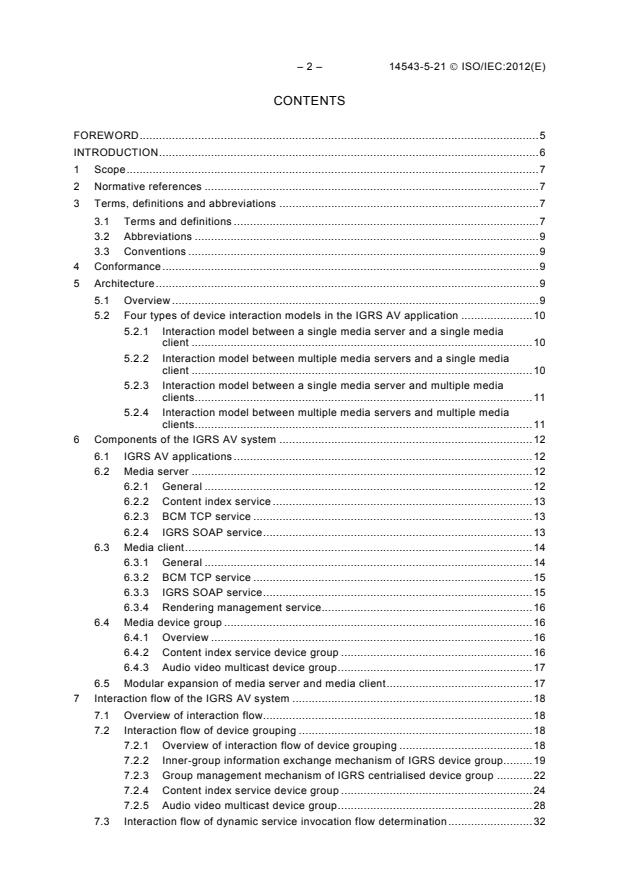
– 2 – 14543-5-21 ISO/IEC:2012(E)
CONTENTS
FOREWORD . 5
INTRODUCTION . 6
1 Scope . 7
2 Normative references . 7
3 Terms, definitions and abbreviations . 7
3.1 Terms and definitions . 7
3.2 Abbreviations . 9
3.3 Conventions . 9
4 Conformance . 9
5 Architecture . 9
5.1 Overview . 9
5.2 Four types of device interaction models in the IGRS AV application . 10
5.2.1 Interaction model between a single media server and a single media
client . 10
5.2.2 Interaction model between multiple media servers and a single media
client . 10
5.2.3 Interaction model between a single media server and multiple media
clients. 11
5.2.4 Interaction model between multiple media servers and multiple media
clients. 11
6 Components of the IGRS AV system . 12
6.1 IGRS AV applications . 12
6.2 Media server . 12
6.2.1 General . 12
6.2.2 Content index service . 13
6.2.3 BCM TCP service . 13
6.2.4 IGRS SOAP service . 13
6.3 Media client . 14
6.3.1 General . 14
6.3.2 BCM TCP service . 15
6.3.3 IGRS SOAP service . 15
6.3.4 Rendering management service. 16
6.4 Media device group . 16
6.4.1 Overview . 16
6.4.2 Content index service device group . 16
6.4.3 Audio video multicast device group . 17
6.5 Modular expansion of media server and media client . 17
7 Interaction flow of the IGRS AV system . 18
7.1 Overview of interaction flow . 18
7.2 Interaction flow of device grouping . 18
7.2.1 Overview of interaction flow of device grouping . 18
7.2.2 Inner-group information exchange mechanism of IGRS device group. 19
7.2.3 Group management mechanism of IGRS centrialised device group . 22
7.2.4 Content index service device group . 24
7.2.5 Audio video multicast device group . 28
7.3 Interaction flow of dynamic service invocation flow determination . 32
14543-5-21 ISO/IEC:2012(E) – 3 –
7.4 Interaction flow of AV playback. 33
7.4.1 General . 33
7.4.2 Media server initiated transport mode . 36
7.4.3 Media client initiated transport mode . 37
7.5 Interaction flow of multicast AV playback . 39
7.6 Interaction flow of content management . 41
7.6.1 General . 41
7.6.2 Interaction flow of collaborative content analysis . 41
7.6.3 Interaction flow of a personalised content recommendation . 43
8 Session . 44
8.1 Session setup. 44
8.2 Session setup condition. 45
8.3 Session setup process . 45
8.4 Session termination . 45
8.5 Service invocation message format . 45
8.5.1 General . 45
8.5.2 Service invocation request message . 45
8.5.3 Service invocation response message . 47
8.5.4 Content directory object update notification message . 48
8.5.5 Service attribute update notification message . 51
Bibliography . 53
Figure 1 – Device grouping model of the IGRS AV profile . 10
Figure 2 – Interaction model of a single media server and single media client . 10
Figure 3 – Interaction model of multiple media servers and a single media client . 11
Figure 4 – Interaction model of a single media server and multiple media clients . 11
Figure 5 – Interaction model of multiple media servers and multiple media clients . 12
Figure 6 – Components of a media server . 12
Figure 7 – Components of a media client . 14
Figure 8 – Modular expansion of a media server and media client . 17
Figure 9 – Overall interaction flow of the IGRS AV system . 18
Figure 10 – Flow of centralised device group management from the perspective of a
master device . 23
Figure 11 – Flow of centralised device group management from the perspective of
slave device . 24
Figure 12 – Flow of content index service device group management from the
perspective of media server set as CIS group master . 27
Figure 13 – Flow of content index service device group management from the
perspective of a media server set as CIS group slave . 28
Figure 14 – Flow of AV multicast device group management from the perspective of
master device . 31
Figure 15 – Flow of audio video multicast device group management from the
perspective of a slave device . 32
Figure 16 – Interaction flow of dynamic service invocation . 32
Figure 17 – Interaction flow of AV playback . 34
Figure 18 – Control of media server initiated transport based on BCM (IGRS dynamic
service invocation module located on media client) . 36
– 4 – 14543-5-21 ISO/IEC:2012(E)
Figure 19 – Control of media server initiated transport based on BCM (IGRS dynamic
service invocation module located on a media server) . 37
Figure 20 – Control of media server initiated transport based on SOAP . 37
Figure 21 – Control of a media client initiated transport based on BCM (IGRS dynamic
service invocation module located on a media client) . 38
Figure 22 – Control of media client initiated transport based on BCM (IGRS dynamic
service invocation module located on media server) . 38
Figure 23 – Control of media client initiated transport based on SOAP . 39
Figure 24 – Flow of multicast AV playback . 40
Figure 25 – Interaction flow of collaborative content analysis . 42
Figure 26 – Interaction flow of a media client accessing a content index service device
group . 43
Figure 27 – Flow of content recommendation by offline personalisation . 44
Figure 28 – Flow of content recommendation by online personalization . 44
Table 1 – IGRS device group inner-group information exchange notification message . 20
Table 2 – IGRS device group inner-group information exchange request message . 21
Table 3 – IGRS device group inner-group information exchange response message . 22
Table 4 – Content index service device group online advertisement message . 25
Table 5 – Audio video multicast device group online advertisement message . 29
Table 6 – Service invocation request message . 46
Table 7 – Service invocation response message . 47
Table 8 – Content directory object update notification message . 48
Table 9 – Service attribute update notification message. 51
14543-5-21 ISO/IEC:2012(E) – 5 –
INFORMATION TECHNOLOGY –
HOME ELECTRONIC SYSTEM (HES) ARCHITECTURE –
Part 5-21: Intelligent grouping and resource sharing
for HES Class 2 and Class 3 –
Application profile – AV profile
FOREWORD
1) ISO (International Organization for Standardization) and IEC (International Electrotechnical Commission) form the
specialized system for worldwide standardization. National bodies that are members of ISO or IEC participate in
the development of International Standards. Their preparation is entrusted to technical committees; any ISO and
IEC member body interested in the subject dealt with may participate in this preparatory work. International
governmental and non-governmental organizations liaising with ISO and IEC also participate in this preparation.
2) In the field of information technology, ISO and IEC have established a joint technical committee, ISO/IEC JTC 1.
Draft International Standards adopted by the joint technical committee are circulated to national bodies for voting.
Publication as an International Standard requires approval by at least 75 % of the national bodies casting a vote.
3) The formal decisions or agreements of IEC and ISO on technical matters express, as nearly as possible, an
international consensus of opinion on the relevant subjects since each technical committee has representation
from all interested IEC and ISO member bodies.
4) IEC, ISO and ISO/IEC publications have the form of recommendations for international use and are accepted
by IEC and ISO member bodies in that sense. While all reasonable efforts are made to ensure that the
technical content of IEC, ISO and ISO/IEC publications is accurate, IEC or ISO cannot be held responsible for
the way in which they are used or for any misinterpretation by any end user.
5) In order to promote international uniformity, IEC and ISO member bodies undertake to apply IEC, ISO and
ISO/IEC publications transparently to the maximum extent possible in their national and regional publications.
Any divergence between any ISO/IEC publication and the corresponding national or regional publication
should be clearly indicated in the latter.
6) ISO and IEC provide no marking procedure to indicate their approval and cannot be rendered responsible for
any equipment declared to be in conformity with an ISO/IEC publication.
7) All users should ensure that they have the latest edition of this publication.
8) No liability shall attach to IEC or ISO or its directors, employees, servants or agents including individual experts
and members of their technical committees and IEC or ISO member bodies for any personal injury, property
damage or other damage of any nature whatsoever, whether direct or indirect, or for costs (including legal fees)
and expenses arising out of the publication of, use of, or reliance upon, this ISO/IEC publication or any other IEC,
ISO or ISO/IEC publications.
9) Attention is drawn to the normative references cited in this publication. Use of the referenced publications is
indispensable for the correct application of this publication.
10) Attention is drawn to the possibility that some of the elements of this International Standard may be the subject of
patent rights. ISO and IEC shall not be held responsible for identifying any or all such patent rights.
International Standard ISO/IEC 14543-5-21 was prepared by subcommittee 25:
Interconnection of information technology equipment, of ISO/IEC joint technical committee 1:
Information technology.
The list of all currently available parts of the ISO/IEC 14543 series, under the general title
Information technology – Home electronic system (HES) architecture, can be found on the
IEC web site.
This International Standard has been approved by vote of the member bodies, and the voting
results may be obtained from the address given on the second title page.
This publication has been drafted in accordance with the ISO/IEC Directives, Part 2.
– 6 – 14543-5-21 ISO/IEC:2012(E)
INTRODUCTION
ISO/IEC 14543-5, Information technology – Home electronic system (HES) architecure –
Part 5: Intelligent Grouping and Resource Sharing for HES (IGRS), consists of six parts:
IGRS Part 5-1: Core protocol
• Specifies the TCP/IP protocol stack as the basis and the HTTP protocol as the
message-exchanging framework among devices.
• Specifies a series of device and service interaction/invocation standards, including
device and service discovery protocol, device and service description, service
invocation, security mechanisms, etc.
• Specifies core protocols for a type of home network that supports streaming media and
other high-speed data transport within a home.
IGRS Parts 5-2#: Application profile
• Based on the IGRS Core Protocol.
• Specifies a device and service interaction mechanism, as well as application interfaces
used in IGRS basic applications.
• Multiple application profiles are specified, including:
• Part 5-21: AV profile
• Part 5-22: File profile
• Additional application profiles are planned (part numbers to be assigned)
• Part 5-2w: DVD profile
• Part 5-2x: QoS profile
• Part 5-2y: DMCP profile
• Part 5-2z: Universal control profile
IGRS Part 5-3: Basic application
• Includes an IGRS basic application list.
• Specifies a basic application framework.
• Specifies operation details (device grouping, service description template, etc.),
function definitions and service invocation interfaces.
IGRS Part 5-4: Device validation
• Specifies a standard method to validate an IGRS-compliant device.
IGRS Part 5-5: Device type
• Specifies IGRS Device types used in IGRS applications.
IGRS Part 5-6: Service type
• Specifies basic service types used in IGRS applications.
14543-5-21 ISO/IEC:2012(E) – 7 –
INFORMATION TECHNOLOGY –
HOME ELECTRONIC SYSTEM (HES) ARCHITECTURE –
Part 5-21: Intelligent grouping and resource sharing
for HES Class 2 and Class 3 –
Application profile – AV profile
1 Scope
This part of ISO/IEC 14543 specifies the media data stream service profile, the device
interaction flow, the request and response message format used in device interaction and the
description format of services provided by the device.
This part of ISO/IEC 14543 is applicable to computers, household appliances and commun-
ication devices that implement media data streaming by wired or wireless means.
2 Normative references
The following referenced documents are indispensable for the application of this document.
For dated references, only the edition cited applies. For undated references, the latest edition
of the referenced document, including any amendments, applies.
ISO/IEC 14543-5-1:2010, Information technology – Home electronic system (HES)
architecture – Part 5-1: Intelligent grouping and resource sharing for Class 2 and Class 3 –
Core protocol
ISO/IEC 14543-5-6:2012, Information technology – Home electronic system (HES)
architecture –Part 5-6:— Intelligent grouping and resource sharing for HES Class 2 and
Class 3 – Service type
ISO/IEC 29341-3-1:2008, Information technology – UPnP Device Architecture – Part 3-1:
Audio Video Device Control Protocol – Audio Video Architecture
3 Terms, definitions and abbreviations
3.1 Terms and definitions
For the purposes of this document the following terms and definitions apply.
3.1.1
audio video multicast device group
type of media device group consisting of a media server and media client with multicast
capability for an AV multicast playback application
3.1.2
content index service device group
type of media device group which consists of multiple media servers for managing content
across multiple media servers in a distributed, collaborative and load-balancing manner
3.1.3
IGRS client
application that invokes the services of one or more connected IGRS devices
– 8 – 14543-5-21 ISO/IEC:2012(E)
NOTE Multiple client instances can exist on a network simultaneously.
3.1.4
IGRS device
information device that conforms to the IGRS specification
3.1.5
IGRS dynamic service invocation module
part of the AV application logic to orchestrate the interaction of application services according
to the capability of the device or device group involved and to coordinate the service
invocation sequence between the media server and media client
NOTE The IGRS dynamic service invocation module should be implemented on a media server, a media client or
another separate device.
3.1.6
IGRS service
sharable resource encapsulated in an IGRS device by implementing application interfaces
and providing services for other IGRS devices
NOTE An IGRS service has an invocation interface that meets the requirements of the IGRS specification. These
invocation interfaces are described and announced on the network through the IGRS service description
specification.
3.1.7
IGRS specification
ISO/IEC 14543-5 series of standards
3.1.8
media client
audio/video device in an IGRS network that possesses multimedia decoding capability
NOTE Examples of media client devices include a TV, set top box, etc. The media client may access content on
the media server as the destination device in an audio/video application.
3.1.9
media device group
embodiment of device group in an audio/video system and a type of centralised device group
defined in ISO/IEC 14543-5-1
NOTE A Media device group consists of two classes: content index service device group and audio video
multicast device group.
3.1.10
media server
audio/video device in IGRS network that possesses storage and computing capabilities
NOTE Examples of media server devices include a PC, network storage server, etc. The media server may
provide a network interface to other audio/video devices in order to access content managed by the media server
as the source device in an audio/video application.
14543-5-21 ISO/IEC:2012(E) – 9 –
3.2 Abbreviations
AV Audio/Video
BCM Back Channel Message
CIS Content Index Service
CMS Connection Management Service
DRM Digital Rights Management
IGRS Intelligent Grouping and Resource Sharing
MAN Mandatory, also refer to message definitions in ISO/IEC 14543-5-1
MC Media Client
MCTMS Media Client Transport Management Service
MP Media Player
MR Media Recorder
MS Media Server
MSTMS Media Server Transport Management Service
QoS Quality of Service
RMS Rendering Management Service
RTP Real-time Transport Protocol
RTSP Real-Time Streaming Protocol
SOAP Simple Object Access Protocol
STB Set Top Box
3.3 Conventions
For the convenience of the implementer, a number of XML schemas specified in this standard
can also be found on the World Wide Web. In case of any differences, the definitions of this
standard shall prevail.
4 Conformance
For conformance to this International Standard the following applies.
• The IGRS AV profile interaction model shall conform to the architecture specification
contained in Clause 5.
• The relevant AV device (media server or media client) and device group (CIS device group,
AV multicast device group) shall conform to the specifications contained in Clause 6.
• AV service invocation flow shall conform to the specifications described in Clause 7.
• AV invocation session setup procedure and message formats shall conform to the
specifications contained in Clause 8.
5 Architecture
5.1 Overview
The IGRS AV application profile describes the composition of an IGRS AV system and an
interaction model for AV devices and device groups in AV applications. An AV device may be
a TV, VCR, CD/DVD player, set top box (STB), audio system, camera or digital photo frame.
An AV device group is a set of devices consisting of multiple AV devices. The IGRS AV
application profile supports transporting multimedia contents among IGRS AV devices using
any transport protocol and any media format.
– 10 – 14543-5-21 ISO/IEC:2012(E)
The IGRS AV system specifies a flexible architecture to support many different types of AV
applications. From the perspective of the device types involved in any given application, the
IGRS AV system supports a single device AV application and a device group AV application.
The IGRS AV system supports a range of application types from simple AV playback to
advanced personalised content management.
The IGRS AV system typically should consist of three types of devices, as shown in Figure 1:
media server, media client and media device group. Correspondingly, four types of interaction
models between devices in an IGRS AV application should be supported: single media server
and single media client (required), multiple media servers and single media client, single
media server and multiple media clients, multiple media servers and multiple media clients.
5.2 specifies each interaction model in detail.
Media Server Media Client
Media Server Media Server Media Client Media Client
Media Server Media Client
Media Device Group Media Device Group
(Content Index Service Device Group) (Audio Video Multicast Device Group)
Figure 1 – Device grouping model of the IGRS AV profile
5.2 Four types of device interaction models in the IGRS AV application
5.2.1 Interaction model between a single media server and a single media client
When an IGRS AV application involves a single media server and a single media client (e.g.,
AV play between a media server and media client), it shall be specified by the interaction
model between a single media server and a single media client (also see Clauses 4 and 5 of
ISO/IEC 29341-3-1:2008), as shown in Figure 2.
Media Client
Media Server
Control Channel
IGRS AV Profile IGRS AV Profile
IGRS Core Protocol
IGRS Core Protocol
Media stream data out-of-band transport path
Figure 2 – Interaction model of a single media server and single media client
5.2.2 Interaction model between multiple media servers and a single media client
When an IGRS AV application involves multiple media servers and a single media client (e.g.,
the content is distributed in a media device group, specifically the content index service
device group, consisting of multiple media servers), it should be specified by the interaction
model between multiple media servers and a single media client, as shown in Figure 3.
Media stream data
out-of-band transport path
14543-5-21 ISO/IEC:2012(E) – 11 –
Media Device Group
Media Client
Media Server Media Server
IGRS AV Profile
Media stream data
IGRS AV Profile IGRS AV Profile
out-of-band transport path
IGRS Core
IGRS Core Protocol IGRS Core Protocol
Protocol
Figure 3 – Interaction model of multiple media servers and a single media client
5.2.3 Interaction model between a single media server and multiple media clients
When an IGRS AV application involves a single media server and multiple media clients (e.g.,
a media stream is transported from a media server to multiple media clients through multicast),
it should be specified by the interaction model between a single media server and multiple
media clients, as shown in Figure 4, where the media client is a member of a media device
group, particularly the audio video multicast device group.
Media Server
Media Client Media Client
IGRS AV Profile
IGRS AV Profile IGRS AV Profile
Media stream data
out-of-band transport path
IGRS Core Protocol
IGRS Core Protocol IGRS Core Protocol
Media Device Group
Figure 4 – Interaction model of a single media server and multiple media clients
5.2.4 Interaction model between multiple media servers and multiple media clients
When an IGRS AV application involves interactions among multiple media servers and
multiple media clients, the application should be specified by the interaction model between
multiple media servers and multiple media clients, as shown in Figure 5, where the media
client is a member of another media device group, particularly the audio video multicast
device group. An example of such an interaction consists of content that is distributed in a
media device group, particularly the content index service device group, consisting of multiple
media severs. The media stream is transported from the media device group consisting of
multiple media servers to multiple media clients through multicast.
– 12 – 14543-5-21 ISO/IEC:2012(E)
Media Device Group
Media Client Media Client
Media Server Media Server
IGRS AV Profile IGRS AV Profile
Media stream data Media stream data
IGRS AV Profile IGRS AV Profile
out-of-band transport path out-of-band transport path
IGRS Core Protocol IGRS Core Protocol
IGRS Core Protocol IGRS Core Protocol
Media Device Group
Figure 5 – Interaction model of multiple media servers and multiple media clients
6 Components of the IGRS AV system
6.1 IGRS AV applications
The IGRS AV system should support two types of AV applications: simple AV playback and
advanced personalised content management. For the two types of AV applications, three
different device types are specified: media server, media client and media device group. 6.2,
6.3 and 6.4 specify the composition of each device type.
6.2 Media server
6.2.1 General
In the IGRS AV system, the media server is a device with powerful computing capability and
storage capacity. For example, a computer or network storage server may become a media
server. In an AV application, the media server usually is used as a source device whose
manageable content is provided for a media client to access and to manipulate using a
standard network interface. The media server also may be used as a destination device that
allows media clients to upload the content stored in other devices on the network to a media
server for universal content management. The components of the IGRS media server are
specified in Figure 6.
Media Server
Content Index Service
I
G
R
S
Connection Management
A
Service
V
BCM TCP
P
Service
r
o
f
Media Server Transport
i
Management Service
l
e
IGRS Core Protocol
Figure 6 – Components of a media server
14543-5-21 ISO/IEC:2012(E) – 13 –
The components of the media server are summarised here and specified in the subsequent
clauses.
– Content index service: a media server shall implement a content index service to enable a
media client to browse, search and access the stored content through the interface
function of the content index service.
– Connection management and transport control mechanism: a media client may select and
play content on a media server. A media server shall support at least one connection
management and transport control mechanism. Transport control manages the out-of-band
data stream. An IGRS media server supports two types of connection management and
transport control mechanisms:
• Connection management and transport control mechanism based on BCM (Back
Channel Message), specified in 6.2.3.
• Connection management and transport control mechanism based on SOAP (Simple
Object Access Protocol), specified in 6.2.4.
A media server shall implement a BCM TCP service to support a BCM-based connection
management and transport control mechanism. This allows the media server to perform
both connection management and transport control on the out-of-band data stream.
A media server shall implement the GetProtocolInfo() interface function of the connection
management service to enable other devices on the network to inquire about the media
format supported by a media server and retrieve the supported connection management
and transport control mechanism.
A media server may implement the connection management service and the media server
transport management service using a SOAP-based connection management and
transport control mechanism. BCM-based connection management and transport control
are simplified access methods compared to SOAP and thus are preferred.
A media server shall support HTTP-GET out-of-band transport data stream protocol.
A media server should support RTSP/RTP out-of-band transport data stream protocol if
multicast AV playback is implemented.
6.2.2 Content index service
The content index service specifies the content representation framework of the IGRS AV
system. Through a content metadata description, the content index service provides the basic
information to match media format and transport mechanism in an AV playback application
between the media server and media client and also provides the necessary advanced
support for a personalised content management application. The detailed specifications of the
content index service are contained in 8.1 of ISO/IEC 14543-5-6.
6.2.3 BCM TCP service
The back channel message (BCM) TCP service is a type of connection management and
transport control mechanism used for AV playback specified in the IGRS AV system. It is
essentially a command token control protocol over the TCP protocol, including the BCM
Server and BCM Client. The detailed specifications of the BCM TCP service are contained in
Clause 9 of ISO/IEC 14543-5-6.
6.2.4 IGRS SOAP service
6.2.4.1 General
The connection management service takes charge of connection management between a
media server and media client. The media server transport management service takes charge
of the transport control of an out-of-band data stream between the media server and media
client.
– 14 – 14543-5-21 ISO/IEC:2012(E)
The IGRS AV system specifies a connection management and transport control mechanism
based on BCM. The Simple Object Access Protocol (SOAP) could be used for these IGRS
services. However, SOAP is not preferred because BCM is a simplified access method.
6.2.4.2 Connection management service
The connection management service specifies the interface function to enable the following
functionalities:
a) inquire about the media format supported by a media server;
b) retrieve the supported connection management and transport control mechanism;
c) setup, query and release the connection between the media server and media client in
IGRS AV system.
The detailed specification of CMS is contained in 8.2 of ISO/IEC 14543-5-6.
6.2.4.3 Media server transport management service
The media server transport management service specifies the interface function to control the
transport of an out-of-band data stream initiated by the media server in the IGRS AV system.
The detailed specification of the MSTMS is contained in 8.3 of ISO/IEC 14543-5-6.
6.3 Media client
6.3.1 General
In an IGRS network the media client is a type of device with powerful multimedia decoding
capability, for example, a TV, STB or high-definition network player. In an AV application, the
media client usually is a destination device that accesses and manipulates content on a
media server through a standard network interface. The media client may be a source device
that uploads the content stored on other devices in the network to a media server for
universal content management. The components of an IGRS media client are shown in
Figure 7.
Media Client
I
G
Connection Management
R
Service
S
BCM TCP
A
Service
V
Media Client Transport
P
Management Service
r
o
f
i
Rendering Management Service
l
e
IGRS Core Protocol
Figure 7 – Components of a media client
The IGRS media client includes two classes of devices: media player and media recorder.
14543-5-21 ISO/IEC:2012(E) – 15 –
After browsing and selecting the content on the media server to play and record, the media
client usually sets up a connection with the media server and performs transport control of the
out-of-band data stream.
The components of a media client are summarised here and specified in the subsequent
clauses.
– Connection management and transport control: a media client supports two types of
connection management and transport control mechanisms:
• connection management and transport control mechanism based on BCM, specified in
6.3.2;
• connection management and transport control mechanism based on SOAP, specified
in 6.3.3.
A media client shall support BCM-based connection management and the transport
control mechanism. This allows the media client server to perform both connection
management and transport control on the out-of-band data stream.
A media client shall implement the GetProtocolInfo() interface function of the connection
management service to enable other devices on the network to inquire about the media
format supported by a media client and retrieve the supported connection management
and transport control mechanism.
A media client may implement the connection management service and media client
transport management service using a SOAP-based connection management and
transport control mechanism. BCM-based connection management and transport control
are simplified access methods compared to SOAP and thus are preferred.
A media client shall support HTTP-GET out-of-band transport data stream protocol.
A media client should support RTSP/RTP out-of-band transport data stream protocol if
multicast AV playback is implemented.
– Rendering management service: a media client should implement a rendering
management service to support content rendering on playback devices, such as
brightness adjustment, contrast control, volume tuning, etc.
6.3.2 BCM TCP service
The back channel message TCP service is a type of connection management and transport
control mechanism used for AV playback specified in the IGRS AV system. It is essentially a
command token control protocol over TCP protocol, including the BCM Server and BCM Client.
The detailed specification of the BCM TCP service is contained in Clause 9 of
ISO/IEC 14543-5-6.
6.3.3 IGRS SOAP service
6.3.3.1 General
The connection management service takes charge of connection management between a
media server and media client. The media client transport management service takes charge
of the transport control of an out-of-band data stream between the media server and media
client.
The IGRS AV system specifies a connection management and transport control mechanism
based on BCM. The simple object access protocol (SOAP) could be used for these IGRS
services. However, SOAP is not preferred because BCM is a simplified access method.
6.3.3.2 Connection management service
The connection management service specifies the interface function to enable the following
functionalities:
a) inquire about the media format supported by a media client;
– 16 – 14543-5-21 ISO/IEC:2012(E)
b) retrieve the supported connection management and transport control mechanism;
c) setup, query and release the connection between a media server and a media client in an
IGRS AV system.
The detailed specification of CMS is contained in 8.2 of ISO/IEC 14543-5-6.
6.3.3.3 Media client transport management service
The media client transport management service specifies the interface function to control the
transport of an out-of-band data stream initiated by the media client in an IGRS AV system.
The detailed specification of MCTMS is contained in 8.4 of ISO/IEC 14543-5-6.
6.3.4 Rendering management service
The rendering management service specifies the interface function to manage the rendering
of content on a media client in an IGRS AV system. The detailed specification of RMS is
contained in 8.5 of ISO/IEC 14543-5-6.
6.4 Media device group
6.4.1 Overview
An IGRS device group is a device type specified by ISO/IEC 14543-5-1 for resource sharing
and device collaboration on an IGRS network. An IGRS device group shall consist of two
types: a peer-to-peer device group and a centralised device group. The detailed specification
is contained in 6.5 of ISO/IEC 14543-5-1.
Based on the definition of a device group in ISO/IEC 14543-5-1, the IGRS AV system
specifies a special type of device group used in an IGRS AV application, namely, the media
device group, which is a centralised device group consisting of a media server or a media
client. The media device group includes:
– content index service device group, specified in 6.4.2.
– audio video multicast device group, spe
...
Questions, Comments and Discussion
Ask us and Technical Secretary will try to provide an answer. You can facilitate discussion about the standard in here.
Loading comments...