


ISO/FDIS 20022-7
(Main)Financial services — Universal financial industry message scheme — Part 7: Registration
Financial services — Universal financial industry message scheme — Part 7: Registration
ISO 20022-7:2013 specifies the responsibilities of the following bodies, which are involved in the registration and maintenance of the ISO 20022 Repository. The Registration Authority (RA) is the operating authority responsible for the registration and maintenance of the ISO 20022 Repository and for providing access to the information described in ISO 20022-1:2013. The RA is assisted by different Standards Evaluation Groups (SEG), i.e. groups of industry experts responsible for specific Business Areas of the Repository. A Technical Support Group (TSG) advises the SEGs, the RA, developers and communities of users on the technical implementation of ISO 20022. The Registration Management Group (RMG) is the governing body of the overall registration process and the appeal body for the communities of users, Submitting Organisations, the RA, the SEGs and the TSG. It monitors the registration process performance.
Services financiers — Schéma universel de messages pour l'industrie financière — Partie 7: Enregistrement
General Information
- Status
- Not Published
- Technical Committee
- ISO/TC 68/SC 9 - Information exchange for financial services
- Drafting Committee
- ISO/TC 68/SC 9 - Information exchange for financial services
- Current Stage
- 5020 - FDIS ballot initiated: 2 months. Proof sent to secretariat
- Start Date
- 31-Dec-2025
- Completion Date
- 31-Dec-2025
Relations
- Effective Date
- 06-Jun-2022
Overview
ISO/FDIS 20022-7 - "Financial services - Universal financial industry message scheme - Part 7: Registration" defines the governance, roles and processes for registering and maintaining the ISO 20022 Repository. Published at the FDIS stage (2025), this part sets out how the Registration Authority (RA), Standards Evaluation Groups (SEGs), Technical Support Group (TSG), Registration Management Group (RMG) and Submitting Organizations coordinate to keep the ISO 20022 DataDictionary and BusinessProcessCatalogue current, discoverable and consistent.
Key topics and requirements
- Registration Authority (RA) responsibilities
- Operates the ISO 20022 Repository and provides public access to repository artefacts.
- Manages releases, archives and publishing of change history.
- Implements the registration request process and interacts with submitters.
- Governance and advisory bodies
- SEGs: industry experts responsible for specific business areas and content evaluation.
- TSG: provides technical implementation advice to SEGs, RA, developers and user communities.
- RMG: governs the overall registration process, monitors performance and acts as the appeal body.
- Registration elements
- Two primary repository areas: DataDictionary (reusable data elements) and BusinessProcessCatalogue (message and process models).
- Life cycle rules
- Only the latest release of each catalogue is the official reference; archives are retained for historical reference.
- A BusinessTransaction can be REGISTERED only when related Catalogue and Dictionary Items are REGISTERED or OBSOLETE with a removal date after the release publication date.
- Change history must be published alongside catalogue releases.
- Submission requirements
- Submissions must follow defined submission formats and media; the RA specifies how input is conveyed and processed.
- Roles of Submitting Organizations
- Submitters supply models, message definitions and artefacts and must follow RA requirements for submission and maintenance.
Applications and who uses it
ISO 20022-7 is essential for:
- Registration Authorities and standards maintainers operating central financial messaging repositories.
- Payment system operators, clearing houses, banks and fintechs implementing or migrating to ISO 20022 messaging.
- Standards evaluators and modelers (SEGs, TSG) who validate content and advise on technical solutions.
- Developers and integrators who need authoritative, versioned schema and dictionary items for message generation and interoperability. Practical uses include repository governance, message lifecycle management, release planning, compliance with canonical message definitions and ensuring interoperable financial messaging implementations.
Related standards
- ISO 20022-1 (Metamodel)
- ISO 20022-2 (UML profile)
- ISO 20022-3 (Modelling)
- ISO 20022-9 (Syntax generation rules) For RA contact and repository access details see the ISO maintenance agencies listing (www.iso.org/maintenance_agencies).
Buy Documents

ISO/FDIS 20022-7 - Financial services — Universal financial industry message scheme — Part 7: Registration Released:17. 12. 2025
REDLINE ISO/FDIS 20022-7 - Financial services — Universal financial industry message scheme — Part 7: Registration Released:17. 12. 2025
Get Certified
Connect with accredited certification bodies for this standard

Great Wall Tianjin Quality Assurance Center
Established 1993, first batch to receive national accreditation with IAF recognition.
Hong Kong Quality Assurance Agency (HKQAA)
Hong Kong's leading certification body.

Innovative Quality Certifications Pvt. Ltd. (IQCPL)
Known for integrity, providing ethical & impartial Assessment & Certification. CMMI Institute Partner.
Sponsored listings
Frequently Asked Questions
ISO/FDIS 20022-7 is a draft published by the International Organization for Standardization (ISO). Its full title is "Financial services — Universal financial industry message scheme — Part 7: Registration". This standard covers: ISO 20022-7:2013 specifies the responsibilities of the following bodies, which are involved in the registration and maintenance of the ISO 20022 Repository. The Registration Authority (RA) is the operating authority responsible for the registration and maintenance of the ISO 20022 Repository and for providing access to the information described in ISO 20022-1:2013. The RA is assisted by different Standards Evaluation Groups (SEG), i.e. groups of industry experts responsible for specific Business Areas of the Repository. A Technical Support Group (TSG) advises the SEGs, the RA, developers and communities of users on the technical implementation of ISO 20022. The Registration Management Group (RMG) is the governing body of the overall registration process and the appeal body for the communities of users, Submitting Organisations, the RA, the SEGs and the TSG. It monitors the registration process performance.
ISO 20022-7:2013 specifies the responsibilities of the following bodies, which are involved in the registration and maintenance of the ISO 20022 Repository. The Registration Authority (RA) is the operating authority responsible for the registration and maintenance of the ISO 20022 Repository and for providing access to the information described in ISO 20022-1:2013. The RA is assisted by different Standards Evaluation Groups (SEG), i.e. groups of industry experts responsible for specific Business Areas of the Repository. A Technical Support Group (TSG) advises the SEGs, the RA, developers and communities of users on the technical implementation of ISO 20022. The Registration Management Group (RMG) is the governing body of the overall registration process and the appeal body for the communities of users, Submitting Organisations, the RA, the SEGs and the TSG. It monitors the registration process performance.
ISO/FDIS 20022-7 is classified under the following ICS (International Classification for Standards) categories: 03.060 - Finances. Banking. Monetary systems. Insurance. The ICS classification helps identify the subject area and facilitates finding related standards.
ISO/FDIS 20022-7 has the following relationships with other standards: It is inter standard links to ISO 20022-7:2013. Understanding these relationships helps ensure you are using the most current and applicable version of the standard.
ISO/FDIS 20022-7 is available in PDF format for immediate download after purchase. The document can be added to your cart and obtained through the secure checkout process. Digital delivery ensures instant access to the complete standard document.
Standards Content (Sample)
FINAL DRAFT
International
Standard
ISO/TC 68/SC 9
Financial services — Universal
Secretariat: AFNOR
financial industry message
Voting begins on:
scheme —
2025-12-31
Part 7:
Voting terminates on:
2026-02-25
Registration
Services financiers — Schéma universel de messages pour
l'industrie financière —
Partie 7: Enregistrement
RECIPIENTS OF THIS DRAFT ARE INVITED TO SUBMIT,
WITH THEIR COMMENTS, NOTIFICATION OF ANY
RELEVANT PATENT RIGHTS OF WHICH THEY ARE AWARE
AND TO PROVIDE SUPPOR TING DOCUMENTATION.
IN ADDITION TO THEIR EVALUATION AS
BEING ACCEPTABLE FOR INDUSTRIAL, TECHNO-
LOGICAL, COMMERCIAL AND USER PURPOSES, DRAFT
INTERNATIONAL STANDARDS MAY ON OCCASION HAVE
TO BE CONSIDERED IN THE LIGHT OF THEIR POTENTIAL
TO BECOME STAN DARDS TO WHICH REFERENCE MAY BE
MADE IN NATIONAL REGULATIONS.
Reference number
FINAL DRAFT
International
Standard
ISO/TC 68/SC 9
Financial services — Universal
Secretariat: AFNOR
financial industry message
Voting begins on:
scheme —
Part 7:
Voting terminates on:
Registration
Services financiers — Schéma universel de messages pour
l'industrie financière —
Partie 7: Enregistrement
RECIPIENTS OF THIS DRAFT ARE INVITED TO SUBMIT,
WITH THEIR COMMENTS, NOTIFICATION OF ANY
RELEVANT PATENT RIGHTS OF WHICH THEY ARE AWARE
AND TO PROVIDE SUPPOR TING DOCUMENTATION.
© ISO 2025
IN ADDITION TO THEIR EVALUATION AS
All rights reserved. Unless otherwise specified, or required in the context of its implementation, no part of this publication may
BEING ACCEPTABLE FOR INDUSTRIAL, TECHNO-
LOGICAL, COMMERCIAL AND USER PURPOSES, DRAFT
be reproduced or utilized otherwise in any form or by any means, electronic or mechanical, including photocopying, or posting on
INTERNATIONAL STANDARDS MAY ON OCCASION HAVE
the internet or an intranet, without prior written permission. Permission can be requested from either ISO at the address below
TO BE CONSIDERED IN THE LIGHT OF THEIR POTENTIAL
or ISO’s member body in the country of the requester.
TO BECOME STAN DARDS TO WHICH REFERENCE MAY BE
MADE IN NATIONAL REGULATIONS.
ISO copyright office
CP 401 • Ch. de Blandonnet 8
CH-1214 Vernier, Geneva
Phone: +41 22 749 01 11
Email: copyright@iso.org
Website: www.iso.org
Published in Switzerland Reference number
ii
Contents Page
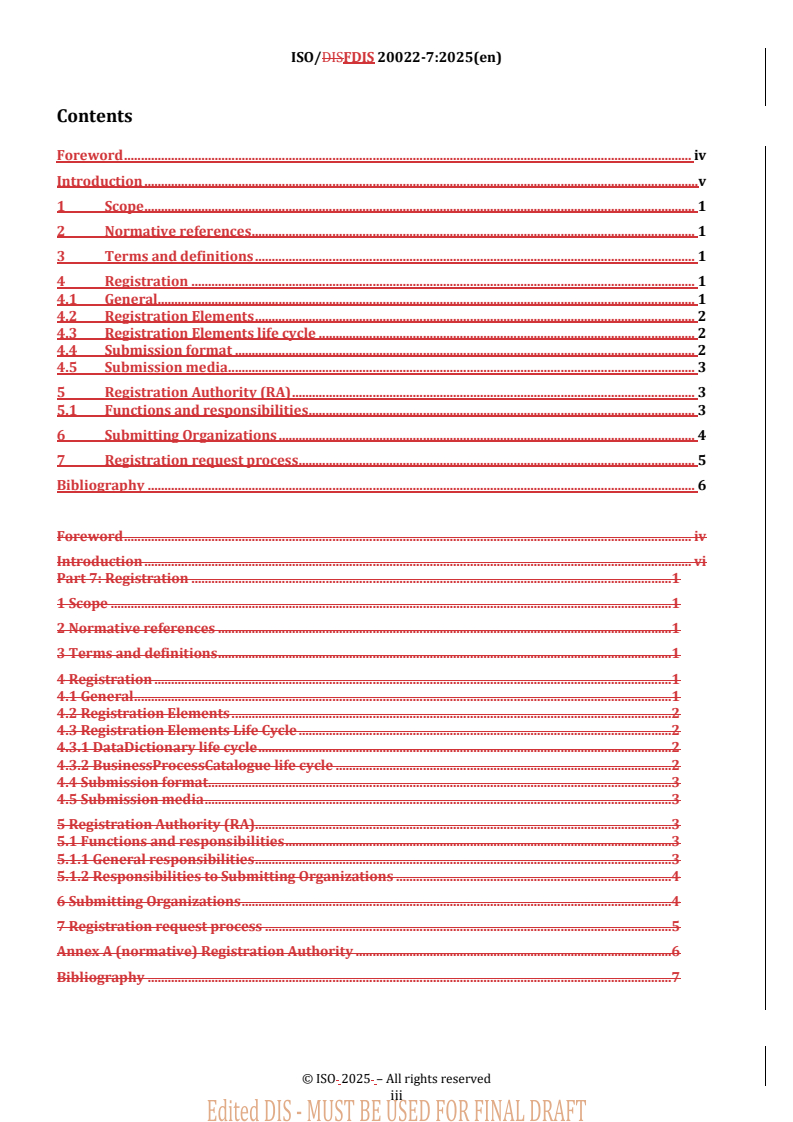
Foreword .iv
Introduction .v
1 Scope . 1
2 Normative references . 1
3 Terms and definitions . 1
4 Registration . 1
4.1 General .1
4.2 Registration Elements .2
4.3 Registration Elements life cycle .2
4.3.1 DataDictionary life cycle .2
4.3.2 BusinessProcessCatalogue life cycle .2
4.4 Submission format .2
4.5 Submission media .2
5 Registration Authority (RA) . 3
5.1 Functions and responsibilities .3
5.1.1 General responsibilities .3
5.1.2 Responsibilities to Submitting Organizations .3
6 Submitting Organizations . 4
7 Registration request process . 5
Bibliography . 6
iii
Foreword
ISO (the International Organization for Standardization) is a worldwide federation of national standards
bodies (ISO member bodies). The work of preparing International Standards is normally carried out through
ISO technical committees. Each member body interested in a subject for which a technical committee
has been established has the right to be represented on that committee. International organizations,
governmental and non-governmental, in liaison with ISO, also take part in the work. ISO collaborates closely
with the International Electrotechnical Commission (IEC) on all matters of electrotechnical standardization.
The procedures used to develop this document and those intended for its further maintenance are described
in the ISO/IEC Directives, Part 1. In particular, the different approval criteria needed for the different types
of ISO document should be noted. This document was drafted in accordance with the editorial rules of the
ISO/IEC Directives, Part 2 (see www.iso.org/directives).
ISO draws attention to the possibility that the implementation of this document may involve the use of (a)
patent(s). ISO takes no position concerning the evidence, validity or applicability of any claimed patent
rights in respect thereof. As of the date of publication of this document, ISO had not received notice of (a)
patent(s) which may be required to implement this document. However, implementers are cautioned that
this may not represent the latest information, which may be obtained from the patent database available at
www.iso.org/patents. ISO shall not be held responsible for identifying any or all such patent rights.
Any trade name used in this document is information given for the convenience of users and does not
constitute an endorsement.
For an explanation of the voluntary nature of standards, the meaning of ISO specific terms and expressions
related to conformity assessment, as well as information about ISO's adherence to the World Trade
Organization (WTO) principles in the Technical Barriers to Trade (TBT), see www.iso.org/iso/foreword.html.
This document was prepared by Technical Committee ISO/TC 68, Financial services, Subcommittee SC 9,
Information exchange for financial services.
This second edition cancels and replaces the first edition (ISO 20022-7:2013), which has been technically
revised.
The main changes are as follows:
— The contents of "Registration Elements" has been harmonized with ISO 20022-1 and ISO/IEC Directives,
Part 1.
— The responsibilities of the Registration Authority have been improved.
— The responsibilities of Submitting Organizations have been updated.
A list of all parts in the ISO 20022 series can be found on the ISO website.
Any feedback or questions on this document should be directed to the user’s national standards body. A
complete listing of these bodies can be found at www.iso.org/members.html.
iv
Introduction
The ISO 20022 series defines a scalable, methodical process to ensure consistent descriptions of messages
throughout the financial services industry.
The purpose of the ISO 20022 series is to describe precisely and completely the externally observable aspects
of financial services messaging in a way that can be verified independently against operational messaging.
The trigger for the creation of the ISO 20022 series was the rapid growth in the scale and sophistication
of messaging within financial services during the 1990s using the ISO 15022 series. The financial services
industry (hereafter referred to as "the industry") created the first version of the ISO 20022 series as the
successor to the ISO 15022 series in response to that trigger. Since ISO 15022 series, the industry has
broadened the scope from securities to the entire industry for the ISO 20022 series.
The ISO 20022 series is based on open technology standards, which historically have evolved more rapidly
than the industry itself. Consequently, the ISO 20022 series adopted a model-driven approach where the
model of the industry's messaging can evolve separately from the evolution of the messaging technology
standards. The period during which the ISO 20022 series has emerged followed the widespread adoption
of the internet for business. The eXtensible Mark-up Language (XML) emerged as the de facto standard for
document representation on the internet and it became the first syntax for the ISO 20022 series.
The modelling process is further refined into three levels which, in addition to the messaging technology
standard, is why the ISO 20022 series is based on four levels: the scope level, the conceptual level, the
logical level and the physical level. This four-level approach is based on the first four levels of the Zachman
[2]
Framework . The remaining two levels of the Zachman Framework are equivalent to the implementations
and the operational levels, respectively.
In ISO 20022-1, the first, second and third levels are described in Unified Modelling Language (UML) because
it is widely supported and supports multiple levels of abstraction. The models created in accordance with
ISO 20022-1 are technology independent in that they do not require any particular physical expression
or implementation. Such models aim to describe all parts of the message exchange. The models form the
definition of the protocol between participants exchanging messages. ISO 20022-1 defines a process by
which these models can be created and maintained by the modellers.
The models artefacts are stored in an ISO 20022 Repository (hereafter referred to as "the Repository").
The Repository and physical level artefacts are exposed in a publicly accessible location, such as a website,
serviced by a Registration Authority. The name and contact information of the Registration Authority for
the ISO 20022 series can be found at www.iso.org/maintenance_agencies.
The Repository is organized into two areas:
— a DataDictionary containing the industry model elements likely to have further or repeated use;
— a BusinessProcessCatalogue that contains models describing specific message definitions and business
processes, and physical syntax implementations.
The ISO 20022 series is organized into the following parts:
— ISO 20022-1 describes the metamodel of all the models and the Repository according to ISO/IEC 19502:2005
(MOF).
— ISO 20022-2 covers the UML profile, a grounding of general UML into a specific subset defined for the
ISO 20022 series (to be used when UML is selected to define the models).
— ISO 20022-3 describes a modelling method to produce models for the ISO 20022 series.
— ISO 20022-4 covers XML schema generation rules to transform a logical level model into a physical level
description in the syntaxes.
— ISO 20022-5 covers business concept model interoperability, and logical model alignment and reverse
engineering.
v
— ISO 20022-6 covers message transport characteristics that define the quality of service required by the
business process definitions so that they can operate successfully.
— This document describes the process of managing the registration of models and physical syntax
implementations.
— ISO 20022-8 gives ASN.1 syntax generation rules to transform a logical level mod
...
ISO/DISFDIS 20022-7:2025(en)
ISO/TC 68/SC 9
Secretariat: AFNOR
Third Edition, Committee Draft
Date: 2025-05-1412-16
Financial services — Universal financial industry message scheme —
Part 7:
Registration
Services financiers — Schéma universel de messages pour l'industrie financière —
Partie 7: Enregistrement
FDIS stage
ISO/AWIFDIS 20022-7:2023(E2025(en)
All rights reserved. Unless otherwise specified, or required in the context of its implementation, no part of this publication
may be reproduced or utilized otherwise in any form or by any means, electronic or mechanical, including photocopying,
or posting on the internet or an intranet, without prior written permission. Permission can be requested from either ISO
at the address below or ISO’s member body in the country of the requester.
ISO copyright office
CP 401 • Ch. de Blandonnet 8
CH-1214 Vernier, Geneva
Phone: + 41 22 749 01 11
E-mail: copyright@iso.org
Website: www.iso.org
Published in Switzerland
ii © ISO 20232025 – All rights reserved
ii
ISO/DISFDIS 20022-7:2025(en)
Contents
Foreword . iv
Introduction . v
1 Scope . 1
2 Normative references . 1
3 Terms and definitions . 1
4 Registration . 1
4.1 General. 1
4.2 Registration Elements . 2
4.3 Registration Elements life cycle . 2
4.4 Submission format . 2
4.5 Submission media . 3
5 Registration Authority (RA) . 3
5.1 Functions and responsibilities . 3
6 Submitting Organizations . 4
7 Registration request process . 5
Bibliography . 6
Foreword . iv
Introduction . vi
Part 7: Registration . 1
1 Scope . 1
2 Normative references . 1
3 Terms and definitions . 1
4 Registration . 1
4.1 General . 1
4.2 Registration Elements . 2
4.3 Registration Elements Life Cycle . 2
4.3.1 DataDictionary life cycle . 2
4.3.2 BusinessProcessCatalogue life cycle . 2
4.4 Submission format . 3
4.5 Submission media . 3
5 Registration Authority (RA). 3
5.1 Functions and responsibilities . 3
5.1.1 General responsibilities . 3
5.1.2 Responsibilities to Submitting Organizations . 4
6 Submitting Organizations . 4
7 Registration request process . 5
Annex A (normative) Registration Authority . 6
Bibliography . 7
© ISO 2025 – All rights reserved
iii
ISO/AWIFDIS 20022-7:2023(E2025(en)
Foreword
ISO (the International Organization for Standardization) is a worldwide federation of national standards
bodies (ISO member bodies). The work of preparing International Standards is normally carried out through
ISO technical committees. Each member body interested in a subject for which a technical committee has been
established has the right to be represented on that committee. International organizations, governmental and
non-governmental, in liaison with ISO, also take part in the work. ISO collaborates closely with the
International Electrotechnical Commission (IEC) on all matters of electrotechnical standardization.
The procedures used to develop this document and those intended for its further maintenance are described
in the ISO/IEC Directives, Part 1. In particular, the different approval criteria needed for the different types of
ISO document should be noted. This document was drafted in accordance with the editorial rules of the
ISO/IEC Directives, Part 2 (see www.iso.org/directives).
ISO draws attention to the possibility that the implementation of this document may involve the use of (a)
patent(s). ISO takes no position concerning the evidence, validity or applicability of any claimed patent rights
in respect thereof. As of the date of publication of this document, ISO had not received notice of (a) patent(s)
which may be required to implement this document. However, implementers are cautioned that this may not
represent the latest information, which may be obtained from the patent database available at
www.iso.org/patents. ISO shall not be held responsible for identifying any or all such patent rights.
Any trade name used in this document is information given for the convenience of users and does not
constitute an endorsement.
For an explanation of the voluntary nature of standards, the meaning of ISO specific terms and expressions
related to conformity assessment, as well as information about ISO's adherence to the World Trade
Organization (WTO) principles in the Technical Barriers to Trade (TBT), see www.iso.org/iso/foreword.html.
This document was prepared by Technical Committee ISO/TC 68, Financial services, Subcommittee SC 9,
Information exchange for financial services.
This second edition cancels and replaces the first edition (ISO 20022-7:2013), which has been technically
revised.
The main changes are as follows:
— The contents of "Registration Elements" has been harmonized with ISO 20022-1 and ISO/IEC Directives,
Part 1.
— The responsibilities of the Registration Authority have been improved.
— The responsibilities of Submitting Organizations have been updated.
A list of all parts in the ISO 20022 series can be found on the ISO website.
Any feedback or questions on this document should be directed to the user’s national standards body. A
complete listing of these bodies can be found at www.iso.org/members.html.
iv © ISO 20232025 – All rights reserved
iv
ISO/DISFDIS 20022-7:2025(en)
Introduction
The ISO 20022 series defines a scalable, methodical process to ensure consistent descriptions of messages
throughout the financial services industry.
The purpose of the ISO 20022 series is to describe precisely and completely the externally observable aspects
of financial services messaging in a way that can be verified independently against operational messaging.
The trigger for the creation of the ISO 20022 series was the rapid growth in the scale and sophistication of
[1]
messaging within financial services during the 1990s using the ISO 15022 series. . The financial services
industry (from here onhereafter referred to as "the industry") created the first version of the ISO 20022 series
as the successor to the ISO 15022 series in response to that trigger. Since ISO the 15022 series, the industry
has broadened the scope from securities to the entire industry for the ISO 20022 series.
The ISO 20022 series is based on open technology standards, which historically have evolved more rapidly
than the industry itself. Consequently, the ISO 20022 series adopted a model-driven approach where the
model of the industry's messaging can evolve separately from the evolution of the messaging technology
standards. The period during which the ISO 20022 series has emerged followed the widespread adoption of
the internet. for business. The eXtensible Mark-up Language (XML) emerged as the de facto standard for
document representation on the internet and it became the first syntax for the ISO 20022 series.
The modelling process is further refined into three levels which, in addition to the messaging technology
standard, is why the ISO 20022 series is based on four levels: the Scopescope level, the Conceptualconceptual
level, the Logicallogical level and the Physicalphysical level.
[2][ ]
This four-level approach is based on the first four levels of the Zachman Framework. 0 . The remaining two
levels of the Zachman Framework are equivalent to the implementations and the operational levels,
respectively.
In ISO 20022-1, the first, second and third levels are described in Unified Modelling Language (UML) because
it is widely supported and supports multiple levels of abstraction. The models created in accordance with ISO
20022-1 are technology independent in that they do not require any particular physical expression or
implementation. Such models aim to describe all parts of the message exchange. The models form the
definition of the protocol between participants exchanging messages. ISO 20022-1 defines a process by which
these models can be created and maintained by the modellers.
The models artefacts are stored in an ISO 20022 Repository (hereafter referred to as "the Repository)."). The
Repository and physical level artefacts are exposed in a publicly accessible location, such as a website, serviced
by a Registration Authority. The name and contact information of the Registration Authority for the ISO 20022
series can be found at www.iso.org/maintenance_agencies.
The Repository is organized into two areas:
— a DataDictionary containing the industry model elements likely to have further or repeated use;
— a BusinessProcessCatalogue that contains models describing specific message definitions and business
processes, and physical syntax implementations.
The ISO 20022 series is organized into the following parts:
— ISO 20022-1 describes in Meta-Object Facility (MOF) the metamodel of all the models and the
[3]
Repository. according to ISO/IEC 19502:2005 (MOF).
— ISO 20022-2 covers the UML profile, a grounding of general UML into a specific subset defined for the ISO
[4]
20022 series (to be used when UML is selected to define the models). ).
© ISO 2025 – All rights reserved
v
ISO/AWIFDIS 20022-7:2023(E2025(en)
[5]
— ISO 20022-3 describes a modelling method to produce models for the ISO 20022 series. .
— ISO 20022-4 covers XML schema generation rules to transform a Logicallogical level model into a
[6]
Physicalphysical level description in the syntaxes. .
— ISO 20022-5 covers business concept model interoperability, and logical model alignment and reverse
[7]
engineering. .
— ISO 20022-6 covers message transport characteristics that define the quality of service required by the
[8]
business process definitions so tha
...
Questions, Comments and Discussion
Ask us and Technical Secretary will try to provide an answer. You can facilitate discussion about the standard in here.
Loading comments...