


ISO/FDIS 12137-1
(Main)Paints and varnishes — Determination of scratch resistance — Part 1: Method using a curved stylus
Paints and varnishes — Determination of scratch resistance — Part 1: Method using a curved stylus
ISO 12137-1:2010 specifies a method for determining, using a curved (loop-shaped or ring-shaped) stylus, the scratch resistance of a single coating of a paint, varnish or related product, or the upper layer of a multicoat system. This test has been found to be useful in comparing the scratch resistance of different coatings. It is most useful in providing relative ratings for a series of coated panels exhibiting significant differences in scratch resistance. ISO 12137-1:2010 does not specify a method using a pointed stylus, which is specified in ISO 12137-2. The choice between the two methods will depend on the particular practical problem.
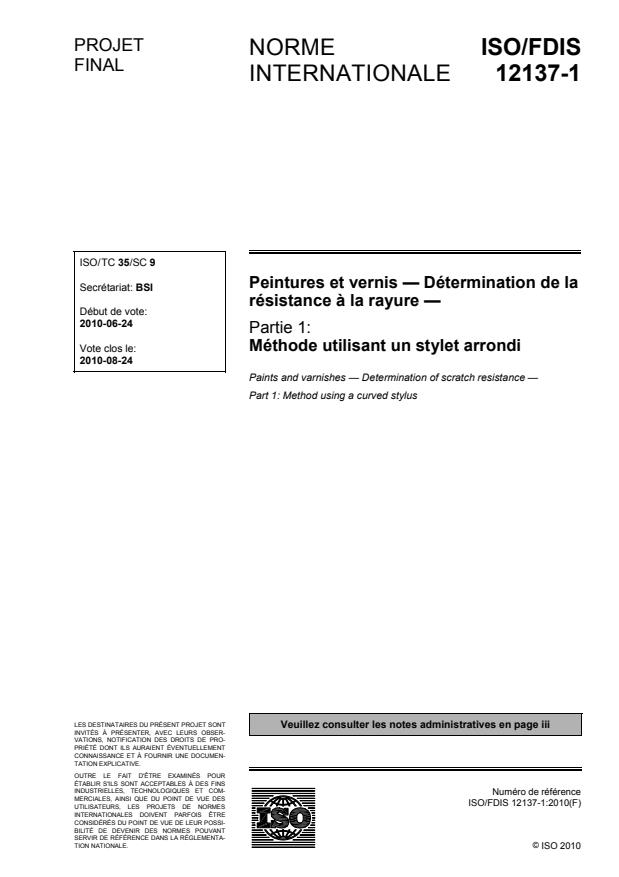
Peintures et vernis — Détermination de la résistance à la rayure — Partie 1: Méthode utilisant un stylet arrondi
L'ISO 12137-1:2010 spécifie une méthode pour la détermination, ŕ l'aide d'un stylet arrondi (en forme de boucle ou d'anneau), de la résistance ŕ la rayure d'une couche unique de peinture, de vernis ou de produit assimilé, ou de la couche supérieure d'un systčme multicouche. Cet essai s'est avéré utile pour comparer la résistance ŕ la rayure de différents revętements. II permet notamment de fournir des valeurs comparatives pour une série de panneaux revętus présentant des différences significatives de résistance ŕ la rayure. L'ISO 12137-1:2010 ne spécifie pas une méthode utilisant un stylet pointu, qui est spécifiée dans l'ISO 12137-2. Le choix entre les deux méthodes va dépendre du problčme pratique particulier.
General Information
- Status
- Withdrawn
- Technical Committee
- ISO/TC 35/SC 9 - General test methods for paints and varnishes
- Drafting Committee
- ISO/TC 35/SC 9 - General test methods for paints and varnishes
- Current Stage
- 5098 - Project deleted
- Start Date
- 01-Jun-2011
- Completion Date
- 14-Feb-2026
Relations
- Consolidates
EN ISO 12137:2011 - Paints and varnishes - Determination of mar resistance (ISO 12137:2011) - Effective Date
- 12-Feb-2026
- Effective Date
- 09-Jul-2011
- Effective Date
- 09-Apr-2011
- Effective Date
- 15-Apr-2008
Buy Documents
ISO/FDIS 12137-1 - Paints and varnishes -- Determination of scratch resistance
ISO/FDIS 12137-1 - Peintures et vernis -- Détermination de la résistance a la rayure
Frequently Asked Questions
ISO/FDIS 12137-1 is a draft published by the International Organization for Standardization (ISO). Its full title is "Paints and varnishes — Determination of scratch resistance — Part 1: Method using a curved stylus". This standard covers: ISO 12137-1:2010 specifies a method for determining, using a curved (loop-shaped or ring-shaped) stylus, the scratch resistance of a single coating of a paint, varnish or related product, or the upper layer of a multicoat system. This test has been found to be useful in comparing the scratch resistance of different coatings. It is most useful in providing relative ratings for a series of coated panels exhibiting significant differences in scratch resistance. ISO 12137-1:2010 does not specify a method using a pointed stylus, which is specified in ISO 12137-2. The choice between the two methods will depend on the particular practical problem.
ISO 12137-1:2010 specifies a method for determining, using a curved (loop-shaped or ring-shaped) stylus, the scratch resistance of a single coating of a paint, varnish or related product, or the upper layer of a multicoat system. This test has been found to be useful in comparing the scratch resistance of different coatings. It is most useful in providing relative ratings for a series of coated panels exhibiting significant differences in scratch resistance. ISO 12137-1:2010 does not specify a method using a pointed stylus, which is specified in ISO 12137-2. The choice between the two methods will depend on the particular practical problem.
ISO/FDIS 12137-1 is classified under the following ICS (International Classification for Standards) categories: 87.040 - Paints and varnishes. The ICS classification helps identify the subject area and facilitates finding related standards.
ISO/FDIS 12137-1 has the following relationships with other standards: It is inter standard links to EN ISO 12137:2011, ISO 12137:2011, ISO 1518-2:2011, ISO 12137-1:1997. Understanding these relationships helps ensure you are using the most current and applicable version of the standard.
ISO/FDIS 12137-1 is available in PDF format for immediate download after purchase. The document can be added to your cart and obtained through the secure checkout process. Digital delivery ensures instant access to the complete standard document.
Standards Content (Sample)
FINAL
INTERNATIONAL ISO/FDIS
DRAFT
STANDARD 12137-1
ISO/TC 35/SC 9
Paints and varnishes — Determination of
Secretariat: BSI
scratch resistance —
Voting begins on:
2010-06-24
Part 1:
Method using a curved stylus
Voting terminates on:
2010-08-24
Peintures et vernis — Détermination de la résistance à la rayure —
Partie 1: Méthode utilisant un stylet arrondi
Please see the administrative notes on page iii
RECIPIENTS OF THIS DRAFT ARE INVITED TO
SUBMIT, WITH THEIR COMMENTS, NOTIFICATION
OF ANY RELEVANT PATENT RIGHTS OF WHICH
THEY ARE AWARE AND TO PROVIDE SUPPORT-
ING DOCUMENTATION.
IN ADDITION TO THEIR EVALUATION AS
Reference number
BEING ACCEPTABLE FOR INDUSTRIAL, TECHNO-
LOGICAL, COMMERCIAL AND USER PURPOSES,
DRAFT INTERNATIONAL STANDARDS MAY ON
OCCASION HAVE TO BE CONSIDERED IN THE
LIGHT OF THEIR POTENTIAL TO BECOME STAN-
DARDS TO WHICH REFERENCE MAY BE MADE IN
©
NATIONAL REGULATIONS. ISO 2010
PDF disclaimer
This PDF file may contain embedded typefaces. In accordance with Adobe's licensing policy, this file may be printed or viewed but
shall not be edited unless the typefaces which are embedded are licensed to and installed on the computer performing the editing. In
downloading this file, parties accept therein the responsibility of not infringing Adobe's licensing policy. The ISO Central Secretariat
accepts no liability in this area.
Adobe is a trademark of Adobe Systems Incorporated.
Details of the software products used to create this PDF file can be found in the General Info relative to the file; the PDF-creation
parameters were optimized for printing. Every care has been taken to ensure that the file is suitable for use by ISO member bodies. In
the unlikely event that a problem relating to it is found, please inform the Central Secretariat at the address given below.
Copyright notice
This ISO document is a Draft International Standard and is copyright-protected by ISO. Except as permitted
under the applicable laws of the user's country, neither this ISO draft nor any extract from it may be
reproduced, stored in a retrieval system or transmitted in any form or by any means, electronic,
photocopying, recording or otherwise, without prior written permission being secured.
Requests for permission to reproduce should be addressed to either ISO at the address below or ISO's
member body in the country of the requester.
ISO copyright office
Case postale 56 • CH-1211 Geneva 20
Tel. + 41 22 749 01 11
Fax + 41 22 749 09 47
E-mail copyright@iso.org
Web www.iso.org
Reproduction may be subject to royalty payments or a licensing agreement.
Violators may be prosecuted.
ii © ISO 2010 – All rights reserved
ISO/CEN PARALLEL PROCESSING
This final draft has been developed within the International Organization for Standardization (ISO), and
processed under the ISO-lead mode of collaboration as defined in the Vienna Agreement. The final draft
was established on the basis of comments received during a parallel enquiry on the draft.
This final draft is hereby submitted to the ISO member bodies and to the CEN member bodies for a parallel
two-month approval vote in ISO and formal vote in CEN.
Positive votes shall not be accompanied by comments.
Negative votes shall be accompanied by the relevant technical reasons.
Foreword
ISO (the International Organization for Standardization) is a worldwide federation of national standards bodies
(ISO member bodies). The work of preparing International Standards is normally carried out through ISO
technical committees. Each member body interested in a subject for which a technical committee has been
established has the right to be represented on that committee. International organizations, governmental and
non-governmental, in liaison with ISO, also take part in the work. ISO collaborates closely with the
International Electrotechnical Commission (IEC) on all matters of electrotechnical standardization.
International Standards are drafted in accordance with the rules given in the ISO/IEC Directives, Part 2.
The main task of technical committees is to prepare International Standards. Draft International Standards
adopted by the technical committees are circulated to the member bodies for voting. Publication as an
International Standard requires approval by at least 75 % of the member bodies casting a vote.
Attention is drawn to the possibility that some of the elements of this document may be the subject of patent
rights. ISO shall not be held responsible for identifying any or all such patent rights.
ISO 12137-1 was prepared by Technical Committee ISO/TC 35, Paints and varnishes, Subcommittee SC 9,
General test methods for paints and varnishes.
This second edition cancels and replaces the first edition (ISO 12137-1:1997), which has been technically
revised. It also incorporates the Technical Corrigendum ISO 12137-1:1997/Cor.1:1998.
The main changes are the following.
a) The terminology concerning marring, scratching and scribing has been revised and a definition of scratch
has been introduced.
b) The supplementary test conditions (formerly Annex A) have been integrated in the test report.
c) The text has been editorially revised and the normative references have been updated.
ISO 12137 consists of the following parts, under the general title Paints and varnishes — Determination of
scratch resistance:
⎯ Part 1: Method using a curved stylus
⎯ Part 2: Method using a pointed stylus
iv © ISO 2010 – All rights reserved
FINAL DRAFT INTERNATIONAL STANDARD ISO/FDIS 12137-1:2010(E)
Paints and varnishes — Determination of scratch resistance —
Part 1:
Method using a curved stylus
1 Scope
This part of ISO 12137 specifies a method for determining, using a curved (loop-shaped or ring-shaped) stylus,
the scratch resistance of a single coating of a paint, varnish or related product, or the upper layer of a
multicoat system.
This test has been found to be useful in comparing the scratch resistance of different coatings. It is most
useful in providing relative ratings for a series of coated panels exhibiting significant differences in scratch
resistance.
This part of ISO 12137 does not specify a method using a pointed stylus, which is specified in ISO 12137-2.
The choice between the two methods will depend on the particular practical problem.
2 Normative references
The following referenced documents are indispensable for the application of this document. For dated
references, only the edition cited applies. For undated references, the latest edition of the referenced
document (including any amendments) applies.
ISO 1513, Paints and varnishes — Examination and preparation of test samples
ISO 1514, Paints and varnishes — Standard panels for testing
ISO 2808, Paints and varnishes — Determination of film thickness
ISO 15528, Paints, varnishes and raw materials for paints and varnishes — Sampling
3 Terms and definitions
For the purposes of this document, the following terms and definitions apply.
3.1
scratch
damage of a surface by making contact with a sharp object
NOTE The result is usually an easily seen line in the surface that disturbs the uniformity of that surface.
4 Principle
The product or system under test is applied at uniform thickness to flat panels of uniform surface texture. After
drying/curing, the scratch resistance is determined by pushing the panels beneath a curved (loop-shaped or
ring-shaped) stylus which is mounted so that it presses down on the surface of the test panel at an angle of
45°. The load on the test panel is increased in steps until the coating is scratched.
5 Apparatus
5.1 Instrument for determining scratch resistance.
A suitable instrument is shown in Figure 1. It consists principally of a counterbalanced beam with a small
scale pan on which weights can be placed to load the stylus. The stylus is mounted at the lower end of a rod
which extends down from the beam at a fixed angle of 45°. The test panel is placed on a sliding table which
can be pushed under the stylus, preferably by the use of mecha
...
PROJET
NORME ISO/FDIS
FINAL
INTERNATIONALE 12137-1
ISO/TC 35/SC 9
Peintures et vernis — Détermination de la
Secrétariat: BSI
résistance à la rayure —
Début de vote:
2010-06-24
Partie 1:
Méthode utilisant un stylet arrondi
Vote clos le:
2010-08-24
Paints and varnishes — Determination of scratch resistance —
Part 1: Method using a curved stylus
LES DESTINATAIRES DU PRÉSENT PROJET SONT
Veuillez consulter les notes administratives en page iii
INVITÉS À PRÉSENTER, AVEC LEURS OBSER-
VATIONS, NOTIFICATION DES DROITS DE PRO-
PRIÉTÉ DONT ILS AURAIENT ÉVENTUELLEMENT
CONNAISSANCE ET À FOURNIR UNE DOCUMEN-
TATION EXPLICATIVE.
OUTRE LE FAIT D'ÊTRE EXAMINÉS POUR
ÉTABLIR S'ILS SONT ACCEPTABLES À DES FINS
INDUSTRIELLES, TECHNOLOGIQUES ET COM-
Numéro de référence
MERCIALES, AINSI QUE DU POINT DE VUE DES
UTILISATEURS, LES PROJETS DE NORMES
INTERNATIONALES DOIVENT PARFOIS ÊTRE
CONSIDÉRÉS DU POINT DE VUE DE LEUR POSSI-
BILITÉ DE DEVENIR DES NORMES POUVANT
SERVIR DE RÉFÉRENCE DANS LA RÉGLEMENTA-
©
TION NATIONALE. ISO 2010
PDF – Exonération de responsabilité
Le présent fichier PDF peut contenir des polices de caractères intégrées. Conformément aux conditions de licence d'Adobe, ce fichier
peut être imprimé ou visualisé, mais ne doit pas être modifié à moins que l'ordinateur employé à cet effet ne bénéficie d'une licence
autorisant l'utilisation de ces polices et que celles-ci y soient installées. Lors du téléchargement de ce fichier, les parties concernées
acceptent de fait la responsabilité de ne pas enfreindre les conditions de licence d'Adobe. Le Secrétariat central de l'ISO décline toute
responsabilité en la matière.
Adobe est une marque déposée d'Adobe Systems Incorporated.
Les détails relatifs aux produits logiciels utilisés pour la création du présent fichier PDF sont disponibles dans la rubrique General Info
du fichier; les paramètres de création PDF ont été optimisés pour l'impression. Toutes les mesures ont été prises pour garantir
l'exploitation de ce fichier par les comités membres de l'ISO. Dans le cas peu probable où surviendrait un problème d'utilisation,
veuillez en informer le Secrétariat central à l'adresse donnée ci-dessous.
Notice de droit d'auteur
Ce document de l'ISO est un projet de Norme internationale qui est protégé par les droits d'auteur de l'ISO.
Sauf autorisé par les lois en matière de droits d'auteur du pays utilisateur, aucune partie de ce projet ISO
ne peut être reproduite, enregistrée dans un système d'extraction ou transmise sous quelque forme que ce
soit et par aucun procédé, électronique ou mécanique, y compris la photocopie, les enregistrements ou
autres, sans autorisation écrite préalable.
Les demandes d'autorisation de reproduction doivent être envoyées à l'ISO à l'adresse ci-après ou au
comité membre de l'ISO dans le pays du demandeur.
ISO copyright office
Case postale 56 • CH-1211 Geneva 20
Tel. + 41 22 749 01 11
Fax + 41 22 749 09 47
E-mail copyright@iso.org
Web www.iso.org
Toute reproduction est soumise au paiement de droits ou à un contrat de licence.
Les contrevenants pourront être poursuivis.
ii © ISO 2010 – Tous droits réservés
TRAITEMENT PARALLÈLE ISO/CEN
Le présent projet final a été élaboré dans le cadre de l'Organisation internationale de normalisation (ISO) et
soumis selon le mode de collaboration sous la direction de l'ISO, tel que défini dans l'Accord de Vienne.
Le projet final a été établi sur la base des observations reçues lors de l'enquête parallèle sur le projet.
Le projet final est par conséquent soumis aux comités membres de l'ISO et aux comités membres du CEN
en parallèle à un vote d'approbation de deux mois au sein de l'ISO et à un vote formel au sein du CEN.
Les votes positifs ne doivent pas être accompagnés d'observations.
Les votes négatifs doivent être accompagnés des arguments techniques pertinents.
Avant-propos
L'ISO (Organisation internationale de normalisation) est une fédération mondiale d'organismes nationaux de
normalisation (comités membres de l'ISO). L'élaboration des Normes internationales est en général confiée
aux comités techniques de l'ISO. Chaque comité membre intéressé par une étude a le droit de faire partie du
comité technique créé à cet effet. Les organisations internationales, gouvernementales et non
gouvernementales, en liaison avec l'ISO participent également aux travaux. L'ISO collabore étroitement avec
la Commission électrotechnique internationale (CEI) en ce qui concerne la normalisation électrotechnique.
Les Normes internationales sont rédigées conformément aux règles données dans les Directives ISO/CEI,
Partie 2.
La tâche principale des comités techniques est d'élaborer les Normes internationales. Les projets de Normes
internationales adoptés par les comités techniques sont soumis aux comités membres pour vote. Leur
publication comme Normes internationales requiert l'approbation de 75 % au moins des comités membres
votants.
L'attention est appelée sur le fait que certains des éléments du présent document peuvent faire l'objet de
droits de propriété intellectuelle ou de droits analogues. L'ISO ne saurait être tenue pour responsable de ne
pas avoir identifié de tels droits de propriété et averti de leur existence.
L'ISO 12137-1 a été élaborée par le comité technique ISO/TC 35, Peintures et vernis, sous-comité SC 9,
Méthodes générales d'essais des peintures et vernis.
Cette deuxième édition annule et remplace la première édition (ISO 12137-1:1997), qui a fait l'objet d'une
révision technique. Elle incorpore également le Rectificatif technique ISO 12137-1:1997/Cor.1:1998.
Les principaux changements sont les suivants.
a) La terminologie relative à la détérioration, à la rayure et au traçage a été révisée et une définition de la
rayure a été ajoutée.
b) Les conditions d'essai supplémentaires (ancienne Annexe A) ont été intégrées au rapport d'essai.
c) Le texte a fait l'objet d'une révision rédactionnelle et les références normatives ont été mises à jour.
L'ISO 12137 comprend les parties suivantes, présentées sous le titre général Peintures et vernis —
Détermination de la résistance à la rayure:
⎯ Partie 1: Méthode utilisant un stylet arrondi
⎯ Partie 2: Méthode utilisant un stylet pointu
iv © ISO 2010 – Tous droits réservés
PROJET FINAL DE NORME INTERNATIONALE ISO/FDIS 12137-1:2010(F)
Peintures et vernis — Détermination de la résistance à la
rayure —
Partie 1:
Méthode utilisant un stylet arrondi
1 Domaine d'application
La présente partie de l'ISO 12137 spécifie une méthode pour la détermination, à l'aide d'un stylet arrondi (en
forme de boucle ou d'anneau), de la résistance à la rayure d'une couche unique de peinture, de vernis ou de
produit assimilé, ou de la couche supérieure d'un système multicouche.
Cet essai s'est avéré utile pour comparer la résistance à la rayure de différents revêtements. II permet
notamment de fournir des valeurs comparatives pour une série de panneaux revêtus présentant des
différences significatives de résistance à la rayure.
La présente partie I'ISO 12137 ne spécifie pas une méthode utilisant un stylet pointu, qui est spécifiée dans
l'ISO 12137-2. Le choix entre les deux méthodes va dépendre du problème pratique particulier.
2 Références normatives
Les documents de référence suivants sont indispensables pour l'application du présent document. Pour les
références datées, seule l'édition citée s'applique. Pour les références non datées, la dernière édition du
'
document de référence sapplique (y compris les éventuels amendements).
ISO 1513, Peintures et vernis — Examen et préparation des échantillons pour essai
ISO 1514, Peintures et vernis — Panneaux normalisés pour essais
ISO 2808, Peintures et vernis — Détermination de l'épaisseur du feuil
ISO 15528, Peintures, vernis et matières premières pour peintures et vernis — Échantillonnage
3 Termes et définitions
Pour les besoins du présent document, les termes et définitions suivants s'appliquent.
3.1
rayure
détérioration d'une surface au contact d'un objet présentant des angles vifs
NOTE Le résultat se traduit habituellement par une ligne visible à la surface, qui rompt l'uniformité de cette surface.
4 Principe
Le produit ou le système soumis à essai est appliqué en épaisseur uniforme sur des panneaux plats, ayant
une texture de surface uniforme. Après séchage/polymérisation, la résistance à la rayure est déterminée en
poussant les panneaux sous un stylet arrondi (en forme de boucle ou d'anneau) qui est monté de manière à
exercer une pression sur la surface du panneau d'essai à un angle de 45°. La charge appliquée au panneau
d'essai est augmentée graduellement jusqu'à ce que le revêtement soit rayé.
5 Appareillage
5.1 Appareil pour déterminer la résistance à la rayure.
Un appareil approprié est représenté à la Figure 1. II se compose principalement d'un traversin muni d'un
dispositif équilibreur et d'un petit plateau de balance sur lequel il est possible de placer des poids pour
appliquer des charges au stylet. Le stylet est monté à l'extrémité inférieure d'une tige qui descend du traversin
à un angle fixe de 45°. Le panneau d'essai est placé sur une table coulissante que l'on peut pousser sous le
stylet, de préférence à l'aide d'un système mécanique.
L'appareil doit être conçu de manière à pouvoir effectuer les
...
Questions, Comments and Discussion
Ask us and Technical Secretary will try to provide an answer. You can facilitate discussion about the standard in here.
Loading comments...