

ISO 11265:2025
(Main)Environmental solid matrices — Determination of the specific electrical conductivity
General Information
- Abstract
This document specifies an instrumental method for the routine determination of the specific electrical conductivity in an aqueous extract of soil, sludge, biowaste or waste. The determination is carried out to obtain an indication of the content of water-soluble electrolytes in a sample. This document is applicable to all types of air-dried samples of soil, sludge, biowaste and waste.
- Status
- Published
- Publication Date
- 27-Aug-2025
- Technical Committee
- ISO/TC 190/SC 3 - Chemical and physical characterization
- Drafting Committee
- ISO/TC 190/SC 3 - Chemical and physical characterization
- Current Stage
- 6060 - International Standard published
- Start Date
- 28-Aug-2025
- Due Date
- 24-Oct-2025
- Completion Date
- 28-Aug-2025
Buy Documents
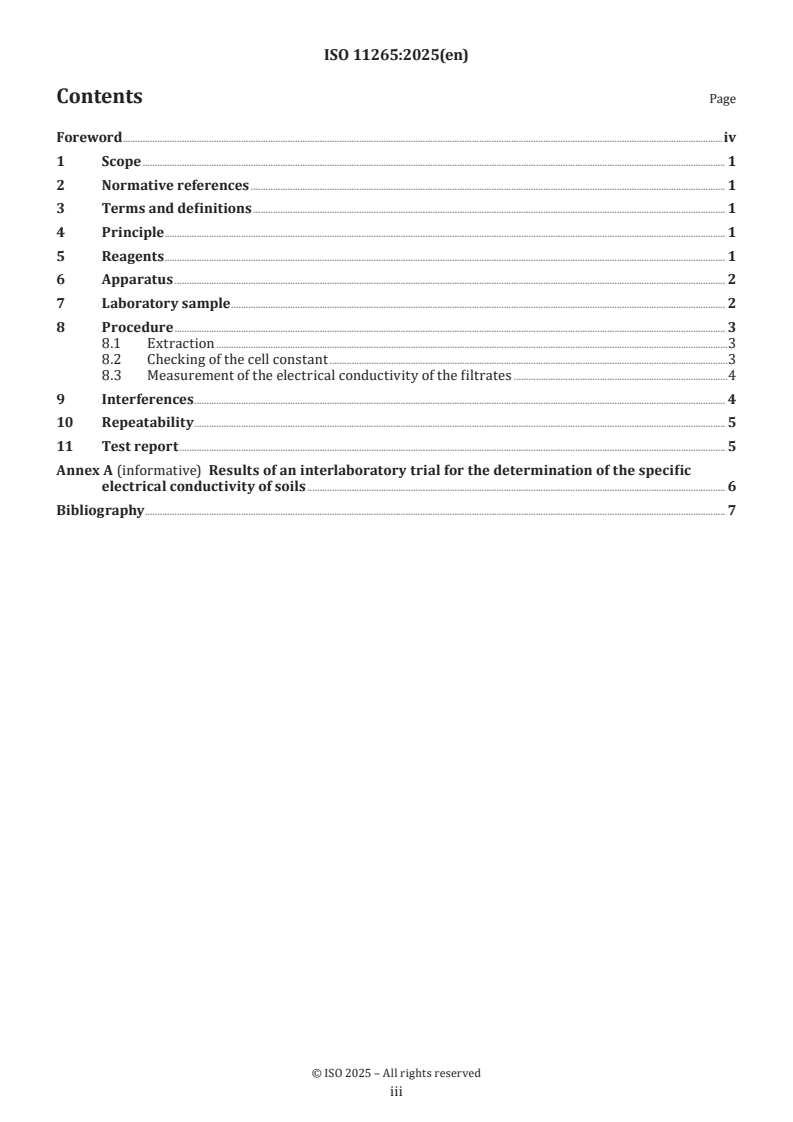
ISO 11265:2025 - Environmental solid matrices — Determination of the specific electrical conductivity Released:28. 08. 2025
ISO 11265:2025 - Matrices solides environnementales — Détermination de la conductivité électrique spécifique Released:28. 08. 2025
Overview
ISO 11265:2025 specifies a routine instrumental method for determining the specific electrical conductivity (SEC) in an aqueous extract of environmental solid matrices - including soil, sludge, biowaste and waste. The measurement gives an indication of the content of water‑soluble electrolytes and applies to all types of air‑dried samples. This second edition updates temperature criteria during extraction and clarifies the distinction between solid and sludge‑like matrices.
Key Topics
- Scope and matrices: Applicable to air‑dried soils, sludges, biowaste and wastes; also permits direct measurement of fresh liquid sludge when appropriate.
- Sample preparation: Pretreatment guidance referenced (ISO 11464); use particle fraction <2 mm for soils; comminution and controlled air‑drying (≤ 40 °C) for biowaste.
- Extraction procedure: Extract solids with demineralized water at (22 ± 3) °C using an extraction ratio 1:5 (m/V); shake for 30 min and filter.
- Measurement and temperature correction: Measure conductivity with a conductivity meter and correct results to 25 °C (either automatically or by formula). Report results in mS/m to one decimal place.
- Calibration and quality control: Use potassium chloride calibration solutions (e.g., 0.1 mol/L KCl = 1 288 mS/m at 25 °C) for checking the cell constant. Calculated cell constant must be within ±5% of the manufacturer’s value.
- Reagents and apparatus: Demineralized water (≤ 0.2 mS/m at 25 °C), KCl standards, a conductivity meter with temperature correction, cell‑constant control, shaking machine, and low‑ash filter paper.
- Interferences: Electrode contamination, air bubbles, and atmospheric CO2/NH3 (affects low conductivities < 1 mS/m) can bias results.
- Performance and reporting: Blank value ≤ 1 mS/m; repeatability requirements depend on conductivity range (see standard). Test reports must reference ISO 11265:2025 and include sample ID, results, deviations, unusual features and test date.
Applications
ISO 11265:2025 is used by:
- Environmental and soil testing laboratories for routine electrolyte assessment.
- Waste management and composting facilities monitoring soluble salts in biowaste.
- Agronomy and land‑reclamation projects assessing salinity risks in soils.
- Regulatory bodies and consultants performing compliance or baseline studies. Practical uses include screening for salinity, process control in waste treatment, and supporting decisions in remediation, irrigation management and land application of biosolids.
Related Standards
- ISO 11464 - Soil quality - Pretreatment of samples for physico‑chemical analysis (normative reference)
- ISO 7888 - Definitions related to electrical conductivity (referenced for concepts)
- ISO 5725 - Accuracy (repeatability and reproducibility) (used in interlaboratory context)
- CEN/EN standards referenced for sample handling: EN 15002, EN 16179, EN 13038
Keywords: ISO 11265:2025, specific electrical conductivity, soil conductivity, sludge conductivity, biowaste, aqueous extract, conductivity meter, KCl calibration, extraction ratio 1:5.
Relations
- Effective Date
- 12-Feb-2026
- Effective Date
- 29-Oct-2022
- Effective Date
- 29-Oct-2022
Buy Documents
ISO 11265:2025 - Environmental solid matrices — Determination of the specific electrical conductivity Released:28. 08. 2025
ISO 11265:2025 - Matrices solides environnementales — Détermination de la conductivité électrique spécifique Released:28. 08. 2025
Get Certified
Connect with accredited certification bodies for this standard

CIS Institut d.o.o.
Personal Protective Equipment (PPE) certification body. Notified Body NB-2890 for EU Regulation 2016/425 PPE.

Kiwa BDA Testing
Building and construction product certification.
Kmetijski inštitut Slovenije
Agricultural Institute of Slovenia. Soil testing, plant health, agricultural product analysis.
Sponsored listings
Frequently Asked Questions
ISO 11265:2025 is a standard published by the International Organization for Standardization (ISO). Its full title is "Environmental solid matrices — Determination of the specific electrical conductivity". This standard covers: This document specifies an instrumental method for the routine determination of the specific electrical conductivity in an aqueous extract of soil, sludge, biowaste or waste. The determination is carried out to obtain an indication of the content of water-soluble electrolytes in a sample. This document is applicable to all types of air-dried samples of soil, sludge, biowaste and waste.
This document specifies an instrumental method for the routine determination of the specific electrical conductivity in an aqueous extract of soil, sludge, biowaste or waste. The determination is carried out to obtain an indication of the content of water-soluble electrolytes in a sample. This document is applicable to all types of air-dried samples of soil, sludge, biowaste and waste.
ISO 11265:2025 is classified under the following ICS (International Classification for Standards) categories: 13.080.20 - Physical properties of soils. The ICS classification helps identify the subject area and facilitates finding related standards.
ISO 11265:2025 has the following relationships with other standards: It is inter standard links to EN ISO 11265:2025, ISO 11265:1994, ISO 11265:1994/Cor 1:1996. Understanding these relationships helps ensure you are using the most current and applicable version of the standard.
ISO 11265:2025 is available in PDF format for immediate download after purchase. The document can be added to your cart and obtained through the secure checkout process. Digital delivery ensures instant access to the complete standard document.
Standards Content (Sample)
International
Standard
ISO 11265
Second edition
Environmental solid matrices —
2025-08
Determination of the specific
electrical conductivity
Matrices solides environnementales — Détermination de la
conductivité électrique spécifique
Reference number
© ISO 2025
All rights reserved. Unless otherwise specified, or required in the context of its implementation, no part of this publication may
be reproduced or utilized otherwise in any form or by any means, electronic or mechanical, including photocopying, or posting on
the internet or an intranet, without prior written permission. Permission can be requested from either ISO at the address below
or ISO’s member body in the country of the requester.
ISO copyright office
CP 401 • Ch. de Blandonnet 8
CH-1214 Vernier, Geneva
Phone: +41 22 749 01 11
Email: copyright@iso.org
Website: www.iso.org
Published in Switzerland
ii
Contents Page
Foreword .iv
1 Scope . 1
2 Normative references . 1
3 Terms and definitions . 1
4 Principle . 1
5 Reagents . 1
6 Apparatus . 2
7 Laboratory sample . 2
8 Procedure . 3
8.1 Extraction .3
8.2 Checking of the cell constant .3
8.3 Measurement of the electrical conductivity of the filtrates .4
9 Interferences . 4
10 Repeatability . 5
11 Test report . 5
Annex A (informative) Results of an interlaboratory trial for the determination of the specific
electrical conductivity of soils . 6
Bibliography . 7
iii
Foreword
ISO (the International Organization for Standardization) is a worldwide federation of national standards
bodies (ISO member bodies). The work of preparing International Standards is normally carried out through
ISO technical committees. Each member body interested in a subject for which a technical committee
has been established has the right to be represented on that committee. International organizations,
governmental and non-governmental, in liaison with ISO, also take part in the work. ISO collaborates closely
with the International Electrotechnical Commission (IEC) on all matters of electrotechnical standardization.
The procedures used to develop this document and those intended for its further maintenance are described
in the ISO/IEC Directives, Part 1. In particular, the different approval criteria needed for the different types
of ISO documents should be noted. This document was drafted in accordance with the editorial rules of the
ISO/IEC Directives, Part 2 (see www.iso.org/directives).
ISO draws attention to the possibility that the implementation of this document may involve the use of (a)
patent(s). ISO takes no position concerning the evidence, validity or applicability of any claimed patent
rights in respect thereof. As of the date of publication of this document, ISO had not received notice of (a)
patent(s) which may be required to implement this document. However, implementers are cautioned that
this may not represent the latest information, which may be obtained from the patent database available at
www.iso.org/patents. ISO shall not be held responsible for identifying any or all such patent rights.
Any trade name used in this document is information given for the convenience of users and does not
constitute an endorsement.
For an explanation of the voluntary nature of standards, the meaning of ISO specific terms and expressions
related to conformity assessment, as well as information about ISO’s adherence to the World Trade
Organization (WTO) principles in the Technical Barriers to Trade (TBT), see www.iso.org/iso/foreword.html.
This document was prepared by Technical Committee ISO/TC 190, Soil quality, Subcommittee SC 3, Chemical
and physical characterization, in collaboration with the European Committee for Standardization (CEN)
Technical Committee CEN/TC 444, Environmental characterization of solid matrices, in accordance with the
Agreement on technical cooperation between ISO and CEN (Vienna Agreement).
This second edition cancels and replaces the first edition (ISO 11265:1994), which has been technically
revised. It also incorporates the Technical Corrigendum ISO 11265:1994/Cor 1:1996.
The main changes are as follows:
— change of temperature criteria during extraction;
— the distinction between solid and sludge-like matrices is added.
Any feedback or questions on this document should be directed to the user’s national standards body. A
complete listing of these bodies can be found at www.iso.org/members.html.
iv
International Standard ISO 11265:2025(en)
Environmental solid matrices — Determination of the specific
electrical conductivity
1 Scope
This document specifies an instrumental method for the routine determination of the specific electrical
conductivity in an aqueous extract of soil, sludge, biowaste or waste. The determination is carried out to
obtain an indication of the content of water-soluble electrolytes in a sample.
This document is applicable to all types of air-dried samples of soil, sludge, biowaste and waste.
2 Normative references
The following documents are referred to in the text in such a way that some or all their content constitutes
requirements of this document. For dated references, only the edition cited applies. For undated references,
the latest edition of the referenced document (including any amendments) applies.
ISO 11464, Soil quality — Pretreatment of samples for physico-chemical analysis
3 Terms and definitions
No terms and definitions are listed in this document.
ISO and IEC maintain terminology databases for use in standardization at the following addresses:
— ISO Online browsing platform: available at https:// www .iso .org/ obp
— IEC Electropedia: available at https:// www .electropedia .org/
4 Principle
Air-dried solids are extracted with water at (22 ± 3) °C at an extraction ratio of 1:5 (m/V), to dissolve the
electrolytes. The specific electrical conductivity of the extract or fresh liquid sludge is measured, and the
result is corrected to a temperature of 25 °C.
NOTE For definitions of the concepts used, see ISO 7888.
5 Reagents
Use only reagents of recognized analytical grade.
5.1 Water, demineralized, with a specific electrical conductivity not higher than 0,2 mS/m at 25 °C.
5.2 Potassium chloride solution, c(KCl) = 0,1 mol/l.
Dissolve 7,456 g of potassium chloride, previously dried for 2 h at (105 ± 5) °C in water (5.1), and dilute to
1 000 ml at 20 °C. The specific electrical conductivity of this solution is 1 288 mS/m at 25 °C.
5.3 Potassium chloride solution, c(KCl) = 0,020 0 mol/l.
Pour 200,0 ml of the potassium chloride solution (5.2) into a 1 000 ml volumetric flask and dilute to volume
with water at 20 °C. The specific electrical conductivity of this solution is 277 mS/m at 25 °C.
5.4 Potassium chloride solution, c(KCl) = 0,010 0 mol/l.
Pour 100,0 ml of the potassium chloride solution (5.2) into a 1 000 ml volumetric flask and dilute to volume
with water at 20 °C. The specific electrical conductivity of this solution is 141 mS/m at 25 °C.
All the potassium chloride solutions (5.2, 5.3 and above) used for calibration shall be stored in tightly sealed
bottles which do not release sufficient alka
...
Norme
internationale
ISO 11265
Deuxième édition
Matrices solides
2025-08
environnementales —
Détermination de la conductivité
électrique spécifique
Environmental solid matrices — Determination of the specific
electrical conductivity
Numéro de référence
DOCUMENT PROTÉGÉ PAR COPYRIGHT
© ISO 2025
Tous droits réservés. Sauf prescription différente ou nécessité dans le contexte de sa mise en œuvre, aucune partie de cette
publication ne peut être reproduite ni utilisée sous quelque forme que ce soit et par aucun procédé, électronique ou mécanique,
y compris la photocopie, ou la diffusion sur l’internet ou sur un intranet, sans autorisation écrite préalable. Une autorisation peut
être demandée à l’ISO à l’adresse ci-après ou au comité membre de l’ISO dans le pays du demandeur.
ISO copyright office
Case postale 401 • Ch. de Blandonnet 8
CH-1214 Vernier, Genève
Tél.: +41 22 749 01 11
E-mail: copyright@iso.org
Web: www.iso.org
Publié en Suisse
ii
Sommaire Page
Avant-propos .iv
1 Domaine d’application . 1
2 Références normatives . 1
3 Termes et définitions . 1
4 Principe. 1
5 Réactifs . 1
6 Appareillage . 2
7 Échantillon pour laboratoire . 2
8 Mode opératoire . 3
8.1 Extraction .3
8.2 Vérification de la constante de cellule .3
8.3 Mesurage de la conductivité électrique des filtrats .4
9 Interférences . 4
10 Répétabilité . 5
11 Rapport d’essai . 5
Annexe A (informative) Résultats d’un essai interlaboratoires pour la détermination de la
conductivité électrique spécifique des sols . 6
Bibliographie . 7
iii
Avant-propos
L'ISO (Organisation internationale de normalisation) est une fédération mondiale d'organismes nationaux
de normalisation (comités membres de l'ISO). L'élaboration des Normes internationales est en général
confiée aux comités techniques de l'ISO. Chaque comité membre intéressé par une étude a le droit de faire
partie du comité technique créé à cet effet. Les organisations internationales, gouvernementales et non
gouvernementales, en liaison avec l'ISO participent également aux travaux. L'ISO collabore étroitement avec
la Commission électrotechnique internationale (IEC) en ce qui concerne la normalisation électrotechnique.
Les procédures utilisées pour élaborer le présent document et celles destinées à sa mise à jour sont
décrites dans les Directives ISO/IEC, Partie 1. Il convient, en particulier, de prendre note des différents
critères d'approbation requis pour les différents types de documents ISO. Le présent document a
été rédigé conformément aux règles de rédaction données dans les Directives ISO/IEC, Partie 2 (voir
www.iso.org/directives).
L’ISO attire l’attention sur le fait que la mise en application du présent document peut entraîner l’utilisation
d’un ou de plusieurs brevets. L’ISO ne prend pas position quant à la preuve, à la validité et à l’applicabilité de
tout droit de brevet revendiqué à cet égard. À la date de publication du présent document, l’ISO n’avait pas
reçu notification qu’un ou plusieurs brevets pouvaient être nécessaires à sa mise en application. Toutefois,
il y a lieu d’avertir les responsables de la mise en application du présent document que des informations
plus récentes sont susceptibles de figurer dans la base de données de brevets, disponible à l'adresse
www.iso.org/brevets. L’ISO ne saurait être tenue pour responsable de ne pas avoir identifié tout ou partie de
tels droits de propriété.
Les appellations commerciales éventuellement mentionnées dans le présent document sont données pour
information, par souci de commodité, à l’intention des utilisateurs et ne sauraient constituer un engagement.
Pour une explication de la nature volontaire des normes, la signification des termes et expressions
spécifiques de l'ISO liés à l'évaluation de la conformité, ou pour toute information au sujet de l'adhésion de
l'ISO aux principes de l’Organisation mondiale du commerce (OMC) concernant les obstacles techniques au
commerce (OTC), voir www.iso.org/avant-propos.
Le présent document a été élaboré par le comité technique ISO/TC 190, Qualité du sol, sous-comité SC 3,
Méthodes chimiques et caractéristiques physiques, en collaboration avec le comité technique CEN/TC 444,
Méthodes d'essai pour la caractérisation environnementale des matrices solides, du Comité européen de
normalisation (CEN), conformément à l'Accord de coopération technique entre l'ISO et le CEN (Accord de
Vienne).
Cette seconde édition annule et remplace la première édition (ISO 11265:1994), qui a fait l’objet d’une
révision technique. Elle comprend également le Rectificatif technique ISO 11265:1994/Cor 1:1996.
Les principales modifications sont les suivantes:
— modification des critères de température lors de l’extraction;
— distinction entre matrices solides et matrices de type boues.
Il convient que l’utilisateur adresse tout retour d’information ou toute question concernant le présent
document à l’organisme national de normalisation de son pays. Une liste exhaustive desdits organismes se
trouve à l’adresse https://www.iso.org/fr/members.html.
iv
Norme internationale ISO 11265:2025(fr)
Matrices solides environnementales — Détermination de la
conductivité électrique spécifique
1 Domaine d’application
Le présent document spécifie une méthode instrumentale pour la détermination en routine de la conductivité
électrique spécifique d’un extrait aqueux de sol, de boues, de biodéchets ou de déchets. La détermination est
effectuée afin d’obtenir une indication sur la teneur en électrolytes hydrosolubles d’un échantillon.
Le présent document est applicable à tous les types d’échantillons de sols, de boues, de biodéchets et de
déchets séchés à l’air.
2 Références normatives
Les documents suivants sont cités dans le texte de sorte qu’ils constituent, pour tout ou partie de leur
contenu, des exigences du présent document. Pour les références datées, seule l’édition citée s’applique. Pour
les références non datées, la dernière édition du document de référence s’applique (y compris les éventuels
amendements).
ISO 11464, Qualité du sol — Prétraitement des échantillons pour analyses physico-chimiques
3 Termes et définitions
Aucun terme n’est défini dans le présent document.
L’ISO et l’IEC tiennent à jour des bases de données terminologiques destinées à être utilisées en normalisation,
consultables aux adresses suivantes:
— Plateforme de consultation en ligne ISO: disponible à l’adresse https:// www .iso .org/ obp
— IEC Electropedia: disponible à l’adresse https:// www .electropedia .org/
4 Principe
Des solides séchés à l’air sont extraits avec de l’eau à (22 ± 3) °C, selon un rapport d’extraction de 1:5 (m/V),
pour dissoudre les électrolytes. La conductivité électrique spécifique de l’extrait ou de la boue liquide fraîche
est mesurée et le résultat est corrigé à une température de 25 °C.
NOTE Pour la définition des concepts utilisés, voir l’ISO 7888.
5 Réactifs
Utiliser uniquement des réactifs de qualité analytique reconnue.
5.1 Eau, déminéralisée, de conductivité électrique spécifique inférieure ou égale à 0,2 mS/m à 25 °C.
5.2 Solution de chlorure de potassium, c(KCl) = 0,1 mol/l.
Dissoudre 7,456 g de chlorure de potassium, préalablement séché pendant 2 h à (105 ± 5) °C, dans de l’eau
(5.1) et diluer à 1 000 ml à 20 °C. La conductivité électrique spécifique de cette solution est de 1 288 mS/m
à 25 °C.
5.3 Solution de chlorure de potassium, c(KCl) = 0,020 0 mol/l.
Verser 200,0 ml de la solution de chlorure de potassium (5.2) dans une fiole jaugée de 1 000 ml et diluer
jusqu’au trait de jauge avec de l’eau à 20 °C. La conductivité électrique spécifique de cette solution est de
277 mS/m à 25 °C.
5.4 Solution de chlorure de potassium, c(KCl) = 0,010 0 mol/l.
Verser 100,0 ml de la solution de chlorure de potassium (5.2) dans une fiole jaugée de 1 000 ml et diluer
jusqu’au trait de jauge avec de l’eau à 20 °C. La conductivité électrique spécifique de cette solution est de
141 mS/m à 25 °C.
Toutes les solutions de chlorure de potassium (5.2, 5.3 et la solution ci-dessus) utilisées pour l’étalonnage
doivent être conservées dans des flacons à fermeture étanche ne libérant pas suffisamment de métal alcalin
ou de cations alcalino-terreux pour affecter la conductivité électrique des solutions.
NOTE 1 Des flacons en plastique peuvent convenir.
NOTE 2 Pour les flacons contenant les solutions de chlorure de potassium
...