

ISO 7240-18:2017
(Main)Fire detection and alarm systems — Part 18: Input/output devices
General Information
- Abstract
ISO 7240-18:2017 specifies requirements, test methods and performance criteria for input/output devices connected to a transmission path of a fire detection and alarm system used to receive and/or transmit signals to or from the transmission path, necessary for the operation of the fire detection and fire alarm system and/or fire protection system. An input/output device can be a physically separate device or its function can be integrated into another device, in which case ISO 7240-18:2017 can be used to assess this function. ISO 7240-18:2017 is applicable to input/output devices which include signal amplifiers and signal transfer in separate enclosures. Control and indicating equipment and ancillary control and indicating equipment (e.g. repeater panels and fire brigade panels) are not covered by ISO 7240-18:2017.
- Status
- Published
- Publication Date
- 04-Sep-2017
- Technical Committee
- ISO/TC 21/SC 3 - Fire detection and alarm systems
- Drafting Committee
- ISO/TC 21/SC 3 - Fire detection and alarm systems
- Current Stage
- 9093 - International Standard confirmed
- Start Date
- 15-Sep-2025
- Completion Date
- 29-Aug-2026
Buy Documents
ISO 7240-18:2017 - Fire detection and alarm systems

ISO 7240-18:2017 - Fire detection and alarm systems — Part 18: Input/output devices/5/2017
Overview
ISO 7240-18:2017 - Fire detection and alarm systems - Part 18: Input/output devices specifies requirements, test methods and performance criteria for input/output (I/O) devices that connect to the transmission path of a fire detection and alarm system. The standard covers devices used to receive and/or transmit signals necessary for the operation of fire detection, alarm and protection systems. It applies whether the I/O function is a standalone unit (including signal amplifiers and signal transfer in separate enclosures) or integrated into another device. Control and indicating equipment (e.g., repeater or fire brigade panels) are explicitly excluded.
Key topics and technical requirements
ISO 7240-18:2017 focuses on functional performance, reliability and interoperability of I/O devices. Major technical topics include:
- Functional specification: Manufacturers must adequately specify the device function so its performance can be assessed against the standard.
- Requirements for software-controlled devices: Software design, program/data storage and controls are covered to ensure predictable device behaviour.
- Environmental and mechanical testing: The standard defines test methods and performance criteria, including:
- Dry heat, cold, and damp heat tests
- Damp heat steady-state and cyclic endurance
- Sulfur dioxide (SO2) corrosion endurance
- Shock and impact (operational)
- Vibration (sinusoidal) for operational and endurance conditions
- Electromagnetic compatibility (EMC) immunity: EMC immunity tests are required (the 2017 edition replaces EN 50130-4 with IEC 62599-2 for immunity testing).
- Monitoring of detachable devices: Requirements for detecting and signalling loss or disconnection of detachable components.
- Marking and documentation: Clause 7 covers marking; Clause 8 details required hardware and software documentation for conformity assessment.
- Test reporting: Structured test report requirements to support certification.
Applications and who uses this standard
ISO 7240-18:2017 is used for:
- Product development and design verification by manufacturers of I/O modules, signal amplifiers and interface units for fire alarm systems.
- Testing and certification bodies and independent laboratories performing environmental, EMC and functional tests.
- Fire protection engineers, system integrators and specifiers selecting compliant I/O devices for building fire detection and alarm installations.
- Procurement teams and installers requiring documented compliance and reliable interoperability between field devices and control panels.
- Maintenance organisations ensuring continued functional performance and safe operation of installed I/O devices.
Practical uses include component selection, type testing during product development, third-party certification, and creating compliant system specifications.
Related standards
Key normative references cited in ISO 7240-18:2017 include:
- ISO 7240-1 (General and definitions for fire detection and alarm systems)
- IEC/ISO environmental test standards (IEC 60068 series)
- IEC 62599-2 (EMC immunity test reference used in the 2017 edition)
Keywords: ISO 7240-18:2017, fire detection and alarm systems, input/output devices, I/O devices, test methods, EMC, environmental testing, signal amplifiers, fire protection.
Relations
- Consolidated By
ISO 6450:2021 - Rubber- or plastics-coated fabrics — Determination of resistance to liquids - Effective Date
- 06-Jun-2022
- Effective Date
- 05-Nov-2015
Buy Documents
ISO 7240-18:2017 - Fire detection and alarm systems
ISO 7240-18:2017 - Fire detection and alarm systems — Part 18: Input/output devices/5/2017
Get Certified
Connect with accredited certification bodies for this standard

CIS Institut d.o.o.
Personal Protective Equipment (PPE) certification body. Notified Body NB-2890 for EU Regulation 2016/425 PPE.

Kiwa BDA Testing
Building and construction product certification.
Kmetijski inštitut Slovenije
Agricultural Institute of Slovenia. Soil testing, plant health, agricultural product analysis.
Sponsored listings
Frequently Asked Questions
ISO 7240-18:2017 is a standard published by the International Organization for Standardization (ISO). Its full title is "Fire detection and alarm systems — Part 18: Input/output devices". This standard covers: ISO 7240-18:2017 specifies requirements, test methods and performance criteria for input/output devices connected to a transmission path of a fire detection and alarm system used to receive and/or transmit signals to or from the transmission path, necessary for the operation of the fire detection and fire alarm system and/or fire protection system. An input/output device can be a physically separate device or its function can be integrated into another device, in which case ISO 7240-18:2017 can be used to assess this function. ISO 7240-18:2017 is applicable to input/output devices which include signal amplifiers and signal transfer in separate enclosures. Control and indicating equipment and ancillary control and indicating equipment (e.g. repeater panels and fire brigade panels) are not covered by ISO 7240-18:2017.
ISO 7240-18:2017 specifies requirements, test methods and performance criteria for input/output devices connected to a transmission path of a fire detection and alarm system used to receive and/or transmit signals to or from the transmission path, necessary for the operation of the fire detection and fire alarm system and/or fire protection system. An input/output device can be a physically separate device or its function can be integrated into another device, in which case ISO 7240-18:2017 can be used to assess this function. ISO 7240-18:2017 is applicable to input/output devices which include signal amplifiers and signal transfer in separate enclosures. Control and indicating equipment and ancillary control and indicating equipment (e.g. repeater panels and fire brigade panels) are not covered by ISO 7240-18:2017.
ISO 7240-18:2017 is classified under the following ICS (International Classification for Standards) categories: 13.220.20 - Fire protection. The ICS classification helps identify the subject area and facilitates finding related standards.
ISO 7240-18:2017 has the following relationships with other standards: It is inter standard links to ISO 6450:2021, ISO 7240-18:2009. Understanding these relationships helps ensure you are using the most current and applicable version of the standard.
ISO 7240-18:2017 is available in PDF format for immediate download after purchase. The document can be added to your cart and obtained through the secure checkout process. Digital delivery ensures instant access to the complete standard document.
Standards Content (Sample)
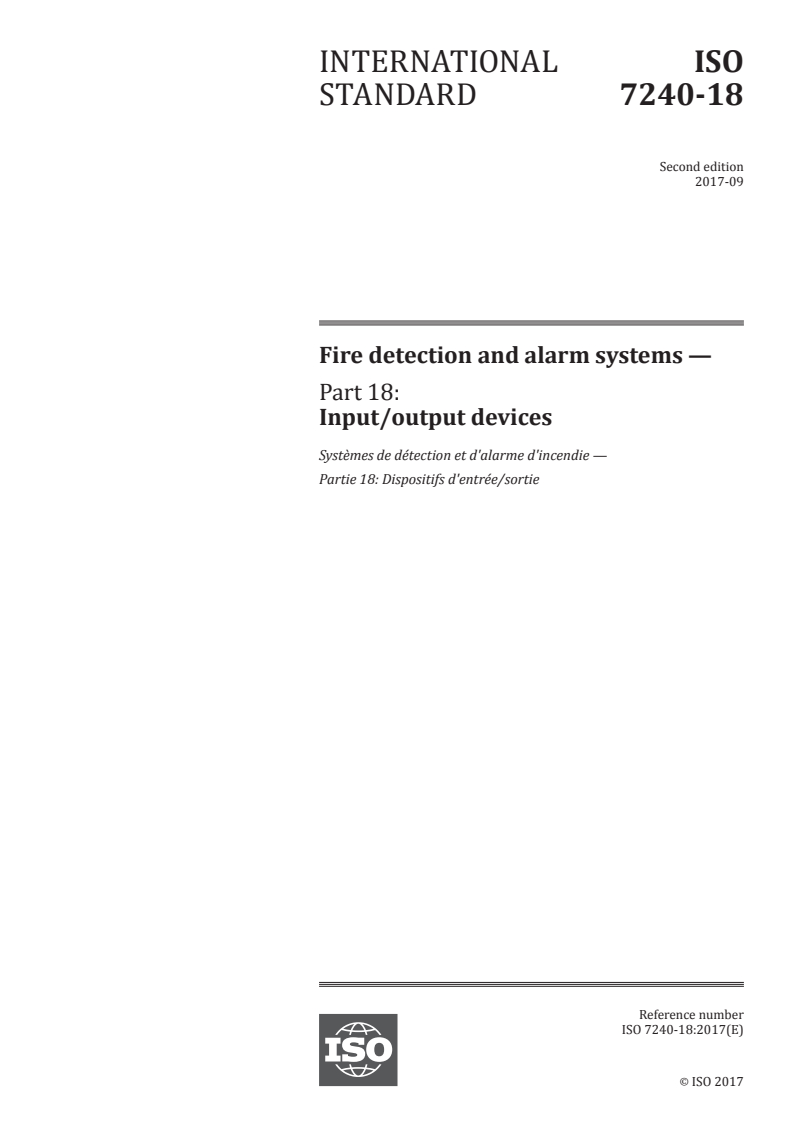
INTERNATIONAL ISO
STANDARD 7240-18
Second edition
2017-09
Fire detection and alarm systems —
Part 18:
Input/output devices
Systèmes de détection et d'alarme d'incendie —
Partie 18: Dispositifs d'entrée/sortie
Reference number
©
ISO 2017
© ISO 2017, Published in Switzerland
All rights reserved. Unless otherwise specified, no part of this publication may be reproduced or utilized otherwise in any form
or by any means, electronic or mechanical, including photocopying, or posting on the internet or an intranet, without prior
written permission. Permission can be requested from either ISO at the address below or ISO’s member body in the country of
the requester.
ISO copyright office
Ch. de Blandonnet 8 • CP 401
CH-1214 Vernier, Geneva, Switzerland
Tel. +41 22 749 01 11
Fax +41 22 749 09 47
copyright@iso.org
www.iso.org
ii © ISO 2017 – All rights reserved
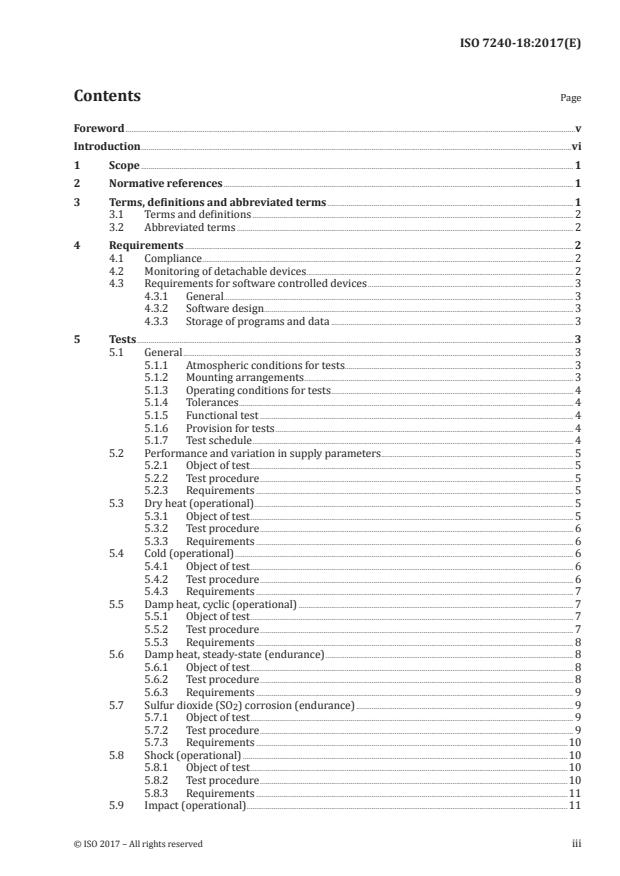
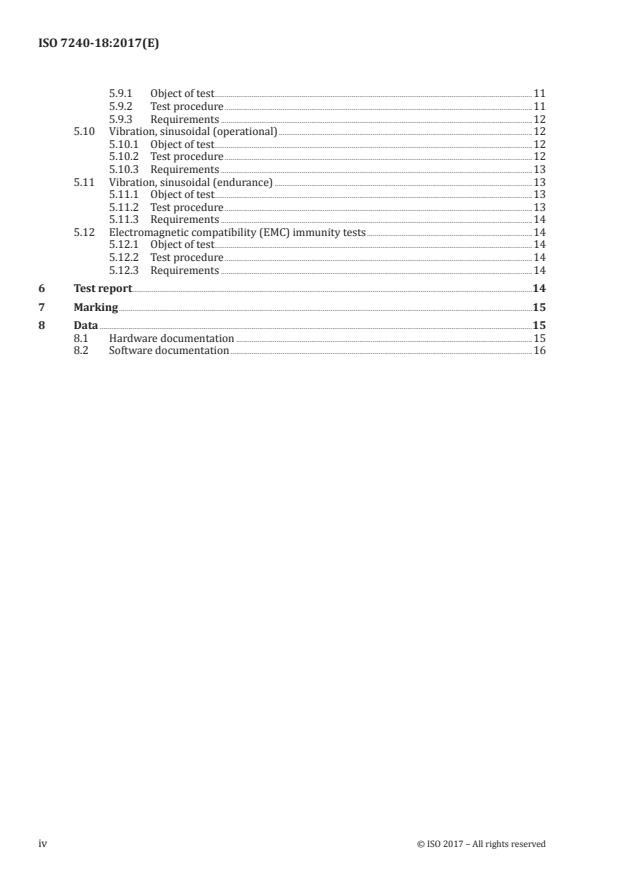
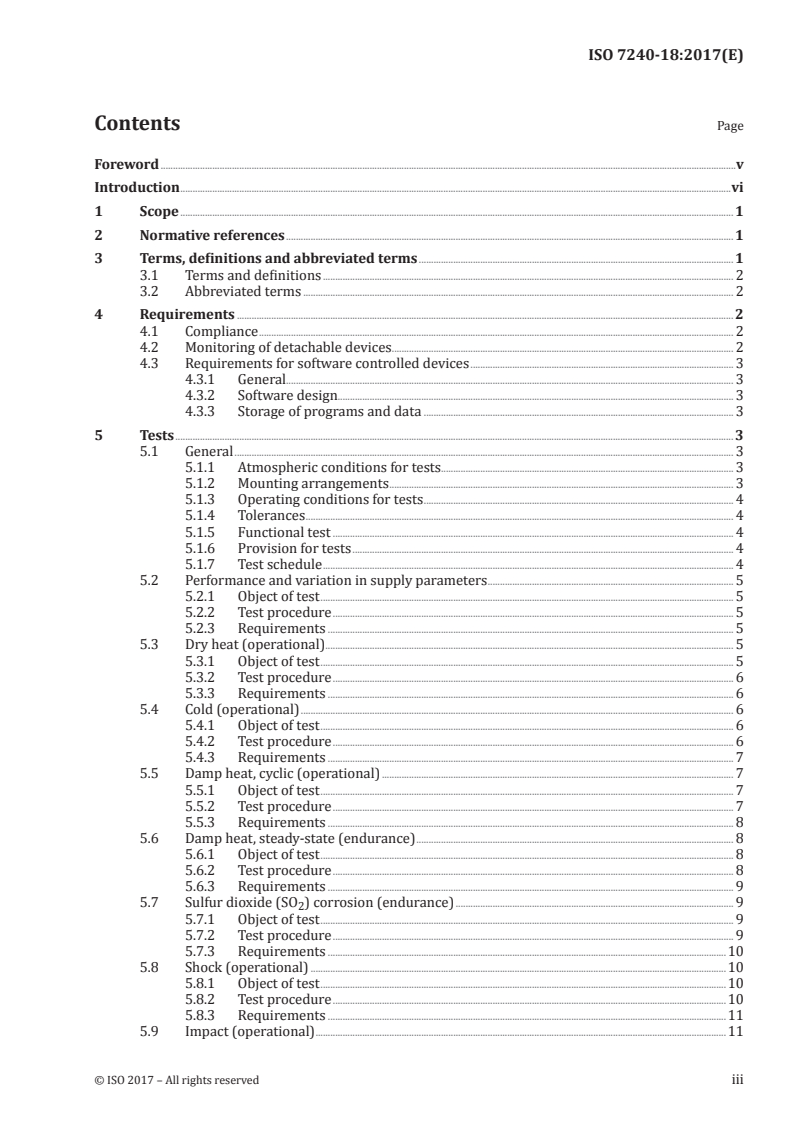
Contents Page
Foreword .v
Introduction .vi
1 Scope . 1
2 Normative references . 1
3 Terms, definitions and abbreviated terms . 1
3.1 Terms and definitions . 2
3.2 Abbreviated terms . 2
4 Requirements . 2
4.1 Compliance . 2
4.2 Monitoring of detachable devices . 2
4.3 Requirements for software controlled devices . 3
4.3.1 General. 3
4.3.2 Software design. 3
4.3.3 Storage of programs and data . 3
5 Tests . 3
5.1 General . 3
5.1.1 Atmospheric conditions for tests. 3
5.1.2 Mounting arrangements . 3
5.1.3 Operating conditions for tests . 4
5.1.4 Tolerances . 4
5.1.5 Functional test . 4
5.1.6 Provision for tests . 4
5.1.7 Test schedule . 4
5.2 Performance and variation in supply parameters . 5
5.2.1 Object of test . 5
5.2.2 Test procedure . 5
5.2.3 Requirements . 5
5.3 Dry heat (operational) . 5
5.3.1 Object of test . 5
5.3.2 Test procedure . 6
5.3.3 Requirements . 6
5.4 Cold (operational) . 6
5.4.1 Object of test . 6
5.4.2 Test procedure . 6
5.4.3 Requirements . 7
5.5 Damp heat, cyclic (operational) . 7
5.5.1 Object of test . 7
5.5.2 Test procedure . 7
5.5.3 Requirements . 8
5.6 Damp heat, steady-state (endurance) . 8
5.6.1 Object of test . 8
5.6.2 Test procedure . 8
5.6.3 Requirements . 9
5.7 Sulfur dioxide (SO ) corrosion (endurance) . 9
5.7.1 Object of test . 9
5.7.2 Test procedure . 9
5.7.3 Requirements .10
5.8 Shock (operational) .10
5.8.1 Object of test .10
5.8.2 Test procedure .10
5.8.3 Requirements .11
5.9 Impact (operational) .11
5.9.1 Object of test .11
5.9.2 Test procedure .11
5.9.3 Requirements .12
5.10 Vibration, sinusoidal (operational) .12
5.10.1 Object of test .12
5.10.2 Test procedure .12
5.10.3 Requirements .13
5.11 Vibration, sinusoidal (endurance) .13
5.11.1 Object of test .13
5.11.2 Test procedure .13
5.11.3 Requirements .14
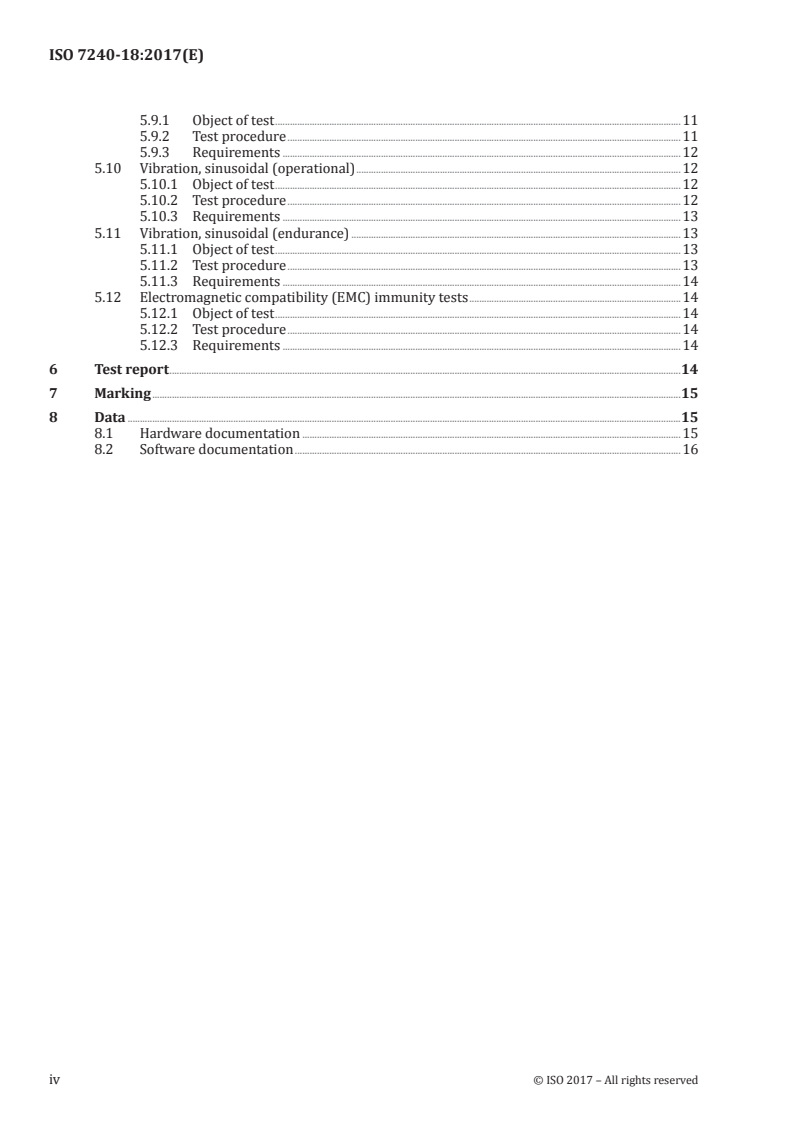
5.12 Electromagnetic compatibility (EMC) immunity tests .14
5.12.1 Object of test .14
5.12.2 Test procedure .14
5.12.3 Requirements .14
6 Test report .14
7 Marking .15
8 Data .15
8.1 Hardware documentation .15
8.2 Software documentation .16
iv © ISO 2017 – All rights reserved
Foreword
ISO (the International Organization for Standardization) is a worldwide federation of national standards
bodies (ISO member bodies). The work of preparing International Standards is normally carried out
through ISO technical committees. Each member body interested in a subject for which a technical
committee has been established has the right to be represented on that committee. International
organizations, governmental and non-governmental, in liaison with ISO, also take part in the work.
ISO collaborates closely with the International Electrotechnical Commission (IEC) on all matters of
electrotechnical standardization.
The procedures used to develop this document and those intended for its further maintenance are
described in the ISO/IEC Directives, Part 1. In particular the different approval criteria needed for the
different types of ISO documents should be noted. This document was drafted in accordance with the
editorial rules of the ISO/IEC Directives, Part 2 (see www.iso.org/directives).
Attention is drawn to the possibility that some of the elements of this document may be the subject of
patent rights. ISO shall not be held responsible for identifying any or all such patent rights. Details of
any patent rights identified during the development of the document will be in the Introduction and/or
on the ISO list of patent declarations received (see www.iso.org/patents).
Any trade name used in this document is information given for the convenience of users and does not
constitute an endorsement.
For an explanation on the voluntary nature of standards, the meaning of ISO specific terms and
expressions related to conformity assessment, as well as information about ISO's adherence to the
World Trade Organization (WTO) principles in the Technical Barriers to Trade (TBT) see the following
URL: www.iso.org/iso/foreword.html.
This document was prepared by Technical Committee ISO/TC 21, Equipment for fire protection and fire
fighting, Subcommittee SC 3, Fire detection and alarm systems.
This second edition cancels and replaces the first edition (ISO 7240-18:2009), which has been
technically revised with the following changes:
— in 5.12 (electromagnetic compatibility immunity tests), EN 50130-4 has been replaced by
IEC 62599-2;
— marking has been moved to a new Clause 7;
— data and software requirements have been moved to a new Clause 8.
A list of all the parts in the ISO 7240 series can be found on the ISO website.
Introduction
The term input/output devices, used in this document, covers a wide range of different types of devices
that are intended for different applications and can, therefore, have different functions. This document
does not, therefore, include detailed functional requirements for the input/output devices but requires
that their function is sufficiently specified by the manufacturer and that they function correctly in
accordance with the manufacturer’s specification.
vi © ISO 2017 – All rights reserved
INTERNATIONAL STANDARD ISO 7240-18:2017(E)
Fire detection and alarm systems —
Part 18:
Input/output devices
1 Scope
This document specifies requirements, test methods and performance criteria for input/output devices
connected to a transmission path of a fire detection and alarm system used to receive and/or transmit
signals to or from the transmission path, necessary for the operation of the fire detection and fire alarm
system and/or fire protection system.
An input/output device can be a physically separate device or its function can be integrated into another
device, in which case this document can be used to assess this function.
This document is applicable to input/output devices which include signal amplifiers and signal transfer
in separate enclosures.
Control and indicating equipment and ancillary control and indicating equipment (e.g. repeater panels
and fire brigade panels) are not covered by this document.
2 Normative references
The following documents are referred to in the text in such a way that some or all of their content
constitutes requirements of this document. For dated references, only the edition cited applies. For
undated references, the latest edition of the referenced document (including any amendments) applies.
ISO 7240-1, Fire detection and alarm systems — Part 1: General and definitions
IEC 60068-1, Environmental testing — Part 1: General and guidance
IEC 60068-2-1, Environmental testing — Part 2-1: Tests — Test A: Cold
IEC 60068-2-2, Environmental testing — Part 2-2: Tests — Test B: Dry heat
IEC 60068-2-6, Environmental testing — Part 2-6: Tests — Test Fc: Vibration (sinusoidal)
IEC 60068-2-27, Environmental testing — Part 2-27: Tests. Test Ea and guidance: Shock
IEC 60068-2-30, Environmental testing — Part 2-30: Tests — Test Db: Damp heat, cyclic (12 h + 12 h cycle)
IEC 60068-2-42, Environmental testing — Part 2-42: Tests — Test Kc: Sulphur dioxide test for contacts and
connections
IEC 60068-2-75, Environmental testing — Part 2-75: Tests — Test Eh: Hammer tests
IEC 60068-2-78, Environmental testing — Part 2-78: Tests — Test Cab: Damp heat, steady state
IEC 62599-2, Alarm systems — Part 2: Electromagnetic compatibility — Immunity requirements for
components of fire and security alarm systems
3 Terms, definitions and abbreviated terms
For the purposes of this document, the terms and definitions given in ISO 7240-1 and the following apply.
ISO and IEC maintain terminological databases for use in standardization at the following addresses:
— IEC Electropedia: available at http://www.electropedia.org/
— ISO Online browsing platform: available at http://www.iso.org/obp
3.1 Terms and definitions
3.1.1
conditioning
exposure of a specimen to environmental conditions in order to determine the effect of such conditions
on the specimen
3.1.2
recovery
treatment of a specimen, after conditioning (3.1.1), so that the properties of the specimen may be
stabilized before measurement
3.2 Abbreviated terms
FDCIE fire detection control and indicating equipment
EMC electromagnetic compatibility
4 Requirements
4.1 Compliance
4.1.1 In order to comply with this document, the input/output device shall:
a) meet the requirements of Clause 4, which shall be verified by visual inspection or engineering
assessment,
b) be tested as specified in Clause 5, and shall meet the requirements of the tests, and
c) meet the requirements of Clauses 7 and 8, which shall be verified by visual inspection.
4.1.2 For input/output devices integrated into another device that is already covered by an existing
part of ISO 7240, the environmental conditioning shall be performed in accordance with that part of
ISO 7240, with the addition of the functional tests before, during and/or after conditioning, as required
in this document. In some detector standards, the dry heat (operational) test is conducted in special test
equipment (e.g. in the heat tunnel for heat detectors). The required functional testing of the integrated
input/output device before, during and after the dry heat conditioning may be done with this equipment,
if this is possible without disrupting the detector measurements. Otherwise, a separate dry heat test,
with the same conditioning, shall be conducted. For heat detectors, the test temperature is the maximum
application temperature.
4.2 Monitoring of detachable devices
If an input/output device is detachable (i.e. it is attached to a detachable mounting base), then a means
shall be provided for a remote monitoring system (e.g. the FDCIE) to detect the removal of the device
from the base, in order to give a fault signal.
2 © ISO 2017 – All rights reserved
4.3 Requirements for software controlled devices
4.3.1 General
For input/output devices that rely on software control in order to fulfil the requirements of this
document, the requirements of 4.3.2 and 4.3.3 shall be met.
4.3.2 Software design
In order to ensure the reliability of the device, the following requirements for software design shall apply.
a) The software shall have a modular structure.
b) The design of the interfaces for manually and automatically generated data shall not permit invalid
data to cause error in the program operation.
c) The software shall be designed to avoid the occurrence of deadlock of the program flow.
4.3.3 Storage of programs and data
4.3.3.1 The program necessary to comply with this document and any preset data, such as
manufacturer's settings, shall be held in non-volatile memory. Writing to areas of memory containing
this program and data shall be possible only by the use of some special tool or code and shall not be
possible during normal operation of the device.
4.3.3.2 Site-specific data shall be held in memory that can retain data for at least two weeks without
external power to the device, unless provision is made for the automatic renewal of such data, following
loss of power, within 1 h of power being restored.
5 Tests
5.1 General
5.1.1 Atmospheric conditions for tests
5.1.1.1 Unless otherwise stated in a test procedure, carry out the testing after the test specimen has
been allowed to stabilize in the standard atmospheric conditions for testing as specified in IEC 60068-1
as follows:
— temperature: (15 to 35) °C;
— relative humidity: (25 to 75) %;
— air pressure: (86 to 106) kPa.
5.1.1.2 The temperature and humidity shall be substantially constant for each environmental test
where the standard atmospheric conditions are applied.
5.1.2 Mounting arrangements
The specimen shall be mounted by its normal means of attachment in accordance with the
manufacturer's instructions. If these instructions describe more than one method of mounting, then
the method considered to be most unfavourable shall be chosen for each test.
5.1.3 Operating conditions for tests
5.1.3.1 If a test method requires that a specimen be operational, t
...
INTERNATIONAL ISO
STANDARD 7240-18
Second edition
2017-09
Fire detection and alarm systems —
Part 18:
Input/output devices
Systèmes de détection et d'alarme d'incendie —
Partie 18: Dispositifs d'entrée/sortie
Reference number
©
ISO 2017
© ISO 2017, Published in Switzerland
All rights reserved. Unless otherwise specified, no part of this publication may be reproduced or utilized otherwise in any form
or by any means, electronic or mechanical, including photocopying, or posting on the internet or an intranet, without prior
written permission. Permission can be requested from either ISO at the address below or ISO’s member body in the country of
the requester.
ISO copyright office
Ch. de Blandonnet 8 • CP 401
CH-1214 Vernier, Geneva, Switzerland
Tel. +41 22 749 01 11
Fax +41 22 749 09 47
copyright@iso.org
www.iso.org
ii © ISO 2017 – All rights reserved
Contents Page
Foreword .v
Introduction .vi
1 Scope . 1
2 Normative references . 1
3 Terms, definitions and abbreviated terms . 1
3.1 Terms and definitions . 2
3.2 Abbreviated terms . 2
4 Requirements . 2
4.1 Compliance . 2
4.2 Monitoring of detachable devices . 2
4.3 Requirements for software controlled devices . 3
4.3.1 General. 3
4.3.2 Software design. 3
4.3.3 Storage of programs and data . 3
5 Tests . 3
5.1 General . 3
5.1.1 Atmospheric conditions for tests. 3
5.1.2 Mounting arrangements . 3
5.1.3 Operating conditions for tests . 4
5.1.4 Tolerances . 4
5.1.5 Functional test . 4
5.1.6 Provision for tests . 4
5.1.7 Test schedule . 4
5.2 Performance and variation in supply parameters . 5
5.2.1 Object of test . 5
5.2.2 Test procedure . 5
5.2.3 Requirements . 5
5.3 Dry heat (operational) . 5
5.3.1 Object of test . 5
5.3.2 Test procedure . 6
5.3.3 Requirements . 6
5.4 Cold (operational) . 6
5.4.1 Object of test . 6
5.4.2 Test procedure . 6
5.4.3 Requirements . 7
5.5 Damp heat, cyclic (operational) . 7
5.5.1 Object of test . 7
5.5.2 Test procedure . 7
5.5.3 Requirements . 8
5.6 Damp heat, steady-state (endurance) . 8
5.6.1 Object of test . 8
5.6.2 Test procedure . 8
5.6.3 Requirements . 9
5.7 Sulfur dioxide (SO ) corrosion (endurance) . 9
5.7.1 Object of test . 9
5.7.2 Test procedure . 9
5.7.3 Requirements .10
5.8 Shock (operational) .10
5.8.1 Object of test .10
5.8.2 Test procedure .10
5.8.3 Requirements .11
5.9 Impact (operational) .11
5.9.1 Object of test .11
5.9.2 Test procedure .11
5.9.3 Requirements .12
5.10 Vibration, sinusoidal (operational) .12
5.10.1 Object of test .12
5.10.2 Test procedure .12
5.10.3 Requirements .13
5.11 Vibration, sinusoidal (endurance) .13
5.11.1 Object of test .13
5.11.2 Test procedure .13
5.11.3 Requirements .14
5.12 Electromagnetic compatibility (EMC) immunity tests .14
5.12.1 Object of test .14
5.12.2 Test procedure .14
5.12.3 Requirements .14
6 Test report .14
7 Marking .15
8 Data .15
8.1 Hardware documentation .15
8.2 Software documentation .16
iv © ISO 2017 – All rights reserved
Foreword
ISO (the International Organization for Standardization) is a worldwide federation of national standards
bodies (ISO member bodies). The work of preparing International Standards is normally carried out
through ISO technical committees. Each member body interested in a subject for which a technical
committee has been established has the right to be represented on that committee. International
organizations, governmental and non-governmental, in liaison with ISO, also take part in the work.
ISO collaborates closely with the International Electrotechnical Commission (IEC) on all matters of
electrotechnical standardization.
The procedures used to develop this document and those intended for its further maintenance are
described in the ISO/IEC Directives, Part 1. In particular the different approval criteria needed for the
different types of ISO documents should be noted. This document was drafted in accordance with the
editorial rules of the ISO/IEC Directives, Part 2 (see www.iso.org/directives).
Attention is drawn to the possibility that some of the elements of this document may be the subject of
patent rights. ISO shall not be held responsible for identifying any or all such patent rights. Details of
any patent rights identified during the development of the document will be in the Introduction and/or
on the ISO list of patent declarations received (see www.iso.org/patents).
Any trade name used in this document is information given for the convenience of users and does not
constitute an endorsement.
For an explanation on the voluntary nature of standards, the meaning of ISO specific terms and
expressions related to conformity assessment, as well as information about ISO's adherence to the
World Trade Organization (WTO) principles in the Technical Barriers to Trade (TBT) see the following
URL: www.iso.org/iso/foreword.html.
This document was prepared by Technical Committee ISO/TC 21, Equipment for fire protection and fire
fighting, Subcommittee SC 3, Fire detection and alarm systems.
This second edition cancels and replaces the first edition (ISO 7240-18:2009), which has been
technically revised with the following changes:
— in 5.12 (electromagnetic compatibility immunity tests), EN 50130-4 has been replaced by
IEC 62599-2;
— marking has been moved to a new Clause 7;
— data and software requirements have been moved to a new Clause 8.
A list of all the parts in the ISO 7240 series can be found on the ISO website.
Introduction
The term input/output devices, used in this document, covers a wide range of different types of devices
that are intended for different applications and can, therefore, have different functions. This document
does not, therefore, include detailed functional requirements for the input/output devices but requires
that their function is sufficiently specified by the manufacturer and that they function correctly in
accordance with the manufacturer’s specification.
vi © ISO 2017 – All rights reserved
INTERNATIONAL STANDARD ISO 7240-18:2017(E)
Fire detection and alarm systems —
Part 18:
Input/output devices
1 Scope
This document specifies requirements, test methods and performance criteria for input/output devices
connected to a transmission path of a fire detection and alarm system used to receive and/or transmit
signals to or from the transmission path, necessary for the operation of the fire detection and fire alarm
system and/or fire protection system.
An input/output device can be a physically separate device or its function can be integrated into another
device, in which case this document can be used to assess this function.
This document is applicable to input/output devices which include signal amplifiers and signal transfer
in separate enclosures.
Control and indicating equipment and ancillary control and indicating equipment (e.g. repeater panels
and fire brigade panels) are not covered by this document.
2 Normative references
The following documents are referred to in the text in such a way that some or all of their content
constitutes requirements of this document. For dated references, only the edition cited applies. For
undated references, the latest edition of the referenced document (including any amendments) applies.
ISO 7240-1, Fire detection and alarm systems — Part 1: General and definitions
IEC 60068-1, Environmental testing — Part 1: General and guidance
IEC 60068-2-1, Environmental testing — Part 2-1: Tests — Test A: Cold
IEC 60068-2-2, Environmental testing — Part 2-2: Tests — Test B: Dry heat
IEC 60068-2-6, Environmental testing — Part 2-6: Tests — Test Fc: Vibration (sinusoidal)
IEC 60068-2-27, Environmental testing — Part 2-27: Tests. Test Ea and guidance: Shock
IEC 60068-2-30, Environmental testing — Part 2-30: Tests — Test Db: Damp heat, cyclic (12 h + 12 h cycle)
IEC 60068-2-42, Environmental testing — Part 2-42: Tests — Test Kc: Sulphur dioxide test for contacts and
connections
IEC 60068-2-75, Environmental testing — Part 2-75: Tests — Test Eh: Hammer tests
IEC 60068-2-78, Environmental testing — Part 2-78: Tests — Test Cab: Damp heat, steady state
IEC 62599-2, Alarm systems — Part 2: Electromagnetic compatibility — Immunity requirements for
components of fire and security alarm systems
3 Terms, definitions and abbreviated terms
For the purposes of this document, the terms and definitions given in ISO 7240-1 and the following apply.
ISO and IEC maintain terminological databases for use in standardization at the following addresses:
— IEC Electropedia: available at http://www.electropedia.org/
— ISO Online browsing platform: available at http://www.iso.org/obp
3.1 Terms and definitions
3.1.1
conditioning
exposure of a specimen to environmental conditions in order to determine the effect of such conditions
on the specimen
3.1.2
recovery
treatment of a specimen, after conditioning (3.1.1), so that the properties of the specimen may be
stabilized before measurement
3.2 Abbreviated terms
FDCIE fire detection control and indicating equipment
EMC electromagnetic compatibility
4 Requirements
4.1 Compliance
4.1.1 In order to comply with this document, the input/output device shall:
a) meet the requirements of Clause 4, which shall be verified by visual inspection or engineering
assessment,
b) be tested as specified in Clause 5, and shall meet the requirements of the tests, and
c) meet the requirements of Clauses 7 and 8, which shall be verified by visual inspection.
4.1.2 For input/output devices integrated into another device that is already covered by an existing
part of ISO 7240, the environmental conditioning shall be performed in accordance with that part of
ISO 7240, with the addition of the functional tests before, during and/or after conditioning, as required
in this document. In some detector standards, the dry heat (operational) test is conducted in special test
equipment (e.g. in the heat tunnel for heat detectors). The required functional testing of the integrated
input/output device before, during and after the dry heat conditioning may be done with this equipment,
if this is possible without disrupting the detector measurements. Otherwise, a separate dry heat test,
with the same conditioning, shall be conducted. For heat detectors, the test temperature is the maximum
application temperature.
4.2 Monitoring of detachable devices
If an input/output device is detachable (i.e. it is attached to a detachable mounting base), then a means
shall be provided for a remote monitoring system (e.g. the FDCIE) to detect the removal of the device
from the base, in order to give a fault signal.
2 © ISO 2017 – All rights reserved
4.3 Requirements for software controlled devices
4.3.1 General
For input/output devices that rely on software control in order to fulfil the requirements of this
document, the requirements of 4.3.2 and 4.3.3 shall be met.
4.3.2 Software design
In order to ensure the reliability of the device, the following requirements for software design shall apply.
a) The software shall have a modular structure.
b) The design of the interfaces for manually and automatically generated data shall not permit invalid
data to cause error in the program operation.
c) The software shall be designed to avoid the occurrence of deadlock of the program flow.
4.3.3 Storage of programs and data
4.3.3.1 The program necessary to comply with this document and any preset data, such as
manufacturer's settings, shall be held in non-volatile memory. Writing to areas of memory containing
this program and data shall be possible only by the use of some special tool or code and shall not be
possible during normal operation of the device.
4.3.3.2 Site-specific data shall be held in memory that can retain data for at least two weeks without
external power to the device, unless provision is made for the automatic renewal of such data, following
loss of power, within 1 h of power being restored.
5 Tests
5.1 General
5.1.1 Atmospheric conditions for tests
5.1.1.1 Unless otherwise stated in a test procedure, carry out the testing after the test specimen has
been allowed to stabilize in the standard atmospheric conditions for testing as specified in IEC 60068-1
as follows:
— temperature: (15 to 35) °C;
— relative humidity: (25 to 75) %;
— air pressure: (86 to 106) kPa.
5.1.1.2 The temperature and humidity shall be substantially constant for each environmental test
where the standard atmospheric conditions are applied.
5.1.2 Mounting arrangements
The specimen shall be mounted by its normal means of attachment in accordance with the
manufacturer's instructions. If these instructions describe more than one method of mounting, then
the method considered to be most unfavourable shall be chosen for each test.
5.1.3 Operating conditions for tests
5.1.3.1 If a test method requires that a specimen be operational, t
...