

ISO 16507:2013
(Main)Timber structures — Uniform, concentrated static and concentrated impact loads on wood-based roof and floor panel assemblies — Test methods
General Information
- Abstract
ISO 16507:2013 is applicable to determining the resistance to deflection and damage of wood-based panels subjected to concentrated impact loads from nonrigid blunt objects, concentrated static loads, and uniformly distributed loads. Surface indentation is not evaluated separately from deflection. The procedures are intended to simulate loading on roof or floor sheathing materials installed directly to framing. Three applications are covered: roof sheathing, subfloors, and single floors. Panels are tested parallel and/or perpendicular to the panel strength axis. Roof sheathing is tested in both a dry and a wet condition, while subfloors and single floors are both tested in a dry condition, as well as a condition of having dried out after being wet. These moisture conditions are those commonly experienced with site-built construction. These procedures do not cover vibration and are not intended for the evaluation of the framed assembly as a whole.
- Status
- Published
- Publication Date
- 01-Sep-2013
- Technical Committee
- ISO/TC 165 - Timber structures
- Drafting Committee
- ISO/TC 165 - Timber structures
- Current Stage
- 9093 - International Standard confirmed
- Start Date
- 29-Aug-2024
- Completion Date
- 29-Aug-2026
Overview
ISO 16507:2013 - Timber structures: Test methods for uniform, concentrated static and concentrated impact loads on wood‑based roof and floor panel assemblies - defines laboratory procedures to determine the resistance of wood‑based panels (sheathing, subfloors, single floors) to deflection and damage under realistic service loads. The standard focuses on deflection and damage from non‑rigid blunt impact, concentrated static loads, and uniformly distributed loads for panels installed directly to framing. It does not evaluate surface indentation separately, vibration effects, or the framed assembly as a whole.
Key topics and technical requirements
- Test types
- Concentrated static load test
- Concentrated impact load test
- Uniformly distributed load test
- Specimen conditioning
- Dry: Conditioning to constant weight or for at least 2 weeks at (20 ± 2) °C and (65 ± 5) % RH
- Wet: Continuous water spray to top surface for 3 days (no ponding or immersion)
- Redried: Wet conditioning followed by dry conditioning
- Applications covered
- Roof sheathing (tested dry and wet)
- Subfloors (tested dry and redried)
- Single floors (tested dry and redried)
- Orientation and installation
- Panels tested parallel and/or perpendicular to panel strength axis
- Specimens installed on framing with the intended fastener schedule and details
- Apparatus and measurement
- Loading disks: 76 mm diameter (foot traffic / stiffness), 25 mm diameter (concentrated strength); edges rounded to ≤1.5 mm radius
- Deflection measurement: rigid tripod‑mounted gauge or equivalent with resolution ≤0.03 mm and ≤1 % error
- Load application through self‑aligning ball‑and‑socket joint; supports must prevent framing deflection
- Specimen size notes
- Minimum specimen widths and span considerations are specified (e.g., ≥595 mm for spans ≤610 mm)
- Reporting
- Test procedures include required reporting elements (load, deflection, conditioning state, orientation, failures)
Practical applications and users
ISO 16507:2013 is used by:
- Manufacturers of wood‑based roof and floor panels for product development and performance claims
- Independent testing laboratories performing durability and structural tests
- Structural and façade engineers assessing panel performance under concentrated loads and impacts
- Code officials, product certifiers, and specifiers who need comparable test data for span ratings and acceptance
- Builders and contractors interested in in‑service performance under construction traffic and fixture loads
Practical uses include evaluating stiffness and strength for span rating, verifying resistance to construction and in‑service impacts, and supporting design decisions for roof and floor sheathing selection.
Related standards
- ASTM E661 (basis for concentrated static/impact procedures)
- NIST Voluntary Product Standard PS 1 (basis for uniformly distributed load procedure)
- References to PS 1, PS 2 and CSA O325 span‑rating conventions are provided in Annex A for performance guidance.
Keywords: ISO 16507:2013, timber structures, wood‑based panels, roof sheathing, floor sheathing, concentrated impact loads, concentrated static loads, uniformly distributed loads, test methods, deflection, specimen conditioning.
Get Certified
Connect with accredited certification bodies for this standard

DIBt (Deutsches Institut für Bautechnik)
German Institute for Building Technology.
DIN CERTCO
DIN Group product certification.

Aboma Certification B.V.
Specialized in construction, metal, and transport sectors.
Sponsored listings
Frequently Asked Questions
ISO 16507:2013 is a standard published by the International Organization for Standardization (ISO). Its full title is "Timber structures — Uniform, concentrated static and concentrated impact loads on wood-based roof and floor panel assemblies — Test methods". This standard covers: ISO 16507:2013 is applicable to determining the resistance to deflection and damage of wood-based panels subjected to concentrated impact loads from nonrigid blunt objects, concentrated static loads, and uniformly distributed loads. Surface indentation is not evaluated separately from deflection. The procedures are intended to simulate loading on roof or floor sheathing materials installed directly to framing. Three applications are covered: roof sheathing, subfloors, and single floors. Panels are tested parallel and/or perpendicular to the panel strength axis. Roof sheathing is tested in both a dry and a wet condition, while subfloors and single floors are both tested in a dry condition, as well as a condition of having dried out after being wet. These moisture conditions are those commonly experienced with site-built construction. These procedures do not cover vibration and are not intended for the evaluation of the framed assembly as a whole.
ISO 16507:2013 is applicable to determining the resistance to deflection and damage of wood-based panels subjected to concentrated impact loads from nonrigid blunt objects, concentrated static loads, and uniformly distributed loads. Surface indentation is not evaluated separately from deflection. The procedures are intended to simulate loading on roof or floor sheathing materials installed directly to framing. Three applications are covered: roof sheathing, subfloors, and single floors. Panels are tested parallel and/or perpendicular to the panel strength axis. Roof sheathing is tested in both a dry and a wet condition, while subfloors and single floors are both tested in a dry condition, as well as a condition of having dried out after being wet. These moisture conditions are those commonly experienced with site-built construction. These procedures do not cover vibration and are not intended for the evaluation of the framed assembly as a whole.
ISO 16507:2013 is classified under the following ICS (International Classification for Standards) categories: 91.080.20 - Timber structures. The ICS classification helps identify the subject area and facilitates finding related standards.
ISO 16507:2013 is available in PDF format for immediate download after purchase. The document can be added to your cart and obtained through the secure checkout process. Digital delivery ensures instant access to the complete standard document.
Standards Content (Sample)
INTERNATIONAL ISO
STANDARD 16507
First edition
2013-09-01
Timber structures — Uniform,
concentrated static and concentrated
impact loads on wood-based roof and
floor panel assemblies — Test methods
Structures en bois — Assemblages de panneaux en bois pour toitures
et planchers sous charges concentrées et réparties, statique et par
impact — Méthodes d’essais
Reference number
©
ISO 2013
© ISO 2013
All rights reserved. Unless otherwise specified, no part of this publication may be reproduced or utilized otherwise in any form
or by any means, electronic or mechanical, including photocopying, or posting on the internet or an intranet, without prior
written permission. Permission can be requested from either ISO at the address below or ISO’s member body in the country of
the requester.
ISO copyright office
Case postale 56 • CH-1211 Geneva 20
Tel. + 41 22 749 01 11
Fax + 41 22 749 09 47
E-mail copyright@iso.org
Web www.iso.org
Published in Switzerland
ii © ISO 2013 – All rights reserved
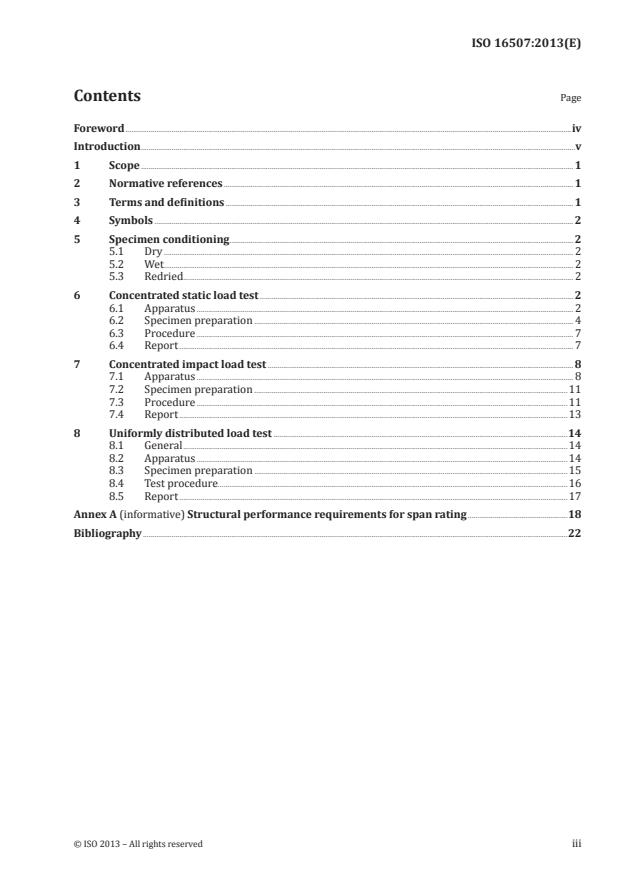
Contents Page
Foreword .iv
Introduction .v
1 Scope . 1
2 Normative references . 1
3 Terms and definitions . 1
4 Symbols . 2
5 Specimen conditioning. 2
5.1 Dry . 2
5.2 Wet . 2
5.3 Redried . . 2
6 Concentrated static load test . 2
6.1 Apparatus . 2
6.2 Specimen preparation . 4
6.3 Procedure . 7
6.4 Report . 7
7 Concentrated impact load test . 8
7.1 Apparatus . 8
7.2 Specimen preparation .11
7.3 Procedure .11
7.4 Report .13
8 Uniformly distributed load test .14
8.1 General .14
8.2 Apparatus .14
8.3 Specimen preparation .15
8.4 Test procedure .16
8.5 Report .17
Annex A (informative) Structural performance requirements for span rating .18
Bibliography .22
Foreword
ISO (the International Organization for Standardization) is a worldwide federation of national standards
bodies (ISO member bodies). The work of preparing International Standards is normally carried out
through ISO technical committees. Each member body interested in a subject for which a technical
committee has been established has the right to be represented on that committee. International
organizations, governmental and non-governmental, in liaison with ISO, also take part in the work.
ISO collaborates closely with the International Electrotechnical Commission (IEC) on all matters of
electrotechnical standardization.
The procedures used to develop this document and those intended for its further maintenance are
described in the ISO/IEC Directives, Part 1. In particular the different approval criteria needed for the
different types of ISO documents should be noted. This document was drafted in accordance with the
editorial rules of the ISO/IEC Directives, Part 2 (see www.iso.org/directives).
Attention is drawn to the possibility that some of the elements of this document may be the subject of
patent rights. ISO shall not be held responsible for identifying any or all such patent rights. Details of
any patent rights identified during the development of the document will be in the Introduction and/or
on the ISO list of patent declarations received (see www.iso.org/patents).
Any trade name used in this document is information given for the convenience of users and does not
constitute an endorsement.
For an explanation on the meaning of ISO specific terms and expressions related to conformity
assessment, as well as information about ISO’s adherence to the WTO principles in the Technical Barriers
to Trade (TBT) see the following URL: Foreword - Supplementary information
The committee responsible for this document is ISO/TC 165, Timber structures.
iv © ISO 2013 – All rights reserved
Introduction
During construction and occupancy of a building, floor and roof sheathing are subjected to uniform and
concentrated static and impact loads that frequently govern the thickness required. Static loads may
simulate either foot traffic, or loads from fixtures, when applied through loading disks of appropriate
size. Impact loads will occur during construction and also in service. Uniform loads may simulate snow,
wind, or occupancy loads.
Roof sheathing and subflooring are likely to be critical in strength or stiffness, or both, under foot
traffic and construction loads, while single-layer floors are generally critical under fixture loads, foot
traffic, and in-service impact loads. Subfloors, like single floors, must also support fixture loads, but
they will have an additional layer of material, such as underlayment above, which will help to distribute
concentrated loads.
The procedures outlined will provide data that can be used to evaluate the structural performance,
under concentrated and uniform loads, of roof and floor sheathing, separate from the effects of the
framing, under simulated conditions representative of those in actual service.
[5]
The concentrated static and impact test procedures are based upon ASTM E661-03 . The uniformly
[3]
distributed load test is based upon NIST Voluntary Product Standard PS 1-09 .
Annex A contains non-mandatory sampling and product performance guidelines that correspond to span
rating categories found in PS 1, PS 2, and CSA O325. These three structrural wood-based panel standards
have been referenced in North American building codes for several decades. Over this period of time,
the performance guidelines established in these standards have resulted in reliable and satisfactory in-
service structural performance.
INTERNATIONAL STANDARD ISO 16507:2013(E)
Timber structures — Uniform, concentrated static and
concentrated impact loads on wood-based roof and floor
panel assemblies — Test methods
1 Scope
This International Standard is applicable to determining the resistance to deflection and damage of wood-
based panels subjected to concentrated impact loads from nonrigid blunt objects, concentrated static
loads, and uniformly distributed loads. Surface indentation is not evaluated separately from deflection.
The procedures are intended to simulate loading on roof or floor sheathing materials installed directly
to framing. Three applications are covered: roof sheathing, subfloors, and single floors. Panels are tested
parallel and/or perpendicular to the panel strength axis. Roof sheathing is tested in both a dry and a
wet condition, while subfloors and single floors are both tested in a dry condition, as well as a condition
of having dried out after being wet. These moisture conditions are those commonly experienced with
site-built construction.
These procedures do not cover vibration and are not intended for the evaluation of the framed
assembly as a whole.
2 Normative references
The following documents, in whole or in part, are normatively referenced in this document and are
indispensable for its application. For dated references, only the edition cited applies. For undated
references, the latest edition of the referenced document (including any amendments) applies.
None.
3 Terms and definitions
For the purposes of this document, the following terms and definitions apply.
3.1
subfloor
panel that provides the structural integrity of the floor and is directly fastened to the floor framing, in
conventional timber framing
3.2
underlayment
panel that provides a smooth surface for direct installation of non-structural finish floor covering, in
conventional timber framing
3.3
single floor
panel that performs the function of subfloor and underlayment
3.4
span rating
index number, based on customary inch units, that identifies the recommended maximum centre-to-
centre support spacing for the specified end use under normal use conditions
Note 1 to entry: Spans are defined for end uses such as roof, subfloor, and single floor. As a matter of convention,
spans are typically specified by a single index number for single floor (e.g. Floor 24 o.c.), while roof and subfloor
are often combined in a fractional format (e.g. 32/16).
EXAMPLE A span rating of 32/16 designates a roof span of 813 mm (32 inches) and a subfloor span of
406 mm (16 inches).
4 Symbols
d distance from outer support to the point of maximum deflection for a uniformly loaded two-span
system, in mm
S test assembly span as measured from centre to centre of supports, in mm
W specimen width, in mm
5 Specimen conditioning
5.1 Dry
Conditioning to either constant weight or moisture content, or for at least 2 weeks at (20 ± 2) °C and
(65 ± 5) % relative humidity.
NOTE 1 Tables A.1 and A.2, footnote a contain alternate conditions for Dry.
NOTE 2 The conditions specified in 5.1 may result in higher results than the conditions permitted for Dry in
Tables A.1 and A.2, footnote a.
5.2 Wet
Conditioning to a continuous water spray for three days, applied to the top surface of the specimen at
a rate such as to keep this surface continuously wet. The position of the specimen shall preclude water
ponding on it, or immersion of any portion.
NOTE A simplified spray tank may be used to support the sheathing in a near vertical position during
exposure to the water spray. The tank should be fitted with drains so that water spray does not accumulate, and
the sheathing should be placed on blocks to elevate its lower edge above the residual water in the tank bottom.
5.3 Redried
Wet conditioning per 5.2 followed by dry conditioning per 5.1.
NOTE The use of a fan is recommeneded in order to dry specimens to a constant weight or moisture content.
6 Concentrated static load test
6.1 Apparatus
The apparatus for the concentrated load test shall conform to Figure 1 and 6.1.1 to 6.1.4. Alternative
methods for measuring deflection shall be permitted (see 6.1.4).
2 © ISO 2013 – All rights reserved
Key
1 dial gauge
2 dial gauge support
3 test specimen
4 loading disk (self-aligning)
5 threaded rod (height adjustable)
6 loading yoke
a
Load.
Figure 1 — Concentrated static and impact load apparatus
6.1.1 Supports
The framing members shall be supported in order not to deflect under the applied loads. The support
system shall include provisions for rigidly restraining the ends of the framing members, to prevent
rotation or vertical movement during testing.
6.1.2 Loading device
Any convenient means may be used for applying a compressive load up to ultimate, and for measuring the
load within 1 % accuracy. Load shall be applied through a ball-and-socket joint to ensure even application.
6.1.3 Loading disk
Two steel disks are required: one having a diameter of 25 mm, representing a concentrated load, and one
of 76 mm, representing foot traffic, each with a thickness of at least 13 mm. The edge of the loading disk
contacting the test specimen shall be rounded to a radius not exceeding 1,5 mm. Disk diameters in Table
1 shall be used for evaluating strength per 6.3.2. The 76-mm-diameter disk shall be used for evaluating
stiffness per 6.3.1.
Table 1 — Disk diameters for concentrated load strength
Dimensions in millimetres
Application
Conditioning
Roof Subfloor Single floor
a a
Wet 76 76 76
Dry 76 76 25
Redried 76 25
a
Testing in the wet condition for subfloors and single floors is not common, and is not required in Annex A.
6.1.4 Deflection gauge
The deflection gauge shall be mounted on a rigid tripod whose legs rest on the sheathing immediately
above the framing members that are adjacent to the load point (Figure 1). Alternatively, other deflection
measuring devices capable of measuring panel deflection separately from deformation of the test
apparatus (e.g. supporting frame, load head, etc.) shall be permitted. The deflection gauge shall have a
range exceeding the maximum anticipated deflection, have a maximum error of less than 1 %, and have
a resolution not more than 0,03 mm.
6.2 Specimen preparation
The specimen shall be installed and its test points are located in the framing assembly per Figure 2.
The specimen length perpendicular to the main framing members shall conform to the centre-to-centre
spacing, S, anticipated in service. Where sheathing is continuous over more than one span, its length
shall be equal to the minimum number of spans permitted or recommended for the product used and its
intended application, multiplied by the centre-to-centre spacing of the framing members.
The specimen width shall be at least 595 mm for spans up to 610 mm. For greater spans, the specimen
width shall be either 1 220 mm or the full panel width, which ever is less. The specimen width shall
conform to its nominal full panel width when edges are fully supported. When edges are unsupported
or partially supported, the specimen may be trimmed to a width not less than 595 mm.
The specimen shall be cut to the required size prior to conditioning. The specimen shall be conditioned
to either dry, wet, or redried (see 5.1 to 5.3).
The conditioned specimen shall be installed using the type of framing, fastener schedule, and
installation details as planned for use in service. After fabrication, test specimens promptly at ambient
laboratory conditions.
4 © ISO 2013 – All rights reserved
Specimens may be used for more than one test provided the test locations are at least 455 mm apart
(measured parallel to the framing), occur in different spans (see Figure 2), and show no sign of damage
from other tests.
NOTE 1 Annex A contains recommended specimen conditioning requirements
NOTE 2 Where the specimen is installed on wood framing, the framing may be of any species and grade
commonly used in construction that has a specific gravity of 0,40 to 0,70, oven-dry basis, with a maximum moisture
content of 19 %. If nails are used, they may be double-headed to simplify the disassembly of the specimen upon
completion of testing, providing such nails will not damage the testing equipment. Framing may be reused for
more than one test, provided it has not been significantly damaged by previous testing. Steel framing and cleats
simulating nails may be used instead of wood framing.
Dimensions in millimetres
a) Edges partially supported b) Edges not supported
c) Edges fully supported
6 © ISO 2013 – All rights reserved
Key
1 unsupported edges
2 partially supported edge (T&G, edge clips or similar)
3 framing members
4 sheathing
5 framing members, ends clamped to prevent rotation or vertical movement during testing (framing
supported at test locations)
test location
a
23 ½ in, min.
b
2 ½ in
c
18 in, min.
NOTE Symbols used in Figure 2 are defined in Clause 4.
Figure 2 — Concentrated static load test locations
6.3 Procedure
The concentrated static load shall be applied at one location on the top surface of the specimen, midway
between framing members per Figure 2. If the edge of the specimen is fully supported between main
framing members, apply the concentrated load at midwidth. If the edge is unsupported, or partially
supported, as with clips or a tongue and groove joint, apply the load 65 mm in from the unsupported or
partially supported edge as shown in Figure 2.
6.3.1 Stiffness
Load the specimen with the 76-mm-diameter loading disk, to produce deflection at a rate of 2,5 mm/min.
Measure the net deflection between 0 N and 890 N. Alternatively, to reduce the effects of specimen
settling, measure the net deflection between a preload of 100 N and 990 N. Remove the deflection
measuring device. If testing single floor, remove the load and replace the 76 mm disc with the 25 mm
disc. Continue to strength testing in 6.3.2.
NOTE The specimen may be seated before commencing the test by loading the specimen to 250 N, then
removing the load.
6.3.2 Strength
Following stiffness testing, loading shall be applied at a continuous rate so as to produce the maximum
load in 300 s ± 120 s. Record the maximum load.
NOTE The load at which the first significant break on top, the bottom, or both surfaces of the specimen
is detected may be recorded. A significant break of the sheathing is defined as a fracture that propagates into
or through the specimen, or other deformation that affects its basic stiffness or strength. Minor leafing of the
surface which may occur at the test location is not considered a significant break.
6.4 Report
The report shall include the following:
a) specimen thickness after conditioning at the test point;
b) detailed description of the test assembly, including framing and fastening schedule, and other
pertinent construction details;
c) conditioning;
d) loading disk size;
e) location of test points;
f) the preload, if used;
g) the sample minimum, maximum, and average deflection under a net 890 N concentrated load;
h) the sample minimum, maximum, and average ultimate concentrated load;
i) the sample minimum, maximum, and average concentrated static load, at which the first significant
break on top, bottom, or both surfaces of the specimen is detected (see Note in 6.3.2), if recorded;
j) the moisture content at time of test.
7 Concentrated impact load test
7.1 Apparatus
The apparatus for the impact load test shall conform to the requirements of 6.1.1 to 6.1.4, in addition to
the following equipment.
8 © ISO 2013 – All rights reserved
---
...