


ISO/IEC 23090-3:2022
(Main)Information technology -- Coded representation of immersive media
Information technology -- Coded representation of immersive media
This document specifies a video coding technology known as versatile video coding (VVC), comprising a video coding technology with a compression capability that is substantially beyond that of the prior generations of such standards and with sufficient versatility for effective use in a broad range of applications. Only the syntax format, semantics, and associated decoding process requirements are specified, while other matters such as pre-processing, the encoding process, system signalling and multiplexing, data loss recovery, post-processing, and video display are considered to be outside the scope of this document. Additionally, the internal processing steps performed within a decoder are also considered to be outside the scope of this document; only the externally observable output behaviour is required to conform to the specifications of this document. This document is designed to be generic in the sense that it serves a wide range of applications, bit rates, resolutions, qualities and services. Applications include, but are not limited to, video coding for digital storage media, television broadcasting and real-time communication. In the course of creating This document, various requirements from typical applications have been considered, necessary algorithmic elements have been developed, and these have been integrated into a single syntax. Hence, this document is designed to facilitate video data interchange among different applications.
Technologies de l'information -- Représentation codée de média immersifs
General Information
- Status
- Published
- Publication Date
- 25-Sep-2022
- Current Stage
- 4060 - Close of voting
- Start Date
- 29-Dec-2021
- Completion Date
- 28-Dec-2021
Relations
- Effective Date
- 18-Feb-2023
- Effective Date
- 21-Aug-2021
Overview
ISO/IEC 23090-3:2022 - "Information technology - Coded representation of immersive media - Part 3: Versatile Video Coding (VVC)" - specifies the syntax, semantics and required decoding processes for the Versatile Video Coding (VVC) video coding technology. Published as the second edition in 2022 and developed jointly with ITU‑T (as H.266), this international standard defines a highly efficient, versatile video coding format intended to support a broad range of bit rates, resolutions and services for immersive and conventional video use.
Important scope notes:
- The standard mandates the bitstream format, semantics and externally observable decoder behavior.
- It does not standardize encoder implementations, pre/post‑processing, system signalling/multiplexing, data‑loss recovery, or internal decoder algorithms beyond external outputs.
Key topics and technical requirements
- Versatile Video Coding (VVC) syntax and semantics for bitstream representation.
- Decoding process requirements covering NAL units, slice and picture decoding, intra/inter prediction, transform and inverse transform, quantization, in‑loop filtering (deblocking, SAO, ALF), and reconstruction.
- Bitstream formats and parsing, including byte‑stream format, raw byte sequence payloads, and alignment rules.
- Profiles, tiers and levels, with normative annexes defining operational ranges and level semantics (includes level extensions such as level 6.3).
- Supplemental data and signalling: SEI (Supplemental Enhancement Information), timing and HRD parameters.
- Entropy coding and parsing: specification of CABAC parsing, Exp‑Golomb code handling and related parsing procedures.
- Normative annexes such as a hypothetical reference decoder and byte‑stream format for interoperability and conformance testing.
Practical applications
ISO/IEC 23090-3:2022 is designed to enable interoperable video data interchange across applications, including:
- Television broadcasting and next‑generation broadcast services.
- OTT streaming and digital storage media requiring efficient compression at high resolutions (4K/8K) and HDR.
- Real‑time communication (video conferencing, low‑latency streaming) where compression efficiency and versatility matter.
- Immersive media workflows (VR/AR) that need flexible coding for varied projection formats and multi‑view content.
Who uses this standard
- Codec developers and decoder implementers building VVC‑compliant software or hardware decoders.
- System integrators and broadcasters requiring clear bitstream and decoder behavior for interoperability.
- Streaming platforms, device manufacturers and content producers evaluating codec capabilities and compliance.
- Standards bodies and testing labs performing conformance and interoperability testing.
Related standards
- ITU‑T H.266 (VVC) - same core specification harmonized with ISO/IEC 23090‑3.
- Other parts of the ISO/IEC 23090 series covering coded representation of immersive media (for system‑level and ancillary specifications).
Keywords: ISO/IEC 23090-3:2022, VVC, versatile video coding, video coding standard, immersive media, decoder specification, bitstream, profiles tiers levels, SEI, CABAC, video compression.


Frequently Asked Questions
ISO/IEC 23090-3:2022 is a standard published by the International Organization for Standardization (ISO). Its full title is "Information technology -- Coded representation of immersive media". This standard covers: This document specifies a video coding technology known as versatile video coding (VVC), comprising a video coding technology with a compression capability that is substantially beyond that of the prior generations of such standards and with sufficient versatility for effective use in a broad range of applications. Only the syntax format, semantics, and associated decoding process requirements are specified, while other matters such as pre-processing, the encoding process, system signalling and multiplexing, data loss recovery, post-processing, and video display are considered to be outside the scope of this document. Additionally, the internal processing steps performed within a decoder are also considered to be outside the scope of this document; only the externally observable output behaviour is required to conform to the specifications of this document. This document is designed to be generic in the sense that it serves a wide range of applications, bit rates, resolutions, qualities and services. Applications include, but are not limited to, video coding for digital storage media, television broadcasting and real-time communication. In the course of creating This document, various requirements from typical applications have been considered, necessary algorithmic elements have been developed, and these have been integrated into a single syntax. Hence, this document is designed to facilitate video data interchange among different applications.
This document specifies a video coding technology known as versatile video coding (VVC), comprising a video coding technology with a compression capability that is substantially beyond that of the prior generations of such standards and with sufficient versatility for effective use in a broad range of applications. Only the syntax format, semantics, and associated decoding process requirements are specified, while other matters such as pre-processing, the encoding process, system signalling and multiplexing, data loss recovery, post-processing, and video display are considered to be outside the scope of this document. Additionally, the internal processing steps performed within a decoder are also considered to be outside the scope of this document; only the externally observable output behaviour is required to conform to the specifications of this document. This document is designed to be generic in the sense that it serves a wide range of applications, bit rates, resolutions, qualities and services. Applications include, but are not limited to, video coding for digital storage media, television broadcasting and real-time communication. In the course of creating This document, various requirements from typical applications have been considered, necessary algorithmic elements have been developed, and these have been integrated into a single syntax. Hence, this document is designed to facilitate video data interchange among different applications.
ISO/IEC 23090-3:2022 is classified under the following ICS (International Classification for Standards) categories: 35.040.40 - Coding of audio, video, multimedia and hypermedia information. The ICS classification helps identify the subject area and facilitates finding related standards.
ISO/IEC 23090-3:2022 has the following relationships with other standards: It is inter standard links to ISO/IEC 23090-3:2024, ISO/IEC 23090-3:2021. Understanding these relationships helps ensure you are using the most current and applicable version of the standard.
ISO/IEC 23090-3:2022 is available in PDF format for immediate download after purchase. The document can be added to your cart and obtained through the secure checkout process. Digital delivery ensures instant access to the complete standard document.
Standards Content (Sample)
INTERNATIONAL ISO/IEC
STANDARD 23090-3
Second edition
2022-09
Information technology — Coded
representation of immersive media —
Part 3:
Versatile video coding
Technologies de l'information — Représentation codée de média
immersifs —
Partie 3: Codage vidéo polyvalent
Reference number
© ISO/IEC 2022
© ISO/IEC 2022
All rights reserved. Unless otherwise specified, or required in the context of its implementation, no part of this publication may
be reproduced or utilized otherwise in any form or by any means, electronic or mechanical, including photocopying, or posting on
the internet or an intranet, without prior written permission. Permission can be requested from either ISO at the address below
or ISO’s member body in the country of the requester.
ISO copyright office
CP 401 • Ch. de Blandonnet 8
CH-1214 Vernier, Geneva
Phone: +41 22 749 01 11
Email: copyright@iso.org
Website: www.iso.org
Published in Switzerland
ii
© ISO/IEC 2022 – All rights reserved
ISO/IEC FDIS 23090-3:2022(E)
Contents
Foreword . vi
Introduction .vi i
1 Scope . 1
2 Normative references . 1
3 Terms and definitions . 1
4 Abbreviated terms . 16
5 Conventions . 18
5.1 General . 18
5.2 Arithmetic operators . 19
5.3 Logical operators . 19
5.4 Relational operators . 19
5.5 Bit-wise operators . 20
5.6 Assignment operators . 20
5.7 Range notation . 20
5.8 Mathematical functions . 20
5.9 Order of operation precedence . 21
5.10 Variables, syntax elements and tables . 22
5.11 Text description of logical operations . 23
5.12 Processes . 24
6 Bitstream and picture formats, partitionings, scanning processes and neighbouring
relationships . 25
6.1 Bitstream formats . 25
6.2 Source, decoded and output picture formats . 25
6.3 Partitioning of pictures, subpictures, slices, tiles, and CTUs . 27
6.3.1 Partitioning of pictures into subpictures, slices, and tiles . 27
6.3.2 Block, quadtree and multi-type tree structures . 30
6.3.3 Spatial or component-wise partitionings . 30
6.4 Availability processes . 31
6.4.1 Allowed quad split process . 31
6.4.2 Allowed binary split process . 32
6.4.3 Allowed ternary split process . 34
6.4.4 Derivation process for neighbouring block availability . 35
6.5 Scanning processes. 36
6.5.1 CTB raster scanning, tile scanning, and subpicture scanning processes . 36
6.5.2 Up-right diagonal scan order array initialization process . 40
6.5.3 Horizontal and vertical traverse scan order array initialization process . 40
7 Syntax and semantics . 41
7.1 Method of specifying syntax in tabular form . 41
7.2 Specification of syntax functions and descriptors . 42
7.3 Syntax in tabular form . 44
7.3.1 NAL unit syntax . 44
7.3.2 Raw byte sequence payloads, trailing bits and byte alignment syntax . 44
7.3.3 Profile, tier, and level syntax . 64
7.3.4 DPB parameters syntax . 67
7.3.5 Timing and HRD parameters syntax . 67
7.3.6 Supplemental enhancement information message syntax . 68
7.3.7 Slice header syntax . 68
7.3.8 Weighted prediction parameters syntax . 71
7.3.9 Reference picture lists syntax . 72
© ISO/IEC 2022 – All rights reserved iii
ISO/IEC FDIS 23090-3:2022(E)
7.3.10 Reference picture list structure syntax . 72
7.3.11 Slice data syntax . 73
7.4 Semantics. 95
7.4.1 General . 95
7.4.2 NAL unit semantics. 95
7.4.3 Raw byte sequence payloads, trailing bits and byte alignment semantics . 104
7.4.4 Profile, tier, and level semantics . 163
7.4.5 DPB parameters semantics . 169
7.4.6 Timing and HRD parameters semantics . 170
7.4.7 Supplemental enhancement information message semantics . 175
7.4.8 Slice header semantics . 175
7.4.9 Weighted prediction parameters semantics . 185
7.4.10 Reference picture lists semantics . 187
7.4.11 Reference picture list structure semantics . 188
7.4.12 Slice data semantics . 189
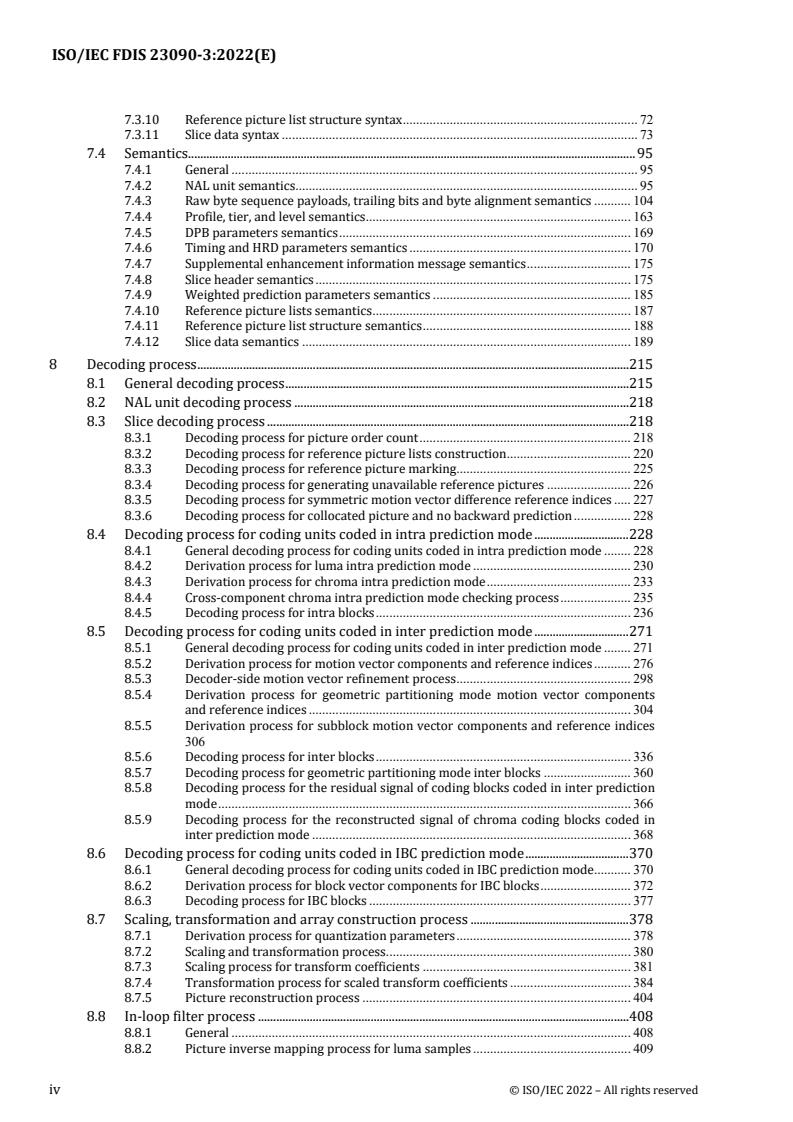
8 Decoding process .21 5
8.1 General decoding process .21 5
8.2 NAL unit decoding process .21 8
8.3 Slice decoding process .21 8
8.3.1 Decoding process for picture order count . 218
8.3.2 Decoding process for reference picture lists construction . 220
8.3.3 Decoding process for reference picture marking . 225
8.3.4 Decoding process for generating unavailable reference pictures . 226
8.3.5 Decoding process for symmetric motion vector difference reference indices . 227
8.3.6 Decoding process for collocated picture and no backward prediction . 228
8.4 Decoding process for coding units coded in intra prediction mode . 228
8.4.1 General decoding process for coding units coded in intra prediction mode . 228
8.4.2 Derivation process for luma intra prediction mode . 230
8.4.3 Derivation process for chroma intra prediction mode . 233
8.4.4 Cross-component chroma intra prediction mode checking process . 235
8.4.5 Decoding process for intra blocks . 236
8.5 Decoding process for coding units coded in inter prediction mode . 271
8.5.1 General decoding process for coding units coded in inter prediction mode . 271
8.5.2 Derivation process for motion vector components and reference indices . 276
8.5.3 Decoder-side motion vector refinement process . 298
8.5.4 Derivation process for geometric partitioning mode motion vector components
and reference indices . 304
8.5.5 Derivation process for subblock motion vector components and reference indices
8.5.6 Decoding process for inter blocks . 336
8.5.7 Decoding process for geometric partitioning mode inter blocks . 360
8.5.8 Decoding process for the residual signal of coding blocks coded in inter prediction
mode . 366
8.5.9 Decoding process for the reconstructed signal of chroma coding blocks coded in
inter prediction mode . 368
8.6 Decoding process for coding units coded in IBC prediction mode . 370
8.6.1 General decoding process for coding units coded in IBC prediction mode . 370
8.6.2 Derivation process for block vector components for IBC blocks . 372
8.6.3 Decoding process for IBC blocks . 377
8.7 Scaling, transformation and array construction process . 378
8.7.1 Derivation process for quantization parameters . 378
8.7.2 Scaling and transformation process . 380
8.7.3 Scaling process for transform coefficients . 381
8.7.4 Transformation process for scaled transform coefficients . 384
8.7.5 Picture reconstruction process . 404
8.8 In-loop filter process .40 8
8.8.1 General . 408
8.8.2 Picture inverse mapping process for luma samples . 409
iv © ISO/IEC 2022 – All rights reserved
ISO/IEC FDIS 23090-3:2022(E)
8.8.3 Deblocking filter process . 410
8.8.4 Sample adaptive offset process . 440
8.8.5 Adaptive loop filter process . 442
9 Parsing process .45 5
9.1 General .45 5
9.2 Parsing process for k-th order Exp-Golomb codes .45 5
9.2.1 General . 455
9.2.2 Mapping process for signed Exp-Golomb codes . 457
9.3 CABAC parsing process for slice data .45 7
9.3.1 General . 457
9.3.2 Initialization process . 459
9.3.3 Binarization process . 482
9.3.4 Decoding process flow . 492
Annex A (normative) Profiles, tiers and levels .51 0
Annex B (normative) Byte stream format .53 0
Annex C (normative) Hypothetical reference decoder .53 3
Annex D (normative) Supplemental enhancement information and use of SEI and VUI . 559
© ISO/IEC 2022 – All rights reserved v
ISO/IEC FDIS 23090-3:2022 (E)
Foreword
ISO (the International Organization for Standardization) and IEC (the International Electrotechnical
Commission) form the specialized system for worldwide standardization. National bodies that are
members of ISO or IEC participate in the development of International Standards through technical
committees established by the respective organization to deal with particular fields of technical activity.
ISO and IEC technical committees collaborate in fields of mutual interest. Other international
organizations, governmental and non-governmental, in liaison with ISO and IEC, also take part in the
work.
The procedures used to develop this document and those intended for its further maintenance are
described in the ISO/IEC Directives, Part 1. In particular, the different approval criteria needed for the
different types of document should be noted. This document was drafted in accordance with the
editorial rules of the ISO/IEC Directives, Part 2 (see www.iso.org/directives or
www.iec.ch/members_experts/refdocs).
Attention is drawn to the possibility that some of the elements of this document may be the subject of
patent rights. ISO and IEC shall not be held responsible for identifying any or all such patent rights.
Details of any patent rights identified during the development of the document will be in the
Introduction and/or on the ISO list of patent declarations received (see www.iso.org/patents) or the
IEC list of patent declarations received (see https://patents.iec.ch).
Any trade name used in this document is information given for the convenience of users and does not
constitute an endorsement.
For an explanation of the voluntary nature of standards, the meaning of ISO specific terms and
expressions related to conformity assessment, as well as information about ISO's adherence to the
World Trade Organization (WTO) principles in the Technical Barriers to Trade (TBT) see
www.iso.org/iso/foreword.html. In the IEC, see www.iec.ch/understanding-standards.
This document was prepared by Joint Technical Committee ISO/IEC JTC 1, Information technology,
Subcommittee SC 29, Coding of audio, picture, multimedia and hypermedia information, in collaboration
with ITU-T (as ITU-T H.266).
This second edition cancels and replaces the first edition (ISO/IEC 23090-3:2021), which has been
technically revised.
The main changes are as follows:
— the specification of operation range extensions,
— the addition of level 6.3,
— the addition of the SEI manifest SEI message, the SEI prefix indication SEI message, and the
constrained RASL encoding indication SEI message, and
— the specification of SEI payload type values and necessary variables for use of a number of SEI
messages added to the second edition of Rec. ITU-T H.274 | ISO/IEC 23002-7.
A list of all parts in the ISO/IEC 23090 series can be found on the ISO and IEC websites.
Any feedback or questions on this document should be directed to the user’s national standards body. A
complete listing of these bodies can be found at www.iso.org/members.html and www.iec.ch/national-
committees.
© ISO/IEC 2022 – All rights reserved
vi
Introduction
Purpose
This document specifies a video coding technology known as versatile video coding. It has been
designed with two primary goals. The first of these is to specify a video coding technology with a
compression capability that is substantially beyond that of the prior generations of such standards, and
the second is for this technology to be highly versatile for effective use in a broader range of
applications than that addressed by prior standards. Some key application areas for the use of this
document particularly include ultra-high-definition video (e.g., with 3840×2160 or 7620×4320 picture
resolution and bit depth of 10 bits as specified in Rec. ITU-R BT.2100), video with a high dynamic range
and wide colour gamut (e.g., with the perceptual quantization or hybrid log-gamma transfer
characteristics specified in Rec. ITU-R BT.2100), and video for immersive media applications such as
360° omnidirectional video projected using a common projection format such as the equirectangular or
cubemap projection formats, in addition to the applications that have commonly been addressed by
prior video coding standards.
Profiles, tiers, and levels
This document is designed to be versatile in the sense that it serves a wide range of applications, bit
rates, resolutions, qualities, and services. Applications include, but are not limited to, video coding for
digital storage media, television broadcasting, video streaming services, real-time communication. In
the course of creating this document, various requirements from typical applications have been
considered, necessary algorithmic elements have been developed, and these have been integrated into a
single syntax. Hence, this document is designed to facilitate video data interchange among different
applications.
Considering the practicality of implementing the full syntax of this document, however, a limited
number of subsets of the syntax are also stipulated by means of "profiles", "tiers", and "levels". These
and other related terms are formally defined in Clause 3.
A "profile" is a subset of the entire bitstream syntax that is specified in this document. Within the
bounds imposed by the syntax of a given profile it is still possible to require a very large variation in the
performance of encoders and decoders depending upon the values taken by syntax elements in the
bitstream, such as the specified size of the decoded pictures. In many applications, it is currently neither
practical nor economical to implement a decoder capable of dealing with all hypothetical uses of the
syntax within a particular profile.
In order to deal with this problem, "tiers" and "levels" are specified within each profile. A level of a tier
is a specified set of constraints imposed on values of the syntax elements in the bitstream. Some of these
constraints are expressed as simple limits on values, while others take the form of constraints on
arithmetic combinations of values (e.g. picture width multiplied by picture height multiplied by number
of pictures decoded per second). A level specified for a lower tier is more constrained than a level
specified for a higher tier.
Coded video content conforming to this document uses a common syntax. In order to achieve a subset
of the complete syntax, flags, parameters, and other syntax elements are included in the bitstream that
signal the presence or absence of syntactic elements that occur later in the bitstream.
Encoding process, decoding process, and use of VUI parameters and SEI messages
Any encoding process that produces bitstream data that conforms to the specified bitstream syntax
format requirements of this document is considered to be in conformance with the requirements of this
document. The decoding process is specified such that all decoders that conform to a specified
combination of capabilities known as the profile, tier, and level will produce numerically identical
cropped decoded output pictures when invoking the decoding process associated with that profile for a
bitstream conforming to that profile, tier and level. Any decoding process that produces identical
© ISO/IEC 2022 – All rights reserved
vii
cropped decoded output pictures to those produced by the process described herein (with the correct
output order or output timing, as specified) is considered to be in conformance with the requirements
of this document.
Rec. ITU-T H.274 | ISO/IEC 23002-7 specifies the syntax and semantics of the video usability
information (VUI) parameters and supplemental enhancement information (SEI) messages that do not
affect the conformance specifications in Annex C. These VUI parameters and SEI messages may be used
together with this document.
Versions of this document
Rec. ITU-T H.266 | ISO/IEC 23090-3 version 1 refers to the first approved version of this document. The
first edition published by ISO/IEC as ISO/IEC 23090-3:2021 corresponded to the first version.
Rec. ITU-T H.266 | ISO/IEC 23090-3 version 2 (the current version) refers to the integrated text
additionally containing operation range extensions, a new level (level 6.3), additional supplement
enhancement information, and corrections to various minor defects in the prior content of the
document. This document corresponds to the second version. At the time of publication of this
document, a corresponding second edition of Rec. ITU-T H.266 was in preparation for publication by
ITU-T.
Overview of the design characteristics
The coded representation specified in the syntax is designed to enable a high compression capability for
a desired image or video quality. The algorithm is typically not mathematically lossless, as the exact
source sample values are typically not preserved through the encoding and decoding processes,
although some modes are included that provide lossless coding capability. A number of techniques are
specified to enable highly efficient compression. Encoding algorithms (not specified within the scope of
this document) may select between inter, intra, intra block copy (IBC), and palette coding for block-
shaped regions of each picture. Inter coding uses motion vectors for block-based inter-picture
prediction to exploit temporal statistical dependencies between different pictures, intra coding uses
various spatial prediction modes to exploit spatial statistical dependencies in the source signal within
the same picture, and intra block copy coding uses block displacement vectors to reference previously
decoded regions of the same picture to exploit statistical similarities among different areas of the same
picture. Motion vectors, intra prediction modes, and IBC block vectors are specified for a variety of
block sizes in the picture. The prediction residual can then be further compressed using a spatial
transform to remove spatial correlation inside a block before it is quantized, producing a possibly
irreversible process that typically discards less important visual information while forming a close
approximation to the source samples. Finally, the motion vectors, intra prediction modes, and block
vectors can also be further compressed using a variety of prediction mechanisms, and, after prediction,
are combined with the quantized transform coefficient information and encoded using arithmetic
coding.
How to read this document
It is suggested that the reader starts with Clause 1 and moves on to Clause 3. Clause 6 should be read for
the geometrical relationship of the source, input, and output of the decoder. Clause 7 specifies the order
to parse syntax elements from the bitstream. See subclauses 7.1 to 7.3 for syntactical order and
subclause 7.4 for semantics; e.g. the scope, restrictions, and conditions that are imposed on the syntax
elements. The actual parsing for most syntax elements is specified in Clause 9. Finally, Clause 8 specifies
how the syntax elements are mapped into decoded samples. Annexes A through D also form an integral
part of this document.
Annex A specifies profiles, each being tailored to certain application domains, and defines the so-called
tiers and levels of the profiles. Annex B specifies syntax and semantics of a byte stream format for
delivery of coded video as an ordered stream of bytes. Annex C specifies the hypothetical reference
decoder, bitstream conformance, decoder conformance, and the use of the hypothetical reference
decoder to check bitstream and decoder conformance. Annex D specifies syntax and semantics for
© ISO/IEC 2022 – All rights reserved
viii
supplemental enhancement information (SEI) message payloads that affect the conformance
specifications in Annex C. Rec. ITU-T H.274 | ISO/IEC 23002-7 specifies the syntax and semantics of the
video usability information (VUI) parameters as well as SEI messages that do not affect the
conformance specifications in Annex C. These VUI parameters and SEI messages may be used together
with this document.
The term "this document" is used to refer to this Recommendation | International Standard.
In this document, the following verbal forms are used:
— “shall” indicates a requirement;
— “should” indicates a recommendation;
— “may” indicates a permission;
— “can” indicates a possibility or a capability.
Information marked as “NOTE” is intended to assist the understanding or use of the document. “Notes
to entry” used in Clause 3 provide additional information that supplements the terminological data and
can contain provisions relating to the use of a term.
Patent declarations
The International Organization for Standardization (ISO) and International Electrotechnical
Commission (IEC) draw attention to the fact that it is claimed that compliance with this document may
involve the use of patents.
ISO and IEC take no position concerning the evidence, validity and scope of these patent rights.
The holder of these patent rights have assured ISO and IEC that he/she is willing to negotiate licences
under reasonable and non-discriminatory terms and conditions with applicants throughout the world.
In this respect, the statements of the holders of these patent rights are registered with ISO and IEC.
Information may be obtained from the patent database available at www.iso.org/patents.
Attention is drawn to the possibility that some of the elements of this document may be the subject of
patent rights other than those in the patent database. ISO and IEC shall not be held responsible for
identifying any or all such patent rights.
© ISO/IEC 2022 – All rights reserved
ix
INTERNATIONAL STANDARD ISO/IEC 23090-3:2022(E)
Information technology — Coded representation of
immersive media —
Part 3:
Versatile video coding
1 Scope
This document specifies a video coding technology known as versatile video coding (VVC), comprising a
video coding technology with a compression capability that is substantially beyond that of the prior
generations of such standards and with sufficient versatility for effective use in a broad range of
applications.
Only the syntax format, semantics, and associated decoding process requirements are specified, while
other matters such as pre-processing, the encoding process, system signalling and multiplexing, data
loss recovery, post-processing, and video display are considered to be outside the scope of this
document. Additionally, the internal processing steps performed within a decoder are also considered
to be outside the scope of this document; only the externally observable output behaviour is required to
conform to the specifications of this document.
This document is designed to be generic in the sense that it serves a wide range of applications, bit
rates, resolutions, qualities and services. Applications include, but are not limited to, video coding for
digital storage media, television broadcasting and real-time communication. In the course of creating
This document, various requirements from typical applications have been considered, necessary
algorithmic elements have been developed, and these have been integrated into a single syntax. Hence,
this document is designed to facilitate video data interchange among different applications.
2 Normative references
The following documents are referred to in the text in such a way that some or all of their content
constitutes requirements of this document. For dated references, only the edition cited applies. For
undated references, the latest edition of the referenced document (including any amendments) applies.
Rec. ITU-T H.274 | ISO/IEC 23002-7, Versatile supplemental enhancement information messages for
coded video bitstreams
Rec. ITU-T T.35, Procedure for the allocation of ITU-T defined codes for non standard facilities
3 Terms and definitions
For the purposes of this document, the following terms and definitions apply.
ISO and IEC maintain terminology databases for use in standardization at the following addresses:
ISO Online browsing platform: available at https://www.iso.org/obp
IEC Electropedia: available at https://www.electropedia.org/
3.1
access unit
set of PUs that belong to different layers and contain coded pictures associated with the same time for
output from the DPB
3.2
adaptive colour transform
cross-component transform applied to the decoded residual of a coding unit in the 4:4:4 colour format
prior to reconstruction and loop filtering
© ISO/IEC 2022 – All rights reserved 1
3.3
adaptive loop filter
filtering process that is applied as part of the decoding process and is controlled by parameters
conveyed in an APS
3.4
ALF APS
APS that controls the ALF process
3.5
adaptation parameter set
syntax structure containing syntax elements that apply to zero or more slices as determined by zero or
more syntax elements found in slice headers
3.6
associated GDR picture
previous GDR picture (when present) in decoding order, for a particular picture with nuh_layer_id equal
to a particular value layerId, that has nuh_layer_id equal to layerId and between which and the
particular picture in decoding order there is no IRAP picture with nuh_layer_id equal to layerId
3.7
associated IRAP picture
previous IRAP picture (when present) in decoding order, for a particular picture with nuh_layer_id equal
to a particular value layerId, that has nuh_layer_id equal to layerId and between which and the
particular picture in decoding order there is no GDR picture with nuh_layer_id equal to layerId
3.8
associated IRAP subpicture
previous IRAP subpicture (when present) in decoding order, for a particular subpicture with
nuh_layer_id equal to a particular value layerId and subpicture index equal to a particular value
subpicIdx, that has nuh_layer_id equal to layerId and subpicture index equal to subpicIdx and between
which and the particular subpicture in decoding order there is no GDR subpicture with nuh_layer_id
equal to layerId and subpicture index equal to subpicIdx
3.9
associated non-VCL NAL unit
non-VCL NAL unit (when present) for a VCL NAL unit where the VCL NAL unit is the associated VCL NAL
unit of the non-VCL NAL unit
3.10
associated VCL NAL unit
preceding VCL NAL unit in decoding order for a non-VCL NAL unit with nal_unit_type equal to EOS_NUT,
EOB_NUT, SUFFIX_APS_NUT, SUFFIX_SEI_NUT, FD_NUT, RSV_NVCL_27, UNSPEC_30, or UNSPEC_31; or
otherwise the next VCL NAL unit in decoding order
3.11
bin
bit of a bin string
3.12
binarization
set of bin strings for all possible values of a syntax element
3.13
binarization process
unique mapping process of all possible values of a syntax element onto a set of bin strings
2 © ISO/IEC 2022 – All rights reserved
3.14
binary split
split of a rectangular MxN block of samples into two blocks where a vertical split results in a first
(M / 2)xN block and a second (M / 2)xN block, and a horizontal split results in a first Mx(N / 2) block
and a second Mx(N / 2) block
3.15
bin string
intermediate binary representation of values of syntax elements from the binarization of the syntax
element
3.16
bi-predictive slice
B slice
slice that is decoded using intra prediction or using inter prediction with at most two motion vectors and
reference indices to predict the sample values of each block
3.17
bitstream
sequence of bits, in the form of a NAL unit stream or a byte stream, that forms the representation of a
sequence of AUs forming one or more coded video sequences (CVSs)
3.18
block
MxN (M-column by N-row) array of samples, or an MxN array of transform coefficients
3.19
block vector
two-dimensional vector that provides an offset from the coordinates of the current coding block to the
coordinates of the reference block in the same decoded slice
3.20
byte
sequence of 8 bits, within which, when written or read as a sequence of bit values, the left-most and
right-most bits represent the most and least significant bits, respectively
3.21
byte-aligned
positioned an integer multiple of 8 bits from the position of the first bit in the bitstream
3.22
byte-aligned
position at which it appears in a bitstream is byte-aligned
3.23
byte stream
encapsulation of a NAL unit stream into a series of bytes containing start code prefixes and NAL units
3.24
chroma
sample array or single sample representing one of the two colour difference signals related to the
primary colours, represented by the symbols Cb and Cr
Note 1 to entry: The term chroma is used rather than the term chrominance in order to avoid the implication of
the use of linear light transfer characteristics that is often associated with the term chrominance.
3.25
CRA PU
PU in which the coded picture is a CRA picture
© ISO/IEC 2022 – All rights reserved 3
3.26
CRA picture
IRAP picture for which each VCL NAL unit has nal_unit_type equal to CRA_NUT
Note 1 to entry: A CRA picture does not use inter prediction in its decoding process, and could be the first picture
in the bitstream in decoding order, or could appear later in the bitstream. A CRA picture could have associated
RADL or RASL pictures. When a CRA picture has NoOutputBeforeRecoveryFlag equal to 1, the associated RASL
pictures are not output by the decoder, because they might not be decodable, as they could contain references to
pictures that are not present in the bitstream.
3.27
CRA subpicture
IRAP subpicture for which each VCL NAL unit has nal_unit_type equal to CRA_NUT
3.28
coded layer video sequence:
sequence of PUs with the same value of nuh_layer_id that consists, in decoding order, of a CLVSS PU,
followed by zero or more PUs that are not CLVSS PUs, including all subsequent PUs up to but not
including any subsequent PU that is a CLVSS PU
Note 1 to entry: A CLVSS PU could be an IDR PU, a CRA PU, or a GDR PU. The value of
NoOutputBeforeRecoveryFlag is equal to 1 for each IDR PU, and each CRA PU that has HandleCraAsClvsStartFlag
equal to 1, and each CRA or GDR PU that is the first PU in the layer of the bitstream in decoding order or the first
PU in the layer of the bitstream that follows an EOS NAL unit in the layer in decoding order.
3.29
CLVSS PU
PU in which the coded picture is a CLVSS picture
3.30
CLVSS picture
coded picture that is an IRAP picture with NoOutputBeforeRecoveryFlag equal to 1 or a GDR picture with
NoOutputBeforeRecoveryFlag equal to 1
3.31
coded picture
coded representation of a picture comprising VCL NAL units with a particular value of nuh_layer_id
within an AU and containing all CTUs of the picture
3.32
coded picture buffer
first-in first-out buffer containing DUs in decoding order specified in the hypothetical reference decoder
Note 1 to entry: The hypothetical reference decoder is specified in Annex C.
3.33
coded representation
data element as represented in its coded form
3.34
coded slice NAL unit
NAL unit that contains a coded slice
3.35
coded video sequence
sequence of AUs that consists, in decoding order, of a CVSS AU, followed by zero or more AUs that are not
CVSS AUs, including all subsequent AUs up to but not including any subsequent AU that is a CVSS AU
3.36
CVSS AU
IRAP AU or GDR AU for which the coded picture in each PU is a CLVSS picture
4 © ISO/IEC 2022 – All rights reserved
3.37
coding block
MxN block of samples for some values of M and N such that the division of a CTB into coding blocks is a
partitioning
3.38
coding tree block
N×N block of samples for some value of N such that the division of a component into CTBs is a
partitioning
3.39
coding tree unit
CTB of luma samples, two corresponding CTBs of chroma samples of a picture that has three sample
arrays, or a CTB of samples of a monochrome picture, and syntax structures used to code the samples
3.40
coding unit
coding block of luma samples, two corresponding coding blocks of chroma samples of a picture that has
three sample arrays in the single tree mode, or a coding block of luma samples of a picture that has three
sample arrays in the dual tree mode, or two coding blocks of chroma samples of a picture that has three
sample arrays in the dual tree mode, or a coding block of samples of a monochrome picture, and syntax
structures used to code the samples
3.41
component
array or single sample from one of the three arrays (luma and two chroma) that compose a picture in
4:2:0, 4:2:2, or 4:4:4 colour format or the array or a single sample of the array that compose a picture in
monochrome format
3.42
context variable
variable specified for the adaptive binary arithmetic decoding process of a bin by a formula containing
recently decoded bins
3.43
deblocking filter
filtering process that is applied as part of the decoding process in order to minimize the appearance of
visual artefacts at the boundaries between blocks
3.44
decoded picture
picture produced by applying the decoding process to a coded picture
3.45
decoded picture buffer
buffer holding decoded pictures for reference, output reordering, or output delay specified for the
hypothetical reference decoder
3.46
decoder
embodiment of a decoding process
3.47
decoding order
order in which syntax elements are processed by the decoding process
3.48
decoding process
process specified in this document that reads a bitstream and derives decoded pictures from it
© ISO/IEC 2022 – All rights reserved 5
3.49
decoding unit
AU if DecodingUnitHrdFlag is equal to 0 or a subset of an AU otherwise, consisting of one or more VCL
NAL units in an AU and the associated non-VCL NAL units
3.50
emulation prevention byte
byte equal to 0x03 that is present within a NAL unit when the syntax elements of the bitstream form
certain patterns of byte values in a manner that ensures that no sequence of consecutive byte-aligned
bytes in the NAL unit can contain a start code prefix
3.51
encoder
embodiment of an encoding process
3.52
encoding process
process not specified in this document that produces a bitstream conforming to this document
3.53
filler data NAL units
NAL units with nal_unit_type equal to FD_NUT
3.54
flag
variable or single-bit syntax element that can take one of the two possible values: 0 and 1
3.55
frequency index
one-dimensional or two-dimensional index associated with a transform coefficient prior to the
application of a transform in the decoding process
3.56
GDR AU
AU in which there is a PU for each layer present in the CVS and the coded picture in each present PU is a
GDR picture
3.57
GDR PU
PU in which the coded picture is a GDR picture
3.58
GDR picture
picture for which each VCL NAL unit has nal_unit_type equal to GDR_NUT
Note 1 to entry: The value
...
Questions, Comments and Discussion
Ask us and Technical Secretary will try to provide an answer. You can facilitate discussion about the standard in here.
Loading comments...