

ISO 14590:2016
(Main)Cold-reduced steel sheet of high tensile strength and low yield point with improved formability
General Information
- Abstract
ISO 14590:2016 applies to cold-reduced steel sheet of two types that are commercially available in the world. Type 1 represents steels that are produced to mechanical properties only and Type 2 represents steels that are produced to both chemical and mechanical properties. Bake hardening steels are included in both types. It does not cover steels designated as commercial quality or drawing qualities (covered in ISO 3574), steels of structural quality (covered in ISO 4997) or steels of higher strength with improved formability (covered in ISO 13887).
- Status
- Published
- Publication Date
- 03-Aug-2016
- Technical Committee
- ISO/TC 17/SC 12 - Continuous mill flat rolled products
- Drafting Committee
- ISO/TC 17/SC 12 - Continuous mill flat rolled products
- Current Stage
- 9093 - International Standard confirmed
- Start Date
- 23-Mar-2022
- Completion Date
- 29-Aug-2026
Buy Documents

ISO 14590:2016 - Cold-reduced steel sheet of high tensile strength and low yield point with improved formability

ISO 14590:2016 - Cold-reduced steel sheet of high tensile strength and low yield point with improved formability/4/2016
Overview
ISO 14590:2016 - Cold-reduced steel sheet of high tensile strength and low yield point with improved formability - defines requirements for commercially available cold‑reduced sheet steels engineered for a combination of high tensile strength, low yield point and enhanced formability. The standard covers two product types: Type 1 (specified to mechanical properties only) and Type 2 (specified to both chemical and mechanical properties). Bake hardening grades are included in both types.
Key scope points:
- Thickness range: 0.25 mm to 3.2 mm; widths 600 mm and over (coils or cut lengths).
- Excludes commercial/drawing qualities (ISO 3574), structural quality (ISO 4997) and higher-strength improved formability steels (ISO 13887).
Key topics and requirements
ISO 14590:2016 sets out technical and quality requirements including:
- Chemical composition: Heat analysis and product analysis limits for Type 2 grades (including SS, DP and BH families) and limits on additional alloying elements (Cu, Ni, Cr, Mo, Nb, V, Ti).
- Mechanical properties: Defined tensile, yield and elongation requirements given in the standard’s tables for Type 1 and Type 2 grades.
- Testing and sampling: Tensile testing procedures and sampling rules (see Clauses 6–8); tensile testing referenced to ISO 6892‑1.
- Bake hardening: Special bake‑hardening test method (Annex A) - includes the strain/heat treatment cycle used to measure BH response (definitions reference 170 °C for 20 min).
- Manufacture & surface requirements: Manufacturer’s discretion on making steel, with purchaser entitlements for process information; surface condition, finish, oiling, coil size, dimensional and shape tolerances (reference ISO 16162).
- Inspection and marking: Requirements for inspection, acceptance, marking and information to be supplied by the purchaser.
Practical applications and users
Who uses ISO 14590:2016:
- Steel producers and rolling mills specifying cold‑reduced sheet with improved formability.
- Automotive and appliance OEMs and Tier suppliers specifying sheet steels for formed components where low yield point and bake hardening are important.
- Fabricators and stampers that require predictable formability and post‑paint bake performance.
- Purchasing/specification engineers, testing laboratories and quality inspectors verifying chemical and mechanical conformity.
Practical benefits:
- Ensures consistent formability and strength for deep‑drawn or complex stamped parts.
- Provides standardized test methods and reporting for procurement and quality control.
- Controls ageing and bake‑hardening behavior important to paint bake cycles.
Related standards
- ISO 6892-1 (tensile testing)
- ISO 16162 (dimensional and shape tolerances)
- ISO 3574, ISO 4997, ISO 13887 (standards covering excluded product categories)
Relations
- Effective Date
- 30-Aug-2014
Buy Documents
ISO 14590:2016 - Cold-reduced steel sheet of high tensile strength and low yield point with improved formability
ISO 14590:2016 - Cold-reduced steel sheet of high tensile strength and low yield point with improved formability/4/2016
Get Certified
Connect with accredited certification bodies for this standard

Element Materials Technology
Materials testing and product certification.

Inštitut za kovinske materiale in tehnologije
Institute of Metals and Technology. Materials testing, metallurgical analysis, NDT.
Sponsored listings
Frequently Asked Questions
ISO 14590:2016 is a standard published by the International Organization for Standardization (ISO). Its full title is "Cold-reduced steel sheet of high tensile strength and low yield point with improved formability". This standard covers: ISO 14590:2016 applies to cold-reduced steel sheet of two types that are commercially available in the world. Type 1 represents steels that are produced to mechanical properties only and Type 2 represents steels that are produced to both chemical and mechanical properties. Bake hardening steels are included in both types. It does not cover steels designated as commercial quality or drawing qualities (covered in ISO 3574), steels of structural quality (covered in ISO 4997) or steels of higher strength with improved formability (covered in ISO 13887).
ISO 14590:2016 applies to cold-reduced steel sheet of two types that are commercially available in the world. Type 1 represents steels that are produced to mechanical properties only and Type 2 represents steels that are produced to both chemical and mechanical properties. Bake hardening steels are included in both types. It does not cover steels designated as commercial quality or drawing qualities (covered in ISO 3574), steels of structural quality (covered in ISO 4997) or steels of higher strength with improved formability (covered in ISO 13887).
ISO 14590:2016 is classified under the following ICS (International Classification for Standards) categories: 77.140.50 - Flat steel products and semi-products. The ICS classification helps identify the subject area and facilitates finding related standards.
ISO 14590:2016 has the following relationships with other standards: It is inter standard links to ISO 14590:2005. Understanding these relationships helps ensure you are using the most current and applicable version of the standard.
ISO 14590:2016 is available in PDF format for immediate download after purchase. The document can be added to your cart and obtained through the secure checkout process. Digital delivery ensures instant access to the complete standard document.
Standards Content (Sample)
INTERNATIONAL ISO
STANDARD 14590
Third edition
2016-08-15
Cold-reduced steel sheet of high
tensile strength and low yield point
with improved formability
Tôles en acier laminées à froid à haute résistance à la traction et
faible limite d’élasticité, et aptitude au formage accrue
Reference number
©
ISO 2016
© ISO 2016, Published in Switzerland
All rights reserved. Unless otherwise specified, no part of this publication may be reproduced or utilized otherwise in any form
or by any means, electronic or mechanical, including photocopying, or posting on the internet or an intranet, without prior
written permission. Permission can be requested from either ISO at the address below or ISO’s member body in the country of
the requester.
ISO copyright office
Ch. de Blandonnet 8 • CP 401
CH-1214 Vernier, Geneva, Switzerland
Tel. +41 22 749 01 11
Fax +41 22 749 09 47
copyright@iso.org
www.iso.org
ii © ISO 2016 – All rights reserved
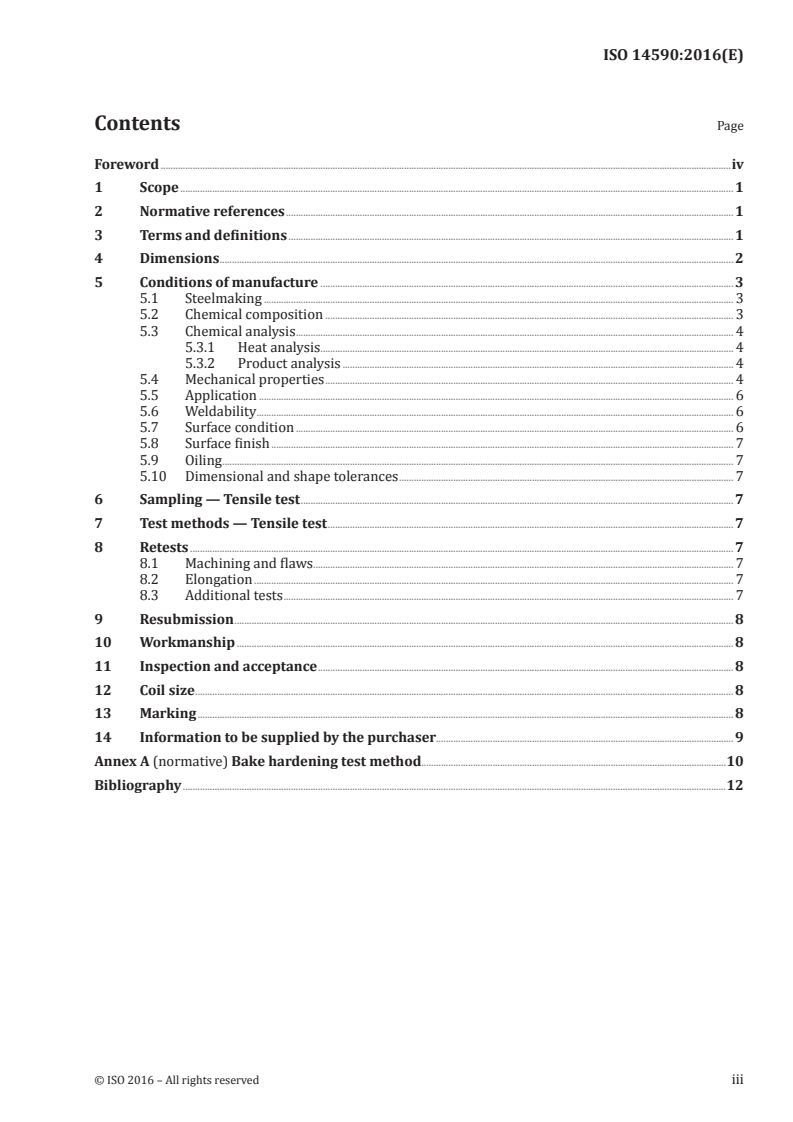
Contents Page
Foreword .iv
1 Scope . 1
2 Normative references . 1
3 Terms and definitions . 1
4 Dimensions . 2
5 Conditions of manufacture . 3
5.1 Steelmaking . 3
5.2 Chemical composition . 3
5.3 Chemical analysis . 4
5.3.1 Heat analysis . . 4
5.3.2 Product analysis . 4
5.4 Mechanical properties . 4
5.5 Application . 6
5.6 Weldability . 6
5.7 Surface condition . 6
5.8 Surface finish . 7
5.9 Oiling . 7
5.10 Dimensional and shape tolerances . 7
6 Sampling — Tensile test . 7
7 Test methods — Tensile test . 7
8 Retests . 7
8.1 Machining and flaws. 7
8.2 Elongation . 7
8.3 Additional tests . 7
9 Resubmission . 8
10 Workmanship . 8
11 Inspection and acceptance . 8
12 Coil size . 8
13 Marking . 8
14 Information to be supplied by the purchaser. 9
Annex A (normative) Bake hardening test method.10
Bibliography .12
Foreword
ISO (the International Organization for Standardization) is a worldwide federation of national standards
bodies (ISO member bodies). The work of preparing International Standards is normally carried out
through ISO technical committees. Each member body interested in a subject for which a technical
committee has been established has the right to be represented on that committee. International
organizations, governmental and non-governmental, in liaison with ISO, also take part in the work.
ISO collaborates closely with the International Electrotechnical Commission (IEC) on all matters of
electrotechnical standardization.
The procedures used to develop this document and those intended for its further maintenance are
described in the ISO/IEC Directives, Part 1. In particular the different approval criteria needed for the
different types of ISO documents should be noted. This document was drafted in accordance with the
editorial rules of the ISO/IEC Directives, Part 2 (see www.iso.org/directives).
Attention is drawn to the possibility that some of the elements of this document may be the subject of
patent rights. ISO shall not be held responsible for identifying any or all such patent rights. Details of
any patent rights identified during the development of the document will be in the Introduction and/or
on the ISO list of patent declarations received (see www.iso.org/patents).
Any trade name used in this document is information given for the convenience of users and does not
constitute an endorsement.
For an explanation on the meaning of ISO specific terms and expressions related to conformity assessment,
as well as information about ISO’s adherence to the World Trade Organization (WTO) principles in the
Technical Barriers to Trade (TBT) see the following URL: www.iso.org/iso/foreword.html.
The committee responsible for this document is ISO/TC 17, Steel, Subcommittee SC 12, Continuous mill
flat rolled products.
This third edition cancels and replaces the second edition (ISO 14590:2005), which has been technically
revised.
iv © ISO 2016 – All rights reserved
INTERNATIONAL STANDARD ISO 14590:2016(E)
Cold-reduced steel sheet of high tensile strength and low
yield point with improved formability
1 Scope
This International Standard applies to cold-reduced steel sheet of two types that are commercially
available in the world. Type 1 represents steels that are produced to mechanical properties only and
Type 2 represents steels that are produced to both chemical and mechanical properties. Bake hardening
steels are included in both types.
This International Standard does not cover steels designated as commercial quality or drawing qualities
(covered in ISO 3574), steels of structural quality (covered in ISO 4997) or steels of higher strength
with improved formability (covered in ISO 13887).
2 Normative references
The following documents, in whole or in part, are normatively referenced in this document and are
indispensable for its application. For dated references, only the edition cited applies. For undated
references, the latest edition of the referenced document (including any amendments) applies.
ISO 6892-1, Metallic materials — Tensile testing — Part 1: Method of test at room temperature
ISO 16162, Cold-rolled steel sheet products — Dimensional and shape tolerances
3 Terms and definitions
For the purposes of this document, the following terms and definitions apply.
3.1
bake hardenable steel
highly formable steel that, subsequent to cold working, has been subjected to a low-temperature heat
treatment, such as that used for paint baking (170 °C to 200 °C), in order to effect a significant increase
in its yield strength, primarily due to carbon ageing
3.2
cold-reduced steel sheet
product obtained from hot-rolled descaled steel sheet by cold-reducing to the required sheet thickness
followed by annealing to recrystallize the grain structure
3.3
dual-phase steel
steel whose thermal processing has resulted in a multi-phase structure that includes one or more low-
temperature transformation products, thus providing for improved formability at higher strength levels
3.4
skin pass
light cold-rolling of the product
Note 1 to entry: The purpose of the skin passing is one or more of the following: to minimize the appearance of
coil breaks, stretcher strains and fluting; to control the shape; and to obtain the required surface finish.
Note 2 to entry: Some increase in hardness and some decrease of ductility will result from skin passing.
3.5
ageing
change in steel properties with the passage of time
Note 1 to entry: Ageing may result in a change in yield strength and a corresponding decrease in ductility
during storage. Ageing always has a negative effect on formability. The redevelopment of a definite yield point
phenomenon as a result of ageing can result in a renewed susceptibility to surface imperfections, such as
stretcher strain marks (Lüder’s Lines) and fluting when the steel is formed. To avoid these adverse outcomes, it
is essential that the period between final processing at the producing mill and fabrication be kept to a minimum.
Rotation of stock, by using the oldest material first, is important. Effective roller levelling immediately prior to
fabrication can achieve reasonable freedom from stretcher strain marks.
3.6
lot
up to a specified quantity of steel sheet of the same designation rolled to the same thickness and grade
3.7
Type 1
cold-reduced steel sheet (3.2) specified to mechanical properties only
3.8
Type 2
cold-reduced steel sheet (3.2) specified to both mechanical properties and chemical composition
3.9
preliminary strain load
F
WH
load (kgf or N) of work hardening reached when the preliminary strain elongation specified in the
tensile test is reached
Note 1 to entry: Preliminary strain elongation herein shall be 2 %.
Note 2 to entry: to entry: Refer to Figure A.2.
3.10
strain ageing yield load
F
SA
load (kgf or N) at yielding measured during the tensile testing of the specimen after it has been strained
and heat-treated at 170 °C for 20 min
Note 1 to entry: Refer to Figure A.1.
3.11
BH amount
O
BH
2 2
value (kgf/mm or N/mm ) obtained by dividing the value (kgf or N) derived by subtracting the
preliminary strain load, F , from the strain ageing yield load, F , of the test piece parallel portion
WH SA
original area (mm ) before the preliminary strain
4 Dimensions
Cold-reduced steel sheet of high tensile strength and low yield point with improved formability is
produced in thicknesses from 0,25 mm to 3,2 mm and in widths of 600 mm and over in coils and cut
lengths. Product less than 600 mm wide, slit from wide sheet, will be considered as sheet.
2 © ISO 2016 – All rights reserved
5 Conditions of manufacture
5.1 Steelmaking
Unless otherwise agreed upon by the interested parties, the processes used in making the steel and in
manufacturing cold-reduced steel sheet are left to the discretion of the manufacturer. On request, the
purchaser shall be informed of the steelmaking process being used.
5.2 Chemical composition
The chemical composition (heat analysis) shall conform to the requirements given in Tables 1 and 2.
Table 1 — Chemical composition for Type 2 (heat analysis)
Mass fractions in percent
C Si Mn P S
a
Grade
max. max. max. max. max.
SS220 0,10 0,50 1,00 0,100 0,030
SS260 0,10 0,50 1,50 0,120 0,030
SS300 0,15 0,50 1,50 0,140 0,030
DP250 0,10 0,70 2,00 0,030 0,030
DP280 0,12 0,70 2,50 0,030 0,030
DP300 0,14 1,40 2,00 0,080 0,030
DP350 0,14 1,40 2,50 0,100 0,030
DP400 0,18 1,40 2,50 0,030 0,030
DP600 0,20 1,40 3,00 0,030 0,030
BH180 0,04 0,50 0,70 0,060 0,030
BH220 0,08 0,50 0,70 0,080 0,030
BH260 0,08 0,5
...
INTERNATIONAL ISO
STANDARD 14590
Third edition
2016-08-15
Cold-reduced steel sheet of high
tensile strength and low yield point
with improved formability
Tôles en acier laminées à froid à haute résistance à la traction et
faible limite d’élasticité, et aptitude au formage accrue
Reference number
©
ISO 2016
© ISO 2016, Published in Switzerland
All rights reserved. Unless otherwise specified, no part of this publication may be reproduced or utilized otherwise in any form
or by any means, electronic or mechanical, including photocopying, or posting on the internet or an intranet, without prior
written permission. Permission can be requested from either ISO at the address below or ISO’s member body in the country of
the requester.
ISO copyright office
Ch. de Blandonnet 8 • CP 401
CH-1214 Vernier, Geneva, Switzerland
Tel. +41 22 749 01 11
Fax +41 22 749 09 47
copyright@iso.org
www.iso.org
ii © ISO 2016 – All rights reserved
Contents Page
Foreword .iv
1 Scope . 1
2 Normative references . 1
3 Terms and definitions . 1
4 Dimensions . 2
5 Conditions of manufacture . 3
5.1 Steelmaking . 3
5.2 Chemical composition . 3
5.3 Chemical analysis . 4
5.3.1 Heat analysis . . 4
5.3.2 Product analysis . 4
5.4 Mechanical properties . 4
5.5 Application . 6
5.6 Weldability . 6
5.7 Surface condition . 6
5.8 Surface finish . 7
5.9 Oiling . 7
5.10 Dimensional and shape tolerances . 7
6 Sampling — Tensile test . 7
7 Test methods — Tensile test . 7
8 Retests . 7
8.1 Machining and flaws. 7
8.2 Elongation . 7
8.3 Additional tests . 7
9 Resubmission . 8
10 Workmanship . 8
11 Inspection and acceptance . 8
12 Coil size . 8
13 Marking . 8
14 Information to be supplied by the purchaser. 9
Annex A (normative) Bake hardening test method.10
Bibliography .12
Foreword
ISO (the International Organization for Standardization) is a worldwide federation of national standards
bodies (ISO member bodies). The work of preparing International Standards is normally carried out
through ISO technical committees. Each member body interested in a subject for which a technical
committee has been established has the right to be represented on that committee. International
organizations, governmental and non-governmental, in liaison with ISO, also take part in the work.
ISO collaborates closely with the International Electrotechnical Commission (IEC) on all matters of
electrotechnical standardization.
The procedures used to develop this document and those intended for its further maintenance are
described in the ISO/IEC Directives, Part 1. In particular the different approval criteria needed for the
different types of ISO documents should be noted. This document was drafted in accordance with the
editorial rules of the ISO/IEC Directives, Part 2 (see www.iso.org/directives).
Attention is drawn to the possibility that some of the elements of this document may be the subject of
patent rights. ISO shall not be held responsible for identifying any or all such patent rights. Details of
any patent rights identified during the development of the document will be in the Introduction and/or
on the ISO list of patent declarations received (see www.iso.org/patents).
Any trade name used in this document is information given for the convenience of users and does not
constitute an endorsement.
For an explanation on the meaning of ISO specific terms and expressions related to conformity assessment,
as well as information about ISO’s adherence to the World Trade Organization (WTO) principles in the
Technical Barriers to Trade (TBT) see the following URL: www.iso.org/iso/foreword.html.
The committee responsible for this document is ISO/TC 17, Steel, Subcommittee SC 12, Continuous mill
flat rolled products.
This third edition cancels and replaces the second edition (ISO 14590:2005), which has been technically
revised.
iv © ISO 2016 – All rights reserved
INTERNATIONAL STANDARD ISO 14590:2016(E)
Cold-reduced steel sheet of high tensile strength and low
yield point with improved formability
1 Scope
This International Standard applies to cold-reduced steel sheet of two types that are commercially
available in the world. Type 1 represents steels that are produced to mechanical properties only and
Type 2 represents steels that are produced to both chemical and mechanical properties. Bake hardening
steels are included in both types.
This International Standard does not cover steels designated as commercial quality or drawing qualities
(covered in ISO 3574), steels of structural quality (covered in ISO 4997) or steels of higher strength
with improved formability (covered in ISO 13887).
2 Normative references
The following documents, in whole or in part, are normatively referenced in this document and are
indispensable for its application. For dated references, only the edition cited applies. For undated
references, the latest edition of the referenced document (including any amendments) applies.
ISO 6892-1, Metallic materials — Tensile testing — Part 1: Method of test at room temperature
ISO 16162, Cold-rolled steel sheet products — Dimensional and shape tolerances
3 Terms and definitions
For the purposes of this document, the following terms and definitions apply.
3.1
bake hardenable steel
highly formable steel that, subsequent to cold working, has been subjected to a low-temperature heat
treatment, such as that used for paint baking (170 °C to 200 °C), in order to effect a significant increase
in its yield strength, primarily due to carbon ageing
3.2
cold-reduced steel sheet
product obtained from hot-rolled descaled steel sheet by cold-reducing to the required sheet thickness
followed by annealing to recrystallize the grain structure
3.3
dual-phase steel
steel whose thermal processing has resulted in a multi-phase structure that includes one or more low-
temperature transformation products, thus providing for improved formability at higher strength levels
3.4
skin pass
light cold-rolling of the product
Note 1 to entry: The purpose of the skin passing is one or more of the following: to minimize the appearance of
coil breaks, stretcher strains and fluting; to control the shape; and to obtain the required surface finish.
Note 2 to entry: Some increase in hardness and some decrease of ductility will result from skin passing.
3.5
ageing
change in steel properties with the passage of time
Note 1 to entry: Ageing may result in a change in yield strength and a corresponding decrease in ductility
during storage. Ageing always has a negative effect on formability. The redevelopment of a definite yield point
phenomenon as a result of ageing can result in a renewed susceptibility to surface imperfections, such as
stretcher strain marks (Lüder’s Lines) and fluting when the steel is formed. To avoid these adverse outcomes, it
is essential that the period between final processing at the producing mill and fabrication be kept to a minimum.
Rotation of stock, by using the oldest material first, is important. Effective roller levelling immediately prior to
fabrication can achieve reasonable freedom from stretcher strain marks.
3.6
lot
up to a specified quantity of steel sheet of the same designation rolled to the same thickness and grade
3.7
Type 1
cold-reduced steel sheet (3.2) specified to mechanical properties only
3.8
Type 2
cold-reduced steel sheet (3.2) specified to both mechanical properties and chemical composition
3.9
preliminary strain load
F
WH
load (kgf or N) of work hardening reached when the preliminary strain elongation specified in the
tensile test is reached
Note 1 to entry: Preliminary strain elongation herein shall be 2 %.
Note 2 to entry: to entry: Refer to Figure A.2.
3.10
strain ageing yield load
F
SA
load (kgf or N) at yielding measured during the tensile testing of the specimen after it has been strained
and heat-treated at 170 °C for 20 min
Note 1 to entry: Refer to Figure A.1.
3.11
BH amount
O
BH
2 2
value (kgf/mm or N/mm ) obtained by dividing the value (kgf or N) derived by subtracting the
preliminary strain load, F , from the strain ageing yield load, F , of the test piece parallel portion
WH SA
original area (mm ) before the preliminary strain
4 Dimensions
Cold-reduced steel sheet of high tensile strength and low yield point with improved formability is
produced in thicknesses from 0,25 mm to 3,2 mm and in widths of 600 mm and over in coils and cut
lengths. Product less than 600 mm wide, slit from wide sheet, will be considered as sheet.
2 © ISO 2016 – All rights reserved
5 Conditions of manufacture
5.1 Steelmaking
Unless otherwise agreed upon by the interested parties, the processes used in making the steel and in
manufacturing cold-reduced steel sheet are left to the discretion of the manufacturer. On request, the
purchaser shall be informed of the steelmaking process being used.
5.2 Chemical composition
The chemical composition (heat analysis) shall conform to the requirements given in Tables 1 and 2.
Table 1 — Chemical composition for Type 2 (heat analysis)
Mass fractions in percent
C Si Mn P S
a
Grade
max. max. max. max. max.
SS220 0,10 0,50 1,00 0,100 0,030
SS260 0,10 0,50 1,50 0,120 0,030
SS300 0,15 0,50 1,50 0,140 0,030
DP250 0,10 0,70 2,00 0,030 0,030
DP280 0,12 0,70 2,50 0,030 0,030
DP300 0,14 1,40 2,00 0,080 0,030
DP350 0,14 1,40 2,50 0,100 0,030
DP400 0,18 1,40 2,50 0,030 0,030
DP600 0,20 1,40 3,00 0,030 0,030
BH180 0,04 0,50 0,70 0,060 0,030
BH220 0,08 0,50 0,70 0,080 0,030
BH260 0,08 0,5
...