

ISO 22717:2015
(Main)Cosmetics — Microbiology — Detection of Pseudomonas aeruginosa
General Information
- Abstract
ISO 22717:2015 gives general guidelines for the detection and identification of the specified microorganism Pseudomonas aeruginosa in cosmetic products. Microorganisms considered as specified in this International Standard might differ from country to country according to national practices or regulations. In order to ensure product quality and safety for consumers, it is advisable to perform an appropriate microbiological risk analysis to determine the types of cosmetic product to which this International Standard is applicable. Products considered to present a low microbiological (see ISO 29621) risk include those with low water activity, hydro-alcoholic products, extreme pH values, etc. The method described in this International Standard is based on the detection of Pseudomonas aeruginosa in a non-selective liquid medium (enrichment broth), followed by isolation on a selective agar medium. Other methods may be appropriate, depending on the level of detection required. NOTE For the detection of Pseudomonas aeruginosa, subcultures can be performed on non-selective culture media followed by suitable identification steps (e.g. using identification kits). Because of the large variety of cosmetic products within this field of application, this method may not be appropriate in every detail for some products (e.g. certain water immiscible products). Other International Standards (ISO 18415) may be appropriate. Other methods (e.g. automated) may be substituted for the tests presented here provided that their equivalence has been demonstrated or the method has been otherwise shown to be suitable.
- Status
- Published
- Publication Date
- 17-Nov-2015
- Technical Committee
- ISO/TC 217 - Cosmetics
- Drafting Committee
- ISO/TC 217/WG 1 - Microbiological standards and limits
- Current Stage
- 9060 - Close of review
- Completion Date
- 02-Dec-2031
Buy Documents
ISO 22717:2015 - Cosmetics -- Microbiology -- Detection of Pseudomonas aeruginosa
ISO 22717:2015 - Cosmetics — Microbiology — Detection of Pseudomonas aeruginosa/18/2015
ISO 22717:2015 - Cosmétiques -- Microbiologie -- Détection de Pseudomonas aeruginosa
ISO 22717:2015 - Cosmétiques — Microbiologie — Détection de Pseudomonas aeruginosa/18/2015
Overview
ISO 22717:2015 - "Cosmetics - Microbiology - Detection of Pseudomonas aeruginosa" provides laboratory guidance for detecting and identifying Pseudomonas aeruginosa in cosmetic products. The standard establishes a practical, two-step approach - enrichment in a non-selective liquid medium followed by isolation on selective agar - and emphasizes the need for microbiological risk analysis to determine applicability across diverse cosmetic matrices.
Key topics and technical requirements
- Scope and risk-based approach: Applies where P. aeruginosa detection is relevant; products with low water activity or extreme pH may present low microbiological risk (see ISO 29621).
- Two-step method (principle):
- Enrichment in a non-selective enrichment broth (may include neutralizers/dispersants).
- Isolation on a selective agar medium and subsequent identification.
- Neutralization of antimicrobial activity: Demonstration of effective neutralization of product antimicrobial agents is mandatory (Clause 11). Neutralizers and rinsing liquids guidance are provided (Annex B).
- Sample handling and preparation: Procedures cover water‑miscible, water‑immiscible and filterable products, plus preparation of initial suspensions and dilutions (Clauses 8–9).
- Identification features: Typical traits of P. aeruginosa are listed (growth on cetrimide agar, oxidase positive, production of diffusible fluorescent pigments and pyocyanin).
- Method suitability and validation: The standard requires suitability testing for media and neutralizers; alternative or automated methods may be used if demonstrated equivalent.
- Practical lab details: Examples of media composition and preparation are provided (e.g., autoclave sterilization at 121 °C for 15 min; specified pH ranges for diluents/media).
Practical applications and users
Who uses ISO 22717:
- Cosmetic manufacturers' quality control and microbiology labs
- Contract testing laboratories and third‑party microbiological service providers
- Regulatory authorities conducting product safety assessments
- R&D teams responsible for formulation and preservative efficacy assessments
Typical applications:
- Routine release and stability testing to ensure products are free of P. aeruginosa
- Investigation of suspected microbial contamination or spoilage events
- Supplier audits and raw material testing when water or aqueous ingredients are involved
- Demonstrating compliance with national regulations and international best practice
Related standards
- ISO 21148:2005 - General instructions for microbiological examination of cosmetics
- ISO 29621 - Guidelines for microbiological risk assessment of cosmetic products
- ISO 18415 - Methods relevant for certain product types and additional microorganism detection
ISO 22717 is a practical, risk‑focused standard for ensuring cosmetic product safety by reliably detecting Pseudomonas aeruginosa using validated enrichment, neutralization and isolation steps.
Relations
- Effective Date
- 25-Aug-2026
- Consolidates
EN ISO 22717:2015 - Cosmetics - Microbiology - Detection of Pseudomonas aeruginosa (ISO 22717:2015) - Effective Date
- 12-Feb-2026
- Effective Date
- 26-Nov-2021
- Effective Date
- 04-Nov-2015
Buy Documents
ISO 22717:2015 - Cosmetics -- Microbiology -- Detection of Pseudomonas aeruginosa
ISO 22717:2015 - Cosmetics — Microbiology — Detection of Pseudomonas aeruginosa/18/2015
ISO 22717:2015 - Cosmétiques -- Microbiologie -- Détection de Pseudomonas aeruginosa
ISO 22717:2015 - Cosmétiques — Microbiologie — Détection de Pseudomonas aeruginosa/18/2015
Get Certified
Connect with accredited certification bodies for this standard

ECOCERT
Organic and sustainability certification.

Eurofins Food Testing Global
Global leader in food, environment, and pharmaceutical product testing.

Intertek Bangladesh
Intertek certification and testing services in Bangladesh.
Sponsored listings
Frequently Asked Questions
ISO 22717:2015 is a standard published by the International Organization for Standardization (ISO). Its full title is "Cosmetics — Microbiology — Detection of Pseudomonas aeruginosa". This standard covers: ISO 22717:2015 gives general guidelines for the detection and identification of the specified microorganism Pseudomonas aeruginosa in cosmetic products. Microorganisms considered as specified in this International Standard might differ from country to country according to national practices or regulations. In order to ensure product quality and safety for consumers, it is advisable to perform an appropriate microbiological risk analysis to determine the types of cosmetic product to which this International Standard is applicable. Products considered to present a low microbiological (see ISO 29621) risk include those with low water activity, hydro-alcoholic products, extreme pH values, etc. The method described in this International Standard is based on the detection of Pseudomonas aeruginosa in a non-selective liquid medium (enrichment broth), followed by isolation on a selective agar medium. Other methods may be appropriate, depending on the level of detection required. NOTE For the detection of Pseudomonas aeruginosa, subcultures can be performed on non-selective culture media followed by suitable identification steps (e.g. using identification kits). Because of the large variety of cosmetic products within this field of application, this method may not be appropriate in every detail for some products (e.g. certain water immiscible products). Other International Standards (ISO 18415) may be appropriate. Other methods (e.g. automated) may be substituted for the tests presented here provided that their equivalence has been demonstrated or the method has been otherwise shown to be suitable.
ISO 22717:2015 gives general guidelines for the detection and identification of the specified microorganism Pseudomonas aeruginosa in cosmetic products. Microorganisms considered as specified in this International Standard might differ from country to country according to national practices or regulations. In order to ensure product quality and safety for consumers, it is advisable to perform an appropriate microbiological risk analysis to determine the types of cosmetic product to which this International Standard is applicable. Products considered to present a low microbiological (see ISO 29621) risk include those with low water activity, hydro-alcoholic products, extreme pH values, etc. The method described in this International Standard is based on the detection of Pseudomonas aeruginosa in a non-selective liquid medium (enrichment broth), followed by isolation on a selective agar medium. Other methods may be appropriate, depending on the level of detection required. NOTE For the detection of Pseudomonas aeruginosa, subcultures can be performed on non-selective culture media followed by suitable identification steps (e.g. using identification kits). Because of the large variety of cosmetic products within this field of application, this method may not be appropriate in every detail for some products (e.g. certain water immiscible products). Other International Standards (ISO 18415) may be appropriate. Other methods (e.g. automated) may be substituted for the tests presented here provided that their equivalence has been demonstrated or the method has been otherwise shown to be suitable.
ISO 22717:2015 is classified under the following ICS (International Classification for Standards) categories: 07.100.40 - Cosmetics microbiology; 07.100.99 - Other standards related to microbiology; 71.100.70 - Cosmetics. Toiletries. The ICS classification helps identify the subject area and facilitates finding related standards.
ISO 22717:2015 has the following relationships with other standards: It is inter standard links to EN ISO 21322:2021, EN ISO 22717:2015, ISO 22717:2015/Amd 1:2022, ISO 22717:2006. Understanding these relationships helps ensure you are using the most current and applicable version of the standard.
ISO 22717:2015 is available in PDF format for immediate download after purchase. The document can be added to your cart and obtained through the secure checkout process. Digital delivery ensures instant access to the complete standard document.
Standards Content (Sample)
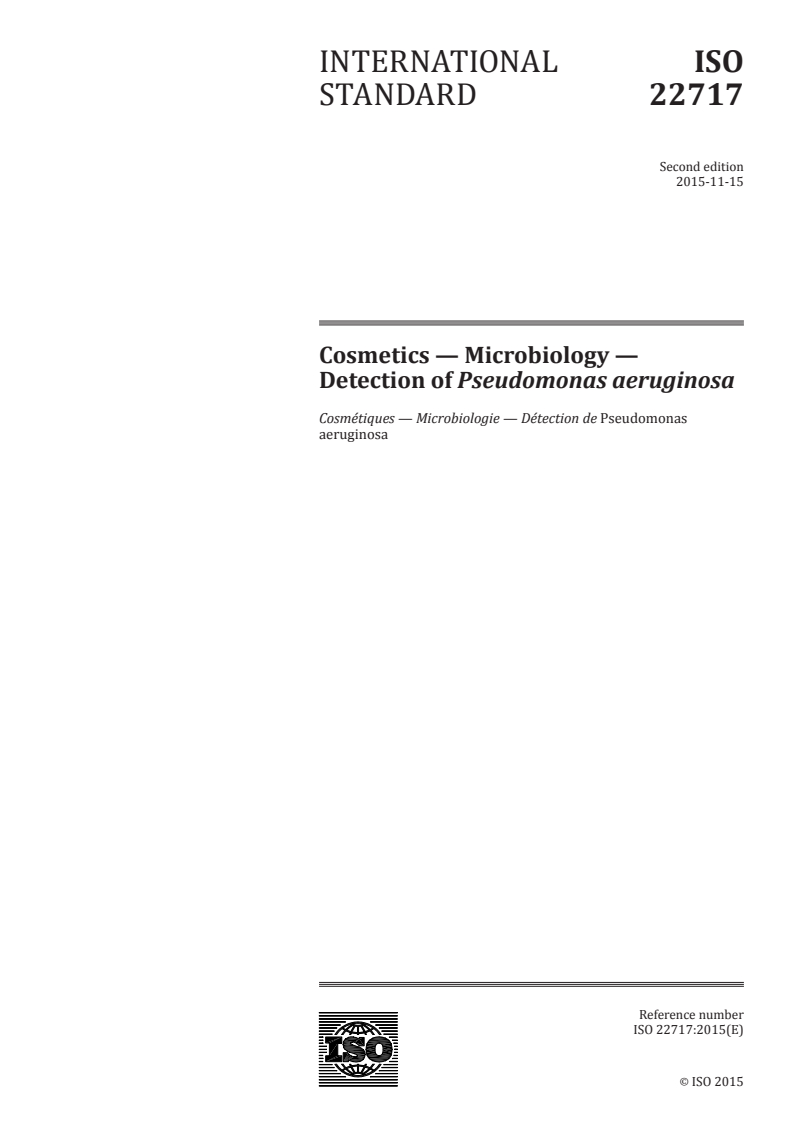
INTERNATIONAL ISO
STANDARD 22717
Second edition
2015-11-15
Cosmetics — Microbiology —
Detection of Pseudomonas aeruginosa
Cosmétiques — Microbiologie — Détection de Pseudomonas
aeruginosa
Reference number
©
ISO 2015
© ISO 2015, Published in Switzerland
All rights reserved. Unless otherwise specified, no part of this publication may be reproduced or utilized otherwise in any form
or by any means, electronic or mechanical, including photocopying, or posting on the internet or an intranet, without prior
written permission. Permission can be requested from either ISO at the address below or ISO’s member body in the country of
the requester.
ISO copyright office
Ch. de Blandonnet 8 • CP 401
CH-1214 Vernier, Geneva, Switzerland
Tel. +41 22 749 01 11
Fax +41 22 749 09 47
copyright@iso.org
www.iso.org
ii © ISO 2015 – All rights reserved
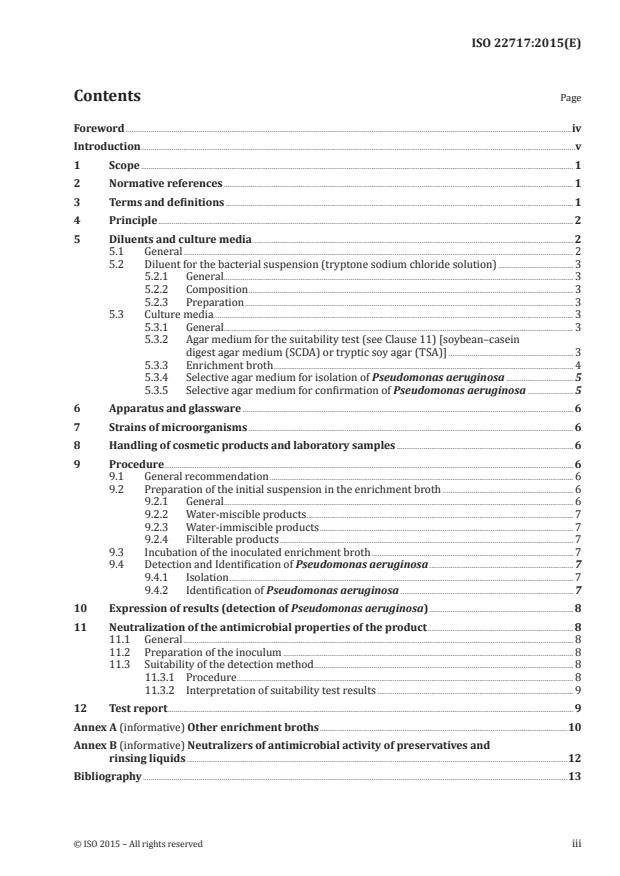
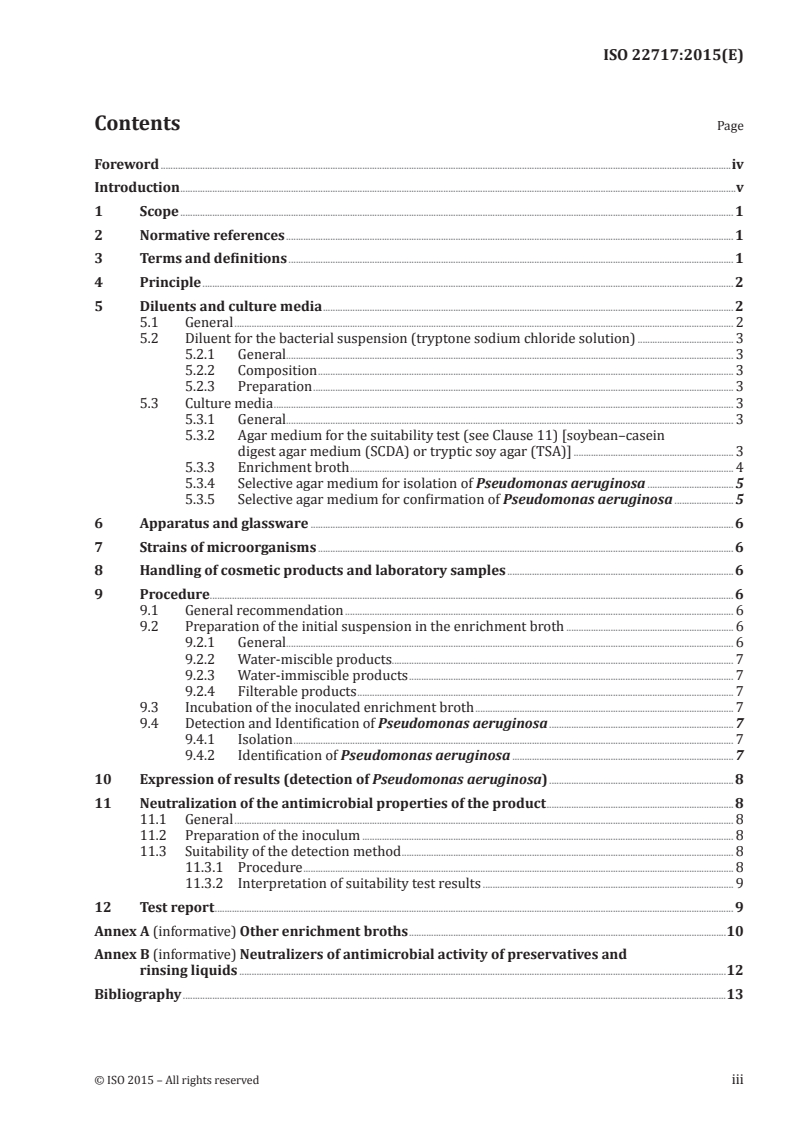
Contents Page
Foreword .iv
Introduction .v
1 Scope . 1
2 Normative references . 1
3 Terms and definitions . 1
4 Principle . 2
5 Diluents and culture media . 2
5.1 General . 2
5.2 Diluent for the bacterial suspension (tryptone sodium chloride solution) . 3
5.2.1 General. 3
5.2.2 Composition . 3
5.2.3 Preparation . 3
5.3 Culture media . 3
5.3.1 General. 3
5.3.2 Agar medium for the suitability test (see Clause 11) [soybean–casein
digest agar medium (SCDA) or tryptic soy agar (TSA)] . 3
5.3.3 Enrichment broth . 4
5.3.4 Selective agar medium for isolation of Pseudomonas aeruginosa . 5
5.3.5 Selective agar medium for confirmation of Pseudomonas aeruginosa . 5
6 Apparatus and glassware . 6
7 Strains of microorganisms . 6
8 Handling of cosmetic products and laboratory samples . 6
9 Procedure. 6
9.1 General recommendation . 6
9.2 Preparation of the initial suspension in the enrichment broth . 6
9.2.1 General. 6
9.2.2 Water-miscible products. 7
9.2.3 Water-immiscible products . 7
9.2.4 Filterable products . 7
9.3 Incubation of the inoculated enrichment broth . 7
9.4 Detection and Identification of Pseudomonas aeruginosa . 7
9.4.1 Isolation . 7
9.4.2 Identification of Pseudomonas aeruginosa . 7
10 Expression of results (detection of Pseudomonas aeruginosa) . 8
11 Neutralization of the antimicrobial properties of the product . 8
11.1 General . 8
11.2 Preparation of the inoculum . 8
11.3 Suitability of the detection method . 8
11.3.1 Procedure . 8
11.3.2 Interpretation of suitability test results . 9
12 Test report . 9
Annex A (informative) Other enrichment broths .10
Annex B (informative) Neutralizers of antimicrobial activity of preservatives and
rinsing liquids .12
Bibliography .13
Foreword
ISO (the International Organization for Standardization) is a worldwide federation of national standards
bodies (ISO member bodies). The work of preparing International Standards is normally carried out
through ISO technical committees. Each member body interested in a subject for which a technical
committee has been established has the right to be represented on that committee. International
organizations, governmental and non-governmental, in liaison with ISO, also take part in the work.
ISO collaborates closely with the International Electrotechnical Commission (IEC) on all matters of
electrotechnical standardization.
The procedures used to develop this document and those intended for its further maintenance are
described in the ISO/IEC Directives, Part 1. In particular the different approval criteria needed for the
different types of ISO documents should be noted. This document was drafted in accordance with the
editorial rules of the ISO/IEC Directives, Part 2 (see www.iso.org/directives).
Attention is drawn to the possibility that some of the elements of this document may be the subject of
patent rights. ISO shall not be held responsible for identifying any or all such patent rights. Details of
any patent rights identified during the development of the document will be in the Introduction and/or
on the ISO list of patent declarations received (see www.iso.org/patents).
Any trade name used in this document is information given for the convenience of users and does not
constitute an endorsement.
For an explanation on the meaning of ISO specific terms and expressions related to conformity
assessment, as well as information about ISO’s adherence to the WTO principles in the Technical
Barriers to Trade (TBT) see the following URL: Foreword - Supplementary information
The committee responsible for this document is ISO/TC 217, Cosmetics.
This second edition cancels and replaces the first edition (ISO 22717:2006), of which it constitutes a
minor revision.
iv © ISO 2015 – All rights reserved
Introduction
Microbiological examinations of cosmetic products are carried out according to an appropriate
microbiological risk analysis in order to ensure their quality and safety for consumers.
Microbiological risk analysis depends on several parameters such as the following:
— potential alteration of cosmetic products;
— pathogenicity of microorganisms;
— site of application of the cosmetic product (hair, skin, eyes, mucous membranes);
— type of users (adults, children under 3 years).
For cosmetics and other topical products, the detection of skin pathogens such as Staphylococcus
aureus, Pseudomonas aeruginosa and Candida albicans may be relevant because they can cause skin
or eye infections. The detection of other kinds of microorganism might be of interest since these
microorganisms (including indicators of faecal contamination e.g. Escherichia coli) suggest hygienic
failure during the manufacturing process.
INTERNATIONAL STANDARD ISO 22717:2015(E)
Cosmetics — Microbiology — Detection of Pseudomonas
aeruginosa
1 Scope
This International Standard gives general guidelines for the detection and identification of the
specified microorganism Pseudomonas aeruginosa in cosmetic products. Microorganisms considered
as specified in this International Standard might differ from country to country according to national
practices or regulations.
In order to ensure product quality and safety for consumers, it is advisable to perform an appropriate
microbiological risk analysis to determine the types of cosmetic product to which this International
Standard is applicable. Products considered to present a low microbiological (see ISO 29621) risk
include those with low water activity, hydro-alcoholic products, extreme pH values, etc.
The method described in this International Standard is based on the detection of Pseudomonas
aeruginosa in a non-selective liquid medium (enrichment broth), followed by isolation on a selective
agar medium. Other methods may be appropriate, depending on the level of detection required.
NOTE For the detection of Pseudomonas aeruginosa, subcultures can be performed on non-selective culture
media followed by suitable identification steps (e.g. using identification kits).
Because of the large variety of cosmetic products within this field of application, this method may
not be appropriate in every detail for some products (e.g. certain water immiscible products). Other
International Standards (ISO 18415) may be appropriate. Other methods (e.g. automated) may be
substituted for the tests presented here provided that their equivalence has been demonstrated or the
method has been otherwise shown to be suitable.
2 Normative references
The following documents, in whole or in part, are normatively referenced in this document and are
indispensable for its application. For dated references, only the edition cited applies. For undated
references, the latest edition of the referenced document (including any amendments) applies.
ISO 21148:2005, Cosmetics — Microbiology — General instructions for microbiological examination
EN 12353, Chemical disinfectants and antiseptics — Preservation of test organisms used for the
determination of bactericidal (including Legionella), mycobactericidal, sporicidal, fungicidal and virucidal
(including bacteriophages) activity
3 Terms and definitions
For the purposes of this document, the following terms and definitions apply.
3.1
product
portion of an identified cosmetic product received in the laboratory for testing
3.2
sample
portion of the product (at least 1 g or 1 ml) that is used in the test to prepare the initial suspension
3.3
initial suspension
suspension (or solution) of the sample in a defined volume of an appropriate enrichment broth
3.4
sample dilution
dilution of the initial suspension
3.5
specified microorganism
aerobic mesophilic bacterium or yeast that is undesirable in a cosmetic product and is recognized as a
skin pathogen species that may be harmful for human health or as an indication of hygienic failure in
the manufacturing process
3.6
Pseudomonas aeruginosa
gram-negative rod, motile; smooth colonies pigmented brown or greenish
Note 1 to entry: The main characteristics for identification are: growth on selective cetrimide agar medium,
oxidase positive, production of diffusible fluorescent pigments and production of a soluble phenazine pigment
(pyocyanin) in suitable media.
Note 2 to entry: Pseudomonas aeruginosa may be isolated from a wide variety of environmental sources,
especially in water and has a very high potential to spoil many different substrates. It may produce infections of
human skin or eye area. It is undesirable in cosmetic products for its potential pathogenicity and its capacity to
affect the physico-chemical properties of the cosmetic formula.
3.7
enrichment broth
non-selective liquid medium containing suitable neutralizers and/or dispersing agents and
demonstrated to be suitable for the product under test
4 Principle
The first step of the procedure is to perform an enrichment by using a non-selective broth medium to
increase the number of microorganisms without the risk of inhibition by the selective ingredients that
are present in selective/differential growth media.
The second step of the test (isolation) is performed on a selective medium followed by identification tests.
The possible inhibition of microbial growth by the sample shall be neutralized to allow the detection
[1]
of viable microorganisms. In all cases and whatever the methodology, the neutralization of the
antimicrobial properties of the product shall be checked and demonstrated (see Clause 11).
5 Diluents and culture media
5.1 General
General instructions are given in ISO 21148. When water is mentioned in this International Standard,
use distilled water or purified water as specified in ISO 21148.
The enrichment broth is used to disperse the sample and to increase the initial microbial population. It
may contain neutralizers if the specimen to be tested has antimicrobial properties. The efficacy of the
neutralization shall be demonstrated (see Clause 11). Information relative to suitable neutralizers is
given in Annex B.
The enrichment broth (5.3.3.1), or any of the ones listed in Annex A, is suitable for checking the presence
of Pseudomonas aeruginosa in accordance with this International Standard provided that it has been
demonstrated to be suitable in accordance with Clause 11.
2 © ISO 2015 – All rights reserved
Other diluents and culture media may be used if it has been demonstrated that they are suitable for use.
5.2 Diluent for the bacterial suspension (tryptone sodium chloride solution)
5.2.1 General
The diluent is used for the preparation of bacterial suspension used for the suitability test procedure
(see Clause 11).
5.2.2 Composition
— tryptone, pancreatic digest of casein 1,0 g
— sodium chloride 8,5 g
— water 1 000 ml
5.2.3 Preparation
Dissolve the components in water by mixing while heating. Dispense into suitable containers. Sterilize
in the autoclave at 121 °C for 15 min.
After sterilization and cooling down, the pH shall be equivalent to 7,0 ± 0,2 when measured at room
temperature.
5.3 Culture media
5.3.1 General
Culture media may be prepared using the descriptions provided below or from dehydrated culture
media according to the instructions of the manufacturer. The instructions provided by the supplier of
the media should be followed.
NOTE Ready-to-use media can be used when their composition and/or growth yields are comparable to
those of the formulae given herein.
5.3.2 Agar medium for the suitability test (see Clause 11) [soybean–casein digest agar medium
(SCDA) or tryptic soy agar (TSA)]
5.3.2.1 Composition
— pancreatic digest of casein 15,0 g
— papaic digest of soybean meal 5,0 g
— sodium chloride
...
INTERNATIONAL ISO
STANDARD 22717
Second edition
2015-11-15
Cosmetics — Microbiology —
Detection of Pseudomonas aeruginosa
Cosmétiques — Microbiologie — Détection de Pseudomonas
aeruginosa
Reference number
©
ISO 2015
© ISO 2015, Published in Switzerland
All rights reserved. Unless otherwise specified, no part of this publication may be reproduced or utilized otherwise in any form
or by any means, electronic or mechanical, including photocopying, or posting on the internet or an intranet, without prior
written permission. Permission can be requested from either ISO at the address below or ISO’s member body in the country of
the requester.
ISO copyright office
Ch. de Blandonnet 8 • CP 401
CH-1214 Vernier, Geneva, Switzerland
Tel. +41 22 749 01 11
Fax +41 22 749 09 47
copyright@iso.org
www.iso.org
ii © ISO 2015 – All rights reserved
Contents Page
Foreword .iv
Introduction .v
1 Scope . 1
2 Normative references . 1
3 Terms and definitions . 1
4 Principle . 2
5 Diluents and culture media . 2
5.1 General . 2
5.2 Diluent for the bacterial suspension (tryptone sodium chloride solution) . 3
5.2.1 General. 3
5.2.2 Composition . 3
5.2.3 Preparation . 3
5.3 Culture media . 3
5.3.1 General. 3
5.3.2 Agar medium for the suitability test (see Clause 11) [soybean–casein
digest agar medium (SCDA) or tryptic soy agar (TSA)] . 3
5.3.3 Enrichment broth . 4
5.3.4 Selective agar medium for isolation of Pseudomonas aeruginosa . 5
5.3.5 Selective agar medium for confirmation of Pseudomonas aeruginosa . 5
6 Apparatus and glassware . 6
7 Strains of microorganisms . 6
8 Handling of cosmetic products and laboratory samples . 6
9 Procedure. 6
9.1 General recommendation . 6
9.2 Preparation of the initial suspension in the enrichment broth . 6
9.2.1 General. 6
9.2.2 Water-miscible products. 7
9.2.3 Water-immiscible products . 7
9.2.4 Filterable products . 7
9.3 Incubation of the inoculated enrichment broth . 7
9.4 Detection and Identification of Pseudomonas aeruginosa . 7
9.4.1 Isolation . 7
9.4.2 Identification of Pseudomonas aeruginosa . 7
10 Expression of results (detection of Pseudomonas aeruginosa) . 8
11 Neutralization of the antimicrobial properties of the product . 8
11.1 General . 8
11.2 Preparation of the inoculum . 8
11.3 Suitability of the detection method . 8
11.3.1 Procedure . 8
11.3.2 Interpretation of suitability test results . 9
12 Test report . 9
Annex A (informative) Other enrichment broths .10
Annex B (informative) Neutralizers of antimicrobial activity of preservatives and
rinsing liquids .12
Bibliography .13
Foreword
ISO (the International Organization for Standardization) is a worldwide federation of national standards
bodies (ISO member bodies). The work of preparing International Standards is normally carried out
through ISO technical committees. Each member body interested in a subject for which a technical
committee has been established has the right to be represented on that committee. International
organizations, governmental and non-governmental, in liaison with ISO, also take part in the work.
ISO collaborates closely with the International Electrotechnical Commission (IEC) on all matters of
electrotechnical standardization.
The procedures used to develop this document and those intended for its further maintenance are
described in the ISO/IEC Directives, Part 1. In particular the different approval criteria needed for the
different types of ISO documents should be noted. This document was drafted in accordance with the
editorial rules of the ISO/IEC Directives, Part 2 (see www.iso.org/directives).
Attention is drawn to the possibility that some of the elements of this document may be the subject of
patent rights. ISO shall not be held responsible for identifying any or all such patent rights. Details of
any patent rights identified during the development of the document will be in the Introduction and/or
on the ISO list of patent declarations received (see www.iso.org/patents).
Any trade name used in this document is information given for the convenience of users and does not
constitute an endorsement.
For an explanation on the meaning of ISO specific terms and expressions related to conformity
assessment, as well as information about ISO’s adherence to the WTO principles in the Technical
Barriers to Trade (TBT) see the following URL: Foreword - Supplementary information
The committee responsible for this document is ISO/TC 217, Cosmetics.
This second edition cancels and replaces the first edition (ISO 22717:2006), of which it constitutes a
minor revision.
iv © ISO 2015 – All rights reserved
Introduction
Microbiological examinations of cosmetic products are carried out according to an appropriate
microbiological risk analysis in order to ensure their quality and safety for consumers.
Microbiological risk analysis depends on several parameters such as the following:
— potential alteration of cosmetic products;
— pathogenicity of microorganisms;
— site of application of the cosmetic product (hair, skin, eyes, mucous membranes);
— type of users (adults, children under 3 years).
For cosmetics and other topical products, the detection of skin pathogens such as Staphylococcus
aureus, Pseudomonas aeruginosa and Candida albicans may be relevant because they can cause skin
or eye infections. The detection of other kinds of microorganism might be of interest since these
microorganisms (including indicators of faecal contamination e.g. Escherichia coli) suggest hygienic
failure during the manufacturing process.
INTERNATIONAL STANDARD ISO 22717:2015(E)
Cosmetics — Microbiology — Detection of Pseudomonas
aeruginosa
1 Scope
This International Standard gives general guidelines for the detection and identification of the
specified microorganism Pseudomonas aeruginosa in cosmetic products. Microorganisms considered
as specified in this International Standard might differ from country to country according to national
practices or regulations.
In order to ensure product quality and safety for consumers, it is advisable to perform an appropriate
microbiological risk analysis to determine the types of cosmetic product to which this International
Standard is applicable. Products considered to present a low microbiological (see ISO 29621) risk
include those with low water activity, hydro-alcoholic products, extreme pH values, etc.
The method described in this International Standard is based on the detection of Pseudomonas
aeruginosa in a non-selective liquid medium (enrichment broth), followed by isolation on a selective
agar medium. Other methods may be appropriate, depending on the level of detection required.
NOTE For the detection of Pseudomonas aeruginosa, subcultures can be performed on non-selective culture
media followed by suitable identification steps (e.g. using identification kits).
Because of the large variety of cosmetic products within this field of application, this method may
not be appropriate in every detail for some products (e.g. certain water immiscible products). Other
International Standards (ISO 18415) may be appropriate. Other methods (e.g. automated) may be
substituted for the tests presented here provided that their equivalence has been demonstrated or the
method has been otherwise shown to be suitable.
2 Normative references
The following documents, in whole or in part, are normatively referenced in this document and are
indispensable for its application. For dated references, only the edition cited applies. For undated
references, the latest edition of the referenced document (including any amendments) applies.
ISO 21148:2005, Cosmetics — Microbiology — General instructions for microbiological examination
EN 12353, Chemical disinfectants and antiseptics — Preservation of test organisms used for the
determination of bactericidal (including Legionella), mycobactericidal, sporicidal, fungicidal and virucidal
(including bacteriophages) activity
3 Terms and definitions
For the purposes of this document, the following terms and definitions apply.
3.1
product
portion of an identified cosmetic product received in the laboratory for testing
3.2
sample
portion of the product (at least 1 g or 1 ml) that is used in the test to prepare the initial suspension
3.3
initial suspension
suspension (or solution) of the sample in a defined volume of an appropriate enrichment broth
3.4
sample dilution
dilution of the initial suspension
3.5
specified microorganism
aerobic mesophilic bacterium or yeast that is undesirable in a cosmetic product and is recognized as a
skin pathogen species that may be harmful for human health or as an indication of hygienic failure in
the manufacturing process
3.6
Pseudomonas aeruginosa
gram-negative rod, motile; smooth colonies pigmented brown or greenish
Note 1 to entry: The main characteristics for identification are: growth on selective cetrimide agar medium,
oxidase positive, production of diffusible fluorescent pigments and production of a soluble phenazine pigment
(pyocyanin) in suitable media.
Note 2 to entry: Pseudomonas aeruginosa may be isolated from a wide variety of environmental sources,
especially in water and has a very high potential to spoil many different substrates. It may produce infections of
human skin or eye area. It is undesirable in cosmetic products for its potential pathogenicity and its capacity to
affect the physico-chemical properties of the cosmetic formula.
3.7
enrichment broth
non-selective liquid medium containing suitable neutralizers and/or dispersing agents and
demonstrated to be suitable for the product under test
4 Principle
The first step of the procedure is to perform an enrichment by using a non-selective broth medium to
increase the number of microorganisms without the risk of inhibition by the selective ingredients that
are present in selective/differential growth media.
The second step of the test (isolation) is performed on a selective medium followed by identification tests.
The possible inhibition of microbial growth by the sample shall be neutralized to allow the detection
[1]
of viable microorganisms. In all cases and whatever the methodology, the neutralization of the
antimicrobial properties of the product shall be checked and demonstrated (see Clause 11).
5 Diluents and culture media
5.1 General
General instructions are given in ISO 21148. When water is mentioned in this International Standard,
use distilled water or purified water as specified in ISO 21148.
The enrichment broth is used to disperse the sample and to increase the initial microbial population. It
may contain neutralizers if the specimen to be tested has antimicrobial properties. The efficacy of the
neutralization shall be demonstrated (see Clause 11). Information relative to suitable neutralizers is
given in Annex B.
The enrichment broth (5.3.3.1), or any of the ones listed in Annex A, is suitable for checking the presence
of Pseudomonas aeruginosa in accordance with this International Standard provided that it has been
demonstrated to be suitable in accordance with Clause 11.
2 © ISO 2015 – All rights reserved
Other diluents and culture media may be used if it has been demonstrated that they are suitable for use.
5.2 Diluent for the bacterial suspension (tryptone sodium chloride solution)
5.2.1 General
The diluent is used for the preparation of bacterial suspension used for the suitability test procedure
(see Clause 11).
5.2.2 Composition
— tryptone, pancreatic digest of casein 1,0 g
— sodium chloride 8,5 g
— water 1 000 ml
5.2.3 Preparation
Dissolve the components in water by mixing while heating. Dispense into suitable containers. Sterilize
in the autoclave at 121 °C for 15 min.
After sterilization and cooling down, the pH shall be equivalent to 7,0 ± 0,2 when measured at room
temperature.
5.3 Culture media
5.3.1 General
Culture media may be prepared using the descriptions provided below or from dehydrated culture
media according to the instructions of the manufacturer. The instructions provided by the supplier of
the media should be followed.
NOTE Ready-to-use media can be used when their composition and/or growth yields are comparable to
those of the formulae given herein.
5.3.2 Agar medium for the suitability test (see Clause 11) [soybean–casein digest agar medium
(SCDA) or tryptic soy agar (TSA)]
5.3.2.1 Composition
— pancreatic digest of casein 15,0 g
— papaic digest of soybean meal 5,0 g
— sodium chloride
...
NORME ISO
INTERNATIONALE 22717
Deuxième édition
2015-12-01
Cosmétiques — Microbiologie —
Détection de Pseudomonas aeruginosa
Cosmetics — Microbiology — Detection of Pseudomonas aeruginosa
Numéro de référence
©
ISO 2015
DOCUMENT PROTÉGÉ PAR COPYRIGHT
© ISO 2015, Publié en Suisse
Droits de reproduction réservés. Sauf indication contraire, aucune partie de cette publication ne peut être reproduite ni utilisée
sous quelque forme que ce soit et par aucun procédé, électronique ou mécanique, y compris la photocopie, l’affichage sur
l’internet ou sur un Intranet, sans autorisation écrite préalable. Les demandes d’autorisation peuvent être adressées à l’ISO à
l’adresse ci-après ou au comité membre de l’ISO dans le pays du demandeur.
ISO copyright office
Ch. de Blandonnet 8 • CP 401
CH-1214 Vernier, Geneva, Switzerland
Tel. +41 22 749 01 11
Fax +41 22 749 09 47
copyright@iso.org
www.iso.org
ii © ISO 2015 – Tous droits réservés
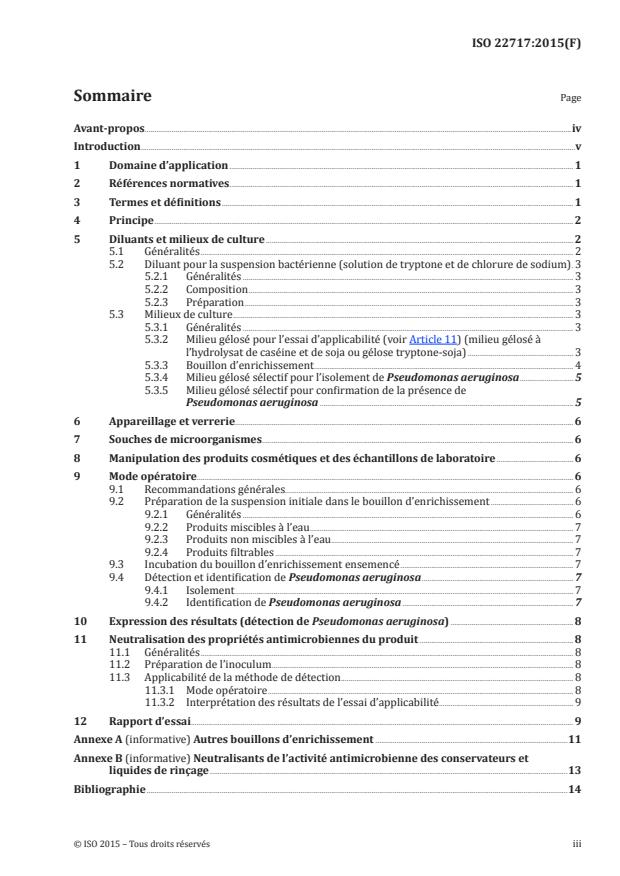
Sommaire Page
Avant-propos .iv
Introduction .v
1 Domaine d’application . 1
2 Références normatives . 1
3 Termes et définitions . 1
4 Principe . 2
5 Diluants et milieux de culture . 2
5.1 Généralités . 2
5.2 Diluant pour la suspension bactérienne (solution de tryptone et de chlorure de sodium) . 3
5.2.1 Généralités . 3
5.2.2 Composition . 3
5.2.3 Préparation . 3
5.3 Milieux de culture . 3
5.3.1 Généralités . 3
5.3.2 Milieu gélosé pour l’essai d’applicabilité (voir Article 11) (milieu gélosé à
l’hydrolysat de caséine et de soja ou gélose tryptone-soja) . 3
5.3.3 Bouillon d’enrichissement . 4
5.3.4 Milieu gélosé sélectif pour l’isolement de Pseudomonas aeruginosa . 5
5.3.5 Milieu gélosé sélectif pour confirmation de la présence de
Pseudomonas aeruginosa . 5
6 Appareillage et verrerie . 6
7 Souches de microorganismes . 6
8 Manipulation des produits cosmétiques et des échantillons de laboratoire .6
9 Mode opératoire. 6
9.1 Recommandations générales. 6
9.2 Préparation de la suspension initiale dans le bouillon d’enrichissement . 6
9.2.1 Généralités . 6
9.2.2 Produits miscibles à l’eau . 7
9.2.3 Produits non miscibles à l’eau . 7
9.2.4 Produits filtrables . 7
9.3 Incubation du bouillon d’enrichissement ensemencé . 7
9.4 Détection et identification de Pseudomonas aeruginosa . 7
9.4.1 Isolement . 7
9.4.2 Identification de Pseudomonas aeruginosa . 7
10 Expression des résultats (détection de Pseudomonas aeruginosa) .8
11 Neutralisation des propriétés antimicrobiennes du produit . 8
11.1 Généralités . 8
11.2 Préparation de l’inoculum . 8
11.3 Applicabilité de la méthode de détection. 8
11.3.1 Mode opératoire . 8
11.3.2 Interprétation des résultats de l’essai d’applicabilité. 9
12 Rapport d’essai . 9
Annexe A (informative) Autres bouillons d’enrichissement .11
Annexe B (informative) Neutralisants de l’activité antimicrobienne des conservateurs et
liquides de rinçage .13
Bibliographie .14
Avant-propos
L’ISO (Organisation internationale de normalisation) est une fédération mondiale d’organismes
nationaux de normalisation (comités membres de l’ISO). L’élaboration des Normes internationales est
en général confiée aux comités techniques de l’ISO. Chaque comité membre intéressé par une étude
a le droit de faire partie du comité technique créé à cet effet. Les organisations internationales,
gouvernementales et non gouvernementales, en liaison avec l’ISO participent également aux travaux.
L’ISO collabore étroitement avec la Commission électrotechnique internationale (IEC) en ce qui
concerne la normalisation électrotechnique.
Les procédures utilisées pour élaborer le présent document et celles destinées à sa mise à jour sont
décrites dans les Directives ISO/IEC, Partie 1. Il convient, en particulier de prendre note des différents
critères d’approbation requis pour les différents types de documents ISO. Le présent document a été
rédigé conformément aux règles de rédaction données dans les Directives ISO/IEC, Partie 2 (voir www.
iso.org/directives).
L’attention est appelée sur le fait que certains des éléments du présent document peuvent faire l’objet de
droits de propriété intellectuelle ou de droits analogues. L’ISO ne saurait être tenue pour responsable
de ne pas avoir identifié de tels droits de propriété et averti de leur existence. Les détails concernant
les références aux droits de propriété intellectuelle ou autres droits analogues identifiés lors de
l’élaboration du document sont indiqués dans l’Introduction et/ou dans la liste des déclarations de
brevets reçues par l’ISO (voir www.iso.org/brevets).
Les appellations commerciales éventuellement mentionnées dans le présent document sont données
pour information, par souci de commodité, à l’intention des utilisateurs et ne sauraient constituer
un engagement.
Pour une explication de la signification des termes et expressions spécifiques de l’ISO liés à
l’évaluation de la conformité, ou pour toute information au sujet de l’adhésion de l’ISO aux principes
de l’OMC concernant les obstacles techniques au commerce (OTC), voir le lien suivant: Avant-propos —
Informations supplémentaires.
Le comité chargé de l’élaboration du présent document est l’ISO/TC 217, Cosmétiques.
Cette deuxième édition annule et remplace la première édition (ISO 22717:2006), qui a fait l’objet d’une
révision mineure.
iv © ISO 2015 – Tous droits réservés
Introduction
Les examens microbiologiques des produits cosmétiques sont réalisés selon une analyse de risque
microbiologique appropriée afin de garantir leur qualité et la sécurité des consommateurs.
L’analyse de risque microbiologique dépend de plusieurs paramètres tels que les suivants:
— l’altération potentielle des produits cosmétiques;
— le caractère pathogène des microorganismes;
— le site d’application du produit cosmétique (cheveux, peau, yeux, muqueuses);
— la catégorie d’utilisateurs (adultes, enfants de moins de 3 ans).
Pour les cosmétiques et les autres produits topiques, la détection d’agents pathogènes pour la peau, tels
que Staphylococcus aureus, Pseudomonas aeruginosa et Candida albicans peut être justifiée, parce qu’ils
peuvent causer des infections cutanées ou oculaires. La recherche d’autres sortes de microorganismes
peut aussi présenter un intérêt car ceux-ci (y compris des indicateurs de contamination fécale, par exemple
Escherichia coli) peuvent indiquer une défaillance de l’hygiène au cours du processus de fabrication.
NORME INTERNATIONALE ISO 22717:2015(F)
Cosmétiques — Microbiologie — Détection de
Pseudomonas aeruginosa
1 Domaine d’application
La présente Norme internationale donne des lignes directrices générales pour la détection et
l’identification du microorganisme spécifié Pseudomonas aeruginosa dans les produits cosmétiques. Les
microorganismes considérés comme spécifiés dans la présente Norme internationale peuvent différer
d’un pays à l’autre suivant les pratiques ou les réglementations nationales.
Pour garantir la qualité du produit et la sécurité des consommateurs, il est préférable d’effectuer une
analyse appropriée du risque microbiologique afin de déterminer les types de produits cosmétiques
qui relèvent de la présente Norme internationale. Les produits considérés comme présentant un
faible risque microbiologique (voir ISO 29621) comprennent ceux ayant une faible activité de l’eau, les
produits hydroalcooliques, ceux ayant des valeurs de pH extrêmes, etc.
La méthode décrite dans la présente Norme internationale repose d’abord sur la détection de
Pseudomonas aeruginosa dans un milieu liquide non sélectif (bouillon d’enrichissement), suivie d’un
isolement sur un milieu gélosé sélectif. D’autres méthodes peuvent être appropriées en fonction du
niveau de détection exigé.
NOTE Pour la détection de Pseudomonas aeruginosa, il est possible de réaliser des subcultures sur des milieux
de culture non sélectifs, puis de procéder aux étapes appropriées d’identification (par exemple en utilisant des
kits d’identification).
En raison de la grande variété de produits cosmétiques relevant de ce domaine d’application, il se peut
que cette méthode ne soit pas adaptée en tous points à certains produits (par exemple aux produits non
miscibles à l’eau). D’autres Normes internationales (ISO 18415) peuvent être appropriées. Il est possible
de remplacer les essais présentés ici par d’autres méthodes (par exemple des méthodes automatisées)
sous réserve que leur équivalence ait été démontrée ou que la méthode ait été validée par ailleurs.
2 Références normatives
Les documents ci-après, en totalité ou en partie, sont des références normatives indispensables à
l’application du présent document. Pour les références datées, seule l’édition citée s’applique. Pour les
références non datées, la dernière édition du document de référence s’applique (y compris les éventuels
amendements).
ISO 21148:2005, Cosmétiques — Microbiologie — Instructions générales pour les examens microbiologiques
EN 12353, Antiseptiques et désinfectants chimiques — Conservation des microorganismes d’essai utilisés
pour la détermination de l’activité bactéricide (Legionella incluses), mycobactéricide, sporicide, fongicide et
virucide (bactériophages inclus)
3 Termes et définitions
Pour les besoins du présent document, les termes et définitions suivants s’appliquent.
3.1
produit
portion d’un produit cosmétique identifié reçue au laboratoire pour essais
3.2
échantillon
portion du produit (au moins 1 g ou 1 ml) utilisée lors de l’essai pour préparer la suspension initiale
(solution mère)
3.3
suspension initiale
suspension (ou solution) de l’échantillon dans un volume défini d’un bouillon d’enrichissement approprié
3.4
dilution de l’échantillon
dilution de la suspension initiale
3.5
microorganisme spécifié
bactérie aérobie mésophile ou levure qui est indésirable dans un produit cosmétique et qui est reconnue
comme étant une espèce pathogène pour la peau, susceptible d’être néfaste pour la santé humaine ou
considérée comme une indication de défaillance de l’hygiène dans le processus de fabrication
3.6
Pseudomonas aeruginosa
bacille Gram négatif mobile, formant des colonies lisses pigmentées de couleur marron ou verdâtre
Note 1 à l’article: Les principales caractéristiques pour l’identification sont les suivantes: croissance sur milieu
sélectif gélose cétrimide, oxydase positive, production de pigments fluorescents diffusibles et production de
pigment phénazine soluble (pyocyanine) dans les milieux appropriés.
Note 2 à l’article: Pseudomonas aeruginosa peut être isolé à partir d’une grande variété de sources
environnementales, notamment l’eau; il est capable de contaminer un grand nombre de substrats différents.
Il peut être à l’origine d’infections cutanées ou oculaires chez l’homme. Sa présence est donc indésirable dans
les produits cosmétiques en raison de son caractère potentiellement pathogène et de sa capacité à modifier les
propriétés physicochimiques de la formulation du cosmétique.
3.7
bouillon d’enrichissement
milieu liquide non sélectif contenant des neutralisants et/ou des agents dispersants appropriés, dont il
a été démontré qu’il convient pour le produit soumis à essai
4 Principe
La première étape du mode opératoire est une phase d’enrichissement utilisant un bouillon non sélectif
afin d’augmenter le nombre de microorganismes sans risque d’inhibition par les ingrédients sélectifs
qui sont présents dans les milieux de culture sélectifs/différentiels.
La seconde étape (isolement) de l’essai est réalisée sur un milieu sélectif et elle est suivie d’essais
d’identification
L’inhibition potentielle de la croissance microbienne par l’échantillon doit être neutralisée pour
[1]
permettre la détection des microorganismes viables. Dans tous les cas et quelle que soit la méthode
employée, la neutralisation des propriétés antimicrobiennes du produit doit être vérifiée et démontrée
(voir Article 11).
5 Diluants et milieux de culture
5.1 Généralités
Des instructions générales sont données dans l’ISO 21148. Lorsque la présente Norme internationale
mentionne l’emploi d’eau, il faut utiliser de l’eau distillée ou de l’eau purifiée comme spécifié dans
l’ISO 21148.
2 © ISO 2015 – Tous droits réservés
Le bouillon d’enrichissement est utilisé pour disperser l’échantillon et pour augmenter la population
microbienne initiale. Il peut contenir des neutralisants si l’échantillon à soumettre à essai possède
des propriétés antimicrobiennes. L’efficacité de la neutralisation doit être démontrée (voir Article 11).
L’Annexe B fournit des informations relatives aux neutralisants appropriés.
Le bouillon d’enrichissement (5.3.3.1), ou l’un de ceux donnés dans l’Annexe A, peut être utilisé pour
vérifier la présence de Pseudomonas aeruginosa conformément à la présente Norme internationale à
condition qu’il ait été démontré qu’il est approprié conformément à l’Article 11.
D’autres diluants et milieux de culture sont utilisables s’il a été démontré que leur emploi convient.
5.2 Diluant pour la suspension bactérienne (solution de tryptone et de chlorure de
sodium)
5.2.1 Généralités
Le diluant est utilisé pour préparer la suspension bactérienne utilisée pour le mode opératoire de l’essai
d’applicabilité (voir Article 11).
5.2.2 Composition
— tryptone, hydrolysat pancréatique de caséine 1,0 g
— chlorure de sodium 8,5 g
— eau 1 000 ml
5.2.3 Préparation
Dissoudre les composants dans l’eau en mélangeant tout en chauffant. Répartir dans des récipients
appropriés. Stériliser à l’autoclave à 121 °C pendant 15 min.
Après stérilisation et refroidissement, le pH doit être de 7,0 ± 0,2, le mesurage étant effectué à
température ambiante.
5.3 Milieux de culture
5.3.1 Généralités
Les milieux de culture peuvent être préparés suivant les modes opératoires ci-dessous ou à partir de
milieux de culture déshydratés conformément aux instructions du fabricant. Il convient de se conformer
aux instructions données par le fournisseur des milieux.
NOTE Il est possible d’utiliser des milieux prêts à l’emploi quand leur composition et/ou leurs performances
de croissance sont comparables à celles des formules indiquées ci-après.
5.3.2 Milieu gélosé pour l’essai d’applicabilité (voir Article 11) (milieu gélosé à l’hydrolysat de
caséine et de soja ou gélose tryptone-soja)
5.3.2.1 Composition
— hydrolysat pancréatique de caséine 15,0 g
— hydrolysat papaïque de soja 5,0 g
— chlorure de sodium 5,0 g
— agar 15,0 g
— eau 1 000 ml
5.3.2.2 Préparation
Dissoudre les composants ou le milieu complet déshydraté dans l’eau en mélangeant tout en chauffant.
Répartir le milieu dans des récipients appropriés. Stériliser à l’autoclave à 121 °C pendant 15
...
NORME ISO
INTERNATIONALE 22717
Deuxième édition
2015-12-01
Cosmétiques — Microbiologie —
Détection de Pseudomonas aeruginosa
Cosmetics — Microbiology — Detection of Pseudomonas aeruginosa
Numéro de référence
©
ISO 2015
DOCUMENT PROTÉGÉ PAR COPYRIGHT
© ISO 2015, Publié en Suisse
Droits de reproduction réservés. Sauf indication contraire, aucune partie de cette publication ne peut être reproduite ni utilisée
sous quelque forme que ce soit et par aucun procédé, électronique ou mécanique, y compris la photocopie, l’affichage sur
l’internet ou sur un Intranet, sans autorisation écrite préalable. Les demandes d’autorisation peuvent être adressées à l’ISO à
l’adresse ci-après ou au comité membre de l’ISO dans le pays du demandeur.
ISO copyright office
Ch. de Blandonnet 8 • CP 401
CH-1214 Vernier, Geneva, Switzerland
Tel. +41 22 749 01 11
Fax +41 22 749 09 47
copyright@iso.org
www.iso.org
ii © ISO 2015 – Tous droits réservés
Sommaire Page
Avant-propos .iv
Introduction .v
1 Domaine d’application . 1
2 Références normatives . 1
3 Termes et définitions . 1
4 Principe . 2
5 Diluants et milieux de culture . 2
5.1 Généralités . 2
5.2 Diluant pour la suspension bactérienne (solution de tryptone et de chlorure de sodium) . 3
5.2.1 Généralités . 3
5.2.2 Composition . 3
5.2.3 Préparation . 3
5.3 Milieux de culture . 3
5.3.1 Généralités . 3
5.3.2 Milieu gélosé pour l’essai d’applicabilité (voir Article 11) (milieu gélosé à
l’hydrolysat de caséine et de soja ou gélose tryptone-soja) . 3
5.3.3 Bouillon d’enrichissement . 4
5.3.4 Milieu gélosé sélectif pour l’isolement de Pseudomonas aeruginosa . 5
5.3.5 Milieu gélosé sélectif pour confirmation de la présence de
Pseudomonas aeruginosa . 5
6 Appareillage et verrerie . 6
7 Souches de microorganismes . 6
8 Manipulation des produits cosmétiques et des échantillons de laboratoire .6
9 Mode opératoire. 6
9.1 Recommandations générales. 6
9.2 Préparation de la suspension initiale dans le bouillon d’enrichissement . 6
9.2.1 Généralités . 6
9.2.2 Produits miscibles à l’eau . 7
9.2.3 Produits non miscibles à l’eau . 7
9.2.4 Produits filtrables . 7
9.3 Incubation du bouillon d’enrichissement ensemencé . 7
9.4 Détection et identification de Pseudomonas aeruginosa . 7
9.4.1 Isolement . 7
9.4.2 Identification de Pseudomonas aeruginosa . 7
10 Expression des résultats (détection de Pseudomonas aeruginosa) .8
11 Neutralisation des propriétés antimicrobiennes du produit . 8
11.1 Généralités . 8
11.2 Préparation de l’inoculum . 8
11.3 Applicabilité de la méthode de détection. 8
11.3.1 Mode opératoire . 8
11.3.2 Interprétation des résultats de l’essai d’applicabilité. 9
12 Rapport d’essai . 9
Annexe A (informative) Autres bouillons d’enrichissement .11
Annexe B (informative) Neutralisants de l’activité antimicrobienne des conservateurs et
liquides de rinçage .13
Bibliographie .14
Avant-propos
L’ISO (Organisation internationale de normalisation) est une fédération mondiale d’organismes
nationaux de normalisation (comités membres de l’ISO). L’élaboration des Normes internationales est
en général confiée aux comités techniques de l’ISO. Chaque comité membre intéressé par une étude
a le droit de faire partie du comité technique créé à cet effet. Les organisations internationales,
gouvernementales et non gouvernementales, en liaison avec l’ISO participent également aux travaux.
L’ISO collabore étroitement avec la Commission électrotechnique internationale (IEC) en ce qui
concerne la normalisation électrotechnique.
Les procédures utilisées pour élaborer le présent document et celles destinées à sa mise à jour sont
décrites dans les Directives ISO/IEC, Partie 1. Il convient, en particulier de prendre note des différents
critères d’approbation requis pour les différents types de documents ISO. Le présent document a été
rédigé conformément aux règles de rédaction données dans les Directives ISO/IEC, Partie 2 (voir www.
iso.org/directives).
L’attention est appelée sur le fait que certains des éléments du présent document peuvent faire l’objet de
droits de propriété intellectuelle ou de droits analogues. L’ISO ne saurait être tenue pour responsable
de ne pas avoir identifié de tels droits de propriété et averti de leur existence. Les détails concernant
les références aux droits de propriété intellectuelle ou autres droits analogues identifiés lors de
l’élaboration du document sont indiqués dans l’Introduction et/ou dans la liste des déclarations de
brevets reçues par l’ISO (voir www.iso.org/brevets).
Les appellations commerciales éventuellement mentionnées dans le présent document sont données
pour information, par souci de commodité, à l’intention des utilisateurs et ne sauraient constituer
un engagement.
Pour une explication de la signification des termes et expressions spécifiques de l’ISO liés à
l’évaluation de la conformité, ou pour toute information au sujet de l’adhésion de l’ISO aux principes
de l’OMC concernant les obstacles techniques au commerce (OTC), voir le lien suivant: Avant-propos —
Informations supplémentaires.
Le comité chargé de l’élaboration du présent document est l’ISO/TC 217, Cosmétiques.
Cette deuxième édition annule et remplace la première édition (ISO 22717:2006), qui a fait l’objet d’une
révision mineure.
iv © ISO 2015 – Tous droits réservés
Introduction
Les examens microbiologiques des produits cosmétiques sont réalisés selon une analyse de risque
microbiologique appropriée afin de garantir leur qualité et la sécurité des consommateurs.
L’analyse de risque microbiologique dépend de plusieurs paramètres tels que les suivants:
— l’altération potentielle des produits cosmétiques;
— le caractère pathogène des microorganismes;
— le site d’application du produit cosmétique (cheveux, peau, yeux, muqueuses);
— la catégorie d’utilisateurs (adultes, enfants de moins de 3 ans).
Pour les cosmétiques et les autres produits topiques, la détection d’agents pathogènes pour la peau, tels
que Staphylococcus aureus, Pseudomonas aeruginosa et Candida albicans peut être justifiée, parce qu’ils
peuvent causer des infections cutanées ou oculaires. La recherche d’autres sortes de microorganismes
peut aussi présenter un intérêt car ceux-ci (y compris des indicateurs de contamination fécale, par exemple
Escherichia coli) peuvent indiquer une défaillance de l’hygiène au cours du processus de fabrication.
NORME INTERNATIONALE ISO 22717:2015(F)
Cosmétiques — Microbiologie — Détection de
Pseudomonas aeruginosa
1 Domaine d’application
La présente Norme internationale donne des lignes directrices générales pour la détection et
l’identification du microorganisme spécifié Pseudomonas aeruginosa dans les produits cosmétiques. Les
microorganismes considérés comme spécifiés dans la présente Norme internationale peuvent différer
d’un pays à l’autre suivant les pratiques ou les réglementations nationales.
Pour garantir la qualité du produit et la sécurité des consommateurs, il est préférable d’effectuer une
analyse appropriée du risque microbiologique afin de déterminer les types de produits cosmétiques
qui relèvent de la présente Norme internationale. Les produits considérés comme présentant un
faible risque microbiologique (voir ISO 29621) comprennent ceux ayant une faible activité de l’eau, les
produits hydroalcooliques, ceux ayant des valeurs de pH extrêmes, etc.
La méthode décrite dans la présente Norme internationale repose d’abord sur la détection de
Pseudomonas aeruginosa dans un milieu liquide non sélectif (bouillon d’enrichissement), suivie d’un
isolement sur un milieu gélosé sélectif. D’autres méthodes peuvent être appropriées en fonction du
niveau de détection exigé.
NOTE Pour la détection de Pseudomonas aeruginosa, il est possible de réaliser des subcultures sur des milieux
de culture non sélectifs, puis de procéder aux étapes appropriées d’identification (par exemple en utilisant des
kits d’identification).
En raison de la grande variété de produits cosmétiques relevant de ce domaine d’application, il se peut
que cette méthode ne soit pas adaptée en tous points à certains produits (par exemple aux produits non
miscibles à l’eau). D’autres Normes internationales (ISO 18415) peuvent être appropriées. Il est possible
de remplacer les essais présentés ici par d’autres méthodes (par exemple des méthodes automatisées)
sous réserve que leur équivalence ait été démontrée ou que la méthode ait été validée par ailleurs.
2 Références normatives
Les documents ci-après, en totalité ou en partie, sont des références normatives indispensables à
l’application du présent document. Pour les références datées, seule l’édition citée s’applique. Pour les
références non datées, la dernière édition du document de référence s’applique (y compris les éventuels
amendements).
ISO 21148:2005, Cosmétiques — Microbiologie — Instructions générales pour les examens microbiologiques
EN 12353, Antiseptiques et désinfectants chimiques — Conservation des microorganismes d’essai utilisés
pour la détermination de l’activité bactéricide (Legionella incluses), mycobactéricide, sporicide, fongicide et
virucide (bactériophages inclus)
3 Termes et définitions
Pour les besoins du présent document, les termes et définitions suivants s’appliquent.
3.1
produit
portion d’un produit cosmétique identifié reçue au laboratoire pour essais
3.2
échantillon
portion du produit (au moins 1 g ou 1 ml) utilisée lors de l’essai pour préparer la suspension initiale
(solution mère)
3.3
suspension initiale
suspension (ou solution) de l’échantillon dans un volume défini d’un bouillon d’enrichissement approprié
3.4
dilution de l’échantillon
dilution de la suspension initiale
3.5
microorganisme spécifié
bactérie aérobie mésophile ou levure qui est indésirable dans un produit cosmétique et qui est reconnue
comme étant une espèce pathogène pour la peau, susceptible d’être néfaste pour la santé humaine ou
considérée comme une indication de défaillance de l’hygiène dans le processus de fabrication
3.6
Pseudomonas aeruginosa
bacille Gram négatif mobile, formant des colonies lisses pigmentées de couleur marron ou verdâtre
Note 1 à l’article: Les principales caractéristiques pour l’identification sont les suivantes: croissance sur milieu
sélectif gélose cétrimide, oxydase positive, production de pigments fluorescents diffusibles et production de
pigment phénazine soluble (pyocyanine) dans les milieux appropriés.
Note 2 à l’article: Pseudomonas aeruginosa peut être isolé à partir d’une grande variété de sources
environnementales, notamment l’eau; il est capable de contaminer un grand nombre de substrats différents.
Il peut être à l’origine d’infections cutanées ou oculaires chez l’homme. Sa présence est donc indésirable dans
les produits cosmétiques en raison de son caractère potentiellement pathogène et de sa capacité à modifier les
propriétés physicochimiques de la formulation du cosmétique.
3.7
bouillon d’enrichissement
milieu liquide non sélectif contenant des neutralisants et/ou des agents dispersants appropriés, dont il
a été démontré qu’il convient pour le produit soumis à essai
4 Principe
La première étape du mode opératoire est une phase d’enrichissement utilisant un bouillon non sélectif
afin d’augmenter le nombre de microorganismes sans risque d’inhibition par les ingrédients sélectifs
qui sont présents dans les milieux de culture sélectifs/différentiels.
La seconde étape (isolement) de l’essai est réalisée sur un milieu sélectif et elle est suivie d’essais
d’identification
L’inhibition potentielle de la croissance microbienne par l’échantillon doit être neutralisée pour
[1]
permettre la détection des microorganismes viables. Dans tous les cas et quelle que soit la méthode
employée, la neutralisation des propriétés antimicrobiennes du produit doit être vérifiée et démontrée
(voir Article 11).
5 Diluants et milieux de culture
5.1 Généralités
Des instructions générales sont données dans l’ISO 21148. Lorsque la présente Norme internationale
mentionne l’emploi d’eau, il faut utiliser de l’eau distillée ou de l’eau purifiée comme spécifié dans
l’ISO 21148.
2 © ISO 2015 – Tous droits réservés
Le bouillon d’enrichissement est utilisé pour disperser l’échantillon et pour augmenter la population
microbienne initiale. Il peut contenir des neutralisants si l’échantillon à soumettre à essai possède
des propriétés antimicrobiennes. L’efficacité de la neutralisation doit être démontrée (voir Article 11).
L’Annexe B fournit des informations relatives aux neutralisants appropriés.
Le bouillon d’enrichissement (5.3.3.1), ou l’un de ceux donnés dans l’Annexe A, peut être utilisé pour
vérifier la présence de Pseudomonas aeruginosa conformément à la présente Norme internationale à
condition qu’il ait été démontré qu’il est approprié conformément à l’Article 11.
D’autres diluants et milieux de culture sont utilisables s’il a été démontré que leur emploi convient.
5.2 Diluant pour la suspension bactérienne (solution de tryptone et de chlorure de
sodium)
5.2.1 Généralités
Le diluant est utilisé pour préparer la suspension bactérienne utilisée pour le mode opératoire de l’essai
d’applicabilité (voir Article 11).
5.2.2 Composition
— tryptone, hydrolysat pancréatique de caséine 1,0 g
— chlorure de sodium 8,5 g
— eau 1 000 ml
5.2.3 Préparation
Dissoudre les composants dans l’eau en mélangeant tout en chauffant. Répartir dans des récipients
appropriés. Stériliser à l’autoclave à 121 °C pendant 15 min.
Après stérilisation et refroidissement, le pH doit être de 7,0 ± 0,2, le mesurage étant effectué à
température ambiante.
5.3 Milieux de culture
5.3.1 Généralités
Les milieux de culture peuvent être préparés suivant les modes opératoires ci-dessous ou à partir de
milieux de culture déshydratés conformément aux instructions du fabricant. Il convient de se conformer
aux instructions données par le fournisseur des milieux.
NOTE Il est possible d’utiliser des milieux prêts à l’emploi quand leur composition et/ou leurs performances
de croissance sont comparables à celles des formules indiquées ci-après.
5.3.2 Milieu gélosé pour l’essai d’applicabilité (voir Article 11) (milieu gélosé à l’hydrolysat de
caséine et de soja ou gélose tryptone-soja)
5.3.2.1 Composition
— hydrolysat pancréatique de caséine 15,0 g
— hydrolysat papaïque de soja 5,0 g
— chlorure de sodium 5,0 g
— agar 15,0 g
— eau 1 000 ml
5.3.2.2 Préparation
Dissoudre les composants ou le milieu complet déshydraté dans l’eau en mélangeant tout en chauffant.
Répartir le milieu dans des récipients appropriés. Stériliser à l’autoclave à 121 °C pendant 15
...