

ISO 17215-3:2021
(Main)Road vehicles — Video communication interface for cameras (VCIC) — Part 3: Camera message dictionary
General Information
- Abstract
This document specifies the standardized camera messages and data types used by a VCIC camera (OSI layer 7). Applications hosted on ECUs want to communicate with one or more cameras (e.g. “Ask camera for parameters.”). If the applications can use standardized services supported by the cameras (API layer 7), the development of a vision application is independent on the camera used. The services can be implemented by general libraries. The definition of streaming data is not an issue of this API.
- Status
- Published
- Publication Date
- 24-May-2021
- Technical Committee
- ISO/TC 22/SC 31 - Data communication
- Drafting Committee
- ISO/TC 22/SC 31/WG 4 - Network applications
- Current Stage
- 9092 - International Standard to be revised
- Start Date
- 05-Aug-2026
- Completion Date
- 29-Aug-2026
Buy Documents



ISO 17215-3:2021 - Road vehicles -- Video communication interface for cameras (VCIC)

ISO 17215-3:2021 - Road vehicles — Video communication interface for cameras (VCIC) — Part 3: Camera message dictionary/25/2021
Overview
ISO 17215-3:2021 - "Road vehicles - Video communication interface for cameras (VCIC) - Part 3: Camera message dictionary" defines the standardized camera messages and data types used at OSI layer 7 (application layer) for VCIC cameras. The standard specifies an API (application layer services) so ECUs and hosted applications can communicate with one or more cameras (for example, “Ask camera for parameters.”). Importantly, streaming video payloads are out of scope - ISO 17215-3 focuses on control, metadata and service messages rather than media streaming.
Key topics and requirements
- Camera message dictionary (API layer 7): standardized method IDs, return codes, enumerations and structures that represent camera information and control functions.
- API data types and structures: definitions include intrinsic/extrinsic camera parameters, image dimensions, regions of interest (ROI), video and histogram formats, timestamps, persistent storage entries, imager registers, control modes and camera status.
- Control and configuration services: methods for setting/getting camera controls, registers, video format, ROI, histogram subscriptions, persistent storage and host parameters.
- Enumerations and error handling: standardized enums (e.g., camera modes, error codes, control indices) and API return codes for consistent behaviour across implementations.
- Programming model & SOME/IP: guidance and examples for implementing the API over SOME/IP (service discovery, event group handling, PDU examples and startup behaviour).
- Interoperability principles: API design to enable vision applications to be independent from the specific camera hardware, allowing reuse of libraries and portable application development.
Applications and who uses it
ISO 17215-3 is intended for professionals building, integrating or testing automotive camera systems:
- Automotive software developers and ECU application teams implementing vision features (ADAS, surround view, parking assist).
- Camera manufacturers and firmware engineers providing standardized control interfaces.
- Tier-1 suppliers and system integrators designing in-vehicle networks and camera middleware.
- Test engineers and validation teams verifying camera-control behaviour and API conformance.
- Tool and library vendors creating common VCIC client/server libraries or SOME/IP adapters.
Benefits include faster development, reduced integration effort, and improved interoperability between cameras and vehicle ECUs.
Related standards
- ISO 17215 series (other parts define streaming, transport or complementary aspects).
- Standards and protocols referenced for implementation (e.g., SOME/IP and OSI model guidance) are addressed in the document.
Keywords: ISO 17215-3:2021, VCIC, camera message dictionary, video communication interface for cameras, OSI layer 7, SOME/IP, automotive camera API, ECU camera control, camera metadata.
Relations
- Effective Date
- 16-Mar-2024
- Effective Date
- 23-Apr-2020
Buy Documents
ISO 17215-3:2021 - Road vehicles -- Video communication interface for cameras (VCIC)
ISO 17215-3:2021 - Road vehicles — Video communication interface for cameras (VCIC) — Part 3: Camera message dictionary/25/2021
Get Certified
Connect with accredited certification bodies for this standard

TÜV Rheinland
TÜV Rheinland is a leading international provider of technical services.

TÜV SÜD
TÜV SÜD is a trusted partner of choice for safety, security and sustainability solutions.

DEKRA Certification Inc.
DEKRA US certification services.
Sponsored listings
Frequently Asked Questions
ISO 17215-3:2021 is a standard published by the International Organization for Standardization (ISO). Its full title is "Road vehicles — Video communication interface for cameras (VCIC) — Part 3: Camera message dictionary". This standard covers: This document specifies the standardized camera messages and data types used by a VCIC camera (OSI layer 7). Applications hosted on ECUs want to communicate with one or more cameras (e.g. “Ask camera for parameters.”). If the applications can use standardized services supported by the cameras (API layer 7), the development of a vision application is independent on the camera used. The services can be implemented by general libraries. The definition of streaming data is not an issue of this API.
This document specifies the standardized camera messages and data types used by a VCIC camera (OSI layer 7). Applications hosted on ECUs want to communicate with one or more cameras (e.g. “Ask camera for parameters.”). If the applications can use standardized services supported by the cameras (API layer 7), the development of a vision application is independent on the camera used. The services can be implemented by general libraries. The definition of streaming data is not an issue of this API.
ISO 17215-3:2021 is classified under the following ICS (International Classification for Standards) categories: 43.040.15 - Car informatics. On board computer systems. The ICS classification helps identify the subject area and facilitates finding related standards.
ISO 17215-3:2021 has the following relationships with other standards: It is inter standard links to ISO 3386-1:2025, ISO 17215-3:2014. Understanding these relationships helps ensure you are using the most current and applicable version of the standard.
ISO 17215-3:2021 is available in PDF format for immediate download after purchase. The document can be added to your cart and obtained through the secure checkout process. Digital delivery ensures instant access to the complete standard document.
Standards Content (Sample)
INTERNATIONAL ISO
STANDARD 17215-3
Second edition
2021-05
Road vehicles — Video communication
interface for cameras (VCIC) —
Part 3:
Camera message dictionary
Véhicules routiers — Interface de communication vidéo pour caméras
(ICVC) —
Partie 3: Dictionnaire de message de caméra
Reference number
©
ISO 2021
© ISO 2021
All rights reserved. Unless otherwise specified, or required in the context of its implementation, no part of this publication may
be reproduced or utilized otherwise in any form or by any means, electronic or mechanical, including photocopying, or posting
on the internet or an intranet, without prior written permission. Permission can be requested from either ISO at the address
below or ISO’s member body in the country of the requester.
ISO copyright office
CP 401 • Ch. de Blandonnet 8
CH-1214 Vernier, Geneva
Phone: +41 22 749 01 11
Email: copyright@iso.org
Website: www.iso.org
Published in Switzerland
ii © ISO 2021 – All rights reserved
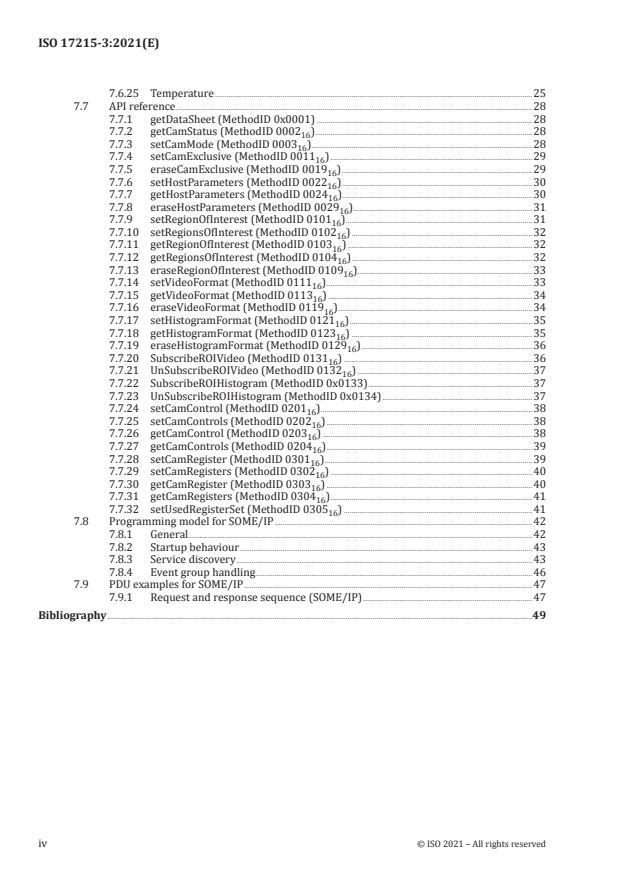
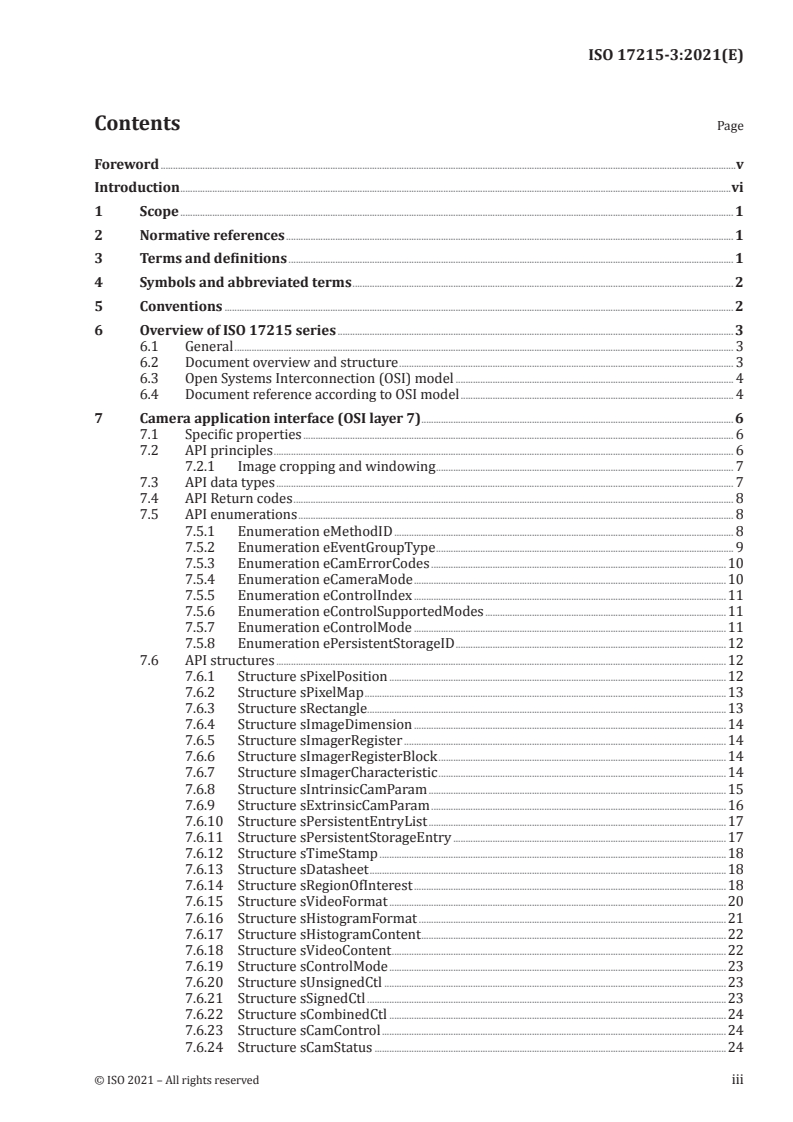
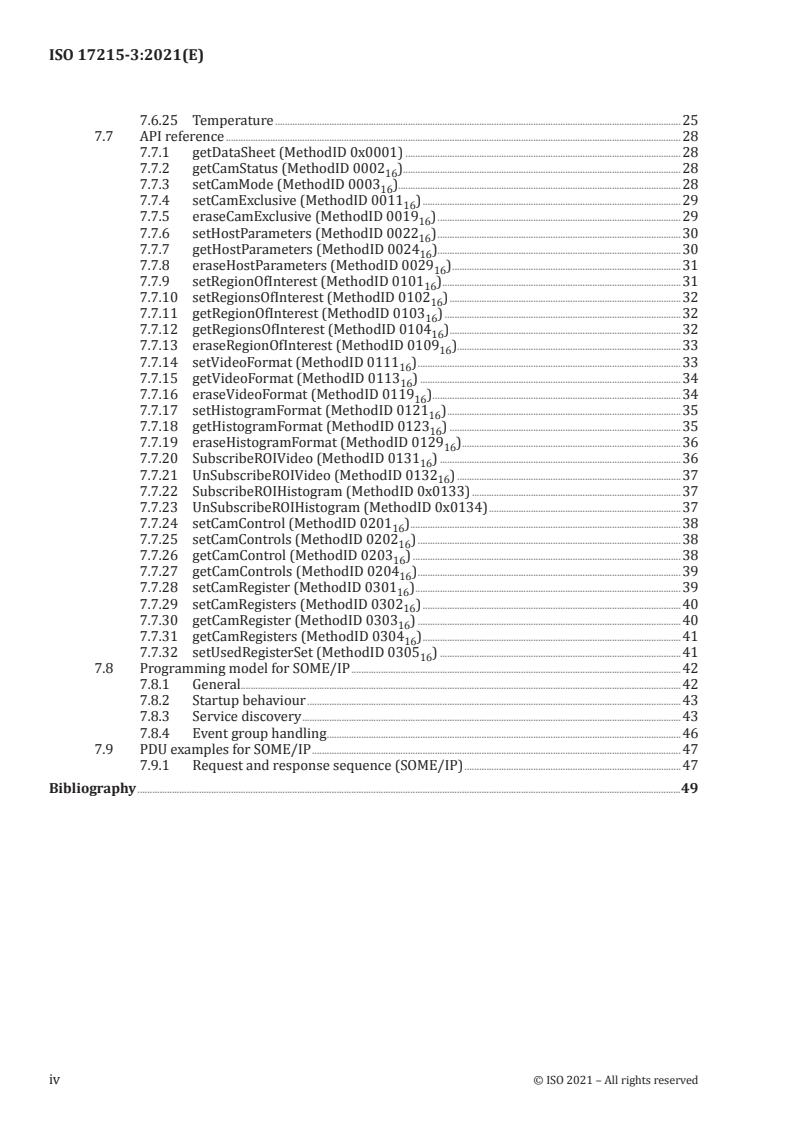
Contents Page
Foreword .v
Introduction .vi
1 Scope . 1
2 Normative references . 1
3 Terms and definitions . 1
4 Symbols and abbreviated terms . 2
5 Conventions . 2
6 Overview of ISO 17215 series . 3
6.1 General . 3
6.2 Document overview and structure . 3
6.3 Open Systems Interconnection (OSI) model . 4
6.4 Document reference according to OSI model . 4
7 Camera application interface (OSI layer 7) . 6
7.1 Specific properties . 6
7.2 API principles . 6
7.2.1 Image cropping and windowing . 7
7.3 API data types . 7
7.4 API Return codes . 8
7.5 API enumerations . 8
7.5.1 Enumeration eMethodID . 8
7.5.2 Enumeration eEventGroupType . 9
7.5.3 Enumeration eCamErrorCodes .10
7.5.4 Enumeration eCameraMode .10
7.5.5 Enumeration eControlIndex .11
7.5.6 Enumeration eControlSupportedModes .11
7.5.7 Enumeration eControlMode .11
7.5.8 Enumeration ePersistentStorageID .12
7.6 API structures .12
7.6.1 Structure sPixelPosition .12
7.6.2 Structure sPixelMap .13
7.6.3 Structure sRectangle . . .13
7.6.4 Structure sImageDimension .14
7.6.5 Structure sImagerRegister .14
7.6.6 Structure sImagerRegisterBlock .14
7.6.7 Structure sImagerCharacteristic .14
7.6.8 Structure sIntrinsicCamParam .15
7.6.9 Structure sExtrinsicCamParam .16
7.6.10 Structure sPersistentEntryList .17
7.6.11 Structure sPersistentStorageEntry .17
7.6.12 Structure sTimeStamp .18
7.6.13 Structure sDatasheet .18
7.6.14 Structure sRegionOfInterest .18
7.6.15 Structure sVideoFormat .20
7.6.16 Structure sHistogramFormat .21
7.6.17 Structure sHistogramContent .22
7.6.18 Structure sVideoContent .22
7.6.19 Structure sControlMode .23
7.6.20 Structure sUnsignedCtl .23
7.6.21 Structure sSignedCtl .23
7.6.22 Structure sCombinedCtl .24
7.6.23 Structure sCamControl .24
7.6.24 Structure sCamStatus .24
7.6.25 Temperature .25
7.7 API reference .28
7.7.1 getDataSheet (MethodID 0x0001) .28
7.7.2 getCamStatus (MethodID 0002 ) .28
7.7.3 setCamMode (MethodID 0003 ).28
7.7.4 setCamExclusive (MethodID 0011 ) .29
7.7.5 eraseCamExclusive (MethodID 0019 ) .29
7.7.6 setHostParameters (MethodID 0022 ) .30
7.7.7 getHostParameters (MethodID 0024 ).30
7.7.8 eraseHostParameters (MethodID 0029 ) .31
7.7.9 setRegionOfInterest (MethodID 0101 ) .31
7.7.10 setRegionsOfInterest (MethodID 0102 ) .32
7.7.11 getRegionOfInterest (MethodID 0103 ) .32
7.7.12 getRegionsOfInterest (MethodID 0104 ) .32
7.7.13 eraseRegionOfInterest (MethodID 0109 ).33
7.7.14 setVideoFormat (MethodID 0111 ) .33
7.7.15 getVideoFormat (MethodID 0113 ) .34
7.7.16 eraseVideoFormat (MethodID 0119 ) .34
7.7.17 setHistogramFormat (MethodID 0121 ) .35
7.7.18 getHistogramFormat (MethodID 0123 ) .35
7.7.19 eraseHistogramFormat (MethodID 0129 ) .36
7.7.20 SubscribeROIVideo (MethodID 0131 ) .36
7.7.21 UnSubscribeROIVideo (MethodID 0132 ) .37
7.7.22 SubscribeROIHistogram (MethodID 0x0133) .37
7.7.23 UnSubscribeROIHistogram (MethodID 0x0134) .37
7.7.24 setCamControl (MethodID 0201 ) .38
7.7.25 setCamControls (MethodID 0202 ) .38
7.7.26 getCamControl (MethodID 0203 ) .38
7.7.27 getCamControls (MethodID 0204 ) .39
7.7.28 setCamRegister (MethodID 0301 ) .39
7.7.29 setCamRegisters (MethodID 0302 ) .40
7.7.30 getCamRegister (MethodID 0303 ) .40
7.7.31 getCamRegisters (MethodID 0304 ) .41
7.7.32 setUsedRegisterSet (MethodID 0305 ) .41
7.8 Programming model for SOME/IP .42
7.8.1 General.42
7.8.2 Startup behaviour .43
7.8.3 Service discovery .43
7.8.4 Event group handling .46
7.9 PDU examples for SOME/IP .47
7.9.1 Request and response sequence (SOME/IP) .47
Bibliography .49
iv © ISO 2021 – All rights reserved
Foreword
ISO (the International Organization for Standardization) is a worldwide federation of national standards
bodies (ISO member bodies). The work of preparing International Standards is normally carried out
through ISO technical committees. Each member body interested in a subject for which a technical
committee has been established has the right to be represented on that committee. International
organizations, governmental and non-governmental, in liaison with ISO, also take part in the work.
ISO collaborates closely with the International Electrotechnical Commission (IEC) on all matters of
electrotechnical standardization.
The procedures used to develop this document and those intended for its further maintenance are
described in the ISO/IEC Directives, Part 1. In particular, the different approval criteria needed for the
different types of ISO documents should be noted. This document was drafted in accordance with the
editorial rules of the ISO/IEC Directives, Part 2 (see www .iso .org/ directives).
Attention is drawn to the possibility that some of the elements of this document may be the subject of
patent rights. ISO shall not be held responsible for identifying any or all such patent rights. Details of
any patent rights identified during the development of the document will be in the Introduction and/or
on the ISO list of patent declarations received (see www .iso .org/ patents).
Any trade name used in this document is information given for the convenience of users and does not
constitute an endorsement.
For an explanation of the voluntary nature of standards, the meaning of ISO specific terms and
expressions related to conformity assessment, as well as information about ISO's adherence to the
World Trade Organization (WTO) principles in the Technical Barriers to Trade (TBT), see www .iso .org/
iso/ foreword .html.
This document was prepared by Technical Committee ISO/TC 22, Road vehicles, Subcommittee SC 31,
Data communication.
This second edition cancels and replaces the first edition (ISO 17215-3:2014), which has been technically
revised.
The main changes compared to the previous edition are as follows:
— corrections of Formulae and scaling in 7.6.8;
— editorial adoptions and corrections.
A list of all parts in the ISO 17215 series can be found on the ISO website.
Any feedback or questions on this document should be directed to the user’s national standards body. A
complete listing of these bodies can be found at www .iso .org/ members .html.
Introduction
Driver assistance systems are increasingly common in road vehicles. From the beginning, cameras were
part of this trend. Analogue cameras were used in the beginning because of the lower complexity of the
first systems. With increasing demand for more advanced functionality, digital image processing has
been introduced. So-called one box design cameras (combining a digital image sensor and a processing
unit) started being used in vehicles.
Currently, the market demands such systems with multiple functions. Even different viewing directions
are in use. It seems plausible that in the near future a single vehicle could have between 6 and 12
cameras. For this reason and others like limitations in size, power consumption, etc., designs have been
made where the cameras are separated from the processing unit. Therefore, a high-performance digital
interface between camera and processing unit is necessary.
This document has been established in order to define the use cases, the communication protocol, and
the physical layer requirements of a video communication interface for cameras, which covers the
needs of driver assistance applications.
The video communication interface for cameras:
— incorporates the needs of the whole life cycle of an automotive grade digital camera,
— utilizes existing standards to define a long-term stable state-of-the-art video communication
interface for cameras, usable for operating and diagnosis purposes,
— can be easily adapted to new physical data link layers including wired and wireless connections by
using existing adaption layers, and
— is compatible with AUTOSAR.
This document is related to the general information and use case definition. This is a general overview
document which is not related to the OSI model.
To achieve this, it is based on the Open Systems Interconnection (OSI) basic reference model specified
in ISO/IEC 7498-1 and ISO/IEC 10731, which structures communication systems into seven layers.
When mapped on this model, the protocol and physical layer requirements specified by this document,
in accordance with Table 1 are broken into following layers:
— application (layer 7), specified in this document (ISO 17215-3);
— presentation layer (layer 6), specified in ISO 17215-2;
— session layer (layer 5), specified in ISO 17215-2;
— transport protocol (layer 4), specified in ISO 17215-4, ISO 13400-2;
— network layer (layer 3), specified in ISO 17215-4, ISO 13400-2;
— data link layer (layer 2), specified in ISO 17215-4, ISO 13400-3;
— physical layer (layer 1), specified in ISO 17215-4, ISO 13400-3.
vi © ISO 2021 – All rights reserved
Table 1 — Specifications applicable to the OSI layers
Video communication interface for camer-
Applicability OSI 7 layers Camera diagnostics
as
Seven layers Application (layer 7) ISO 17215-3
according to
Presentation (layer 6) ISO 17215-2
ISO 7498–1 and
Session (layer 5) ISO 17215-2
ISO/IEC 10731
Transport (layer 4) ISO 17215-4 Other future interface ISO 13400-2
standards
Network (layer 3)
Data link (layer 2) ISO 17215-4 ISO 13400-3
Physical (layer 1)
ISO 17215-1 has been established in order to define the use cases for vehicle communication systems
implemented on a video communication interface for cameras; it is an overall document not related to
the OSI model.
ISO 17215-2 covers the presentation layer implementation of the video communication interface for
cameras.
This document, ISO 17215-3, covers the application layer implementation of the video communication
interface for cameras; it includes the API.
ISO 17215-4 is the common standard for the OSI layers 1 to 4 for video communication interface for
cameras. It complements ISO 13400 2 and ISO 13400 3 and adds the requirement for video transmission
over Ethernet.
ISO 17215-2 and ISO 17215-3 (OSI layer 5 to 7) services have been defined to be independent of the
ISO 17215-4 (OSI layer 1 to 4) implementation. Therefore, ISO 17215-4 could be replaced by another
future communication document.
INTERNATIONAL STANDARD ISO 17215-3:2021(E)
Road vehicles — Video communication interface for
cameras (VCIC) —
Part 3:
Camera message dictionary
1 Scope
This document specifies the standardized camera messages and data types used by a VCIC camera (OSI
layer 7).
Applications hosted on ECUs want to communicate with one or more cameras (e.g. “Ask camera for
parameters.”). If the applications can use standardized services supported by the cameras (API layer
7), the development of a vision application is independent on the camera used. The services can be
implemented by general libraries.
The definition of streaming data is not an issue of this API.
2 Normative references
The following documents are referred to in the text in such a way that some or all of their content
constitutes requirements of this document. For dated references, only the edition cited applies. For
undated references, the latest edition of the referenced document (including any amendments) applies.
ISO 17215-1, Road vehicles — Video communication interface for cameras (VCIC) — Part 1: General
information and use case definition
ISO 17215-2, Road vehicles — Video communication interface for cameras (VCIC) — Part 2: Service
discovery and control
ISO 17215-4, Road vehicles — Video communication interface for cameras (VCIC) — Part 4: Implementation
of communication requirements
3 Terms and definitions
For the purposes of this document, the terms and definitions given in ISO 17215-1 and the following
apply.
ISO and IEC maintain terminological databases for use in standardization at the following addresses:
— ISO Online browsing platform: available at https:// www .iso .org/ obp
— IEC Electropedia: available at http:// www .electropedia .org/
3.1
extrinsic parameter
parameter that denotes the coordinate system transformations from 3D world (vehicle) coordinates
(m,°) to 3D-camera coordinates (m,°)
3.2
frame rate
update rate per time of camera images
3.3
global shutter
exposure that exposes all pixels at the same time
3.4
histogram
type of chart that acts as a graphical representation of the tonal distribution in a digital image
3.5
intrinsic camera parameter
parameter that denotes the coordinate system transformations from 3D camera (m) to 2D pixel
coordinates (pixel)
4 Symbols and abbreviated terms
Abbreviated Symbol Full term
term
API Application Programming Interface
AEC Automatic Exposure Control
AGC Automatic Gain Control
DAS Driver Assistance System
ECU Electronic Control Unit
HDR High Dynamic Range
HMI Human Machine Interface
ID Identifier
ISO International Organization for Standardization
LDR Low Dynamic Range
LSB Least significant bit
MAC Media Access Control
OSI Open Systems Interconnection
PSE Persistent storage entry
ROI ρ Region of Interest, i.e. sub-part of overall image
RPC Remote Procedure Call
5 Conventions
This document is based on the conventions as specified in the OSI service conventions ISO/IEC 10731 as
they apply for physical layer, protocol, network, and transport protocol and diagnostic services.
2 © ISO 2021 – All rights reserved
6 Overview of ISO 17215 series
6.1 General
This document has been established to implement a standardized video communication interface for
cameras on a communication data link.
The focus of this document is to use existing protocols.
— Figure 1 specifies the relation to the other parts of this document.
— Figure 2 specifies the relation of this document to existing protocols.
Figure 1 — Overview of the ISO 17215 series
6.2 Document overview and structure
The ISO 17215 series consists of a set of four parts, which provide all references and requirements to
support the implementation of a standardized video communication interface for cameras according to
the document at hand.
— ISO 17215-1 provides an overview of the document set and structure along with use case definitions
and a common set of resources (definitions, references) for use by all subsequent parts.
— ISO 17215-2 specifies the discovery and control of services provided by a VCIC camera.
— This document specifies the standardized camera messages and data types used by a VCIC camera
(OSI layer 7).
— ISO 17215-4 specifies standardized low-level communication requirements for implementation of
the physical layer, data link layer, network layer, and transport layer (OSI layers 1 to 4).
6.3 Open Systems Interconnection (OSI) model
This document is based on the Open Systems Interconnection (OSI) basic reference model as specified
in ISO/IEC 7498 which structures communication systems into seven layers.
All parts of the ISO 17215 series are guided by the OSI service conventions as specified in ISO/IEC 10731
to the extent that they are applicable to diagnostic services. These conventions define the interaction
between the service user and the service provider through service primitives.
The aim of this subclause is to give an overview of the OSI model and show how it has been used as a
guideline for this document. It also shows how the OSI service conventions have been applied to this
document.
The OSI model structures data communication into seven layers called (from top to bottom) the
application layer (layer 7), presentation layer, session layer, transport layer, network layer, data link
layer, and physical layer (layer 1). A subset of these layers is used in this document.
The purpose of each layer is to provide services to the layer above. The active parts of each layer,
implemented in software, hardware, or any combination of software and hardware, are called entities.
In the OSI model, communication takes place between entities of the same layer in different nodes. Such
communicating entities of the same layer are called peer entities.
The services provided by one layer are available at the service access point (SAP) of that layer. The layer
above can use them by exchanging data parameters.
This document distinguishes between the services provided by a layer to the layer above it and the
protocol used by the layer to send a message between the peer entities of that layer. The reason for this
distinction is to make the services, especially the application layer services, and the transport layer
services, reusable also for other types of networks than the video communication interface for cameras.
In this way, the protocol is hidden from the service user and it is possible to change the protocol if
demanded by special system requirements.
6.4 Document reference according to OSI model
Figure 2 illustrates the document references.
4 © ISO 2021 – All rights reserved
Figure 2 — Document reference according to OSI model
7 Camera application interface (OSI layer 7)
7.1 Specific properties
In the automotive environment, the network topologies are semi-static and the characteristics of
all components, including cameras, are bound to a specific car platform design. Components and
characteristics of components not included in the design need not to be supported.
There is no requirement for a least common video mode. The minimum compatibility requirement is
to recognize the reason of unexpected behaviour. Compatibility is ensured during the design phase.
Incompatibility is detected during development, assembling, or repair of a car.
Consequently, the standard specifies the interface to an automotive camera, but does not specify the
characteristics of automotive cameras.
For instance, no mandatory or standard video formats are specified. However, all provisions are made
to implement standard video formats.
7.2 API principles
The camera API consists of a variety of data structures describing video modes, camera controls, and
stored items and a set of API functions.
The API is independent of specific programming languages. It is an abstract list of data structures and
functions to be offered by all implementations. A fundamental principle of all camera API functions is
the usage of remote procedure calls (RPC).
The addressing of multiple cameras can be expressed by Formula (1):
Ff=…CF,, Ia ,,a (1)
{}{}
Camera Instance APIMethodn1
where
F is the camera function;
Camera
f is the mathematical sign for function;
C is the camera instance;
Instance
F is the API function;
API
I is the Method ID;
Method
a is the argument 1;
a is the argument n;
n
The implementation depends highly on the programming language used. Therefore, this document only
covers the API function itself.
Camera data structures can be read, written, and deleted using the associated camera API functions.
Camera API functions can be grouped by the mechanism they are using in:
— set, get, and erase functions, and
— subscribe and unsubscribe functions.
All API functions starting with set, get, and erase are used to modify the cameras data structures and
the underlying functionality, for instance setting the exposure time of the imager. They are using a
request/response mechanism. A request is followed by a single response.
6 © ISO 2021 – All rights reserved
Functions are generally identified by their Method ID.
The Method IDs are specified in 7.5.1.
All API functions starting with unsubscribe/subscribe are used to acquire cyclically data from
the camera, for instance, a video stream. They are using subscribe/notification mechanism. After
subscribing an event, multiple notification packages follow.
Events are identified by its respective Eventgroup ID.
The Eventgroup IDs are specified in 7.5.2.
The SOME/IP protocol defined in ISO 17215-2 provides the mechanism for such an RPC-based
implementation.
Camera functions and the associated structures can be grouped in functional context in:
— general camera functions (MethodID 0001 –00FF );
16 16
— video format functions (MethodID 0101 –01FF );
16 16
— image control functions (MethodID 0201 –02FF ), and;
16 16
— imager functions (MethodID 0301 –03FF ).
16 16
7.2.1 Image cropping and windowing
The definition of the image windows is shown in Figure 3.
Figure 3 — Image cropping and windowing
7.3 API data types
All used data types are specified in ISO 17215-2:2014, 6.3.1.
7.4 API Return codes
Each function of the API returns a byte (8 bits) to signalize the status of the operation.
— The return codes (00 to 1F ) are defined in ISO 17215-2:2014, 6.1.1.7.
16 16
— The return codes (20 to 3F ) are function-specific and are described in 7.5.3.
16 16
7.5 API enumerations
7.5.1 Enumeration eMethodID
Table 2 provides enumeration that is used to identify the methods supported by the camera.
This enumeration is based on uint16 data type.
Table 2 — enumeration eMethodID
Name Value Description
getDataSheet 0001 Returns the datasheet of the camera.
getCamStatus 0002 Returns the current status of the camera.
setCamMode 0003 Start, stops, and restarts the camera application in the camera.
setCamExclusive 0011 Assigns the control of the camera exclusively to the requesting
client.
eraseCamExclusive 0019 Removes the exclusive control lock for the requesting client.
setHostParameters 0022 Sets the host parameters using persistent storage entries.
getHostParameters 0024 Gets the requested host parameter by reading persistent stor-
age entries.
eraseHostParameters 0029 Forces the camera to erase the requested host parameters ad-
dressed by the PSE ID.
setRegionOfInterest 0101 Sets the parameter for a region of interest addressed by index.
setRegionsOfInterest 0102 Sets the parameter for all supported regions of interest.
getRegionOfInterest 0103 Returns the parameter for region of interest addressed by ROI
index.
getRegionsOfInterest 0104 Returns the parameter for all supported region of interest.
eraseRegionOfInterest 0109 Erases all parameter for the requested ROI.
setVideoFormat 0111 Sets the video format for a ROI addressed by ROI index.
getVideoFormat 0113 Reads the parameter of the current video format, addressed by
the ROI index.
eraseVideoFormat 0119 Erases all video format parameter for the requested ROI.
setHistogramFormat 0121 It is the histogram format parameter for a ROI addressed by ROI
index.
getHistogramFormat 0123 It is the parameter of the current histogram format, addressed
by the ROI index.
eraseHistogramFormat 0129 Erases all histogram format parameter for the requested ROI.
SubscribeROIVideo 0131 Starts the transmission of a video stream for the requested ROI.
UnSubscribeROIVideo 0132 Stops the video streaming for the requested ROI.
SubscribeROIHistogram 0133 Starts the transmission of the histograms for the requested ROI.
UnSubscribeROIHistogram 0134 Signs off the transmission of the histograms for the requested
ROI.
setCamControl 0201 Sets the parameter for a camera control addressed by the con-
trol index.
setCamControls 0202 Sets the parameters for all camera controls.
8 © ISO 2021 – All rights reserved
Table 2 (continued)
Name Value Description
getCamControl 0203 Returns the current parameter for a camera control addressed
by the control index.
getCamControls 0204 Returns all current camera control parameters.
setCamRegister 0301 Writes the content of a register of the camera imager addressed
by physical register address.
setCamRegisters 0302 Writes (atomic access) the content of a register block of the
camera imager.
getCamRegister 0303 Reads the content of a register of the camera imager address by
the physical register address.
getCamRegisters 0304 Reads the content of a register block of the camera imager.
setUsedRegisterSet 0305 Forces the camera to write the imager register set stored in the
requested PSE to the imager.
7.5.2 Enumeration eEventGroupType
Table 3 provides enumeration that is used to identify the event groups supported by the camera.
This enumeration is based on uint16 data type.
Table 3 — Enumeration eEventGroupType
Name Value Description
E_LOCKED_BY_FOREIGN_INSTANCE 20 Camera service is already locked by another client.
E_LOCK_ EXPIRED 21 The camera lock has expired.
E_NOT_LOCKED 22 Camera is not locked.
E_INVALID_PS_ENTRY 24 The requested PSE ID is unknown.
E_INVALID_PS_OPERATION 25 The requested PSE operation is not allowed, e.g.
store on a RO PSE.
E_INVALID_PS_DATA 26 The PSE contains a CRC16 error.
E_NO_MORE_SPACE 27 There is no more space available to store the PSE.
E_INVALID_ROI_INDEX 30 The requested ROI is out of range.
E_INVALID_ROI_NUMBER 31 The requested number of ROIs is out of range, de-
fined by sDatasheet.numOfRegionOfInterest.
E_INVALID_VIDEO_FORMAT 32 It is an invalid value in video format.
E_INVALID_HISTOGRAM_FORMAT 33 It is an invalid value in histogram format.
E_INVALID_CONTROL_INDEX 35 The requested camControlIndex is out of range or
not supported by the camera.
E_INVALID_CONTROL_MODE 36 The requested control mode is not supported by
the camera.
E_INVALID_CONTROL_VALUE 37 The requested control value is out of the range,
defined in sCamControl.
E_INVALID_REGISTER_ADDRESS 38 The register address is not supported by the imag-
er.
E_INVALID_REGISTER_VALUE 39 The value for the given register address is not sup-
ported by the imager.
E_INVALID_REGISTER_OPERATION 3A The requested operation (read or write) for the
given register address is not supported by the
imager.
7.5.3 Enumeration eCamErrorCodes
Table 4 provides enumeration that defines the camera API specific return codes. The values are in the
range of 20 to 3F .
16 16
Table 4 — Enumeration eCamErrorCodes
Name Value Description
E_LOCKED_BY_FOREIGN_INSTANCE 20 Camera service is already locked by another client.
E_LOCK_EXPIRED 21 The camera lock has expired.
E_NOT_LOCKED 22 Camera is not locked.
E_INVALID_PS_ENTRY 24 The requested PSE ID is unknown.
E_INVALID_PS_OPERATION 25 The requested PSE operation is not allowed, e.g.
store on a RO PSE.
E_INVALID_PS_DATA 26 The PSE contains a CRC16 error.
E_NO_MORE_SPACE 27 There is no more space available to store the PSE.
E_INVALID_ROI_INDEX 30 The requested ROI is out of range.
E_INVALID_ROI_NUMBER 31 The requested number of ROIs is out of range, de-
fined by sDatasheet.numOfRegionOfInterest.
E_INVALID_VIDEO_FORMAT 32 It is an invalid value in video format.
E_INVALID_HISTOGRAM_FORMAT 33 It is an invalid value in histogram format.
E_INVALID_CONTROL_INDEX 35 The requested camControlIndex is out of range or
not supported by the camera.
E_INVALID_CONTROL_MODE 36 The requested control mode is not supported by
the camera.
E_INVALID_CONTROL_VALUE 37 The requested control value is out of the range,
defined in sCamControl.
E_INVALID_REGISTER_ADDRESS 38 The register address is not supported by the imag-
er.
E_INVALID_REGISTER_VALUE 39 The value for the given register address is not sup-
ported by the imager.
E_INVALID_REGISTER_OPERATION 3A The requested operation (read or write) for the
given register address is not supported by the
imager.
7.5.4 Enumeration eCameraMode
Table 5 provides an enumeration type that defines the camera operating modes which can be set by
using the setCamMode method.
Table 5 — Enumeration eCameraMode
Name Value Description
StartCameraService 1 The camera application shall be started.
StopCameraService 2 The camera application shall be stopped. Power-intensive compo-
nents like imager should be switched off.
ReStartCameraService 3 The camera application shall restart. When restarting, the cam-
era application shall use the PSE ‘UseAtBootTime’.
StopCamera 4 The camera device shall enter standby mode (CC OFF, Communi-
cation-Controller OFF) and stores the settings.
This state can be only left by repowering or wake up on LAN.
10 © ISO 2021 – All rights reserved
7.5.5 Enumeration eControlIndex
Table 6 defines the enumeration eControlIndex.
Table 6 — Enumeration eControlIndex
Name Value Description
exposureTime 1 Controls the integration time.
Brightness 2 Controls the black level offset.
Gain 3 Controls the gain circuits of the camera.
Hue 4 Controls the hue circuits of the camera.
Saturation 5 Controls the saturation circuits of the camera.
Gamma 6 Controls the gamma correction circuit of the camera.
whiteBalance 7 Controls the white balance circuit of the camera.
synchronization 8 Controls the synchronization method.
Heater 9 Controls the method to use the heater.
7.5.6 Enumeration eControlSupportedModes
Table 7 defines the valid values for the supported modes of operation of camera controls.
Table 7 — Enumeration eControlSupportedModes
Name Value Description
StatnotSupported 0 Control not supported
StatRW_nA_nO 1 Read/write, no continuous automatic, no OnePush automatic
StatRO_nA_nO 3 Read only, no continuous automatic, no OnePush automatic
StatRO_A_nO 5 Read only, continuous automatic, no OnePush automatic
StatRW_A_nO 7 Read/write, continuous automatic, no OnePush automatic
StatRO_nA_O 9 Read only, no continuous automatic, OnePush automatic
StatRW_nA_O 11 Read/write, no continuous automatic, OnePush automatic
StatRO_A_O 13 Read only, continuous automatic, OnePush automatic
StatRW_A_O 15 Read/write, continuous automatic, OnePush automatic
Manual mode: the written value is taken.
One push automatic mode: the built-in automatic control works until the automatic reaches the desired
value. Then, the mode switches automatically back to manual mode.
Automatic mode: built-in automatic control works until the mode of operation changes.
7.5.7 Enumeration eControlMode
Table 8 provides an enumeration type that is used to set the mode of operation of a certain camera
control.
Table 8 — Enumeration eControlMode
Name Value Description
ModeManual 2 Manual mode, value not modified
ModeManualModified 3 Manual mode, value modified
ModeAuto 4 Continuous automatic mode
ModeOnePush 8 onePush automatic mode
7.5.8 E
...
INTERNATIONAL ISO
STANDARD 17215-3
Second edition
2021-05
Road vehicles — Video communication
interface for cameras (VCIC) —
Part 3:
Camera message dictionary
Véhicules routiers — Interface de communication vidéo pour caméras
(ICVC) —
Partie 3: Dictionnaire de message de caméra
Reference number
©
ISO 2021
© ISO 2021
All rights reserved. Unless otherwise specified, or required in the context of its implementation, no part of this publication may
be reproduced or utilized otherwise in any form or by any means, electronic or mechanical, including photocopying, or posting
on the internet or an intranet, without prior written permission. Permission can be requested from either ISO at the address
below or ISO’s member body in the country of the requester.
ISO copyright office
CP 401 • Ch. de Blandonnet 8
CH-1214 Vernier, Geneva
Phone: +41 22 749 01 11
Email: copyright@iso.org
Website: www.iso.org
Published in Switzerland
ii © ISO 2021 – All rights reserved
Contents Page
Foreword .v
Introduction .vi
1 Scope . 1
2 Normative references . 1
3 Terms and definitions . 1
4 Symbols and abbreviated terms . 2
5 Conventions . 2
6 Overview of ISO 17215 series . 3
6.1 General . 3
6.2 Document overview and structure . 3
6.3 Open Systems Interconnection (OSI) model . 4
6.4 Document reference according to OSI model . 4
7 Camera application interface (OSI layer 7) . 6
7.1 Specific properties . 6
7.2 API principles . 6
7.2.1 Image cropping and windowing . 7
7.3 API data types . 7
7.4 API Return codes . 8
7.5 API enumerations . 8
7.5.1 Enumeration eMethodID . 8
7.5.2 Enumeration eEventGroupType . 9
7.5.3 Enumeration eCamErrorCodes .10
7.5.4 Enumeration eCameraMode .10
7.5.5 Enumeration eControlIndex .11
7.5.6 Enumeration eControlSupportedModes .11
7.5.7 Enumeration eControlMode .11
7.5.8 Enumeration ePersistentStorageID .12
7.6 API structures .12
7.6.1 Structure sPixelPosition .12
7.6.2 Structure sPixelMap .13
7.6.3 Structure sRectangle . . .13
7.6.4 Structure sImageDimension .14
7.6.5 Structure sImagerRegister .14
7.6.6 Structure sImagerRegisterBlock .14
7.6.7 Structure sImagerCharacteristic .14
7.6.8 Structure sIntrinsicCamParam .15
7.6.9 Structure sExtrinsicCamParam .16
7.6.10 Structure sPersistentEntryList .17
7.6.11 Structure sPersistentStorageEntry .17
7.6.12 Structure sTimeStamp .18
7.6.13 Structure sDatasheet .18
7.6.14 Structure sRegionOfInterest .18
7.6.15 Structure sVideoFormat .20
7.6.16 Structure sHistogramFormat .21
7.6.17 Structure sHistogramContent .22
7.6.18 Structure sVideoContent .22
7.6.19 Structure sControlMode .23
7.6.20 Structure sUnsignedCtl .23
7.6.21 Structure sSignedCtl .23
7.6.22 Structure sCombinedCtl .24
7.6.23 Structure sCamControl .24
7.6.24 Structure sCamStatus .24
7.6.25 Temperature .25
7.7 API reference .28
7.7.1 getDataSheet (MethodID 0x0001) .28
7.7.2 getCamStatus (MethodID 0002 ) .28
7.7.3 setCamMode (MethodID 0003 ).28
7.7.4 setCamExclusive (MethodID 0011 ) .29
7.7.5 eraseCamExclusive (MethodID 0019 ) .29
7.7.6 setHostParameters (MethodID 0022 ) .30
7.7.7 getHostParameters (MethodID 0024 ).30
7.7.8 eraseHostParameters (MethodID 0029 ) .31
7.7.9 setRegionOfInterest (MethodID 0101 ) .31
7.7.10 setRegionsOfInterest (MethodID 0102 ) .32
7.7.11 getRegionOfInterest (MethodID 0103 ) .32
7.7.12 getRegionsOfInterest (MethodID 0104 ) .32
7.7.13 eraseRegionOfInterest (MethodID 0109 ).33
7.7.14 setVideoFormat (MethodID 0111 ) .33
7.7.15 getVideoFormat (MethodID 0113 ) .34
7.7.16 eraseVideoFormat (MethodID 0119 ) .34
7.7.17 setHistogramFormat (MethodID 0121 ) .35
7.7.18 getHistogramFormat (MethodID 0123 ) .35
7.7.19 eraseHistogramFormat (MethodID 0129 ) .36
7.7.20 SubscribeROIVideo (MethodID 0131 ) .36
7.7.21 UnSubscribeROIVideo (MethodID 0132 ) .37
7.7.22 SubscribeROIHistogram (MethodID 0x0133) .37
7.7.23 UnSubscribeROIHistogram (MethodID 0x0134) .37
7.7.24 setCamControl (MethodID 0201 ) .38
7.7.25 setCamControls (MethodID 0202 ) .38
7.7.26 getCamControl (MethodID 0203 ) .38
7.7.27 getCamControls (MethodID 0204 ) .39
7.7.28 setCamRegister (MethodID 0301 ) .39
7.7.29 setCamRegisters (MethodID 0302 ) .40
7.7.30 getCamRegister (MethodID 0303 ) .40
7.7.31 getCamRegisters (MethodID 0304 ) .41
7.7.32 setUsedRegisterSet (MethodID 0305 ) .41
7.8 Programming model for SOME/IP .42
7.8.1 General.42
7.8.2 Startup behaviour .43
7.8.3 Service discovery .43
7.8.4 Event group handling .46
7.9 PDU examples for SOME/IP .47
7.9.1 Request and response sequence (SOME/IP) .47
Bibliography .49
iv © ISO 2021 – All rights reserved
Foreword
ISO (the International Organization for Standardization) is a worldwide federation of national standards
bodies (ISO member bodies). The work of preparing International Standards is normally carried out
through ISO technical committees. Each member body interested in a subject for which a technical
committee has been established has the right to be represented on that committee. International
organizations, governmental and non-governmental, in liaison with ISO, also take part in the work.
ISO collaborates closely with the International Electrotechnical Commission (IEC) on all matters of
electrotechnical standardization.
The procedures used to develop this document and those intended for its further maintenance are
described in the ISO/IEC Directives, Part 1. In particular, the different approval criteria needed for the
different types of ISO documents should be noted. This document was drafted in accordance with the
editorial rules of the ISO/IEC Directives, Part 2 (see www .iso .org/ directives).
Attention is drawn to the possibility that some of the elements of this document may be the subject of
patent rights. ISO shall not be held responsible for identifying any or all such patent rights. Details of
any patent rights identified during the development of the document will be in the Introduction and/or
on the ISO list of patent declarations received (see www .iso .org/ patents).
Any trade name used in this document is information given for the convenience of users and does not
constitute an endorsement.
For an explanation of the voluntary nature of standards, the meaning of ISO specific terms and
expressions related to conformity assessment, as well as information about ISO's adherence to the
World Trade Organization (WTO) principles in the Technical Barriers to Trade (TBT), see www .iso .org/
iso/ foreword .html.
This document was prepared by Technical Committee ISO/TC 22, Road vehicles, Subcommittee SC 31,
Data communication.
This second edition cancels and replaces the first edition (ISO 17215-3:2014), which has been technically
revised.
The main changes compared to the previous edition are as follows:
— corrections of Formulae and scaling in 7.6.8;
— editorial adoptions and corrections.
A list of all parts in the ISO 17215 series can be found on the ISO website.
Any feedback or questions on this document should be directed to the user’s national standards body. A
complete listing of these bodies can be found at www .iso .org/ members .html.
Introduction
Driver assistance systems are increasingly common in road vehicles. From the beginning, cameras were
part of this trend. Analogue cameras were used in the beginning because of the lower complexity of the
first systems. With increasing demand for more advanced functionality, digital image processing has
been introduced. So-called one box design cameras (combining a digital image sensor and a processing
unit) started being used in vehicles.
Currently, the market demands such systems with multiple functions. Even different viewing directions
are in use. It seems plausible that in the near future a single vehicle could have between 6 and 12
cameras. For this reason and others like limitations in size, power consumption, etc., designs have been
made where the cameras are separated from the processing unit. Therefore, a high-performance digital
interface between camera and processing unit is necessary.
This document has been established in order to define the use cases, the communication protocol, and
the physical layer requirements of a video communication interface for cameras, which covers the
needs of driver assistance applications.
The video communication interface for cameras:
— incorporates the needs of the whole life cycle of an automotive grade digital camera,
— utilizes existing standards to define a long-term stable state-of-the-art video communication
interface for cameras, usable for operating and diagnosis purposes,
— can be easily adapted to new physical data link layers including wired and wireless connections by
using existing adaption layers, and
— is compatible with AUTOSAR.
This document is related to the general information and use case definition. This is a general overview
document which is not related to the OSI model.
To achieve this, it is based on the Open Systems Interconnection (OSI) basic reference model specified
in ISO/IEC 7498-1 and ISO/IEC 10731, which structures communication systems into seven layers.
When mapped on this model, the protocol and physical layer requirements specified by this document,
in accordance with Table 1 are broken into following layers:
— application (layer 7), specified in this document (ISO 17215-3);
— presentation layer (layer 6), specified in ISO 17215-2;
— session layer (layer 5), specified in ISO 17215-2;
— transport protocol (layer 4), specified in ISO 17215-4, ISO 13400-2;
— network layer (layer 3), specified in ISO 17215-4, ISO 13400-2;
— data link layer (layer 2), specified in ISO 17215-4, ISO 13400-3;
— physical layer (layer 1), specified in ISO 17215-4, ISO 13400-3.
vi © ISO 2021 – All rights reserved
Table 1 — Specifications applicable to the OSI layers
Video communication interface for camer-
Applicability OSI 7 layers Camera diagnostics
as
Seven layers Application (layer 7) ISO 17215-3
according to
Presentation (layer 6) ISO 17215-2
ISO 7498–1 and
Session (layer 5) ISO 17215-2
ISO/IEC 10731
Transport (layer 4) ISO 17215-4 Other future interface ISO 13400-2
standards
Network (layer 3)
Data link (layer 2) ISO 17215-4 ISO 13400-3
Physical (layer 1)
ISO 17215-1 has been established in order to define the use cases for vehicle communication systems
implemented on a video communication interface for cameras; it is an overall document not related to
the OSI model.
ISO 17215-2 covers the presentation layer implementation of the video communication interface for
cameras.
This document, ISO 17215-3, covers the application layer implementation of the video communication
interface for cameras; it includes the API.
ISO 17215-4 is the common standard for the OSI layers 1 to 4 for video communication interface for
cameras. It complements ISO 13400 2 and ISO 13400 3 and adds the requirement for video transmission
over Ethernet.
ISO 17215-2 and ISO 17215-3 (OSI layer 5 to 7) services have been defined to be independent of the
ISO 17215-4 (OSI layer 1 to 4) implementation. Therefore, ISO 17215-4 could be replaced by another
future communication document.
INTERNATIONAL STANDARD ISO 17215-3:2021(E)
Road vehicles — Video communication interface for
cameras (VCIC) —
Part 3:
Camera message dictionary
1 Scope
This document specifies the standardized camera messages and data types used by a VCIC camera (OSI
layer 7).
Applications hosted on ECUs want to communicate with one or more cameras (e.g. “Ask camera for
parameters.”). If the applications can use standardized services supported by the cameras (API layer
7), the development of a vision application is independent on the camera used. The services can be
implemented by general libraries.
The definition of streaming data is not an issue of this API.
2 Normative references
The following documents are referred to in the text in such a way that some or all of their content
constitutes requirements of this document. For dated references, only the edition cited applies. For
undated references, the latest edition of the referenced document (including any amendments) applies.
ISO 17215-1, Road vehicles — Video communication interface for cameras (VCIC) — Part 1: General
information and use case definition
ISO 17215-2, Road vehicles — Video communication interface for cameras (VCIC) — Part 2: Service
discovery and control
ISO 17215-4, Road vehicles — Video communication interface for cameras (VCIC) — Part 4: Implementation
of communication requirements
3 Terms and definitions
For the purposes of this document, the terms and definitions given in ISO 17215-1 and the following
apply.
ISO and IEC maintain terminological databases for use in standardization at the following addresses:
— ISO Online browsing platform: available at https:// www .iso .org/ obp
— IEC Electropedia: available at http:// www .electropedia .org/
3.1
extrinsic parameter
parameter that denotes the coordinate system transformations from 3D world (vehicle) coordinates
(m,°) to 3D-camera coordinates (m,°)
3.2
frame rate
update rate per time of camera images
3.3
global shutter
exposure that exposes all pixels at the same time
3.4
histogram
type of chart that acts as a graphical representation of the tonal distribution in a digital image
3.5
intrinsic camera parameter
parameter that denotes the coordinate system transformations from 3D camera (m) to 2D pixel
coordinates (pixel)
4 Symbols and abbreviated terms
Abbreviated Symbol Full term
term
API Application Programming Interface
AEC Automatic Exposure Control
AGC Automatic Gain Control
DAS Driver Assistance System
ECU Electronic Control Unit
HDR High Dynamic Range
HMI Human Machine Interface
ID Identifier
ISO International Organization for Standardization
LDR Low Dynamic Range
LSB Least significant bit
MAC Media Access Control
OSI Open Systems Interconnection
PSE Persistent storage entry
ROI ρ Region of Interest, i.e. sub-part of overall image
RPC Remote Procedure Call
5 Conventions
This document is based on the conventions as specified in the OSI service conventions ISO/IEC 10731 as
they apply for physical layer, protocol, network, and transport protocol and diagnostic services.
2 © ISO 2021 – All rights reserved
6 Overview of ISO 17215 series
6.1 General
This document has been established to implement a standardized video communication interface for
cameras on a communication data link.
The focus of this document is to use existing protocols.
— Figure 1 specifies the relation to the other parts of this document.
— Figure 2 specifies the relation of this document to existing protocols.
Figure 1 — Overview of the ISO 17215 series
6.2 Document overview and structure
The ISO 17215 series consists of a set of four parts, which provide all references and requirements to
support the implementation of a standardized video communication interface for cameras according to
the document at hand.
— ISO 17215-1 provides an overview of the document set and structure along with use case definitions
and a common set of resources (definitions, references) for use by all subsequent parts.
— ISO 17215-2 specifies the discovery and control of services provided by a VCIC camera.
— This document specifies the standardized camera messages and data types used by a VCIC camera
(OSI layer 7).
— ISO 17215-4 specifies standardized low-level communication requirements for implementation of
the physical layer, data link layer, network layer, and transport layer (OSI layers 1 to 4).
6.3 Open Systems Interconnection (OSI) model
This document is based on the Open Systems Interconnection (OSI) basic reference model as specified
in ISO/IEC 7498 which structures communication systems into seven layers.
All parts of the ISO 17215 series are guided by the OSI service conventions as specified in ISO/IEC 10731
to the extent that they are applicable to diagnostic services. These conventions define the interaction
between the service user and the service provider through service primitives.
The aim of this subclause is to give an overview of the OSI model and show how it has been used as a
guideline for this document. It also shows how the OSI service conventions have been applied to this
document.
The OSI model structures data communication into seven layers called (from top to bottom) the
application layer (layer 7), presentation layer, session layer, transport layer, network layer, data link
layer, and physical layer (layer 1). A subset of these layers is used in this document.
The purpose of each layer is to provide services to the layer above. The active parts of each layer,
implemented in software, hardware, or any combination of software and hardware, are called entities.
In the OSI model, communication takes place between entities of the same layer in different nodes. Such
communicating entities of the same layer are called peer entities.
The services provided by one layer are available at the service access point (SAP) of that layer. The layer
above can use them by exchanging data parameters.
This document distinguishes between the services provided by a layer to the layer above it and the
protocol used by the layer to send a message between the peer entities of that layer. The reason for this
distinction is to make the services, especially the application layer services, and the transport layer
services, reusable also for other types of networks than the video communication interface for cameras.
In this way, the protocol is hidden from the service user and it is possible to change the protocol if
demanded by special system requirements.
6.4 Document reference according to OSI model
Figure 2 illustrates the document references.
4 © ISO 2021 – All rights reserved
Figure 2 — Document reference according to OSI model
7 Camera application interface (OSI layer 7)
7.1 Specific properties
In the automotive environment, the network topologies are semi-static and the characteristics of
all components, including cameras, are bound to a specific car platform design. Components and
characteristics of components not included in the design need not to be supported.
There is no requirement for a least common video mode. The minimum compatibility requirement is
to recognize the reason of unexpected behaviour. Compatibility is ensured during the design phase.
Incompatibility is detected during development, assembling, or repair of a car.
Consequently, the standard specifies the interface to an automotive camera, but does not specify the
characteristics of automotive cameras.
For instance, no mandatory or standard video formats are specified. However, all provisions are made
to implement standard video formats.
7.2 API principles
The camera API consists of a variety of data structures describing video modes, camera controls, and
stored items and a set of API functions.
The API is independent of specific programming languages. It is an abstract list of data structures and
functions to be offered by all implementations. A fundamental principle of all camera API functions is
the usage of remote procedure calls (RPC).
The addressing of multiple cameras can be expressed by Formula (1):
Ff=…CF,, Ia ,,a (1)
{}{}
Camera Instance APIMethodn1
where
F is the camera function;
Camera
f is the mathematical sign for function;
C is the camera instance;
Instance
F is the API function;
API
I is the Method ID;
Method
a is the argument 1;
a is the argument n;
n
The implementation depends highly on the programming language used. Therefore, this document only
covers the API function itself.
Camera data structures can be read, written, and deleted using the associated camera API functions.
Camera API functions can be grouped by the mechanism they are using in:
— set, get, and erase functions, and
— subscribe and unsubscribe functions.
All API functions starting with set, get, and erase are used to modify the cameras data structures and
the underlying functionality, for instance setting the exposure time of the imager. They are using a
request/response mechanism. A request is followed by a single response.
6 © ISO 2021 – All rights reserved
Functions are generally identified by their Method ID.
The Method IDs are specified in 7.5.1.
All API functions starting with unsubscribe/subscribe are used to acquire cyclically data from
the camera, for instance, a video stream. They are using subscribe/notification mechanism. After
subscribing an event, multiple notification packages follow.
Events are identified by its respective Eventgroup ID.
The Eventgroup IDs are specified in 7.5.2.
The SOME/IP protocol defined in ISO 17215-2 provides the mechanism for such an RPC-based
implementation.
Camera functions and the associated structures can be grouped in functional context in:
— general camera functions (MethodID 0001 –00FF );
16 16
— video format functions (MethodID 0101 –01FF );
16 16
— image control functions (MethodID 0201 –02FF ), and;
16 16
— imager functions (MethodID 0301 –03FF ).
16 16
7.2.1 Image cropping and windowing
The definition of the image windows is shown in Figure 3.
Figure 3 — Image cropping and windowing
7.3 API data types
All used data types are specified in ISO 17215-2:2014, 6.3.1.
7.4 API Return codes
Each function of the API returns a byte (8 bits) to signalize the status of the operation.
— The return codes (00 to 1F ) are defined in ISO 17215-2:2014, 6.1.1.7.
16 16
— The return codes (20 to 3F ) are function-specific and are described in 7.5.3.
16 16
7.5 API enumerations
7.5.1 Enumeration eMethodID
Table 2 provides enumeration that is used to identify the methods supported by the camera.
This enumeration is based on uint16 data type.
Table 2 — enumeration eMethodID
Name Value Description
getDataSheet 0001 Returns the datasheet of the camera.
getCamStatus 0002 Returns the current status of the camera.
setCamMode 0003 Start, stops, and restarts the camera application in the camera.
setCamExclusive 0011 Assigns the control of the camera exclusively to the requesting
client.
eraseCamExclusive 0019 Removes the exclusive control lock for the requesting client.
setHostParameters 0022 Sets the host parameters using persistent storage entries.
getHostParameters 0024 Gets the requested host parameter by reading persistent stor-
age entries.
eraseHostParameters 0029 Forces the camera to erase the requested host parameters ad-
dressed by the PSE ID.
setRegionOfInterest 0101 Sets the parameter for a region of interest addressed by index.
setRegionsOfInterest 0102 Sets the parameter for all supported regions of interest.
getRegionOfInterest 0103 Returns the parameter for region of interest addressed by ROI
index.
getRegionsOfInterest 0104 Returns the parameter for all supported region of interest.
eraseRegionOfInterest 0109 Erases all parameter for the requested ROI.
setVideoFormat 0111 Sets the video format for a ROI addressed by ROI index.
getVideoFormat 0113 Reads the parameter of the current video format, addressed by
the ROI index.
eraseVideoFormat 0119 Erases all video format parameter for the requested ROI.
setHistogramFormat 0121 It is the histogram format parameter for a ROI addressed by ROI
index.
getHistogramFormat 0123 It is the parameter of the current histogram format, addressed
by the ROI index.
eraseHistogramFormat 0129 Erases all histogram format parameter for the requested ROI.
SubscribeROIVideo 0131 Starts the transmission of a video stream for the requested ROI.
UnSubscribeROIVideo 0132 Stops the video streaming for the requested ROI.
SubscribeROIHistogram 0133 Starts the transmission of the histograms for the requested ROI.
UnSubscribeROIHistogram 0134 Signs off the transmission of the histograms for the requested
ROI.
setCamControl 0201 Sets the parameter for a camera control addressed by the con-
trol index.
setCamControls 0202 Sets the parameters for all camera controls.
8 © ISO 2021 – All rights reserved
Table 2 (continued)
Name Value Description
getCamControl 0203 Returns the current parameter for a camera control addressed
by the control index.
getCamControls 0204 Returns all current camera control parameters.
setCamRegister 0301 Writes the content of a register of the camera imager addressed
by physical register address.
setCamRegisters 0302 Writes (atomic access) the content of a register block of the
camera imager.
getCamRegister 0303 Reads the content of a register of the camera imager address by
the physical register address.
getCamRegisters 0304 Reads the content of a register block of the camera imager.
setUsedRegisterSet 0305 Forces the camera to write the imager register set stored in the
requested PSE to the imager.
7.5.2 Enumeration eEventGroupType
Table 3 provides enumeration that is used to identify the event groups supported by the camera.
This enumeration is based on uint16 data type.
Table 3 — Enumeration eEventGroupType
Name Value Description
E_LOCKED_BY_FOREIGN_INSTANCE 20 Camera service is already locked by another client.
E_LOCK_ EXPIRED 21 The camera lock has expired.
E_NOT_LOCKED 22 Camera is not locked.
E_INVALID_PS_ENTRY 24 The requested PSE ID is unknown.
E_INVALID_PS_OPERATION 25 The requested PSE operation is not allowed, e.g.
store on a RO PSE.
E_INVALID_PS_DATA 26 The PSE contains a CRC16 error.
E_NO_MORE_SPACE 27 There is no more space available to store the PSE.
E_INVALID_ROI_INDEX 30 The requested ROI is out of range.
E_INVALID_ROI_NUMBER 31 The requested number of ROIs is out of range, de-
fined by sDatasheet.numOfRegionOfInterest.
E_INVALID_VIDEO_FORMAT 32 It is an invalid value in video format.
E_INVALID_HISTOGRAM_FORMAT 33 It is an invalid value in histogram format.
E_INVALID_CONTROL_INDEX 35 The requested camControlIndex is out of range or
not supported by the camera.
E_INVALID_CONTROL_MODE 36 The requested control mode is not supported by
the camera.
E_INVALID_CONTROL_VALUE 37 The requested control value is out of the range,
defined in sCamControl.
E_INVALID_REGISTER_ADDRESS 38 The register address is not supported by the imag-
er.
E_INVALID_REGISTER_VALUE 39 The value for the given register address is not sup-
ported by the imager.
E_INVALID_REGISTER_OPERATION 3A The requested operation (read or write) for the
given register address is not supported by the
imager.
7.5.3 Enumeration eCamErrorCodes
Table 4 provides enumeration that defines the camera API specific return codes. The values are in the
range of 20 to 3F .
16 16
Table 4 — Enumeration eCamErrorCodes
Name Value Description
E_LOCKED_BY_FOREIGN_INSTANCE 20 Camera service is already locked by another client.
E_LOCK_EXPIRED 21 The camera lock has expired.
E_NOT_LOCKED 22 Camera is not locked.
E_INVALID_PS_ENTRY 24 The requested PSE ID is unknown.
E_INVALID_PS_OPERATION 25 The requested PSE operation is not allowed, e.g.
store on a RO PSE.
E_INVALID_PS_DATA 26 The PSE contains a CRC16 error.
E_NO_MORE_SPACE 27 There is no more space available to store the PSE.
E_INVALID_ROI_INDEX 30 The requested ROI is out of range.
E_INVALID_ROI_NUMBER 31 The requested number of ROIs is out of range, de-
fined by sDatasheet.numOfRegionOfInterest.
E_INVALID_VIDEO_FORMAT 32 It is an invalid value in video format.
E_INVALID_HISTOGRAM_FORMAT 33 It is an invalid value in histogram format.
E_INVALID_CONTROL_INDEX 35 The requested camControlIndex is out of range or
not supported by the camera.
E_INVALID_CONTROL_MODE 36 The requested control mode is not supported by
the camera.
E_INVALID_CONTROL_VALUE 37 The requested control value is out of the range,
defined in sCamControl.
E_INVALID_REGISTER_ADDRESS 38 The register address is not supported by the imag-
er.
E_INVALID_REGISTER_VALUE 39 The value for the given register address is not sup-
ported by the imager.
E_INVALID_REGISTER_OPERATION 3A The requested operation (read or write) for the
given register address is not supported by the
imager.
7.5.4 Enumeration eCameraMode
Table 5 provides an enumeration type that defines the camera operating modes which can be set by
using the setCamMode method.
Table 5 — Enumeration eCameraMode
Name Value Description
StartCameraService 1 The camera application shall be started.
StopCameraService 2 The camera application shall be stopped. Power-intensive compo-
nents like imager should be switched off.
ReStartCameraService 3 The camera application shall restart. When restarting, the cam-
era application shall use the PSE ‘UseAtBootTime’.
StopCamera 4 The camera device shall enter standby mode (CC OFF, Communi-
cation-Controller OFF) and stores the settings.
This state can be only left by repowering or wake up on LAN.
10 © ISO 2021 – All rights reserved
7.5.5 Enumeration eControlIndex
Table 6 defines the enumeration eControlIndex.
Table 6 — Enumeration eControlIndex
Name Value Description
exposureTime 1 Controls the integration time.
Brightness 2 Controls the black level offset.
Gain 3 Controls the gain circuits of the camera.
Hue 4 Controls the hue circuits of the camera.
Saturation 5 Controls the saturation circuits of the camera.
Gamma 6 Controls the gamma correction circuit of the camera.
whiteBalance 7 Controls the white balance circuit of the camera.
synchronization 8 Controls the synchronization method.
Heater 9 Controls the method to use the heater.
7.5.6 Enumeration eControlSupportedModes
Table 7 defines the valid values for the supported modes of operation of camera controls.
Table 7 — Enumeration eControlSupportedModes
Name Value Description
StatnotSupported 0 Control not supported
StatRW_nA_nO 1 Read/write, no continuous automatic, no OnePush automatic
StatRO_nA_nO 3 Read only, no continuous automatic, no OnePush automatic
StatRO_A_nO 5 Read only, continuous automatic, no OnePush automatic
StatRW_A_nO 7 Read/write, continuous automatic, no OnePush automatic
StatRO_nA_O 9 Read only, no continuous automatic, OnePush automatic
StatRW_nA_O 11 Read/write, no continuous automatic, OnePush automatic
StatRO_A_O 13 Read only, continuous automatic, OnePush automatic
StatRW_A_O 15 Read/write, continuous automatic, OnePush automatic
Manual mode: the written value is taken.
One push automatic mode: the built-in automatic control works until the automatic reaches the desired
value. Then, the mode switches automatically back to manual mode.
Automatic mode: built-in automatic control works until the mode of operation changes.
7.5.7 Enumeration eControlMode
Table 8 provides an enumeration type that is used to set the mode of operation of a certain camera
control.
Table 8 — Enumeration eControlMode
Name Value Description
ModeManual 2 Manual mode, value not modified
ModeManualModified 3 Manual mode, value modified
ModeAuto 4 Continuous automatic mode
ModeOnePush 8 onePush automatic mode
7.5.8 E
...