

ISO 13399-61
(Main)Cutting tool data representation and exchange — Part 61: Company codes
- Abstract
This document specifies the company codes for cutting tool data representation and exchange. It specifies a reference dictionary and the structure of company codes.
- Status
- Not Published
- Technical Committee
- ISO/TC 29 - Small tools
- Drafting Committee
- ISO/TC 29/WG 34 - Cutting tool data representation and exchange
- Current Stage
- 6000 - International Standard under publication - 60 Publication
- Start Date
- 03-Oct-2026
Buy Documents
ISO/FDIS 13399-61 - Cutting tool data representation and exchange — Part 61: Company codes
REDLINE ISO/FDIS 13399-61 - Cutting tool data representation and exchange — Part 61: Company codes
ISO/FDIS 13399-61 - Représentation et échange des données relatives aux outils coupants — Partie 61: Codes des entreprises
ISO 13399-61 is an ISO standard in the ISO 13399 series for cutting tool data representation and exchange. It specifies company codes as a unique code space, including how the codes are built, assigned, registered, and administered for use in connection codes. It is written for organizations that create or manage cutting tool data, especially cutting tool manufacturers and the designated Registration Authority.
What does ISO 13399-61 specify?
ISO 13399-61 establishes the rules for company codes used in cutting tool data representation and exchange. It sets the code construction, assignment rules, registration metadata, and the administration of the company codes system.
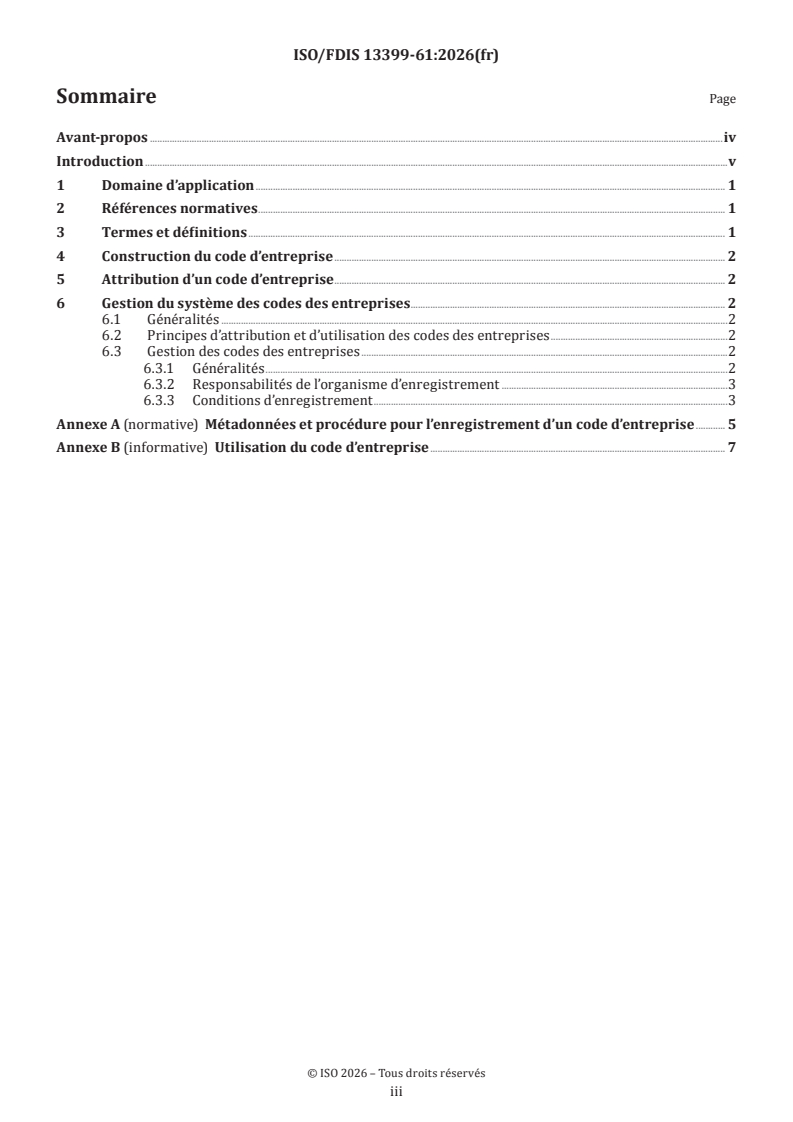
The document is organized into six main clauses and two annexes. Clause 4 covers construction of the company code, Clause 5 covers assignment, and Clause 6 covers administration of the company codes system. Annex A is normative and gives the registration metadata and process, while Annex B is informative and shows how the company code is used in practice.
| Annex | What it covers |
|---|---|
| Annex A | Metadata and process for the registration of a company code |
| Annex B | Use of the company code |
What are the key requirements of ISO 13399-61?
ISO 13399-61 requires a company code to be a controlled identifier for creating unique connection codes, not a general company identifier. In practice, this means the code is used only in the connection code defined by ISO/TS 13399-60.
Code construction and form
Clause 4 requires a company code to consist of one to four upper-case English letters. For users, this sets a strict format that keeps the code short and machine-readable.
Assignment and permanence
Clause 5 requires the registrant to provide company-specific information so the Registration Authority can complete the assignment. Once assigned, the company code shall not be altered, replaced, or re-used, so companies can rely on stable identifiers over time.
Assignment principles
Clause 6.2 says a company code shall be assigned only to an organization for the purpose of creating unique connection codes. The code must be unique to one registrant, one registrant normally has one company code, and any assigned code must remain persistent and backward compatible even if the company merges or stops operating.
Clause 6.2 also states that the company code has no legal meaning as evidence of ownership rights. That matters because the code is for data exchange, not for proving corporate rights.
Administration by the Registration Authority
Clause 6.3 assigns supervision, coordination, and administration to the Registration Authority. The Registration Authority defines the required metadata, allocates unique company codes, keeps the list current and secure, resolves duplicate assignments, handles appeals, and makes the codes and associated metadata available.
Registration conditions and metadata
Clause 6.3.3 ties registration to the principles in Clause 5 and the metadata in Annex A. It also requires current registrant information, notification of changes, and no removal or reassignment of company codes.
Registration workflow and use
Annex A outlines the registration process from user need, to application, to review and validation, to publication of the updated list. Annex B shows how the company code appears in the insert interface code and how shorter codes are padded with $ symbols.
What terms does ISO 13399-61 define?
- Company code - A code space assigned to an organization to create unique connection codes; it is typically assigned to a company manufacturing cutting tools.
- Connection code - The complete code in which the company code is used, as defined by ISO/TS 13399-60.
- Registration Authority (RA) - The body that administers company codes, validates applications, and maintains the official list.
- Registrant - The organization applying for and receiving a company code.
- Metadata - The descriptive information supplied and maintained for each company code registration.
- Trade Name (DBA-Doing Business As) - The business name used by the company in addition to its legal name.
Who uses ISO 13399-61?
ISO 13399-61 is used by organizations that exchange cutting tool data and need a controlled way to identify company-specific connection codes. It is particularly relevant to cutting tool manufacturers, because the standard notes that company codes are typically assigned to companies in that field.
The standard is also used by the Registration Authority and by people managing master data, product data, or digital catalogs for cutting tools. In practice, they use it to apply for a code, maintain the registration record, publish or consume the code list, and keep connection codes consistent across systems.
Which standards are used with ISO 13399-61?
ISO 13399-61 uses ISO/TS 13399-60, Cutting tool data representation and exchange - Part 60: Reference dictionary for connection systems. ISO/TS 13399-60 provides the reference dictionary and defines the connection code in which the company code is used, including the construction of the complete connection code and the meaning of special symbols.
What does the ISO 13399-61 document contain?
ISO 13399-61 contains the company code format rule, the assignment rule, and the governance rules for the company codes system. It also includes the required registration metadata in Annex A, which helps applicants provide a complete and consistent record.
The document gives a process view of registration in Annex A, moving from user need to application, review, validation, and publication. Annex B gives worked examples of company codes inside insert interface codes, which helps users apply the code structure correctly in software or data exchange workflows.
Clause 6.3.2 lists the Registration Authority’s operational responsibilities, including allocation, maintenance, duplicate handling, appeals, documentation, notifications, and training. That section is the practical basis for how the registry is run day to day.
Buy Documents
ISO/FDIS 13399-61 - Cutting tool data representation and exchange — Part 61: Company codes
REDLINE ISO/FDIS 13399-61 - Cutting tool data representation and exchange — Part 61: Company codes
ISO/FDIS 13399-61 - Représentation et échange des données relatives aux outils coupants — Partie 61: Codes des entreprises
Get Certified
Connect with accredited certification bodies for this standard

BSI Group
BSI (British Standards Institution) is the business standards company that helps organizations make excellence a habit.

DVS-ZERT GmbH
German welding certification society.

CARES (UK Certification Authority for Reinforcing Steels)
UK certification for reinforcing steels and construction.
Sponsored listings
Frequently Asked Questions
ISO 13399-61 is a draft published by the International Organization for Standardization (ISO). Its full title is "Cutting tool data representation and exchange — Part 61: Company codes". This standard covers: This document specifies the company codes for cutting tool data representation and exchange. It specifies a reference dictionary and the structure of company codes.
This document specifies the company codes for cutting tool data representation and exchange. It specifies a reference dictionary and the structure of company codes.
ISO 13399-61 is classified under the following ICS (International Classification for Standards) categories: 25.100.01 - Cutting tools in general; 35.240.50 - IT applications in industry. The ICS classification helps identify the subject area and facilitates finding related standards.
ISO 13399-61 is available in PDF format for immediate download after purchase. The document can be added to your cart and obtained through the secure checkout process. Digital delivery ensures instant access to the complete standard document.
Standards Content (Sample)
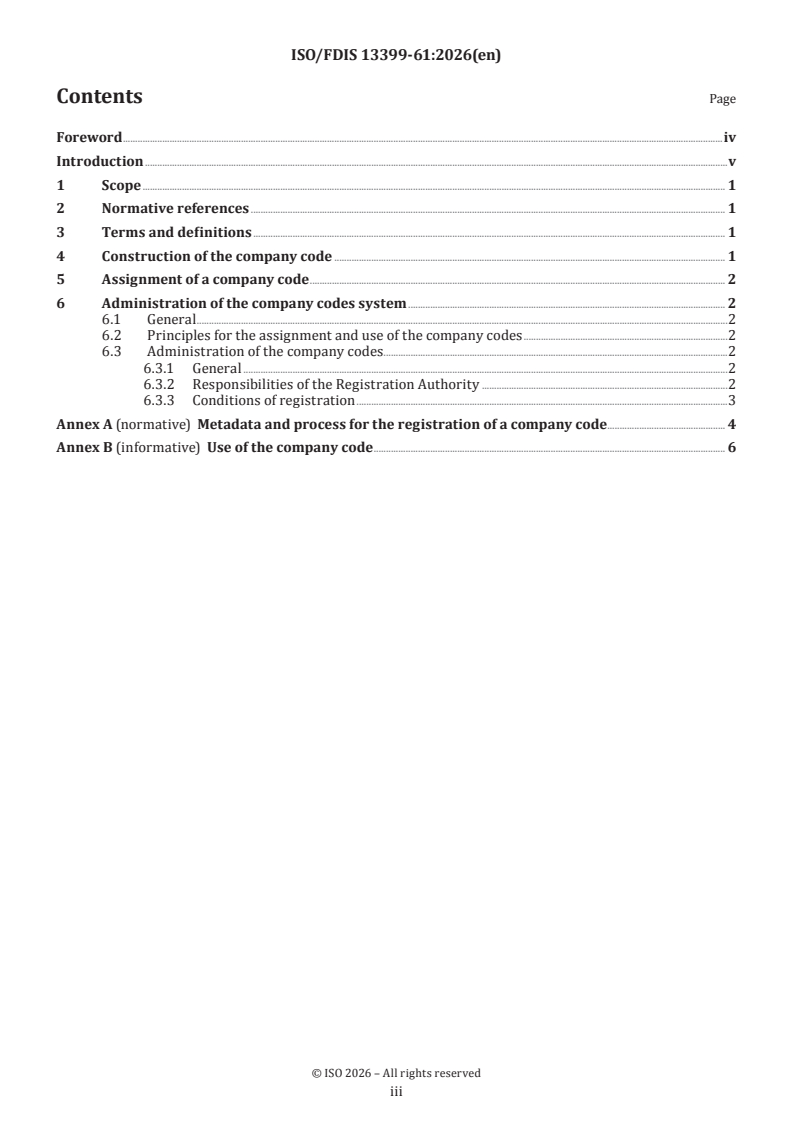
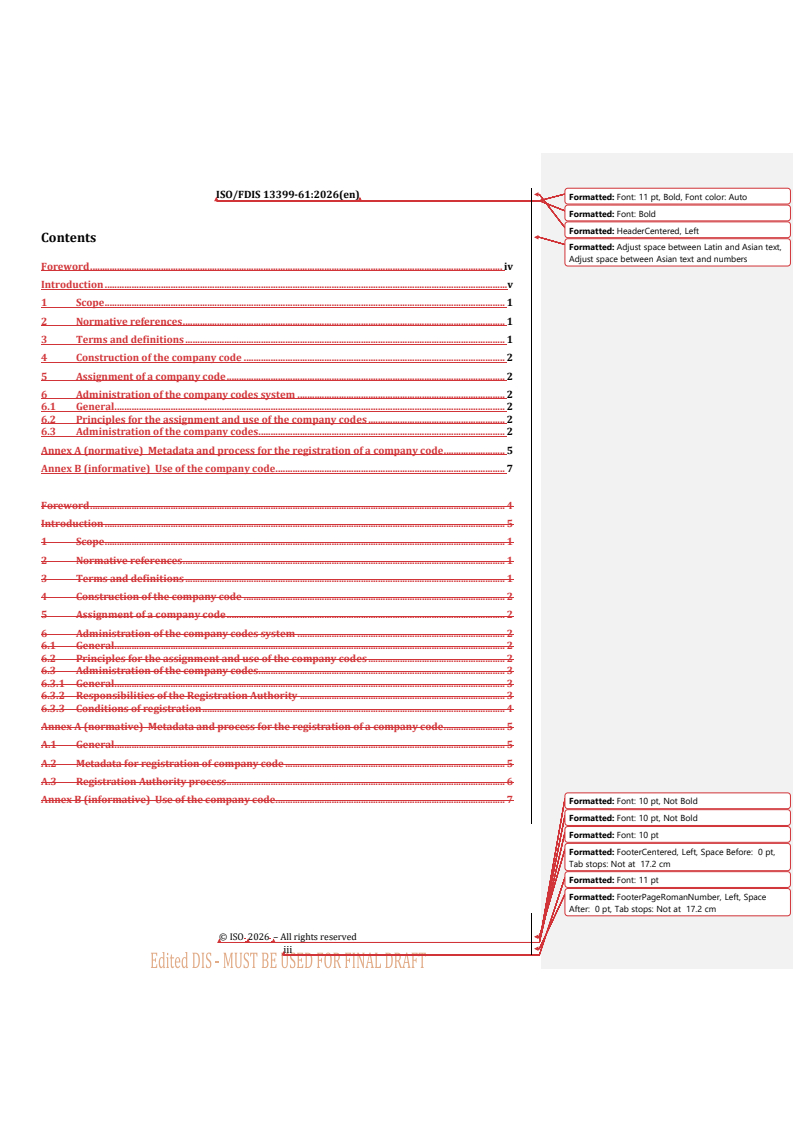
Contents
- Introduction
- 1 Scope
- 2 Normative references
- 3 Terms and definitions
- 3.1 company code
- 4 Construction of the company code
- 5 Assignment of a company code
- 6 Administration of the company codes system
- 6.1 General
- 6.2 Principles for the assignment and use of the company codes
- 6.3 Administration of the company codes
- Annex A
- Annex B
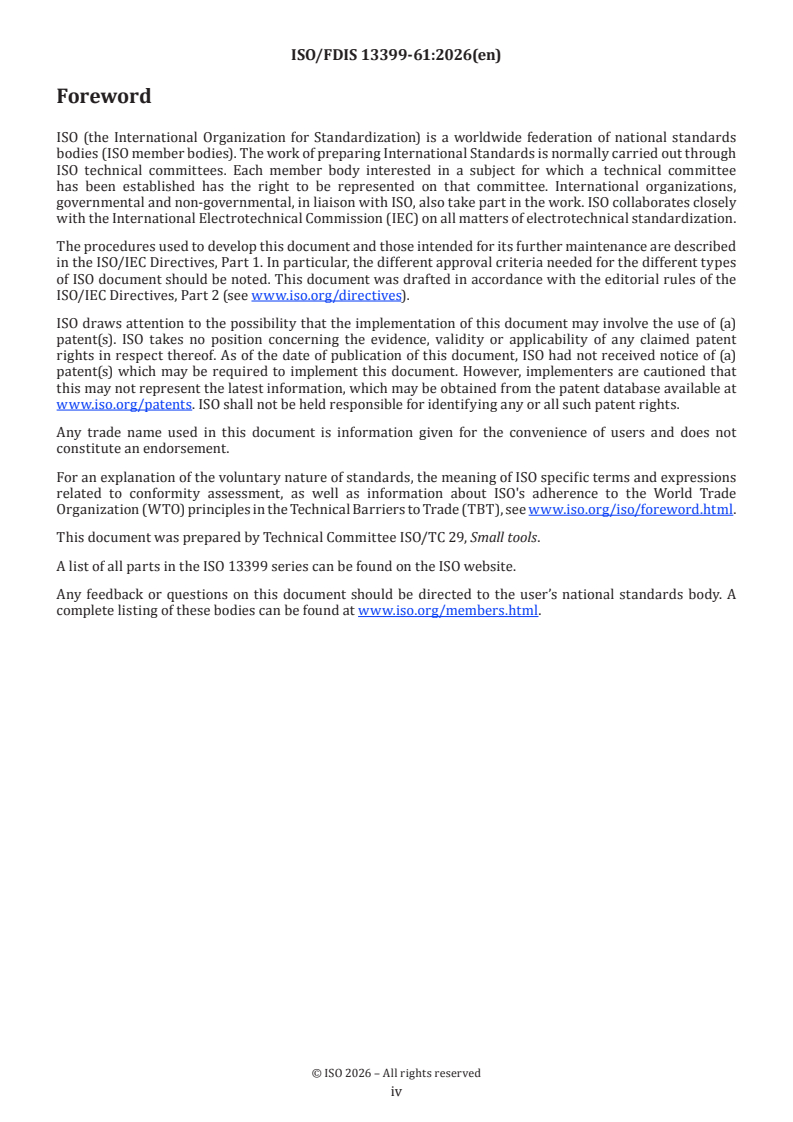
Introduction
The purpose of this document is to provide company code as a unique code space for cutting tool data representation and exchange. The implementation of this document is completed by the registration authority ISO/TC 29/RA.
A cutting tool with defined cutting edges is used on a machine to remove material from a workpiece by a shearing action at the cutting edges of the tool. Cutting tool data that can be described by the ISO 13399 series include, but are not limited to, everything between the workpiece and the machine tool. Information about inserts (e.g. regular and irregular shaped replaceable cutting items), solid tools (e.g. solid drill and solid end mill), assembled tools (e.g. boring bars, indexable drills and indexable milling cutters), adaptors (e.g. milling arbor and drilling chuck), components (e.g. shims, screws and clamps) and their relationships can be represented by the ISO 13399 series.
FINAL DRAFT International Standard ISO/FDIS 13399-61:2026(en) Cutting tool data representation and exchange — Part 61:
Company codes
1 Scope
This document establishes the specifications for the company code as a unique code space for cutting tool data representation and exchange.
It specifies the construction of the company codes, the rules for assignment, the use of metadata to be associated with the company codes allocation, and the administration of the company codes. A company code is only used in the connection code as defined by ISO/TS 13399-60. NOTE 1 The use of the company code is illustrated in Annex B.
2 Normative references
The following document is referred to in the text in such a way that some or all its content constitutes requirements of this document. For dated references, only the edition cited applies. For undated references, the latest edition of the referenced document (including any amendments) applies. ISO/TS 13399-60, Cutting tool data representation and exchange — Part 60: Reference dictionary for connection systems
3 Terms and definitions
For the purposes of this document, the terms and definitions given in ISO/TS 13399-60 and the following apply.
ISO and IEC maintain terminology databases for use in standardization at the following addresses:
- ISO Online browsing platform: available at https:// www .iso .org/ obp
- IEC Electropedia: available at https:// www .electropedia .org/
3.1 company code
code space assigned to an organisation with the purpose of creating unique connection codes Note 1 to entry: A company code is typically assigned to a company manufacturing cutting tools. Note 2 to entry: The purpose of company code is not to identify an organization. Note 3 to entry: The code space is assigned by the designated registration authority. Note 4 to entry: The creation of connection codes is specified in ISO/TS 13399-60.
4 Construction of the company code
A company code shall be assigned in accordance with the specifications of 6.2. A company code shall consist of one to maximum four upper-case English letters.
ISO/FDIS 13399-61:2026(en)
5 Assignment of a company code
5.1 As part of the application for a company code, the registrant shall supply information specific to the company according to the specification and direction of the registration authority in order to allow the completion of registration into company code assignment records (see Annex A). 5.2 Once a company code is assigned, it shall not be altered, replaced, or re-used.
...
Contents
- Introduction
- 1 Scope
- 2 Normative references
- 3 Terms and definitions
- 4 Construction of the company code
- 5 Assignment of a company code
- 6 Administration of the company codes system Adjust space between Asian text and numbers
- 6.1 General
- 6.2 Principles for the assignment and use of the company codes
- 6.3 Administration of the company codes
- Annex A
- Annex B
Introduction
The purpose of this document is to provide company code as a unique code space for cutting tool data representation and exchange. The implementation of this document is completed by the Registration Authorityregistration authority ISO/TC 29/RA.
A cutting tool with defined cutting edges is used on a machine to remove material from a workpiece by a shearing action at the cutting edges of the tool. Cutting tool data that can be described by the ISO 13399 series Formatted: Default Paragraph Font include, but are not limited to, everything between the workpiece and the machine tool. Information about Formatted: Default Paragraph Font inserts (e.g. regular and irregular shaped replaceable cutting items), solid tools (e.g. solid drill and solid end Formatted: Default Paragraph Font mill), assembled tools (e.g. boring bars, indexable drills and indexable milling cutters), adaptors (e.g. milling arbor and drilling chuck), components (e.g. shims, screws and clamps) and their relationships can be represented by the ISO 13399 series.
Formatted: Default Paragraph Font Formatted: Default Paragraph Font
Formatted: Default Paragraph Font
Formatted: Font: 10 pt, Not Bold Formatted: Font: 10 pt, Not Bold Formatted: Font: 10 pt Formatted: FooterCentered, Left, Space Before: 0 pt, Tab stops: Not at 17.2 cm Formatted: Font: 11 pt Formatted: FooterPageRomanNumber, Left, Space After: 0 pt, Tab stops: Not at 17.2 cm
DRAFT International Standard ISO/FDIS 13399-61:2026(en)
Formatted: Font: Not Bold Formatted: Header, Space After: 0 pt, Line spacing:
single Cutting tool data representation and exchange — — Formatted: Main Title 2, Adjust space between Latin Part 61:
and Asian text, Adjust space between Asian text and Company codes numbers Formatted: Left: 1.5 cm, Right: 1.5 cm, Bottom: 1 cm,
1 Scope
Header distance from edge: 1.27 cm, Footer distance from edge: 0.5 cm This document establishes the specifications for the company code as a unique code space for cutting tool data representation and exchange.
It specifies the construction of the company codes, the rules for assignment, the use of metadata to be Formatted: Default Paragraph Font associated with the company codes allocation, and the administration of the company codes. A company code is only used in the connection code as defined by ISO/TS 13399-60. Formatted: Adjust space between Latin and Asian text, Adjust space between Asian text and numbers, Tab
stops: Not at 0.7 cm + 1.4 cm + 2.1 cm + 2.8 cm + 3.5 cm + 4.2 cm + 4.9 cm + 5.6 cm + 6.3 cm + 7 cm NOTE 1: The use of the company code is illustrated in Annex B.Annex B. Formatted: Adjust space between Latin and Asian text, Adjust space between Asian text and numbers
2 Normative references
Formatted: Default Paragraph Font The following document is referred to in the text in such a way that some or all its content constitutes Formatted: Default Paragraph Font requirements of this document. For dated references, only the edition cited applies. For undated references, Formatted: Adjust space between Latin and Asian text, the latest edition of the referenced document (including any amendments) applies. Adjust space between Asian text and numbers, Tab stops: Not at 0.7 cm + 1.4 cm + 2.1 cm + 2.8 cm + ISO/TS 13399--60, Cutting tool data representation and exchange — Part 60: Reference dictionary for 3.5 cm + 4.2 cm + 4.9 cm + 5.6 cm + 6.3 cm + 7 cm connection systems Formatted: Adjust space between Latin and Asian text, Adjust space between Asian text and numbers
3 Terms and definitions
Formatted: Default Paragraph Font For the purposes of this document, the terms and definitions given in ISO/TS 13399-60 and the following Formatted: Adjust space between Latin and Asian text, apply.
Adjust space between Asian text and numbers, Tab stops: Not at 0.7 cm + 1.4 cm + 2.1 cm + 2.8 cm + ISO and IEC maintain terminology databases for use in standardization at the following addresses:
3.5 cm + 4.2 cm + 4.9 cm + 5.6 cm + 6.3 cm + 7 cm Formatted: TermNum2, Adjust space between Latin - — ISO Online browsing platform: available at https://www.iso.org/obphttps://www.iso.org/obp and Asian text, Adjust space between Asian text and numbers - — IEC Electropedia: available at https://www.electropedia.org/https://www.electropedia.org/ Formatted: Font: 10 pt 3.1 3.1 Formatted: Font: 10 pt company code Formatted: Adjust space between Latin and Asian text, code space assigned to an organisation with the purpose of creating unique connection codes Adjust space between Asian text and numbers, Tab stops: Not at 0.7 cm + 1.4 cm + 2.1 cm + 2.8 cm + Note 1 to entry: A company code is typically assigned to a company manufacturing cutting tools. 3.5 cm + 4.2 cm + 4.9 cm + 5.6 cm + 6.3 cm + 7 cm Note 2 to entry: The purpose of company code is not to identify an organization. Formatted: Font: 10 pt Formatted: Font: 10 pt Note 3 to entry: The code space is assigned by the designated registration authority. Formatted: Font: 10 pt Note 4 to entry: The creation of connection codes is specified in ISO/TS 13399-60. Formatted: Footer, Left, Space After: 0 pt, Tab stops:
Not at 17.2 cm
ISO/FDIS 13399-61:2026(en) Formatted: Font: Bold Formatted: HeaderCentered
4 Construction of the company code
Formatted: Adjust space between Latin and Asian text, Adjust space between Asian text and numbers A company code shall be assigned in accordance with the specifications of 6.2.6.2. A company code shall Formatted: Font: 11 pt, Not Bold consist of one to maximum four upper-case English letters.
Formatted: Adjust space between Latin and Asian text, Adjust space between Asian text and numbers, Tab
5 Assignment of a company code
stops: Not at 0.7 cm + 1.4 cm + 2.1 cm + 2.8 cm + 3.5 cm + 4.2 cm + 4.9 cm + 5.6 cm + 6.3 cm + 7 cm 5.1 5.1 As part of the application for a company code, the registrant shall supply information specific to the company according to the specification and direction of the registration authority in order to Formatted: Font: Not Bold allow the completion of registration into company code assignment records (see Annex A).Annex A). Formatted: Font: 11 pt, Not Bold Formatted: Font: Not Bold 5.2 5.2 Once a company code is assigned, it shall not be altered, replaced, or re-used. Formatted: Adjust space between Latin and Asian text,
6 Administration of the company codes system Adjust space between Asian text and numbers
Formatted: Adjust space between Latin and Asian text,
6.1 General
Adjust space between Asian text and numbers, Tab stops: Not at 0.71 cm The details of the registration authority are stated at:
...
Contents
- Introduction
- 1 Domaine d’application
- 2 Références normatives
- 3 Termes et définitions
- 3.1 code d’entreprise
- 4 Construction du code d’entreprise
- 5 Attribution d’un code d’entreprise
- 6 Gestion du système des codes des entreprises
- 6.1 Généralités
- 6.2 Principes d’attribution et d’utilisation des codes des entreprises
- 6.3 Gestion des codes des entreprises
- Annexe A
- Annexe B
Introduction
L'objectif du présent document est de fournir un code d'entreprise qui soit un espace de codification unique pour la représentation et l'échange de données relatives aux outils coupants. La mise en œuvre du présent document est assurée par l'autorité d'enregistrement ISO/TC 29/RA. Un outil coupant à arêtes coupantes définies est utilisé sur une machine pour enlever de la matière sur une pièce par une action de coupe au niveau des arêtes coupantes de l'outil. Les données relatives aux outils coupants pouvant être décrites dans la série ISO 13399 incluent, mais n'y sont pas limitées, tout ce qui se situe entre la pièce et la machine-outil. Les informations concernant les plaquettes (par exemple, des éléments coupants amovibles de forme régulière ou irrégulière), les outils monoblocs (par exemple, des forets monoblocs et des fraises cylindriques 2 tailles monoblocs), les outils assemblés (par exemple, des barres d'alésage, des forets et des fraises à plaquettes amovibles), les attachements (par exemple, des mandrins porte-fraise et des mandrins porte-foret), les accessoires (par exemples, des cales, des vis et des brides), et leurs relations peuvent être indiquées dans la série ISO 13399.
PROJET FINAL Norme internationale ISO/FDIS 13399-61:2026(fr) Représentation et échange des données relatives aux outils coupants — Partie 61:
Codes des entreprises
1 Domaine d’application
Le présent document établit les spécifications des codes des entreprises en tant qu'espace de code unique pour la représentation et l'échange de données relatives aux outils coupants. Il spécifie la construction des codes des entreprises, les règles d'attribution, l'utilisation des métadonnées à associer à l'attribution des codes des entreprises, ainsi que la gestion des codes des entreprises. Un code d'entreprise n'est utilisé que dans le code de connexion tel que défini par l'ISO/TS 13399-60. NOTE 1 L'utilisation des codes des entreprises est illustrée dans l'Annexe B.
2 Références normatives
Le document suivant est cité dans le texte de sorte qu’il constitue, pour tout ou partie de son contenu, des exigences du présent document. Pour les références datées, seule l’édition citée s’applique. Pour les références non datées, la dernière édition du document de référence s'applique (y compris les éventuels amendements). ISO/TS 13399-60, Représentation et échange des données relatives aux outils coupants — Partie 60: Dictionnaire de référence pour les systèmes de connexion
3 Termes et définitions
Pour les besoins du présent document, les termes et définitions de l'ISO/TS 13399-60 ainsi que les suivants s’appliquent.
L'ISO et l'IEC tiennent à jour des bases de données terminologiques destinées à être utilisées en normalisation, consultables aux adresses suivantes:
- ISO Online browsing platform: disponible à l'adresse https:// www .iso .org/ obp
- IEC Electropedia: disponible à l'adresse https:// www .electropedia .org/
3.1 code d’entreprise
espace de code attribué à une organisation dans le but de créer des codes de connexion uniques Note 1 à l'article: Un code d’entreprise est typiquement attribué à une entreprise qui produit des outils coupants. Note 2 à l'article: L’objectif d’un code d’entreprise n’est pas d’identifier une organisation. Note 3 à l'article: L’espace de code est attribué par l’organisme d’enregistrement désigné. Note 4 à l'article: La création des codes de connexion est spécifiée dans l’ISO/TS 13399-60.
ISO/FDIS 13399-61:2026(fr)
4 Construction du code d’entreprise
Un code d’entreprise doit être attribué conformément aux spécifications du 6.2. Un code d’entreprise doit être constitué de une à quatre lettres anglaises maximum, en majuscules.
5 Attribution d’un code d’entreprise
5.1 Dans le cadre de la procédure de demande d’un code d’entreprise, le déclarant doit fournir les informations spécifiques à l’entreprise conformément aux spécifications et aux instructions de l’organisme d’enregistrement, afin de permettre de compléter l’enregistrement dans les registres d’attribution de code d’entreprise (voir Annexe A).
5.2 Une fois qu’un code d’entreprise a été attribué, il ne doit pas être modifié, remplacé ou réutilisé.
6 Gestion du système des codes des entreprises
6.1 Généralités
Le détail des organismes d’enregistrement est spécifié à l’adresse: https:// www .iso .org/ fr/ maintenance _agencies .html.
...