


ISO/IEC TR 11735:1996
(Main)Information technology — Extensions for real-time Ada
Information technology — Extensions for real-time Ada
Is intended to define a standard Ada library for hard real time (HRT) to support application portability at the source level. This is intended for application software developers as well as for Ada real time executive developers.
Technologies de l'information — Extensions temps réel Ada
General Information
- Status
- Withdrawn
- Publication Date
- 13-Nov-1996
- Withdrawal Date
- 13-Nov-1996
- Technical Committee
- ISO/IEC JTC 1/SC 22 - Programming languages, their environments and system software interfaces
- Drafting Committee
- ISO/IEC JTC 1/SC 22/WG 9 - Ada
- Current Stage
- 9599 - Withdrawal of International Standard
- Start Date
- 01-Oct-2003
- Completion Date
- 12-Feb-2026
Get Certified
Connect with accredited certification bodies for this standard

BSI Group
BSI (British Standards Institution) is the business standards company that helps organizations make excellence a habit.

NYCE
Mexican standards and certification body.
Sponsored listings
Frequently Asked Questions
ISO/IEC TR 11735:1996 is a technical report published by the International Organization for Standardization (ISO). Its full title is "Information technology — Extensions for real-time Ada". This standard covers: Is intended to define a standard Ada library for hard real time (HRT) to support application portability at the source level. This is intended for application software developers as well as for Ada real time executive developers.
Is intended to define a standard Ada library for hard real time (HRT) to support application portability at the source level. This is intended for application software developers as well as for Ada real time executive developers.
ISO/IEC TR 11735:1996 is classified under the following ICS (International Classification for Standards) categories: 35.060 - Languages used in information technology. The ICS classification helps identify the subject area and facilitates finding related standards.
ISO/IEC TR 11735:1996 is available in PDF format for immediate download after purchase. The document can be added to your cart and obtained through the secure checkout process. Digital delivery ensures instant access to the complete standard document.
Standards Content (Sample)
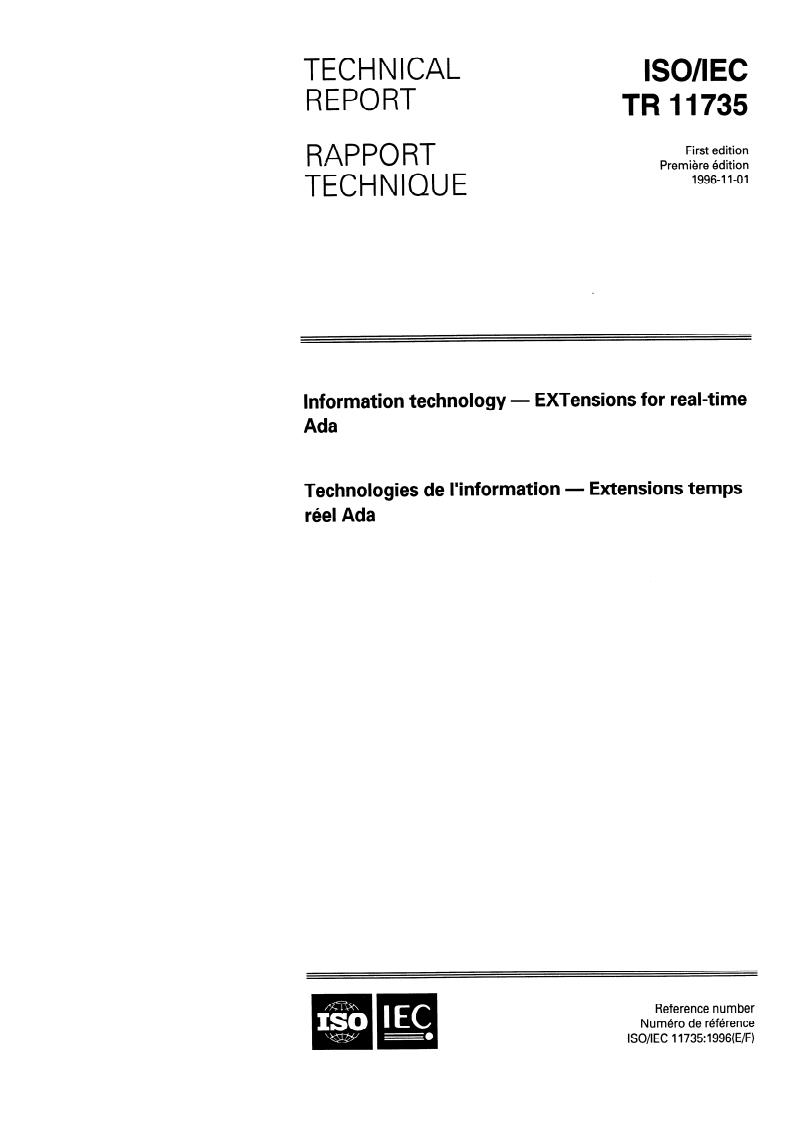
TECHNICAL
ISOAEC
REPORT
TR 11735
First edition
R.APPORT
Premihre kdition
1996-l l-01
TECHNIQUE
Information technology - EXTensions for real-time
Ada
Technologies de I’information - Extensions temps
reel Ada
Reference number
Num&o de rbfkrence
lSO/IEC 11735:1996(E/F)
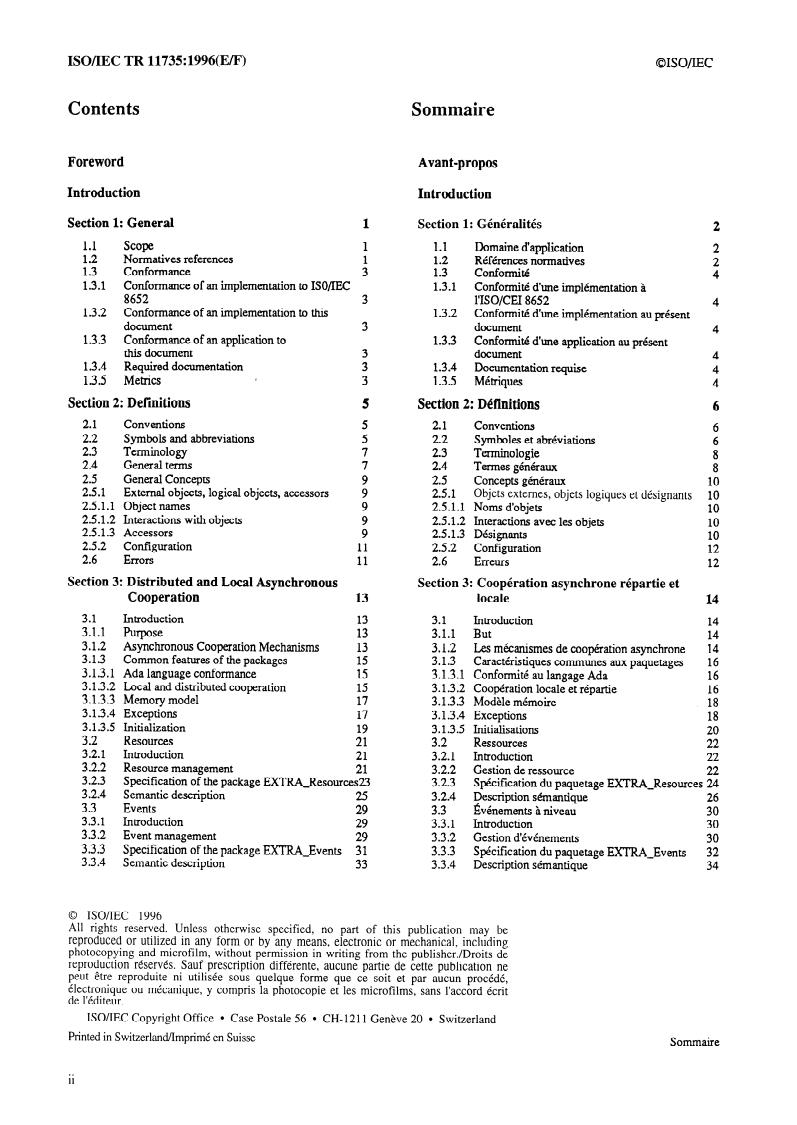
Contents Sommaire
Avant-propos
Foreword
Introduction
Introduction
Section 1: Generai 1 Section 1: G&dralit6s
scope 1 1.1 Domaine d’application
1.1 2
Normatives references 1 1.2 References normatives
1.2 2
1.3 Conformance 3 1.3 confomlit6
Conformance of an implementation to ISO/IEC 1.3.1 Conformiti dune implementation a
1.3.1
l’ISO/CEI 8652
8652 4
1.3.2 Conformance of an implementation to this 1.3.2 Conformiti d’une implementation au present
3 document
document 4
1.3.3 Conformiti dune application au present
1.3.3 Conformance of an application to
this document 3 document
3 1.3.4 Documentation requise
1.3.4 Required documentation 4
!
3 1.3.5 Metriques
1.3.5 Metrics 4
Section 2: Definitions 5 Section 2: D&initions
2.1 Conventions 5 2.1 Conventions 6
2.2 Symbols and abbreviations 5 2.2 Symboles et abreviations
2.3 Terminology 7 2.3 Terminologie
2.4 General terms 7 2.4 Termes generaux
General Concepts Concepts generaux
2.5 9 2.5 10
logical objects, Objets externes, objets logiques et designants
2.5.1 External obje&, accessors 9 2.5.1 10
2.5.1.1 Object names 9 Noms d’objets
2.5.1.1 10
Interactions with objects Interactions avec les objets
2.5.1.2 9 2.5.1.2 10
Accessors
2.5.1.3 9 2.5.1.3 D&ignants 10
2.5.2 Configuration 11
2.5.2 Configuration 12
2.6 Errors
11 2.6 Eneurs 12
Section 3: Coopkation asynchrone rkpartie et
Section 3: Distributed and Local Asynchronous
locale
13 14
Cooperation
3.1
Introduction 13 3.1 Introduction 14
3.1.1 13 3.1.1 But 14
Purpose
3.1.2 Asynchronous Cooperation Mechanisms 13 3.1.2 Les mecanismes de cooperation asynchrone 14
3.1.3 Common features of the packages 15 3.1.3 Caracteristiques communes aux paquetages 16
3.1.3.1 Ada language conformance 15 3.1.3.1 Conformite au langage Ada 16
3.1.3.2 Local and distributed cooperation 15 3.1.3.2 Coop&ation locale et repartie
3.1.3.3 17 3.1.3.3 ModYe memoire 18
Memory model
3.1.3.4
Exceptions 17 3.1.3.4 Exceptions 18
3.1.3.5 19 3.1.3.5 Initialisations 20
Initialization
3.2
21 3.2 Ressources 22
Resources
3.2.1 21 3.2.1 Introduction 22
Introduction
3.2.2 management 21 3.2.2 Gestion de ressource 22
Resource
3.2.3 Specification of the package EXTRA-Resources23
3.2.3 Sp&ification du paquetage EXTRA-Resources 24
3.2.4 25 3.2.4 26
Semantic description Description s&nantique
3.3 gvenements a niveau 30
Events 29 3.3
3.3.1 29 3.3.1 30
Introduction Introduction
3.3.2 management 30
Event 29 3.3.2 Gestion d’evenements
3.3.3 Specification of the package EXTRA_Events
31 3.3.3 Sp&fication du paquetage EXTRA-Events 32
3.3.4
33 3.3.4 34
Semantic description Description s&nantique
0 ISO/IEC 1996
All rights reserved. Unless otherwise specified, no part of this publication may be
reproduced or utilized in any form or by any means, electronic or mechanical, including
photocopying and microfilm, without permission in writing from the publisher./Droits de
reproduction reserves. Sauf prescription differente, aucune partie de cette publication ne
peut etre reproduite ni utilisee sous quelque forme que ce soit et par aucun procede,
electronique ou mecanique, y compris la photocopie et les microfilms, sans l’accord &x-it
de l’edi teur.
ISO/IEC Copyright Office l Case Postale 56 l CH-1211 Geneve 20 l Switzerland
Printed in Switzerland/‘Imprime en Suisse
Sommaire
ii
0 ISO/IEC ISOAEC TR 11735:1996(E/F)
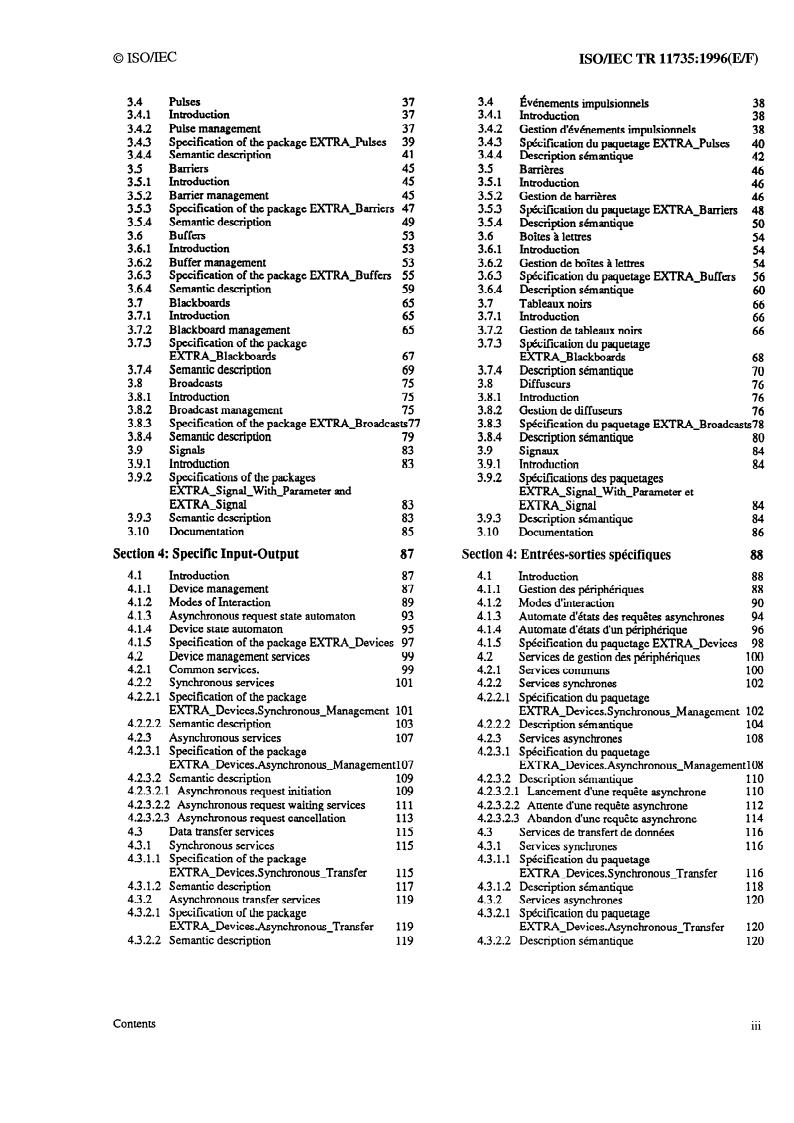
Pulses 37 3.4
3.4 &&rements impulsionnels 38
Introduction 37 3.4.1
3.4.1 IntroduCtiOll 38
3.4.2 Pulse management 37 3.4.2 Gestion d’bhements impulsionnels
Specification of the package EXTRAJulses 39 3.43
3.43 Sp&ification du paquetage EXTRAJulses 40
3.4.4 Semantic description 41 3.4.4 Description sbrnantique
Barriers 45 3.5 Barr&es
35 46
Introduction 45 3.5.1 Introduction
35.1 46
35.2 Barrier management 45 3.5.2 Gestion de barri&=
353 Specification of the package EXTRA~Barriers 47 3.53 Spbcification du paquetage EXTRA-Barriers 48
Semantic description 49 3.5.4 Description shantique
35.4 50
3.6 Buffers 53 3.6 Bobs a lettres 54
3.6.1 Introduction 53 3.6.1 IIltdllCtiOIl 54
3.6.2 Buffer management 53 3.6.2 Gestion de bobs B lettres
3.6.3 Specification of the package EXTRA-Buffers 3.63 Sp&f%ation du paquetage EXTRA_Buffers 56
3.6.4 Semantic description 59 3.6.4 Description s&nantique 60
3.7 Blackboards 65 3.7 Tableaux no&s
3.7.1 Introduction 65 3.7.1 Introduction 66
3.7.2 Blackboard management 65 3.7.2 Gestion de tableaux noirs
3.73 Specification of the package 3.7.3 SptZcification du paquetage
EXTRA~Blackboards 67 EXTRA Blackboards
3.7.4 Semantic description 69 3.7.4 Description s&nantique
Broadcasts 75 3.8 Diffuseurs
3.8 76
3.8.1 Introduction 75 3.8.1 Introduction 76
3.8.2 Broadcast management 75 3.8.2 Gestion de difiseurs 76
3.83 Specification of the package EXTRA-Broadcasts77 3.8.3 Sp&ification du paquetage EXTRA-Broadcasts78
3.8.4 Semantic description 79 3.8.4 Description s&nantique 80
3.9 Signals 83 3.9 Signaux 84
Introduction 83 3.9.1 Introduction
3.9.1 84
3.9.2 Specifications of the packages 3.9.2 Sp6cifications des paquetages
ExTRA&naI_With Parameter and EXTRA Signal With Parameteret
EXTR&Signal - 83 EXTRA~Signal- - 84
Semantic description 83 3.9.3 Description s&nantique 84
3.93
Documentation 3.10
3.10 85 Documentation 86
Section 4: Entrges-sorties spkcifiques
Section 4: Specific Input-Output 87 88
4.1
4.1 Introduction 87 Introduction 88
87 4.1.1 Gestion des p&iph&iques 88
4.1.1 Device management
89 4.1.2 Modes d&era&on 90
4.1.2 Modes of Interaction
4.1.3 Asynchronous request state automaton 4.1.3 Automate d’etats des requetes asynchrones 94
4.1.4 Device state automaton 95 4.1.4 Automate d’&ats dun p&iph&ique 96
4.15 Specification of the package EXTRA-Devices 97 4.1.5 Sp&fication du paquetage EXTRA Devices 98
Device management services 4.2 Services de gestion des p&iphCriqu~ 100
4.2 99
4.2.1 Common services. 4.2.1 Services communs 100
4.22 Synchnmous services 101 4.2.2 Services synchrones
4.2.2.1 Specification of the package 4.2.2.1 Sp&fication du paquetage
EXTR&Devices.Synchronous~Management 101 EXTRAJevices.Synchronous Management 102
4.2.2.2 Semantic description 103 4.2.2.2 Description s&nantique - 104
4.2.3 Asynchronous services 107 4.2.3 Services asynchrones 108
4.2.3.1 Specification of the package 4.2.3.1 Sficification du paquetage
EXTRAJIevices.Asynchronous-Management107 EXTRA-Devices.Asynchronous Management108
4.2.3.2 Semantic description 4.2.3.2 Description semantique - 110
4.2.3.2.1 Asynchronous request initiation 109 4.2.3.2.1 Lancement dune requste asynchrone 110
4.2.3.2.2 Asynchronous request waiting services 111 4.2.3.2.2 Attente dune requete asynchrone 112
4.2.3.2.3 Asynchronous request cancellation 4.2.3.2.3 Abandon d’une requete asynchrone 114
Data transfer services 115 4.3 Services de transfert de don&es 116
4.3.1 Synchronous services 4.3.1 Services synchrones 116
4.3.1.1 Specification of the package 4.3.1.1 Sp6cification du paquetage
EXTRAJIevicesSynchronous-Transfer 115 EXTRADevices.Synchronous Transfer
4.3.1.2 Semantic description 117 4.3.1.2 Description s&mantique -
4.3.2 Asynchronous transfer services 119 4.3.2 Services asynchrones 120
4.3.2.1 Specification of the package 4.3.2.1 Sp&fication du paquetage
EXTRADevices.Asynchronous_Transfer 119 EXTRA DevicesAsynchronous Transfer 120
4.3.2.2 Semantic description 119 4.3.2.2 Description s&nantique - 120
. . .
Contents
0 ISOAEC
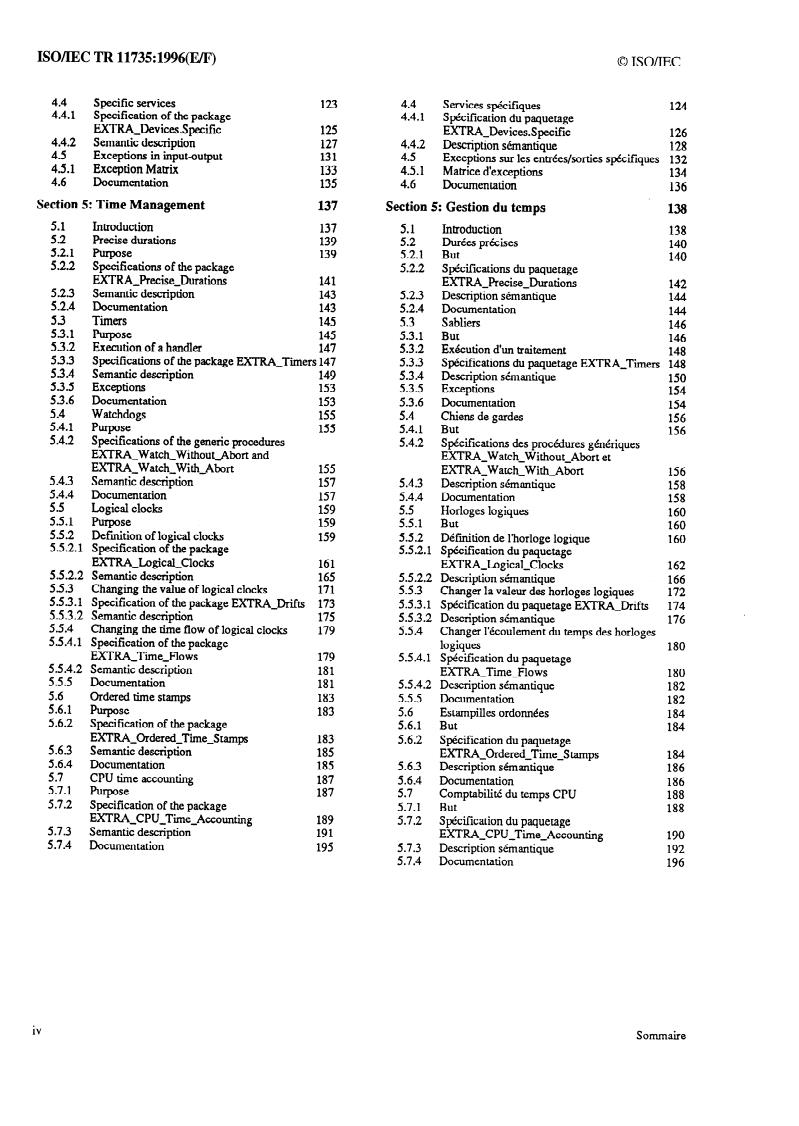
4.4 Specific services 123 4.4 Services sp&ifiques 124
4.4.1
4.4.1 Specification of the package Sphfication du paquetage
125 EXTRA Devices.Specific 126
EXTRA-Devices.Specific
127 4.4.2 DescriptLn sbmantique 128
4.4.2 Semantic description
4.5
131 Exceptions sur les entrees/sorties @cifiques 132
4.5 Exceptions in input-output
4.5.1
133 Matrice d’exceptions 134
4.5.1 Exception Matrix
135 4.6 Documentation 136
4.6 Documentation
137 Section 5: Gestion du temps 138
Section 5: Time Management
5.1
137 5.1 Introduction 138
Introduction
5.2 5.2
139 Dunks prkcises 140
Precise durations
52.1
139 5.2.1 But 140
Purpose
5.2.2 Specifications of the package 5.2.2 Sp&ifications du paquetage
EXTRA PreciseDurations EXTRA Precise Durations
141 142
143 5.2.3 Description s&nZique
5.2.3 144
Semanti~description
52.4 143 5.2.4 Documentation
Documentation 144
53 145 5.3 Sabliers 146
Timers
53.1 145 5.3.1 But 146
Purpose
53.2 Execution of a handler 147 5.3.2 Execution d’un traitement
53.3 Specifications of the package m-Timers 147 5.3.3 Specifications du paquetage EXTRA-Timers 148
5.3.4 Description Gmantique
53.4 149 150
Semantic description
5.3.5 153 5.35 Exceptions
Exceptions 154
5.3.6 153 5.3.6 Documentation
Documentation 154
5.4 155 5.4 Chiens de gardes
Watchdogs
5.4.1 155 5.4.1 But 156
Purpose
5.4.2 Specifications of the generic procedures 5.4.2 Specifications des procedures g&&iques
EXTRA Watch-Without Abort and EXTRA Watch Without Abort et
EIURA-Watch With Abort 155 EXTRA-Watch-With Abort
5.4.3
- 157 5.4.3 Description sem%iqui 158
Semanti~descri~tion
5.4.4
157 5.4.4 Documentation 158
Documentation
5.5
159 5.5 Horloges logiques 160
Logical clocks
5.5.1 159 5.5.1 But 160
Purpose
5.5.2 Definition of logical clocks 159 5.5.2 D&ftition de l‘horloge logique 160
- .-
5.5.2.1 Specification of the package 5.5.2.1 Specification du paquetage
161 EXTRA-bgical Clocks 162
EXTRAJ~gical~Clocks
165 5.5.2.2 Description Grn~tique 166
5.5.2.2 Semantic description
55.3 Changing the value of logical clocks 171 5.5.3 Changer la valeur des horloges logiques 172
5.5.3.1 Specification of the package EXTRA-Drifts 173 5.5.3.1 Sp&fication du paquetage EXTRADrifts 174
175 5.5.3.2 Description semantique 176
5.5.3.2 Semantic description
5.5.4 Changing the time flow of logical clocks 5.5.4 Changer l’ecoulement du temps des horloges
5.5.4.1 Specification of the package
logiques 180
EXTRA Time Flows 179 5.5.4.1 Specification du paquetage
181 EXTRA Time Flows 180
5.5.4.2 Semanticdes&&tion
5.5.5 Documentation- 181 5.5.4.2 Description s&Lntique 182
5.6 Ordered time stamps 183 5.5.5 Documentation 182
5.6.1 183 5.6 Estampilles ordonnees 184
Purpose
5.6.2 Specification of the package 5.6.1 But 184
EXTRA~Ordered_Time_Stamps 183
5.6.2 Specification du paquetage
5.6.3 Semantic description 185 184
EXTRA-Ordered-Time-Stamps
5.6.4 Documentation 185 186
5.6.3 Description sernantique
5.7
CPU time accounting 187 5.6.4 Documentation 186
5.7.1 Purpose
187 5.7 Comptabilite du temps CPU 188
5.7.2
Specification of the package 5.7.1 But 188
EXTRA-CPU-Time_Accounting 189 5.7.2 SpGfication du paquetage
5.7.3
Semantic description 191 EXTRA-CPU-Time-Accounting 190
5.7.4
Documentation 195 5.7.3 Description s&antique 192
5.7.4 Documentation 196
Sommaire
0 ISO/lEC
ISOAEC TR 11735: 1996(E/F)
Section 6: Task Dispatching Management
Section 6: Gestion de l’ordonnancement
des tkhes
Introduction 197 6.1 IlltYOdUCtiOIl
6.1 198
6.2
6.2 Task identities 199 Identitk des tihes 200
6.2.1 Exceptions 199 6.2.1 Exceptions 200
6.2.2 Specification of the package 6.2.2 Spbcification du paquetage
EXTRA-Task-Identification 199 EXTRA Task Identification 200
6.2.3 Semantic description 201 6.2.3 Description s&antique 202
6.2.4 Documentation 201 6.2.4 Documentation 202
63 Pre-emption control 203 6.3 Contile de la pr&mption 204
63.1 Specification of the package 6.3.1 Sp&ification du paquetage
EXIRAJkpatching 203 EXTRAJispatching 204
6.3.2 Semantic description 203 6.3.2 Description Anantique 204
6.3.3 Documentation 203 6.3.3 Documentation 204
6.4 Task suspension 205 6.4 Suspension de tiche 206
6.4.1
6.4.1 Specification of the package Sp&fication du paquetage
EXTRA&y&ronous Task-Control
EXTRA-Asynchronous-Task-Control 205 206
6.4.2
6.4.2 Semantic description 205 Description Anantique- 206
6.43
6.4.3 Documentation 205 Documentation 206
6.5 Dynamic priorities 207 6.5 Priori&s dynamiques 208
6.5.1
6.5.1 Specification of the package Sp&ification du paquetage
EXTIUJynamicJriorities
EXTRAJynamicJ’riorities 207 208
6.5.2 Semantic description 207 6.5.2 Description Anantique 208
6.3.3 Documentation 207 6.5.3 Documentation 208
Section 7: Gestion des interruptions
Section 7: Interrupt Management 209 210
7.1 Introduction 209 7.1 Introduction 210
7.1.1 Operations on interrupts 211 7.1.1 Opbrations sur les interruptions 212
7.1.2 Execution of an interrupt handler 211 7.1.2 Exdcution d’un t&e-interruption 212
7.1.3 Exception Invalid_oPeration 211 7.13 Exception Invalid-Operation 212
7.2 Specification of the package 7.2 Sp&ification du paquetage
ExTRAJnteRupts 213 EXRAJlltermptS 214
7.3 Semantic description 217 7.3 Description Anantique 218
7.4 Documentation 225 7.4 Documentation 226
Section 8: Memory Management 227 228
Section 8: Gestion de la mkmoire
8.1 Introduction 227 8.1 Introduction 228
8.2 Memory management 229 8.2 Gestion de la mkmoire 230
8.2.1 Operations on different kinds 8.2.1 Op&ations sur les diffdrentes sortes
of memories 229 de m&noires 230
Exceptions 8.2.2 Exceptions 230
8.2.2 229
Configuration 8.2.3 Configuration 230
8.2.3 229
Specification of the package 8.3 Sp&ification du paquetage
8.3
EXTRA-Memories EXTRA-Memories 232
Semantic description 8.4 Description Anantique 234
8.4 233
Documentation 8.5 Documentation 240
8.5 239
Annex A : Requirements 241 Annexe A : Expressions de besoin 242
Annex B : Relationship with Annexe B: Relations avec la
revised ISO/IEC 8652 275 &vision de l’ISO/CEI 8652 276
.
Annexe C . Relations avec
Annex C : Relationship with
d’autres normes
other standards 294
Annexe D : Glossaire 306
Annex D : Glossary 300
Annexe E : Bibliographic 314
Annex E : Bibliography 314
English alphabetical index 318 Index alphabktique fransais 328
Contents
V
ISOAEC TR 11735:1996(E/F) 0 ISO/rEC
Foreword
IS0 (the International Organization for Standardization) and IEC (the International
Electrotechnical Commission) form the specialized system for worldwide standardiz-
ation. National bodies that are members of IS0 or IEC participate in the development
of International Standards through technical committees established by the respective
organization to deal with particular fields of technical activity. IS0 and IEC technical
committees collaborate in fields of mutual interest. Other international organizations,
governmental and non-governmental, in liaison with IS0 and IEC, also take part in the
work.
In the field of information technology, IS0 and IEC have established a joint technical
committee, ISO/IEC JTC 1.
The main task of technical committees is to prepare International Standards, but in
exceptional circumstances a technical committee may propose the publication of a
Technical Report of one of the following types:
- type 1, when the required support cannot be obtained for the publication of an
International Standard, despite repeated efforts;
- type 2, when the subject is still under technical development or where for
any other reason there is the future but not immediate possibility of an agreement
on an International Standard;
- type 3, when a technical committee has collected data of a different kind
from that which is normally published as an International Standard (“state of the
art”, for example).
Technical Reports of types 1 and 2 are subject to review within three years of
publication, to decide whether they can be transformed into International Standards.
Technical Reports of type 3 do not necessarily have to be reviewed until the data they
provide are considered to be no longer valid or useful.
ISO/IEC TR 11735, which is a Technical Report of type 2, was prepared by Joint
Technical Committee ISO/IEC JTC 1, Znfomzution technology.
Annexes A to E of this Technical Report are for information only.
0 ISO/IEC ISO/IEC TR 11735:1996(E/F)
Avant-propos
L’ISO (Organisation intemationale de normalisation) et la CEI (Commission
electrotechnique intemationale) forment le systeme speciali& de normalisation
mondiale. Les organismes nationaux membres de 1’ISO ou de la CEI participent au
developpement de Normes intemationales par l’intermediaire des comites techniques
cr& par l’organisation concemee afin de s’occuper des differents domaines particuliers
de l’activite technique. Les comites techniques de I’ISO et de la CEI collaborent dans
des domaines d’interet commun. D’autres organisations intemationales, gouveme-
mentales ou non gouvemementales, en liaison avec 1’ISO et la CEI participent
egalement aux travaux.
Dans le domaine des technologies de l’information, I’ISO et la CEI ont cn% un comite
technique mixte, l’ISO/CEI JTC 1.
La t&he principale des comites techniques est d’elaborer les Normes intemationales,
mais exceptionnellement, un comite technique .peut proposer la publication d’un
rapport technique de l’un des types suivants:
- type 1, lorsque, en depit de maints efforts, l’accord
requis ne peut etre realise en
faveur de la publication d’une Nor-me intemationale;
- type 2, lorsque le sujet en question est encore en tours de developpement
technique ou lorsque, pout toute autre raison, la possibilite d’un accord pour la
publication d’une Norme intemationale peut etre envisagee pour l’avenir mais pas
dans l’imnkliat;
- type 3, lorsqu’un comite technique a reuni des don&es de nature differente de
celles qui sont normalement publiees comme Normes intemationales (ceci
pouvant comprendre des informations sur Mat de la technique, par exemple).
Les rapports techniques des types 1 et 2 font l’objet d’un nouvel examen trois ans au
plus tard apres leur publication afin de decider eventuellement de leur transformation
en Normes intemationales. Les rapports techniques du type 3 ne doivent pas
necessairement etre revises avant que les don&es fournies ne soient plus jugees
valables ou utiles.
L’ISOKEI TR 11735, rapport technique du type 2, a ete elabore par le comite
technique mixte ISOICEI JTC 1, Technologies de l’infomtion.
Les annexes A a E du present Rapport technique sont donnees uniquement i titre
d’information.
vii
ISO/lEC TR 11735:lW6(E/F) 0 ISO/rEC
Introduction
The purpose of this Technical Report is to define a standard Ada library for hard real time (HRT) to support application
portability at the source level. This is intended for application software developers as well as for Ada real time executive
developers.
Organization of this Technical Report
This Technical Report is divided into three elements:
Statement of scope, normative references and conformance (Section 1)
1)
Definitions and global concepts (Section 2)
2)
Various interface facilities (Sections 3 to 8)
3)
Base Documents
The library unit interfaces described in this Technical Report are based on the following documents:
EXTRA (Extensions Temps-R&z1 Ada) proposals.
CIFO 3.0 (Catalogue of Interface Features and Options) developed by the ACM/SIGAda/ARTEWG (Ada
RunTime Environment Working Group).
The differences between these documents and this Technical Report are justified by the fact that the editing team has
tried to increase as much as possible the global uniformity of this Technical Report and its consistency with other
incoming standards, especially Ada9X which aims to provide a revised standard for ISO/IEC 8652: 1987.
Background
The developers of this Technical Report represent the major actors of the worldwide hard real time community involved
in avionics, aerospace, military, transport and nuclear applicatrion areas. In the course of their work, they reviewed
related standards and reports. They have focused on the existing practice in the targeted domains to provide uniform
solutions for common requirements.
Audience
The intended audience for this Technical Report is all persons concerned with hard real time systems programmed in the
Ada language. This includes at least four groups of people:
(1) Persons buying hard real time systems,
(2) Persons managing companies involved in the hard real time market,
(3) Persons implementing real time executives for hard real time systems, and finally
(4) Persons designing and writing hard real time applications where portability is an objective.
. . .
Vlll Introduction
0 ISO/rEC ISO/IEC TR 11735:1996(W)
Introduction
Le but du present Rapport Technique est de definir une bibliotheque A& normative pour le temps r&l h fortes
contra&es @RI’) pour supporter la portabilite des applications au niveau du texte source. Elk est d&in& au& bien aux
d6veloppeurs de logiciels d’application qu’aux developpeurs d’executifs temps reel Ada.
Organisation du p&sent Rapport Technique
Le p&ent Rapport Technique se divise en trois elements:
Delimitation du domaine d’application, references nonnatives and conformiti (Section 1)
1)
Definitions et concepts generaux (Section 2)
2)
Interfaces des divers services (Sections 3 to 8)
3)
Documents de base
Les interfaces des unites de’bibliotheque de&es dans le present Rapport Technique sont fond&s sur les documents
suivants:
Propositions EXTRA (Extensions temps-reel Ada).
CIFO 3.0 (Catalogue of Interface Features and Options) developpe par ACM/SIGAda/ARTEWG (Ada
RunTime Environment Working Group).
Les differences entre ces documents et le present Rapport Technique sont dues au fait que l’equipe d&l&ion a essay6
d’augmenter le plus possible l’uniformite globale du p&sent Rapport Technique et sa coherence avec d’autres normes en
tours de developpement, en particulier avec Ada9X dont le but est de produire une norme r&i&e a ISO/CEI 8652: 1987.
Origine et sources
Les developpeurs du present Rapport Technique representent les acteurs majeurs de la communaute mondiale du temps
reel a fortes contraintes dans les domaines de I’aeronautique, de l&pace, de la defense, du transport et du nucl&re. Au
tours de leurs travaux, ils ont examine les normes et les documents ayant un rapport avec le sujet. Ils se sont concentres
sur la pratique courante dans les domaines vises pour foumir des solutions uniformes a des besoins communs.
Public
Le public vise par le present Rapport Technique comprend toutes les personnes concemees par les systemes temps reel a
fortes contra&es programmes dans le langage Ada. Cela inclut au minimum les quatre groupes suivants:
Les personnes qui achetent des syskmes temps reel a fortes contraintes,
(1)
Les personnes qui g&rent des so&es impliquees dans le marche du temps reel a fortes contraintes,
(2)
Les personnes qui implementent des executifs temps reel pour des systemes temps reel a fortes
(3)
contraintes, et enfin
Les personnes qui conCoivent et &ivent des applications temps reel a fortes contraintes, oii la portabilite
est un objectif.
Introduction
ix
ISOIIEC TR 11735:1996(E/F)
0 ISO/IEC
The principles which have guided the development of this Technical Report are:
The Ada programming language
The Ada programming language was designed in order to build large and complex systems requiring safety, in
particular real time embedded systems. This Technical Report is an Ada secondary standard that has been
developed to improve economic trade-offs in software for hard real time systems. Some features may be
considered for withdrawal in future revisions due to revision of ISOLIEC 8652. These features are retained in
this version because of their widespread use or because they are required to define other features.
Within the Ada model
One of the main objectives during the development of this Technical Report was the conformance to the Ada
“virtual machine” model keeping the “sprit” of Ada. Special care has been taken to define library units that can
be implemented using the Ada programming language.
No interaction with the Ada compiler
One of the main principles that has guided the development of this Technical Report was the necessity to avoid
any burden to Ada compiler vendors. Hence, this Technical Report defines only Ada library units and no
pragmas or attributes have been added. All the library units can be implemented without any modification to a
conformant Ada compiler.
Used and proven, rather than too innovative mechanisms
The developers of this Technical Report have focused on existing practice in the area of hard real time and
have tried not to introduce too innovative solutions. Hence, the solutions are to uniformize widely used and
proven mechanisms.
Interface, not implementation
This Technical Report defines an interface and not an implementation. No implementation details are given in
the normative part of this standard. However, implementation has been constantly present in the minds of the
developers in order to make sure that performance requirements can be met and that the library units are
implementable across a wide range of existing and future systems and hardware platforms. Some Ada
prototypes have been developed for this purpose. A future informative annex will present lessons learned from
these prototypes.
Performance
Because hard real time systems are targeted by this Technical Report, performance has always been one of the
most important criteria underlying the development of this Technical Report. Simple solutions have been
preferred in order to be implemented efficiently. In particular, implementations with static data space
configurations can be constructed.
Safety
Safety is one the most important requirement of hard real time systems. Special care has been taken in building
this Technical Report to meet this requirement; in particular, whenever possible, mechanisms enabling error
recovery and fault tolerance have been included; the semantic models adopted are very simple.
Application oriented
The basic goal was to promote portability of real time applications written in Ada by developing a clear,
consistent and unambiguous standard for the interface specifications of a library of real time functionalities.
This library can be implemented either in hardware (at least partially) or in portable Ada.
Minimal fully defined interface
The set of library units defined in this Technical Report provides sufficient services, while keeping this
standard as small as possible. In particular, redundancy has been avoided. The semantic specifications are
precisely and fully defined reducing interpretation ambiguities and implementation dependent behaviors.
Introduction
0 ISO/lEC
Objectif et principes ghCraux
La principes qui ont guide le developpement du present Rapport Technique sontz
Le langage Ada
Le langage de programmation Ada a 6t6 conGu pour construire des grands syst6mes complexes qui nkessitent
un haut degr6 de &et& en particulier dans les systkmes temps r&l embarquCs. Le present Rapport Technique
est une norme secondaire Ada qui a ete developpee pour ameliorer le bilan economique des logiciels de
syst&mes temps r&l a fortes contraintes. Certaines fonctionnalites de la presente norme pourront etre retirees
dans les revisions futures, a cause d’une revision de la norme ISO/CEI 8652. Ces fonctionnalitis sont gardees
dans cette version pour leur large utilisation ou parce qu’elles sont rkessaires pour d6fini.r d’autres
fonctionnalit&.
Dans le mod&le Ada
L’un des objectifs principaux pendant le developpement de la presente norme a ete la conformite au modele de
la “machine virtuelle” Ada, gardant ainsi 1”‘esprit” Ada. Un soin particulier a ete pris pour defmir des unites de
bibliotheques qui peuvent etre implement&s en utilisant le langage de programmation Ada.
Pas d’interaction avec le compilateur Ada
L’un des objectifs principaux qui a guide le developpement de la presente norme a ete la necessite d’eviter de
mettre une charge supplementaire aux foumisseurs de compilateurs Ada. En consequence, cette norme ne
d&nit que des unites de bibliotheques et ni pragma ni attribut n’ont ete ajoutk Toutes les unites de librairies
peuvent etre implement& sans aucune modification d’un compilateur Ada conforme a la norme.
Des mkanismes utilisbs et 6prouv&, plut6t que des solutions trop innovatives
Les developpeurs de cette norme se sont concentres sur la pratique courante dans le domaine du temps reel a
fortes contra&es et ont cherch6 a ne pas introduire des solutions trop novatrices. En consequence, les solutions
reprkntent une uniformisation de mecanismes deja largement utilisk et eprouves.
L’interface, pas I’impl6mentation
Cette norme d&nit des interfaces et non des implementations. Aucun detail d’implementation n’est don& dans
la partie normative de la presente norme. Cependant, l’implementation est rest& constamment dans les esprits
des developpeurs afin de s’assurer que les besoins en performance pouvaient &re respect& et que les unitis de
bibliotheque pouvaient etre implcmentkes sur une gamme &endue de systemes et de plates-formes materielles
presents et futurs. Pour cet objectif, quelques prototypes en Ada ont etk developpk Une annexe informative
future presentera l’exp&ience acquise lors de ce prototypage.
Les performances
Parce que les systkmes temps reel & fortes contraintes sont la cible de la presente norme, les performances ont
toujours ete l’un des criteres les plus importants qui ont sous-tendus la construction de cette norme. On a
souvent p&f&Z des solutions simples afm qu’elles puissent &i-e implement&s efficacement. En particulier, des
implementations statiques en mcmoire peuvent We construites.
La &et6 de fonctionnement
La surete de fonctionnement est l’un des besoins les plus importants dans les systemes temps reel a fortes
contraintes. Un soin par&her a ete pris dans la construction de la pr&ente norme pour satisfaire ce besoin: en
particulier, lorsque cela est possible, il existe des moyens permettant la r&.@ration sur erreur et la tolerance
aux fautes; les modeles semantiques sont des plus simples.
Une orientation vers les applications
A la base, le but a ete de promouvoir la portabilite des applications temps reel &rites en Ada en developpant
une norme Claire, coherente et non ambigui! specifiant les interfaces d’une bibliotheque de fonctionnalites
temps reel. Cette bibliotheque peut &re implement& en mat&iel (au moins en partie) ou en Ada portable.
Une interface minimale, complhtement dkfinie
L’ensemble des unites de bibliotheque qui ont cte dcfinies dans la presente norme fournit des services
suffisants, tout en gardant la norme la plus minimale possible. En particulier, la redondance a ett5 evitee. Les
specifications semantiques sont definies precisement et completement, reduisant ainsi les ambiguMs
d’interpretation et les comportements dependant des implementations.
Introduction xi
ISOREC TR 11735:l!W6(ElF’) 0 ISO/IEC
This Technical Report is elaborated by the “Real time Le present Rapport Technique est &bore par le “Real
time Rapporteur Group” (RRG) du groupe de travail sur
Rapporteur Group (RRG)” of the working group on the
A& language of IS0 (ISO/IEC JTCl/SC22/WG9). le langage A& de l’IS0 (ISO/cEI JTCl/SC22/WG9).
WG9 convener= Robert Mathis Animateur du WG9: Robert Mathis.
RRG Project Editor: Nasser KETTANI. Chef du projet RRG: Nasser KETTANI
New address : RATIONAL, 1, PI Charles de Gaulle Nlle adresse : RATIONAL, 1, PI Charles de Gaulle
F-78180 Montigny le Bretonneux , France, F-78180 Montigny le Bretonneux , France,
Phone: dir +33 (1) 30 12 09 61,std +33 (1) 30 12 09 50 Phone: dir +33 (1) 30 12 09 61, std +33 (1) 30 12 09 50
Fax: +33 (1) 30 12 09 66, Fax: +33 (1) 30 12 09 66,
E-mail: kettani@rational.com
E-mail: kettani@rational.com
Dominique L.R. Chandesris a ete le chef de projet
Dominique L.R. Chandesris has been the initial project
initial. du RRG.
editor of the RRG.
RRG editing team: EXTRA team LVquipe d’&lition du RRG: Groupe EXTRA
The active members of the EXTRA team are: Les membres actifs du groupe EXTRA sont:
Brigitte Bauer SEXTANT AVIONIQUE Pascal Leroy SAGEM
Philip Marquis DASSAULT AVIATION
Patrick Bougel DGAISTEI
Jean-Michel Maurel SNECMAIElecma
Michel Coatrieux THOMSONICCSF
M. Michel Meignien
Rhi Creusot MATRA THOMSONICSF
Pierre-Yves David DASSAULT AVIATION Piene Parayre DGAIDEI
Jean Perrin EDF
Edmond Devrez DGAIDCN Irtgt!nietie
Jean Pierre Queilk? MATRA Espace
Patrick Farail AEROSPATIALX
christophe Goethals DASSAULT ELECTRONIQUE Emeric Rollin DASSAULT ELECTRONIQUE
Georges Joly DGACKENA Jean-Marie Wallut CNES
Marc IGonental THOMSONICSF Jean-Michel Tabart SNECMAIElecma
Bertrand Leray DGAKTEIKZAR Olivier Thivolet MATRA D6fense
The secretariat of the EXTRA team is assumed by Le secr&ariat du groupe EXTRA est assure par Nasser
Nasser KETTANI and Vincent CELIER. KET’I’ANI et Vincent CELIER,.
Mary Forthofer was a major contributor to CoKect usage Mary Forthofer a ete dune tres grande contribution
of the English language. pour la correction de la langue anglaise.
Le present Rapport Technique a grandement b@ficiC
This Technical Report has grealty benefited from
cooperation between the EXTRA team and the <
Run Time Environment Working Groups (ARTEWG) Time Environment Working Groups (ARTEWG) du
of the c
aAssociation of Computing Machinery>) (ACM) among l’<
which some members are important contributors: certains membres sont des contributeurs importants:
DockAllen Computing Devices I#l. Sue Legrand PRC
NealAhnan SEItCkuU LarryLehman Integrated Systems Inc.
Eric Beser Westinghouse John Litke Gtumman Cop Res. Center
George Buchanan IT Rematch lnrtitute Carl Malec Boeing Aerospace
AlanBurns Univemity of York Fred A. Maymir-Ducharme Paramux-STARS
Scott carter McDonnell Douglas Electroni Sys. Charles W. Mckay University of Houston-
Janice Chelini Delco System Mike Mills Department of the Air Force
Jim Chelini R#eon Richard D. Powers Texas Insttuments
Patrick Farail Aeroqatiale Aircrap Division Tom Quiggle Tell@
Mary Forthofer IBMIFSC Roger Racine Draper Labs
Tom Griest LabTek Corporation Marc Richard-Foy AZsys SA
Jeff Grover GA TechKTRIICSITL Pat Rogers SBS Engineering Inc.
Mark Hall Larkheed Aeronautical Systems John Sniedze Boeing Defense & Space Group
hem Juergens Encore Computer Corp. Chak Sriprsasd Intel Cop.
Mike Kamrad Pammax Systems Corp. Joyce Tokar Tartan, Inc.
Nasser Kettani CR2A Andy Wellings University of York.
Other important contributors are: D’autres contributeurs importants sont:
Carsten Jurgenson CRI (Denmark) Keith Hopper (New-Zelande)
Dr Rainer Gerlich Dornier (Gemany) Brian Dobbing Alsys SA (UK)
Jean-Yves Comiglion CR2A (France) Daniel Gepner Dassault Elechtronique (France)
Jean-Marie Sers Sextant Avionique(France) Dominique Ragueneau SAGEM (France)
xii Introduction
0 ISO/IEC ISOAEC TR 11735:1996(m)
This work is sponsored by the French Ministry of Ce travail est finance par le Minis&e francais de la
Defense / Armament Board / Electronic and Informatic Defense / D&gation G&&ale a l’Armement / Direction
Direction. de 1’Electronique et de I’Informatique.
L’AJPO (Ada Join Program Office) a donne un grand
The AJPO (Ada Join Program Office) has given great
logistics support to this work, providing public FTP support logistique a ce travail, foumissant des facilit&
facilities and hosting the RRG mailing list. de FIP public et accueillant la liste d’adresses.
If you have interest in participating in the RRG working Si vous &es in&e&s a participer aux travaux du RRG,
group, please send your name, address, phone number veuillez envoyer votre nom, adresse, numero de
and potentially electronic mail address to the Secretary, telephone et eventuellement adresse electronique au
EXTRA, CR2A, 19. Av Dubonnet, F92411 Courbevoie Secretariat, EXTRA, CR2A, 19. Av Dubonnet, F92411
Cedex, France, Phone: +33 (1) 47.68.97.97, Courbevoie Cedex, France, Phone: +33 (1) 476897.97,
Fax: +33 47.68.87.81, Fax: +33 47.68.87.81,
(1) (1)
E-mail:extra@CRIZA.fr or rrg-request@sw-eng.falls- E-mail:extra@CR’LA.fr ou rrg-request@sw-eng.falls-
church.va.us, and ask to be added to the mailing list. church.va.us, et demandez a etre rajoute dans la liste de
diffusion.
. . .
Introduction x111
This page intentionally left blank
TECHNICAL REPORT OISO/IEC ISO/IEC TR 117351996 (E/F)
Information technology - EXTensions for real-time Ada
Section 1: General
l Scope
1 This Technical Report defines standard Ada library units to support application portability at the source level. It is
intended to be used both by application software developers as well as Ada real time executive developers.
This Technical Report is aimed to support development of hard real time embedded applications requiring tight
constraints in terms of external environment, time, reliability and safety and that are developed using the Ada
programming language standard { 1 }. The main areas of concerns targeted by this Technical Report are avionics,
aerospace, military, nuclear and transport.
This Technical Report is divided into the following components:
(1) Conventions, terminology, general concepts and defmitions
(2) Definitions of library unit interfaces and specifications of semantics
The following areas are outside the scope of this Technical Report:
(1) Interface between the Ada compiler and the Ada run-time system,
(2) Interface between the Ada run-time system and a potential underlying operating system, and
(3) Interface of internals of the Ada compiler or run-time system in order to build ancillary tools.
This Technical Report describes the external characteristics and facilities that are important to applications c&dopers,
rather than the internal techniques employed to achieve these capabilities. This Technical Report has been defined at the
source-code level, in the Ada programming language.
It is outside the scope of this Technical Report to support applications which would use anything other than the Ada
programming language together with a conformant implementation of this Technical Report.
12 Nonnatives references
.
1 The following standards contain provisions which, through references in this text, constitute provisions of this Technical
Report. At the time of publication, the editions indicated were valid. All standards are subject to revision, and parties to
agreements based on this Technical Report are encouraged to investigate the possibility of applying the most recent
editions of the standards indicated below. Members of IEC and IS0 maintain registers of currently valid International
Standards.
ISO/IEC 8652: 1995, Information technology--Programming lang~ges--Ada.
RAPPORT TECHNIQUE OISO/IEC ISO/IEC TR 117351996 (E/F)
Technologies de l’information - Extensions temps rhel Ada
Section 1: Gh6ralit6s
11 0 Domaine d’application
Le present Rapport Technique delinit des unites de bibliotheque Ada normatives pour supporter la portabilit6 des ’
applications au niveau du texte source. Elle est destin6e a etre utilisk aussi bien par des developpeurs de logiciel
d’application que par des developpeurs d’exkttifs temps reel Ada.
Le present Rapport Technique est destin6e a supporter le developpement des applications embarquees temps reel
nkessitant des contraintes fortes en termes d’environnement exteme, de temps, de fiabilit6 et de surete de
fonctionnement, et developpees en utilisant le langage de progrwnmation normalis6 A& ( 1) . Les principaux domaines
d’int&& vi&s par le p&sent Rapport Technique sont l’aeronautique, l’espace, la defense, le nucl&ire et le transport.
Le p&sent Rapport Technique comprend les elements suivants:
(1) Conventions, terminologie, concepts g&&aux et definitions
(2) DBinitions d’interfaces d’unitis de bibliotheque et spkifkations s6mantiques
Les domaines suivants ne sont pas couverts par le present Rapport Technique :
(1) Interface entre le compilateur Ada et l’executif temps &I Ada,
(2) Interface entre l’ex6cutif temps r&l Ada et un eventuel syst&me d’exploitation sous-jacent, et
(3) Interface des parties intemes du compilateur Ada ou de l’ex6cutif temps reel Ada pour pouvoir construire
des outils de genie logiciel.
Le present Rapport Technique decrit les caracteristiques externes et les fonctionnalites qui sont importantes pour les
developpeurs d’application, plut6t que les techniques internes employees pour realiser ces fonctionnalites. Le present
Rapport Technique a ete defini au niveau du code source, dans le langage de programmation Ada.
Il est en dehors du domaine d’application du present Rapport Technique de supporter des applications qui utiliseraient
autre chose que le langage de programmation Ada avec une implementation conforme au present Rapport Technique.
12 a References nonnatives
Les normes suivantes contiennent des dispositions qui, par suite de la reference qui en est faite, constituent des
dispositions valables pour le present Rapport Technique. Au moment de la publication, les editions indiquks &Gent en
vigueur. Toute norme est sujette a revision et les parties prenantes dun accord fond&s sur le present Rapport Technique
sont invitks & rechercher la possibilit6 d’appliquer les editions les plus recentes des normes indiquees ci-apres. Les
membres de la CEI et de HSO possedent un registre des Normes Intemationales en vigueur a un moment don&
ISO/cEI 8652: 1995, Technologies de l’infomationdangages de programdon--Adk
ISO/IEC TR 117351996 (E/F) OISO/IEC
13 . Conformance
1.3.1 Conformance of an implementation to ISO/IEC 8652
1 An implementation claiming conformance to this Technical Report shall be fully conformant to ISO/IEC 8652.
1.3.2 Conformance of an implementation to this Technical Report
.
red interfaces exactly as defined within this Technical Report. These
1 A conforming mplementation shall support the requi
; bed herein.
in .terfaces shal support the functional behavior descri
2 Conformance to this document is permitted on a section by section basis.
shall support all the required
3 An implementation claiming conformance to a normative section interfaces described in that
section. If an implementation supports opti .onal capabilities of this Technical Report, they shall be supported as specified.
A conforming implementation is allowed to modify the library unit specifications of this Technical Report in the
following ways:
add context clauses,
add private parts to packages, and
modify the visible parts in a way that is neutral to clients.
1.3.3 Conformance of an application to this Technical Report
1 An application is said to be conformant to this Technical Report if it uses the Ada programming language and the library
units defined in this Technical Report, and if its execution is conformant to the semantics described in this Technical
Report.
1.3.4 Required documentation
1 A conformance document with the following information shall be provided as part of a conforming implementation. The
conformance document of a conforming implementation shall have the same structure as this Technical Report, with the
information presented in the appropriately numbered sections, clauses and subclauses. The conformance document shall
not contain any information outside the scope of this Technical Report.
The conformance document shall contain a statement that indicates the full name, number and date of the document that
applies.
3 Each normative section of this Technical Report defines a documentation that each conforming implementation shall
provide. The confo
...
Questions, Comments and Discussion
Ask us and Technical Secretary will try to provide an answer. You can facilitate discussion about the standard in here.
Loading comments...