


ISO/IEC/IEEE 29119-5:2016
(Main)Software and systems engineering — Software testing — Part 5: Keyword-Driven Testing
Software and systems engineering — Software testing — Part 5: Keyword-Driven Testing
ISO/IEC/IEEE 29119-5:2016 defines an efficient and consistent solution for Keyword-Driven Testing by: giving an introduction to Keyword-Driven Testing; providing a reference approach to implement Keyword-Driven Testing; defining requirements on frameworks for Keyword-Driven Testing to enable testers to share their work items, such as test cases, test data, keywords, or complete test specifications; defining requirements for tools that support Keyword-Driven Testing. These requirements could apply to any tool that supports the Keyword-Driven approach (e.g., test automation, test design and test management tools); defining interfaces and a common data exchange format to ensure that tools from different vendors can exchange their data (e.g. test cases, test data and test results); defining levels of hierarchical keywords, and advising use of hierarchical keywords. This includes describing specific types of keywords (e.g. keywords for navigation or for checking a value) and when to use "flat" structured keywords; providing an initial list of example generic technical (low-level) keywords, such as "inputData" or "checkValue". These keywords can be used to specify test cases on a technical level, and may be combined to create business-level keywords as required. NOTE This standard is applicable to all those who want to create keyword-driven test specifications, create corresponding frameworks, or build test automation based on keywords.
Ingénierie du logiciel et des systèmes — Essais du logiciel — Partie 5: Essais axés sur des mots-clés
General Information
- Status
- Withdrawn
- Publication Date
- 16-Nov-2016
- Technical Committee
- ISO/IEC JTC 1/SC 7 - Software and systems engineering
- Drafting Committee
- ISO/IEC JTC 1/SC 7/WG 26 - Software testing
- Current Stage
- 9599 - Withdrawal of International Standard
- Start Date
- 19-Dec-2024
- Completion Date
- 12-Feb-2026
Relations
- Effective Date
- 06-Jun-2022
- Effective Date
- 17-Jun-2023
Overview
ISO/IEC/IEEE 29119-5:2016 - Keyword-Driven Testing defines a standardized, vendor-neutral approach for designing, implementing and exchanging keyword-driven test artifacts. Published as part of the ISO/IEC/IEEE 29119 software testing family (first edition 2016), the standard provides guidance and requirements for keyword-driven testing frameworks, tools and data interchange to enable consistent test specification, automation and sharing across teams and tools.
Key Topics and Requirements
- Introduction to Keyword-Driven Testing: concepts, rationale and layers (domain, test interface and implementation layers).
- Types and structure of keywords: definition of simple and composite keywords, navigation/interaction (input) and verification (output) keywords, and guidance on hierarchical vs “flat” keyword structuring.
- Keyword/data interaction: how keywords relate to test data, data-driven testing and sequencing.
- Framework and tool requirements: required components and attributes for keyword-driven frameworks, including keyword-driven editor, decomposer, data sequencer, manual test assistant, tool bridge, test execution engine, keyword library and script repository.
- Interoperability and data interchange: interfaces and a common data exchange format so tools from different vendors can exchange test cases, test data and test results.
- Conformance options: intended usage, full conformance and tailored conformance guidance.
- Practical artifacts: initial example low-level keywords (e.g., inputData, checkValue) and annexes with benefits, issues, getting started advice, roles/tasks and examples.
Applications and Who Should Use It
ISO/IEC/IEEE 29119-5 is applicable to organizations and roles that design, build or manage keyword-driven testing and test automation:
- Test designers and test managers seeking repeatable, maintainable test specifications.
- Test automation engineers and framework developers building keyword-driven automation frameworks and execution engines.
- QA teams and domain experts separating business-level test intent from technical implementation.
- Tool vendors and integrators needing to support a common data interchange format and tooling interfaces for test management, automation, and reporting.
Benefits include improved reusability, clearer separation of concerns (domain vs automation), easier collaboration between domain experts and automation engineers, and vendor/tool interoperability.
Related Standards
- ISO/IEC/IEEE 29119-1: Concepts and definitions
- ISO/IEC/IEEE 29119-2: Test processes
- ISO/IEC/IEEE 29119-3: Test documentation
- ISO/IEC/IEEE 29119-4: Test techniques
Keywords: Keyword-Driven Testing, ISO/IEC/IEEE 29119-5, software testing standard, test automation, keyword-driven framework, test management tools, data interchange format, hierarchical keywords.
Get Certified
Connect with accredited certification bodies for this standard

BSI Group
BSI (British Standards Institution) is the business standards company that helps organizations make excellence a habit.

BSCIC Certifications Pvt. Ltd.
Established 2006, accredited by NABCB, JAS-ANZ, EIAC, IAS. CDSCO Notified Body.

Intertek India Pvt. Ltd.
Delivers Assurance, Testing, Inspection & Certification since 1993 with 26 labs and 32 offices.
Sponsored listings
Frequently Asked Questions
ISO/IEC/IEEE 29119-5:2016 is a standard published by the International Organization for Standardization (ISO). Its full title is "Software and systems engineering — Software testing — Part 5: Keyword-Driven Testing". This standard covers: ISO/IEC/IEEE 29119-5:2016 defines an efficient and consistent solution for Keyword-Driven Testing by: giving an introduction to Keyword-Driven Testing; providing a reference approach to implement Keyword-Driven Testing; defining requirements on frameworks for Keyword-Driven Testing to enable testers to share their work items, such as test cases, test data, keywords, or complete test specifications; defining requirements for tools that support Keyword-Driven Testing. These requirements could apply to any tool that supports the Keyword-Driven approach (e.g., test automation, test design and test management tools); defining interfaces and a common data exchange format to ensure that tools from different vendors can exchange their data (e.g. test cases, test data and test results); defining levels of hierarchical keywords, and advising use of hierarchical keywords. This includes describing specific types of keywords (e.g. keywords for navigation or for checking a value) and when to use "flat" structured keywords; providing an initial list of example generic technical (low-level) keywords, such as "inputData" or "checkValue". These keywords can be used to specify test cases on a technical level, and may be combined to create business-level keywords as required. NOTE This standard is applicable to all those who want to create keyword-driven test specifications, create corresponding frameworks, or build test automation based on keywords.
ISO/IEC/IEEE 29119-5:2016 defines an efficient and consistent solution for Keyword-Driven Testing by: giving an introduction to Keyword-Driven Testing; providing a reference approach to implement Keyword-Driven Testing; defining requirements on frameworks for Keyword-Driven Testing to enable testers to share their work items, such as test cases, test data, keywords, or complete test specifications; defining requirements for tools that support Keyword-Driven Testing. These requirements could apply to any tool that supports the Keyword-Driven approach (e.g., test automation, test design and test management tools); defining interfaces and a common data exchange format to ensure that tools from different vendors can exchange their data (e.g. test cases, test data and test results); defining levels of hierarchical keywords, and advising use of hierarchical keywords. This includes describing specific types of keywords (e.g. keywords for navigation or for checking a value) and when to use "flat" structured keywords; providing an initial list of example generic technical (low-level) keywords, such as "inputData" or "checkValue". These keywords can be used to specify test cases on a technical level, and may be combined to create business-level keywords as required. NOTE This standard is applicable to all those who want to create keyword-driven test specifications, create corresponding frameworks, or build test automation based on keywords.
ISO/IEC/IEEE 29119-5:2016 is classified under the following ICS (International Classification for Standards) categories: 35.080 - Software. The ICS classification helps identify the subject area and facilitates finding related standards.
ISO/IEC/IEEE 29119-5:2016 has the following relationships with other standards: It is inter standard links to ISO 6887-5:2020, ISO/IEC/IEEE 29119-5:2024. Understanding these relationships helps ensure you are using the most current and applicable version of the standard.
ISO/IEC/IEEE 29119-5:2016 is available in PDF format for immediate download after purchase. The document can be added to your cart and obtained through the secure checkout process. Digital delivery ensures instant access to the complete standard document.
Standards Content (Sample)
INTERNATIONAL ISO/IEC/
STANDARD IEEE
29119-5
First edition
2016-11-15
Software and systems engineering —
Software testing —
Part 5:
Keyword-Driven Testing
Ingénierie du logiciel et des systèmes — Essais du logiciel —
Partie 5: Essais axés sur des mots-clés
Reference number
©
ISO/IEC 2016
©
IEEE 2016
© ISO/IEC 2016, Published in Switzerland
© IEEE 2016
All rights reserved. Unless otherwise specified, no part of this publication may be reproduced or utilized otherwise in any form
or by any means, electronic or mechanical, including photocopying, or posting on the internet or an intranet, without
prior written permission. Permission can be requested from either ISO at the address below or ISO’s member body in the
country of the requester.
ISO copyright office IEC Central Office 3,
Institute of Electrical and Electronics Engineers, Inc
Ch. de Blandonnet 8 • CP 401
rue de Varembé CH- 3 Park Avenue, New York
CH-1214 Vernier, Geneva, Switzerland
NY 10016-5997, USA
1211 Geneva 20
Tel. +41 22 749 01 11
Switzerland
Fax +41 22 749 09 47
E-mail inmail@iec.ch
copyright@iso.org
stds.ipr@ieee.org
Web www.iec.ch
www.iso.org
www.ieee.org
© ISO/IEC 2016 – All rights reserved
ii © IEEE 2016 – All rights reserved
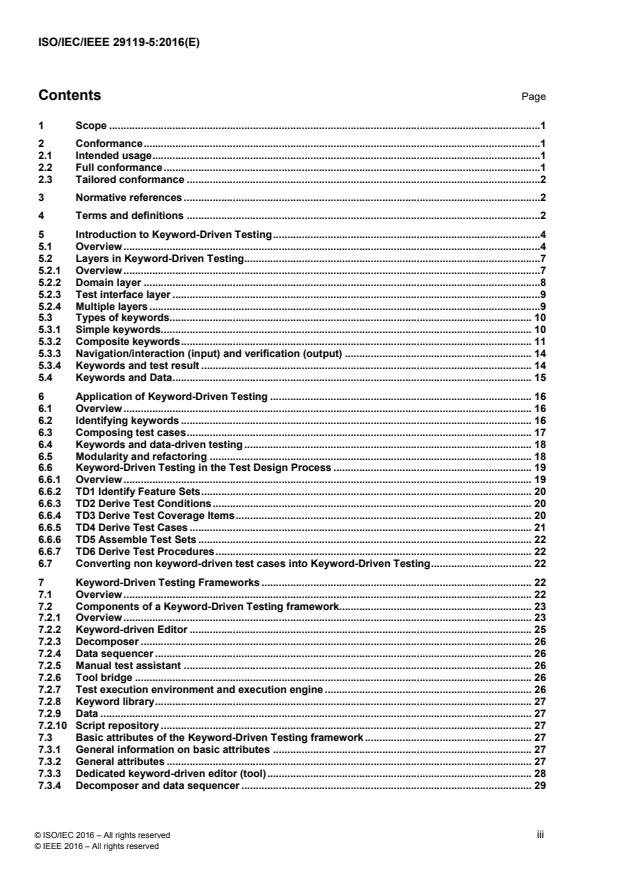
Contents Page
1 Scope .1
2 Conformance .1
2.1 Intended usage .1
2.2 Full conformance .1
2.3 Tailored conformance .2
3 Normative references .2
4 Terms and definitions .2
5 Introduction to Keyword-Driven Testing .4
5.1 Overview .4
5.2 Layers in Keyword-Driven Testing .7
5.2.1 Overview .7
5.2.2 Domain layer .8
5.2.3 Test interface layer .9
5.2.4 Multiple layers .9
5.3 Types of keywords. 10
5.3.1 Simple keywords. 10
5.3.2 Composite keywords . 11
5.3.3 Navigation/interaction (input) and verification (output) . 14
5.3.4 Keywords and test result . 14
5.4 Keywords and Data. 15
6 Application of Keyword-Driven Testing . 16
6.1 Overview . 16
6.2 Identifying keywords . 16
6.3 Composing test cases . 17
6.4 Keywords and data-driven testing . 18
6.5 Modularity and refactoring . 18
6.6 Keyword-Driven Testing in the Test Design Process . 19
6.6.1 Overview . 19
6.6.2 TD1 Identify Feature Sets . 20
6.6.3 TD2 Derive Test Conditions . 20
6.6.4 TD3 Derive Test Coverage Items . 20
6.6.5 TD4 Derive Test Cases . 21
6.6.6 TD5 Assemble Test Sets . 22
6.6.7 TD6 Derive Test Procedures . 22
6.7 Converting non keyword-driven test cases into Keyword-Driven Testing . 22
7 Keyword-Driven Testing Frameworks . 22
7.1 Overview . 22
7.2 Components of a Keyword-Driven Testing framework. 23
7.2.1 Overview . 23
7.2.2 Keyword-driven Editor . 25
7.2.3 Decomposer . 26
7.2.4 Data sequencer . 26
7.2.5 Manual test assistant . 26
7.2.6 Tool bridge . 26
7.2.7 Test execution environment and execution engine . 26
7.2.8 Keyword library . 27
7.2.9 Data . 27
7.2.10 Script repository . 27
7.3 Basic attributes of the Keyword-Driven Testing framework . 27
7.3.1 General information on basic attributes . 27
7.3.2 General attributes . 27
7.3.3 Dedicated keyword-driven editor (tool) . 28
7.3.4 Decomposer and data sequencer . 29
© ISO/IEC 2016 – All rights reserved iii
© IEEE 2016 – All rights reserved
7.3.5 Manual test assistant (tool) . 29
7.3.6 Tool bridge . 29
7.3.7 Test execution engine . 29
7.3.8 Keyword library . 30
7.3.9 Script repository . 30
7.4 Advanced attributes of frameworks . 30
7.4.1 General information on advanced attributes . 30
7.4.2 General attributes . 30
7.4.3 Dedicated keyword-driven editor (tool) . 31
7.4.4 Decomposer and data sequencer . 31
7.4.5 Manual test assistant . 31
7.4.6 Tool bridge . 31
7.4.7 Test execution environment and execution engine . 32
7.4.8 Keyword library . 33
7.4.9 Test data support . 33
7.4.10 Script repository . 33
8 Data interchange . 33
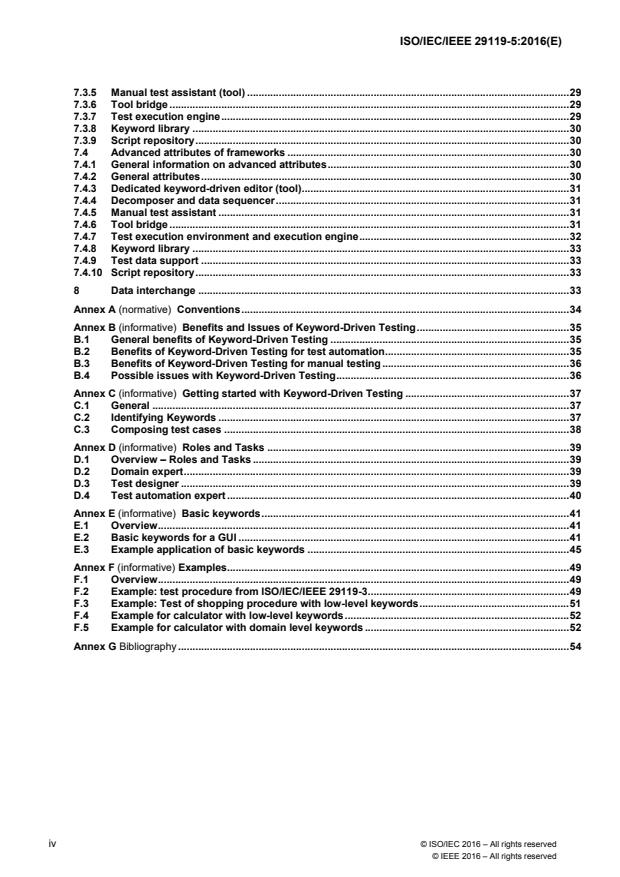
Annex A (normative) Conventions . 34
Annex B (informative) Benefits and Issues of Keyword-Driven Testing . 35
B.1 General benefits of Keyword-Driven Testing . 35
B.2 Benefits of Keyword-Driven Testing for test automation . 35
B.3 Benefits of Keyword-Driven Testing for manual testing . 36
B.4 Possible issues with Keyword-Driven Testing . 36
Annex C (informative) Getting started with Keyword-Driven Testing . 37
C.1 General . 37
C.2 Identifying Keywords . 37
C.3 Composing test cases . 38
Annex D (informative) Roles and Tasks . 39
D.1 Overview – Roles and Tasks . 39
D.2 Domain expert . 39
D.3 Test designer . 39
D.4 Test automation expert . 40
Annex E (informative) Basic keywords . 41
E.1 Overview . 41
E.2 Basic keywords for a GUI . 41
E.3 Example application of basic keywords . 45
Annex F (informative) Examples. 49
F.1 Overview . 49
F.2 Example: test procedure from ISO/IEC/IEEE 29119-3 . 49
F.3 Example: Test of shopping procedure with low-level keywords . 51
F.4 Example for calculator with low-level keywords . 52
F.5 Example for calculator with domain level keywords . 52
Annex G Bibliography . 54
iv © ISO/IEC 2016 – All rights reserved
© IEEE 2016 – All rights reserved
Foreword
ISO (the International Organization for Standardization) and IEC (the International Electrotechnical
Commission) form the specialized system for worldwide standardization. National bodies that are members of
ISO or IEC participate in the development of International Standards through technical committees established
by the respective organization to deal with particular fields of technical activity. ISO and IEC technical
committees collaborate in fields of mutual interest. Other international organizations, governmental and non-
governmental, in liaison with ISO and IEC, also take part in the work. In the field of information technology, ISO
and IEC have established a joint technical committee, ISO/IEC JTC 1.
IEEE Standards documents are developed within the IEEE Societies and the Standards Coordinating
Committees of the IEEE Standards Association (IEEE-SA) Standards Board. The IEEE develops its standards
through a consensus development process, approved by the American National Standards Institute, which
brings together volunteers representing varied viewpoints and interests to achieve the final product. Volunteers
are not necessarily members of the Institute and serve without compensation. While the IEEE administers the
process and establishes rules to promote fairness in the consensus development process, the IEEE does not
independently evaluate, test, or verify the accuracy of any of the information contained in its standards.
International Standards are drafted in accordance with the rules given in the ISO/IEC Directives, Part 2.
The main task of ISO/IEC JTC 1 is to prepare International Standards. Draft International Standards adopted
by the joint technical committee are circulated to national bodies for voting. Publication as an International
Standard requires approval by at least 75 % of the national bodies casting a vote.
Attention is called to the possibility that implementation of this standard may require the use of subject matter
covered by patent rights. By publication of this standard, no position is taken with respect to the existence or
validity of any patent rights in connection therewith. ISO/IEEE is not responsible for identifying essential
patents or patent claims for which a license may be required, for conducting inquiries into the legal validity or
scope of patents or patent claims or determining whether any licensing terms or conditions provided in
connection with submission of a Letter of Assurance or a Patent Statement and Licensing Declaration Form, if
any, or in any licensing agreements are reasonable or non-discriminatory. Users of this standard are expressly
advised that determination of the validity of any patent rights, and the risk of infringement of such rights, is
entirely their own responsibility. Further information may be obtained from ISO or the IEEE Standards
Association.
ISO/IEC/IEEE 29119-5 was prepared by Joint Technical Committee ISO/IEC JTC 1, Information technology,
Subcommittee SC 7, Software and systems engineering, in cooperation with the Software & Systems
Engineering Standards Committee of the IEEE Computer Society, under the Partner Standards Development
Organization cooperation agreement between ISO and IEEE.
ISO/IEC/IEEE 29119 consists of the following parts, under the general title Software and systems engineering
— Software testing:
Part 1: Concepts and definitions
Part 2: Test processes
Part 3: Test documentation
Part 4: Test techniques
Part 5: Keyword-Driven Testing
© ISO/IEC 2016 – All rights reserved v
© IEEE 2016 – All rights reserved
Introduction
The purpose of the ISO/IEC/IEEE 29119 series of software testing standards is to define an internationally-
agreed set of standards for software testing that can be used by any organization when managing or
performing any form of software testing.
This part of ISO/IEC/IEEE 29119 defines a unified approach for describing test cases in a modular way, which
assists with the creation of items like keyword-driven test specifications and test automation frameworks. The
term "keyword" refers to the elements which are, once defined, used to compose test cases, such as with
building blocks. ISO/IEC/IEEE 29119-5 will explain the main concepts and application of Keyword-Driven
Testing. It will also define attributes of frameworks designed to support Keyword-Driven Testing.
The concepts and definitions relating to software testing defined in ISO/IEC/IEEE 29119-1 are also applicable
to ISO/IEC/IEEE 29119-5.
The test process model on which the Keyword-Driven Testing framework is based is defined in ISO/IEC/IEEE
29119-2 Test Processes. It comprises test process descriptions that define the software testing processes at
the organizational level, test management level and dynamic test level. Supporting informative diagrams
describing the processes are also provided in ISO/IEC/IEEE 29119-2. However, ISO/IEC/IEEE 29119-5
describes a specific implementation of the test design and implementation processes of ISO/IEC/IEEE
29119-2; in particular TD4 (Derive Test Cases), TD5 (Assemble Test Sets) and TD6 (Derive Test Procedures)
as here applied to Keyword-Driven Testing.
The templates and examples of test documentation as defined in ISO/IEC/IEEE 29119-3 are also applicable
to ISO/IEC/IEEE 29119-5.
Software test design techniques that can be used during test design are defined in ISO/IEC/IEEE 29119-4
Test Techniques. The application of ISO/IEC/IEEE 29119-4 is assumed when designing test cases that are
then described by keywords according to ISO/IEC/IEEE 29119-5.
This part of ISO/IEC/IEEE 29119-5 has the following structure:
terms and definitions can be found in clause 4
an introduction to Keyword-Driven Testing is given in clause 5
the application of Keyword-Driven Testing is explained in clause 6
frameworks for Keyword-Driven Testing are described in clause 7
data interchange is covered in clause 8
Annex A states naming conventions for keywords
Annex B names benefits that can be achieved with Keyword-Driven Testing
Annex C gives advice on how interested parties wanting to use Keyword-Driven Testing can start
Annex D describes roles that can be used in Keyword-Driven Testing
Annex E contains examples of basic keywords that can be used to create test cases
Annex F contains examples for keyword test cases
vi © ISO/IEC 2016 – All rights reserved
© IEEE 2016 – All rights reserved
INTERNATIONAL STANDARD ISO/IEC/IEEE 29119-5:2016(E)
Software and Systems Engineering — Software Testing —
Part 5: Keyword-Driven Testing
1 Scope
This part of ISO/IEC/IEEE 29119 defines an efficient and consistent solution for Keyword-Driven Testing
by:
giving an introduction to Keyword-Driven Testing;
providing a reference approach to implement Keyword-Driven Testing;
defining requirements on frameworks for Keyword-Driven Testing to enable testers to share their work
items, such as test cases, test data, keywords, or complete test specifications;
defining requirements for tools that support Keyword-Driven Testing. These requirements could apply
to any tool that supports the Keyword-Driven approach (e.g., test automation, test design and test
management tools);
defining interfaces and a common data exchange format to ensure that tools from different vendors
can exchange their data (e.g. test cases, test data and test results);
defining levels of hierarchical keywords, and advising use of hierarchical keywords. This includes
describing specific types of keywords (e.g. keywords for navigation or for checking a value) and
when to use "flat" structured keywords;
providing an initial list of example generic technical (low-level) keywords, such as "inputData" or
"checkValue". These keywords can be used to specify test cases on a technical level, and may be
combined to create business-level keywords as required.
NOTE
This standard is applicable to all those who want to create keyword-driven test specifications, create
corresponding frameworks, or build test automation based on keywords.
2 Conformance
2.1 Intended usage
The requirements in ISO/IEC/IEEE 29119-5 are contained in Clause 7 and in Annex A. ISO/IEC/IEEE 29119-
5 provides requirements on frameworks supporting the application of Keyword-Driven Testing. It is
recognized that particular projects or organizations may not need to use all of the components defined
in this standard. Therefore, implementation of ISO/IEC/IEEE 29119-5 typically involves selecting a set of
components or parts of components suitable for the organization or project. There are two ways that an
organization can claim to conform to the provisions of this standard.
The organization or individual shall assert whether full or tailored conformance to this standard is
claimed.
2.2 Full conformance
Full conformance is achieved by demonstrating that all of the Keyword-Driven Testing requirements (i.e.
shall statements) defined in ISO/IEC/IEEE 29119-5 have been satisfied.
© ISO/IEC 2016 – All rights reserved
© IEEE 2016 – All rights reserved
2.3 Tailored conformance
When ISO/IEC/IEEE 29119-5 is used for implementing components of frameworks that do not qualify for full
conformance, the subset of components for which tailored conformance is claimed should be recorded.
Tailored conformance is achieved by demonstrating that all of the requirements (i.e. shall statements) for the
recorded subset of components have been satisfied.
Where tailoring occurs, the justification shall be provided, either directly or by reference, whenever a
requirement defined in clauses 7 and Annex A of ISO/IEC/IEEE 29119-5 is not followed. All tailoring decisions
shall be recorded with their rationale, including the consideration of any applicable risks. Tailoring decisions
shall be agreed to by the relevant stakeholders.
EXAMPLE Tool vendors may in their portfolio provide only part of a keyword-driven test framework, and thus decide
not to implement requirements that are covered by complementary tools (e.g. a vendor only provides an execution engine,
but no keyword driven editor – then the execution engine can still be conforming with the standard).
3 Normative references
The following documents, in whole or in part, are normatively referenced in this document and are
indispensable for its application. For dated references, only the edition cited applies. For undated references,
the latest edition of the referenced document, including any amendments, applies.
ISO/IEC/IEEE 24765, Systems and software engineering – Vocabulary
ISO/IEC/IEEE 29119-1, Software and systems engineering – Software Testing – Part 1: Concepts and
Definitions
ISO/IEC/IEEE 29119-2, Software and systems engineering – Software Testing – Part 2: Test Processes
ISO/IEC/IEEE 29119-3, Software and systems engineering – Software Testing – Part 3: Test Documentation
ISO/IEC/IEEE 29119-4, Software and systems engineering – Software Testing – Part 4: Test Techniques
Other standards useful for the implementation and interpretation of this standard are listed in the bibliography.
4 Terms and definitions
For the purposes of this document, the terms and definitions given in ISO/IEC/IEEE 24765 and the following
apply.
NOTE Use of the terminology of ISO/IEC/IEEE 29119-5 is for ease of reference and is not mandatory for
conformance with ISO/IEC/IEEE 29119-5. The following terms and definitions are provided to assist with the
understanding and readability of ISO/IEC/IEEE 29119-5. Only terms critical to the understanding of ISO/IEC/IEEE 29119-5
are included. This clause is not intended to provide a complete list of testing terms. The Systems and Software
Engineering vocabulary ISO/IEC/IEEE 24765 can be referenced for terms not defined in this standard. ISO/IEC/IEEE
29119-1 can be referenced for terms related to software testing in general. ISO/IEC/IEEE 29119-5 only defines terms
specific to Keyword-Driven Testing.
4.1
domain layer
highest level of abstraction for the test item
Note 1 to entry: Keywords on this level are chosen in a way that is familiar to domain experts.
2 © ISO/IEC 2016 – All rights reserved
© IEEE 2016 – All rights reserved
4.2
high-level keyword
keyword that covers complex activities that may be composed from other keywords and is used by domain
experts to assemble keyword test cases
4.3
keyword
one or more words used as a reference to a specific set of actions intended to be performed during the
execution of one or more test cases
Note 1 to entry: The actions include interactions with the User Interface during the test, verification, and specific actions to
set up a test scenario.
Note 2 to entry: Keywords are named using at least one verb.
Note 3 to entry: Composite keywords can be constructed based on other keywords.
4.4
keyword dictionary
keyword library
repository containing a set of keywords reflecting the language and level of abstraction used to write test
cases
4.5
Keyword-Driven Testing
testing using test cases composed from keywords
4.6
Keyword-Driven Testing framework
test framework covering the functional capabilities of a keyword-driven editor, decomposer, data sequencer,
manual test assistant, tool bridge, data and script repositories, a keyword library and the test execution
environment
4.7
keyword execution code
implementation of a keyword that is intended to be executed by a test execution engine
4.8
keyword test case
sequence of keywords and the required values for their associated parameters (as applicable) that are
composed to describe the actions of a test case
4.9
low-level keyword
keyword that covers only one or very few simple actions and is not composed from other keywords
4.10
manual testing
humans performing tests by entering information into a test item and verifying the results
Note 1 to entry: Automated testing uses tools, robots, and other test execution engines to perform tests. Manual testing
does not use these items.
4.11
test execution engine
tool implemented in software and sometimes in hardware that can manipulate the test item to execute test
cases
© ISO/IEC 2016 – All rights reserved 3
© IEEE 2016 – All rights reserved
Note 1 to entry: A typical test execution engine includes unit test tool frameworks, stimulation-command systems, capture
and playback tools or hardware robots along with the software to control them.
4.12
test framework
environment that facilitates testing
4.13
test interface
interface to the test item used to stimulate the test item, to get responses (e.g. actual results), or both
Note 1 to entry: The GUI, API or SOA interfaces are typical test interfaces.
Note 2 to entry: Stimulating the test item can involve passing data into it via computer interfaces or attached hardware.
Note 3 to entry: Getting responses includes getting information from the test item under test or associated hardware.
4.14
test interface layer
lowest level of abstraction for keywords, which interacts with the test item directly and encapsulates the
atomic (lowest level) interactions at the test interface
5 Introduction to Keyword-Driven Testing
5.1 Overview
Keyword-Driven Testing is a test case specification approach that is commonly used to support test
automation and the development of test automation frameworks. However, it can also be used if no
automation approach is planned or established.
In principle, Keyword-Driven Testing can be applied at all testing levels (e.g. component testing, system
testing) and for various types of testing (e.g. functional testing, reliability testing). Keyword-Driven Testing
benefits include the following:
ease of use
understandability
maintainability
test information reuse
support of test automation
potential cost and schedule savings
The fundamental idea in Keyword-Driven Testing is to provide a set of "building blocks", referred to as
keywords, that can be used to create manual or automated test cases without requiring detailed knowledge of
programming or test tool expertise. The ultimate goal is to provide a basic, unambiguous set of keywords
comprehensive enough so that most, if not all, required test cases can be entirely composed of these
keywords. The vocabulary included in these dictionaries or libraries of keywords is, therefore, a reflection of
the language and level of abstraction used to write the test cases, and not of any standard computer
programming language.
For test automation, each keyword needs to be implemented in software.
4 © ISO/IEC 2016 – All rights reserved
© IEEE 2016 – All rights reserved
NOTE 1 When keywords are not used, test cases are usually written using natural language or written in a computer
programming language. Compared with natural language, keywords have the advantage of being less ambiguous and
more precise. Compared with a computer programming language, when keywords are well defined and structured, they
have the advantage of being understandable by many people who do not have software engineering skills.
A keyword is usually defined at the following two levels:
At a low level, each keyword is associated with a detailed set of one or more actions that describe the
exact steps that are to be performed.
At a high level, a meaningful name is used to identify the keyword. This keyword may require a set of
input parameters, which would also belong to this level in the structure. The keyword and the parameters
together comprise a high-level description of the actions associated with a test case.
Thus, instead of describing each individual action in test cases, tests can be defined at a higher level of
abstraction using keywords. Higher levels of abstraction can be achieved by using composite keywords, which
are comprised of other keywords to describe associated actions.
An example of the benefits obtained from both manual and automated keyword-driven test cases is enhanced
maintainability. Consider a case where the precise set of actions to carry out a commonly repeated operation
has changed. The modularity introduced by keywords allows modification of only the actions for the changed
operation in the relevant lower-level keyword, leaving the test cases untouched. Without modularity, it may be
necessary to modify each occurrence of this operation in all of the test cases.
Modularization has helped popularize this approach. If test automation is required, a framework can be
created to interpret manually created keyword test cases as executable test automation scripts. This is
achieved by implementing test automation code for each keyword (e.g. keyword execution code).
NOTE 2 Testing tools can be used to support Keyword-Driven Testing, but the available tools may be limited in their
capability to support all the concepts described in this standard.
© ISO/IEC 2016 – All rights reserved 5
© IEEE 2016 – All rights reserved
Figure 1 — Relationships between Keyword-Driven Testing entities
A test procedure can have multiple test cases in it, and a test case can, in turn, be part of different test
procedures (Figure 1). Test cases can be either manual test cases or keyword test cases. A keyword test
case implements a manual test case.
A keyword test case is typically composed of a sequenced series of keywords. Keywords should be chosen to
be modular and generic so that they can be reused in many test cases. Keywords can also be used more than
once in the same test case. A test case is composed from test actions. Keywords represent test actions.
NOTE 3 It is possible to map several keywords to a single action. It is also possible to define keywords in a way that
each keyword represents one action. In these cases, a one-to-one relationship exists between actions and keywords.
However, a test designer can decide to structure keywords in a different way (e.g. use more than one keyword to
implement an action, or to combine two or more actions into one keyword). This relationship is not a 1:1 relationship in
Figure 1.
Test automation is an option that can be chosen when implementing Keyword-Driven Testing, but a manual
approach is also possible. If keyword test cases are automated, each keyword is implemented by keyword
execution code. Keyword execution code is specific to the chosen tool or test execution engine, and will
additionally depend on the test interface. For the manual approach, the action described by a keyword is
executed manually, so there is no keyword execution code. That is why in Figure 1 the relationship between
keyword and keyword execution code is 1 to 0.1.
6 © ISO/IEC 2016 – All rights reserved
© IEEE 2016 – All rights reserved
Test automation is typically highly technical and tool dependent since it depends on the test interface and on
the capabilities of the available tools. In general, keywords can be independent of the test interface (e.g. user
interface) and the tools used to execute the test cases.
In this context, automated test scripts may either be generated automatically by a framework or developed
manually by a test automation specialist. Automated test scripts are typically developed by testers with
programming experience.
NOTE 4 When developing automated test scripts, it is beneficial to align the structure (e.g. levels) of the keywords with
the implementation of the automated test scripts.
If a keyword test case or a set of keyword test cases is automated, the framework for Keyword-Driven Testing
generates the automated test script based on the keyword execution code.
NOTE 5 A framework for Keyword-Driven Testing does not necessarily "generate" code. The required code can also
be prepared by testers and be executed by the framework.
5.2 Layers in Keyword-Driven Testing
5.2.1 Overview
Keywords can represent actions at different abstraction levels. For example, one keyword can refer to a very
complex set of activities, like the creation of a contract, which includes a lot of steps, while another keyword
can refer to a very simple action, like pressing a button on a graphical user interface. The first keyword is
close to the business and end user domain, while the second is closer to the test interface. Keywords that are
written at a similar level of detail, and have a similar relationship to the stakeholder's view, are said to belong
to the same abstraction layer.
Keyword-Driven Testing can be organized by using one or more layers. Typical layers are the end user
domain layer and the test interface layer.
While many implementations of Keyword-Driven Testing will comprise two or three abstraction layers, in some
cases it may be necessary to structure keywords in more layers.
The topmost layer is the most abstract layer, which is generally aligned with the wording of the application's
users. In practice, the topmost layer is usually the domain layer. However, in some situations the domain layer
may not be required, and another, more abstract layer is used (e.g. if the test cases are supposed to span
several different end user domains, a meta domain layer can be introduced).
The lowest layer is the most detailed layer. It is commonly aligned with the names of test interface elements
(e.g. "selectMenuItem"). In practice, this layer is usually, but not always, the test interface layer (e.g. as
sometimes a test interface layer is not required, or for specific reasons, even more detailed layers may be
used).
Most Keyword-Driven Test systems will have more than one layer due to factors such as having
understandable keyword test cases, maintainability and division of work relying on a multi-layer structure. If
only one layer is implemented, it will commonly be either at a low level, which affects the readability of the
keyword test cases, or at a high level, which can result in more keyword execution code.
In Figure 2, an example is given, showing how test cases for two different test interfaces can be structured by
using two layers of keywords.
© ISO/IEC 2016 – All rights reserved 7
© IEEE 2016 – All rights reserved
Figure 2 — Example for defining test cases by keywords at several layers
EXAMPLE In Figure 2, two test cases are shown which are designed using a domain layer and a test interface layer.
One of the examples sketches a test case for a GUI application, the other for a camera API. In both examples, the
implementation of the test cases in respect to test automation is done on the test interface layer. From top to bottom, the
example shows a test case for each test item, shows how one of the used composite keywords on the domain layer for
both test items could be structured, and gives an idea of how the implementation of one of the basic keywords on the test
interface layer for each test item could look.
5.2.2 Domain layer
Keywords in the domain layer correspond to business or domain related activities and reflect the terminology
used by domain experts. Because of this, it can be easier for testers at the domain or business level to create
test cases.
Keywords developed for the domain layer are generally implementation-independent; that is, the keywords
define tests that work regardless of the technology used to implement the test item.
EXAMPLE 1 Consider a keyword test developed to test a word processing application. Domain layer keywords
correspond to the activities that are part of the “business of word processing”:
StartApplication
ClearBuffer
EnterText “Hello World!”
ReplaceText “Hello”, “Goodbye”, “ALL_OCCURRENCES”
VerifyText “Goodbye World!”
StopApplication
This test is valid for any text editor application that provides a global replace function, (e.g. Notepad, MSWord, Notepad++,
GED, EMACS, etc.).
EXAMPLE 2 Frequently used domain layer keywords are "Login" and "CreateAccount"
8 © ISO/IEC 2016 – All rights reserved
© IEEE 2016 – All rights reserved
Tests constructed using domain layer keywords are relatively immune to changes in the implementation of the
test item, and can prevent expensive rework over the lifetime of the test item.
NOTE Extensive changes to the application, (e.g. changes in the workflow) can require test cases to be reworked.
5.2.3 Test interface layer
Keywords at the test interface layer refer to a specific type of test interface, (e.g. the graphical user interface
(GUI)). The actions needed to address the test items can usually be easily identified. The total number of
keywords is typically smaller than at the domain layer, since the test interface is limited.
EXAMPLE 1 A GUI can be used as the test interface. As the GUI controls (along with the associated actions) are
mapped to a fixed set of keywords, a small number of keywords is needed. In the same case the domain-related keywords
can be very versatile, and may need to be extended according to the needs of the tester, which leads to a much bigger
number of keywords.
If automation is desired, the keyword execution code for keywords at the test interface layer is often simpler.
However, for a keyword test case composed from keywords at the test interface layer, it may be difficult to see
how the interface layer keywords are related to the business domain.
Interface layer keywords usually reflect the underlying implementation technology for the interaction with the
test item. For example, keywords such as MenuSelect and PressButton reflect a GUI operation. Using the
example above, they would not be applicable to text editors using a command line interface, such as vi,
because they correspond to window-based operations.
EXAMPLE 2 Consider a test interface that is a graphical user interface. Keywords are chosen to cover single actions
such as "Click" or "Select". These keywords are applied to different elements like lists, grids, or images, and the specific
element can be selected by using the keyword with a parameter (See 5.4 Keywords and Data). Some combinations of
actions and elements can be excluded.
5.2.4 Multiple layers
To combine the advantages
...
Questions, Comments and Discussion
Ask us and Technical Secretary will try to provide an answer. You can facilitate discussion about the standard in here.
Loading comments...