


ISO/IEC 23270:2018
(Main)Information technology - Programming languages - C#
Information technology - Programming languages - C#
This specification describes the form and establishes the interpretation of programs written in the C# programming language. It describes: - The representation of C# programs; - The syntax and constraints of the C# language; - The semantic rules for interpreting C# programs; - The restrictions and limits imposed by a conforming implementation of C#. This specification does not describe - The mechanism by which C# programs are transformed for use by a data-processing system; - The mechanism by which C# applications are invoked for use by a data-processing system; - The mechanism by which input data are transformed for use by a C# application; - The mechanism by which output data are transformed after being produced by a C# application; - The size or complexity of a program and its data that will exceed the capacity of any specific data-processing system or the capacity of a particular processor; - All minimal requirements of a data-processing system that is capable of supporting a conforming implementation.
Technologies de l'information — Langages de programmation — C#
General Information
- Status
- Published
- Publication Date
- 12-Dec-2018
- Current Stage
- 9599 - Withdrawal of International Standard
- Start Date
- 17-Mar-2025
- Completion Date
- 30-Oct-2025
Relations
- Effective Date
- 23-Dec-2017
Overview
ISO/IEC 23270:2018 - "Information technology - Programming languages - C#" is the authoritative international specification that defines the form, syntax, semantics and conformance rules for programs written in the C# programming language. The third edition (2018) documents lexical structure, grammars, type systems, execution behavior and the constraints that a conforming implementation must observe. It does not describe platform-specific transformation, application invocation, input/output processing, system capacity limits or minimal hardware requirements.
Key topics and technical scope
This standard is a comprehensive language definition focused on precise interpretation and conformance. Major technical topics include:
- Lexical structure and tokens: program form, line terminators, comments, white space, identifiers, keywords and literal forms (integers, reals, strings, chars, booleans, null).
- Grammar and parsing: lexical and syntactic grammar notation, ambiguity handling and lexical analysis rules.
- Pre-processing directives: conditional compilation symbols, directives, diagnostic/pragma/region/line directives.
- Core language concepts: declarations, members, scopes, name hiding, signatures and overloading, access control and accessibility domains.
- Types and semantics: reference types (classes, interfaces, arrays, delegates, string, dynamic), value types (structs, simple, integral, floating-point, decimal, bool), nullable types, boxing/unboxing and constructed/generic types.
- Variables and storage: variable categories (static, instance, parameters, array elements), default initialization and lifetime.
- Runtime behavior: automatic memory management, application start/termination semantics, execution order and conformance requirements.
- Conformance and constraints: definition of what constitutes a conforming implementation and language restrictions.
Practical applications
ISO/IEC 23270:2018 is the definitive reference for anyone needing an exact, unambiguous description of C# language behavior. Typical uses:
- Compiler and runtime implementers - ensure conformity with C# syntax, semantics and conformance rules.
- Tooling creators - build linters, static analyzers, formatters, IDE language services and code generators that rely on precise language specs.
- Quality assurance & security teams - validate language feature behavior and detect ambiguous or non-conforming implementations.
- Educators and authors - teach language fundamentals using the official language definition.
- Standards and compliance auditors - certify implementations and interpret language requirements.
Related standards
- Complementary language and platform specifications (other ISO/IEC or ECMA language standards) and platform-specific runtime documentation may be consulted for implementation details not covered by ISO/IEC 23270:2018 (for example, binary transformation, invocation and I/O mechanisms).
Keywords: ISO/IEC 23270:2018, C# standard, C# language specification, programming languages, C# syntax, C# semantics, compiler conformance, lexical grammar, types, automatic memory management.
Frequently Asked Questions
ISO/IEC 23270:2018 is a standard published by the International Organization for Standardization (ISO). Its full title is "Information technology - Programming languages - C#". This standard covers: This specification describes the form and establishes the interpretation of programs written in the C# programming language. It describes: - The representation of C# programs; - The syntax and constraints of the C# language; - The semantic rules for interpreting C# programs; - The restrictions and limits imposed by a conforming implementation of C#. This specification does not describe - The mechanism by which C# programs are transformed for use by a data-processing system; - The mechanism by which C# applications are invoked for use by a data-processing system; - The mechanism by which input data are transformed for use by a C# application; - The mechanism by which output data are transformed after being produced by a C# application; - The size or complexity of a program and its data that will exceed the capacity of any specific data-processing system or the capacity of a particular processor; - All minimal requirements of a data-processing system that is capable of supporting a conforming implementation.
This specification describes the form and establishes the interpretation of programs written in the C# programming language. It describes: - The representation of C# programs; - The syntax and constraints of the C# language; - The semantic rules for interpreting C# programs; - The restrictions and limits imposed by a conforming implementation of C#. This specification does not describe - The mechanism by which C# programs are transformed for use by a data-processing system; - The mechanism by which C# applications are invoked for use by a data-processing system; - The mechanism by which input data are transformed for use by a C# application; - The mechanism by which output data are transformed after being produced by a C# application; - The size or complexity of a program and its data that will exceed the capacity of any specific data-processing system or the capacity of a particular processor; - All minimal requirements of a data-processing system that is capable of supporting a conforming implementation.
ISO/IEC 23270:2018 is classified under the following ICS (International Classification for Standards) categories: 35.060 - Languages used in information technology. The ICS classification helps identify the subject area and facilitates finding related standards.
ISO/IEC 23270:2018 has the following relationships with other standards: It is inter standard links to ISO/IEC 23270:2006. Understanding these relationships helps ensure you are using the most current and applicable version of the standard.
ISO/IEC 23270:2018 is available in PDF format for immediate download after purchase. The document can be added to your cart and obtained through the secure checkout process. Digital delivery ensures instant access to the complete standard document.
Standards Content (Sample)
INTERNATIONAL ISO/IEC
STANDARD 23270
Third edition
2018-12
Information technology —
Programming languages — C#
Technologies de l'information — Langages de programmation — C#
Reference number
©
ISO/IEC 2018
© ISO/IEC 2018
All rights reserved. Unless otherwise specified, or required in the context of its implementation, no part of this publication may
be reproduced or utilized otherwise in any form or by any means, electronic or mechanical, including photocopying, or posting
on the internet or an intranet, without prior written permission. Permission can be requested from either ISO at the address
below or ISO’s member body in the country of the requester.
ISO copyright office
CP 401 • Ch. de Blandonnet 8
CH-1214 Vernier, Geneva
Phone: +41 22 749 01 11
Fax: +41 22 749 09 47
Email: copyright@iso.org
Website: www.iso.org
Published in Switzerland
ii © ISO/IEC 2018 – All rights reserved
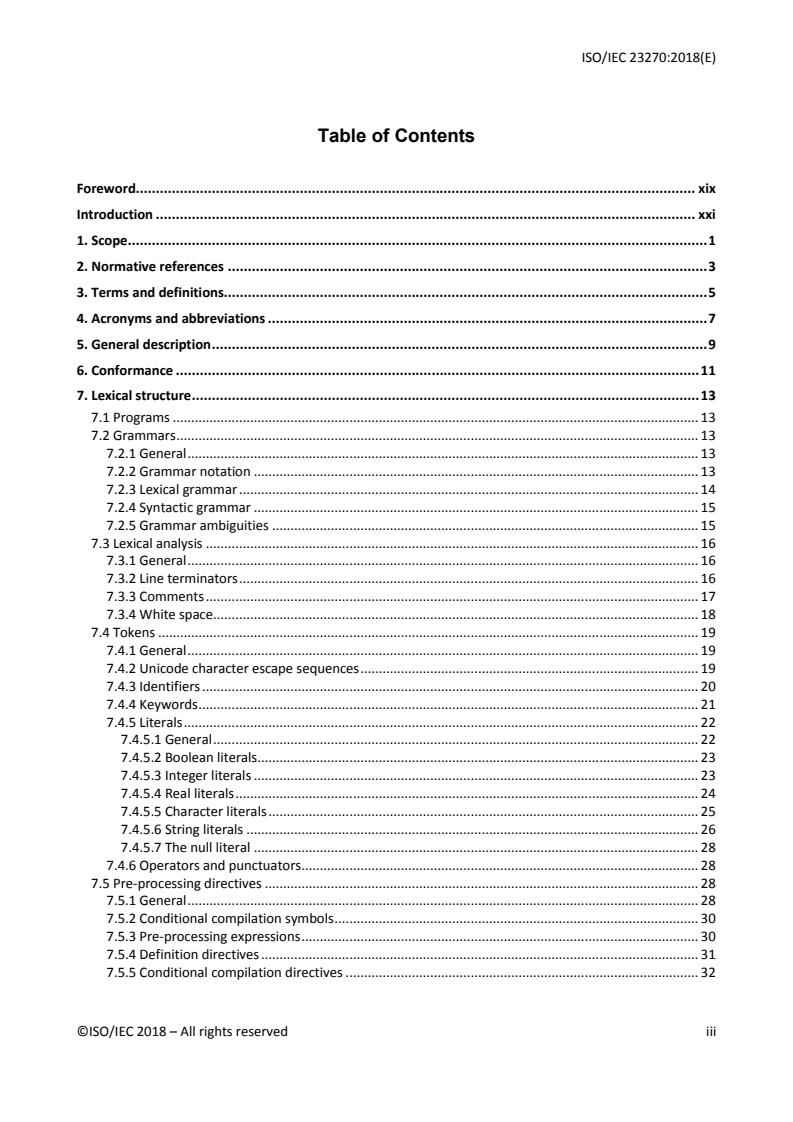
Table of Contents
Foreword . xix
Introduction . xxi
1. Scope . 1
2. Normative references . 3
3. Terms and definitions. 5
4. Acronyms and abbreviations . 7
5. General description . 9
6. Conformance . 11
7. Lexical structure . 13
7.1 Programs . 13
7.2 Grammars . 13
7.2.1 General . 13
7.2.2 Grammar notation . 13
7.2.3 Lexical grammar . 14
7.2.4 Syntactic grammar . 15
7.2.5 Grammar ambiguities . 15
7.3 Lexical analysis . 16
7.3.1 General . 16
7.3.2 Line terminators . 16
7.3.3 Comments . 17
7.3.4 White space . 18
7.4 Tokens . 19
7.4.1 General . 19
7.4.2 Unicode character escape sequences . 19
7.4.3 Identifiers . 20
7.4.4 Keywords . 21
7.4.5 Literals . 22
7.4.5.1 General . 22
7.4.5.2 Boolean literals . 23
7.4.5.3 Integer literals . 23
7.4.5.4 Real literals . 24
7.4.5.5 Character literals . 25
7.4.5.6 String literals . 26
7.4.5.7 The null literal . 28
7.4.6 Operators and punctuators . 28
7.5 Pre-processing directives . 28
7.5.1 General . 28
7.5.2 Conditional compilation symbols . 30
7.5.3 Pre-processing expressions . 30
7.5.4 Definition directives . 31
7.5.5 Conditional compilation directives . 32
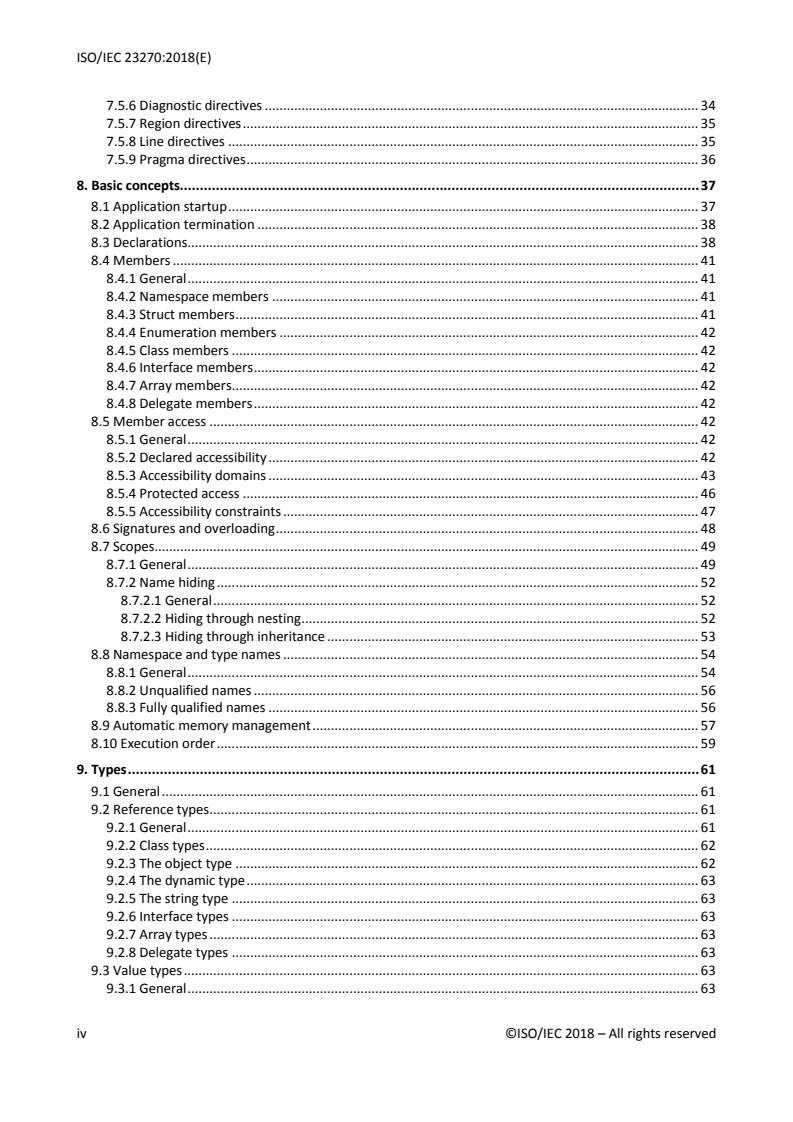
©ISO/IEC 2018 – All rights reserved iii
7.5.6 Diagnostic directives . 34
7.5.7 Region directives . 35
7.5.8 Line directives . 35
7.5.9 Pragma directives . 36
8. Basic concepts. 37
8.1 Application startup . 37
8.2 Application termination . 38
8.3 Declarations. 38
8.4 Members . 41
8.4.1 General . 41
8.4.2 Namespace members . 41
8.4.3 Struct members . 41
8.4.4 Enumeration members . 42
8.4.5 Class members . 42
8.4.6 Interface members . 42
8.4.7 Array members. 42
8.4.8 Delegate members . 42
8.5 Member access . 42
8.5.1 General . 42
8.5.2 Declared accessibility . 42
8.5.3 Accessibility domains . 43
8.5.4 Protected access . 46
8.5.5 Accessibility constraints . 47
8.6 Signatures and overloading . 48
8.7 Scopes. 49
8.7.1 General . 49
8.7.2 Name hiding . 52
8.7.2.1 General . 52
8.7.2.2 Hiding through nesting . 52
8.7.2.3 Hiding through inheritance . 53
8.8 Namespace and type names . 54
8.8.1 General . 54
8.8.2 Unqualified names . 56
8.8.3 Fully qualified names . 56
8.9 Automatic memory management . 57
8.10 Execution order . 59
9. Types . 61
9.1 General . 61
9.2 Reference types . 61
9.2.1 General . 61
9.2.2 Class types . 62
9.2.3 The object type . 62
9.2.4 The dynamic type . 63
9.2.5 The string type . 63
9.2.6 Interface types . 63
9.2.7 Array types . 63
9.2.8 Delegate types . 63
9.3 Value types . 63
9.3.1 General . 63
iv ©ISO/IEC 2018 – All rights reserved
9.3.2 The System.ValueType type . 64
9.3.3 Default constructors . 64
9.3.4 Struct types . 65
9.3.5 Simple types . 65
9.3.6 Integral types . 66
9.3.7 Floating-point types . 67
9.3.8 The decimal type . 68
9.3.9 The bool type . 69
9.3.10 Enumeration types . 69
9.3.11 Nullable value types . 69
9.3.12 Boxing and unboxing . 70
9.4 Constructed types . 70
9.4.1 General . 70
9.4.2 Type arguments . 71
9.4.3 Open and closed types . 71
9.4.4 Bound and unbound types . 72
9.4.5 Satisfying constraints . 72
9.5 Type parameters . 73
9.6 Expression tree types . 73
9.7 The dynamic type . 74
10. Variables . 77
10.1 General . 77
10.2 Variable categories . 77
10.2.1 General . 77
10.2.2 Static variables . 77
10.2.3 Instance variables. 77
10.2.3.1 General . 77
10.2.3.2 Instance variables in classes . 78
10.2.3.3 Instance variables in structs . 78
10.2.4 Array elements . 78
10.2.5 Value parameters . 78
10.2.6 Reference parameters . 78
10.2.7 Output parameters . 79
10.2.8 Local variables . 79
10.3 Default values . 80
10.4 Definite assignment . 80
10.4.1 General . 80
10.4.2 Initially assigned variables . 81
10.4.3 Initially unassigned variables . 81
10.4.4 Precise rules for determining definite assignment . 81
10.4.4.1 General . 81
10.4.4.2 General rules for statements . 82
10.4.4.3 Block statements, checked, and unchecked statements . 82
10.4.4.4 Expression statements . 82
10.4.4.5 Declaration statements . 83
10.4.4.6 If statements . 83
10.4.4.7 Switch statements . 83
10.4.4.8 While statements . 83
10.4.4.9 Do statements . 83
©ISO/IEC 2018 – All rights reserved v
10.4.4.10 For statements . 84
10.4.4.11 Break, continue, and goto statements . 84
10.4.4.12 Throw statements . 84
10.4.4.13 Return statements . 84
10.4.4.14 Try-catch statements . 85
10.4.4.15 Try-finally statements . 85
10.4.4.16 Try-catch-finally statements . 85
10.4.4.17 Foreach statements . 86
10.4.4.18 Using statements . 86
10.4.4.19 Lock statements . 87
10.4.4.20 Yield statements . 87
10.4.4.21 General rules for constant expressions . 87
10.4.4.22 General rules for simple expressions . 88
10.4.4.23 General rules for expressions with embedded expressions . 88
10.4.4.24 Invocation expressions and object creation expressions . 88
10.4.4.25 Simple assignment expressions . 89
10.4.4.26 && expressions . 89
10.4.4.27 || expressions . 90
10.4.4.28 ! expressions . 91
10.4.4.29 ?? expressions . 91
10.4.4.30 ?: expressions . 91
10.4.4.31 Anonymous functions . 92
10.5 Variable references . 92
10.6 Atomicity of variable references . 92
11. Conversions . 93
11.1 General . 93
11.2 Implicit conversions. 93
11.2.1 General . 93
11.2.2 Identity conversion . 94
11.2.3 Implicit numeric conversions . 94
11.2.4 Implicit enumeration conversions . 94
11.2.5 Implicit nullable conversions. 94
11.2.6 Null literal conversions . 94
11.2.7 Implicit reference conversions . 95
11.2.8 Boxing conversions. 95
11.2.9 Implicit dynamic conversions . 97
11.2.10 Implicit constant expression conversions . 97
11.2.11 Implicit conversions involving type parameters . 97
11.2.12 User-defined implicit conversions . 98
11.2.13 Anonymous function conversions and method group conversions . 98
11.3 Explicit conversions . 98
11.3.1 General . 98
11.3.2 Explicit numeric conversions . 99
11.3.3 Explicit enumeration conversions . 101
11.3.4 Explicit nullable conversions . 101
11.3.5 Explicit reference conversions . 101
11.3.6 Unboxing conversions . 102
11.3.7 Explicit dynamic conversions . 103
11.3.8 Explicit conversions involving type parameters . 103
vi ©ISO/IEC 2018 – All rights reserved
11.3.9 User-defined explicit conversions . 105
11.4 Standard conversions . 105
11.4.1 General . 105
11.4.2 Standard implicit conversions . 105
11.4.3 Standard explicit conversions . 105
11.5 User-defined conversions. 105
11.5.1 General . 105
11.5.2 Permitted user-defined conversions . 105
11.5.3 Evaluation of user-defined conversions . 106
11.5.4 User-defined implicit conversions . 107
11.5.5 User-defined explicit conversions . 107
11.6 Conversions involving nullable types . 109
11.6.1 Nullable Conversions. 109
11.6.2 Lifted conversions . 109
11.7 Anonymous function conversions . 109
11.7.1 General . 109
11.7.2 Evaluation of anonymous function conversions to delegate types . 111
11.7.3 Evaluation of anonymous function conversions to expression tree types . 112
11.8 Method group conversions . 112
12. Expressions . 115
12.1 General . 115
12.2 Expression classifications . 115
12.2.1 General . 115
12.2.2 Values of expressions . 116
12.3 Static and Dynamic Binding . 116
12.3.1 General . 116
12.3.2 Binding-time . 117
12.3.3 Dynamic binding . 117
12.3.4 Types of subexpressions . 118
12.4 Operators . 118
12.4.1 General . 118
12.4.2 Operator precedence and associativity . 118
12.4.3 Operator overloading . 119
12.4.4 Unary operator overload resolution . 121
12.4.5 Binary operator overload resolution. 121
12.4.6 Candidate user-defined operators . 121
12.4.7 Numeric promotions . 122
12.4.7.1 General . 122
12.4.7.2 Unary numeric promotions . 122
12.4.7.3 Binary numeric promotions . 122
12.4.8 Lifted operators . 123
12.5 Member lookup . 124
12.5.1 General . 124
12.5.2 Base types . 125
12.6 Function members . 126
12.6.1 General . 126
12.6.2 Argument lists . 128
12.6.2.1 General . 128
12.6.2.2 Corresponding parameters . 129
©ISO/IEC 2018 – All rights reserved vii
12.6.2.3 Run-time evaluation of argument lists. 130
12.6.3 Type inference. 131
12.6.3.1 General . 131
12.6.3.2 The first phase . 132
12.6.3.3 The second phase . 133
12.6.3.4 Input types . 133
12.6.3.5 Output types . 133
12.6.3.6 Dependence . 133
12.6.3.7 Output type inferences . 133
12.6.3.8 Explicit parameter type inferences . 134
12.6.3.9 Exact inferences . 134
12.6.3.10 Lower-bound inferences . 134
12.6.3.11 Upper-bound inferences . 134
12.6.3.12 Fixing . 135
12.6.3.13 Inferred return type . 135
12.6.3.14 Type inference for conversion of method groups . 137
12.6.3.15 Finding the best common type of a set of expressions . 137
12.6.4 Overload resolution . 137
12.6.4.1 General . 137
12.6.4.2 Applicable function member . 138
12.6.4.3 Better function member . 139
12.6.4.4 Better conversion from expression . 140
12.6.4.5 Better conversion from type . 140
12.6.4.6 Better conversion target . 140
12.6.4.7 Overloading in generic classes . 140
12.6.5 Compile-time checking of dynamic member invocation . 141
12.6.6 Function member invocation . 142
12.6.6.1 General . 142
12.6.6.2 Invocations on boxed instances . 143
12.7 Primary expressions . 143
12.7.1 General . 143
12.7.2 Literals . 144
12.7.3 Simple names . 144
12.7.3.1 General . 144
12.7.3.2 Invariant meaning in blocks . 146
12.7.4 Parenthesized expressions . 146
12.7.5 Member access . 147
12.7.5.1 General . 147
12.7.5.2 Identical simple names and type names . 149
12.7.6 Invocation expressions . 149
12.7.6.1 General . 149
12.7.6.2 Method invocations . 150
12.7.6.3 Extension method invocations . 151
12.7.6.4 Delegate invocations . 153
12.7.7 Element access . 154
12.7.7.1 General . 154
12.7.7.2 Array access . 154
12.7.7.3 Indexer access . 155
12.7.8 This access . 156
12.7.9 Base access . 156
viii ©ISO/IEC 2018 – All rights reserved
12.7.10 Postfix increment and decrement operators . 157
12.7.11 The new operator . 158
12.7.11.1 General . 158
12.7.11.2 Object creation expressions . 158
12.7.11.3 Object initializers .
...
Questions, Comments and Discussion
Ask us and Technical Secretary will try to provide an answer. You can facilitate discussion about the standard in here.
Loading comments...