

ISO 3082:2017
(Main)Iron ores — Sampling and sample preparation procedures
General Information
- Abstract
ISO 3082:2017 provides a) the underlying theory, b) the basic principles for sampling and preparation of samples, and c) the basic requirements for the design, installation and operation of sampling systems for mechanical sampling, manual sampling and preparation of samples taken from a lot under transfer. This is in order to determine the chemical composition, moisture content, size distribution and other physical and metallurgical properties of the lot, except bulk density obtained using ISO 3852 (Method 2). The methods specified in this document are applicable to both the loading and discharging of a lot by means of belt conveyors and other ore-handling equipment to which a mechanical sampler can be installed or where manual sampling can safely be conducted. The methods are applicable to all iron ores, whether natural or processed (e.g. concentrates and agglomerates, such as pellets or sinters).
- Status
- Published
- Publication Date
- 16-Jul-2017
- Technical Committee
- ISO/TC 102/SC 1 - Sampling
- Drafting Committee
- ISO/TC 102/SC 1 - Sampling
- Current Stage
- 9092 - International Standard to be revised
- Start Date
- 29-Feb-2024
- Completion Date
- 29-Aug-2026
Buy Documents


ISO 3082:2017 - Iron ores -- Sampling and sample preparation procedures

ISO 3082:2017 - Iron ores — Sampling and sample preparation procedures/17/2017
Overview - ISO 3082:2017 (Iron ores - Sampling and sample preparation procedures)
ISO 3082:2017 defines the theory, principles and basic requirements for sampling and sample preparation of iron ores (natural and processed, e.g., concentrates, pellets, sinters). The standard covers mechanical and manual sampling of lots under transfer - typically during loading and discharging by belt conveyors and other ore-handling equipment - to determine chemical composition, moisture content, particle size distribution and other physical/metallurgical properties. Bulk density is excluded and is obtained using ISO 3852 (Method 2).
Keywords: ISO 3082:2017, iron ores sampling, sample preparation, mechanical sampling, manual sampling, belt conveyor sampling, moisture content, chemical composition.
Key technical topics and requirements
- Fundamentals and theory: Minimization of sampling bias, particle-size degradation, and procedures to achieve representative increments and overall precision.
- Sampling schemes and system verification: How to establish sampling plans, verify performance and check precision and bias.
- Methods of sampling: Mass-basis and time-basis sampling, stratified random sampling, sampling intervals, increment mass and number of increments.
- Sampling from moving streams: Design and placement of primary samplers, cutter types, aperture and speed considerations, safety, robustness and versatility of installations.
- Sample preparation processes: Drying, crushing, grinding, mixing, division (mechanical and manual), and preparing test samples to nominal top sizes (e.g., 250 µm; further grinding to 100 µm or 160 µm where required).
- Online preparation and equipment: Crushers, dividers, dryers and flowsheet examples for automated sampling systems.
- Special situations: Sampling from trucks, wagons, ships, stockpiles and stopped-belt reference sampling.
- Quality control and documentation: Requirements for checking precision and bias, reserve samples, packing and marking, and maintenance/cleaning of samplers.
- Normative references and formulae: Includes mathematical formulae for number of increments (Annex B) and inspection guidance (Annex A).
Practical applications and target users
ISO 3082:2017 is used to ensure representative sampling and reproducible results for:
- Mining and iron-ore producers (ore handling and transfer points)
- Port and bulk handling operators (loading/discharging by belt conveyors)
- Metallurgical plants and pellet/sinter producers (quality control)
- Analytical and QA/QC laboratories (sample preparation protocols)
- Equipment manufacturers (design of mechanical samplers, cutters, dividers)
- Traders, inspectors and auditors involved in contractual quality verification
Adopting ISO 3082 helps reduce commercial disputes, improve laboratory reproducibility and provide defensible data for metallurgical accounting, moisture determination and particle size analysis.
Related standards
- ISO 3852 (Method 2) - referenced for bulk density determination.
- Consult other ISO and industry sampling and testing standards for complementary analytical methods and reporting.
Relations
- Effective Date
- 03-May-2014
Buy Documents
ISO 3082:2017 - Iron ores -- Sampling and sample preparation procedures
ISO 3082:2017 - Iron ores — Sampling and sample preparation procedures/17/2017
Get Certified
Connect with accredited certification bodies for this standard

Bureau Veritas Chile
Bureau Veritas certification services in Chile.
Bureau Veritas Peru
Bureau Veritas certification services in Peru.
BVQI Peru
Bureau Veritas certification in Peru.
Sponsored listings
Frequently Asked Questions
ISO 3082:2017 is a standard published by the International Organization for Standardization (ISO). Its full title is "Iron ores — Sampling and sample preparation procedures". This standard covers: ISO 3082:2017 provides a) the underlying theory, b) the basic principles for sampling and preparation of samples, and c) the basic requirements for the design, installation and operation of sampling systems for mechanical sampling, manual sampling and preparation of samples taken from a lot under transfer. This is in order to determine the chemical composition, moisture content, size distribution and other physical and metallurgical properties of the lot, except bulk density obtained using ISO 3852 (Method 2). The methods specified in this document are applicable to both the loading and discharging of a lot by means of belt conveyors and other ore-handling equipment to which a mechanical sampler can be installed or where manual sampling can safely be conducted. The methods are applicable to all iron ores, whether natural or processed (e.g. concentrates and agglomerates, such as pellets or sinters).
ISO 3082:2017 provides a) the underlying theory, b) the basic principles for sampling and preparation of samples, and c) the basic requirements for the design, installation and operation of sampling systems for mechanical sampling, manual sampling and preparation of samples taken from a lot under transfer. This is in order to determine the chemical composition, moisture content, size distribution and other physical and metallurgical properties of the lot, except bulk density obtained using ISO 3852 (Method 2). The methods specified in this document are applicable to both the loading and discharging of a lot by means of belt conveyors and other ore-handling equipment to which a mechanical sampler can be installed or where manual sampling can safely be conducted. The methods are applicable to all iron ores, whether natural or processed (e.g. concentrates and agglomerates, such as pellets or sinters).
ISO 3082:2017 is classified under the following ICS (International Classification for Standards) categories: 73.060.10 - Iron ores. The ICS classification helps identify the subject area and facilitates finding related standards.
ISO 3082:2017 has the following relationships with other standards: It is inter standard links to ISO 3082:2009. Understanding these relationships helps ensure you are using the most current and applicable version of the standard.
ISO 3082:2017 is available in PDF format for immediate download after purchase. The document can be added to your cart and obtained through the secure checkout process. Digital delivery ensures instant access to the complete standard document.
Standards Content (Sample)
INTERNATIONAL ISO
STANDARD 3082
Fifth edition
2017-07
Iron ores — Sampling and sample
preparation procedures
Minerais de fer — Procédures d’échantillonnage et de préparation des
échantillons
Reference number
©
ISO 2017
© ISO 2017, Published in Switzerland
All rights reserved. Unless otherwise specified, no part of this publication may be reproduced or utilized otherwise in any form
or by any means, electronic or mechanical, including photocopying, or posting on the internet or an intranet, without prior
written permission. Permission can be requested from either ISO at the address below or ISO’s member body in the country of
the requester.
ISO copyright office
Ch. de Blandonnet 8 • CP 401
CH-1214 Vernier, Geneva, Switzerland
Tel. +41 22 749 01 11
Fax +41 22 749 09 47
copyright@iso.org
www.iso.org
ii © ISO 2017 – All rights reserved
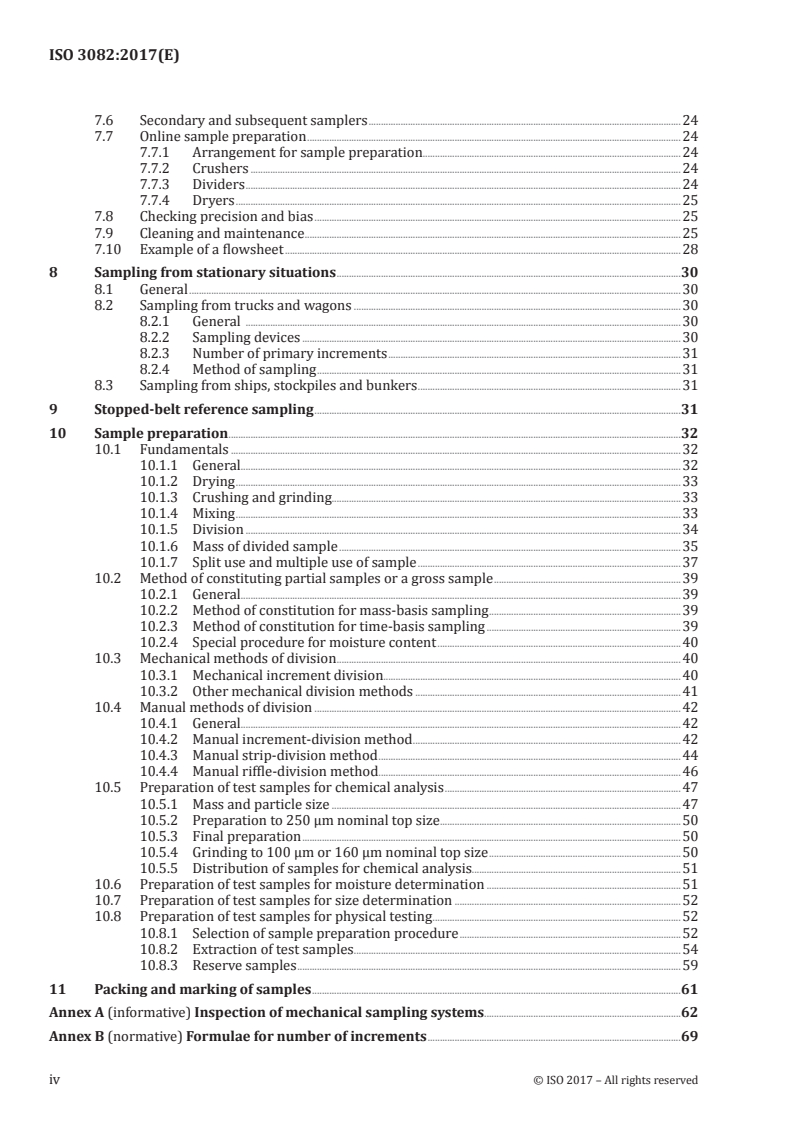
Contents Page
Foreword .vi
1 Scope . 1
2 Normative references . 1
3 Terms and definitions . 2
4 General considerations for sampling and sample preparation . 4
4.1 Basic requirements . 4
4.2 Establishing a sampling scheme . 4
4.3 System verification . 5
5 Fundamentals of sampling and sample preparation . 6
5.1 Minimization of bias . 6
5.1.1 General. 6
5.1.2 Minimization of particle size degradation . 6
5.1.3 Extraction of increments. 6
5.1.4 Increment mass. 7
5.2 Overall precision . 8
5.3 Quality variation .10
5.4 Sampling precision and number of primary increments .11
5.4.1 Mass-basis sampling .11
5.4.2 Time-basis sampling . .11
5.5 Precision of sample preparation and overall precision .12
5.5.1 General.12
5.5.2 Preparation and measurement of gross sample .13
5.5.3 Preparation and measurement of partial samples .13
5.5.4 Preparation and measurement of each increment .13
6 Methods of sampling .14
6.1 Mass-basis sampling .14
6.1.1 Mass of increment .14
6.1.2 Quality variation.14
6.1.3 Number of primary increments .15
6.1.4 Sampling interval .15
6.1.5 Methods of taking increments.15
6.2 Time-basis sampling .15
6.2.1 Mass of increment .15
6.2.2 Quality variation.15
6.2.3 Number of increments .16
6.2.4 Sampling interval .16
6.2.5 Methods of taking increments.16
6.3 Stratified random sampling within fixed mass or time intervals .16
6.3.1 General.16
6.3.2 Fixed mass intervals .17
6.3.3 Fixed time intervals .17
7 Sampling from moving streams .17
7.1 General .17
7.2 Safety of operations .17
7.3 Robustness of sampling installation .18
7.4 Versatility of sampling system .18
7.5 Primary samplers .18
7.5.1 Location .18
7.5.2 Types of primary sampler .18
7.5.3 General design criteria for primary cutters .19
7.5.4 Cutter aperture of primary sampler .23
7.5.5 Cutter speed of primary sampler.23
7.6 Secondary and subsequent samplers .24
7.7 Online sample preparation .24
7.7.1 Arrangement for sample preparation.24
7.7.2 Crushers .24
7.7.3 Dividers .24
7.7.4 Dryers .25
7.8 Checking precision and bias .25
7.9 Cleaning and maintenance .25
7.10 Example of a flowsheet .28
8 Sampling from stationary situations .30
8.1 General .30
8.2 Sampling from trucks and wagons .30
8.2.1 General .30
8.2.2 Sampling devices .30
8.2.3 Number of primary increments .31
8.2.4 Method of sampling .31
8.3 Sampling from ships, stockpiles and bunkers .31
9 Stopped-belt reference sampling .31
10 Sample preparation .32
10.1 Fundamentals .32
10.1.1 General.32
10.1.2 Drying .33
10.1.3 Crushing and grinding.33
10.1.4 Mixing .33
10.1.5 Division .34
10.1.6 Mass of divided sample .35
10.1.7 Split use and multiple use of sample .37
10.2 Method of constituting partial samples or a gross sample .39
10.2.1 General.39
10.2.2 Method of constitution for mass-basis sampling .39
10.2.3 Method of constitution for time-basis sampling .39
10.2.4 Special procedure for moisture content .40
10.3 Mechanical methods of division .40
10.3.1 Mechanical increment division.40
10.3.2 Other mechanical division methods .41
10.4 Manual methods of division .42
10.4.1 General.42
10.4.2 Manual increment-division method .42
10.4.3 Manual strip-division method .44
10.4.4 Manual riffle-division method .46
10.5 Preparation of test samples for chemical analysis .47
10.5.1 Mass and particle size .47
10.5.2 Preparation to 250 µm nominal top size.50
10.5.3 Final preparation .50
10.5.4 Grinding to 100 µm or 160 µm nominal top size .50
10.5.5 Distribution of samples for chemical analysis.51
10.6 Preparation of test samples for moisture determination .51
10.7 Preparation of test samples for size determination .52
10.8 Preparation of test samples for physical testing .52
10.8.1 Selection of sample preparation procedure .52
10.8.2 Extraction of test samples .54
10.8.3 Reserve samples .59
11 Packing and marking of samples .61
Annex A (informative) Inspection of mechanical sampling systems.62
Annex B (normative) Formulae for number of increments .69
iv © ISO 2017 – All rights reserved
Annex C (informative) Alternative methods of taking the reference sample .72
Annex D (normative) Procedure for determining the minimum mass of divided gross
sample for size determination using other mechanical division methods .78
Annex E (normative) Riffle dividers .81
Bibliography .83
Foreword
ISO (the International Organization for Standardization) is a worldwide federation of national standards
bodies (ISO member bodies). The work of preparing International Standards is normally carried out
through ISO technical committees. Each member body interested in a subject for which a technical
committee has been established has the right to be represented on that committee. International
organizations, governmental and non-governmental, in liaison with ISO, also take part in the work.
ISO collaborates closely with the International Electrotechnical Commission (IEC) on all matters of
electrotechnical standardization.
The procedures used to develop this document and those intended for its further maintenance are
described in the ISO/IEC Directives, Part 1. In particular the different approval criteria needed for the
different types of ISO documents should be noted. This document was drafted in accordance with the
editorial rules of the ISO/IEC Directives, Part 2 (see www .iso .org/ directives).
Attention is drawn to the possibility that some of the elements of this document may be the subject of
patent rights. ISO shall not be held responsible for identifying any or all such patent rights. Details of
any patent rights identified during the development of the document will be in the Introduction and/or
on the ISO list of patent declarations received (see www .iso .org/ patents).
Any trade name used in this document is information given for the convenience of users and does not
constitute an endorsement.
For an explanation on the voluntary nature of standards, the meaning of ISO specific terms and
expressions related to conformity assessment, as well as information about ISO’s adherence to the
World Trade Organization (WTO) principles in the Technical Barriers to Trade (TBT) see the following
URL: w w w . i s o .org/ iso/ foreword .html.
This document was prepared by Technical Committee ISO/TC 102, Iron ore and direct reduced iron,
Subcommittee SC 1, Sampling.
This fifth edition cancels and replaces the fourth edition (ISO 3082:2009), which has been technically
revised. It also incorporates the Technical Corrigendum ISO 3082:2009/Cor.1:2009. The main changes
compared to the previous edition are as follows:
— expansion of the definition of test sample;
— insertion of a new paragraph in 4.1 indicating that sampling from the top of a moving conveyor belt
using cross-belt (hammer) samplers is not permitted;
— deletion of reference to increasing the cutter aperture above three times nominal top size to avoid
bridging of the cutter lips for wet sticky ore at the end of 5.1.4.2;
— expression of bulk density in kg/m in 5.1.4.4 and corresponding amendment of Formula (3);
— insertion of an explanation in the first paragraph of 5.2 that better precision means a lower value
of β ;
SPM
— inclusion of an extra column in Table 1 and extra rows in Tables 3 and 5 for mass of lot over 340 000
tonnes and updating of the overall precision values for phosphorus content in Table 1 based on
international data collected on precisions achieved in practice;
— updating of the sampling precision values for phosphorus content in Table 3 based on international
data collected on precisions achieved in practice as well as minor adjustments to the sizing precisions
for sized ore and sinter feed;
— changing of “there will not be any oversize material remaining” in 7.7.2 to “no more than 5 % by
mass oversize material is retained on the relevant sieve”;
— changing of “sample division” to “division” throughout 10.1.5;
vi © ISO 2017 – All rights reserved
— clarification of the requirements for preparation of test samples for moisture determination and
division of individual increments or partial samples in 10.1.6.1.1, 10.1.6.1.2 and 10.1.6.2.3;
— correction of the mass of sample for physical testing to 600 kg in the last sentence of 10.1.6.3;
— major revision of 10.2.4 to clarify the special procedure for moisture content, including a revision of
Table 7;
— insertion of a new clause (10.4.3) describing the manual strip-division method as an acceptable
alternative to manual increment division and riffle division;
— amendment of all particle size specifications in 10.5 to nominal top size, including Figure 11 and
Figure 12;
— significant revision of 10.6 to clarify the procedure for preparation of test samples for moisture
determination.
INTERNATIONAL STANDARD ISO 3082:2017(E)
Iron ores — Sampling and sample preparation procedures
WARNING — This document can involve hazardous materials, operations and equipment, and
does not purport to address all the safety issues associated with its use. It is the responsibility of
the user of this document to establish appropriate health and safety practices.
1 Scope
This document provides
a) the underlying theory,
b) the basic principles for sampling and preparation of samples, and
c) the basic requirements for the design, installation and operation of sampling systems
for mechanical sampling, manual sampling and preparation of samples taken from a lot under transfer.
This is in order to determine the chemical composition, moisture content, size distribution and other
physical and metallurgical properties of the lot, except bulk density obtained using ISO 3852 (Method 2).
The methods specified in this document are applicable to both the loading and discharging of a lot
by means of belt conveyors and other ore-handling equipment to which a mechanical sampler can be
installed or where manual sampling can safely be conducted.
The methods are applicable to all iron ores, whether natural or processed (e.g. concentrates and
agglomerates, such as pellets or sinters).
2 Normative references
The following documents are referred to in the text in such a way that some or all of their content
constitutes requirements of this document. For dated references, only the edition cited applies. For
undated references, the latest edition of the referenced document (including any amendments) applies.
ISO 565, Test sieves — Metal wire cloth, perforated metal plate and electroformed sheet — Nominal sizes
of openings
ISO 3084, Iron ores — Experimental methods for evaluation of quality variation
ISO 3085, Iron ores — Experimental methods for checking the precision of sampling, sample preparation
and measurement
ISO 3086, Iron ores — Experimental methods for checking the bias of sampling
ISO 3087, Iron ores — Determination of the moisture content of a lot
ISO 3271, Iron ores for blast furnace and direct reduction feedstocks — Determination of the tumble and
abrasion indices
ISO 3310-1, Test sieves — Technical requirements and testing — Part 1: Test sieves of metal wire cloth
ISO 3310-2, Test sieves — Technical requirements and testing — Part 2: Test sieves of perforated metal plate
ISO 3852, Iron ores for blast furnace and direct reduction feedstocks — Determination of bulk density
ISO 4695, Iron ores for blast furnace feedstocks — Determination of the reducibility by the rate of
reduction index
ISO 4696-1, Iron ores for blast furnace feedstocks — Determination of low-temperature reduction-
disintegration indices by static method — Part 1: Reduction with CO, CO , H and N
2 2 2
ISO 4696-2, Iron ores for blast furnace feedstocks — Determination of low-temperature reduction-
disintegration indices by static method — Part 2: Reduction with CO and N
ISO 4698, Iron ore pellets for blast furnace feedstocks — Determination of the free-swelling index
ISO 4700, Iron ore pellets for blast furnace and direct reduction feedstocks — Determination of the crushing
strength
ISO 4701, Iron ores and direct reduced iron — Determination of size distribution by sieving
ISO 7215, Iron ores for blast furnace feedstocks — Determination of the reducibility by the final degree of
reduction index
ISO 7992, Iron ores for blast furnace feedstocks — Determination of reduction under load
ISO 8371, Iron ores for blast furnace feedstocks — Determination of the decrepitation index
ISO 11256, Iron ore pellets for shaft direct-reduction feedstocks — Determination of the clustering index
ISO 11257, Iron ores for shaft direct-reduction feedstocks — Determination of the low-temperature
reduction-disintegration index and degree of metallization
ISO 11258, Iron ores for shaft direct-reduction feedstocks — Determination of the reducibility index, final
degree of reduction and degree of metallization
ISO 11323, Iron ore and direct reduced iron — Vocabulary
ISO 13930, Iron ores for blast furnace feedstocks — Determination of low-temperature reduction-
disintegration indices by dynamic method
3 Terms and definitions
For the purposes of this document, the terms and definitions given in ISO 11323 and the following apply.
ISO and IEC maintain terminological databases for use in standardization at the following addresses:
— IEC Electropedia: available at http:// www .electropedia .org/
— ISO Online browsing platform: available at http:// www .iso .org/ obp
3.1
lot
discrete and defined quantity of iron ore or direct reduced iron for which quality characteristics are to
be assessed
3.2
increment
quantity of iron ore or direct reduced iron collected in a single operation of a device for sampling or
sample division
3.3
sample
relatively small quantity of iron ore or direct reduced iron, so taken from a lot as to be representative in
respect of the quality characteristics to be assessed
3.4
partial sample
sample comprising of less than the complete number of increments needed for a gross sample
2 © ISO 2017 – All rights reserved
3.5
gross sample
sample comprising all increments, entirely representative of all quality characteristics of a lot
3.6
test sample
sample prepared from an increment, a partial sample or a gross sample to meet all specific conditions
for a test
3.7
test portion
part of a test sample that is actually and entirely subjected to the specific test
3.8
stratified sampling
sampling of a lot carried out by taking increments from systematically specified positions and in
appropriate proportions from strata
Note 1 to entry: Examples of strata include production periods (e.g. 5 min), production masses (e.g. 1 000 t), holds
in vessels, wagons in a train, or containers and trucks representing a lot.
3.9
systematic sampling
sampling carried out by taking increments from a lot at regular intervals
3.10
mass-basis sampling
sampling carried out so that increments are taken at equal mass intervals, increments being as near as
possible of uniform mass
3.11
time-basis sampling
sampling carried out so that increments are taken from free falling streams, or from conveyors, at
uniform time intervals, the mass of each increment being proportional to the mass flow rate at the
instant of taking the increment
3.12
proportional mass division
division of samples or increments such that the mass of each retained divided portion is a fixed
proportion of the mass being divided
3.13
constant mass division
division of samples or increments such that the retained divided portions are of almost uniform mass,
irrespective of variations in mass of the samples or increments being divided
Note 1 to entry: This method is required for sampling on a mass basis.
Note 2 to entry: “Almost uniform” means that variations in mass are less than 20 % in terms of the coefficient of
variation.
3.14
split use of sample
separate use of parts of a sample, as test samples for separate determinations of quality characteristics
3.15
multiple use of sample
use of a sample in its entirety for the determination of one quality characteristic, followed by the use of
the same sample in its entirety for the determination of one or more other quality characteristics
3.16
nominal top size
particle size expressed by the smallest aperture size of the test sieve (from a square opening complying
with the R20 or R40/3 series in ISO 565), such that no more than 5 % by mass of iron ore is retained on
the sieve
4 General considerations for sampling and sample preparation
4.1 Basic requirements
The basic requirement for a correct sampling scheme is that all parts of the ore in the lot have an equal
[1] [2]
opportunity of being selected and becoming part of the sample for analysis (Gy ; Pitard ). Any
deviation from this basic requirement can result in an unacceptable loss of trueness and precision. An
incorrect sampling scheme cannot be relied on to provide representative samples.
The best sampling location to satisfy the above requirement is at a transfer point between conveyor
belts. Here the full cross-section of the ore stream can be conveniently intercepted at regular intervals,
enabling representative samples to be obtained.
Sampling from the top of a moving conveyor belt using cross-belt (hammer) samplers is not permitted,
because it is impossible to extract a complete cross-section of the ore stream. Consequently, all parts of
the lot do not have an equal opportunity of being sampled. All attempts to validate hammer samplers
show significant bias compared to falling-stream and stopped-belt sampling.
In situ sampling of ships, stockpiles, containers and bunkers is not permitted, because it is impossible
to drive the sampling device down to the bottom and extract the full column of ore. Consequently, all
parts of the lot do not have an equal opportunity of being sampled. The only effective procedure is
sampling from a transfer point at the end of or between conveyor belts when ore is being conveyed to or
from the ship, stockpile, container or bunker.
In situ sampling from stationary situations such as trucks or wagons is permitted only for ores with
nominal top size less than 1 mm, provided the sampling device, e.g. a spear or an auger, penetrates to
the full depth of the concentrate at the point selected for sampling and the full column of concentrate is
extracted.
Sampling shall be carried out by systematic sampling either on a mass basis (see 6.1) or on a time
basis (see 6.2), provided no bias is introduced by periodic variations in quality or quantity. However, if
periodic variations that could introduce bias are present, stratified random sampling within fixed mass
or time intervals shall be carried out (see 6.3).
The methods used for sampling and sample preparation depend on the final choice of the sampling
scheme and on the steps necessary to minimize possible biases and obtain acceptable overall precision.
Moisture samples shall be processed as soon as possible and test portions weighed immediately. If this
is not possible, samples shall be stored in non-absorbent airtight containers with a minimum of free air
space to minimize any change in moisture content, but should be prepared without delay.
4.2 Establishing a sampling scheme
The procedure for establishing a sampling scheme is as follows:
a) identify the lot to be sampled and the quality characteristics to be determined;
b) ascertain the nominal top size;
c) determine the sampling location and the method of taking increments;
d) determine the mass of increment considering the nominal top size, the ore-handling equipment and
the device for taking increments;
4 © ISO 2017 – All rights reserved
e) specify the precision required;
f) ascertain the quality variation, σ , of the lot in accordance with ISO 3084, or, if this is not possible,
W
assume “large” quality variation as specified in 5.3;
g) determine the minimum number of primary increments, n , to be taken from the lot for systematic
or stratified random sampling;
h) determine the sampling interval in tonnes for mass-basis sampling or in minutes for time-basis
sampling;
i) take increments having almost uniform mass for mass-basis sampling or having a mass proportional
to the flow rate of the ore stream at the time of sampling for time-basis sampling. Increments are to
be taken at the intervals determined in (h) during the entire period of handling the lot;
j) determine whether the sample is for split use or multiple use;
k) establish the method of combining increments into a gross sample or partial samples;
l) establish the sample preparation procedure, including division, crushing, mixing and drying;
m) crush the sample, if necessary, except for the size sample and some physical testing samples;
n) dry the sample, if necessary, except for the moisture sample;
o) divide samples according to the minimum mass of divided sample for a given nominal top size,
employing constant mass or proportional division for mass-basis sampling, or proportional
division for time-basis sampling;
p) prepare the test sample.
Special attention shall be given to the total mass of test sample required for physical tests (see 10.1.6.3).
When the mass of the gross sample or partial samples is expected to be less than that required for
preparation of test samples for physical testing, the number and/or mass of increments to be taken shall
be increased to give the required mass. It is preferable that the number of increments be increased,
rather than the increment mass.
4.3 System verification
Stopped-belt sampling is the reference method for collecting samples against which mechanical and
manual sampling procedures may be compared to establish that they are unbiased in accordance
with procedures specified in ISO 3086. However, before any bias tests are conducted, sampling and
sample preparation systems shall first be inspected to confirm that they conform to the correct design
principles specified in this document. Inspections shall also include an examination of whether any
loading, unloading or reclaiming procedures could produce periodic variations in quality in phase
with the taking of increments. These periodic variations could include characteristics such as particle
size distribution and moisture content. When such cyclic variations occur, the source of the variations
shall be investigated to determine the practicability of eliminating the variations. If this is not possible,
stratified random sampling shall be carried out (see 6.3).
An example of a suitable inspection procedure and checklist is provided in Annex A. This will quickly
reveal any serious deficiencies in the sampling or sample preparation system and may avoid the need
for expensive bias testing. Consequently, sampling systems shall be designed and constructed in a
manner that facilitates regular verification of correct operation.
NOTE Further details can be found in Reference [3].
Regular checks of quality variation and precision shall also be carried out in accordance with ISO 3084
and ISO 3085 to monitor variations in quality variation and to verify the precision of sampling, sample
preparation and measurement. This is particularly important for new products or new sampling
systems or when significant changes are made to existing systems.
5 Fundamentals of sampling and sample preparation
5.1 Minimization of bias
5.1.1 General
Minimization of bias in sampling and sample preparation is vitally important. Unlike precision, which
can be improved by collecting more increments or repeating measurements, bias cannot be reduced by
replicating measurements. Consequently, the minimization or preferably elimination of possible biases
should be regarded as more important than improvement of precision. Sources of bias that can be
completely eliminated at the outset by correct design of the sampling and sample preparation system
include sample spillage, sample contamination and incorrect delineation and extraction of increments,
while sources that can be minimized but not completely eliminated include change in moisture content,
loss of dust and particle degradation (for size determination).
5.1.2 Minimization of particle size degradation
Minimization of particle size degradation of samples used for determination of size distribution is vital
in order to reduce bias in the measured size distribution. To prevent particle size degradation, it is
essential to keep free-fall drops to a minimum.
5.1.3 Extraction of increments
It is essential that increments be extracted from the lot in such a manner that all parts of the ore have an
equal opportunity of being selected and becoming part of the final sample for analysis, irrespective of
the size, mass, shape or density of individual particles. If this requirement is not respected, bias is easily
introduced. This results in the following design requirements for sampling and sample preparation
systems:
a) a complete cross-section of the ore stream shall be taken when sampling from a moving stream
(see 7.5);
b) the aperture of the sample cutter shall be at least three times the nominal top size of the ore, or 30 mm
for the primary sampling and 10 mm for subsequent stages, whichever is the greater (see 7.5.4);
c) the speed of the sample cutter shall not exceed 0,6 m/s, unless the cutter aperture is correspondingly
increased (see 7.5.5);
d) the sample cutter shall travel through the ore stream at uniform speed (see 7.5.3), both the leading
and trailing edges of the cutter clearing the ore stream at the end of its traverse;
e) the lips on the sample cutter shall be parallel for straight-path samplers and radial for rotary
cutters (see 7.5.3), and these conditions shall be maintained as the cutter lips wear;
f) changes in moisture content, dust losses and sample contamination shall be avoided;
g) free-fall drops shall be kept to a minimum to reduce size degradation of the ore and hence minimize
bias in size distribution;
h) primary cutters shall be located as near as possible to the loading or discharging point to further
minimize the effects of size degradation;
i) a complete column of ore with nominal top size less than 1 mm shall be extracted when sampling
iron ore concentrate in a wagon (see 8.2).
Sampling systems shall be designed to accommodate the maximum nominal top size and flow rate of
the ore being sampled. Detailed design requirements for sampling and sample preparation systems are
provided in Clauses 7, 8, 9 and 10.
6 © ISO 2017 – All rights reserved
5.1.4 Increment mass
5.1.4.1 General
The increment mass required to obtain an unbiased sample can be calculated for typical sampling
situations [see Formulae (1), (2) and (3)]. Comparing the calculated masses with the actual increment
masses is useful for checking the design and operation of sampling systems. If the difference is
significant, the cause shall be identified and corrective action taken to rectify the problem.
5.1.4.2 Increment mass for falling stream sampling
The mass of increment, m , in kilograms, to be taken (mechanically or manually) by a cutter-type
I
sampler from the ore stream at the discharge end of a conveyor belt is given by Formula (1):
ql
m = (1)
I
36, v
C
where
q is the flow rate, in tonnes per hour, of ore on the conveyor belt;
l is the cutter aperture, in metres, of the sampler;
v is the cutter speed, in metres per second, of the sampler.
C
The minimum increment mass that can be taken, while still avoiding bias, is determined by the
minimum cutter aperture specified in 7.5.4 and the maximum cutter speed specified in 7.5.5.
5.1.4.3 Increment mass for stopped-belt sampling
The mass of increment, m , in kilograms, to be taken manually from a stopped-belt is equal to the mass
I
of a complete cross-sectio
...
INTERNATIONAL ISO
STANDARD 3082
Fifth edition
2017-07
Iron ores — Sampling and sample
preparation procedures
Minerais de fer — Procédures d’échantillonnage et de préparation des
échantillons
Reference number
©
ISO 2017
© ISO 2017, Published in Switzerland
All rights reserved. Unless otherwise specified, no part of this publication may be reproduced or utilized otherwise in any form
or by any means, electronic or mechanical, including photocopying, or posting on the internet or an intranet, without prior
written permission. Permission can be requested from either ISO at the address below or ISO’s member body in the country of
the requester.
ISO copyright office
Ch. de Blandonnet 8 • CP 401
CH-1214 Vernier, Geneva, Switzerland
Tel. +41 22 749 01 11
Fax +41 22 749 09 47
copyright@iso.org
www.iso.org
ii © ISO 2017 – All rights reserved
Contents Page
Foreword .vi
1 Scope . 1
2 Normative references . 1
3 Terms and definitions . 2
4 General considerations for sampling and sample preparation . 4
4.1 Basic requirements . 4
4.2 Establishing a sampling scheme . 4
4.3 System verification . 5
5 Fundamentals of sampling and sample preparation . 6
5.1 Minimization of bias . 6
5.1.1 General. 6
5.1.2 Minimization of particle size degradation . 6
5.1.3 Extraction of increments. 6
5.1.4 Increment mass. 7
5.2 Overall precision . 8
5.3 Quality variation .10
5.4 Sampling precision and number of primary increments .11
5.4.1 Mass-basis sampling .11
5.4.2 Time-basis sampling . .11
5.5 Precision of sample preparation and overall precision .12
5.5.1 General.12
5.5.2 Preparation and measurement of gross sample .13
5.5.3 Preparation and measurement of partial samples .13
5.5.4 Preparation and measurement of each increment .13
6 Methods of sampling .14
6.1 Mass-basis sampling .14
6.1.1 Mass of increment .14
6.1.2 Quality variation.14
6.1.3 Number of primary increments .15
6.1.4 Sampling interval .15
6.1.5 Methods of taking increments.15
6.2 Time-basis sampling .15
6.2.1 Mass of increment .15
6.2.2 Quality variation.15
6.2.3 Number of increments .16
6.2.4 Sampling interval .16
6.2.5 Methods of taking increments.16
6.3 Stratified random sampling within fixed mass or time intervals .16
6.3.1 General.16
6.3.2 Fixed mass intervals .17
6.3.3 Fixed time intervals .17
7 Sampling from moving streams .17
7.1 General .17
7.2 Safety of operations .17
7.3 Robustness of sampling installation .18
7.4 Versatility of sampling system .18
7.5 Primary samplers .18
7.5.1 Location .18
7.5.2 Types of primary sampler .18
7.5.3 General design criteria for primary cutters .19
7.5.4 Cutter aperture of primary sampler .23
7.5.5 Cutter speed of primary sampler.23
7.6 Secondary and subsequent samplers .24
7.7 Online sample preparation .24
7.7.1 Arrangement for sample preparation.24
7.7.2 Crushers .24
7.7.3 Dividers .24
7.7.4 Dryers .25
7.8 Checking precision and bias .25
7.9 Cleaning and maintenance .25
7.10 Example of a flowsheet .28
8 Sampling from stationary situations .30
8.1 General .30
8.2 Sampling from trucks and wagons .30
8.2.1 General .30
8.2.2 Sampling devices .30
8.2.3 Number of primary increments .31
8.2.4 Method of sampling .31
8.3 Sampling from ships, stockpiles and bunkers .31
9 Stopped-belt reference sampling .31
10 Sample preparation .32
10.1 Fundamentals .32
10.1.1 General.32
10.1.2 Drying .33
10.1.3 Crushing and grinding.33
10.1.4 Mixing .33
10.1.5 Division .34
10.1.6 Mass of divided sample .35
10.1.7 Split use and multiple use of sample .37
10.2 Method of constituting partial samples or a gross sample .39
10.2.1 General.39
10.2.2 Method of constitution for mass-basis sampling .39
10.2.3 Method of constitution for time-basis sampling .39
10.2.4 Special procedure for moisture content .40
10.3 Mechanical methods of division .40
10.3.1 Mechanical increment division.40
10.3.2 Other mechanical division methods .41
10.4 Manual methods of division .42
10.4.1 General.42
10.4.2 Manual increment-division method .42
10.4.3 Manual strip-division method .44
10.4.4 Manual riffle-division method .46
10.5 Preparation of test samples for chemical analysis .47
10.5.1 Mass and particle size .47
10.5.2 Preparation to 250 µm nominal top size.50
10.5.3 Final preparation .50
10.5.4 Grinding to 100 µm or 160 µm nominal top size .50
10.5.5 Distribution of samples for chemical analysis.51
10.6 Preparation of test samples for moisture determination .51
10.7 Preparation of test samples for size determination .52
10.8 Preparation of test samples for physical testing .52
10.8.1 Selection of sample preparation procedure .52
10.8.2 Extraction of test samples .54
10.8.3 Reserve samples .59
11 Packing and marking of samples .61
Annex A (informative) Inspection of mechanical sampling systems.62
Annex B (normative) Formulae for number of increments .69
iv © ISO 2017 – All rights reserved
Annex C (informative) Alternative methods of taking the reference sample .72
Annex D (normative) Procedure for determining the minimum mass of divided gross
sample for size determination using other mechanical division methods .78
Annex E (normative) Riffle dividers .81
Bibliography .83
Foreword
ISO (the International Organization for Standardization) is a worldwide federation of national standards
bodies (ISO member bodies). The work of preparing International Standards is normally carried out
through ISO technical committees. Each member body interested in a subject for which a technical
committee has been established has the right to be represented on that committee. International
organizations, governmental and non-governmental, in liaison with ISO, also take part in the work.
ISO collaborates closely with the International Electrotechnical Commission (IEC) on all matters of
electrotechnical standardization.
The procedures used to develop this document and those intended for its further maintenance are
described in the ISO/IEC Directives, Part 1. In particular the different approval criteria needed for the
different types of ISO documents should be noted. This document was drafted in accordance with the
editorial rules of the ISO/IEC Directives, Part 2 (see www .iso .org/ directives).
Attention is drawn to the possibility that some of the elements of this document may be the subject of
patent rights. ISO shall not be held responsible for identifying any or all such patent rights. Details of
any patent rights identified during the development of the document will be in the Introduction and/or
on the ISO list of patent declarations received (see www .iso .org/ patents).
Any trade name used in this document is information given for the convenience of users and does not
constitute an endorsement.
For an explanation on the voluntary nature of standards, the meaning of ISO specific terms and
expressions related to conformity assessment, as well as information about ISO’s adherence to the
World Trade Organization (WTO) principles in the Technical Barriers to Trade (TBT) see the following
URL: w w w . i s o .org/ iso/ foreword .html.
This document was prepared by Technical Committee ISO/TC 102, Iron ore and direct reduced iron,
Subcommittee SC 1, Sampling.
This fifth edition cancels and replaces the fourth edition (ISO 3082:2009), which has been technically
revised. It also incorporates the Technical Corrigendum ISO 3082:2009/Cor.1:2009. The main changes
compared to the previous edition are as follows:
— expansion of the definition of test sample;
— insertion of a new paragraph in 4.1 indicating that sampling from the top of a moving conveyor belt
using cross-belt (hammer) samplers is not permitted;
— deletion of reference to increasing the cutter aperture above three times nominal top size to avoid
bridging of the cutter lips for wet sticky ore at the end of 5.1.4.2;
— expression of bulk density in kg/m in 5.1.4.4 and corresponding amendment of Formula (3);
— insertion of an explanation in the first paragraph of 5.2 that better precision means a lower value
of β ;
SPM
— inclusion of an extra column in Table 1 and extra rows in Tables 3 and 5 for mass of lot over 340 000
tonnes and updating of the overall precision values for phosphorus content in Table 1 based on
international data collected on precisions achieved in practice;
— updating of the sampling precision values for phosphorus content in Table 3 based on international
data collected on precisions achieved in practice as well as minor adjustments to the sizing precisions
for sized ore and sinter feed;
— changing of “there will not be any oversize material remaining” in 7.7.2 to “no more than 5 % by
mass oversize material is retained on the relevant sieve”;
— changing of “sample division” to “division” throughout 10.1.5;
vi © ISO 2017 – All rights reserved
— clarification of the requirements for preparation of test samples for moisture determination and
division of individual increments or partial samples in 10.1.6.1.1, 10.1.6.1.2 and 10.1.6.2.3;
— correction of the mass of sample for physical testing to 600 kg in the last sentence of 10.1.6.3;
— major revision of 10.2.4 to clarify the special procedure for moisture content, including a revision of
Table 7;
— insertion of a new clause (10.4.3) describing the manual strip-division method as an acceptable
alternative to manual increment division and riffle division;
— amendment of all particle size specifications in 10.5 to nominal top size, including Figure 11 and
Figure 12;
— significant revision of 10.6 to clarify the procedure for preparation of test samples for moisture
determination.
INTERNATIONAL STANDARD ISO 3082:2017(E)
Iron ores — Sampling and sample preparation procedures
WARNING — This document can involve hazardous materials, operations and equipment, and
does not purport to address all the safety issues associated with its use. It is the responsibility of
the user of this document to establish appropriate health and safety practices.
1 Scope
This document provides
a) the underlying theory,
b) the basic principles for sampling and preparation of samples, and
c) the basic requirements for the design, installation and operation of sampling systems
for mechanical sampling, manual sampling and preparation of samples taken from a lot under transfer.
This is in order to determine the chemical composition, moisture content, size distribution and other
physical and metallurgical properties of the lot, except bulk density obtained using ISO 3852 (Method 2).
The methods specified in this document are applicable to both the loading and discharging of a lot
by means of belt conveyors and other ore-handling equipment to which a mechanical sampler can be
installed or where manual sampling can safely be conducted.
The methods are applicable to all iron ores, whether natural or processed (e.g. concentrates and
agglomerates, such as pellets or sinters).
2 Normative references
The following documents are referred to in the text in such a way that some or all of their content
constitutes requirements of this document. For dated references, only the edition cited applies. For
undated references, the latest edition of the referenced document (including any amendments) applies.
ISO 565, Test sieves — Metal wire cloth, perforated metal plate and electroformed sheet — Nominal sizes
of openings
ISO 3084, Iron ores — Experimental methods for evaluation of quality variation
ISO 3085, Iron ores — Experimental methods for checking the precision of sampling, sample preparation
and measurement
ISO 3086, Iron ores — Experimental methods for checking the bias of sampling
ISO 3087, Iron ores — Determination of the moisture content of a lot
ISO 3271, Iron ores for blast furnace and direct reduction feedstocks — Determination of the tumble and
abrasion indices
ISO 3310-1, Test sieves — Technical requirements and testing — Part 1: Test sieves of metal wire cloth
ISO 3310-2, Test sieves — Technical requirements and testing — Part 2: Test sieves of perforated metal plate
ISO 3852, Iron ores for blast furnace and direct reduction feedstocks — Determination of bulk density
ISO 4695, Iron ores for blast furnace feedstocks — Determination of the reducibility by the rate of
reduction index
ISO 4696-1, Iron ores for blast furnace feedstocks — Determination of low-temperature reduction-
disintegration indices by static method — Part 1: Reduction with CO, CO , H and N
2 2 2
ISO 4696-2, Iron ores for blast furnace feedstocks — Determination of low-temperature reduction-
disintegration indices by static method — Part 2: Reduction with CO and N
ISO 4698, Iron ore pellets for blast furnace feedstocks — Determination of the free-swelling index
ISO 4700, Iron ore pellets for blast furnace and direct reduction feedstocks — Determination of the crushing
strength
ISO 4701, Iron ores and direct reduced iron — Determination of size distribution by sieving
ISO 7215, Iron ores for blast furnace feedstocks — Determination of the reducibility by the final degree of
reduction index
ISO 7992, Iron ores for blast furnace feedstocks — Determination of reduction under load
ISO 8371, Iron ores for blast furnace feedstocks — Determination of the decrepitation index
ISO 11256, Iron ore pellets for shaft direct-reduction feedstocks — Determination of the clustering index
ISO 11257, Iron ores for shaft direct-reduction feedstocks — Determination of the low-temperature
reduction-disintegration index and degree of metallization
ISO 11258, Iron ores for shaft direct-reduction feedstocks — Determination of the reducibility index, final
degree of reduction and degree of metallization
ISO 11323, Iron ore and direct reduced iron — Vocabulary
ISO 13930, Iron ores for blast furnace feedstocks — Determination of low-temperature reduction-
disintegration indices by dynamic method
3 Terms and definitions
For the purposes of this document, the terms and definitions given in ISO 11323 and the following apply.
ISO and IEC maintain terminological databases for use in standardization at the following addresses:
— IEC Electropedia: available at http:// www .electropedia .org/
— ISO Online browsing platform: available at http:// www .iso .org/ obp
3.1
lot
discrete and defined quantity of iron ore or direct reduced iron for which quality characteristics are to
be assessed
3.2
increment
quantity of iron ore or direct reduced iron collected in a single operation of a device for sampling or
sample division
3.3
sample
relatively small quantity of iron ore or direct reduced iron, so taken from a lot as to be representative in
respect of the quality characteristics to be assessed
3.4
partial sample
sample comprising of less than the complete number of increments needed for a gross sample
2 © ISO 2017 – All rights reserved
3.5
gross sample
sample comprising all increments, entirely representative of all quality characteristics of a lot
3.6
test sample
sample prepared from an increment, a partial sample or a gross sample to meet all specific conditions
for a test
3.7
test portion
part of a test sample that is actually and entirely subjected to the specific test
3.8
stratified sampling
sampling of a lot carried out by taking increments from systematically specified positions and in
appropriate proportions from strata
Note 1 to entry: Examples of strata include production periods (e.g. 5 min), production masses (e.g. 1 000 t), holds
in vessels, wagons in a train, or containers and trucks representing a lot.
3.9
systematic sampling
sampling carried out by taking increments from a lot at regular intervals
3.10
mass-basis sampling
sampling carried out so that increments are taken at equal mass intervals, increments being as near as
possible of uniform mass
3.11
time-basis sampling
sampling carried out so that increments are taken from free falling streams, or from conveyors, at
uniform time intervals, the mass of each increment being proportional to the mass flow rate at the
instant of taking the increment
3.12
proportional mass division
division of samples or increments such that the mass of each retained divided portion is a fixed
proportion of the mass being divided
3.13
constant mass division
division of samples or increments such that the retained divided portions are of almost uniform mass,
irrespective of variations in mass of the samples or increments being divided
Note 1 to entry: This method is required for sampling on a mass basis.
Note 2 to entry: “Almost uniform” means that variations in mass are less than 20 % in terms of the coefficient of
variation.
3.14
split use of sample
separate use of parts of a sample, as test samples for separate determinations of quality characteristics
3.15
multiple use of sample
use of a sample in its entirety for the determination of one quality characteristic, followed by the use of
the same sample in its entirety for the determination of one or more other quality characteristics
3.16
nominal top size
particle size expressed by the smallest aperture size of the test sieve (from a square opening complying
with the R20 or R40/3 series in ISO 565), such that no more than 5 % by mass of iron ore is retained on
the sieve
4 General considerations for sampling and sample preparation
4.1 Basic requirements
The basic requirement for a correct sampling scheme is that all parts of the ore in the lot have an equal
[1] [2]
opportunity of being selected and becoming part of the sample for analysis (Gy ; Pitard ). Any
deviation from this basic requirement can result in an unacceptable loss of trueness and precision. An
incorrect sampling scheme cannot be relied on to provide representative samples.
The best sampling location to satisfy the above requirement is at a transfer point between conveyor
belts. Here the full cross-section of the ore stream can be conveniently intercepted at regular intervals,
enabling representative samples to be obtained.
Sampling from the top of a moving conveyor belt using cross-belt (hammer) samplers is not permitted,
because it is impossible to extract a complete cross-section of the ore stream. Consequently, all parts of
the lot do not have an equal opportunity of being sampled. All attempts to validate hammer samplers
show significant bias compared to falling-stream and stopped-belt sampling.
In situ sampling of ships, stockpiles, containers and bunkers is not permitted, because it is impossible
to drive the sampling device down to the bottom and extract the full column of ore. Consequently, all
parts of the lot do not have an equal opportunity of being sampled. The only effective procedure is
sampling from a transfer point at the end of or between conveyor belts when ore is being conveyed to or
from the ship, stockpile, container or bunker.
In situ sampling from stationary situations such as trucks or wagons is permitted only for ores with
nominal top size less than 1 mm, provided the sampling device, e.g. a spear or an auger, penetrates to
the full depth of the concentrate at the point selected for sampling and the full column of concentrate is
extracted.
Sampling shall be carried out by systematic sampling either on a mass basis (see 6.1) or on a time
basis (see 6.2), provided no bias is introduced by periodic variations in quality or quantity. However, if
periodic variations that could introduce bias are present, stratified random sampling within fixed mass
or time intervals shall be carried out (see 6.3).
The methods used for sampling and sample preparation depend on the final choice of the sampling
scheme and on the steps necessary to minimize possible biases and obtain acceptable overall precision.
Moisture samples shall be processed as soon as possible and test portions weighed immediately. If this
is not possible, samples shall be stored in non-absorbent airtight containers with a minimum of free air
space to minimize any change in moisture content, but should be prepared without delay.
4.2 Establishing a sampling scheme
The procedure for establishing a sampling scheme is as follows:
a) identify the lot to be sampled and the quality characteristics to be determined;
b) ascertain the nominal top size;
c) determine the sampling location and the method of taking increments;
d) determine the mass of increment considering the nominal top size, the ore-handling equipment and
the device for taking increments;
4 © ISO 2017 – All rights reserved
e) specify the precision required;
f) ascertain the quality variation, σ , of the lot in accordance with ISO 3084, or, if this is not possible,
W
assume “large” quality variation as specified in 5.3;
g) determine the minimum number of primary increments, n , to be taken from the lot for systematic
or stratified random sampling;
h) determine the sampling interval in tonnes for mass-basis sampling or in minutes for time-basis
sampling;
i) take increments having almost uniform mass for mass-basis sampling or having a mass proportional
to the flow rate of the ore stream at the time of sampling for time-basis sampling. Increments are to
be taken at the intervals determined in (h) during the entire period of handling the lot;
j) determine whether the sample is for split use or multiple use;
k) establish the method of combining increments into a gross sample or partial samples;
l) establish the sample preparation procedure, including division, crushing, mixing and drying;
m) crush the sample, if necessary, except for the size sample and some physical testing samples;
n) dry the sample, if necessary, except for the moisture sample;
o) divide samples according to the minimum mass of divided sample for a given nominal top size,
employing constant mass or proportional division for mass-basis sampling, or proportional
division for time-basis sampling;
p) prepare the test sample.
Special attention shall be given to the total mass of test sample required for physical tests (see 10.1.6.3).
When the mass of the gross sample or partial samples is expected to be less than that required for
preparation of test samples for physical testing, the number and/or mass of increments to be taken shall
be increased to give the required mass. It is preferable that the number of increments be increased,
rather than the increment mass.
4.3 System verification
Stopped-belt sampling is the reference method for collecting samples against which mechanical and
manual sampling procedures may be compared to establish that they are unbiased in accordance
with procedures specified in ISO 3086. However, before any bias tests are conducted, sampling and
sample preparation systems shall first be inspected to confirm that they conform to the correct design
principles specified in this document. Inspections shall also include an examination of whether any
loading, unloading or reclaiming procedures could produce periodic variations in quality in phase
with the taking of increments. These periodic variations could include characteristics such as particle
size distribution and moisture content. When such cyclic variations occur, the source of the variations
shall be investigated to determine the practicability of eliminating the variations. If this is not possible,
stratified random sampling shall be carried out (see 6.3).
An example of a suitable inspection procedure and checklist is provided in Annex A. This will quickly
reveal any serious deficiencies in the sampling or sample preparation system and may avoid the need
for expensive bias testing. Consequently, sampling systems shall be designed and constructed in a
manner that facilitates regular verification of correct operation.
NOTE Further details can be found in Reference [3].
Regular checks of quality variation and precision shall also be carried out in accordance with ISO 3084
and ISO 3085 to monitor variations in quality variation and to verify the precision of sampling, sample
preparation and measurement. This is particularly important for new products or new sampling
systems or when significant changes are made to existing systems.
5 Fundamentals of sampling and sample preparation
5.1 Minimization of bias
5.1.1 General
Minimization of bias in sampling and sample preparation is vitally important. Unlike precision, which
can be improved by collecting more increments or repeating measurements, bias cannot be reduced by
replicating measurements. Consequently, the minimization or preferably elimination of possible biases
should be regarded as more important than improvement of precision. Sources of bias that can be
completely eliminated at the outset by correct design of the sampling and sample preparation system
include sample spillage, sample contamination and incorrect delineation and extraction of increments,
while sources that can be minimized but not completely eliminated include change in moisture content,
loss of dust and particle degradation (for size determination).
5.1.2 Minimization of particle size degradation
Minimization of particle size degradation of samples used for determination of size distribution is vital
in order to reduce bias in the measured size distribution. To prevent particle size degradation, it is
essential to keep free-fall drops to a minimum.
5.1.3 Extraction of increments
It is essential that increments be extracted from the lot in such a manner that all parts of the ore have an
equal opportunity of being selected and becoming part of the final sample for analysis, irrespective of
the size, mass, shape or density of individual particles. If this requirement is not respected, bias is easily
introduced. This results in the following design requirements for sampling and sample preparation
systems:
a) a complete cross-section of the ore stream shall be taken when sampling from a moving stream
(see 7.5);
b) the aperture of the sample cutter shall be at least three times the nominal top size of the ore, or 30 mm
for the primary sampling and 10 mm for subsequent stages, whichever is the greater (see 7.5.4);
c) the speed of the sample cutter shall not exceed 0,6 m/s, unless the cutter aperture is correspondingly
increased (see 7.5.5);
d) the sample cutter shall travel through the ore stream at uniform speed (see 7.5.3), both the leading
and trailing edges of the cutter clearing the ore stream at the end of its traverse;
e) the lips on the sample cutter shall be parallel for straight-path samplers and radial for rotary
cutters (see 7.5.3), and these conditions shall be maintained as the cutter lips wear;
f) changes in moisture content, dust losses and sample contamination shall be avoided;
g) free-fall drops shall be kept to a minimum to reduce size degradation of the ore and hence minimize
bias in size distribution;
h) primary cutters shall be located as near as possible to the loading or discharging point to further
minimize the effects of size degradation;
i) a complete column of ore with nominal top size less than 1 mm shall be extracted when sampling
iron ore concentrate in a wagon (see 8.2).
Sampling systems shall be designed to accommodate the maximum nominal top size and flow rate of
the ore being sampled. Detailed design requirements for sampling and sample preparation systems are
provided in Clauses 7, 8, 9 and 10.
6 © ISO 2017 – All rights reserved
5.1.4 Increment mass
5.1.4.1 General
The increment mass required to obtain an unbiased sample can be calculated for typical sampling
situations [see Formulae (1), (2) and (3)]. Comparing the calculated masses with the actual increment
masses is useful for checking the design and operation of sampling systems. If the difference is
significant, the cause shall be identified and corrective action taken to rectify the problem.
5.1.4.2 Increment mass for falling stream sampling
The mass of increment, m , in kilograms, to be taken (mechanically or manually) by a cutter-type
I
sampler from the ore stream at the discharge end of a conveyor belt is given by Formula (1):
ql
m = (1)
I
36, v
C
where
q is the flow rate, in tonnes per hour, of ore on the conveyor belt;
l is the cutter aperture, in metres, of the sampler;
v is the cutter speed, in metres per second, of the sampler.
C
The minimum increment mass that can be taken, while still avoiding bias, is determined by the
minimum cutter aperture specified in 7.5.4 and the maximum cutter speed specified in 7.5.5.
5.1.4.3 Increment mass for stopped-belt sampling
The mass of increment, m , in kilograms, to be taken manually from a stopped-belt is equal to the mass
I
of a complete cross-sectio
...