

ISO 11358-2:2021
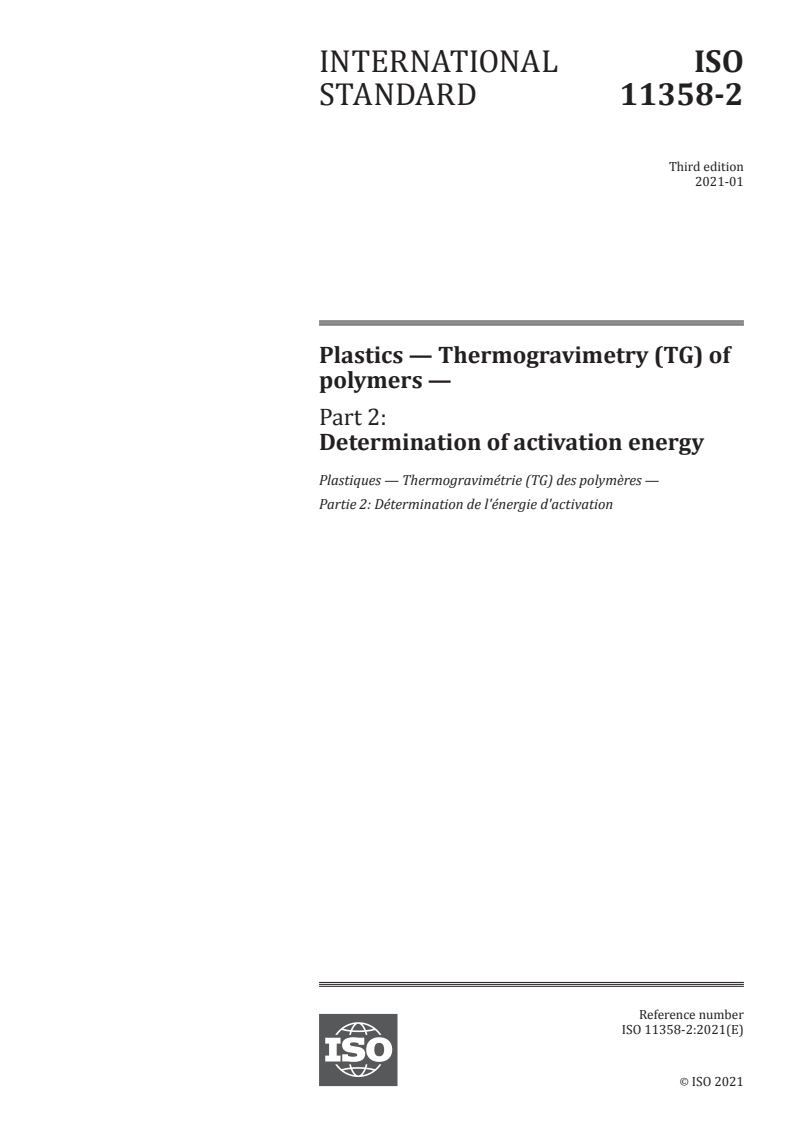
(Main)Plastics — Thermogravimetry (TG) of polymers — Part 2: Determination of activation energy
General Information
- Abstract
This document specifies a method for the determination of the activation energy, Ea, in the Arrhenius formula for the decomposition of polymers using a thermogravimetric technique. The method is applicable only if the reaction proceeds by a single mechanism. It is applicable to multistage reactions if they consist of clearly separated single-stage steps.
- Status
- Published
- Publication Date
- 28-Jan-2021
- Technical Committee
- ISO/TC 61/SC 5 - Physical-chemical properties
- Drafting Committee
- ISO/TC 61/SC 5/WG 8 - Thermal analysis
- Current Stage
- 9093 - International Standard confirmed
- Start Date
- 10-Jun-2026
- Completion Date
- 29-Aug-2026
Buy Documents
ISO 11358-2:2021 - Plastics -- Thermogravimetry (TG) of polymers
ISO 11358-2:2021 - Plastics — Thermogravimetry (TG) of polymers — Part 2: Determination of activation energy/29/2021
Overview
ISO 11358-2:2021 - "Plastics - Thermogravimetry (TG) of polymers - Part 2: Determination of activation energy" specifies a standardized thermogravimetric (TG) method to determine the activation energy (Ea) for polymer decomposition using thermogravimetric analysis (TGA). The method uses multiple dynamic heating-rate TG runs to derive Ea from the temperature dependence of decomposition according to the Arrhenius relationship. It applies only when the decomposition proceeds by a single mechanism or by clearly separated single-stage steps in a multistage reaction.
Key Topics
- Principle: heating specimens at several heating rates, measuring mass change vs temperature, selecting temperatures at given degrees of conversion (C), and calculating Ea from the slope of log(heating rate) vs 1/T plots using the Ozawa / Flynn–Wall approximation.
- Test conditions and apparatus: refers to ISO 11358-1 for general TG principles, apparatus requirements, and calibration (mass and temperature).
- Specimen preparation: powders, pellets, flakes, filaments or film; small particle size preferred (grinding in liquid-nitrogen mill acceptable).
- Experimental parameters:
- Use three or more heating rates; lowest and highest heating rates must differ by a factor ≥ 5.
- Preferred specimen mass < 10 mg and heating rates < 20 K·min⁻¹ to avoid temperature lag.
- Correct for buoyancy and empty-crucible mass changes by subtracting blank runs at each heating rate.
- Atmosphere control: inert (e.g., N2) for non-oxidative tests or oxidative gas (air/O2) for oxidation studies; gas purity and water content per ISO 11358-1.
- Data presentation: TG curves (mass or % mass vs temperature) and graphical determination of temperatures corresponding to fixed degrees of conversion.
- Limitations and notes:
- Not suitable for very high degrees of conversion.
- Unreliable if Ea varies widely with conversion or if log β vs 1/T is non-linear.
- Reporting: detailed test report requirements (sample ID, mass, crucible, atmosphere, heating rates, calibration standards, activation energy value, observations, date).
Applications
- Determining thermal stability and decomposition kinetics of polymers and polymer formulations.
- Material R&D: comparing additives, stabilizers, fillers, and recycling/degradation behavior.
- Quality control and batch comparison in polymer manufacturing.
- Failure analysis and lifetime prediction based on kinetic parameters.
- Thermal analysis laboratories, polymer scientists, instrument manufacturers, and regulatory or certification bodies performing standardized TGA kinetic evaluations.
Related Standards
- ISO 11358-1 - Plastics - Thermogravimetry (TG) of polymers - Part 1: General principles (apparatus, calibration, terminology).
- ISO 11358-3 - referenced in edition changes (alignment of conversion/rate terminology).
Keywords: ISO 11358-2:2021, thermogravimetry, TG, thermogravimetric analysis, activation energy, Arrhenius, polymer decomposition, Flynn–Wall, Ozawa, thermal stability, TGA.
Relations
- Effective Date
- 23-Apr-2020
Buy Documents
ISO 11358-2:2021 - Plastics -- Thermogravimetry (TG) of polymers
ISO 11358-2:2021 - Plastics — Thermogravimetry (TG) of polymers — Part 2: Determination of activation energy/29/2021
Get Certified
Connect with accredited certification bodies for this standard

DIN CERTCO
DIN Group product certification.

Smithers Quality Assessments
US management systems and product certification.
Sponsored listings
Frequently Asked Questions
ISO 11358-2:2021 is a standard published by the International Organization for Standardization (ISO). Its full title is "Plastics — Thermogravimetry (TG) of polymers — Part 2: Determination of activation energy". This standard covers: This document specifies a method for the determination of the activation energy, Ea, in the Arrhenius formula for the decomposition of polymers using a thermogravimetric technique. The method is applicable only if the reaction proceeds by a single mechanism. It is applicable to multistage reactions if they consist of clearly separated single-stage steps.
This document specifies a method for the determination of the activation energy, Ea, in the Arrhenius formula for the decomposition of polymers using a thermogravimetric technique. The method is applicable only if the reaction proceeds by a single mechanism. It is applicable to multistage reactions if they consist of clearly separated single-stage steps.
ISO 11358-2:2021 is classified under the following ICS (International Classification for Standards) categories: 83.080.01 - Plastics in general. The ICS classification helps identify the subject area and facilitates finding related standards.
ISO 11358-2:2021 has the following relationships with other standards: It is inter standard links to ISO 11358-2:2014. Understanding these relationships helps ensure you are using the most current and applicable version of the standard.
ISO 11358-2:2021 is available in PDF format for immediate download after purchase. The document can be added to your cart and obtained through the secure checkout process. Digital delivery ensures instant access to the complete standard document.
Standards Content (Sample)
INTERNATIONAL ISO
STANDARD 11358-2
Third edition
2021-01
Plastics — Thermogravimetry (TG) of
polymers —
Part 2:
Determination of activation energy
Plastiques — Thermogravimétrie (TG) des polymères —
Partie 2: Détermination de l'énergie d'activation
Reference number
©
ISO 2021
© ISO 2021
All rights reserved. Unless otherwise specified, or required in the context of its implementation, no part of this publication may
be reproduced or utilized otherwise in any form or by any means, electronic or mechanical, including photocopying, or posting
on the internet or an intranet, without prior written permission. Permission can be requested from either ISO at the address
below or ISO’s member body in the country of the requester.
ISO copyright office
CP 401 • Ch. de Blandonnet 8
CH-1214 Vernier, Geneva
Phone: +41 22 749 01 11
Email: copyright@iso.org
Website: www.iso.org
Published in Switzerland
ii © ISO 2021 – All rights reserved
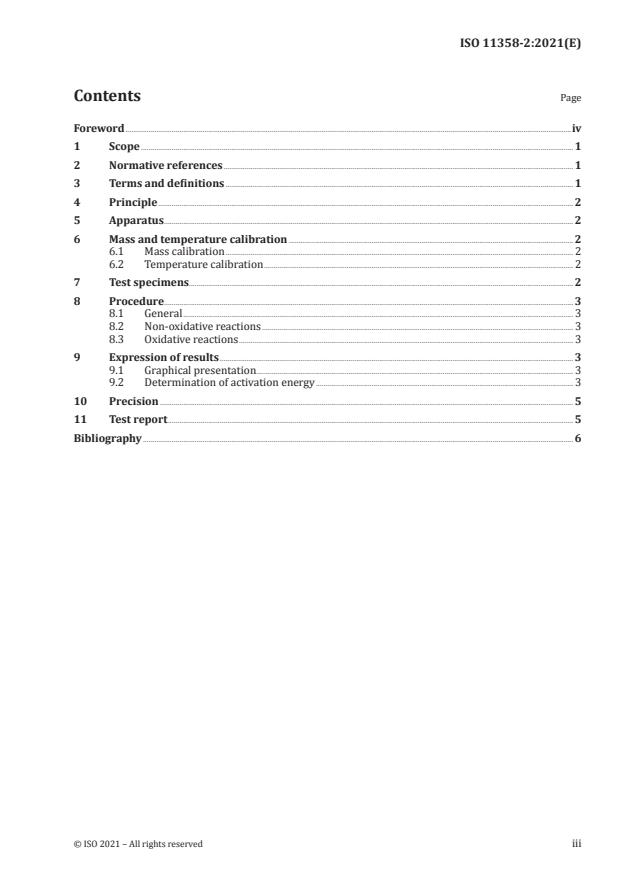
Contents Page
Foreword .iv
1 Scope . 1
2 Normative references . 1
3 Terms and definitions . 1
4 Principle . 2
5 Apparatus . 2
6 Mass and temperature calibration . 2
6.1 Mass calibration . 2
6.2 Temperature calibration . 2
7 Test specimens. 2
8 Procedure. 3
8.1 General . 3
8.2 Non-oxidative reactions . 3
8.3 Oxidative reactions . 3
9 Expression of results . 3
9.1 Graphical presentation . 3
9.2 Determination of activation energy . 3
10 Precision . 5
11 Test report . 5
Bibliography . 6
Foreword
ISO (the International Organization for Standardization) is a worldwide federation of national standards
bodies (ISO member bodies). The work of preparing International Standards is normally carried out
through ISO technical committees. Each member body interested in a subject for which a technical
committee has been established has the right to be represented on that committee. International
organizations, governmental and non-governmental, in liaison with ISO, also take part in the work.
ISO collaborates closely with the International Electrotechnical Commission (IEC) on all matters of
electrotechnical standardization.
The procedures used to develop this document and those intended for its further maintenance are
described in the ISO/IEC Directives, Part 1. In particular, the different approval criteria needed for the
different types of ISO documents should be noted. This document was drafted in accordance with the
editorial rules of the ISO/IEC Directives, Part 2 (see www .iso .org/ directives).
Attention is drawn to the possibility that some of the elements of this document may be the subject of
patent rights. ISO shall not be held responsible for identifying any or all such patent rights. Details of
any patent rights identified during the development of the document will be in the Introduction and/or
on the ISO list of patent declarations received (see www .iso .org/ patents).
Any trade name used in this document is information given for the convenience of users and does not
constitute an endorsement.
For an explanation of the voluntary nature of standards, the meaning of ISO specific terms and
expressions related to conformity assessment, as well as information about ISO's adherence to the
World Trade Organization (WTO) principles in the Technical Barriers to Trade (TBT), see www .iso .org/
iso/ foreword .html.
This document was prepared by Technical Committee ISO/TC 61, Plastics, Subcommittee SC 5, Physical-
chemical properties.
This third edition cancels and replaces the second edition (ISO 11358-2:2014), which has been
technically revised.
The main changes compared to the previous edition are as follows:
— the designation of rate of conversion has been changed in order to match that used in ISO 11358-3;
— the purge gas requirements have been changed with a reference to ISO 11358-1.
A list of all parts in the ISO 11358 series can be found on the ISO website.
Any feedback or questions on this document should be directed to the user’s national standards body. A
complete listing of these bodies can be found at www .iso .org/ members .html.
iv © ISO 2021 – All rights reserved
INTERNATIONAL STANDARD ISO 11358-2:2021(E)
Plastics — Thermogravimetry (TG) of polymers —
Part 2:
Determination of activation energy
1 Scope
This document specifies a method for the determination of the activation energy, E , in the Arrhenius
a
formula for the decomposition of polymers using a thermogravimetric technique. The method is
applicable only if the reaction proceeds by a single mechanism. It is applicable to multistage reactions if
they consist of clearly separated single-stage steps.
2 Normative references
The following documents are referred to in the text in such a way that some or all of their content
constitutes requirements of this document. For dated references, only the edition cited applies. For
undated references, the latest edition of the referenced document (including any amendments) applies.
ISO 1135
...
INTERNATIONAL ISO
STANDARD 11358-2
Third edition
2021-01
Plastics — Thermogravimetry (TG) of
polymers —
Part 2:
Determination of activation energy
Plastiques — Thermogravimétrie (TG) des polymères —
Partie 2: Détermination de l'énergie d'activation
Reference number
©
ISO 2021
© ISO 2021
All rights reserved. Unless otherwise specified, or required in the context of its implementation, no part of this publication may
be reproduced or utilized otherwise in any form or by any means, electronic or mechanical, including photocopying, or posting
on the internet or an intranet, without prior written permission. Permission can be requested from either ISO at the address
below or ISO’s member body in the country of the requester.
ISO copyright office
CP 401 • Ch. de Blandonnet 8
CH-1214 Vernier, Geneva
Phone: +41 22 749 01 11
Email: copyright@iso.org
Website: www.iso.org
Published in Switzerland
ii © ISO 2021 – All rights reserved
Contents Page
Foreword .iv
1 Scope . 1
2 Normative references . 1
3 Terms and definitions . 1
4 Principle . 2
5 Apparatus . 2
6 Mass and temperature calibration . 2
6.1 Mass calibration . 2
6.2 Temperature calibration . 2
7 Test specimens. 2
8 Procedure. 3
8.1 General . 3
8.2 Non-oxidative reactions . 3
8.3 Oxidative reactions . 3
9 Expression of results . 3
9.1 Graphical presentation . 3
9.2 Determination of activation energy . 3
10 Precision . 5
11 Test report . 5
Bibliography . 6
Foreword
ISO (the International Organization for Standardization) is a worldwide federation of national standards
bodies (ISO member bodies). The work of preparing International Standards is normally carried out
through ISO technical committees. Each member body interested in a subject for which a technical
committee has been established has the right to be represented on that committee. International
organizations, governmental and non-governmental, in liaison with ISO, also take part in the work.
ISO collaborates closely with the International Electrotechnical Commission (IEC) on all matters of
electrotechnical standardization.
The procedures used to develop this document and those intended for its further maintenance are
described in the ISO/IEC Directives, Part 1. In particular, the different approval criteria needed for the
different types of ISO documents should be noted. This document was drafted in accordance with the
editorial rules of the ISO/IEC Directives, Part 2 (see www .iso .org/ directives).
Attention is drawn to the possibility that some of the elements of this document may be the subject of
patent rights. ISO shall not be held responsible for identifying any or all such patent rights. Details of
any patent rights identified during the development of the document will be in the Introduction and/or
on the ISO list of patent declarations received (see www .iso .org/ patents).
Any trade name used in this document is information given for the convenience of users and does not
constitute an endorsement.
For an explanation of the voluntary nature of standards, the meaning of ISO specific terms and
expressions related to conformity assessment, as well as information about ISO's adherence to the
World Trade Organization (WTO) principles in the Technical Barriers to Trade (TBT), see www .iso .org/
iso/ foreword .html.
This document was prepared by Technical Committee ISO/TC 61, Plastics, Subcommittee SC 5, Physical-
chemical properties.
This third edition cancels and replaces the second edition (ISO 11358-2:2014), which has been
technically revised.
The main changes compared to the previous edition are as follows:
— the designation of rate of conversion has been changed in order to match that used in ISO 11358-3;
— the purge gas requirements have been changed with a reference to ISO 11358-1.
A list of all parts in the ISO 11358 series can be found on the ISO website.
Any feedback or questions on this document should be directed to the user’s national standards body. A
complete listing of these bodies can be found at www .iso .org/ members .html.
iv © ISO 2021 – All rights reserved
INTERNATIONAL STANDARD ISO 11358-2:2021(E)
Plastics — Thermogravimetry (TG) of polymers —
Part 2:
Determination of activation energy
1 Scope
This document specifies a method for the determination of the activation energy, E , in the Arrhenius
a
formula for the decomposition of polymers using a thermogravimetric technique. The method is
applicable only if the reaction proceeds by a single mechanism. It is applicable to multistage reactions if
they consist of clearly separated single-stage steps.
2 Normative references
The following documents are referred to in the text in such a way that some or all of their content
constitutes requirements of this document. For dated references, only the edition cited applies. For
undated references, the latest edition of the referenced document (including any amendments) applies.
ISO 1135
...