

ISO 18937-3:2026
(Main)Imaging materials — Methods for measuring indoor light stability of photographic prints — Part 3: LED lamp exposure
General Information
- Abstract
This document describes test methods for measuring the light stability of photographic prints when subjected to LED illumination sources under conditions that simulate indoor display. This document is applicable to all types of colour and monochrome photographic reflection prints. This document does not include test procedures for determining the effects of light exposure on the physical stability of images, supports or binder materials. NOTE 1 It is recognized that in some instances, physical degradation such as support embrittlement, image layer cracking, or delamination of an image layer from its support, rather than the stability of the image itself, will determine the useful life of a print material. NOTE 2 General guidance and requirements are given in ISO 18937-1. NOTE 3 Tables 1 and 3 of LED lamp relative spectral irradiance were created using spectra from phosphor-converted blue LED lamps. Other types of LED lamps that meet the criteria of Tables 1 and 3 are also in the scope of this document.
- Status
- Published
- Publication Date
- 03-Mar-2026
- Technical Committee
- ISO/TC 42 - Photography
- Drafting Committee
- ISO/TC 42 - Photography
- Current Stage
- 6060 - International Standard published
- Start Date
- 04-Mar-2026
- Due Date
- 06-Oct-2026
- Completion Date
- 04-Mar-2026


Overview
ISO 18937-3:2026 - Imaging materials - Methods for measuring indoor light stability of photographic prints - Part 3: LED lamp exposure sets forth standardized test methods for assessing the indoor light stability of photographic prints under LED lamp illumination. Developed by ISO Technical Committee 42 (Photography), this standard is designed to help manufacturers, laboratories, cultural institutions, and end users evaluate the resistance of photographic print materials to fading and color change when displayed indoors under modern LED lighting.
This part of ISO 18937 addresses all major types of colour and monochrome photographic reflection prints and simulates real-world exposure conditions found in homes, offices, commercial spaces, galleries, archives, and museums using defined LED illumination sources. This standard supports informed material development, objective product evaluation, and best practices in print preservation and display.
Key Topics
Test Scope and Applicability
- Applies to all types of colour and monochrome photographic prints displayed indoors
- Focuses on image stability under LED lamp exposure
- Does not cover physical degradation of image supports or binders
LED Lamp Specifications
- Emphasis on phosphor-converted blue LED lamps, reflecting market prevalence and their spectral characteristics
- Spectral irradiance requirements clearly defined for both 5000 K (general indoor) and 3000 K (museum/gallery) correlated colour temperatures
Exposure Conditions
- Clearly prescribed environmental parameters: illuminance, temperature, and relative humidity
- Methods for controlling and documenting irradiance uniformity, sensor location, and air quality
- Guidance for both standardized testing (method A) and comparative lamp/material evaluation (method B)
Test Reporting
- Requirements to include detailed documentation of exposure conditions, lamp characteristics, and deviations from the standard
- Reporting restricted to specific system tested; results do not extrapolate to all materials or conditions
Applications
Print Manufacturers and Printers
- Enables systematic testing and comparison of the light stability of photographic prints under standardized LED lighting
- Supports improvements in materials, inks, and production processes for enhanced longevity
Museums, Galleries, and Archives
- Informs the selection of display and storage lighting systems, helping to balance image preservation with visual presentation
- Facilitates condition reporting for high-value collections and exhibitions
Product Development and R&D
- Provides a reliable basis for developing print media and LED lighting solutions aligned with global standards
- Empower manufacturers to make durability claims substantiated by rigorous, repeatable testing
Quality Assurance and Third-Party Labs
- Standardizes methodology for contract laboratories and quality assurance teams conducting lightfastness or permanence evaluations
- Enables comparability across brands and product generations
Related Standards
- ISO 18937-1: General guidance and requirements for measuring indoor light stability of photographic prints
- ISO 18913: Vocabulary for permanence of imaging materials
- ISO/CIE 11664-2: Standards for colorimetric observers and illuminants
- ISO 18937-2: Test methods using other indoor lighting (e.g., filtered Xenon arc)
- ISO/TS 18950: Guidance for museum-grade UV-filtered LED light testing
Keywords: ISO 18937-3, LED lamp exposure, light stability testing, photographic print permanence, image longevity, indoor display preservation, museum lighting standards, color print fading, standardized LED test methods, ISO photography standards
Implementing ISO 18937-3:2026 helps ensure that photographic prints retain their intended appearance under typical indoor LED lighting-supporting higher standards of quality and reliability throughout the imaging materials industry.
Frequently Asked Questions
ISO 18937-3:2026 is a standard published by the International Organization for Standardization (ISO). Its full title is "Imaging materials — Methods for measuring indoor light stability of photographic prints — Part 3: LED lamp exposure". This standard covers: This document describes test methods for measuring the light stability of photographic prints when subjected to LED illumination sources under conditions that simulate indoor display. This document is applicable to all types of colour and monochrome photographic reflection prints. This document does not include test procedures for determining the effects of light exposure on the physical stability of images, supports or binder materials. NOTE 1 It is recognized that in some instances, physical degradation such as support embrittlement, image layer cracking, or delamination of an image layer from its support, rather than the stability of the image itself, will determine the useful life of a print material. NOTE 2 General guidance and requirements are given in ISO 18937-1. NOTE 3 Tables 1 and 3 of LED lamp relative spectral irradiance were created using spectra from phosphor-converted blue LED lamps. Other types of LED lamps that meet the criteria of Tables 1 and 3 are also in the scope of this document.
This document describes test methods for measuring the light stability of photographic prints when subjected to LED illumination sources under conditions that simulate indoor display. This document is applicable to all types of colour and monochrome photographic reflection prints. This document does not include test procedures for determining the effects of light exposure on the physical stability of images, supports or binder materials. NOTE 1 It is recognized that in some instances, physical degradation such as support embrittlement, image layer cracking, or delamination of an image layer from its support, rather than the stability of the image itself, will determine the useful life of a print material. NOTE 2 General guidance and requirements are given in ISO 18937-1. NOTE 3 Tables 1 and 3 of LED lamp relative spectral irradiance were created using spectra from phosphor-converted blue LED lamps. Other types of LED lamps that meet the criteria of Tables 1 and 3 are also in the scope of this document.
ISO 18937-3:2026 is classified under the following ICS (International Classification for Standards) categories: 37.040.20 - Photographic paper, films and plates. Cartridges. The ICS classification helps identify the subject area and facilitates finding related standards.
ISO 18937-3:2026 is available in PDF format for immediate download after purchase. The document can be added to your cart and obtained through the secure checkout process. Digital delivery ensures instant access to the complete standard document.
Standards Content (Sample)
International
Standard
ISO 18937-3
First edition
Imaging materials — Methods for
2026-03
measuring indoor light stability of
photographic prints —
Part 3:
LED lamp exposure
Matériaux pour l'image — Méthodes de mesure de la stabilité de
la lumière en intérieur des épreuves photographiques —
Partie 3: Exposition à une lampe LED
Reference number
© ISO 2026
All rights reserved. Unless otherwise specified, or required in the context of its implementation, no part of this publication may
be reproduced or utilized otherwise in any form or by any means, electronic or mechanical, including photocopying, or posting on
the internet or an intranet, without prior written permission. Permission can be requested from either ISO at the address below
or ISO’s member body in the country of the requester.
ISO copyright office
CP 401 • Ch. de Blandonnet 8
CH-1214 Vernier, Geneva
Phone: +41 22 749 01 11
Email: copyright@iso.org
Website: www.iso.org
Published in Switzerland
ii
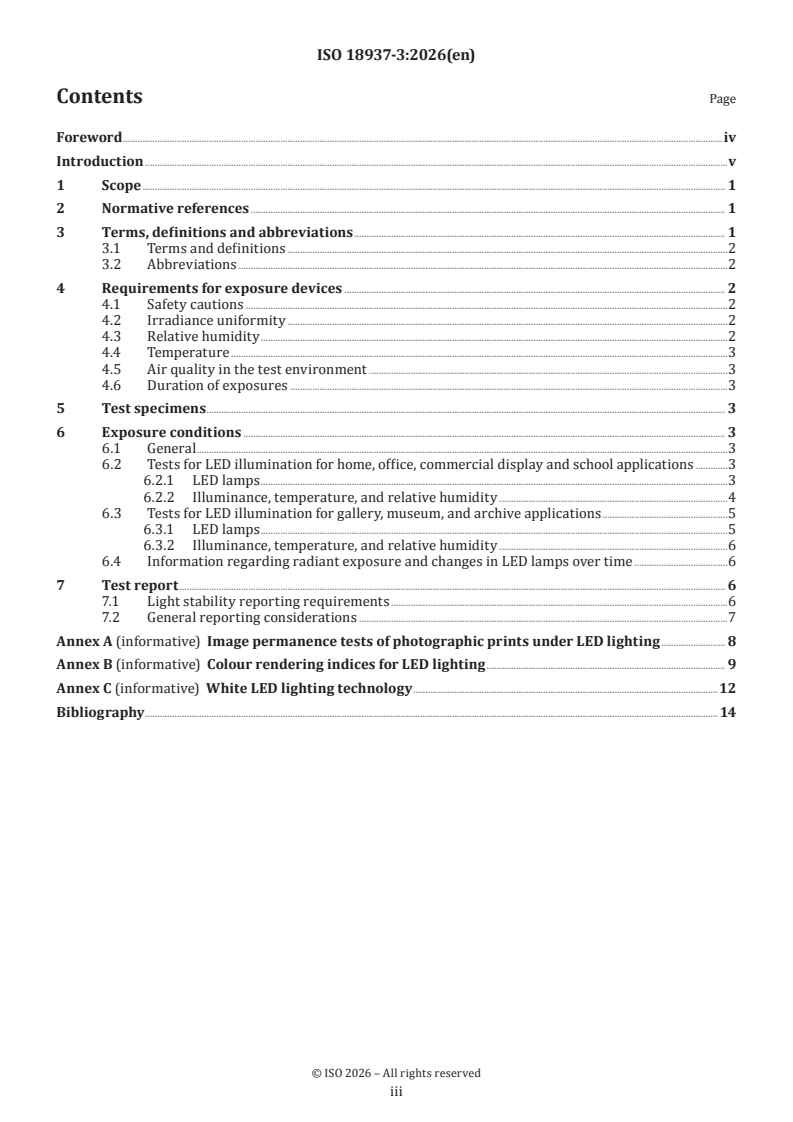
Contents Page
Foreword .iv
Introduction .v
1 Scope . 1
2 Normative references . 1
3 Terms, definitions and abbreviations . 1
3.1 Terms and definitions .2
3.2 Abbreviations .2
4 Requirements for exposure devices . 2
4.1 Safety cautions .2
4.2 Irradiance uniformity .2
4.3 Relative humidity .2
4.4 Temperature .3
4.5 Air quality in the test environment .3
4.6 Duration of exposures .3
5 Test specimens . 3
6 Exposure conditions . 3
6.1 General .3
6.2 Tests for LED illumination for home, office, commercial display and school applications .3
6.2.1 LED lamps .3
6.2.2 Illuminance, temperature, and relative humidity .4
6.3 Tests for LED illumination for gallery, museum, and archive applications .5
6.3.1 LED lamps .5
6.3.2 Illuminance, temperature, and relative humidity .6
6.4 Information regarding radiant exposure and changes in LED lamps over time .6
7 Test report . 6
7.1 Light stability reporting requirements .6
7.2 General reporting considerations .7
Annex A (informative) Image permanence tests of photographic prints under LED lighting . 8
Annex B (informative) Colour rendering indices for LED lighting . 9
Annex C (informative) White LED lighting technology .12
Bibliography . 14
iii
Foreword
ISO (the International Organization for Standardization) is a worldwide federation of national standards
bodies (ISO member bodies). The work of preparing International Standards is normally carried out through
ISO technical committees. Each member body interested in a subject for which a technical committee
has been established has the right to be represented on that committee. International organizations,
governmental and non-governmental, in liaison with ISO, also take part in the work. ISO collaborates closely
with the International Electrotechnical Commission (IEC) on all matters of electrotechnical standardization.
The procedures used to develop this document and those intended for its further maintenance are described
in the ISO/IEC Directives, Part 1. In particular, the different approval criteria needed for the different types
of ISO document should be noted. This document was drafted in accordance with the editorial rules of the
ISO/IEC Directives, Part 2 (see www.iso.org/directives).
ISO draws attention to the possibility that the implementation of this document may involve the use of (a)
patent(s). ISO takes no position concerning the evidence, validity or applicability of any claimed patent
rights in respect thereof. As of the date of publication of this document, ISO had not received notice of (a)
patent(s) which may be required to implement this document. However, implementers are cautioned that
this may not represent the latest information, which may be obtained from the patent database available at
www.iso.org/patents. ISO shall not be held responsible for identifying any or all such patent rights.
Any trade name used in this document is information given for the convenience of users and does not
constitute an endorsement.
For an explanation of the voluntary nature of standards, the meaning of ISO specific terms and expressions
related to conformity assessment, as well as information about ISO's adherence to the World Trade
Organization (WTO) principles in the Technical Barriers to Trade (TBT), see www.iso.org/iso/foreword.html.
This document was prepared by Technical Committee ISO/TC 42, Photography.
A list of all parts in the ISO 18937 series can be found on the ISO website.
Any feedback or questions on this document should be directed to the user’s national standards body. A
complete listing of these bodies can be found at www.iso.org/members.html.
iv
Introduction
The ISO 18937 series of test methods has been written for the determination of the indoor light stability
of photographic prints. ISO 18937-3 is an addition to the series due to the increasing importance of LED
lighting.
This test method is important to the end users of LED lamps for various use cases: home, office, and
commercial applications; and museum, gallery, archive, and other cultural heritage applications. In addition,
manufacturers of printers and printing materials will be able to use this method to test and to improve their
print materials, equipment, and processes. As a reference for LED testing of photographic prints, Annex A
provides a summary of two published test studies.
The type of light source specified for use in this document is an LED lamp with a relative spectral irradiance
that conforms to one of the Tables 1 or 3 for the two groups of use cases. See Annexes B and C for descriptions
and explanations of LED lighting technology, the ability of LED lights to render colours, and the metrics by
which colour rendering are assessed.
Phosphor-converted blue LED lamps represent the majority of LED lamps used for the general lighting use
case. These lamps are relatively low in price, have high electrical efficiency, and many of them can provide
high colour rendering with R of 90+. These LED lamps are available in a variety of correlated colour
a
temperatures (CCT), and some of the lamps are tunable and may be set by the user to several CCT values.
These choices of CCT may be influenced by the time of day, individual preferences, as well as cultural and
geographic customs. For this use case group a CCT of 5 000 K, which corresponds to natural outdoor daylight
in the early morning or late afternoon, is specified.
Museums, galleries, and archives often use LEDs of approximately 3 000 K CCT because their light is similar
in appearance to that of the tungsten-halogen lamps that have been adopted for most display applications in
recent years. Some of the lamps used in these applications have extremely high colour rendering, with R of
a
98+. For this use case group, phosphor-converted blue LED lamps with a CCT of 3 000 K are specified. The
LED lamps as specified in Tables 1 and 3 have very little UV content.
v
International Standard ISO 18937-3:2026(en)
Imaging materials — Methods for measuring indoor light
stability of photographic prints —
Part 3:
LED lamp exposure
1 Scope
This document describes test methods for measuring the light stability of photographic prints when
subjected to LED illumination sources under conditions that simulate indoor display.
This document is applicable to all types of colour and monochrome photographic reflection prints.
This document does not include test procedures for determining the effects of light exposure on the physical
stability of images, supports or binder materials.
NOTE 1 It is recognized that in some instances, physical degradation such as support embrittlement, image layer
cracking, or delamination of an image layer from its support, rather than the stability of the image itself, will determine
the useful life of a print material.
NOTE 2 General guidance and requirements are given in ISO 18937-1.
NOTE 3 Tables 1 and 3 of LED lamp relative spectral irradiance were created using spectra from phosphor-
converted blue LED lamps. Other types of LED lamps that meet the criteria of Tables 1 and 3 are also in the scope of
this document.
2 Normative references
The following documents are referred to in the text in such a way that some or all of their content constitutes
requirements of this document. For dated references, only the edition cited applies. For undated references,
the latest edition of the referenced document (including any amendments) applies.
ISO 18913, Imaging materials — Permanence — Vocabulary
ISO 18937-1, Imaging materials — Methods for measuring indoor light stability of photographic prints — Part
1: General guidance and requirements
3 Terms, definitions and abbreviations
For the purposes of this document, the terms and definitions given in ISO 18913, ISO 18937-1, and the
following apply.
ISO and IEC maintain terminology databases for use in standardization at the following addresses:
— ISO Online browsing platform: available at https:// www .iso .org/ obp
— IEC Electropedia: available at https:// www .electropedia .org/
3.1 Terms and definitions
3.1.1
phosphor-converted blue LED lamp
lamp that comprises an LED pump with peak emission wavelength in the 425 nm to 470 nm range that
stimulates the emission of one or multiple phosphors
Note 1 to entry: This term includes most of the LED lamps known in the industry as “blue-pump LEDs”. The term
“pump” in this context is explained in Annex C.
Note 2 to entry: The phosphor conversion makes up the green-yellow-orange-red portions of the visible spectrum.
Note 3 to entry: Red or green LEDs can also be present in addition to the blue LED in an array.
3.1.2
phosphor-converted violet LED lamp
lamp that comprises an LED pump with peak emission wavelength in the 400 nm to 425 nm range that
stimulates the emission of one or multiple phosphors
Note 1 to entry: This term includes most of the LED lamps known in the industry as “violet-pump LEDs”. The term
“pump” in this context is explained in Annex C.
Note 2 to entry: The phosphor conversion makes up the blue-green-yellow-orange-red portions of the visible spectrum.
Note 3 to entry: Red or green LEDs can also be present in addition to the violet LED in an array.
3.2 Abbreviations
CCT Correlated colour temperature
[37]
CIE R Colour rendering index as standardized in CIE 13.3-1995
a
CRI Colour rendering index
LED Light emitting diode
R Colour rendering index score for colour sample number x in the CIE colour rendering index method
i
[37]
of CIE 13.3-1995
RSI Relative spectral irradiance
NOTE RSI is also commonly known as relative spectral power distribution – or relative SPD.
4 Requirements for exposure devices
4.1 Safety cautions
In light stability tests, a high irradiance level is used. Special care shall be taken to avoid eye injury or skin
erythema, see Reference [1].
4.2 Irradiance uniformity
The irradiance at any position in the area used for specimen exposure shall be at least 90 % of the maximum
irradiance without periodic repositioning of test specimens, or at least 80 % with repositioning. Procedures
for measurement of irradiance uniformity and requirements for periodic repositioning of specimens are
described in ISO 18937–1.
NOTE Reference [2] describes several possible procedures, including random positioning of replicate specimens,
that can be used to reduce the variability in exposure stresses experienced by specimens during exposure.
4.3 Relative humidity
The relative humidity of the air circulating in the test chamber shall be controlled. The location of sensors
used for measuring relative humidity shall be as specified in ISO 18937-1.
4.4 Temperature
The required black panel temperature and chamber air temperature for the tests shall be controlled. The
location of the sensors used to measure the temperature shall be as specified in ISO 18937–1.
NOTE Most lightfastness apparatus uses ambient laboratory air to control chamber air temperature. Therefore,
laboratory conditions are maintained such that the apparatus can control temperature effectively. Air refrigeration
units can be used to maintain the chamber air temperature depending on the ambient laboratory air temperature.
4.5 Air quality in the test environment
Air quality in the test environment shall conform to the requirements of ISO 18937–1.
4.6 Duration of exposures
Duration of exposures shall conform to ISO 18937–1.
5 Test specimens
Test specimens shall conform to ISO 18937–1.
[3]
For information regarding image permanence test target creation, the reader is referred to ISO 18944 and
[4]
ISO/PAS 18940-1 .
6 Exposure conditions
6.1 General
The exposure condition requirements depend upon the intention of the user of this document:
Test method A: For testing the image permanence of printed materials under well-defined LED illumination.
Test method B: For comparative testing of the image fading potential of specific LED lamps (for a set of
printed materials).
6.2 Tests for LED illumination for home, office, commercial display and school applications
6.2.1 LED lamps
6.2.1.1 Test method A1
Test method A1 shall be used whenever image permanence data of printed materials has to be reported.
Phosphor-converted blue LED lamps shall be used for the test. The LED lamps used in test method A1 shall
meet the following requirement:
— relative spectral irradiance of LED lamp between 300 nm and 800 nm shall conform to Table 1.
NOTE 1 Table 1 was created using LED lamps with correlated colour temperature (CCT) of 5 000 ± 250 K and
[37]
CIE 13.3-1995 General colour rendering index, R , greater than or equal to 90.
a
[5]
NOTE 2 Colour rendering index requirements for indoor work places are specified in EN 12464-1 and
[6]
ISO/CIE 8995-1 . For many of those work places, the minimum specified R value is 80.
a
If a test is conducted with a lamp chosen to match an actual display lamp that does not comply with the RSI
requirements of Table 1, then the test would correspond to test method B1.
See Annexes B and C for descriptions of colour rendering indices and LED lamp constructions. The technology
of LED lamps is changing rapidly, and this could make it difficult to select the most appropriate lamps to use.
Relative spectral irradiance can be measured both easily and cheaply, but not absolute spectral irradiance.
The spectral data can be converted to relevant colour rendering indices using the colour calculators in
References [7], [8] and [39].
NOTE 3 The citation of examples of suitable websites for spectral measurements and colour calculations are not
interpreted as any endorsement of products or sites. ISO/TC 42 does not make product endorsements.
Table 1 shows the relative spectral irradiance for phosphor-converted blue LED lamps at CCT of 5 000 K. It
was created using data from measurements of the spectral output of commercially available consumer LED
lamps with CCT around 5 000 K. The upper and lower limits for the RSI in the passbands in Table 1 are taken
from the average plus three standard deviations and the average minus three standard deviations from that
[9]
survey .
Table 1 — Relative spectral irradiance as percentage of energy between 300 nm and 800 nm for
phosphor-converted blue LED lamps at CCT 5 000 K
Wavelength,λ, range Minimum Maximum
nm % %
300 ≤ λ < 400 0 0,2
400 ≤ λ < 430 0 1,7
430 ≤ λ < 460 9,0 18,0
460 ≤ λ < 490 5,5 11,0
490 ≤ λ < 520 7,0 13,0
520 ≤ λ < 550 10,0 15,5
550 ≤ λ < 600 14,0 30,0
600 ≤ λ < 800 10,6 54,5
NOTE Wavelengths from 600 nm to 800 nm do not typically cause significant photodegradation. By definition,
the actual percent relative spectral irradiance of a light source from 300 nm to 800 nm will add to 100 %.
6.2.1.2 Test method B1
Test method B1 may be used for testing of the image fading potential of specific LED lamps that do not meet
the specifications for test method A1 because their RSI lies outside of the profile defined by Table 1. Test
method B1 is useful when it is necessary to assess the fading behaviour of specific printed materials under
LED lamps that do not meet the specifications for Test method A1.
The relative spectral irradiance profile, correlated colour temperature, and colour rendering indices of LED
lamps are not specified for this test method. All types of LED lamp constructions are permitted for this test
method.
Test method B1 is a valid choice when the user of this document wants to apply ISO 18937-3 test conditions
except for the lamp specifications for a particular set of materials only, as different RSI have different
effects on various types of print and materials (for example, those that contain UV absorbers). In this case,
meaningful details of the lamp used will be included in the report for clarity.
6.2.2 Illuminance, temperature, and relative humidity
The range of set points shown in Table 2 shall be used for test methods A1, A2, B1, and B2.
Table 2 — Set points for illuminance, temperatures, and relative humidity
Illuminance at the specimen plane ≤80 klx
Black panel temperature (uninsulated) 25 °C to 35 °C
Chamber air temperature 21 °C to 27 °C
Relative humidity 40 %RH to 60 %RH
The illuminance, black panel temperature, and chamber air temperature range of set points in the above table
are intended to result in a photographic print exposed under these conditions to be indirectly controlled at a
temperature between 25 °C to 30 °C. For information defining black panel thermometers and the associated
temperature, the reader is referred to ISO 18937-1:2023, Clause 5.
6.3 Tests for LED illumination for gallery, museum, and archive applications
6.3.1 LED lamps
6.3.1.1 Test method A2
Test method A2 shall be used whenever image permanence data of printed materials is to be reported.
Phosphor-converted blue LED lamps shall be used for the test.
The standard LED lamps for testing light permanence for gallery, museum, and archive applications shall
meet the following requirement:
— relative spectral irradiance of LED lamp between 300 nm and 800 nm shall conform to Table 3.
NOTE Table 3 was created using LED lamps with correlated colour temperature (CCT) of 3 000 ± 300 K and
[37]
CIE 13.3-1995 General colour rendering index, R , greater than or equal to 90.
a
If a test is conducted with a lamp chosen to match an actual display lamp that does not comply with the
requirements of Table 3, then the test would correspond to test method B2; see also References [11] and [12].
Table 3 shows the relative spectral irradiance for phosphor-converted blue LED lamps at CCT of 3 000 K
It was created using data from measurements of the spectral output of commercially available LED lamps
with CCT near 3 000 K. The upper and lower limits for the RSI in the passbands in Table 3 are taken from the
[9]
average plus three standard deviations and the average minus three standard deviations from that survey .
Table 3 — Relative spectral irradiance as percentage of energy between 300 nm and 800 nm for
phosphor-converted blue LED lamps at CCT 3 000 K
Wavelength,λ, range Minimum Maximum
nm % %
300 ≤ λ < 400 0 0,2
400 ≤ λ < 430 0 1,1
430 ≤ λ < 460 2,5 7,5
460 ≤ λ < 490 2,0 6,5
490 ≤ λ < 520 4,5 9,5
520 ≤ λ < 550 8,0 11,5
550 ≤ λ < 600 16,0 30,0
600 ≤ λ < 800 33,7 67,0
NOTE Wavelengths from 600 nm to 800 nm do not typically cause significant photodegradation. By definition,
the actual percent relative spectral irradiance of a light source from 300 nm to 800 nm will add to 100 %.
Additional UV filters including “blue or violet emission peak trimming filters” may be used to meet the
requirements of specific museums or archives. Optical filters of this sort shall be included in the test if the
[10]
light stability to museum-grade UV-filtered LED light conditions is of interest. ISO/TS 18950 provides
suitable guidance. Such additional UV filtering shall be included when specifying the RSI of the test light
source.
NOTE Test method A2 defines RSI and CCT of applicable light sources for museums and galleries. Test method B2
corresponds to ISO/TS 18950 “Tier I” evaluation in the Introduction, as the light source is open. ISO/TS 18950:2021,
5.3.5 specifies that the best practice for museum display is to use the same light source; next best is to use the same
blue peak wavelength. ISO/TS 18950:2021, Annex C, shows typical LED spectra at CCT of 2 700 K and 5 000 K, but
without a requirement that those spectra be matched.
6.3.1.2 Test method B2
Test method B2 may be used for testing of the image fading potential of specific LED lamps that do not meet
the specifications for test method A2 because their RSI lies outside of the profile defined by Table 1. Test
method B2 is useful when it is necessary to assess the fading behaviour of specific printed materials under
LED lamps that do not meet the specifications for Test method A2.
The relative spectral irradiance profile, correlated colour temperature, and colour rendering indices of LED
lamps are not specified for this test method. All types of LED lamp constructions are permitted for this test
method.
Test method B2 is a valid choice when the user of this document wants to apply ISO 18937-3 test conditions
except for the lamp specifications for a particular set of materials only, as different RSI have different
eff
...