

ISO 29042-2:2009
(Main)Safety of machinery — Evaluation of the emission of airborne hazardous substances — Part 2: Tracer gas method for the measurement of the emission rate of a given pollutant
General Information
- Abstract
ISO 29042-2:2009 specifies a method using tracer gas techniques to enable measurement of the emission rates of gaseous substances from a single machine whose operation can be controlled.
- Status
- Published
- Publication Date
- 10-Feb-2009
- Technical Committee
- ISO/TC 199 - Safety of machinery
- Drafting Committee
- ISO/TC 199 - Safety of machinery
- Current Stage
- 9093 - International Standard confirmed
- Start Date
- 03-Dec-2024
- Completion Date
- 29-Aug-2026
Overview - ISO 29042-2:2009 (Tracer gas method)
ISO 29042-2:2009 - part of the ISO 29042 series on the safety of machinery - specifies a tracer gas method to measure the emission rate of a given gaseous pollutant from a single machine whose operation can be controlled. The standard defines the principle, required apparatus, measurement points, test room and field methods, test procedure, data analysis and reporting requirements for evaluating airborne hazardous substances using tracer gas techniques.
Key topics and technical requirements
- Principle: Use a tracer gas released at a known, constant rate that mimics the aerodynamic behaviour of the pollutant; measure tracer and pollutant concentrations to calculate pollutant emission rate.
- Scope: Applicable to controlled machines (test-room or in-situ/field testing); not retroactive to machines manufactured before publication.
- Apparatus:
- Tracer gas emitter shaped to simulate the real source (point, plane or volumetric).
- Tracer gas flow-rate meter and adjusting device.
- Gas analyser(s) suitable for tracer and pollutant (IR, FID, electron capture, mass spectrometer noted).
- Low-adsorption sampling lines (e.g., PTFE) and filters where necessary.
- Recommended tracer gases (examples in the standard: helium, sulphur hexafluoride, nitrous oxide) chosen for low toxicity, stability, low background and measurability.
- Measurement points: At least three sample points around the machine (typically 1–3 m from source) positioned where the pollutant is generated.
- Procedure: Includes background measurement, stabilisation of analysers, tracer flow calibration, recording concentrations over time (typically several room time‑constants), and data analysis to express emission rates.
- Reporting: Test report content defined (test conditions, instrumentation, tracer gas flow, measured concentrations, calculation methods).
Applications and users
ISO 29042-2 is used for:
- Quantifying pollutant emission rates from machinery for risk assessment and exposure control.
- Designing or verifying ventilation, capture systems and local exhausts.
- Emission testing in test labs, workplace compliance checks, and product development.
Typical users:
- Machine manufacturers and designers
- Occupational hygienists and safety engineers
- Test laboratories and certification bodies
- Environmental and regulatory authorities
Related standards
- ISO 29042-1 - Selection of test methods (companion guidance)
- ISO 12100-1 - Safety of machinery - basic terminology and methodology
- Other parts of ISO 29042 series (test bench, capture efficiency, room methods) that address complementary test methods and parameters.
Keywords: ISO 29042-2, tracer gas method, emission rate, airborne hazardous substances, safety of machinery, tracer gas technique, gas analyser, test room method, field method.
Get Certified
Connect with accredited certification bodies for this standard

CIS Institut d.o.o.
Personal Protective Equipment (PPE) certification body. Notified Body NB-2890 for EU Regulation 2016/425 PPE.

Kiwa BDA Testing
Building and construction product certification.
Kmetijski inštitut Slovenije
Agricultural Institute of Slovenia. Soil testing, plant health, agricultural product analysis.
Sponsored listings
Frequently Asked Questions
ISO 29042-2:2009 is a standard published by the International Organization for Standardization (ISO). Its full title is "Safety of machinery — Evaluation of the emission of airborne hazardous substances — Part 2: Tracer gas method for the measurement of the emission rate of a given pollutant". This standard covers: ISO 29042-2:2009 specifies a method using tracer gas techniques to enable measurement of the emission rates of gaseous substances from a single machine whose operation can be controlled.
ISO 29042-2:2009 specifies a method using tracer gas techniques to enable measurement of the emission rates of gaseous substances from a single machine whose operation can be controlled.
ISO 29042-2:2009 is classified under the following ICS (International Classification for Standards) categories: 13.110 - Safety of machinery. The ICS classification helps identify the subject area and facilitates finding related standards.
ISO 29042-2:2009 is available in PDF format for immediate download after purchase. The document can be added to your cart and obtained through the secure checkout process. Digital delivery ensures instant access to the complete standard document.
Standards Content (Sample)
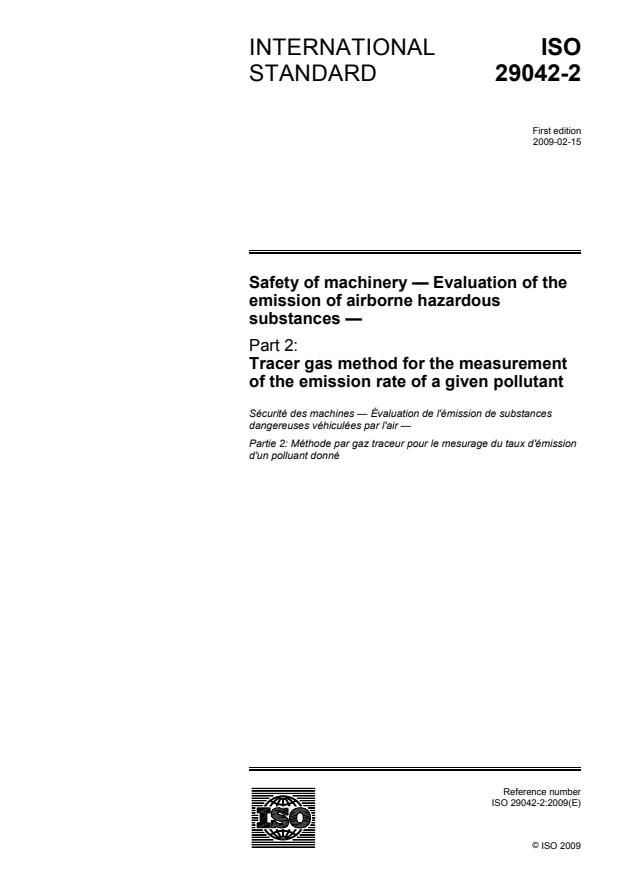
INTERNATIONAL ISO
STANDARD 29042-2
First edition
2009-02-15
Safety of machinery — Evaluation of the
emission of airborne hazardous
substances —
Part 2:
Tracer gas method for the measurement
of the emission rate of a given pollutant
Sécurité des machines — Évaluation de l'émission de substances
dangereuses véhiculées par l'air —
Partie 2: Méthode par gaz traceur pour le mesurage du taux d'émission
d'un polluant donné
Reference number
©
ISO 2009
PDF disclaimer
This PDF file may contain embedded typefaces. In accordance with Adobe's licensing policy, this file may be printed or viewed but
shall not be edited unless the typefaces which are embedded are licensed to and installed on the computer performing the editing. In
downloading this file, parties accept therein the responsibility of not infringing Adobe's licensing policy. The ISO Central Secretariat
accepts no liability in this area.
Adobe is a trademark of Adobe Systems Incorporated.
Details of the software products used to create this PDF file can be found in the General Info relative to the file; the PDF-creation
parameters were optimized for printing. Every care has been taken to ensure that the file is suitable for use by ISO member bodies. In
the unlikely event that a problem relating to it is found, please inform the Central Secretariat at the address given below.
© ISO 2009
All rights reserved. Unless otherwise specified, no part of this publication may be reproduced or utilized in any form or by any means,
electronic or mechanical, including photocopying and microfilm, without permission in writing from either ISO at the address below or
ISO's member body in the country of the requester.
ISO copyright office
Case postale 56 • CH-1211 Geneva 20
Tel. + 41 22 749 01 11
Fax + 41 22 749 09 47
E-mail copyright@iso.org
Web www.iso.org
Published in Switzerland
ii © ISO 2009 – All rights reserved
Foreword
ISO (the International Organization for Standardization) is a worldwide federation of national standards bodies
(ISO member bodies). The work of preparing International Standards is normally carried out through ISO
technical committees. Each member body interested in a subject for which a technical committee has been
established has the right to be represented on that committee. International organizations, governmental and
non-governmental, in liaison with ISO, also take part in the work. ISO collaborates closely with the
International Electrotechnical Commission (IEC) on all matters of electrotechnical standardization.
International Standards are drafted in accordance with the rules given in the ISO/IEC Directives, Part 2.
The main task of technical committees is to prepare International Standards. Draft International Standards
adopted by the technical committees are circulated to the member bodies for voting. Publication as an
International Standard requires approval by at least 75 % of the member bodies casting a vote.
Attention is drawn to the possibility that some of the elements of this document may be the subject of patent
rights. ISO shall not be held responsible for identifying any or all such patent rights.
ISO 29042-2 was prepared by Technical Committee ISO/TC 199, Safety of machinery.
ISO 29042 consists of the following parts, under the general title Safety of machinery — Evaluation of the
emission of airborne hazardous substances:
⎯ Part 1: Selection of test methods
⎯ Part 2: Tracer gas method for the measurement of the emission rate of a given pollutant
⎯ Part 3: Test bench method for the measurement of the emission rate of a given pollutant
⎯ Part 4: Tracer method for the measurement of the capture efficiency of an exhaust system
The following parts are under preparation:
⎯ Part 5: Test bench method for the measurement of the separation efficiency by mass of air cleaning
systems with unducted outlet
⎯ Part 6: Test bench method for the measurement of the separation efficiency by mass of air cleaning
systems with ducted outlet
⎯ Part 7: Test bench method for the measurement of the pollutant concentration parameter
A room method for the measurement of the pollutant concentration parameter and a decontamination index
are to form the subjects of future parts 8 and 9.
Introduction
The structure of safety standards in the field of machinery is as follows:
a) type-A standards (basic safety standards) giving basic concepts, principles for design, and general
aspects that can be applied to all machinery;
b) type-B standards (generic safety standards) dealing with one safety aspect or one type of safeguard that
can be used across a wide range of machinery:
⎯ type-B1 standards on particular safety aspects (e.g. safety distances, surface temperature, noise);
⎯ type-B2 standards on safeguards (e.g. two-hand controls, interlocking devices, pressure-sensitive
devices, guards);
c) type-C standards (machine safety standards) dealing with detailed safety requirements for a particular
machine or group of machines.
This part of ISO 29042 is a type-B standard as stated in ISO 12100-1.
The requirements of this document can be supplemented or modified by a type-C standard.
For machines which are covered by the scope of a type-C standard and which have been designed and built
according to the requirements of that standard, the requirements of that type-C standard take precedence.
ISO/TC 199 has a mandate in this area to produce type-A and type-B standards, which will allow verification of
conformity with the essential safety requirements.
ISO 29042-2 is based on EN 1093-2:2006, amended by Amendment 1:2008, published by the European
Committee for Standardization (CEN).
iv © ISO 2009 – All rights reserved
INTERNATIONAL STANDARD ISO 29042-2:2009(E)
Safety of machinery — Evaluation of the emission of airborne
hazardous substances —
Part 2:
Tracer gas method for the measurement of the emission rate of
a given pollutant
1 Scope
This part of ISO 29042 specifies a method using tracer gas techniques to enable measurement of the
emission rates of gaseous substances from a single machine whose operation can be controlled.
It is not applicable to machinery manufactured before the date of publication of this part of ISO 29042.
2 Normative references
The following referenced documents are indispensable for the application of this document. For dated
references, only the edition cited applies. For undated references the latest edition of the referenced
document (including any amendments) applies.
ISO 12100-1:2003, Safety of machinery — Basic concepts, general principles for design — Part 1: Basic
terminology, methodology
ISO 29042-1:2008, Safety of machinery — Evaluation of the emission of airborne hazardous substances —
Part 1: Selection of test methods
3 Terms and definitions
For the purposes of this document, the terms and definitions given in ISO 12100-1 and ISO 29042-1 and the
following apply.
3.1
tracer gas technique
use of gaseous substances with an aerodynamic behaviour comparable with the gaseous hazardous
substance under consideration and for which concentrations can be reliably measured
4 Principle
The principle is based on the use of a tracer gas generated at a known and constant emission rate to provide
the best representation of the pollutant source. The mean tracer gas and pollutant concentrations are
measured in the vicinity of the source. Assuming that the aerodynamic behaviour of the pollutant is equal to
that of the tracer gas, the pollutant emission rate can be determined.
5 Location of the machine
5.1 General
The method is intended to be used for a machine located either in a test room or in the field.
5.2 Room method
The general airflow patterns in the test room should be characterized to enable more precise control of the
general and local ventilation to be achieved. The machine should be placed in the centre of the room.
5.3 Field method
Many machines cannot be tested in a test room because they are too large, too difficult to handle or have
special installation or process requirements. Tests may be performed on machines in the places where they
are installed, i.e. the workplace. For this purpose, it shall be ensured that pollutants from other emission
sources present in the room shall not affect the measurements of the concentrations of the specific pollutant
emitted from the machine under test.
6 Apparatus and materials
6.1 Tracer gas emitter, capable of providing a release of the tracer gas in the same manner as the
pollutant emission.
The shape of the emitter should resemble the shape of the real pollutant source. A distinction is generally
drawn between
⎯ point sources (e.g. welding operations, localized leaks from gaskets and flanges, localized spraying, such
as a painting jet),
⎯ plane sources (e.g. open vessel or tank containing liquid or melted solid liable to evaporate or sublimate,
such as galvanizing baths and electroplating baths), and
⎯ volumetric sources (e.g. closed machine with distributed leaks, rubber making machine, printing machine,
degreaser, dry-cleaning machine, diffuse spraying such as plant-care products in agriculture).
Point sources should be simulated by opened tubes producing jets of variable aerodynamic characteristics or
by sintered materials diffusing the tracer gas at a low initial velocity. Plane and volumetric sources should be
simulated by a network of point sources or perforated tubes that are suitably distributed.
6.2 Tracer gas flow rate measuring device, capable of measuring tracer gas flow rates in the appropriate
range.
NOTE The tracer gas flow rate depends on the sensitivity of the tracer gas analyser. For most applications, a device
−1 −1
calibrated to measure flo
...