

ISO/TR 27915:2017
(Main)Carbon dioxide capture, transportation and geological storage — Quantification and verification
General Information
- Abstract
ISO/TR 27915:2017 presents a review of publicly available literature identifying materially relevant issues and options relating to "good practices" for quantifying and verifying GHG emissions and reductions at the project level. Its scope covers all components of the CCS chain (e.g. capture, transport, storage) and includes a lifecycle assessment approach to estimating project level emissions and emission reductions from project assessment, construction and operations, through to completion and post-closure activities. This document considers the following at the project level: - a variety of Q&V related boundaries applicable to all components of a CCS project; - the composition of the CO2 stream, including its purity, and requirements for measuring and verifying the physical and chemical state of the CO2 stream in CCS projects; - identification and quantification of GHG emissions and reductions across integrated CCS components; - monitoring objectives, methodologies, and sampling strategies, including locations, periods, and frequencies; - GHG data collection and reporting; - verifying GHG expectations with agreed verification criteria; - life cycle assessment (LCA) of CCS projects.
- Status
- Published
- Publication Date
- 10-Aug-2017
- Technical Committee
- ISO/TC 265 - Carbon dioxide capture, transportation, and geological storage
- Current Stage
- 6060 - International Standard published
- Start Date
- 11-Aug-2017
- Due Date
- 01-Apr-2016
- Completion Date
- 01-Apr-2016
Buy Documents

ISO/TR 27915:2017 - Carbon dioxide capture, transportation and geological storage -- Quantification and verification

ISO/TR 27915:2017 - Carbon dioxide capture, transportation and geological storage — Quantification and verification/11/2017
Overview
ISO/TR 27915:2017 - Carbon dioxide capture, transportation and geological storage - Quantification and verification is a technical report that reviews publicly available literature to identify good practices for quantifying and verifying greenhouse gas (GHG) emissions and emission reductions at the project level across the full CCS chain. It covers capture, transport and geological storage and adopts a life cycle assessment (LCA) perspective spanning project assessment, construction, operations, closure and post‑closure activities.
Key topics and technical requirements
ISO/TR 27915:2017 synthesizes methodological and practical considerations rather than prescribing a single protocol. Key technical topics include:
- System definition and boundaries: guidance on spatial and temporal boundaries for CCS projects (capture, transportation, storage, wells, surface equipment) and how to apply LCA boundaries.
- Principles for quantification and verification: attributes such as relevance, completeness, consistency, accuracy, transparency and conservativeness; fungibility criteria including real, additional, quantifiable, permanent and enforceable reductions.
- Quantification methodologies: identification of emission sources across capture, transport and storage; options for emission estimation and baseline choice; program purpose and scope considerations.
- Measurement, monitoring and sampling: monitoring objectives, measurement methodologies, sampling strategies (locations, periods, frequencies), and verification of CO2 stream composition, purity and impurities.
- Data management and reporting: structuring GHG data collection, documentation, reporting formats and record keeping to support verification.
- Verification planning and execution: verifier competency, verification criteria, assessment of controls and evidence, and reporting of verification conclusions.
- Environmental assessment beyond GHGs: LCA and EIA considerations for broader environmental impacts of CCS projects.
Applications and who uses this standard
ISO/TR 27915:2017 is useful for organizations and stakeholders involved in CCS implementation and oversight:
- Project developers and operators - to design monitoring and reporting frameworks and ensure robust GHG quantification across the CCS lifecycle.
- Regulators and policymakers - to evaluate project-level accounting approaches and set verification expectations.
- Verifiers and auditors - to plan and perform independent verification of emissions and emission reductions.
- LCA practitioners and consultants - to integrate CCS-specific boundaries and data needs into life cycle studies.
- Investors and trading participants - to assess the credibility of claimed emission reductions for carbon markets or compliance programs.
Related standards
Relevant complementary references include ISO 14064‑2, IPCC Guidelines, and applicable national/regional reporting systems (e.g., EU ETS, CDM frameworks), which the report reviews in case studies and comparative analysis.
Keywords: ISO/TR 27915:2017, carbon dioxide capture, transportation, geological storage, CCS, quantification, verification, GHG accounting, life cycle assessment, monitoring, emissions reporting.
Buy Documents
ISO/TR 27915:2017 - Carbon dioxide capture, transportation and geological storage -- Quantification and verification
ISO/TR 27915:2017 - Carbon dioxide capture, transportation and geological storage — Quantification and verification/11/2017
Get Certified
Connect with accredited certification bodies for this standard

BSI Group
BSI (British Standards Institution) is the business standards company that helps organizations make excellence a habit.

Bureau Veritas
Bureau Veritas is a world leader in laboratory testing, inspection and certification services.

DNV
DNV is an independent assurance and risk management provider.
Sponsored listings
Frequently Asked Questions
ISO/TR 27915:2017 is a technical report published by the International Organization for Standardization (ISO). Its full title is "Carbon dioxide capture, transportation and geological storage — Quantification and verification". This standard covers: ISO/TR 27915:2017 presents a review of publicly available literature identifying materially relevant issues and options relating to "good practices" for quantifying and verifying GHG emissions and reductions at the project level. Its scope covers all components of the CCS chain (e.g. capture, transport, storage) and includes a lifecycle assessment approach to estimating project level emissions and emission reductions from project assessment, construction and operations, through to completion and post-closure activities. This document considers the following at the project level: - a variety of Q&V related boundaries applicable to all components of a CCS project; - the composition of the CO2 stream, including its purity, and requirements for measuring and verifying the physical and chemical state of the CO2 stream in CCS projects; - identification and quantification of GHG emissions and reductions across integrated CCS components; - monitoring objectives, methodologies, and sampling strategies, including locations, periods, and frequencies; - GHG data collection and reporting; - verifying GHG expectations with agreed verification criteria; - life cycle assessment (LCA) of CCS projects.
ISO/TR 27915:2017 presents a review of publicly available literature identifying materially relevant issues and options relating to "good practices" for quantifying and verifying GHG emissions and reductions at the project level. Its scope covers all components of the CCS chain (e.g. capture, transport, storage) and includes a lifecycle assessment approach to estimating project level emissions and emission reductions from project assessment, construction and operations, through to completion and post-closure activities. This document considers the following at the project level: - a variety of Q&V related boundaries applicable to all components of a CCS project; - the composition of the CO2 stream, including its purity, and requirements for measuring and verifying the physical and chemical state of the CO2 stream in CCS projects; - identification and quantification of GHG emissions and reductions across integrated CCS components; - monitoring objectives, methodologies, and sampling strategies, including locations, periods, and frequencies; - GHG data collection and reporting; - verifying GHG expectations with agreed verification criteria; - life cycle assessment (LCA) of CCS projects.
ISO/TR 27915:2017 is classified under the following ICS (International Classification for Standards) categories: 13.020.40 - Pollution, pollution control and conservation. The ICS classification helps identify the subject area and facilitates finding related standards.
ISO/TR 27915:2017 is available in PDF format for immediate download after purchase. The document can be added to your cart and obtained through the secure checkout process. Digital delivery ensures instant access to the complete standard document.
Standards Content (Sample)
TECHNICAL ISO/TR
REPORT 27915
First edition
2017-08
Carbon dioxide capture,
transportation and geological
storage — Quantification and
verification
Capture du dioxyde de carbone, transport et stockage géologique —
Quantification et vérification
Reference number
©
ISO 2017
© ISO 2017, Published in Switzerland
All rights reserved. Unless otherwise specified, no part of this publication may be reproduced or utilized otherwise in any form
or by any means, electronic or mechanical, including photocopying, or posting on the internet or an intranet, without prior
written permission. Permission can be requested from either ISO at the address below or ISO’s member body in the country of
the requester.
ISO copyright office
Ch. de Blandonnet 8 • CP 401
CH-1214 Vernier, Geneva, Switzerland
Tel. +41 22 749 01 11
Fax +41 22 749 09 47
copyright@iso.org
www.iso.org
ii © ISO 2017 – All rights reserved
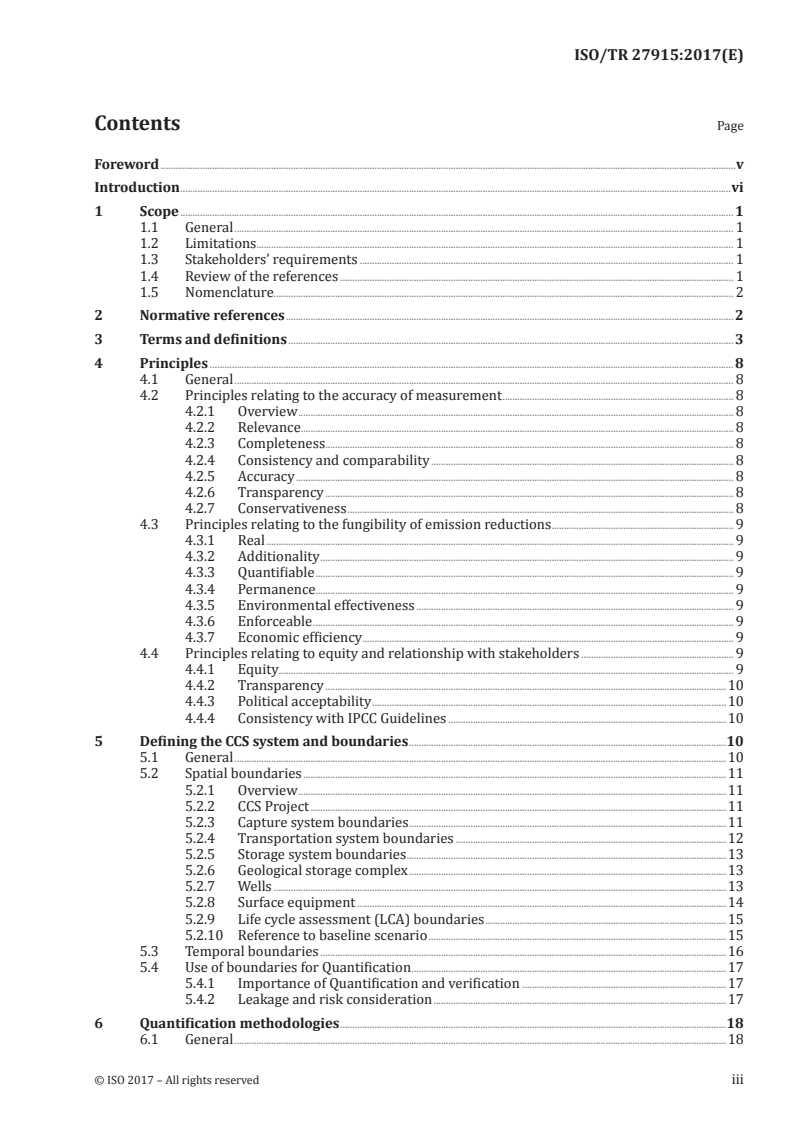
Contents Page
Foreword .v
Introduction .vi
1 Scope . 1
1.1 General . 1
1.2 Limitations . 1
1.3 Stakeholders’ requirements . 1
1.4 Review of the references . 1
1.5 Nomenclature. 2
2 Normative references . 2
3 Terms and definitions . 3
4 Principles . 8
4.1 General . 8
4.2 Principles relating to the accuracy of measurement . 8
4.2.1 Overview . 8
4.2.2 Relevance . . 8
4.2.3 Completeness . 8
4.2.4 Consistency and comparability . 8
4.2.5 Accuracy . 8
4.2.6 Transparency . 8
4.2.7 Conservativeness . 8
4.3 Principles relating to the fungibility of emission reductions . 9
4.3.1 Real . 9
4.3.2 Additionality . 9
4.3.3 Quantifiable . 9
4.3.4 Permanence . . 9
4.3.5 Environmental effectiveness . 9
4.3.6 Enforceable . 9
4.3.7 Economic efficiency . . 9
4.4 Principles relating to equity and relationship with stakeholders . 9
4.4.1 Equity . . 9
4.4.2 Transparency .10
4.4.3 Political acceptability .10
4.4.4 Consistency with IPCC Guidelines .10
5 Defining the CCS system and boundaries .10
5.1 General .10
5.2 Spatial boundaries .11
5.2.1 Overview .11
5.2.2 CCS Project .11
5.2.3 Capture system boundaries .11
5.2.4 Transportation system boundaries .12
5.2.5 Storage system boundaries .13
5.2.6 Geological storage complex .13
5.2.7 Wells .13
5.2.8 Surface equipment .14
5.2.9 Life cycle assessment (LCA) boundaries .15
5.2.10 Reference to baseline scenario .15
5.3 Temporal boundaries .16
5.4 Use of boundaries for Quantification .17
5.4.1 Importance of Quantification and verification .17
5.4.2 Leakage and risk consideration .17
6 Quantification methodologies .18
6.1 General .18
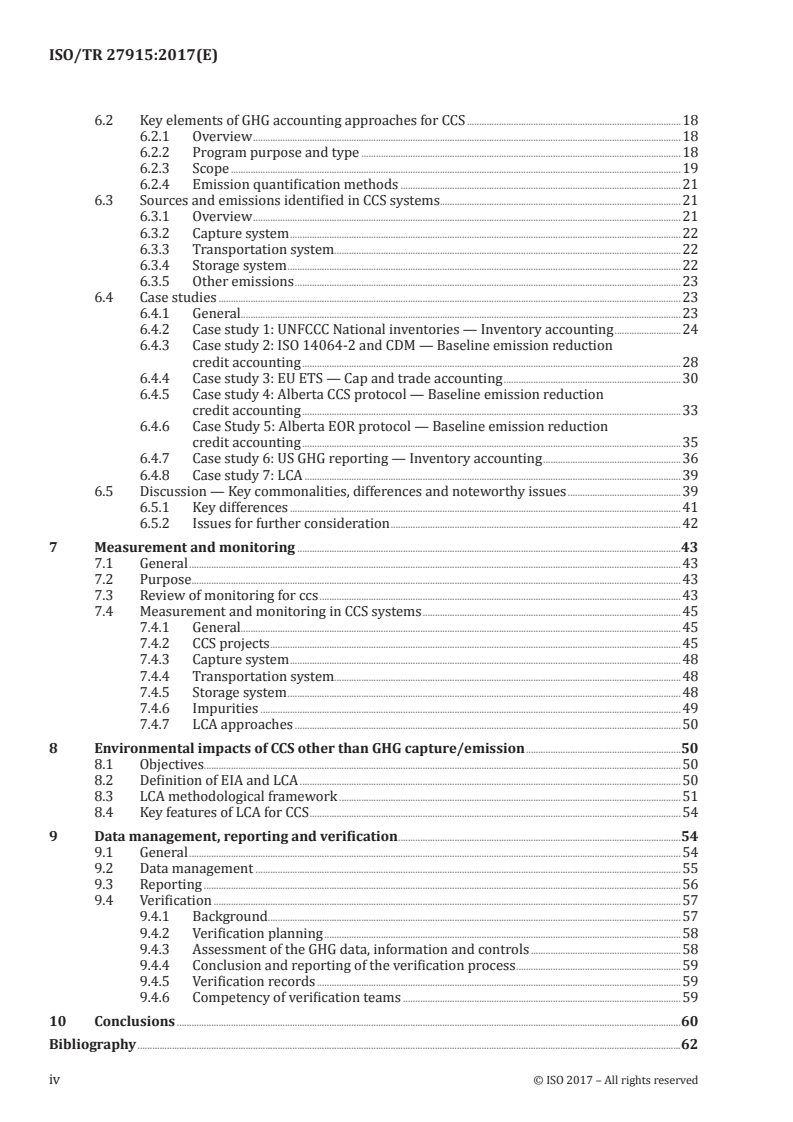
6.2 Key elements of GHG accounting approaches for CCS .18
6.2.1 Overview .18
6.2.2 Program purpose and type .18
6.2.3 Scope .19
6.2.4 Emission quantification methods .21
6.3 Sources and emissions identified in CCS systems.21
6.3.1 Overview .21
6.3.2 Capture system .22
6.3.3 Transportation system.22
6.3.4 Storage system .22
6.3.5 Other emissions .23
6.4 Case studies .23
6.4.1 General.23
6.4.2 Case study 1: UNFCCC National inventories — Inventory accounting .24
6.4.3 Case study 2: ISO 14064‑2 and CDM — Baseline emission reduction
credit accounting .28
6.4.4 Case study 3: EU ETS — Cap and trade accounting .30
6.4.5 Case study 4: Alberta CCS protocol — Baseline emission reduction
credit accounting .33
6.4.6 Case Study 5: Alberta EOR protocol — Baseline emission reduction
credit accounting .35
6.4.7 Case study 6: US GHG reporting — Inventory accounting .36
6.4.8 Case study 7: LCA .39
6.5 Discussion — Key commonalities, differences and noteworthy issues .39
6.5.1 Key differences .41
6.5.2 Issues for further consideration .42
7 Measurement and monitoring .43
7.1 General .43
7.2 Purpose .43
7.3 Review of monitoring for ccs .43
7.4 Measurement and monitoring in CCS systems .45
7.4.1 General.45
7.4.2 CCS projects .45
7.4.3 Capture system .48
7.4.4 Transportation system.48
7.4.5 Storage system .48
7.4.6 Impurities .49
7.4.7 LCA approaches .50
8 Environmental impacts of CCS other than GHG capture/emission .50
8.1 Objectives.50
8.2 Definition of EIA and LCA .50
8.3 LCA methodological framework .51
8.4 Key features of LCA for CCS .54
9 Data management, reporting and verification .54
9.1 General .54
9.2 Data management .55
9.3 Reporting .56
9.4 Verification .57
9.4.1 Background.57
9.4.2 Verification planning .58
9.4.3 Assessment of the GHG data, information and controls .58
9.4.4 Conclusion and reporting of the verification process .59
9.4.5 Verification records .59
9.4.6 Competency of verification teams .59
10 Conclusions .60
Bibliography .62
iv © ISO 2017 – All rights reserved
Foreword
ISO (the International Organization for Standardization) is a worldwide federation of national standards
bodies (ISO member bodies). The work of preparing International Standards is normally carried out
through ISO technical committees. Each member body interested in a subject for which a technical
committee has been established has the right to be represented on that committee. International
organizations, governmental and non-governmental, in liaison with ISO, also take part in the work.
ISO collaborates closely with the International Electrotechnical Commission (IEC) on all matters of
electrotechnical standardization.
The procedures used to develop this document and those intended for its further maintenance are
described in the ISO/IEC Directives, Part 1. In particular the different approval criteria needed for the
different types of ISO documents should be noted. This document was drafted in accordance with the
editorial rules of the ISO/IEC Directives, Part 2 (see www .iso .org/ directives).
Attention is drawn to the possibility that some of the elements of this document may be the subject of
patent rights. ISO shall not be held responsible for identifying any or all such patent rights. Details of
any patent rights identified during the development of the document will be in the Introduction and/or
on the ISO list of patent declarations received (see www .iso .org/ patents).
Any trade name used in this document is information given for the convenience of users and does not
constitute an endorsement.
For an explanation on the voluntary nature of standards, the meaning of ISO specific terms and
expressions related to conformity assessment, as well as information about ISO’s adherence to the
World Trade Organization (WTO) principles in the Technical Barriers to Trade (TBT) see the following
URL: w w w . i s o .org/ iso/ foreword .html.
This document was prepared by Technical Committee ISO/TC 265, Carbon dioxide capture,
transportation, and geological storage.
Introduction
This document is intended to serve as a reference document for future development of any technical
standards that could be approved by TC 265 for the quantification and verification (Q&V) of greenhouse
gas (GHG) emissions and emission reductions from CCS projects. This document is a review of current
practices and requirements, for the Q&V of carbon dioxide captured, transported and geologically
stored; as well as for direct and indirect GHGs that can arise from integrated CCS project activities
associated with injection of carbon dioxide into geological formations for the purposes of isolation
from the atmosphere (and ocean) over the long term. While carbon dioxide (CO ) is the primary target
of the capture process, other GHGs (such as methane, CH ) may be entrained in the capture stream,
and emissions can include GHG’s other than CO . This document includes limited discussion of other
environmental impacts.
This document integrates the various aspects of Q&V adopted by other ISO/TC 265 Working Groups
(WGs) into a comprehensive project framework.
The UNFCCC Paris Agreement (adopted on 12 December 2015) lays the foundation for countries to
work cooperatively to limit the increase in global average temperature to between 1,5 °C and 2 °C above
pre‑industrial levels, by reducing emissions of greenhouse gases (GHGs) into the atmosphere and by
increasing removals of GHGs from the atmosphere. Many of the climate models considered by the IPCC
in their most recent assessment report (IPCC, 2014) suggest that keeping average global temperature
rises to less than 2 °C will require large scale deployment of carbon dioxide capture, transportation and
geological storage technologies (CCS) in order to reduce anthropogenic emissions from the electrical
sector and from industries where there are no viable alternatives. The IPCC (2014) also suggest that
CCS with bio‑energy (BECCS) will be required to remove carbon dioxide from the atmosphere to meet
medium term emission objectives. In the longer term (i.e. 70 to 100 years), it may be necessary, and
viable, to further reduce harmful concentrations of CO in the atmosphere by capturing CO directly
2 2
from the atmosphere for injection into geological formations (DACCS).
While many countries have existing domestic GHG emission reporting requirements, the Paris
Agreement emphasizes “robust accounting” for all countries (UNFCCC, 2015, Article 6, paragraph 2),
covering both anthropogenic emissions of greenhouse gases by sources and removals of greenhouse
gases by sinks (Article 4, paragraph 2). The key principles for accounting and reporting identified
in the Paris Agreement are transparency (to ensure that actions are shared and equitable, and that
outcomes are real), accuracy, completeness, comparability and consistency, and the avoidance of
double accounting (UNFCCC, 2015, Article 4, paragraph 13). Environmental integrity (i.e. no harm to
ecosystems or biodiversity) is a fundamental principle for all activities, as are issues relating to the
socioeconomic impacts of a project.
ISO/TC 265 was established to develop technical standards for the design, construction, operation,
environmental planning and management, risk management, quantification, monitoring and
verification, and related activities in the field of CCS. Six working groups (WGs) have been established.
They all report through to the Technical Committee (TC) and are charged with focusing on particular
aspects of the CCS technology chain.
WG1 – Capture
WG2 – Transport
WG3 – Storage
WG4 – Quantification and Verification
WG5 – Cross-cutting Issues
WG6 – CO storage through Enhanced Oil Recovery (EOR)
This document established under WG4 is intended to provide a credible foundation for future standard
approaches for the quantification and verification (Q&V) of GHGs associated with CCS projects (for
geological storage or for EOR). Future standards developed in this area will improve understanding
vi © ISO 2017 – All rights reserved
and confidence in CCS related GHG mitigation by regulatory authorities, investors and civil society, as
well as enhance validation processes underpinning project compliance obligations.
The development of this document complements the development of other CCS and non-CCS, but
relevant, ISO standards and TRs, including in particular the whole ISO/TC 265 catalogue. Documents
are referenced from the EU, UNFCCC, IPCC, and various government bodies. As CCS Q&V is an ever‑
evolving area of examination, this document has been based on the best available information at the
time of its release.
The principal GHG considered within this document is carbon dioxide (CO ), other GHG’s (as listed in
Chapter 5), are included in the Q&V of CCS projects, but are not usually significant. To some extent,
GHG and CO are used somewhat interchangeably and the reader is invited to consider the context of
the terms. Most of the GHG captured through the CCS system will be a relatively pure stream of CO ,
perhaps mixed with other gases such as N , but in an Enhanced Oil Recovery (EOR) system the recycled
CO could also include methane (CH ). Emissions from fossil‑fired industrial activity could also contain
2 4
some N O.
This document aims to provide a transparent and non‑prescriptive body of information relating to Q&V
processes for CCS projects.
TECHNICAL REPORT ISO/TR 27915:2017(E)
Carbon dioxide capture, transportation and geological
storage — Quantification and verification
1 Scope
1.1 General
This document presents a review of publicly available literature identifying materially relevant issues
and options relating to “good practices” for quantifying and verifying GHG emissions and reductions at
the project level. Its scope covers all components of the CCS chain (e.g. capture, transport, storage) and
includes a lifecycle assessment approach to estimating project level emissions and emission reductions
from project assessment, construction and operations, through to completion and post-closure
activities. This document considers the following at the project level:
— a variety of Q&V related boundaries applicable to all components of a CCS project;
— the composition of the CO stream, including its purity, and requirements for measuring and
verifying the physical and chemical state of the CO stream in CCS projects;
— identification and quantification of GHG emissions and reductions across integrated CCS components;
— monitoring objectives, methodologies, and sampling strategies, including locations, periods, and
frequencies;
— GHG data collection and reporting;
— verifying GHG expectations with agreed verification criteria;
— life cycle assessment (LCA) of CCS projects.
1.2 Limitations
Q&V approaches to measuring and verifying GHG emissions, reductions and removals for CCS projects
continue to evolve. This document identifies the gaps and limitations in current levels of knowledge, of
empirical methodologies and application of good practices for CCS Q&V.
This is a Technical Report and so does not seek to recommend technical standards for any specific Q&V
method. This document cites existing ISO standards and other good-practice protocols that have been
developed to quantify and verify GHGs from integrated CCS projects.
1.3 Stakeholders’ requirements
This document aims to inform all stakeholders who influence, or are directly or indirectly involved
in the reporting of emissions and emission reductions, or removals, for CCS projects. Stakeholders
may include, for example, CCS project developers and operators, policy makers, regulators and other
government oversight bodies, verifying entities, the financial community, equipment manufacturers,
owners of other resources (e.g. water, coal, oil and gas), and members of the general public.
1.4 Review of the references
This document makes reference to a variety of sub‑national, national and international laws applicable
to CCS projects; current Q&V practices to measure GHG emissions and reductions, or removals, by CCS
projects; existing ISO standards that are directly and/or indirectly relevant to CCS projects; identified
stakeholder requirements; and the anticipated outcomes of other ISO/TC 265 WGs.
The discussion of Q&V is applicable to both onshore and offshore environments. At this stage, the
offshore experience is from two Norwegian projects, Sleipner and Snohvit, while the onshore experience
draws on an expanding range of storage, and CO EOR projects, in North America and China; and from
a cumulative body of research, pilot and demonstration projects, in Algeria, Australia, Canada, Europe,
Japan and the USA.
References are cited throughout this document, including relevant standards and protocols. These
references are listed in alphabetic order in the Bibliography.
1.5 Nomenclature
BECCS Bio‑energy with CCS
CCS Carbon Capture and Storage (or Carbon dioxide Capture, transportation and geological
Storage)
CDM Clean Development Mechanism
CEMS Continuous Emission Monitoring System
CMS Continuous Measurement System
CO e Carbon dioxide equivalent
2-
DACCS Direct air carbon dioxide capture and (geological) storage
EIA Environmental Impact Assessment
EOR Enhanced Oil Recovery
EU ETS European Union Emissions Trading Scheme
GHG Greenhouse Gas
IEA GHG International Energy Agency Greenhouse Gas R&D Programme
IPCC Intergovernmental Panel on Climate Change
IPCC SR IPCC Special Report on CCS (2005)
LCA Life Cycle Assessment
MRR Monitoring, Reporting Regulation (ref. EU)
Mt 1 million (metric) tonnes
Q&V Quantification and Verification
tonne 1,000 kg
tCO e tonne CO equivalent
2- 2
TR Technical Report
UNFCCC United Nations Framework Convention on Climate Change
2 Normative references
There are no normative references in this document.
2 © ISO 2017 – All rights reserved
3 Terms and definitions
For the purposes of this document, the terms and definitions given in ISO 27917-1 and the following apply.
ISO and IEC maintain terminological databases for use in standardization at the following addresses:
— IEC Electropedia: available at http:// www .electropedia .org/
— ISO Online browsing platform: available at http:// www .iso .org/ obp
3.1
baseline
reference basis for comparison against which project status or performance is monitored or measured
Note 1 to entry: The IPCC (2014, Annex 1, Glossary, p.1253) defines baseline as “the state against which change
is measured”. In natural systems, a baseline represents the range of pre‑existing natural variation of that
system, which may include a complex range of diurnal, tidal, seasonal, annual, and climatically‑driven natural
fluctuations.
[SOURCE: ISO 21500:2012, 2.3, modified]
3.2
carbon capture and storage
CCS
process consisting of the separation of CO from industrial and energy related sources, transportation
and injection into a geological formation, resulting in its long-term isolation from the atmosphere
Note 1 to entry: CCS projects should also provide for the long‑term isolation of CO from oceans, potable water
supplies and other resources.
[SOURCE: IPCC special report on CCS, 2005]
3.3
client
organization or person requesting validation or verification
Note 1 to entry: The client could be the responsible party or the GHG program administrator or other stakeholder.
[SOURCE: ISO 14064‑1:2006, 2.25]
3.4
CO (GHG) leakage
leakage
unintended release of CO (or other GHGs) out of pre‑defined containment
Note 1 to entry: Examples of containment are compressors, pipelines, trucks, ships, wells and geological
formations. In the context of this document , leakage does not refer to the concept through which efforts to
reduce emissions in one place shift emissions to another location or sector where they remain uncontrolled or
not counted. Specific regulations at the national or sub‑national level may further define leakage within specific
contexts.
3.5
CO stream
stream consisting overwhelmingly of carbon dioxide
Note 1 to entry: A CO stream is likely to contain impurities such as other GHGs, and may also include substances
added to the stream to improve the performance of the CCS stream or to enable detection of the CO . The
minimum concentration of CO in the CO stream is usually subject to regulatory discretion and approval, but
2 2
should be overwhelmingly CO .
[SOURCE: ISO 27917‑1]
3.6
CO stream composition
percentage by volume of each component of the CO stream (3.5)
Note 1 to entry: The CO stream composition is usually subject to regulatory discretion and approval. It
is less common to report stream composition as a mass fraction.
3.7
CO stream purity
percentage by volume of CO as a component of the CO stream (3.5)
2 2
3.8
detection limit
detection threshold
smallest value of a property of a substance that can be reliably detected by a specified measuring
method in a specified context
3.9
emission factor
normalized measure of GHG emissions in terms of activity
Note 1 to entry: For example, tonnes of GHG emitted per tonne of fuel consumed. Valves and other such equipment
might have typical leakage rates based on measurement from similar equipment. Emission factors can be applied
based on experience for such equipment.
[SOURCE: Annex II of the IPCC special report on CCS, 2005]
3.10
GHG/CO emission
emission
total mass of GHG (i.e. CO or CO -e) released to the atmosphere, or surface water bodies, over a
2 2
specified period of time
Note 1 to entry: Emissions from a geological storage complex occur at the interface between the ground and
the atmosphere or at the interface between the seabed and ocean or lake. “GHG/CO emission” is equivalent to
the UNFCCC term “seepage” referred to in the CDM modalities and procedures for CCS project activities (see
Reference [75]).
[SOURCE: ISO 14064‑2:2006, 2.5, modified]
3.11
GHG/CO emission reduction
calculated net decrease of GHG emissions between a baseline (3.1) scenario and the CCS project output
Note 1 to entry: A GHG emission reduction may also be referred to as “CO avoided”, although CO avoided may
2 2
also refer to CO removals from the atmosphere.
[SOURCE: ISO 14064‑2:2006, 2.7, modified]
3.12
GHG removal
total mass of GHG removed from the atmosphere over a specified period of time
Note 1 to entry: CCS projects could achieve GHG removals through BECCS (Bio‑energy with CCS) or by DACCS
(Direct air CO capture and geological storage).
[SOURCE: ISO 14064‑2:2006, 2.6]
4 © ISO 2017 – All rights reserved
3.13
fugitive emission
release of GHG from anthropogenic activities such as the processing or transportation of gas,
petroleum or CO
Note 1 to entry: Fugitive emissions include unintentional releases such as leaks and spills, and intentional releases
such as vents and flares for the purposes of safety, maintenance or to operate specific pieces of equipment (see
Reference [91]).
[SOURCE: Annex II of the IPCC special report on CCS, 2005]
3.14
geological reservoir
subsurface body of rock with sufficient porosity and permeability to contain and transmit fluids
(including super‑critical phase GHGs) with an overlying impermeable seal (or caprock) which prevents
escape of the fluids
[SOURCE: Annex II of the IPCC special report on CCS, 2005]
3.15
geological storage complex
subsurface geological system extending vertically to comprise storage units, and primary and
secondary seals, extending laterally to the defined limits of the CO storage project
Note 1 to entry: Limits can be defined by natural geological boundaries, regulation or legal rights.
3.16
greenhouse gas
GHG
gaseous constituent of the atmosphere, both natural and/or anthropogenic, that absorbs and emits
radiation at specific wavelengths within the spectrum of infrared radiation emitted by the Earth’s
surface, the atmosphere, and clouds
Note 1 to entry: The most common greenhouse gases are carbon dioxide (CO ), methane (CH ), nitrous oxide
2 4
(N O), hydrofluorocarbons (HFCs), nitrogen triflouride (NF ) perfluorocarbons (PFCs) and sulfur hexafluoride
2 3
(SF ). Emissions from these gases are reported under the Kyoto Protocol, and aggregated into carbon dioxide
equivalents (CO -e) using factors called global warming potentials (GWPs).
[SOURCE: ISO 14064‑2:2006, 2.1]
3.17
greenhouse gas activity data
quantitative measure of activity that results in a GHG emission or removal
Note 1 to entry: Examples of GHG activity data include the amount of energy, fuels or electricity consumed,
material produced, service provided or area of land affected.
3.18
greenhouse gas emission or removal factor
conversion factor relating activity data to GHG emissions or removals
3.19
greenhouse gas information system
policies, processes and procedures to establish, manage and maintain GHG information
3.20
greenhouse gas report
stand-alone document intended to communicate an organization’s or project’s GHG-related information
to its intended users (3.23)
[SOURCE: ISO 14064‑2:2006, 2.15]
3.21
greenhouse gas source
process, activity or mechanism that releases a GHG into the atmosphere
[SOURCE: ISO 14064‑2:2006, 2.2, modified; Annex II, IPCC CCS report 2005, modified]
3.22
integrated CCS project
project that involves capturing CO from large point sources, transporting it to a storage site, injecting it
into deep geologic formations (storage complex), and monitoring (3.28) to verify that it remains isolated
from the atmosphere
3.23
intended user
individual or organization identified by those reporting GHG related information as being the one who
relies on that information to make decisions
Note 1 to entry: The intended user could be the client, the responsible party, GHG program administrators,
regulators, the financial community or other affected stakeholders, such as local communities, government
departments or non-governmental organizations
[SOURCE: ISO 14064‑2:2006, 2.22]
3.24
level of assurance
degree of assurance that the intended user (3.23) requires for verification
Note 1 to entry: The level of assurance is used to determine the depth of detail that a verifier designs into their
verification plan to determine if there are any material errors, omissions or misrepresentations.
Note 2 to entry: There are two levels of assurance, reasonable or limited, which result in differently worded
verification statements.
[SOURCE: ISO 14064‑2:2006, 2.24, modified]
3.25
materiality
concept that individual, or the aggregation of, errors, omissions and misrepresentations could affect
the GHG assertion and could influence the intended users’ decisions
Note 1 to entry: The concept of materiality is used when designing the validation or verification and sampling
plans to determine the type of substantive processes used to minimize the risk that the validator or verifier will
not detect a material discrepancy (detection risk).
Note 2 to entry: The concept of materiality is used to identify information that, if omitted or misstated, would
significantly misrepresent a GHG assertion to intended users, thereby influencing their conclusions. Acceptable
materiality is determined by the validator, verifier or GHG program based on the agreed level of assurance.
[SOURCE: ISO 14064‑2:2006, 2.28]
3.26
measurement
determination of quantities through physical devices
Note 1 to entry: Examples of measurements are temperature, flow, concentrations, length, distance, etc.
Measurement may be direct (e.g. length with a meter) or indirect. Indirect measurements may require two steps,
firstly sampling and then analysis. Indirect measures may also use a model to convert the measurement of a
given quantity into the measurement of another one, for example, from velocity to flow rate, taking into account
the pipe and fluid characteristics.
6 © ISO 2017 – All rights reserved
3.27
uncertainty (of measurement)
parameter associated with the result of a measurement that characterizes the dispersion of values that
could reasonably be attributed to the measurement property
3.28
monitoring
continuous or repeated checking, supervising, critically observing, measuring, or determining the
status of a system to identify variance from an expected performance level or baseline (3.1)
3.29
GHG quantification
act of measuring and/or estimating and/or predicting the amount of GHG emissions, reductions and
removals associated with a CCS project
3.30
reporting scope
physical and temporal boundaries of information reported
3.31
responsible party
person or persons responsible for the provision of the GHG quantification (3.29) assertion and the
supporting GHG information
[SOURCE: ISO 14064‑1:2006, 2.23, modified]
3.32
sampling
selection of a subset from a population to estimate characteristics of the whole population
3.33
sampling strategy
set of technical principles or steps that aim to establish, depending on the objectives and the site
considered, the sampling density, distribution, locations, and frequency for each sampling area
3.34
venting
intended release of GHG from pre‑defined containment
3.35
verification of GHG assertion
systematic, independent and documented process for the evaluation of a GHG assertion against agreed
verification criteria
Note 1 to entry: A GHG assertion is a factual and objective statement of performance related to GHGs made by an
organization or project.
[SOURCE: IS
...
TECHNICAL ISO/TR
REPORT 27915
First edition
2017-08
Carbon dioxide capture,
transportation and geological
storage — Quantification and
verification
Capture du dioxyde de carbone, transport et stockage géologique —
Quantification et vérification
Reference number
©
ISO 2017
© ISO 2017, Published in Switzerland
All rights reserved. Unless otherwise specified, no part of this publication may be reproduced or utilized otherwise in any form
or by any means, electronic or mechanical, including photocopying, or posting on the internet or an intranet, without prior
written permission. Permission can be requested from either ISO at the address below or ISO’s member body in the country of
the requester.
ISO copyright office
Ch. de Blandonnet 8 • CP 401
CH-1214 Vernier, Geneva, Switzerland
Tel. +41 22 749 01 11
Fax +41 22 749 09 47
copyright@iso.org
www.iso.org
ii © ISO 2017 – All rights reserved
Contents Page
Foreword .v
Introduction .vi
1 Scope . 1
1.1 General . 1
1.2 Limitations . 1
1.3 Stakeholders’ requirements . 1
1.4 Review of the references . 1
1.5 Nomenclature. 2
2 Normative references . 2
3 Terms and definitions . 3
4 Principles . 8
4.1 General . 8
4.2 Principles relating to the accuracy of measurement . 8
4.2.1 Overview . 8
4.2.2 Relevance . . 8
4.2.3 Completeness . 8
4.2.4 Consistency and comparability . 8
4.2.5 Accuracy . 8
4.2.6 Transparency . 8
4.2.7 Conservativeness . 8
4.3 Principles relating to the fungibility of emission reductions . 9
4.3.1 Real . 9
4.3.2 Additionality . 9
4.3.3 Quantifiable . 9
4.3.4 Permanence . . 9
4.3.5 Environmental effectiveness . 9
4.3.6 Enforceable . 9
4.3.7 Economic efficiency . . 9
4.4 Principles relating to equity and relationship with stakeholders . 9
4.4.1 Equity . . 9
4.4.2 Transparency .10
4.4.3 Political acceptability .10
4.4.4 Consistency with IPCC Guidelines .10
5 Defining the CCS system and boundaries .10
5.1 General .10
5.2 Spatial boundaries .11
5.2.1 Overview .11
5.2.2 CCS Project .11
5.2.3 Capture system boundaries .11
5.2.4 Transportation system boundaries .12
5.2.5 Storage system boundaries .13
5.2.6 Geological storage complex .13
5.2.7 Wells .13
5.2.8 Surface equipment .14
5.2.9 Life cycle assessment (LCA) boundaries .15
5.2.10 Reference to baseline scenario .15
5.3 Temporal boundaries .16
5.4 Use of boundaries for Quantification .17
5.4.1 Importance of Quantification and verification .17
5.4.2 Leakage and risk consideration .17
6 Quantification methodologies .18
6.1 General .18
6.2 Key elements of GHG accounting approaches for CCS .18
6.2.1 Overview .18
6.2.2 Program purpose and type .18
6.2.3 Scope .19
6.2.4 Emission quantification methods .21
6.3 Sources and emissions identified in CCS systems.21
6.3.1 Overview .21
6.3.2 Capture system .22
6.3.3 Transportation system.22
6.3.4 Storage system .22
6.3.5 Other emissions .23
6.4 Case studies .23
6.4.1 General.23
6.4.2 Case study 1: UNFCCC National inventories — Inventory accounting .24
6.4.3 Case study 2: ISO 14064‑2 and CDM — Baseline emission reduction
credit accounting .28
6.4.4 Case study 3: EU ETS — Cap and trade accounting .30
6.4.5 Case study 4: Alberta CCS protocol — Baseline emission reduction
credit accounting .33
6.4.6 Case Study 5: Alberta EOR protocol — Baseline emission reduction
credit accounting .35
6.4.7 Case study 6: US GHG reporting — Inventory accounting .36
6.4.8 Case study 7: LCA .39
6.5 Discussion — Key commonalities, differences and noteworthy issues .39
6.5.1 Key differences .41
6.5.2 Issues for further consideration .42
7 Measurement and monitoring .43
7.1 General .43
7.2 Purpose .43
7.3 Review of monitoring for ccs .43
7.4 Measurement and monitoring in CCS systems .45
7.4.1 General.45
7.4.2 CCS projects .45
7.4.3 Capture system .48
7.4.4 Transportation system.48
7.4.5 Storage system .48
7.4.6 Impurities .49
7.4.7 LCA approaches .50
8 Environmental impacts of CCS other than GHG capture/emission .50
8.1 Objectives.50
8.2 Definition of EIA and LCA .50
8.3 LCA methodological framework .51
8.4 Key features of LCA for CCS .54
9 Data management, reporting and verification .54
9.1 General .54
9.2 Data management .55
9.3 Reporting .56
9.4 Verification .57
9.4.1 Background.57
9.4.2 Verification planning .58
9.4.3 Assessment of the GHG data, information and controls .58
9.4.4 Conclusion and reporting of the verification process .59
9.4.5 Verification records .59
9.4.6 Competency of verification teams .59
10 Conclusions .60
Bibliography .62
iv © ISO 2017 – All rights reserved
Foreword
ISO (the International Organization for Standardization) is a worldwide federation of national standards
bodies (ISO member bodies). The work of preparing International Standards is normally carried out
through ISO technical committees. Each member body interested in a subject for which a technical
committee has been established has the right to be represented on that committee. International
organizations, governmental and non-governmental, in liaison with ISO, also take part in the work.
ISO collaborates closely with the International Electrotechnical Commission (IEC) on all matters of
electrotechnical standardization.
The procedures used to develop this document and those intended for its further maintenance are
described in the ISO/IEC Directives, Part 1. In particular the different approval criteria needed for the
different types of ISO documents should be noted. This document was drafted in accordance with the
editorial rules of the ISO/IEC Directives, Part 2 (see www .iso .org/ directives).
Attention is drawn to the possibility that some of the elements of this document may be the subject of
patent rights. ISO shall not be held responsible for identifying any or all such patent rights. Details of
any patent rights identified during the development of the document will be in the Introduction and/or
on the ISO list of patent declarations received (see www .iso .org/ patents).
Any trade name used in this document is information given for the convenience of users and does not
constitute an endorsement.
For an explanation on the voluntary nature of standards, the meaning of ISO specific terms and
expressions related to conformity assessment, as well as information about ISO’s adherence to the
World Trade Organization (WTO) principles in the Technical Barriers to Trade (TBT) see the following
URL: w w w . i s o .org/ iso/ foreword .html.
This document was prepared by Technical Committee ISO/TC 265, Carbon dioxide capture,
transportation, and geological storage.
Introduction
This document is intended to serve as a reference document for future development of any technical
standards that could be approved by TC 265 for the quantification and verification (Q&V) of greenhouse
gas (GHG) emissions and emission reductions from CCS projects. This document is a review of current
practices and requirements, for the Q&V of carbon dioxide captured, transported and geologically
stored; as well as for direct and indirect GHGs that can arise from integrated CCS project activities
associated with injection of carbon dioxide into geological formations for the purposes of isolation
from the atmosphere (and ocean) over the long term. While carbon dioxide (CO ) is the primary target
of the capture process, other GHGs (such as methane, CH ) may be entrained in the capture stream,
and emissions can include GHG’s other than CO . This document includes limited discussion of other
environmental impacts.
This document integrates the various aspects of Q&V adopted by other ISO/TC 265 Working Groups
(WGs) into a comprehensive project framework.
The UNFCCC Paris Agreement (adopted on 12 December 2015) lays the foundation for countries to
work cooperatively to limit the increase in global average temperature to between 1,5 °C and 2 °C above
pre‑industrial levels, by reducing emissions of greenhouse gases (GHGs) into the atmosphere and by
increasing removals of GHGs from the atmosphere. Many of the climate models considered by the IPCC
in their most recent assessment report (IPCC, 2014) suggest that keeping average global temperature
rises to less than 2 °C will require large scale deployment of carbon dioxide capture, transportation and
geological storage technologies (CCS) in order to reduce anthropogenic emissions from the electrical
sector and from industries where there are no viable alternatives. The IPCC (2014) also suggest that
CCS with bio‑energy (BECCS) will be required to remove carbon dioxide from the atmosphere to meet
medium term emission objectives. In the longer term (i.e. 70 to 100 years), it may be necessary, and
viable, to further reduce harmful concentrations of CO in the atmosphere by capturing CO directly
2 2
from the atmosphere for injection into geological formations (DACCS).
While many countries have existing domestic GHG emission reporting requirements, the Paris
Agreement emphasizes “robust accounting” for all countries (UNFCCC, 2015, Article 6, paragraph 2),
covering both anthropogenic emissions of greenhouse gases by sources and removals of greenhouse
gases by sinks (Article 4, paragraph 2). The key principles for accounting and reporting identified
in the Paris Agreement are transparency (to ensure that actions are shared and equitable, and that
outcomes are real), accuracy, completeness, comparability and consistency, and the avoidance of
double accounting (UNFCCC, 2015, Article 4, paragraph 13). Environmental integrity (i.e. no harm to
ecosystems or biodiversity) is a fundamental principle for all activities, as are issues relating to the
socioeconomic impacts of a project.
ISO/TC 265 was established to develop technical standards for the design, construction, operation,
environmental planning and management, risk management, quantification, monitoring and
verification, and related activities in the field of CCS. Six working groups (WGs) have been established.
They all report through to the Technical Committee (TC) and are charged with focusing on particular
aspects of the CCS technology chain.
WG1 – Capture
WG2 – Transport
WG3 – Storage
WG4 – Quantification and Verification
WG5 – Cross-cutting Issues
WG6 – CO storage through Enhanced Oil Recovery (EOR)
This document established under WG4 is intended to provide a credible foundation for future standard
approaches for the quantification and verification (Q&V) of GHGs associated with CCS projects (for
geological storage or for EOR). Future standards developed in this area will improve understanding
vi © ISO 2017 – All rights reserved
and confidence in CCS related GHG mitigation by regulatory authorities, investors and civil society, as
well as enhance validation processes underpinning project compliance obligations.
The development of this document complements the development of other CCS and non-CCS, but
relevant, ISO standards and TRs, including in particular the whole ISO/TC 265 catalogue. Documents
are referenced from the EU, UNFCCC, IPCC, and various government bodies. As CCS Q&V is an ever‑
evolving area of examination, this document has been based on the best available information at the
time of its release.
The principal GHG considered within this document is carbon dioxide (CO ), other GHG’s (as listed in
Chapter 5), are included in the Q&V of CCS projects, but are not usually significant. To some extent,
GHG and CO are used somewhat interchangeably and the reader is invited to consider the context of
the terms. Most of the GHG captured through the CCS system will be a relatively pure stream of CO ,
perhaps mixed with other gases such as N , but in an Enhanced Oil Recovery (EOR) system the recycled
CO could also include methane (CH ). Emissions from fossil‑fired industrial activity could also contain
2 4
some N O.
This document aims to provide a transparent and non‑prescriptive body of information relating to Q&V
processes for CCS projects.
TECHNICAL REPORT ISO/TR 27915:2017(E)
Carbon dioxide capture, transportation and geological
storage — Quantification and verification
1 Scope
1.1 General
This document presents a review of publicly available literature identifying materially relevant issues
and options relating to “good practices” for quantifying and verifying GHG emissions and reductions at
the project level. Its scope covers all components of the CCS chain (e.g. capture, transport, storage) and
includes a lifecycle assessment approach to estimating project level emissions and emission reductions
from project assessment, construction and operations, through to completion and post-closure
activities. This document considers the following at the project level:
— a variety of Q&V related boundaries applicable to all components of a CCS project;
— the composition of the CO stream, including its purity, and requirements for measuring and
verifying the physical and chemical state of the CO stream in CCS projects;
— identification and quantification of GHG emissions and reductions across integrated CCS components;
— monitoring objectives, methodologies, and sampling strategies, including locations, periods, and
frequencies;
— GHG data collection and reporting;
— verifying GHG expectations with agreed verification criteria;
— life cycle assessment (LCA) of CCS projects.
1.2 Limitations
Q&V approaches to measuring and verifying GHG emissions, reductions and removals for CCS projects
continue to evolve. This document identifies the gaps and limitations in current levels of knowledge, of
empirical methodologies and application of good practices for CCS Q&V.
This is a Technical Report and so does not seek to recommend technical standards for any specific Q&V
method. This document cites existing ISO standards and other good-practice protocols that have been
developed to quantify and verify GHGs from integrated CCS projects.
1.3 Stakeholders’ requirements
This document aims to inform all stakeholders who influence, or are directly or indirectly involved
in the reporting of emissions and emission reductions, or removals, for CCS projects. Stakeholders
may include, for example, CCS project developers and operators, policy makers, regulators and other
government oversight bodies, verifying entities, the financial community, equipment manufacturers,
owners of other resources (e.g. water, coal, oil and gas), and members of the general public.
1.4 Review of the references
This document makes reference to a variety of sub‑national, national and international laws applicable
to CCS projects; current Q&V practices to measure GHG emissions and reductions, or removals, by CCS
projects; existing ISO standards that are directly and/or indirectly relevant to CCS projects; identified
stakeholder requirements; and the anticipated outcomes of other ISO/TC 265 WGs.
The discussion of Q&V is applicable to both onshore and offshore environments. At this stage, the
offshore experience is from two Norwegian projects, Sleipner and Snohvit, while the onshore experience
draws on an expanding range of storage, and CO EOR projects, in North America and China; and from
a cumulative body of research, pilot and demonstration projects, in Algeria, Australia, Canada, Europe,
Japan and the USA.
References are cited throughout this document, including relevant standards and protocols. These
references are listed in alphabetic order in the Bibliography.
1.5 Nomenclature
BECCS Bio‑energy with CCS
CCS Carbon Capture and Storage (or Carbon dioxide Capture, transportation and geological
Storage)
CDM Clean Development Mechanism
CEMS Continuous Emission Monitoring System
CMS Continuous Measurement System
CO e Carbon dioxide equivalent
2-
DACCS Direct air carbon dioxide capture and (geological) storage
EIA Environmental Impact Assessment
EOR Enhanced Oil Recovery
EU ETS European Union Emissions Trading Scheme
GHG Greenhouse Gas
IEA GHG International Energy Agency Greenhouse Gas R&D Programme
IPCC Intergovernmental Panel on Climate Change
IPCC SR IPCC Special Report on CCS (2005)
LCA Life Cycle Assessment
MRR Monitoring, Reporting Regulation (ref. EU)
Mt 1 million (metric) tonnes
Q&V Quantification and Verification
tonne 1,000 kg
tCO e tonne CO equivalent
2- 2
TR Technical Report
UNFCCC United Nations Framework Convention on Climate Change
2 Normative references
There are no normative references in this document.
2 © ISO 2017 – All rights reserved
3 Terms and definitions
For the purposes of this document, the terms and definitions given in ISO 27917-1 and the following apply.
ISO and IEC maintain terminological databases for use in standardization at the following addresses:
— IEC Electropedia: available at http:// www .electropedia .org/
— ISO Online browsing platform: available at http:// www .iso .org/ obp
3.1
baseline
reference basis for comparison against which project status or performance is monitored or measured
Note 1 to entry: The IPCC (2014, Annex 1, Glossary, p.1253) defines baseline as “the state against which change
is measured”. In natural systems, a baseline represents the range of pre‑existing natural variation of that
system, which may include a complex range of diurnal, tidal, seasonal, annual, and climatically‑driven natural
fluctuations.
[SOURCE: ISO 21500:2012, 2.3, modified]
3.2
carbon capture and storage
CCS
process consisting of the separation of CO from industrial and energy related sources, transportation
and injection into a geological formation, resulting in its long-term isolation from the atmosphere
Note 1 to entry: CCS projects should also provide for the long‑term isolation of CO from oceans, potable water
supplies and other resources.
[SOURCE: IPCC special report on CCS, 2005]
3.3
client
organization or person requesting validation or verification
Note 1 to entry: The client could be the responsible party or the GHG program administrator or other stakeholder.
[SOURCE: ISO 14064‑1:2006, 2.25]
3.4
CO (GHG) leakage
leakage
unintended release of CO (or other GHGs) out of pre‑defined containment
Note 1 to entry: Examples of containment are compressors, pipelines, trucks, ships, wells and geological
formations. In the context of this document , leakage does not refer to the concept through which efforts to
reduce emissions in one place shift emissions to another location or sector where they remain uncontrolled or
not counted. Specific regulations at the national or sub‑national level may further define leakage within specific
contexts.
3.5
CO stream
stream consisting overwhelmingly of carbon dioxide
Note 1 to entry: A CO stream is likely to contain impurities such as other GHGs, and may also include substances
added to the stream to improve the performance of the CCS stream or to enable detection of the CO . The
minimum concentration of CO in the CO stream is usually subject to regulatory discretion and approval, but
2 2
should be overwhelmingly CO .
[SOURCE: ISO 27917‑1]
3.6
CO stream composition
percentage by volume of each component of the CO stream (3.5)
Note 1 to entry: The CO stream composition is usually subject to regulatory discretion and approval. It
is less common to report stream composition as a mass fraction.
3.7
CO stream purity
percentage by volume of CO as a component of the CO stream (3.5)
2 2
3.8
detection limit
detection threshold
smallest value of a property of a substance that can be reliably detected by a specified measuring
method in a specified context
3.9
emission factor
normalized measure of GHG emissions in terms of activity
Note 1 to entry: For example, tonnes of GHG emitted per tonne of fuel consumed. Valves and other such equipment
might have typical leakage rates based on measurement from similar equipment. Emission factors can be applied
based on experience for such equipment.
[SOURCE: Annex II of the IPCC special report on CCS, 2005]
3.10
GHG/CO emission
emission
total mass of GHG (i.e. CO or CO -e) released to the atmosphere, or surface water bodies, over a
2 2
specified period of time
Note 1 to entry: Emissions from a geological storage complex occur at the interface between the ground and
the atmosphere or at the interface between the seabed and ocean or lake. “GHG/CO emission” is equivalent to
the UNFCCC term “seepage” referred to in the CDM modalities and procedures for CCS project activities (see
Reference [75]).
[SOURCE: ISO 14064‑2:2006, 2.5, modified]
3.11
GHG/CO emission reduction
calculated net decrease of GHG emissions between a baseline (3.1) scenario and the CCS project output
Note 1 to entry: A GHG emission reduction may also be referred to as “CO avoided”, although CO avoided may
2 2
also refer to CO removals from the atmosphere.
[SOURCE: ISO 14064‑2:2006, 2.7, modified]
3.12
GHG removal
total mass of GHG removed from the atmosphere over a specified period of time
Note 1 to entry: CCS projects could achieve GHG removals through BECCS (Bio‑energy with CCS) or by DACCS
(Direct air CO capture and geological storage).
[SOURCE: ISO 14064‑2:2006, 2.6]
4 © ISO 2017 – All rights reserved
3.13
fugitive emission
release of GHG from anthropogenic activities such as the processing or transportation of gas,
petroleum or CO
Note 1 to entry: Fugitive emissions include unintentional releases such as leaks and spills, and intentional releases
such as vents and flares for the purposes of safety, maintenance or to operate specific pieces of equipment (see
Reference [91]).
[SOURCE: Annex II of the IPCC special report on CCS, 2005]
3.14
geological reservoir
subsurface body of rock with sufficient porosity and permeability to contain and transmit fluids
(including super‑critical phase GHGs) with an overlying impermeable seal (or caprock) which prevents
escape of the fluids
[SOURCE: Annex II of the IPCC special report on CCS, 2005]
3.15
geological storage complex
subsurface geological system extending vertically to comprise storage units, and primary and
secondary seals, extending laterally to the defined limits of the CO storage project
Note 1 to entry: Limits can be defined by natural geological boundaries, regulation or legal rights.
3.16
greenhouse gas
GHG
gaseous constituent of the atmosphere, both natural and/or anthropogenic, that absorbs and emits
radiation at specific wavelengths within the spectrum of infrared radiation emitted by the Earth’s
surface, the atmosphere, and clouds
Note 1 to entry: The most common greenhouse gases are carbon dioxide (CO ), methane (CH ), nitrous oxide
2 4
(N O), hydrofluorocarbons (HFCs), nitrogen triflouride (NF ) perfluorocarbons (PFCs) and sulfur hexafluoride
2 3
(SF ). Emissions from these gases are reported under the Kyoto Protocol, and aggregated into carbon dioxide
equivalents (CO -e) using factors called global warming potentials (GWPs).
[SOURCE: ISO 14064‑2:2006, 2.1]
3.17
greenhouse gas activity data
quantitative measure of activity that results in a GHG emission or removal
Note 1 to entry: Examples of GHG activity data include the amount of energy, fuels or electricity consumed,
material produced, service provided or area of land affected.
3.18
greenhouse gas emission or removal factor
conversion factor relating activity data to GHG emissions or removals
3.19
greenhouse gas information system
policies, processes and procedures to establish, manage and maintain GHG information
3.20
greenhouse gas report
stand-alone document intended to communicate an organization’s or project’s GHG-related information
to its intended users (3.23)
[SOURCE: ISO 14064‑2:2006, 2.15]
3.21
greenhouse gas source
process, activity or mechanism that releases a GHG into the atmosphere
[SOURCE: ISO 14064‑2:2006, 2.2, modified; Annex II, IPCC CCS report 2005, modified]
3.22
integrated CCS project
project that involves capturing CO from large point sources, transporting it to a storage site, injecting it
into deep geologic formations (storage complex), and monitoring (3.28) to verify that it remains isolated
from the atmosphere
3.23
intended user
individual or organization identified by those reporting GHG related information as being the one who
relies on that information to make decisions
Note 1 to entry: The intended user could be the client, the responsible party, GHG program administrators,
regulators, the financial community or other affected stakeholders, such as local communities, government
departments or non-governmental organizations
[SOURCE: ISO 14064‑2:2006, 2.22]
3.24
level of assurance
degree of assurance that the intended user (3.23) requires for verification
Note 1 to entry: The level of assurance is used to determine the depth of detail that a verifier designs into their
verification plan to determine if there are any material errors, omissions or misrepresentations.
Note 2 to entry: There are two levels of assurance, reasonable or limited, which result in differently worded
verification statements.
[SOURCE: ISO 14064‑2:2006, 2.24, modified]
3.25
materiality
concept that individual, or the aggregation of, errors, omissions and misrepresentations could affect
the GHG assertion and could influence the intended users’ decisions
Note 1 to entry: The concept of materiality is used when designing the validation or verification and sampling
plans to determine the type of substantive processes used to minimize the risk that the validator or verifier will
not detect a material discrepancy (detection risk).
Note 2 to entry: The concept of materiality is used to identify information that, if omitted or misstated, would
significantly misrepresent a GHG assertion to intended users, thereby influencing their conclusions. Acceptable
materiality is determined by the validator, verifier or GHG program based on the agreed level of assurance.
[SOURCE: ISO 14064‑2:2006, 2.28]
3.26
measurement
determination of quantities through physical devices
Note 1 to entry: Examples of measurements are temperature, flow, concentrations, length, distance, etc.
Measurement may be direct (e.g. length with a meter) or indirect. Indirect measurements may require two steps,
firstly sampling and then analysis. Indirect measures may also use a model to convert the measurement of a
given quantity into the measurement of another one, for example, from velocity to flow rate, taking into account
the pipe and fluid characteristics.
6 © ISO 2017 – All rights reserved
3.27
uncertainty (of measurement)
parameter associated with the result of a measurement that characterizes the dispersion of values that
could reasonably be attributed to the measurement property
3.28
monitoring
continuous or repeated checking, supervising, critically observing, measuring, or determining the
status of a system to identify variance from an expected performance level or baseline (3.1)
3.29
GHG quantification
act of measuring and/or estimating and/or predicting the amount of GHG emissions, reductions and
removals associated with a CCS project
3.30
reporting scope
physical and temporal boundaries of information reported
3.31
responsible party
person or persons responsible for the provision of the GHG quantification (3.29) assertion and the
supporting GHG information
[SOURCE: ISO 14064‑1:2006, 2.23, modified]
3.32
sampling
selection of a subset from a population to estimate characteristics of the whole population
3.33
sampling strategy
set of technical principles or steps that aim to establish, depending on the objectives and the site
considered, the sampling density, distribution, locations, and frequency for each sampling area
3.34
venting
intended release of GHG from pre‑defined containment
3.35
verification of GHG assertion
systematic, independent and documented process for the evaluation of a GHG assertion against agreed
verification criteria
Note 1 to entry: A GHG assertion is a factual and objective statement of performance related to GHGs made by an
organization or project.
[SOURCE: IS
...