

ISO 21433:2018
(Main)Plain bearings — Handling of plain bearings
General Information
- Abstract
This document specifies requirements and guidance on the storage, transportation, handling, installation, operation and replacement of plain bearings and related parts.
- Status
- Withdrawn
- Publication Date
- 14-Oct-2018
- Technical Committee
- ISO/TC 123/SC 6 - Terms and common items
- Drafting Committee
- ISO/TC 123/SC 6 - Terms and common items
- Current Stage
- 9599 - Withdrawal of International Standard
- Start Date
- 02-Oct-2025
- Completion Date
- 29-Aug-2026
Buy Documents
ISO 21433:2018 - Plain bearings -- Handling of plain bearings
ISO 21433:2018 - Plain bearings — Handling of plain bearings/15/2018
Overview
ISO 21433:2018 - Plain bearings - Handling of plain bearings provides requirements and practical guidance for the safe and reliable storage, transportation, handling, installation, operation and replacement of plain bearings and related parts. The document helps prevent premature damage, contamination and deformation of bearings during the full handling lifecycle.
Key topics and technical requirements
The standard is organized around four main handling phases and includes detailed guidance and requirements:
Storage and transportation
- Packing methods and purposes: protect against impact, dust, moisture and rust.
- Recommended packing materials (examples): rust-inhibitor paper, oil‑impregnated paper, polyethylene-coated paper, polyethylene sheets, foamed polystyrene/polyurethane; deoxygenating agents for oil-free packing.
- Container types and design: cardboard, corrugated, plastic, metal - purpose-built containers or wooden boxes for large/heavy or special-shaped bearings.
- Avoid packing materials that produce fibrous waste or paper dust that can impair bearing function.
- Requirements for labeling, unpacking procedures, partitioning inside containers to prevent impingement, and attachment of test/quality certificates.
- Storage environment considerations: warehouse conditions, ambient temperature, humidity control and first-in-first-out (FIFO) practices.
Installation (fitting)
- Installation methods covered: press-fit, screw-fixing, keyed joint, retaining-ring fixing, shrink fitting by cooling or heating.
- Requirements for housing and mating shaft inspection, correct assembly procedures and post-installation checks.
Operation
- Commissioning practices: flushing/cleaning lubrication systems, running-in procedures.
- Supervision during operation: control/check items and recordkeeping for maintenance and monitoring.
Replacement
- Guidance on dismounting and replacing plain bearings and associated documentation.
Applications
ISO 21433 is practical for activities that directly affect bearing life and machine reliability:
- Protecting bearings during logistics and storage
- Specifying packaging and container requirements for shipment
- Establishing installation procedures in production and assembly lines
- Commissioning and maintenance procedures for industrial equipment
- Defining supplier–customer agreements on rust inhibitors, cleaning agents and documentation
Who should use this standard
- Bearing manufacturers and suppliers
- Machine designers and assembly engineers
- Maintenance and reliability engineers
- Warehouse, logistics and quality assurance personnel
- Procurement teams specifying bearing handling requirements
Related standards
- ISO 4378-1 - Plain bearings: terms, definitions, classification and symbols (referenced normative document).
ISO 21433:2018 is a practical reference to reduce handling-related failures and to standardize safe, consistent practices for plain bearings across manufacturing, storage and field service operations.
Relations
- Effective Date
- 15-Jun-2024
Buy Documents
ISO 21433:2018 - Plain bearings -- Handling of plain bearings
ISO 21433:2018 - Plain bearings — Handling of plain bearings/15/2018
Frequently Asked Questions
ISO 21433:2018 is a standard published by the International Organization for Standardization (ISO). Its full title is "Plain bearings — Handling of plain bearings". This standard covers: This document specifies requirements and guidance on the storage, transportation, handling, installation, operation and replacement of plain bearings and related parts.
This document specifies requirements and guidance on the storage, transportation, handling, installation, operation and replacement of plain bearings and related parts.
ISO 21433:2018 is classified under the following ICS (International Classification for Standards) categories: 21.100.10 - Plain bearings. The ICS classification helps identify the subject area and facilitates finding related standards.
ISO 21433:2018 has the following relationships with other standards: It is inter standard links to ISO 21433:2025. Understanding these relationships helps ensure you are using the most current and applicable version of the standard.
ISO 21433:2018 is available in PDF format for immediate download after purchase. The document can be added to your cart and obtained through the secure checkout process. Digital delivery ensures instant access to the complete standard document.
Standards Content (Sample)
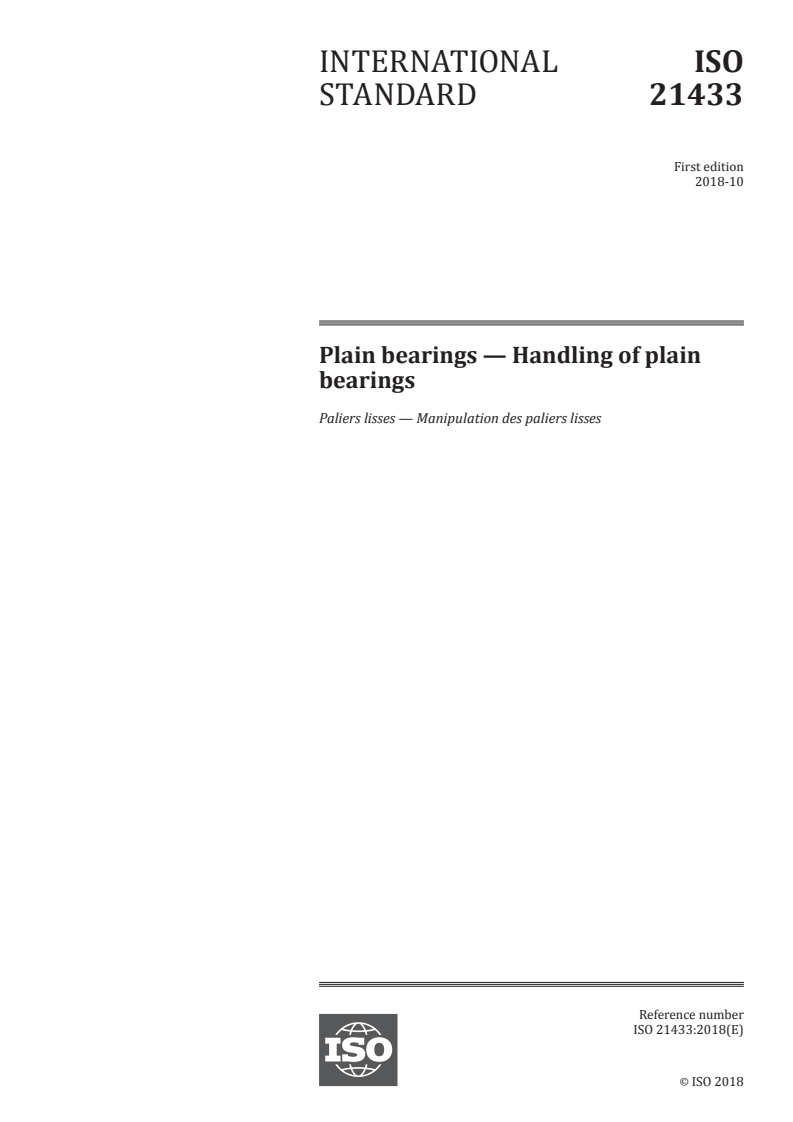
INTERNATIONAL ISO
STANDARD 21433
First edition
2018-10
Plain bearings — Handling of plain
bearings
Paliers lisses — Manipulation des paliers lisses
Reference number
©
ISO 2018
© ISO 2018
All rights reserved. Unless otherwise specified, or required in the context of its implementation, no part of this publication may
be reproduced or utilized otherwise in any form or by any means, electronic or mechanical, including photocopying, or posting
on the internet or an intranet, without prior written permission. Permission can be requested from either ISO at the address
below or ISO’s member body in the country of the requester.
ISO copyright office
CP 401 • Ch. de Blandonnet 8
CH-1214 Vernier, Geneva
Phone: +41 22 749 01 11
Fax: +41 22 749 09 47
Email: copyright@iso.org
Website: www.iso.org
Published in Switzerland
ii © ISO 2018 – All rights reserved
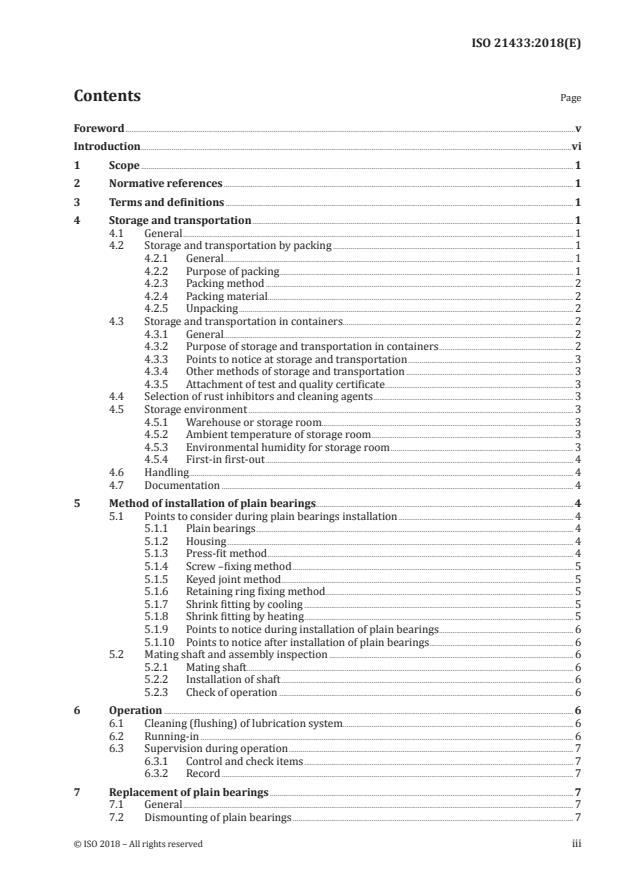
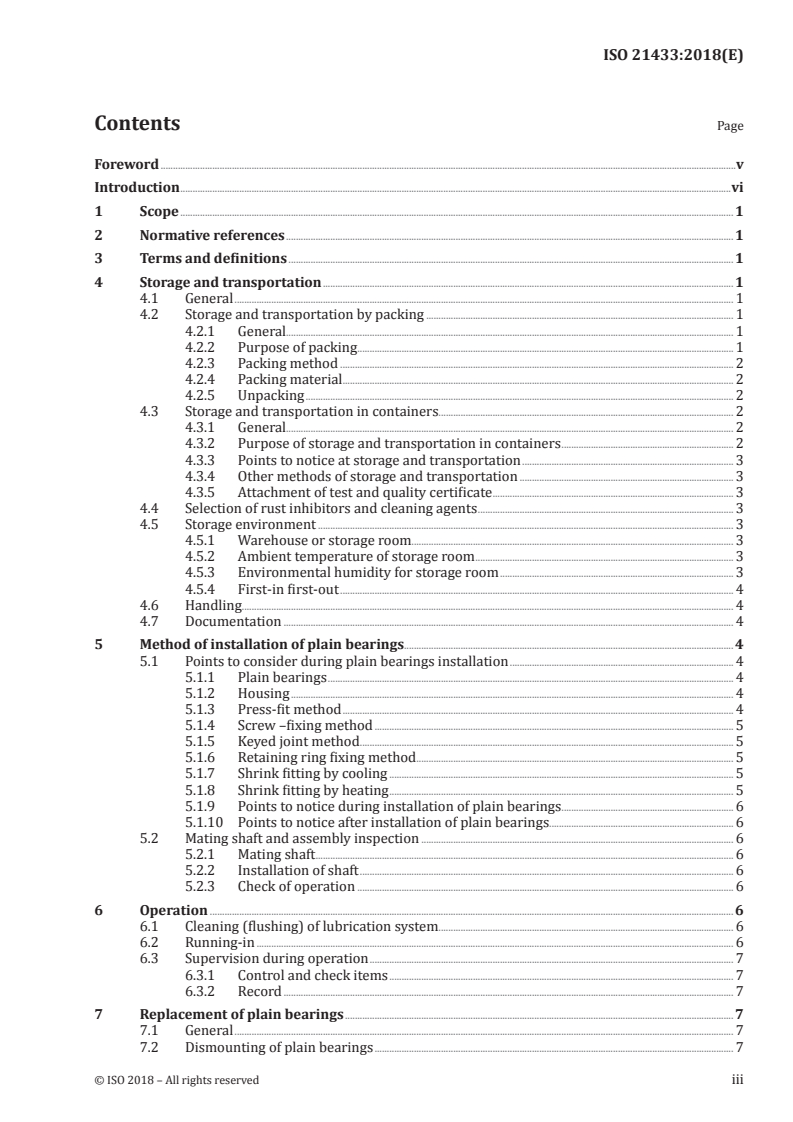
Contents Page
Foreword .v
Introduction .vi
1 Scope . 1
2 Normative references . 1
3 Terms and definitions . 1
4 Storage and transportation . 1
4.1 General . 1
4.2 Storage and transportation by packing . 1
4.2.1 General. 1
4.2.2 Purpose of packing . . 1
4.2.3 Packing method . 2
4.2.4 Packing material . 2
4.2.5 Unpacking . 2
4.3 Storage and transportation in containers. 2
4.3.1 General. 2
4.3.2 Purpose of storage and transportation in containers . 2
4.3.3 Points to notice at storage and transportation . 3
4.3.4 Other methods of storage and transportation . 3
4.3.5 Attachment of test and quality certificate . 3
4.4 Selection of rust inhibitors and cleaning agents . 3
4.5 Storage environment . 3
4.5.1 Warehouse or storage room. 3
4.5.2 Ambient temperature of storage room . 3
4.5.3 Environmental humidity for storage room . 3
4.5.4 First-in first-out . 4
4.6 Handling. 4
4.7 Documentation . 4
5 Method of installation of plain bearings. 4
5.1 Points to consider during plain bearings installation . 4
5.1.1 Plain bearings . 4
5.1.2 Housing . 4
5.1.3 Press-fit method . 4
5.1.4 Screw –fixing method . 5
5.1.5 Keyed joint method . . 5
5.1.6 Retaining ring fixing method . 5
5.1.7 Shrink fitting by cooling . 5
5.1.8 Shrink fitting by heating . 5
5.1.9 Points to notice during installation of plain bearings . 6
5.1.10 Points to notice after installation of plain bearings. 6
5.2 Mating shaft and assembly inspection . 6
5.2.1 Mating shaft . . 6
5.2.2 Installation of shaft . 6
5.2.3 Check of operation . 6
6 Operation . 6
6.1 Cleaning (flushing) of lubrication system . . 6
6.2 Running-in . 6
6.3 Supervision during operation . 7
6.3.1 Control and check items . 7
6.3.2 Record . 7
7 Replacement of plain bearings . 7
7.1 General . 7
7.2 Dismounting of plain bearings . 7
7.3 Replacement by new plain bearings . 8
Bibliography . 9
iv © ISO 2018 – All rights reserved
Foreword
ISO (the International Organization for Standardization) is a worldwide federation of national standards
bodies (ISO member bodies). The work of preparing International Standards is normally carried out
through ISO technical committees. Each member body interested in a subject for which a technical
committee has been established has the right to be represented on that committee. International
organizations, governmental and non-governmental, in liaison with ISO, also take part in the work.
ISO collaborates closely with the International Electrotechnical Commission (IEC) on all matters of
electrotechnical standardization.
The procedures used to develop this document and those intended for its further maintenance are
described in the ISO/IEC Directives, Part 1. In particular the different approval criteria needed for the
different types of ISO documents should be noted. This document was drafted in accordance with the
editorial rules of the ISO/IEC Directives, Part 2 (see www .iso .org/directives).
Attention is drawn to the possibility that some of the elements of this document may be the subject of
patent rights. ISO shall not be held responsible for identifying any or all such patent rights. Details of
any patent rights identified during the development of the document will be in the Introduction and/or
on the ISO list of patent declarations received (see www .iso .org/patents).
Any trade name used in this document is information given for the convenience of users and does not
constitute an endorsement.
For an explanation on the voluntary nature of standards, the meaning of ISO specific terms and
expressions related to conformity assessment, as well as information about ISO's adherence to the
World Trade Organization (WTO) principles in the Technical Barriers to Trade (TBT) see the following
URL: www .iso .org/iso/foreword .html.
This document was prepared by Technical Committee ISO/TC 123, Plain bearings, Subcommittee SC 6,
Terms and common items.
Any feedback or questions on this document should be directed to the user’s national standards body. A
complete listing of these bodies can be found at www .iso .org/members .html.
Introduction
The purpose of this document is to give appropriate methods of handling plain bearings. Alternative
practises may be adopted as agreed between bearing suppliers and their customers.
Inappropriate handling can cause premature damage to bearings and should be avoided.
This document provides four clauses for the handling of plain bearings:
— storage and transportation;
— installation (fitting);
— operation (running);
— replacement (exchange of bearing).
vi © ISO 2018 – All rights reserved
INTERNATIONAL STANDARD ISO 21433:2018(E)
Plain bearings — Handling of plain bearings
1 Scope
This document specifies requirements and guidance on the storage, transportation, handling,
installation, operation and replacement of plain bearings and related parts.
2 Normative references
The following documents are referred to in the text in such a way that some or all of their content
constitutes requirements of this document. For dated references, only the edition cited applies. For
undated references, the latest edition of the referenced document (including any amendments) applies.
ISO 4378-1, Plain bearings — Terms, definitions, classification and symbols — Part 1: Design, bearing
materials and their properties
3 Terms and definitions
For the purposes of this document, the terms and definitions given in ISO 4378-1 apply.
ISO and IEC maintain terminological databases for use in standardization at the following addresses:
— ISO Online browsing platform: available at https: //www .iso .org/obp
— IEC Electropedia: available at http: //www .electropedia .org/
4 Storage and transportation
4.1 General
The plain bearings are stored and transported after manufacture until installation into machines. In
this period, they shall be protected from damage, deterioration, deformation and contamination by
foreign matter.
4.2 Storage and transportation by packing
4.2.1 General
The plain bearings are stored and transported by using sheets, bags or boxes. The environment shall be
taken into consideration and respected when packing materials are manufactured, e.g. by implementing
an environmental management system such as ISO 14001.
4.2.2 Purpose of packing
Plain bearings are protected against damage by impact load during storage and transportation and
against rust and contaminants such as dust and moisture by using packing materials with a rust-
preventive function.
On the outside of the package, the contents should be indicated (type, name, part number, size, number
of pieces, production lot number, etc.) in order to identify the contents without removing the protective
packaging.
Packaging should be robust enough to withstand long-term storage without damage to the contents.
When bearings of the same type and size are packed in groups, indication of the contents should be
the same as when individually packed. However, the number of packed plain bearings should also be
indicated clearly on each pack.
4.2.3 Packing method
Plain bearings should be packed so that they can be easily unpacked at the receiving inspection by
the users or before their installation.
...
INTERNATIONAL ISO
STANDARD 21433
First edition
2018-10
Plain bearings — Handling of plain
bearings
Paliers lisses — Manipulation des paliers lisses
Reference number
©
ISO 2018
© ISO 2018
All rights reserved. Unless otherwise specified, or required in the context of its implementation, no part of this publication may
be reproduced or utilized otherwise in any form or by any means, electronic or mechanical, including photocopying, or posting
on the internet or an intranet, without prior written permission. Permission can be requested from either ISO at the address
below or ISO’s member body in the country of the requester.
ISO copyright office
CP 401 • Ch. de Blandonnet 8
CH-1214 Vernier, Geneva
Phone: +41 22 749 01 11
Fax: +41 22 749 09 47
Email: copyright@iso.org
Website: www.iso.org
Published in Switzerland
ii © ISO 2018 – All rights reserved
Contents Page
Foreword .v
Introduction .vi
1 Scope . 1
2 Normative references . 1
3 Terms and definitions . 1
4 Storage and transportation . 1
4.1 General . 1
4.2 Storage and transportation by packing . 1
4.2.1 General. 1
4.2.2 Purpose of packing . . 1
4.2.3 Packing method . 2
4.2.4 Packing material . 2
4.2.5 Unpacking . 2
4.3 Storage and transportation in containers. 2
4.3.1 General. 2
4.3.2 Purpose of storage and transportation in containers . 2
4.3.3 Points to notice at storage and transportation . 3
4.3.4 Other methods of storage and transportation . 3
4.3.5 Attachment of test and quality certificate . 3
4.4 Selection of rust inhibitors and cleaning agents . 3
4.5 Storage environment . 3
4.5.1 Warehouse or storage room. 3
4.5.2 Ambient temperature of storage room . 3
4.5.3 Environmental humidity for storage room . 3
4.5.4 First-in first-out . 4
4.6 Handling. 4
4.7 Documentation . 4
5 Method of installation of plain bearings. 4
5.1 Points to consider during plain bearings installation . 4
5.1.1 Plain bearings . 4
5.1.2 Housing . 4
5.1.3 Press-fit method . 4
5.1.4 Screw –fixing method . 5
5.1.5 Keyed joint method . . 5
5.1.6 Retaining ring fixing method . 5
5.1.7 Shrink fitting by cooling . 5
5.1.8 Shrink fitting by heating . 5
5.1.9 Points to notice during installation of plain bearings . 6
5.1.10 Points to notice after installation of plain bearings. 6
5.2 Mating shaft and assembly inspection . 6
5.2.1 Mating shaft . . 6
5.2.2 Installation of shaft . 6
5.2.3 Check of operation . 6
6 Operation . 6
6.1 Cleaning (flushing) of lubrication system . . 6
6.2 Running-in . 6
6.3 Supervision during operation . 7
6.3.1 Control and check items . 7
6.3.2 Record . 7
7 Replacement of plain bearings . 7
7.1 General . 7
7.2 Dismounting of plain bearings . 7
7.3 Replacement by new plain bearings . 8
Bibliography . 9
iv © ISO 2018 – All rights reserved
Foreword
ISO (the International Organization for Standardization) is a worldwide federation of national standards
bodies (ISO member bodies). The work of preparing International Standards is normally carried out
through ISO technical committees. Each member body interested in a subject for which a technical
committee has been established has the right to be represented on that committee. International
organizations, governmental and non-governmental, in liaison with ISO, also take part in the work.
ISO collaborates closely with the International Electrotechnical Commission (IEC) on all matters of
electrotechnical standardization.
The procedures used to develop this document and those intended for its further maintenance are
described in the ISO/IEC Directives, Part 1. In particular the different approval criteria needed for the
different types of ISO documents should be noted. This document was drafted in accordance with the
editorial rules of the ISO/IEC Directives, Part 2 (see www .iso .org/directives).
Attention is drawn to the possibility that some of the elements of this document may be the subject of
patent rights. ISO shall not be held responsible for identifying any or all such patent rights. Details of
any patent rights identified during the development of the document will be in the Introduction and/or
on the ISO list of patent declarations received (see www .iso .org/patents).
Any trade name used in this document is information given for the convenience of users and does not
constitute an endorsement.
For an explanation on the voluntary nature of standards, the meaning of ISO specific terms and
expressions related to conformity assessment, as well as information about ISO's adherence to the
World Trade Organization (WTO) principles in the Technical Barriers to Trade (TBT) see the following
URL: www .iso .org/iso/foreword .html.
This document was prepared by Technical Committee ISO/TC 123, Plain bearings, Subcommittee SC 6,
Terms and common items.
Any feedback or questions on this document should be directed to the user’s national standards body. A
complete listing of these bodies can be found at www .iso .org/members .html.
Introduction
The purpose of this document is to give appropriate methods of handling plain bearings. Alternative
practises may be adopted as agreed between bearing suppliers and their customers.
Inappropriate handling can cause premature damage to bearings and should be avoided.
This document provides four clauses for the handling of plain bearings:
— storage and transportation;
— installation (fitting);
— operation (running);
— replacement (exchange of bearing).
vi © ISO 2018 – All rights reserved
INTERNATIONAL STANDARD ISO 21433:2018(E)
Plain bearings — Handling of plain bearings
1 Scope
This document specifies requirements and guidance on the storage, transportation, handling,
installation, operation and replacement of plain bearings and related parts.
2 Normative references
The following documents are referred to in the text in such a way that some or all of their content
constitutes requirements of this document. For dated references, only the edition cited applies. For
undated references, the latest edition of the referenced document (including any amendments) applies.
ISO 4378-1, Plain bearings — Terms, definitions, classification and symbols — Part 1: Design, bearing
materials and their properties
3 Terms and definitions
For the purposes of this document, the terms and definitions given in ISO 4378-1 apply.
ISO and IEC maintain terminological databases for use in standardization at the following addresses:
— ISO Online browsing platform: available at https: //www .iso .org/obp
— IEC Electropedia: available at http: //www .electropedia .org/
4 Storage and transportation
4.1 General
The plain bearings are stored and transported after manufacture until installation into machines. In
this period, they shall be protected from damage, deterioration, deformation and contamination by
foreign matter.
4.2 Storage and transportation by packing
4.2.1 General
The plain bearings are stored and transported by using sheets, bags or boxes. The environment shall be
taken into consideration and respected when packing materials are manufactured, e.g. by implementing
an environmental management system such as ISO 14001.
4.2.2 Purpose of packing
Plain bearings are protected against damage by impact load during storage and transportation and
against rust and contaminants such as dust and moisture by using packing materials with a rust-
preventive function.
On the outside of the package, the contents should be indicated (type, name, part number, size, number
of pieces, production lot number, etc.) in order to identify the contents without removing the protective
packaging.
Packaging should be robust enough to withstand long-term storage without damage to the contents.
When bearings of the same type and size are packed in groups, indication of the contents should be
the same as when individually packed. However, the number of packed plain bearings should also be
indicated clearly on each pack.
4.2.3 Packing method
Plain bearings should be packed so that they can be easily unpacked at the receiving inspection by
the users or before their installation.
...