


ISO 14708-5:2010
(Main)Implants for surgery — Active implantable medical devices — Part 5: Circulatory support devices
Implants for surgery — Active implantable medical devices — Part 5: Circulatory support devices
ISO 14708-5:2010 specifies requirements for safety and performance of active implantable circulatory support devices. It is not applicable to extracorporeal perfusion devices, cardiomyoplasty, heart restraint devices and counter-pulsation devices, such as extra- or intra-aortic balloon pumps. ISO 14708-5:2010 specifies type tests, animal studies and clinical evaluation requirements.
Implants chirurgicaux — Dispositifs médicaux implantables actifs — Partie 5: Appareils annexes circulatoires
General Information
- Status
- Withdrawn
- Publication Date
- 25-Jan-2010
- Withdrawal Date
- 25-Jan-2010
- Technical Committee
- ISO/TC 150/SC 6 - Active implants
- Drafting Committee
- ISO/TC 150/SC 6/WG 6 - Circulatory support devices
- Current Stage
- 9599 - Withdrawal of International Standard
- Start Date
- 12-May-2020
- Completion Date
- 12-Feb-2026
Relations
- Effective Date
- 05-Nov-2015


Get Certified
Connect with accredited certification bodies for this standard

BSI Group
BSI (British Standards Institution) is the business standards company that helps organizations make excellence a habit.

TÜV Rheinland
TÜV Rheinland is a leading international provider of technical services.

TÜV SÜD
TÜV SÜD is a trusted partner of choice for safety, security and sustainability solutions.
Sponsored listings
Frequently Asked Questions
ISO 14708-5:2010 is a standard published by the International Organization for Standardization (ISO). Its full title is "Implants for surgery — Active implantable medical devices — Part 5: Circulatory support devices". This standard covers: ISO 14708-5:2010 specifies requirements for safety and performance of active implantable circulatory support devices. It is not applicable to extracorporeal perfusion devices, cardiomyoplasty, heart restraint devices and counter-pulsation devices, such as extra- or intra-aortic balloon pumps. ISO 14708-5:2010 specifies type tests, animal studies and clinical evaluation requirements.
ISO 14708-5:2010 specifies requirements for safety and performance of active implantable circulatory support devices. It is not applicable to extracorporeal perfusion devices, cardiomyoplasty, heart restraint devices and counter-pulsation devices, such as extra- or intra-aortic balloon pumps. ISO 14708-5:2010 specifies type tests, animal studies and clinical evaluation requirements.
ISO 14708-5:2010 is classified under the following ICS (International Classification for Standards) categories: 11.040.40 - Implants for surgery, prosthetics and orthotics. The ICS classification helps identify the subject area and facilitates finding related standards.
ISO 14708-5:2010 has the following relationships with other standards: It is inter standard links to ISO 14708-5:2020. Understanding these relationships helps ensure you are using the most current and applicable version of the standard.
ISO 14708-5:2010 is available in PDF format for immediate download after purchase. The document can be added to your cart and obtained through the secure checkout process. Digital delivery ensures instant access to the complete standard document.
Standards Content (Sample)
INTERNATIONAL ISO
STANDARD 14708-5
First edition
2010-02-01
Implants for surgery — Active
implantable medical devices —
Part 5:
Circulatory support devices
Implants chirurgicaux — Dispositifs médicaux implantables actifs —
Partie 5: Appareils annexes circulatoires
Reference number
©
ISO 2010
PDF disclaimer
This PDF file may contain embedded typefaces. In accordance with Adobe's licensing policy, this file may be printed or viewed but
shall not be edited unless the typefaces which are embedded are licensed to and installed on the computer performing the editing. In
downloading this file, parties accept therein the responsibility of not infringing Adobe's licensing policy. The ISO Central Secretariat
accepts no liability in this area.
Adobe is a trademark of Adobe Systems Incorporated.
Details of the software products used to create this PDF file can be found in the General Info relative to the file; the PDF-creation
parameters were optimized for printing. Every care has been taken to ensure that the file is suitable for use by ISO member bodies. In
the unlikely event that a problem relating to it is found, please inform the Central Secretariat at the address given below.
© ISO 2010
All rights reserved. Unless otherwise specified, no part of this publication may be reproduced or utilized in any form or by any means,
electronic or mechanical, including photocopying and microfilm, without permission in writing from either ISO at the address below or
ISO's member body in the country of the requester.
ISO copyright office
Case postale 56 • CH-1211 Geneva 20
Tel. + 41 22 749 01 11
Fax + 41 22 749 09 47
E-mail copyright@iso.org
Web www.iso.org
Published in Switzerland
ii © ISO 2010 – All rights reserved
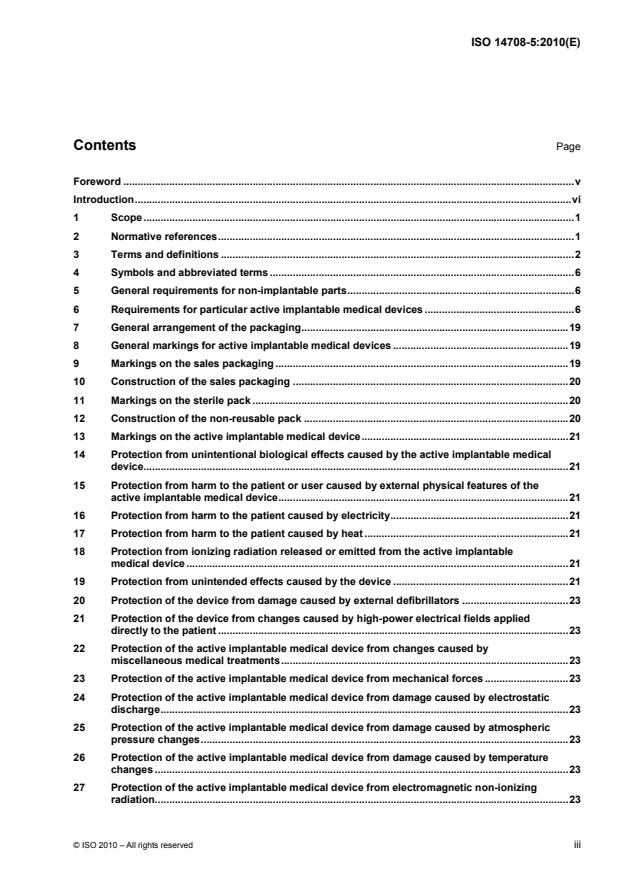
Contents Page
Foreword .v
Introduction.vi
1 Scope.1
2 Normative references.1
3 Terms and definitions .2
4 Symbols and abbreviated terms .6
5 General requirements for non-implantable parts.6
6 Requirements for particular active implantable medical devices .6
7 General arrangement of the packaging.19
8 General markings for active implantable medical devices .19
9 Markings on the sales packaging .19
10 Construction of the sales packaging .20
11 Markings on the sterile pack .20
12 Construction of the non-reusable pack .20
13 Markings on the active implantable medical device.21
14 Protection from unintentional biological effects caused by the active implantable medical
device.21
15 Protection from harm to the patient or user caused by external physical features of the
active implantable medical device.21
16 Protection from harm to the patient caused by electricity.21
17 Protection from harm to the patient caused by heat .21
18 Protection from ionizing radiation released or emitted from the active implantable
medical device .21
19 Protection from unintended effects caused by the device .21
20 Protection of the device from damage caused by external defibrillators .23
21 Protection of the device from changes caused by high-power electrical fields applied
directly to the patient .23
22 Protection of the active implantable medical device from changes caused by
miscellaneous medical treatments.23
23 Protection of the active implantable medical device from mechanical forces .23
24 Protection of the active implantable medical device from damage caused by electrostatic
discharge.23
25 Protection of the active implantable medical device from damage caused by atmospheric
pressure changes.23
26 Protection of the active implantable medical device from damage caused by temperature
changes .23
27 Protection of the active implantable medical device from electromagnetic non-ionizing
radiation.23
28 Accompanying documentation .23
Annex AA (informative) Relationship between the fundamental principles in ISO/TR 14283 and the
clauses of this part of ISO 14708 .26
Annex BB (informative) Relationship between the clauses of this part of ISO 14708 and the
fundamental principles listed in Annex AA .35
Annex CC (informative) Rationale .37
Annex DD (informative) In vitro test .42
Bibliography .46
iv © ISO 2010 – All rights reserved
Foreword
ISO (the International Organization for Standardization) is a worldwide federation of national standards bodies
(ISO member bodies). The work of preparing International Standards is normally carried out through ISO
technical committees. Each member body interested in a subject for which a technical committee has been
established has the right to be represented on that committee. International organizations, governmental and
non-governmental, in liaison with ISO, also take part in the work. ISO collaborates closely with the
International Electrotechnical Commission (IEC) on all matters of electrotechnical standardization.
International Standards are drafted in accordance with the rules given in the ISO/IEC Directives, Part 2.
The main task of technical committees is to prepare International Standards. Draft International Standards
adopted by the technical committees are circulated to the member bodies for voting. Publication as an
International Standard requires approval by at least 75 % of the member bodies casting a vote.
Attention is drawn to the possibility that some of the elements of this document may be the subject of patent
rights. ISO shall not be held responsible for identifying any or all such patent rights.
ISO 14708-5 was prepared by Technical Committee ISO/TC 150, Implants for surgery, Subcommittee SC 6,
Active implants.
ISO 14708 consists of the following parts, under the general title Implants for surgery — Active implantable
medical devices:
⎯ Part 1: General requirements for safety, marking and for information to be provided by the manufacturer
⎯ Part 2: Cardiac pacemakers
⎯ Part 3: Implantable neurostimulators
⎯ Part 4: Implantable infusion pumps
⎯ Part 5: Circulatory support devices
⎯ Part 6: Particular requirements for active implantable medical devices intended to treat tachyarrhythmia
(including implantable defibrillators)
Introduction
This part of ISO 14708 specifies requirements for safety and performance of active implantable circulatory
support devices. It is not intended to be used for extracorporeal perfusion devices, cardiomyoplasty, heart
restraint devices, and counter-pulsation devices such as extra- or intra-aortic balloon pumps. It amends and
supplements ISO 14708-1:2000, hereinafter referred to as ISO 14708-1. The requirements of this part of
ISO 14708 take priority over those of ISO 14708-1.
Heart failure (HF) is a major public health problem. It is estimated that worldwide more than 5 million people
die per year due to heart failure. The number of newly diagnosed cases is more than 550 000 per year in the
[13]
USA alone (AHA ). In 2001, nearly 53 000 patients in the United States died of HF as a primary cause.
Further, heart failure is implicated as a contributing factor in more than 250 000 deaths each year in the USA
[29]
alone (Yusuf ). Particularly at a higher risk for heart failure are the elderly (> 60 years), who account for
[18]
70 % of heart failure patients (Haldeman et al ), and for whom congestive heart failure is the leading cause
of hospitalization. From 1990 to 1999, the annual number of hospitalizations has increased from
approximately 810 000 to over 1 million for HF as a primary diagnosis and from 2,4 million to 3,6 million for HF
[30]
as a primary or secondary diagnosis (Koelling TM et al, ). The economic costs are enormous. It has been
estimated that in 2005, the total direct and indirect cost of HF in the United States is equal to $27,9 billion
[13]
(AHA ). Worldwide, it is estimated that over $900 billion per year is spent and almost one third of patients
are younger than 60. Heart transplantation in recent years has become an effective treatment for end-stage
heart failure. Unfortunately the number of donor hearts is limited to just about 3 000 worldwide, available only
to a small fraction of patients who need heart transplants. Future drug discoveries and/or biological therapies
such as cell regeneration and gene therapy hold promise for the future in the treatment of chronic heart failure.
However, as of today, mechanical circulatory devices remain the only alternative to heart transplantation and
will continue to be a viable treatment for end-stage heart failure for the foreseeable future.
Within this part of ISO 14708, the following terms are used to amend and supplement ISO 14708-1:
“Replacement”: the clause of ISO 14708-1 is replaced completely by the text of this particular part of
ISO 14708.
“Addition”: the text of this particular part is additional to the requirements of ISO 14708-1.
“Amendment”: the clause of ISO 14708-1 is amended as indicated by the text of this particular part of
ISO 14708.
“Not used”: the clause of ISO 14708-1 is not applied in this particular part of ISO 14708.
Subclauses, figures, or tables that are additional to those of ISO 14708-1 are numbered starting from 101;
additional annexes are lettered AA, BB, etc.
vi © ISO 2010 – All rights reserved
INTERNATIONAL STANDARD ISO 14708-5:2010(E)
Implants for surgery — Active implantable medical devices —
Part 5:
Circulatory support devices
1 Scope
This part of ISO 14708 specifies requirements for safety and performance of active implantable circulatory
support devices. It is not applicable to extracorporeal perfusion devices, cardiomyoplasty, heart restraint
devices and counter-pulsation devices, such as extra- or intra-aortic balloon pumps.
This part of ISO 14708 specifies type tests, animal studies and clinical evaluation requirements.
NOTE The device that is commonly referred to as an active implantable medical device can in fact be a single
device, a combination of devices, or a combination of a device or devices and one or more accessories. Not all of these
parts are required to be either partially or totally implantable, but there is a need to specify main requirements of non-
implantable parts and accessories if they could affect the safety or performance of the implantable device.
2 Normative references
The following referenced documents are indispensable for the application of this document. For dated
references, only the edition cited applies. For undated references, the latest edition of the referenced
document (including any amendments) applies.
ISO 5198, Centrifugal, mixed flow and axial pumps — Code for hydraulic performance tests — Precision
grade
ISO 5840, Cardiovascular implants — Cardiac valve prostheses
ISO 7198, Cardiovascular implants —Tubular vascular prostheses
ISO 10993-1, Biological evaluation of medical devices — Part 1: Evaluation and testing within a risk
management process
1)
ISO 14155 , Clinical investigation of medical devices for human subjects — Good clinical practice
ISO 14708-1, Implants for surgery — Active implantable medical devices — Part 1: General requirements for
safety, marking and for information to be provided by the manufacturer
ISO 14971, Medical devices — Application of risk management to medical devices
IEC 60601-1, Medical electrical equipment — Part 1: General requirements for basic safety and essential
performance
IEC 60601-1-1, Medical electrical equipment — Part 1-1: General requirements for safety — Collateral
standard: Safety requirements for medical electrical systems
1) To be published. (Revision of ISO 14155-1 and ISO 14155-2)
IEC 60601-1-2, Medical electrical equipment — Part 1-2: General requirements for basic safety and essential
performance — Collateral standard: Electromagnetic compatibility — Requirements and tests
IEC 60601-1-8, Medical electrical equipment — Part 1-8: General requirements for basic safety and essential
performance — Collateral Standard: General requirements, tests and guidance for alarm systems in medical
electrical equipment and medical electrical systems
IEC 62304, Medical device software — Software life cycle processes
3 Terms and definitions
For the purposes of this document, the terms and definitions given in ISO 14708-1 and ISO 14971 and the
following apply.
3.101
accessory device
separate part of a circulatory support system that is not essential to the primary function of the circulatory
support system
NOTE Examples are programming units, monitoring units and alternative power supply units.
3.102
artificial valve
prosthetic valve
component of the circulatory support system that directs the unidirectional flow of the blood into and out of the
pump
3.103
atrial cuff
connector between the right or left atrial ring after resection of the natural ventricle and the inlet of the right or
left blood pump in total artificial heart replacement
3.104
cavitation
sudden formation and collapse of low pressure bubbles in the blood by means of mechanical forces
3.105
clinical study
evaluation of a device in humans
3.106
conduit
component of the circulatory support system that connects the pump to the patient’s circulation
3.107
controller
component of the circulatory support system that contains the logic, circuitry and/or software to control the
driving mechanism that enables the system to perform its primary function
3.108
diastolic pressure
arithmetic average of diastolic blood pressure (when the left ventricle is not contracting), over a sufficient
number of cycles to filter out cyclic variation, of the minimum aortic pressures in a pulsatile pressure waveform
3.109
dp/dt
time derivative of pressure giving the rate of change of pressure with respect to time
NOTE dp/dt is expressed in millimetres of mercury per second, mmHg/s (kiloPascal per second [kPa/s] in SI units).
2 © ISO 2010 – All rights reserved
3.110
dQ/dt
time derivative of flow giving the rate of change of flow with respect to time
NOTE dQ/dt is expressed in units of litres per minute per second.
3.111
drive line
tube and/or cable that connects a driver or energy source to the pump
EXAMPLE The tube that connects a pneumatic console to a pneumatically driven pump.
3.112
durability
ability of an item to perform a required function under given conditions of use and maintenance, until a limiting
state is reached
NOTE A limiting state of an item should be characterized by the end of the useful life, unsuitability for any economic
or technological reasons, or other relevant factors.
3.113
ejection/fill
E/F
ratio between the ejection time period and the filling time period of the blood pump cycle
NOTE E/F is identical to S/D (systolic/diastolic) when related to the natural heart.
3.114
extracorporeal component
component or subsystem of the circulatory support system that is kept external to the patient (outside of the
body)
3.115
failure
termination of the ability of an item to perform a required function
NOTE 1 After failure, the item has a fault.
NOTE 2 “Failure” is an event, as distinguished from “fault”, which is a state.
NOTE 3 This concept as defined does not apply to items consisting of software only.
3.116
fault
state of an item characterized by inability to perform a required function, excluding the inability during
preventive maintenance or other planned actions, or due to lack of external resources
NOTE A fault is often the result of a failure of the item itself, but might exist without prior failure.
3.117
fully implantable
implanted circulatory support system with no skin penetrations (i.e. percutaneous lead)
3.118
hazard analysis
identification of hazards and their initiating causes
3.119
labelling
marking
any written, printed, or graphical matter affixed to a medical device or any of its containers or wrappers, or
accompanying the medical device related to identification, technical description and use, but excluding
shipping documents
3.120
monitor
component of the circulatory support system that allows data pertaining to the operation of the system to be
displayed
3.121
peak flow
maximum flow rate during ejection of blood from a pump into the host circulatory system
3.122
peak pressure
maximum pressure generated by the circulatory support system
3.123
percutaneous lead
lead (electrical or otherwise) that crosses the patient's skin to connect implantable parts of a circulatory
support system to extracorporeal parts of the system
3.124
power supply
source of energy
3.125
pulsatile flow
characteristic of the output of a pump where the flow is time-dependent (flow varies with time during one beat)
3.126
pump fill
filling phase of a volume displacement pump
NOTE Diastole is used to describe only the filling phase of the host’s native ventricle(s).
3.127
pump output
performance measure for a circulatory support system indicating the volume of blood pumped into the host
circulatory system per minute
NOTE The pump output is expressed in litres per minute or its equivalent in other units.
3.128
pump/pulse rate
performance measure for a circulatory support system indicating the number of complete pump cycles per
minute
NOTE The pump rate is expressed in beats per minute.
3.129
pump stroke volume
performance measure for a circulatory support system indicating the volume pumped into the host circulatory
system per beat by a pump with pulsatile flow
NOTE The pump stroke volume is expressed in millilitres.
4 © ISO 2010 – All rights reserved
3.130
pump volume
volumetric capacity of the pump
3.131
pump displacement
volume displacement
pump that imparts its pumping action by changing the volume of the pumping chamber
EXAMPLE By displacement of a diaphragm or pusher plate.
3.132
reliability
probability that an item can perform a required function under given conditions for a given time interval (t1, t2)
NOTE 1 It is generally assumed that the item is in a state to perform this required function at the beginning of the time
interval.
NOTE 2 The term “reliability” is also used to denote the reliability performance quantified by this probability [see 191-
02-06 of IEC 60050-191 definition of reliability (performance)].
3.133
remote access device
component of the circulatory support system that allows modification and/or monitoring of the controller and
the operation of the system
3.134
rotary pump
pump that imparts its pumping action directly on the blood by a rotating mechanism
3.135
safe and effective
reasonable assurance that a device will not induce harm to the recipient and that it will provide clinical benefit
for the recipient for its conditions of use
3.136
safety
freedom from unacceptable risk
[ISO/IEC Guide 51:1999, definition 3.1]
3.137
safety hazard
potentially detrimental effect on the patient, other persons, animals, or the surroundings, arising directly from
the circulatory support system
3.138
sales packaging
packaging that protects and identifies the device during storage and handling by the purchaser
NOTE The sales packaging should be enclosed in further packaging, for example a “shipping package”, for delivery.
3.139
stroke volume
amount of blood pumped by the ventricle of the heart in one contraction
3.140
systolic pressure
arithmetic average, over a sufficient number of cycles to filter out cyclic variation, of the peak aortic pressures
in a pulsatile pressure waveform
3.141
transcutaneous energy transmission system
TETS
system used to send electrical energy wirelessly into a device implanted inside the body
3.142
total artificial heart
TAH
circulatory support system that replaces the pumping function of a patient’s native heart
3.143
ventricular assist system
ventricular assist device
VAS/VAD
circulatory support system that augments the function of either one or both ventricles of the patient's native
heart by capturing blood from the atrium(a) or ventricle(s) and providing work to pump blood into the
pulmonary and/or systemic circulation
4 Symbols and abbreviated terms
This clause of ISO 14708-1 applies.
5 General requirements for non-implantable parts
This clause of ISO 14708-1 applies.
6 Requirements for particular active implantable medical devices
Addition
6.101 Intended clinical use/indications
The intended use and indications for the device system shall be described. The intended use describes what
the device system does (e.g. provides circulatory support) and where it may be used safely (e.g. hospital,
home, ground and/or air transport vehicles). The indications are the disease(s) or condition(s) the device will
diagnose, treat, prevent, cure, or mitigate and a description of the target population for which the device is
intended without causing unreasonable risk of illness or injury associated with use of the device.
6.102 System description
6.102.1 General
A comprehensive description of the system should be documented, including discussions on the principle(s) of
operation, design consideration(s), system configuration(s), system component(s), and system performance
and operating limits.
Design specifications for the complete system include the full range of system operating limits for each
parameter (e.g. beat rates, E/F ratio, rotation speeds, power), system operational modes (e.g. manual,
automatic), system component configurations (e.g. hospital, home, power sources, optional display, optional
subsystems, optional console), alarm thresholds, and all associated tolerances on each of these parameters.
6 © ISO 2010 – All rights reserved
6.102.2 Principle of operation
A discussion of the operating principle of the system should include the blood pumping mechanism,
connections to the cardiovascular system, power system, and control mechanisms.
6.102.3 Design consideration
The rationale for key design choices should be given. This should include, but is not limited to, approaches
taken to minimize blood component damage, methods for thermal management, choice of drive mechanisms,
a power management scheme, reliability considerations, adequacy of anatomic fit, and patient interaction.
6.102.4 System configuration
A detailed physical description of the system shall be given including implantation sites of various implantable
components, external wearable units, and external consoles. Size, shape, weight, and volume of the
components should be given, as well as the different configurations of system components that can be used
to provide support.
6.102.5 System performance and operating limits
The entire performance range of the system shall be given, even if some operation conditions are not
expected to be used clinically or might cause the system to malfunction.
6.103 Design analysis
A comprehensive analysis should be performed for the integrated system, the various component
configurations, as well as for each system component for all safety and effectiveness issues, including human
factors. The in vitro, in vivo, and clinical testing performed to address each issue should be identified.
6.104 Risk analysis
Risk analysis, part of the risk management process, should be performed on the system. The risk analysis
should include a top-down analysis (such as a hazard analysis or fault tree analysis, FTA), a bottom up
analysis (such as failure mode, effects, and criticality analysis, FMECA), as well as an analysis for potential
use or user error (human factors analysis). The risk analysis should utilize a method to classify the severity of
failure modes, the probability of occurrence, the risk priority number, and the detection method. The analysis
should include discussion of methods used to mitigate the criticality of the failure modes (see 19.2).
NOTE For further information on risk analysis, see ISO 14971.
6.105 Human factors
Human factors evaluation should consist of both integrated system testing and subsystem testing. The user
interface, both hardware and software, should be designed to be understandable and compatible with the
intended users' anticipated capabilities (e.g. physical, mental, or sensory) to reduce the likelihood of error
and/or confusion. Further, appropriate alarms and warnings are necessary and shall be designed to warn
users of system or subsystem failures. Guidance for human factors can be found in IEC 62366.
6.106 In vitro design evaluation and system performance testing
6.106.1 Objective
In vitro testing shall include design characterization of the integrated system and its individual system
subcomponents against all of its system design specifications. Test set-ups should be reasonably
representative of the intended patient population in which pressures, compliances and flow should be at
appropriate values. A description of the in vitro testing systems, including all pressures, compliances, and the
location of all measurement equipment, as well as the rationale for the test set-up, shall be provided.
In both a volume displacement pump and a rotary pump VAD system, this testing includes the
characterization of all time dependent parameters as they operate with (or as a replacement for) the native
heart in a pulsatile environment. In this way the simulated performance effects of the system on the patient
and the patient on the system can be understood.
6.106.2 Initial design evaluation of the pump system
6.106.2.1 Pump performance test
The pump performance test shall evaluate the ability of its design to meet the specification. The test shall be
conducted using blood or a blood analogue solution that mimics critical characteristics of blood, such as
viscosity, temperature and density as they might affect pump performance of the particular devices.
6.106.2.2 Fluid dynamic analysis
A fluid dynamic characterization of the device should be conducted and its results should be discussed in
terms of how these characteristics relate to the design specification and the results of other in vitro and in vivo
design evaluations including hemolysis, cavitation, and thrombus formation. Such studies include
computational fluid dynamics (CFD) or flow visualization study (see Annex DD.4). These study results should
be used for justification of design improvement of the device.
6.106.2.3 Vibration measurement
A vibration test shall be conducted over the entire range of operating speed to ensure that critical speed
resonance (induced either mechanically or by magnetic bearing control systems) will not cause unacceptable
mechanical instability. It might be necessary to positively restrict the operating speed range to avoid critical
speeds.
NOTE For further information on vibration testing, see ISO 14708-1.
6.106.2.4 Cavitation observation
Because cavitation can have highly damaging effects on both the device material surfaces and on the formed
elements of the blood and small bubbles are capable of embolising to distal organs, it is essential that
cavitation be avoided under all designed operating conditions. Potential cavitation phenomena should be
investigated in the laboratory and/or via computational fluid dynamics (CFD) simulation. The critical cavitation
conditions, NPSHR (net positive suction head required) shall be provided for rotary devices and dynamic
cavitation potential in pulsatile devices (particularly in the prosthetic valves) should be investigated.
NOTE For further information on cavitation in rotary devices, see ISO 5198.
Characteristics of the test fluid might have a significant effect on cavitation behaviour. Justification for the test
fluid in terms of its cavitation potential compared to blood should be documented.
6.106.3 System characterization
6.106.3.1 General
In vitro system characterization testing is a complete evaluation of the final system design in the simulated use
environment.
8 © ISO 2010 – All rights reserved
6.106.3.2 Test set-up
All applicable parameters should be documented and reported.
The testing should simulate the effects of changes in system performance on the patient and the effects of
patient changes on system performance. The effects of extremes of operation on both the device and the
patient (i.e., test set-up) should be determined. The extremes of operation include the minimum blood flow
and maximum blood flow, hypertension, hypotension, responses to changes in flow, pressure and possible
inflow/outflow restrictions.
Ventricular assist device (VAD) and total artificial heart (TAH) system performance (e.g. alarms, back-up
systems, information displayed, measurement accuracy and precision, and failures) should be monitored and
reported as specified in ISO 14708-1 and with alarms conforming to IEC 60601-1-8.
6.106.3.3 Test articles
6.106.3.3.1 General
At least one clinically representative device system shall be characterized. A complete system is comprised of
all system components required for that system to be operational in its intended environment. If clinical
operation of the device can utilize multiple configurations of components and accessories, then testing of each
configuration is required. Where the design analysis demonstrates that critical components/sub-assemblies at
the extremes of their specifications might impact overall device performance, test articles will be used which
characterize that variability.
6.106.3.3.2 Substitution of device components
If a device component (e.g. biological prosthetic valves, vascular graft or atrial cuff) is substituted by its
alternative, justification shall be provided.
6.106.3.4 Test equipment
6.106.3.4.1 General
Test equipment required for in vitro system characterization testing of the complete device system shall
include a mock circulatory loop and all test measurement equipment.
6.106.3.4.2 Mock circulatory loop
In vitro models used to appropriately simulate the natural heart, as appropriate, and the vascular compliance
and resistance, shall be documented, and justified as to the necessary physiological limits prescribed.
6.106.3.4.3 Physiological limits
Mock circulatory loops shall be appropriate to the intended diseased patient population, and not limited to
those ranges found within the “normal” population. For those devices used in conjunction with a patient's
native heart, the in vitro performance testing shall account for native heart rates, and systolic/diastolic
pressures and flows.
6.106.3.4.4 Blood analogue fluid
Fluids used to simulate the properties of human blood shall be described. Fluids used may be Newtonian.
Characteristics of the fluid and its chemical composition shall be given. Justification for necessary blood-
matching trade-offs shall be given (e.g. viscosity, temperature, salinity and pH).
6.106.3.4.5 Test measurement equipment
6.106.3.4.5.1 Transducers
All transducers used for the measurement of system parameters shall be specified in the study protocol or test
procedure. Transducers shall be appropriate for measuring time dependent waveforms so that any
subsequent ensemble averaging to produce representative waveforms can be achieved and any cycle to
cycle variation can be measured. All transducer characteristics, including amplifier devices (e.g. range,
resolution, error, frequency response), shall be given. Calibration schedules and calibration methods used for
all transducers are required, as well as evidence that the transducers have been calibrated before use.
6.106.3.4.5.2 Use of the device system as test measurement equipment
Many device systems are capable of measuring, acquiring, manipulating, displaying, and storing desired
parameters to be measured. The device system measurement and data handling systems shall be
documented, calibrated as appropriate, and validated.
6.106.3.4.5.3 Data handling
Systems used for data acquisition, manipulation, display, and storage shall be documented. Data acquisition
methods and equipment used shall be specified (e.g. real time, triggering methods, sampling rate, filters,
amplification). If any data manipulation (e.g. averaging, smoothing) is performed prior to display and storage
of final information, this should be clearly explained, including the algorithms used and documenting evidence
of system consistency. Characteristics for the display shall be documented (e.g. accuracy, precision, error).
6.106.3.5 Test conditions
A matrix of test conditions should be generated in order to characterize the system over the full range of
operational limits using all possible component configurations against all of the design specifications of the
device. The relevant conditions used to characterize the system should be selected according to the type of
the system (e.g. volume displacement or continuous flow, total artificial heart or ventricular assist system).
See Annex DD.2 for more information.
6.106.3.6 Parameters to be measured
The following parameters should be measured depending upon the nature of the blood pump design, but not
limited to (see Annex DD.3 for more information):
a) blood pump inlet and outlet pressure waveforms;
b) blood pump outlet flow waveform;
c) average outflow pressure from the pump;
d) average inflow pressure to the pump;
e) average pump outflow;
f) maximum achievable operating limits.
6.106.3.7 Data analysis
Data analysis is necessary to show that the system performance meets the design specifications for the
system. This should include statistical significance calculations comparing actual in vitro system performance
to the expected design specification. Further, data analysis of system performance and the expected clinical
effects of the system, based upon a review of the literature, should be provided.
10 © ISO 2010 – All rights reserved
6.106.3.8 “Worst case” operating conditions
System characterization data should be evaluated to determine the worst-case modes of operation (power
input, pump flow, pressures, battery life, etc.) within the design input specification. A discussion should
provide the rationale for the selection of the conditions determined to be worst case and what effect they might
have on the device.
6.106.4 System component testing
6.106.4.1 Control and drive units
6.106.4.1.1 External units
Blood pump controlling and driving units that are carried by patients should be tested against the design
requirement specifications. At a minimum, these units should be qualified by verifying the following
requirements.
a) Electrical input (voltage range, ripple, current range, power requirements).
b) Electrical and/or mechanical output (voltage, current, power, torque, pressure, etc.).
c) Electrical safety requirements, as specified in IEC 60601-1 for life support systems, shall be met.
d) Software used in the controlling and driving units shall be verified as specified in IEC 62304.
e) The unit alarms should meet the requirements of IEC 60417.
f) The external control and drive unit qualification should also include the following testing:
1) IEC 60068-1;
2) IEC 60068-2-64;
3) IEC 60068-2-27;
4) IEC 60068-2-32.
g) Unit enclosure temperature shall be as specified in IEC 60601-1-1.
h) Biocompatibility of materials that might be in contact with the patient's skin shall also be verified.
6.106.4.1.2 Implantable controllers and drivers
Implantable devices shall comply with the safety, marking and supplied information requirements specified in
ISO 14708-1.
6.106.4.2 Programming and monitoring units
These devices are for the programming of the system, collecting, storing and displaying information in
hospitals and/or home environment. As a part of the Life Supporting system these units shall be tested as
described in 6.106.4.1.1. Where appropriate, the test levels shall be documented for the intended use
environment (e.g. hospital, home and ambulance).
6.106.4.3 Power supplies
Power supplies (including battery chargers) for the mechanical circulatory devices shall meet safety
requirements for medical devices as specified in IEC 60601-1. Electrical input and output (voltage range,
ripple, current and power) as well as overload capabilities and protection shall be verified.
Where appropriate, the test levels shall be documented for the intended use environment (e.g. hospital, home,
ambulance).
6.106.4.4 Batteries
Battery-powered circulatory support systems should be considered for testing the following:
a) battery voltage from full capacity to the depleted state;
b) effect of current (load) on battery performance (voltage, capacity, case temperature);
c) effect of time, temperature, load, and cycles on the battery's capacity (aging);
d) battery preventive maintenance and replacement schedule (based on cycles or time);
e) emergency back-up procedure if the battery fails;
f) recharge specifications; charge current, end of charge determination, recharge time, etc;
g) method to measure battery depletion;
h) method to control hazard from potential gases produced while charging;
i) battery status indicator that gives advance warning of battery depletion. The manufacturer shall define the
time interval between the activation of this indicator and the point at which the battery will cease to
support the normal operation of the device;
j) audible warning alarms in the event of battery depletion;
k) appropriateness of parallel redundancy for battery sources;
l) method to measure/identify high discharge temperatures;
m) protection against battery explosion or burst.
6.106.4.5 Connections and connectors
6.106.4.5.1 Electrical connection
Electrical connections to and from all power supplies, batteries, controllers, and blood pumps should be
subjected to pull strength, torsion, flex, drop, permeation test and vibration tests. The connection should be
tested for electrical/mechanical integrity, resistance to corrosion, proper connector mating, connector
connect/disconnect cycling, and conductivity/resistance both before and after each of the appropriate tests to
ensure design specifications are met. Conformance to ISO 14708-1 shall be deemed sufficient.
6.106.4.5.2 Lines
For systems with pneumatic drives, all drive lines to and from the pneumatic supply and the blood pump (the
entire gas pathway) should be evaluated for pull strength, torsion, drop, vibration, kink (bend radius), and
abrasion. Following this testing, the drive lines should be tested for damage, leakage, and any changes in
pressure drop in accordance with design specifications.
12 © ISO 2010 – All rights reserved
6.106.4.5.3 Vascular grafts, cannulae, blood conduits, atrial and apical cuffs
All blood conduits should be evaluated for conformance with ISO 7198.
Inflow conduits and their connectors used with rotary and some pulsatile devices need to withstand significant
negative pressures without collapse or entrainment of air. Tests to establish satisfactory performance should
be conducted in excess of the maximum negative pressure capable of being generated by the device.
All connections to and from the blood pump and the blood pathway should be evaluated for conformance with
specifications with tests such as pull strength, torsion, vibration, kink (bend radius), and seal integrity.
Connection interfaces should avoid gaps and steps in the flow path that could generate unacceptable levels of
microemboli, as assessed by design analysis and in animal trials.
6.106.4.6 Artificial/prosthetic valves
If possible, prosthetic valves within the device should be tested as part of the durability and reliability sections
descri
...
Questions, Comments and Discussion
Ask us and Technical Secretary will try to provide an answer. You can facilitate discussion about the standard in here.
Loading comments...