

ISO/IEC 13235-1:1998
(Main)Information technology — Open Distributed Processing — Trading function: Specification — Part 1:
General Information
- Abstract
The scope of this Recommendation | International Standard is: ? an enterprise specification for the trading function; ? an information specification for the trading function; ? a computational specification for traders (i.e. objects providing the trading function); ? conformance requirements in terms of conformance points. It is not a goal of this Recommendation | International Standard to state how the trading function should be realized. Therefore this Recommendation | International Standard does not include an engineering specification. The field of application for this Recommendation | Intenational Standard is any ODP system in which it is required to introduce and discover services incrementally, dynamically and openly.
- Status
- Published
- Publication Date
- 16-Dec-1998
- Technical Committee
- ISO/IEC JTC 1/SC 38 - Cloud computing and distributed platforms
- Drafting Committee
- ISO/IEC JTC 1/SC 38 - Cloud computing and distributed platforms
- Current Stage
- 9093 - International Standard confirmed
- Start Date
- 21-Dec-2022
- Completion Date
- 29-Aug-2026
Buy Documents

ISO/IEC 13235-1:1998 - Information technology — Open Distributed Processing — Trading function: Specification — Part 1: Released:12/17/1998

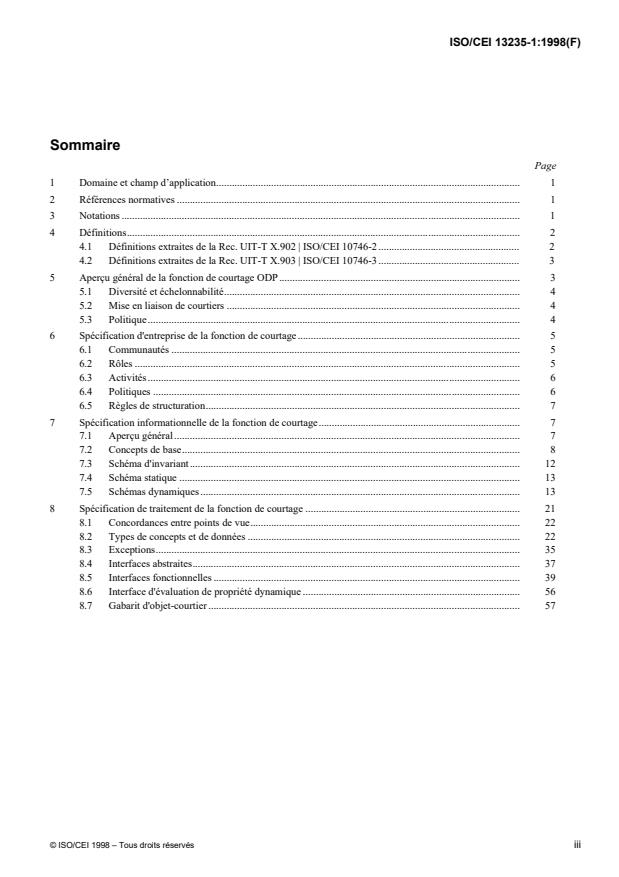
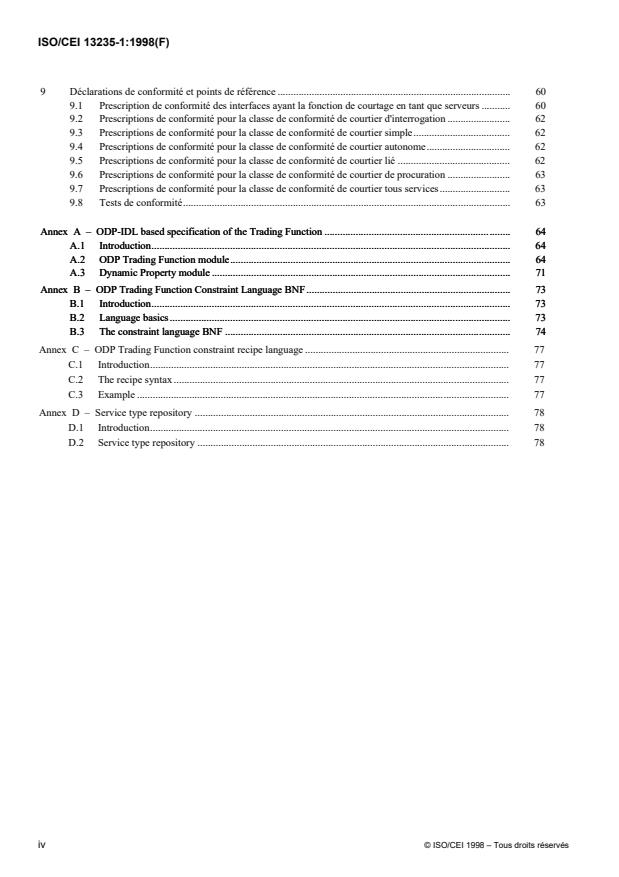
ISO/IEC 13235-1:1998 - Technologies de l'information — Traitement réparti ouvert — Fonction de courtage: Spécification — Partie 1: Released:2/17/2000
Overview
ISO/IEC 13235-1:1998 - Information technology - Open Distributed Processing (ODP) - Trading function: Specification (Part 1) - defines the architecture and specifications for an ODP trading function. The trading function provides a standardized way for distributed systems to advertise (export) and discover (import) services dynamically and openly. The standard supplies enterprise, information and computational specifications for traders (objects that implement the trading function) and sets out conformance requirements - but it does not prescribe engineering or implementation techniques.
Key topics and technical requirements
- Trading function scope
- Enterprise specification: roles, communities, activities, policies and structuring rules for trading in ODP environments.
- Information specification: formal schemas (in Z) including invariant, static and dynamic schemata describing service descriptions and constraints.
- Computational specification: interface signatures, data types, exceptions and abstract/functional interfaces for trader objects (ODP-IDL based).
- Conformance requirements: conformance classes (query, simple, stand-alone, linked, proxy, full-service) and conformance testing guidance.
- Core concepts
- Export (advertise a service with descriptive metadata and a location).
- Import (query the trader for services matching criteria, returning interface locations).
- Federation: linking traders to extend scope and enable discovery across partitions; support for interceptors when needed.
- Policy and dynamic property evaluation: mechanisms to express constraints and preferences when matching offers to requests.
- Normative annexes
- Annex A: ODP-IDL module specifications.
- Annex B: Constraint language BNF.
- Annex C: Constraint recipe language.
- Annex D: Service Type Repository (informative).
Practical applications and users
- Who uses it:
- System architects and enterprise architects designing service-oriented, open distributed systems.
- Middleware and directory service developers implementing trader-like registries, brokers or service registries.
- Standards bodies and integrators ensuring interoperable discovery/federation across heterogeneous platforms.
- Typical applications:
- Dynamic service registries and service brokers in large-scale distributed environments.
- Federated service discovery across organizational or technology boundaries.
- Environments requiring late binding to services and policy-driven matching of service offers and requests.
Related standards (short)
- RM-ODP family: ISO/IEC 10746-1/2/3 (Reference Model of ODP).
- ISO/IEC 14750 (ODP Interface Definition Language).
- Alignment noted with the OMG Trading Object Service.
Keywords: ISO/IEC 13235-1, ODP trading function, trader, service discovery, export/import, federated traders, ODP-IDL, constraint language, service registry, conformance.
Buy Documents
ISO/IEC 13235-1:1998 - Information technology — Open Distributed Processing — Trading function: Specification — Part 1: Released:12/17/1998
ISO/IEC 13235-1:1998 - Technologies de l'information — Traitement réparti ouvert — Fonction de courtage: Spécification — Partie 1: Released:2/17/2000
Get Certified
Connect with accredited certification bodies for this standard

BSI Group
BSI (British Standards Institution) is the business standards company that helps organizations make excellence a habit.

BSCIC Certifications Pvt. Ltd.
Established 2006, accredited by NABCB, JAS-ANZ, EIAC, IAS. CDSCO Notified Body.

Intertek India Pvt. Ltd.
Delivers Assurance, Testing, Inspection & Certification since 1993 with 26 labs and 32 offices.
Sponsored listings
Frequently Asked Questions
ISO/IEC 13235-1:1998 is a standard published by the International Organization for Standardization (ISO). Its full title is "Information technology — Open Distributed Processing — Trading function: Specification — Part 1:". This standard covers: The scope of this Recommendation | International Standard is: ? an enterprise specification for the trading function; ? an information specification for the trading function; ? a computational specification for traders (i.e. objects providing the trading function); ? conformance requirements in terms of conformance points. It is not a goal of this Recommendation | International Standard to state how the trading function should be realized. Therefore this Recommendation | International Standard does not include an engineering specification. The field of application for this Recommendation | Intenational Standard is any ODP system in which it is required to introduce and discover services incrementally, dynamically and openly.
The scope of this Recommendation | International Standard is: ? an enterprise specification for the trading function; ? an information specification for the trading function; ? a computational specification for traders (i.e. objects providing the trading function); ? conformance requirements in terms of conformance points. It is not a goal of this Recommendation | International Standard to state how the trading function should be realized. Therefore this Recommendation | International Standard does not include an engineering specification. The field of application for this Recommendation | Intenational Standard is any ODP system in which it is required to introduce and discover services incrementally, dynamically and openly.
ISO/IEC 13235-1:1998 is classified under the following ICS (International Classification for Standards) categories: 35.080 - Software. The ICS classification helps identify the subject area and facilitates finding related standards.
ISO/IEC 13235-1:1998 is available in PDF format for immediate download after purchase. The document can be added to your cart and obtained through the secure checkout process. Digital delivery ensures instant access to the complete standard document.
Standards Content (Sample)
INTERNATIONAL ISO/IEC
STANDARD 13235-1
First edition
1998-12-15
Information technology — Open Distributed
Processing — Trading function:
Specification
Technologies de l'information — Traitement distribué ouvert — Fonction
commerciale: Spécifications
Reference number
B C
Contents
Page
1 Scope and field of application . 1
2 Normative References. 1
3 Notations. 1
4 Definitions . 2
4.1 Definitions from ITU-T Rec. X.902 | ISO/IEC 10746-2 . 2
4.2 Definitions from ITU-T X.903 | ISO/IEC 10746-3 . 3
5 Overview of the ODP Trading Function. 3
5.1 Diversity and scalability . 4
5.2 Linking traders. 4
5.3 Policy. 4
6 Enterprise specification of the Trading Function. 5
6.1 Communities. 5
6.2 Roles. 5
6.3 Activities . 6
6.4 Policies . 6
6.5 Structuring rules . 6
7 Information specification of the Trading Function . 7
7.1 Overview . 7
7.2 Basic concepts . 8
7.3 Invariant schema. 12
7.4 Static schema. 13
7.5 Dynamic schemata. 13
8 Computational specification of the Trading Function. 21
8.1 Viewpoint correspondences. 22
8.2 Concepts and data types . 22
8.3 Exceptions . 35
8.4 Abstract interfaces. 37
8.5 Functional interfaces. 39
8.6 Dynamic Property Evaluation interface. 55
8.7 Trader object template. 56
9 Conformance statements and reference points. 58
9.1 Conformance requirement for trading function interfaces as server . 59
9.2 Conformance requirements for query trader conformance class. 60
9.3 Conformance requirements for simple trader conformance class . 60
© ISO/IEC 1998
All rights reserved. Unless otherwise specified, no part of this publication may be reproduced or
utilized in any form or by any means, electronic or mechanical, including photocopying and micro-
film, without permission in writing from the publisher.
ISO/IEC Copyright Office • Case postale 56 • CH-1211 Genève 20 • Switzerland
Printed in Switzerland
ii
©
ISO/IEC ISO/IEC 13235-1:1998(E)
9.4 Conformance requirements for stand-alone trader conformance class. 60
9.5 Conformance requirements for linked trader conformance class . 61
9.6 Conformance requirements for proxy trader conformance class. 61
9.7 Conformance requirements for full-service trader conformance class . 61
9.8 Conformance tests. 61
Annex A – ODP-IDL based specification of the Trading Function. 62
A.1 Introduction. 62
A.2 ODP Trading Function module. 62
A.3 Dynamic Property module . 69
Annex B – ODP Trading Function Constraint Language BNF . 71
B.1 Introduction. 71
B.2 Language basics . 71
B.3 The constraint language BNF. 72
Annex C – ODP Trading Function constraint recipe language. 75
C.1 Introduction. 75
C.2 The recipe syntax . 75
C.3 Example . 75
Annex D – Service type repository. 76
D.1 Introduction. 76
D.2 Service type repository. 76
iii
©
Foreword
ISO (the International Organization for Standardization) and IEC (the International Electrotechnical Commission) form the
specialized system for worldwide standardization. National bodies that are members of ISO or IEC participate in the
development of International Standards through technical committees established by the respective organization to deal with
particular fields of technical activity. ISO and IEC technical committees collaborate in fields of mutual interest. Other
international organizations, governmental and non-governmental, in liaison with ISO and IEC, also take part in the work.
In the field of information technology, ISO and IEC have established a joint technical committee, ISO/IEC JTC 1. Draft
International Standards adopted by the joint technical committee are circulated to national bodies for voting. Publication as an
International Standard requires approval by at least 75 % of the national bodies casting a vote.
International Standard ISO/IEC 13235-1 was prepared by Joint Technical Committee ISO/IEC JTC 1, Information technology,
Subcommittee SC 33, Distributed application services, in collaboration with ITU-T. The identical text is published as ITU-T
Recommendation X.950.
ISO/IEC 13235 consists of the following parts, under the general title Information technology — Open Distributed
Processing — Trading function:
— Part 1: Specification
— Part 2: (TBD)
— Part 3: Provision of trading function using OSI Directory service
Annexes A to D form an integral part of this part of ISO/IEC 13235.
iv
©
ISO/IEC ISO/IEC 13235-1:1998(E)
Introduction
The rapid growth of distributed processing has lead to a need for a coordinating framework for the standardization of Open
Distributed Processing (ODP). The Reference Model of Open Distributed Processing (RM-ODP) provides such a framework. It
defines an architecture within which support of distribution, interoperability and portability can be integrated.
One of the components of the architecture (described in RM-ODP Part 3: Architecture) (ITU-T Rec. X.903 | ISO/IEC 10746-3)
is the ODP Trading function. The trading function provides the means to offer a service and the means to discover services that
have been offered. This Recommendation | International Standard provides an architecture for systems implementing the
trading function and the specification of interfaces within the architecture.
NOTE – The specification of computational interfaces in this Recommendation | International Standard is technically aligned with the
OMG Trading Object Service.
The goals of this Recommendation | International Standard are:
– to provide a standard which is independent of any implementation;
– to ensure implementations are capable of being made to interoperate (i.e. can be federated);
– to provide sufficient detail to allow conformance claims to be assessed.
Annex A is a normative ODP-IDL specification of the trading function interface signatures.
Annex B is a normative specification of the ODP trading function constraint language.
Annex C is a normative specification of the ODP trading function constraint recipe language.
Annex D is an informative description of a Service Type Repository.
v
INTERNATIONAL STANDARD
ISO/IEC 13235-1 : 1997 (E)
ITU-T Rec. X.950 (1997 E)
ITU-T RECOMMENDATION
INFORMATION TECHNOLOGY – OPEN DISTRIBUTED PROCESSING –
TRADING FUNCTION: SPECIFICATION
1 Scope and field of application
The scope of this Recommendation | International Standard is:
– an enterprise specification for the trading function;
– an information specification for the trading function;
– a computational specification for traders (i.e. objects providing the trading function);
– conformance requirements in terms of conformance points.
It is not a goal of this Recommendation | International Standard to state how the trading function should be realized. Therefore
this Recommendation | International Standard does not include an engineering specification.
The field of application for this Recommendation | Intenational Standard is any ODP system in which it is required to introduce
and discover services incrementally, dynamically and openly.
2 Normative References
The following Recommendations and International Standards contain provisions which, trough reference in this text, constitute
provisions of this Recommendation | International Standard. At the time of publication, the editions indicated were valid. All
Recommendations and Standards are subject to revision, and parties to agreements based on this Recommendation |
International Standard are encouraged to investigate the possibility of applying the most recent edition of the Recommendations
and Standards listed below. Members of IEC and ISO maintain registers of currently valid International Standards. The
Telecommunication Standardization Bureau of the ITU maintains a list of currently valid ITU-T Recommendations.
– ITU-T Recommendation X.901 (1997) | ISO/IEC 10746-1:1998, Information technology – Open distributed
processing – Reference Model: Overview.
– ITU-T Recommendation X.902 (1995) | ISO/IEC 10746-2:1996, Information technology – Open Distributed
Processing – Reference Model: Foundations.
– ITU-T Recommendation X.903 (1995) | ISO/IEC 10746-3:1996, Information technology – Open Distributed
Processing – Reference Model: Architecture.
– ITU-T Recommendation X.920 (1997) | ISO/IEC 14750:1998, Information technology – Open Distributed
Processing – Interface Definition Language.
1)
– ISO/IEC 13568 , Information technology – The Z Specification Language.
3 Notations
The information specification of the trading function is described using the Z formal description language. The signature of the
computational interface for the trading function is described using ODP Interface Definition Language, in clause 8 and in
Annex A.
ITU-T Rec. X.950 (1997 E) 1
4 Definitions
4.1 Definitions from ITU-T Rec. X.902 | ISO/IEC 10746-2
This Specification is based on the framework of abstractions and concepts developed in RM-ODP and makes use of the
following definitions from RM-ODP Part 2: Foundations (see ITU-T Rec. X.902 | ISO/IEC 10746-2).
a) action;
b) activity;
c) behaviour;
d) behavioural compatibility;
e) binding;
f) client object;
g) conformance point;
h) contract;
i) domain;
j) establishing behaviour;
k) failure;
l) identifier;
m) initiating object;
n) instance;
o) interaction;
p) interface;
q) interface signature;
r) name;
s) object;
t) obligation;
u) ODP system;
v) permission;
w) policy;
x) prohibition;
y) quality of service;
z) reference point;
aa) responding object;
bb) role;
cc) server object;
dd) subtype;
ee) supertype;
ff) template;
gg) template type;
hh) trading;
ii) transparency;
jj) type;
kk) viewpoint.
2 ITU-T Rec. X.950 (1997 E)
4.2 Definitions from ITU-T X.903 | ISO/IEC 10746-3
This Specification is based on the framework of abstractions and concepts developed in RM-ODP and makes use of the
following definitions from RM-ODP Part 3: Architecture (see ITU-T Rec. X.903 | ISO/IEC 10746-3).
a) community;
b) computational interface template;
c) computational viewpoint;
d) dynamic schema;
e) engineering viewpoint;
f) enterprise viewpoint;
g) exporter;
h) information viewpoint;
i) invariant schema;
j) schema;
k) service export;
l) service import;
m) service offer;
n) static schema;
o) technology viewpoint;
p) federation.
5 Overview of the ODP Trading Function
In the context of the ODP goal of providing distribution transparent utilization of services over heterogeneous platforms and
networks, the role of the Trading Function is to allow users to find potential services. It is a corollary of distribution that the
finding of services will occur dynamically.
The ODP trading function facilitates the offering and the discovery of instances of interfaces which provide services of
particular types. A trader is an object that supports the Trading Function in a distributed environment. It can be viewed as an
object through which other objects can advertise their capabilities and match their needs against advertised capabilities.
Advertising a capability or offering a service is called "export". Matching against needs or discovering services is called
"import". Export and import facilitate dynamic discovery of and late binding to services.
To export, an object gives the trader a description of a service together with the location of an interface at which that service is
available. To import, an object asks the trader for a service having certain characteristics. The trader checks against the
descriptions of services and responds to the importer with the location(s) of matched service interface(s). The importer is then
able to interact with a matched service. These interactions are shown in Figure 1.
T
EI
T0727950-97/d01
Sequence of interactions:
1. Export
2. Import
3. Service Interaction
Figure 1 – Interaction between the trader and its clients
FIGURE 1/X.950.[D01] =
ITU-T Rec. X.950 (1997 E) 3
The service interaction could be decoupled from the trading interactions (export and import) by modelling a service provider
object and a service user object explicitly. This would imply interactions between service provider and exporter and between
importer and service user that are trading actions, as defined in ITU-T Rec. X.902 | ISO/IEC 10746-2. However, these implied
interactions need not conform to this Specification.
Due to the sheer number of service offers that will be offered worldwide, and the differing requirements that users of the
trading service will have, it is inevitable that the trading service will be split up and that the service offers will be partitioned.
Each partition will, in the first instance, meet the trading needs of a community of clients (exporters and importers). Where a
client needs a scope for its trading activities that is wider than that provided by one partition, it will access other partitions
either directly or indirectly. Directly means that the client interacts with the traders handling those partitions. Indirectly, means
that the client interacts with one trader only and this trader interacts with other traders responsible for other partitions. The
latter possibility is referred to as federation of traders. In some cases, interceptors may be required between federated traders.
A user of a trader that interoperates with other traders, may associate with only one trader, and can transparently access the
service offers of other traders with which that trader can interoperate .
Thus, the trading function in an ODP environment allows:
– objects to export (advertise) services;
– objects to import information about one or more exported services, according to some criteria;
– federation of traders.
5.1 Diversity and scalability
The concept of trading to discover new services is one that is applicable in a wide range of scenarios. A trader may contain a
large number of offers of service and its implementation may be inclined to be based upon a database. Or, a trader may contain
a few offers only and so be implementable as a memory resident trader. These two cases exhibit different qualities: availability
and integrity in the first case and performance in the second. The variation in these scenarios illustrates the need for scalability,
both upwards for very big systems and downwards for small, fast systems.
To discover any arbitrary offer of service, a trader needs all offers to be, in some sense, visible to it. One partition cannot hold
every offer, many will necessarily be held at other partitions, therefore, in addition to a number of offers, a trader must possess
information about other partitions. However, there is no need for a trader to know about all other partitions. Some of this
knowledge can be obtained indirectly via other traders.
The partitioning of the offer space and the limited knowledge held with one partition about other partitions is the basis for
meeting requirements for both distribution and contextualisation of the trading function.
5.2 Linking traders
The requirements to contextualise the offer space and to distribute the trading function are both met by linking traders together.
By linking to other traders, each trader makes the offer space of those traders implicitly available to its own clients.
Each trader has a horizon limited to those other traders to which it is explicitly linked. As those traders are in turn linked to yet
more traders, a large number of traders are reachable from a given starting trader. The traders are linked to form a directed
graph with the information describing the graph distributed among the traders. This graph is called the trading graph.
Links may cross domain boundaries: administrative, technological or whatever. Trading may thus be a federated system, i.e.
one that spans many domains.
5.3 Policy
To meet the diverse requirements likely to be placed upon the trading function, some degrees of freedom are necessary when
specifying the behaviour of a trader object. To accomplish this, and yet still meet the goals of this Specification, the concept of
policy is used to provide a framework for describing the behaviour of any ODP conformant trading system.
This Specification identifies a number of policies and gives them semantics. Each policy partly determines the behaviour of a
trader. When claiming conformance, an implementation may need to state which combination of policies will ensure
conformant behaviour.
Policies may be communicated during interaction, in which case they relate to an expectation on subsequent behaviour.
4 ITU-T Rec. X.950 (1997 E)
6 Enterprise specification of the Trading Function
The scope of an enterprise specification is defined in RM-ODP Part 3: Architecture (see ITU-T Rec. X.903 | ISO/IEC 10746-
3). This enterprise specification identifies the objectives and the policy statements that govern the activities of a trading
function.
The objective of the trading function is to provide the means to offer and to discover instances of a particular type of service,
with particular characteristics.
A trading community is comprised by members that have different roles, for example, trader, exporter and importer. An object
can have several roles within the same community. For example, an object can both be an importer and an exporter.
The trading activities of the community are service exports and service imports. These activities are governed by a set of
policies of the trading community. A service import activity may propagate from one trading community to another. In such a
case the domains associated with these two traders are federated. These trader domain boundaries may coincide with other
domain boundaries (e.g. type domain or security policy domain).
A policy is a set of rules with a particular objective. Each rule constrains some aspects of a trader’s behaviour consistent with
the common objective. Members of the trading community are obliged to obey the rules of the policies. These rules provide the
guidelines for decisions to satisfy the community’s objectives. The rules are not prescribed in this Specification. The enterprise
specification identifies the set of policies that limit the trader in certain type of behaviour. The policies identified provide a
framework within which the trader object's behaviour may be implemented or configured.
6.1 Communities
6.1.1 trading community: A community of objects established for the purpose of trading and governed by a trading
policy. The objects perform roles listed in 6.2.
A single trading community (at one level of abstraction) may be refined into a number of interworking trading communities at a
second, more detailed level of abstraction. Subject to community policy, the interworking of trading communities at the
detailed level is able to maintain the impression of the single abstract community, allowing objects with trader, importer or
exporter roles in one subcommunity to interact with objects in any other subcommunity.
6.2 Roles
Objects may play the following roles within a trading community.
6.2.1 trader: A role which registers service offers from exporter objects and returns service offers upon request to importer
objects according to some criteria.
6.2.2 exporter: A role which registers service offers with the trader object.
6.2.3 importer: A role which obtains service offers, satisfying some criteria, from the trader object.
6.2.4 trader administrator: A role which defines, manages, and enforces the trader policy of the trader object. The trader
administrator is the controlling object of a trader domain (the trader and its set of service offers).
6.2.5 service offer: A role which maintains a description of a service.
NOTE – The description may be the basis of a future contract.
ITU-T Rec. X.950 (1997 E) 5
6.3 Activities
The following activities are relevant to a trading community.
6.3.1 service export: A chain of actions by an exporter object and the trader object which establish and terminate a liaison
in which the trader object is permitted to provide the exporter object's service offer to a group of importer objects.
6.3.2 service import: A chain of actions between an importer object and the trader object in which the importer object
obtains a number of service offers which meet some criteria.
6.4 Policies
The behaviours of enterprise objects within a trading community are governed by the policies of the trading community. Some
policies govern trading activities, and some policies place constraints on other aspects of behaviour of a trader and other roles
in the trading community, consistent with the common objective of the community. Where an activity involves interactions
between objects, the resulting policy will be a compromise between the policies of the interacting objects. The compromise will
be reached via a form of arbitration.
NOTE – For example, a trader object may be governed by policies such that it is obliged to propagate a search to a depth of 2 links, but it
is also permitted to terminate a search after propagating a search to a depth of 1 link. If the trader object is permitted (or obliged) to meet
an importer’s requirement regarding depth of links to be traversed for a search, then there is a need for some rules to arbitrate between
conflicting policies.
6.4.1 Export activity policy: A set of rules related to the service export activity (i.e. the offering of services so that they
might subsequently be discovered by other objects).
The policy may include, amongst other things:
– an obligation for a service offer to be described in a specific way;
– a prohibition of specified service import activities from discovering the service offer;
– an obligation for a service offer providing rules to be evaluated as part of a service import activity.
Each exporter may have its own export policy. This would describe the exporter’s expectation of a service export. Therefore,
the service export activity is governed by both the trader’s export policy and the exporter’s export policy.
6.4.2 Import activity policy: A set of rules related to the service import activity (i.e. the attempt to discover offered
services that meet a specified requirement.
The policy may include, amongst other things:
– an obligation to limit the use of resources, including duration of activity;
– permissions to propagate the service import to one or more interworking trading communities.
6.4.3 Arbitration policy: A set of rules to arbitrate on conflicting rules arising during trading activities.
The policy may include, amongst other things, an obligation to arbitrate in favour of the trader object’s rules on:
– use of resources during service import;
– propagating service import activities.
6.4.4 Service offer acceptance policy: A set of rules restricting the set of service offers that will be accepted by the trader.
6.4.5 Type management policy: A set of rules related to the specification of types and the relationship between types.
NOTE 1 – The policy may be to defer to a type repository function with respect to either or both of these aspects.
NOTE 2 – Examples would be to use name equivalence or to use signature subtyping in type matching.
6.4.6 Search policy: A set of rules guiding the search for suitable service offers through the trading system.
6.5 Structuring rules
6.5.1 Community rules
In a trading community there must be an object which assumes a trader role (a trader object). Becoming a member of a trading
community enables an object to interact with the trader object in an importer or an exporter role. An object may assume the
exporter role, the importer role, or both the exporter and importer roles.
An "enterprise" may include multiple trading communities. An object can be a member of multiple trading communities. The
trader object of one community may assume an importer or exporter role within another community of which it is a member.
The community may span several domains with respect to security, types, management, remuneration, etc.
Each trader, along with its set of service offers, is a trader domain. Thus, a set of trader domains which interoperate within a
trading community is a federation of traders.
6 ITU-T Rec. X.950 (1997 E)
NOTE – Federated traders domains do not always require interceptors placed at their boundary in the engineering viewpoint.
6.5.2 Transfer rules
Exporter objects can export offers for services which they provide at their own interfaces, or may export offers for services
provided by a distinct service provider object.
Importer objects can import service offers for their own use, or for use by distinct service user objects.
6.5.3 Delineation of authority rules
Each trader administrator object of a trading community has complete control over its own trader object.
The exporter object is responsible for the accuracy of its service offers.
For traders to be a member of an established federation of traders:
– one trader is not obliged to perform an activity initiated by another trader;
– each trader must have complete autonomy with respect to its own trader policies.
In particular, each trader determines its own trader search policies over the group of interworking traders.
6.5.4 Quality of service rules
The trader object is neither accountable nor responsible for the quality of services described in service offers.
A trader object may be obliged to ensure the timely removal of service offers.
NOTE – Two examples for achieving this are:
1) A trader service offer acceptance policy may oblige service offers to have an expiry date. The trader object is permitted to
remove expired service offers.
2) A trader import policy may prohibit the trader object from returning service offers which have expired at the time of an import.
6.5.5 Matching rules
A service import requires computational interface signature type checking. It can, in addition, involve further levels of checking
for subtype or supertype relationships, behavioural compatibility and environment constraints. Further checking on enterprise,
information, engineering, and technology aspects may also be provided.
7 Information specification of the Trading Function
7.1 Overview
The scope of an information specification is defined in RM-ODP Part 3: Architecture (see ITU-T Rec. X.903 | ISO/IEC 10746-
3). This information specification describes the types of information and the relationships between them which are required to
define the ODP trading function. It uses the information language defined in RM-ODP and where appropriate interprets the
language in terms of the formal specification notation Z. Paragraphs of formal notation are interspersed with English text in the
usual Z style.
ITU-T Rec. X.950 (1997 E) 7
The information specification in this clause defines:
– basic concepts for information used in this Specification;
– static, invariant and dynamic schemata for this Specification.
7.2 Basic concepts
7.2.1 Interfaces
A service is offered at an interface. There is a need to for a service offer to identify the interface signature type and the interface
identifier of the service interface.
7.2.1.1 Interface signature type
The interface signature type identifies the signature of interfaces of objects.
In Z, interface signature types are formally defined by introducing a given set to represent the values they can take:
[InterfaceSignatureType]
7.2.1.2 Interface identifier
An interface identifier identifies an interface at which a service is available or required.
In Z, interface identifiers are formally defined by a given set.
7.2.2 Service type
A service is a set of capabilities provided by an object at a computational interface. A service is an instance of a service type.
A service type definition consists of an interface signature type, a set of service property definitions, and a set of rules about the
modes of the service properties.
Service property definitions are explicitly described in the formal specification in terms of names, value types and modes. The
valid modes are:
– normal (read and write but optional presence);
– read-only (read but optional presence);
– mandatory (read and write mandatory presence); and
– read-only and mandatory (read only, mandatory presence).
A value type is a set of values.
[Name, Value]
ValueType == ¿Value
Mode ::= { normal, readonly, mandatory, readonly_mandatory }
Service properties contain information about computational aspects (such as the behaviour and the environment of an interface)
as well as describing the technology, engineering, information, and enterprise aspects of the service.
The formal definition of service type is given in the Z schema ServiceType . It groups together an interface signature type and a
set of service property definitions.
ServiceType
signature : InterfaceSignatureType
prop_defs : Name ( ValueType · Mode)
8 ITU-T Rec. X.950 (1997 E)
In Z, functions are used to extract the set of property names which must be present (i.e. they are mandatory or readonly_
mandatory) and the set of property names which cannot be modified (i.e. they are readonly, or readonly_ mandatory). These
two functions are formally defined as follows:
mandatory_props : ServiceType ¿ Name
readonly_props : ServiceType ¿ Name
" s: ServiceType • mandatory_props s =
{ n : Name | second (s.prop_defs n) ˛ {mandatory, readonly_mandatory}}
" s: ServiceType • readonly_props s =
{n : Name | second (s.prop_defs n) ˛ {readonly, readonly_mandatory}}
7.2.3 Service type subtyping rules
The general rules for service subtyping for a conformant trader are as follows:
In the most general case, a service type b is a subtype of service type a, if, and only if:
– the interface signature type of b is a subtype of the interface signature type of a;
– all the named properties of a are in b;
– all of the named properties of a have a value type which is a supertype of the identically named property in b;
– all of the named properties of a have a mode which is a supertype of the mode of the identically named property
in b.
NOTE – The above rules are equivalent to the normal ODP interface subtyping rules, if the properties are viewed as operations, with the
type and mode as return arguments of the operations.
The Z representation requires that three relations are defined to represent interface signature subtyping, value supertyping and
mode supertyping. The interface signature subtyping rules are those given in ITU-T
Rec. X.903 | ISO/IEC 10746-3 and are not further defined here. Formal definitions are given for supertyping relations across
the modes and value types.
_ is_sig_subtype_of _ : InterfaceSignatureType InterfaceSignatureType
_ is_value_supertype_of _ : ValueType ValueType
_ is_mode_supertype_of _ : Mode Mode
" a,b:Mode • a is_mode_supertype_of b
(a,b) ˛ {(normal,readonly),(normal,mandatory),(normal, readonly_mandatory),
(readonly,readonly_mandatory), (mandatory,readonly_mandatory)}
" a,b:ValueType • a is_value_supertype_of b b ˝ a
__ is_subtype_of __ : ServiceTypeServiceType
" a,b : ServiceType • b is_subtype_of a
b.signature is_sig_subtype_of a.signature
dom a.prop_defs ˝ dom b.prop_defs
(" n: dom a.prop_defs •
first (a.prop_defs n) is_value_supertype_of first (b.prop_defs n)
second (a.prop_defs n) is_mode_supertype_of second (b.prop_defs n))
ITU-T Rec. X.950 (1997 E) 9
7.2.4 Service offer
A service offer advertises a service. It is an assertion made by an exporter about a service being offered for use by other objects
at a computational interface. It consists of an instantiation of a service type, an identifier for the service offer and an identifier
for the interface through which the service may be used. A service offer may also include a set of service offer property values.
For Z, a given set is introduced to represent the service offer identifiers that are unambiguous within a trading community.
[ServiceOfferIdentifier]
The formal Z definition of a service offer is given by the schema ServiceOffer. Each service offer must satisfy it’s service type:
i.e. the service offer must have a value for all the properties defined by the service type as mandatory or readonly-mandatory;
and all those properties which are properties of the service type must have values drawn from the sets defined in the service
type.
ServiceOffer
service_type : ServiceType
prop_vals : Name Value
interface_identifier : InterfaceIdentifier
service_offer_identifier : ServiceOfferIdentifier
mandatory_props service_type ˝ dom prop_vals
"n: dom service_type.prop_defs ˙ dom prop_vals •
prop_vals n ∈ first (service_type.prop_defs n)
7.2.5 Criteria and constraints
Policies in the enterprise viewpoint are represented by criteria and constraints in the information viewpoint.
There are three aspects to specifying the set of service offers which are acceptable results of a search or select action. Two of
these are filtering relations over the service properties and service offer properties. The first defines the essential properties
which cannot be violated in order to match. The second is a preference which acts as a selection filter when there are many
offers which match the essential properties. The third aspect is a scoping relation which restricts the set of service offers which
are to be compared with the matching rules. These specifications may be provided by both the importer and the trading system,
with the final specification being a combination of the two. The trading system is defined in 7.3.
7.2.5.1 Matching criteria
Rules which are applied to the total set of service offers to yield a smaller set of acceptable service offers.
In Z , the matching criteria may be expressed as the set of all possible service offers which would satisfy the matching rules.
The process of applying these rules to a set of service offers may then be represented by taking the intersection of two sets.
MatchingCriteria == ¿ServiceOffer
7.2.5.2 Preference criteria
Rules which are applied to the set of acceptable service offers to yield an ordered sequence of service offers.
10 ITU-T Rec. X.950 (1997 E)
In Z, the preference criteria may be expressed as a total function from sets of service offers to a sequence of service offers. The
application of these rules is formally described in 7.5.10.
PreferenceCriteria == ¿ServiceOffer seq ServiceOffer
7.2.5.3 Scope criteria
Rules which restrict the set of service offers which are to be compared with the matching rules.
In Z, scope criteria may be expressed as a set of service offers.
ScopeCriteria == ¿ServiceOffer
7.2.5.4 Edge criteria
Rules which restrict the set of nodes reachable from a given node.
In Z, edge criteria can be expressed as associations:
EdgeCriteria == Node x Node
7.2.5.5 Trader matching constraint
A constraint on the matching criteria imposed by policy of the trading system.
In Z, matching constraints can be specified in the same manner as matching criteria. Applying these constraints may be
represented by set intersection.
7.2.5.6 Trader preference constraint
A constraint on the preference criteria imposed by policy of the trading system.
In Z, preference constraints are represented by a total function between two sets of preference criteria. The application of this
function is described in 7.5.10.
PreferenceConstraint == PreferenceCriteria PreferenceCriteria
7.2.5.7 Trader scope constraint
A constraint on the scope criteria imposed by trader policy.
In Z, scope constraints are represented by a set of service offers as for scope criteria.
7.2.5.8 Trading system constraints
For the formal Z specification it is convenient to collect the constraints of the trading system together into the schema
TradingSystemConstraints. This definition is used in 7.5.9.
TradingSystemConstraints
trader_matching : MatchingCriteria
trader_scope : ScopeCriteria
trader_preference : PreferenceConstraint
ITU-T Rec. X.950 (1997 E) 11
7.2.6 Search request
A search request is a specification of the importer policy applying to a particular search action.
In Z, a search request may be modelled as a schema consisting of the importer's matching, scope and preference criteria and the
service type of the desired service. All offers which satisfy the importers matching requirements must have a service type which
is a subtype of the specified service type. This definition is used in 7.5.9.
Search Request
importer_matching : MatchingCriteria
importer_scope : ScopeCriteria
importer_preference : PreferenceCriteria
importer_service_type : ServiceType
∀s:importer_matching • s.service_type is_subtype_of importer_service_type
7.3 Invariant schema
The service offer space will be partitioned and associated with any one partition will be knowledge of a limited number of other
partitions. This pattern is repeated for focusing on any given partition. In the information specification, this is modelled as a
directed graph, where the nodes represent the partitions and the edges represent the knowledge relating partitions. This graph is
referred to as the trading graph.
There may be any number of bases upon which to partition the offer space, over and above distribution. For example the
partitioning may be based upon:
– properties of the location (e.g. machine architecture);
– properties of the service offers (e.g. a security classification);
– properties of the service (e.g. it’s availability).
An edge may have properties that describe the perception of one partition when viewed from another partition.
The components of the trading system are:
– A set (offers) of service offers which are available for import;
– A set (nodes) of nodes into which these service offers are partitioned;
– A relationship (edges) between nodes to represent the edges of the trading graph, which governs the propagation
of searches;
– Sets (edge_properties) of properties which are associated with the edges;
– Service offers are distinguished by their service offer identifiers, which are unique and unambiguous. This is
captured by the invariants of the TradingSystem schema in Z.
Individ
...
NORME ISO/CEI
INTERNATIONALE 13235-1
Première édition
1998-12-15
Technologies de l'information —
Traitement réparti ouvert — Fonction de
courtage: Spécification
Information technology — Open Distributed Processing — Trading
function: Specification
Numéro de référence
ISO/CEI 13235-1:1998(F)
©
ISO/CEI 1998
ISO/CEI 13235-1:1998(F)
PDF – Exonération de responsabilité
Le présent fichier PDF peut contenir des polices de caractères intégrées. Conformément aux conditions de licence d'Adobe, ce fichier peut
être imprimé ou visualisé, mais ne doit pas être modifié à moins que l'ordinateur employé à cet effet ne bénéficie d'une licence autorisant
l'utilisation de ces polices et que celles-ci y soient installées. Lors du téléchargement de ce fichier, les parties concernées acceptent de fait la
responsabilité de ne pas enfreindre les conditions de licence d'Adobe. Le Secrétariat central de l'ISO décline toute responsabilité en la
matière.
Adobe est une marque déposée d'Adobe Systems Incorporated.
Les détails relatifs aux produits logiciels utilisés pour la création du présent fichier PDF sont disponibles dans la rubrique General Info du
fichier; les paramètres de création PDF ont été optimisés pour l'impression. Toutes les mesures ont été prises pour garantir l'exploitation de
ce fichier par les comités membres de l'ISO. Dans le cas peu probable où surviendrait un problème d'utilisation, veuillez en informer le
Secrétariat central à l'adresse donnée ci-dessous.
© ISO/CEI 1998
Droits de reproduction réservés. Sauf prescription différente, aucune partie de cette publication ne peut être reproduite ni utilisée sous quelque
forme que ce soit et par aucun procédé, électronique ou mécanique, y compris la photocopie et les microfilms, sans l'accord écrit de l’ISO à
l’adresse ci-après ou du comité membre de l’ISO dans le pays du demandeur.
ISO copyright office
Case postale 56 � CH-1211 Geneva 20
Tel. + 41 22 749 01 11
Fax. + 41 22 734 10 79
E-mail copyright@iso.ch
Web www.iso.ch
Version française parue en 2000
ImpriméenSuisse
ii © ISO/CEI 1998 – Tous droits réservés
ISO/CEI 13235-1:1998(F)
Sommaire
0AGE
1 Domaine et champ d’application. 1
2 Références normatives . 1
3 Notations . 1
4 Définitions. 2
4.1 Définitions extraites de la Rec. UIT-T X.902 | ISO/CEI 10746-2 . 2
4.2 Définitions extraites de la Rec. UIT-T X.903 | ISO/CEI 10746-3 . 3
5 Aperçu général de la fonction de courtage ODP. 3
5.1 Diversité et échelonnabilité. 4
5.2 Mise en liaison de courtiers . 4
5.3 Politique . 4
6 Spécification d'entreprise de la fonction de courtage. 5
6.1 Communautés . 5
6.2 Rôles . 5
6.3 Activités . 6
6.4 Politiques . 6
6.5 Règles de structuration. 7
7 Spécification informationnelle de la fonction de courtage. 7
7.1 Aperçu général. 7
7.2 Concepts de base. 8
7.3 Schéma d'invariant. 12
7.4 Schéma statique . 13
7.5 Schémas dynamiques . 13
8 Spécification de traitement de la fonction de courtage . 21
8.1 Concordances entre points de vue. 22
8.2 Types de concepts et de données . 22
8.3 Exceptions. 35
8.4 Interfaces abstraites. 37
8.5 Interfaces fonctionnelles . 39
8.6 Interface d'évaluation de propriété dynamique . 56
8.7 Gabarit d'objet-courtier . 57
© ISO/CEI 1998 – Tous droits réservés iii
ISO/CEI 13235-1:1998(F)
9 Déclarations de conformité et points de référence . 60
9.1 Prescription de conformité des interfaces ayant la fonction de courtage en tant que serveurs . 60
9.2 Prescriptions de conformité pour la classe de conformité de courtier d'interrogation . 62
9.3 Prescriptions de conformité pour la classe de conformité de courtier simple. 62
9.4 Prescriptions de conformité pour la classe de conformité de courtier autonome. 62
9.5 Prescriptions de conformité pour la classe de conformité de courtier lié . 62
9.6 Prescriptions de conformité pour la classe de conformité de courtier de procuration . 63
9.7 Prescriptions de conformité pour la classe de conformité de courtier tous services. 63
9.8 Tests de conformité. 63
Annex A – ODP-IDL based specification of the Trading FunctionAnnex A – ODP-IDL based specification of the Trading Function . 6464
A.1A.1 IntroductionIntroduction. 6464
A.2A.2 ODP Trading Function moduleODP Trading Function module. 6464
A.3A.3 Dynamic Property moduleDynamic Property module . 7171
Annex B – ODP Trading Function Constraint Language BNFAnnex B – ODP Trading Function Constraint Language BNF . 7373
B.1B.1 IntroductionIntroduction. 7373
B.2B.2 Language basicsLanguage basics. 7373
B.3B.3 The constraint language BNFThe constraint language BNF . 7474
Annex C – ODP Trading Function constraint recipe language . 77
C.1 Introduction. 77
C.2 The recipe syntax . 77
C.3 Example . 77
Annex D – Service type repository . 78
D.1 Introduction. 78
D.2 Service type repository . 78
iv © ISO/CEI 1998 – Tous droits réservés
ISO/CEI 13235-1:1998(F)
Avant-propos
L'ISO (Organisation internationale de normalisation) et la CEI (Commission électrotechnique internationale)
forment le système spécialisé de la normalisation mondiale. Les organismes nationaux membres de l'ISO ou de la
CEI participent au développement de Normes internationales par l'intermédiaire des comités techniques créés par
l'organisation concernée afin de s'occuper des domaines particuliers de l'activité technique. Les comités
techniques de l'ISO et de la CEI collaborent dans des domaines d'intérêt commun. D'autres organisations
internationales, gouvernementales et non gouvernementales, en liaison avec l'ISO et la CEI participent également
aux travaux.
Dans le domaine des technologies de l'information, l'ISO et la CEI ont créé un comité technique mixte,
l'ISO/CEI JTC 1. Les projets de Normes internationales adoptés par le comité technique mixte sont soumis aux
organismes nationaux pour vote. Leur publication comme Normes internationales requiert l'approbation de 75 % au
moins des organismes nationaux votants.
La Norme internationale ISO/CEI 13235-1 a été élaborée par le comité technique mixte ISO/CEI JTC 1,
Technologies de l'information, sous-comité SC 33, Services d'applications distribuées, en collaboration avec
l'UIT-T. Le texte identique est publié en tant que Recommandation UIT-T X.950.
L'ISO/CEI 13235 comprend les parties suivantes, présentées sous le titre général Technologies de l'information —
Traitement réparti ouvert — Fonction de courtage:
� Partie 1: Spécification
� Partie 2: (TBD)
� Partie 3: Fourniture de la fonction de courtage au moyen du service d'annuaire OSI
Les annexes A à D constituent des éléments normatifs de la présente partie de l'ISO/CEI 13235.
© ISO/CEI 1998 – Tous droits réservés v
ISO/CEI 13235-1:1998(F)
Introduction
La rapide croissance des applications réparties a fait naître le besoin d'un cadre pour coordonner la normalisation du
traitement réparti ouvert (ODP). Le modèle de référence ODP fournit ce cadre. Il établit une architecture qui permet la
prise en compte de la répartition, de l'interopérabilité et de la portabilité.
L'une des composantes de l'architecture décrite dans la Rec. UIT-T X.903 | ISO/CEI 10746-3: Traitement réparti ouvert
e
– Modèle de référence: architecture (3 partie du modèle RM-ODP) est la fonction de courtage ODP, qui permet d'offrir
un service et de découvrir les services qui ont été offerts. La présente Recommandation | Norme internationale décrit une
architecture applicable aux systèmes qui mettent en œuvre la fonction de courtage. Elle spécifie également les interfaces
contenues dans cette architecture.
NOTE – Dans la présente Recommandation | Norme internationale, la spécification des interfaces de traitement est techniquement
alignée sur le service de courtage du groupe de gestion des objets (OMG).
Les objectifs de la présente Recommandation | Norme internationale sont les suivants:
– offrir une norme qui soit indépendante de toute réalisation;
– garantir que l'on pourra faire interfonctionner (c'est-à-dire fédérer) les mises en œuvre;
– donner suffisamment de détails pour permettre d'évaluer les revendications de conformité.
L'Annexe A (normative) est une spécification en langage IDL (langage de définition d'interface) du traitement ODP pour
les signatures d'interface de la fonction de courtage.
L'Annexe B (normative) est une spécification du langage de contrainte pour la fonction de courtage ODP.
L'Annexe C (normative) est une spécification du langage de recette de contrainte pour la fonction de courtage ODP.
L'Annexe D (informative) est une description du conteneur de types de service.
vi © ISO/CEI 1998 – Tous droits réservés
)3/�#%)�����������������&�
./2-%��).4%2.!4)/.!,%
ISO/CEI 13235-1 : 1998 (F)
Rec. UIT-T X.950 (1997 F)
2%#/--!.$!4)/.��5)4�4
4%#(./,/’)%3��$%��,�).&/2-!4)/.�� ��42!)4%-%.4��2�0!24)��/56%24��
&/.#4)/.��$%��#/524!’%���30�#)&)#!4)/.
� $OMAINE�ET�CHAMP�D�APPLICATION
Le domaine d'application de la présente Recommandation | Norme internationale est le suivant:
– constituer une spécification d'entreprise pour la fonction de courtage;
– constituer une spécification d'information pour la fonction de courtage;
– constituer une spécification de traitement pour les courtiers (c'est-à-dire les objets assurant la fonction de
courtage);
– formuler des prescriptions de conformité en termes de points de conformité.
La présente Recommandation | Norme internationale ne vise pas à indiquer la façon dont la fonction de courtage doit
être réalisée. Elle n'inclut donc pas de spécification d'ingénierie.
Le champ d'application de la présente Recommandation | Norme internationale est tout système dans lequel il faut
introduire et découvrir progressivement, dynamiquement et ouvertement des services.
� 2'F'RENCES�NORMATIVES
Les Recommandations et Normes internationales suivantes contiennent des dispositions qui, par suite de la référence qui
y est faite, constituent des dispositions valables pour la présente Recommandation | Norme internationale. Au moment de
la publication, les éditions indiquées étaient en vigueur. Toutes Recommandations et Normes sont sujettes à révision et
les parties prenantes aux accords fondés sur la présente Recommandation | Norme internationale sont invitées à
rechercher la possibilité d'appliquer les éditions les plus récentes des Recommandations et Normes indiquées ci-après.
Les membres de la CEI et de l'ISO possèdent le registre des Normes internationales en vigueur. Le Bureau de la
normalisation des télécommunications de l'UIT tient à jour une liste des Recommandations de l'UIT-T en vigueur.
– Recommandation UIT-T X.901 (1997) | ISO/CEI 10746-1:1998, 4ECHNOLOGIES� DE� L�INFORMATION�
4RAITEMENT�R'PARTI�OUVERT� �-OD¤LE�DE�R'F'RENCE��APER§U�G'N'RAL.
– Recommandation UIT-T X.902 (1995) | ISO/CEI 10746-2:1996, 4ECHNOLOGIES� DE� L�INFORMATION�
4RAITEMENT�R'PARTI�OUVERT� �-OD¤LE�DE�R'F'RENCE��FONDEMENTS�
– Recommandation UIT-T X.903 (1995) | ISO/CEI 10746-3:1996, 4ECHNOLOGIES� DE� L�INFORMATION�
4RAITEMENT�R'PARTI�OUVERT� �-OD¤LE�DE�R'F'RENCE��ARCHITECTURE�
– Recommandation UIT-T X.920 (1997) | ISO/CEI 14750:1998, 4ECHNOLOGIES� DE� L�INFORMATION�
4RAITEMENT�R'PARTI�OUVERT� �,ANGAGE�DE�D'FINITION�D�INTERFACE�
1)
– ISO/CEI 13568 : 4ECHNOLOGIES�DE�L�INFORMATION� �,E�LANGAGE�DE�SP'CIFICATION�:.
� .OTATIONS
La spécification d'information de la fonction de courtage est décrite au moyen du langage SDL-Z. La signature de
l'interface de traitement pour la fonction de courtage est décrite à l'article 8 et dans l'Annexe A au moyen du langage de
définition d'interface (IDL, INTERFACE�DEFINITION�LANGUAGE) du traitement ODP.
_______________
1)
A publier.
2EC��5)4�4�8�����������&� 1
)3/�#%)�����������������&�
� $'FINITIONS
��� $'FINITIONS�EXTRAITES�DE�LA�2EC��5)4�4�8�����\�)3/�#%)��������
La présente Spécification est fondée sur le cadre d'abstractions et de concepts mis au point dans le modèle RM-ODP.
Elle fait usage des termes suivants, qui sont définis dans la Rec. UIT-T X.902 | ISO/CEI 10746-2 (Partie 2 du modèle
RM-ODP: fondements):
a) action
b) activité
c) comportement
d) compatibilité de comportement
e) rattachement
f) objet client
g) point de conformité
h) contrat
i) domaine
j) comportement d'établissement
k) défaillance
l) identificateur
m) objet initiateur
n) instance
o) interaction
p) interface
q) signature d'interface
r) nom
s) objet
t) obligation
u) système ODP
v) permission
w) politique
x) interdiction
y) qualité de service
z) point de référence
aa) objet répondeur
bb) rôle
cc) objet serveur
dd) sous-type
ee) supertype
ff) gabarit
gg) type-gabarit
hh) courtage
ii) transparence
jj) type
kk) point de vue
2 2EC��5)4�4�8�����������&�
)3/�#%)�����������������&�
��� $'FINITIONS�EXTRAITES�DE�LA�2EC��5)4�4�8�����\�)3/�#%)��������
La présente Spécification est fondée sur le cadre d'abstractions et de concepts mis au point dans le modèle RM-ODP.
Elle fait usage des termes suivants, qui sont définis dans la Rec. UIT-T X.903 | ISO/CEI 10746-3 (Partie 3 du modèle
RM-ODP: architecture):
a) communauté
b) gabarit d'interface de traitement
c) point de vue traitement
d) schéma dynamique
e) point de vue ingénierie
f) point de vue entreprise
g) exportateur
h) point de vue information
i) schéma d'invariant
j) schéma
k) exportation de service
l) importation de service
m) offre de service
n) schéma statique
o) point de vue technologie
p) fédération
� !PER§U�G'N'RAL�DE�LA�FONCTION�DE�COURTAGE�/$0
Dans le cadre des objectifs du traitement ODP, qui consiste à offrir une répartition transparente des services sur des
plates-formes ou réseaux hétérogènes, le rôle de la fonction de courtage est de permettre aux usagers de trouver des
possibilités de service. La découverte dynamique des services est un corollaire de leur répartition.
La fonction de courtage ODP facilite l'offre et la découverte d'instances d'interfaces qui fournissent des services de types
particuliers. Un courtier est un objet qui prend en charge la fonction de courtage dans un environnement réparti. On peut
le considérer comme un objet par l'intermédiaire duquel d'autres objets peuvent faire connaître leurs capacités et adapter
leurs besoins aux capacités signalées. La signalisation d'une capacité ou d'une offre de service est appelée «exportation».
L'adaptation aux besoins ou la découverte de services est appelée «importation». L'exportation et l'importation facilitent
la découverte dynamique de services et le rattachement retardé à des services.
Pour effectuer une exportation, un objet donne au courtier une description de service accompagnée de la localisation
d'une interface à laquelle ce service est disponible. Pour effectuer une importation, un objet demande au courtier un
service possédant certaines caractéristiques. Le courtier effectue une vérification sur la base des descriptions de service
dont il dispose et répond à l'importateur en lui indiquant la localisation d'interface(s) offrant un service concordant.
L'importateur peut ensuite entrer en interaction avec un tel service. Ces interactions sont représentées sur la Figure 1.
T
EI
T0727950-97/d01
Séquence des interactions:
1. Exportation
2. Importation
3. Interaction avec le service
&IGURE��� �)NTERACTION�ENTRE�LE�COURTIER�ET�SES�CLIENTS
FIGURE 1/X.950.[D01] =
2EC��5)4�4�8�����������&� 3
)3/�#%)�����������������&�
On peut dissocier, d’une part, l’interaction avec le service et, d’autre part, les interactions avec la fonction de courtage
(exportations et importations) en modélisant explicitement un objet FOURNISSEUR�DE�SERVICES et un objet UTILISATEUR�DE
SERVICES. Ce modèle implique des interactions entre fournisseur et exportateur de services ainsi qu'entre importateur et
utilisateur de services, qui négocient des actions comme défini dans la Rec. UIT-T X.902 | ISO/CEI 10746-2. Ces inter-
actions implicites ne sont cependant pas soumises à la présente Spécification.
Etant donné le nombre réel des offres de service dans le monde et les différents besoins qui seront exprimés par les
utilisateurs du service de courtage, il est inévitable que ce service soit subdivisé et que les offres de service soient
partitionnées.
Chaque partition répondra, en première instance, aux besoins de courtage d'une communauté de clients (exportateurs et
importateurs). Lorsqu'un client a besoin, pour ses activités de courtage, d'un domaine de visibilité plus étendu que celui
qui correspond à une seule partition, ce client accédera, directement ou indirectement, à d'autres partitions. En accès
direct, le client entrera en interaction avec les courtiers traitant ces partitions. En accès indirect, le client n'entrera en
interaction qu'avec un seul courtier et celui-ci interagira avec d'autres courtiers, chargés d'autres partitions. Cette dernière
possibilité est appelée F'D'RATION�DE�COURTIERS. Dans certains cas, des intercepteurs peuvent être nécessaires entre des
courtiers fédérés.
L'utilisateur d'un courtier qui interfonctionne avec d'autres courtiers ne peut s'associer qu'à un seul courtier et peut avoir
accès transparent aux offres de service des autres courtiers avec lesquels ce courtier peut interfonctionner.
La fonction de courtage permet donc, dans un environnement de traitement ODP:
– aux objets d'exporter (signaler) des services;
– aux objets d'importer des informations sur un ou plusieurs services exportés, selon certains critères;
– aux courtiers de se fédérer.
��� $IVERSIT'�ET�'CHELONNABILIT'
Le concept de courtage permettant de découvrir de nouveaux services est applicable à une large gamme de scénarios. Un
courtier peut détenir un grand nombre d'offres de service et sa réalisation peut tendre à être fondée sur une base de
données. Un courtier peut également ne détenir qu'un petit nombre d'offres de service et être donc réalisable sous la
forme d'un courtier résident en mémoire. Ces deux cas possèdent des qualités différentes: la disponibilité et l'intégrité
dans le premier cas, la performance dans le second. Les variantes de ces scénarios montrent la nécessité d'une
échelonnabilité, aussi bien vers le haut pour les très grands systèmes que vers le bas pour les petits systèmes rapides.
Pour découvrir une certaine offre de service, un courtier a besoin que toutes les offres lui soient (en quelque sorte)
visibles. Une partition donnée ne peut pas contenir toutes les offres. Celles-ci seront nécessairement réparties entre
plusieurs partitions. Un courtier devra donc posséder, en plus d'un certain nombre d'offres, des renseignements sur
d'autres partitions. Il n'est cependant pas nécessaire qu'un courtier soit informé de toutes les autres partitions. Certaines
de ces connaissances peuvent être obtenues indirectement, par l'intermédiaire d'autres courtiers.
Le partitionnement de l'espace consacré aux offres de services et les connaissances limitées qui sont détenues dans une
partition donnée au sujet des autres partitions constituent la base des prescriptions à observer, tant pour la répartition que
pour la mise en contexte de la fonction de courtage.
��� -ISE�EN�LIAISON�DE�COURTIERS
Les prescriptions de mise en contexte de l'espace consacré aux offres de services et de répartition de la fonction de
courtage sont, dans les deux cas, satisfaites par une mise en liaison de courtiers. Le fait de mettre un courtier en liaison
avec des homologues permet implicitement à ce courtier de mettre à la disposition de ses propres clients l'espace réservé
à des offres de services par ces homologues.
Chaque courtier a un horizon limité aux homologues auxquels il est explicitement lié. Si ces homologues sont à leur tour
mis en liaison avec d'autres courtiers, un grand nombre de courtiers pourront être atteints à partir d'un courtier de départ
donné. Les courtiers sont liés de façon à former un graphe orienté, dont les informations descriptives sont réparties entre
courtiers. Ce graphe est appelé GRAPHE�DE�COURTAGE.
Les liaisons peuvent traverser des frontières de domaine administratif, de domaine technologique, etc. Le courtage peut
donc former un système fédéré, c'est-à-dire englobant de nombreux domaines.
��� 0OLITIQUE
Pour répondre aux diverses prescriptions susceptibles de régir la fonction de courtage, quelques degrés de liberté sont
nécessaires lors de la spécification du comportement d'un objet de courtage. A cette fin – tout en restant en conformité
4 2EC��5)4�4�8�����������&�
)3/�#%)�����������������&�
avec les objectifs de la présente Spécification – le concept de POLITIQUE est utilisé en tant que cadre de description du
comportement de tout système de courtage ODP conforme.
La présente Spécification identifie un certain nombre de politiques et leur attribue des sémantèmes. Chaque politique
détermine partiellement le comportement d'un courtier. Pour faire valoir sa conformité, une réalisation peut avoir besoin
d'indiquer quelle est la combinaison de politiques qui garantira un comportement conforme.
Les politiques peuvent être communiquées en cours d'interaction, auquel cas elles se rapportent à une hypothèse quant au
comportement attendu.
� 3P'CIFICATION�D�ENTREPRISE�DE�LA�FONCTION�DE�COURTAGE
Le domaine d'application d'une spécification d'entreprise est défini dans la Rec. UIT-T X.903 | ISO/CEI 10746-3
(Partie 3 du modèle RM-ODP: architecture). Cette spécification d'entreprise identifie les objectifs et les déclarations de
politique qui régissent les activités d'une fonction de courtage.
L'objectif de la fonction de courtage est de donner la possibilité d'offrir et de découvrir des instances d'un type de service
particulier, ayant des caractéristiques particulières.
Une communauté de courtage se compose de membres ayant différents rôles, par exemple courtier, exportateur,
importateur. Un objet peut avoir plusieurs rôles dans la même communauté. Par exemple, un objet peut à la fois être
importateur et exportateur.
Les activités de courtage de la communauté sont les exportations et les importations de services. Ces activités sont régies
par un ensemble de politiques de la communauté de courtage. Une activité d'importation de service peut se propager
d'une communauté de courtage à une autre. Dans un tel cas, les domaines associés à ces deux courtiers sont fédérés. Les
frontières de ces domaines de courtage peuvent coïncider avec celles d'un autre domaine (par exemple un domaine de
type ou un domaine de politique de sécurité).
Une politique est un ensemble de règles visant un objectif particulier. Chaque règle contraint certains aspects d'un
comportement de courtier compatible avec l'objectif commun. Les membres de la communauté de courtage sont tenus de
respecter les règles des politiques. Ces règles fournissent les directives régissant les décisions visant à répondre aux
objectifs de la communauté. Ces règles ne sont pas prescrites dans la présente Spécification. C'est la spécification
d'entreprise qui identifie l'ensemble des politiques qui limitent le courtier dans certains types de comportement. Les
politiques identifiées constituent un cadre dans lequel le comportement de l'objet-courtier peut être mis en œuvre ou
configuré.
��� #OMMUNAUT'S
����� COMMUNAUT'�DE�COURTAGE: communauté d'objets constituée en vue du courtage et régie par une politique de
courtage. Les objets remplissent les rôles énumérés au 6.2.
Une communauté de courtage donnée peut (à un niveau d'abstraction donné) être subdivisée en un certain nombre de
communautés de courtage interfonctionnant à un deuxième niveau (plus détaillé) d'abstraction. Sous réserve de la
politique de la communauté, l'interfonctionnement des communautés de courtage au niveau détaillé est susceptible
de donner l'impression qu'il n'existe qu'une seule communauté abstraite, ce qui permet aux objets ayant, dans une
sous-communauté donnée, un rôle de courtier, d'importateur ou d'exportateur, d'interagir avec les objets d'une
sous-communauté.
��� 2·LES
Les objets peuvent jouer les rôles suivants au sein d'une communauté de courtage.
����� COURTIER: rôle d'une entité qui enregistre les offres de service issues d'objets exportateurs et qui, sur demande,
renvoie à l'importateur des offres de service conformes à certains critères.
����� EXPORTATEUR: rôle d'une entité qui enregistre des offres de service auprès de l'objet-courtier.
����� IMPORTATEUR: rôle d'une entité qui obtient de l'objet-courtier des offres de service répondant à certains critères.
����� ADMINISTRATEUR�COURTIER: rôle d'une entité qui définit, gère et met en œuvre la politique de courtage de
l'objet-courtier. L'administrateur-courtier est l'objet qui contrôle un domaine de courtier (celui-ci et son ensemble d'offres
de services).
����� OFFRE�DE�SERVICE: rôle d'une entité qui tient à jour la description d'un service.
NOTE – Une telle description peut constituer la base d'un futur contrat. [COMP/PV12]
2EC��5)4�4�8�����������&� 5
)3/�#%)�����������������&�
��� !CTIVIT'S
Les activités suivantes relèvent d'une communauté de courtage.
����� EXPORTATION�DE�SERVICE: enchaînement d'actions par un objet-exportateur et par l'objet-courtier, qui établit et
termine une liaison au cours de laquelle l'objet-courtier est autorisé à communiquer à un groupe d'objets importateurs
l'offre de service de l'objet-exportateur.
����� IMPORTATION�DE�SERVICE: enchaînement d'actions entre un objet-importateur et l'objet-courtier, dans lequel
l'objet-importateur obtient un certain nombre d'offres de service répondant à certains critères.
��� 0OLITIQUES
Les comportements d'objets d'entreprise à l'intérieur d'une communauté de courtage sont régis par les politiques de
celle-ci. Certaines politiques régissent des activités de courtage et certaines politiques imposent des contraintes à d'autres
aspects relatifs au comportement d'un courtier et à d'autres rôles joués dans la communauté de courtage, en fonction de
l'objectif commun de la communauté. Lorsqu'une activité implique des interactions d'objets, la politique résultante sera
un compromis entre les politiques des objets interactifs. Ce compromis sera réalisé au moyen d'un processus de type
arbitrage.
NOTE – Par exemple, un objet-courtier peut être régi par des politiques telles qu'il soit obligé de propager une recherche à une
profondeur de deux liaisons; mais cet objet peut également être autorisé à terminer une recherche après l'avoir propagée à une
profondeur d'une seule liaison. Si l'objet-courtier est autorisé (ou obligé) à répondre aux prescriptions d'un importateur concernant
la profondeur des liaisons à traverser pour une recherche, il est nécessaire que certaines règles permettent d'effectuer un arbitrage
entre politiques contradictoires.
����� POLITIQUE�D�ACTIVIT'�D�EXPORTATION: la politique d'activité d'exportation est un ensemble de règles relatives à
l'activité d'exportation de services (c'est-à-dire concernant une offre de services telle que ceux-ci puissent être découverts
ultérieurement par d'autres objets).
La politique d'activité d'exportation peut comporter, entre autres conditions:
– l'obligation de décrire d'une certaine façon une offre de service;
– l'interdiction d'une découverte de l'offre de service par des activités spécifiques d'importation;
– une obligation d'offre de service fournissant des règles à évaluer dans le cadre d'une activité d'importation
de service.
Chaque exportateur peut avoir sa propre politique d'activité d'exportation, qui décrira ce que cet exportateur attend d'une
exportation de service. L'activité d'exportation de service est donc régie aussi bien par la politique d'exportation du
courtier que par la politique d'exportation de l'exportateur.
����� POLITIQUE�D�ACTIVIT'�D�IMPORTATION: la politique d'activité d'importation est un ensemble de règles relatives à
l'activité d'importation de services (c'est-à-dire concernant la tentative de découverte de services offerts, répondant à une
prescription spécifiée).
La politique d'activité d'importation peut comporter, entre autres conditions:
– l'obligation de limiter l'utilisation de ressources, y compris la durée d'activité;
– l'autorisation de propager l'importation de service vers une ou plusieurs communautés de courtage en
interfonctionnement.
����� POLITIQUE�D�ARBITRAGE: la politique d'arbitrage est un ensemble de règles relatives à l'arbitrage en cas
d'apparition de règles contradictoires au cours d'activités de courtage.
La politique d'arbitrage peut comporter, entre autres conditions, l'obligation d'effectuer un arbitrage en faveur des règles
de l'objet-courtier au sujet des opérations suivantes:
– l'utilisation de ressources au cours d'une importation de service;
– la propagation d'activités d'importation de services.
����� POLITIQUE�D�ACCEPTATION�D�OFFRE�DE�SERVICE: la politique d'acceptation d'offre de service est un ensemble de
règles limitant l'ensemble des offres de service qui seront acceptées par le courtier.
����� POLITIQUE�DE�GESTION�DE�TYPE: la politique de gestion de type est un ensemble de règles relatives à la spécifi-
cation des types et aux relations entre les types.
NOTE 1 – La politique de gestion de type peut consister à renvoyer vers une fonction de conteneur de types au sujet d'un de ces
aspects ou des deux.
NOTE 2 – Exemples: utilisation d'équivalences de noms ou utilisation de sous-types de signature pour faire concorder des types.
����� POLITIQUE�DE�RECHERCHE: la politique de recherche est un ensemble de règles régissant la recherche d'offres de
service appropriées dans le système de courtage.
6 2EC��5)4�4�8�����������&�
)3/�#%)�����������������&�
��� 2¤GLES�DE�STRUCTURATION
����� 2¤GLES�DE�COMMUNAUT'
Dans une communauté de courtage, il doit y avoir un objet qui joue le rôle de courtier (objet-courtier). En devenant
membre d'une communauté de courtage, un objet obtient la capacité d'interagir avec l'objet-courtier en jouant un rôle
d'importateur ou d'exportateur. Un objet peut jouer le rôle d'exportateur, le rôle d'importateur, ou les deux rôles.
Une «entreprise» peut comporter plusieurs communautés de courtage. Un objet peut être membre de plusieurs
communautés de courtage. L'objet-courtier d'une communauté donnée peut jouer un rôle d'importateur ou d'exportateur à
l'intérieur d'une autre communauté dont il est membre.
La communauté peut couvrir plusieurs domaines en termes de sécurité, de types, de gestion, de rémunération, etc.
Chaque courtier forme, avec son ensemble d'offres de services, un domaine de courtier. Un ensemble de domaines de
courtiers qui interfonctionne dans le cadre d'une communauté de courtage constitue donc une fédération de courtiers.
NOTE – Les domaines de courtiers fédérés n'exigent pas toujours que des intercepteurs soient placés à leurs frontières au point de
vue ingénierie.
����� 2¤GLES�DE�TRANSFERT
Les objets-exportateurs peuvent exporter des offres pour des services qu'ils fournissent à leurs propres interfaces; ils
peuvent également exporter des offres pour des services fournis par un objet-fournisseur de services distinct.
Les objets-importateurs peuvent importer des offres de services pour leur propre usage ou pour celui d'objets-utilisateurs
de services distincts.
����� $'MARCATION�DES�R¤GLES�D�AUTORIT'
Chaque objet-administrateur de courtier d'une communauté de courtage a le contrôle complet de son propre objet-
courtier.
L'objet-exportateur est responsable de l'exactitude de ses offres de services.
Pour faire partie d'une fédération établie de courtiers:
– un courtier donné n'est pas obligé d'exercer l'activité commencée par un autre courtier;
– chaque courtier doit avoir une autonomie totale en ce qui concerne ses propres politiques de courtage.
En particulier, chaque courtier détermine ses propres politiques de recherche d'homologues dans le groupe des courtiers
en interfonctionnement (fédérés).
����� 2¤GLES�DE�QUALIT'�DE�SERVICE
L'objet-courtier n'est ni redevable ni responsable de la qualité des services décrits dans les offres de service.
Un objet-courtier peut être obligé d'assurer la suppression programmée d'offres de service.
NOTE – Les deux cas suivants constituent un exemple:
1) Une politique d'acceptation d'offre de service pour courtage peut imposer une date d'expiration à des offres de service.
L'objet-courtier est autorisé à supprimer les offres de service périmées.
2) Une politique d'importation pour courtage peut interdire à l'objet-courtier de renvoyer des offres de service qui ont
expiré au moment d'une importation.
����� 2¤GLES�DE�CONCORDANCE
Une importation de service nécessite une vérification du type de signature à l'interface de traitement. Elle peut aussi
impliquer d'autres niveaux de vérification concernant les relations avec des sous-types ou des supertypes, la compati-
bilité de comportement et les contraintes d'environnement. On peut également effectuer une vérification complémentaire
des aspects d'entreprise, d'information, d'ingénierie et de technologie.
� 3P'CIFICATION�INFORMATIONNELLE�DE�LA�FONCTION�DE�COURTAGE
��� !PER§U�G'N'RAL
Le domaine d'application d'une spécification d'information est défini dans la Rec. UIT-T X.903 | ISO/CEI 10746-3
(Partie 3 du modèle RM-ODP: architecture). Cette spécification d'information décrit les types d'information et les
relations que ces types doivent avoir entre eux pour définir la fonction de courtage ODP. Elle utilise le langage
2EC��5)4�4�8�����������&� 7
)3/�#%)�����������������&�
d'information défini dans le modèle RM-ODP et, le cas échéant, interprète ce langage en termes de notation formelle
SDL-Z. Les alinéas de la notation formelle comportent du texte anglais intercalé dans le style habituel du langage Z.
La spécification d'information décrite dans le présent article définit les éléments suivants:
– les concepts fondamentaux pour les informations utilisées dans la présente Spécification;
– les schémas statiques, les schémas d'invariant et les schémas dynamiques pour la présente Spécification.
��� #ONCEPTS�DE�BASE
����� )NTERFACES
Un service est offert à une interface. Il est nécessaire qu'une offre de service indique le type de signature d'interface et
l'identificateur de l'interface de ce service.
������� 4YPE�DE�SIGNATURE�D�INTERFACE
Le type de signature d'interface identifie la signature des interfaces d'objets.
En langage Z, les types de signature d'interface sont définis formellement par l'introduction d'un ensemble représentant
les valeurs que ces types peuvent avoir:
;)NTERFACE3IGNATURE4YPE=
������� )DENTIFICATEUR�D�INTERFACE
Un identificateur d'interface désigne l'interface à laquelle un service est disponible ou requis.
En langage Z, ces identificateurs sont formellement définis par un ensemble donné.
����� 4YPE�DE�SERVICE
Un service est un ensemble de capacités fournies par un objet à une interface de traitement. C'est une instance d'un type
de service.
Une définition de type de service se compose d'un type de signature d'interface, d'un ensemble de définitions de
propriété de service et d'un ensemble de règles sur les modes des propriétés de service.
Les définitions de propriété de service sont explicitement décrites dans la spécification formelle en termes de noms, de
types de valeur et de modes. Les modes valides sont les suivants:
– normal (lecture et écriture mais présence facultative);
– lecture seulement (lecture mais présence facultative);
– obligatoire (présence obligatoire de la lecture et de l'écriture);
– lecture seulement et obligatoire (lecture seulement, présence obligatoire).
Un type de valeur est un ensemble de valeurs.
;.AME��6ALUE=
6ALUE4YPE����§6ALUE
-ODE�����[�NORMAL��READONLY��MANDATORY��READONLY?MANDATORY�]
Les propriétés de service contiennent des informations sur les aspects de traitement (tels que le comportement et
l'environnement d'une interface) ainsi que sur la description des aspects technologie, ingénierie, information et entreprise
du service.
La définition formelle du type de service est donnée dans le schéma 3ERVICE4YPE en langage Z. Elle regroupe un type de
signature d'interface et un ensemble de définitions de propriété de service.
3ERVICE4YPE
SIGNATURE : )NTERFACE3IGNATURE4YPE
PROP?DEFS :�.AME���(�6ALUE4YPE���-ODE)
8 2EC��5)4�4�8�����������&�
)3/�#%)�����������������&�
En langage Z, on fait appel à des fonctions pour extraire l'ensemble des noms des propriétés qui doivent être présentes
(c'est-à-dire de type MANDATORY ou READONLY?MANDATORY) ainsi que l'ensemble des noms des propriétés qui ne peuvent
pas être modifiées (c'est-à-dire de type READONLY ou READONLY?MANDATORY). Ces deux fonctions sont définies
formellement comme suit:
MANDATORY?PROPS���3ERVICE4YPE�� §�.AME
READONLY?PROPS���3ERVICE4YPE�� §�.AME
"�S��3ERVICE4YPE�•�MANDATORY?PROPS�S��
��[�N���.AME�\�SECOND��S�PROP?DEFS�N��¶�[MANDATORY��READONLY?MANDATORY]]
"�S��3ERVICE4YPE�•�READONLY?PROPS�S��
��[N���.AME�\�SECOND��S�PROP?DEFS�N��¶�[READONLY��READONLY?MANDATORY]]
����� 2¤GLES�DE�SOUS�TYPAGE�DES�TYPES�DE�SERVICE
Les règles générales pour le sous-typage des services sont les suivantes pour un courtier conforme.
Dans le cas le plus général, un service de type B est un sous-type du type de service A, si et seulement si:
– le type de signature d'interface de B est un sous-type du type de signature d'interface de A;
– toutes les propriétés nommées de A sont dans B;
– toutes les propriétés nommées de A ont un type de valeur qui est un supertype de la propriété nommée de
manière identique dans B;
– toutes les propriétés nommées de A ont un mode qui est un supertype du mode de la propriété nommée de
manière identique dans B.
NOTE – Les règles ci-dessus sont équivalentes aux règles normales de sous-typage d'interface ODP, si les propriétés sont
considérées comme des opérations, avec le type et le mode considérés comme des arguments de retour des opérations.
La représentation en langage Z nécessite la définition de trois relations pour représenter le sous-typage de signature
d'interface, le supertypage de valeur et le supertypage de mode. Les règles de sous-typage de signature d'interface
sont indiquées dans la Rec.
...