

ISO 23673:2021
(Main)Plastics — Elasticity index — Determination of elastic property of melts
General Information
- Abstract
This document specifies a procedure for the determination of an elasticity index based on measurements of the shear storage modulus using oscillatory rheometers, establishes general principles, and gives guidelines for performance of measurements. The elasticity index is applicable to all thermoplastics and viscoelastic materials for which the elastic behaviour is a crucial application property.
- Status
- Published
- Publication Date
- 20-May-2021
- Technical Committee
- ISO/TC 61/SC 5 - Physical-chemical properties
- Drafting Committee
- ISO/TC 61/SC 5/WG 9 - Rheology
- Current Stage
- 9093 - International Standard confirmed
- Start Date
- 10-Jun-2026
- Completion Date
- 29-Aug-2026
Buy Documents

ISO 23673:2021 - Plastics -- Elasticity index -- Determination of elastic property of melts
ISO 23673:2021 - Plastics — Elasticity index — Determination of elastic property of melts/21/2021
Overview
ISO 23673:2021 specifies a standardized procedure to determine an elasticity index (EI) for plastic melts and viscoelastic materials. The EI is defined from the shear storage modulus G' measured with an oscillatory rheometer at a fixed angular frequency, strain/stress and temperature. The standard provides general principles, measurement guidelines, and reporting requirements for thermoplastics and other materials where melt elasticity is a critical property.
Key topics and technical requirements
- Principle: EI is based on G' measured using parallel-plate or cone-and-plate oscillatory rheometry (cone angle < 5°).
- Reference methods: Measurement and apparatus requirements follow ISO 6721-10 and ISO 6721-1 for dynamic mechanical testing.
- Apparatus & specimen:
- Parallel plates typical diameter: 20–50 mm; specimen thickness 0.5–3 mm.
- Cone-and-plate allowed with < 5° cone angle and tight concentricity (separation variation < ±0.01 mm).
- Procedure essentials:
- Measure G' at a fixed angular frequency (example: 1.0 rad·s⁻¹), with stress/strain and temperature selected for the material.
- Determine thermal stability and the linear-viscoelastic region by strain or stress sweeps. Use the largest strain/torque below the threshold where G' deviates by 5% from linear behaviour.
- Average EI from five repeated measurements.
- Expression of results: Report EI with its measurement conditions, e.g. EI (ω, ε, σ, T) - EXAMPLE: EI (1.0 rad·s⁻¹, 10.0%, 22.2 MPa, 210.0 °C).
- Test report: Must include reference to ISO 23673:2021, material ID, rheometer details, plate geometry, preheating/equilibration times, thermal-stability time, test duration, corrections, and visual observations (melt fracture, air entrapment).
Practical applications and users
Who uses ISO 23673:2021:
- Polymer rheologists and materials scientists evaluating melt elasticity.
- Quality control and R&D teams in plastics manufacturing and compounding.
- Product designers and process engineers optimizing extrusion, injection moulding and film/blow molding where elastic behaviour affects processing and final properties.
Why it’s useful:
- Provides a single, comparable elasticity index (analogous to MFR/MVR for viscosity) to differentiate materials with similar viscosity but different elastic response.
- Supports material selection, formulation tuning, and process parameter optimization where elastic behaviour impacts melt fracture, die swell, or dimensional stability.
Related standards
- ISO 6721-1: General principles for dynamic mechanical properties
- ISO 6721-10: Complex shear viscosity using parallel-plate oscillatory rheometer
- ISO 1133-1 / ISO 1133-2: Melt flow rate (MFR/MVR) methods (contextual reference)
ISO 23673:2021 helps quantify melt elasticity with a reproducible EI metric for better material comparison, process control, and product development in plastics and viscoelastic materials.
Buy Documents
ISO 23673:2021 - Plastics -- Elasticity index -- Determination of elastic property of melts
ISO 23673:2021 - Plastics — Elasticity index — Determination of elastic property of melts/21/2021
Get Certified
Connect with accredited certification bodies for this standard

DIN CERTCO
DIN Group product certification.

Smithers Quality Assessments
US management systems and product certification.
Sponsored listings
Frequently Asked Questions
ISO 23673:2021 is a standard published by the International Organization for Standardization (ISO). Its full title is "Plastics — Elasticity index — Determination of elastic property of melts". This standard covers: This document specifies a procedure for the determination of an elasticity index based on measurements of the shear storage modulus using oscillatory rheometers, establishes general principles, and gives guidelines for performance of measurements. The elasticity index is applicable to all thermoplastics and viscoelastic materials for which the elastic behaviour is a crucial application property.
This document specifies a procedure for the determination of an elasticity index based on measurements of the shear storage modulus using oscillatory rheometers, establishes general principles, and gives guidelines for performance of measurements. The elasticity index is applicable to all thermoplastics and viscoelastic materials for which the elastic behaviour is a crucial application property.
ISO 23673:2021 is classified under the following ICS (International Classification for Standards) categories: 83.080.01 - Plastics in general. The ICS classification helps identify the subject area and facilitates finding related standards.
ISO 23673:2021 is available in PDF format for immediate download after purchase. The document can be added to your cart and obtained through the secure checkout process. Digital delivery ensures instant access to the complete standard document.
Standards Content (Sample)
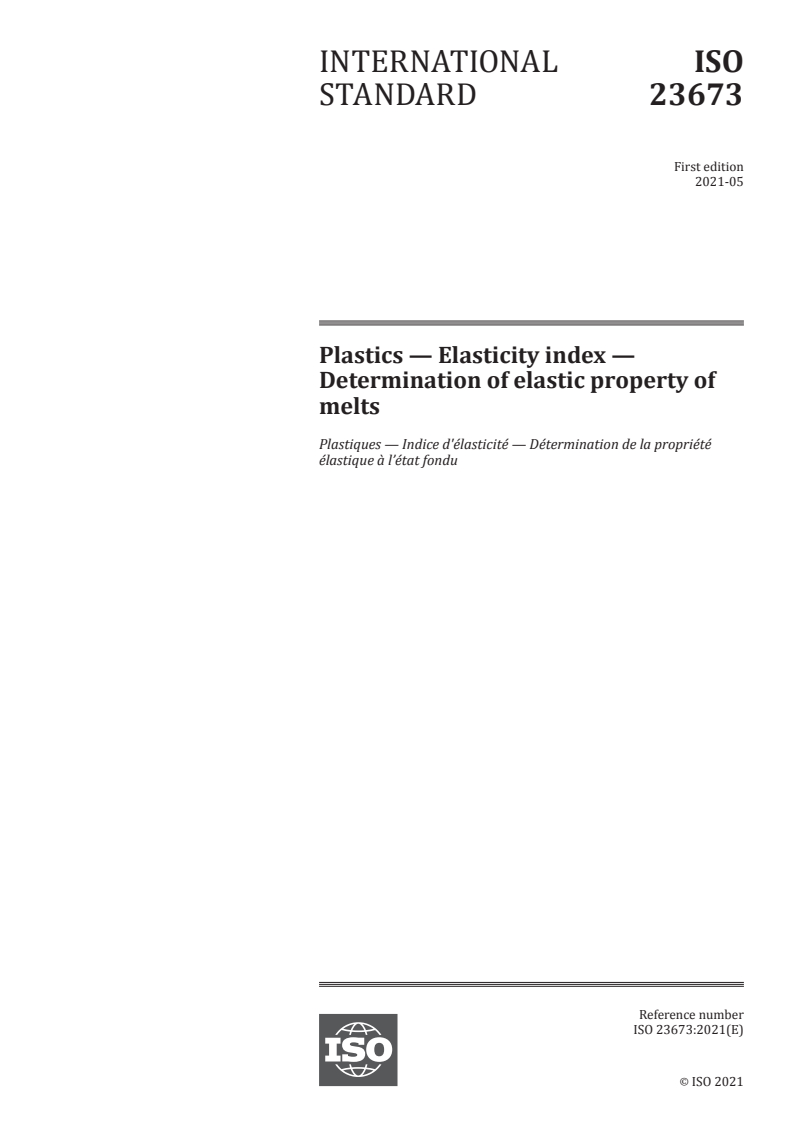
INTERNATIONAL ISO
STANDARD 23673
First edition
2021-05
Plastics — Elasticity index —
Determination of elastic property of
melts
Plastiques — Indice d'élasticité — Détermination de la propriété
élastique à l’état fondu
Reference number
©
ISO 2021
© ISO 2021
All rights reserved. Unless otherwise specified, or required in the context of its implementation, no part of this publication may
be reproduced or utilized otherwise in any form or by any means, electronic or mechanical, including photocopying, or posting
on the internet or an intranet, without prior written permission. Permission can be requested from either ISO at the address
below or ISO’s member body in the country of the requester.
ISO copyright office
CP 401 • Ch. de Blandonnet 8
CH-1214 Vernier, Geneva
Phone: +41 22 749 01 11
Email: copyright@iso.org
Website: www.iso.org
Published in Switzerland
ii © ISO 2021 – All rights reserved
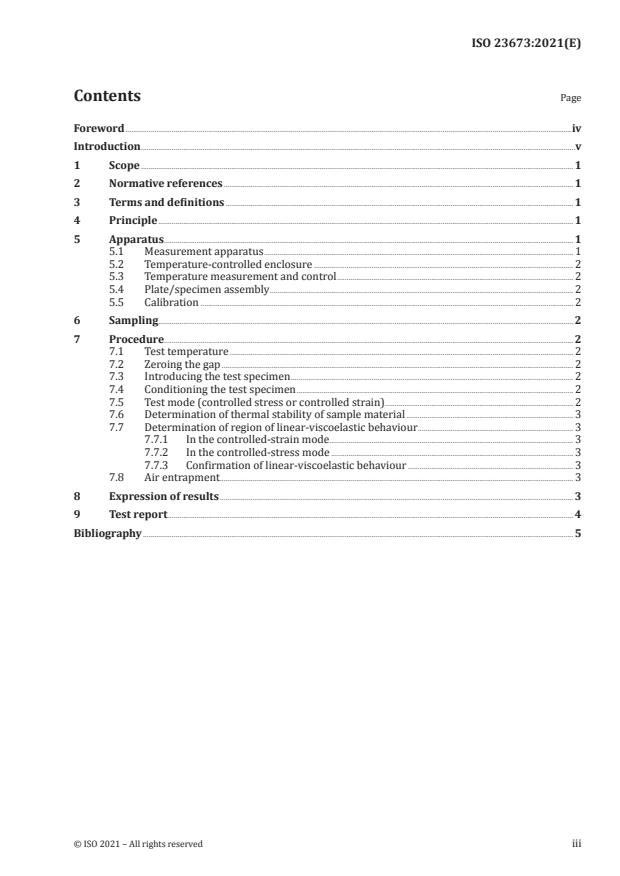
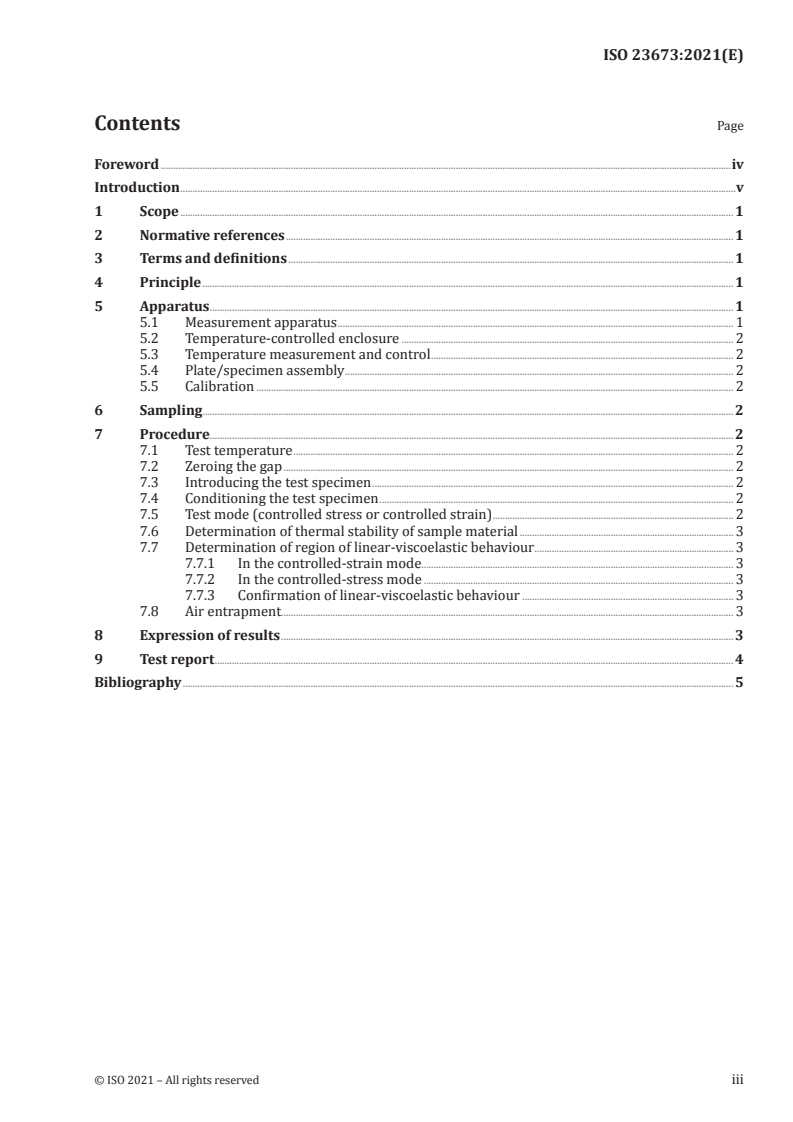
Contents Page
Foreword .iv
Introduction .v
1 Scope . 1
2 Normative references . 1
3 Terms and definitions . 1
4 Principle . 1
5 Apparatus . 1
5.1 Measurement apparatus . 1
5.2 Temperature-controlled enclosure . 2
5.3 Temperature measurement and control . 2
5.4 Plate/specimen assembly . 2
5.5 Calibration . 2
6 Sampling . 2
7 Procedure. 2
7.1 Test temperature . 2
7.2 Zeroing the gap . 2
7.3 Introducing the test specimen . 2
7.4 Conditioning the test specimen . 2
7.5 Test mode (controlled stress or controlled strain) . 2
7.6 Determination of thermal stability of sample material . 3
7.7 Determination of region of linear-viscoelastic behaviour . 3
7.7.1 In the controlled-strain mode. 3
7.7.2 In the controlled-stress mode . 3
7.7.3 Confirmation of linear-viscoelastic behaviour . 3
7.8 Air entrapment. 3
8 Expression of results . 3
9 Test report . 4
Bibliography . 5
Foreword
ISO (the International Organization for Standardization) is a worldwide federation of national standards
bodies (ISO member bodies). The work of preparing International Standards is normally carried out
through ISO technical committees. Each member body interested in a subject for which a technical
committee has been established has the right to be represented on that committee. International
organizations, governmental and non-governmental, in liaison with ISO, also take part in the work.
ISO collaborates closely with the International Electrotechnical Commission (IEC) on all matters of
electrotechnical standardization.
The procedures used to develop this document and those intended for its further maintenance are
described in the ISO/IEC Directives, Part 1. In particular, the different approval criteria needed for the
different types of ISO documents should be noted. This document was drafted in accordance with the
editorial rules of the ISO/IEC Directives, Part 2 (see www .iso .org/ directives).
Attention is drawn to the possibility that some of the elements of this document may be the subject of
patent rights. ISO shall not be held responsible for identifying any or all such patent rights. Details of
any patent rights identified during the development of the document will be in the Introduction and/or
on the ISO list of patent declarations received (see www .iso .org/ patents).
Any trade name used in this document is information given for the convenience of users and does not
constitute an endorsement.
For an explanation of the voluntary nature of standards, the meaning of ISO specific terms and
expressions related to conformity assessment, as well as information about ISO's adherence to the
World Trade Organization (WTO) principles in the Technical Barriers to Trade (TBT), see www .iso .org/
iso/ foreword .html.
This document was prepared by Technical Committee ISO/TC 61, Plastics, Subcommittee SC 5, Physical-
chemical properties.
Any feedback or questions on this document should be directed to the user’s national standards body. A
complete listing of these bodies can be found at www .iso .org/ members .html.
iv © ISO 2021 – All rights reserved
Introduction
Many thermoplastic materials show similar viscosities, but elastic properties can vary significantly,
which can lead to inappropriate applications.
The definition of an elasticity index describing the elastic properties of resins in a similar way as the
viscosity is indicated by the melt flow rate opens a possibility to designate the elastic properties using
a simple characteristic number.
Selecting G' at a particular frequency as elasticity index can no longer describe the complete behaviour
of materials with varying frequency. But considering the success MFR/MVR (see ISO 1133-1 and
ISO 1133-2) as characteristic numbers of viscosity the elasticity index provides a similar useful
characteristic number for the elasticity of materials.
© ISO
...
INTERNATIONAL ISO
STANDARD 23673
First edition
2021-05
Plastics — Elasticity index —
Determination of elastic property of
melts
Plastiques — Indice d'élasticité — Détermination de la propriété
élastique à l’état fondu
Reference number
©
ISO 2021
© ISO 2021
All rights reserved. Unless otherwise specified, or required in the context of its implementation, no part of this publication may
be reproduced or utilized otherwise in any form or by any means, electronic or mechanical, including photocopying, or posting
on the internet or an intranet, without prior written permission. Permission can be requested from either ISO at the address
below or ISO’s member body in the country of the requester.
ISO copyright office
CP 401 • Ch. de Blandonnet 8
CH-1214 Vernier, Geneva
Phone: +41 22 749 01 11
Email: copyright@iso.org
Website: www.iso.org
Published in Switzerland
ii © ISO 2021 – All rights reserved
Contents Page
Foreword .iv
Introduction .v
1 Scope . 1
2 Normative references . 1
3 Terms and definitions . 1
4 Principle . 1
5 Apparatus . 1
5.1 Measurement apparatus . 1
5.2 Temperature-controlled enclosure . 2
5.3 Temperature measurement and control . 2
5.4 Plate/specimen assembly . 2
5.5 Calibration . 2
6 Sampling . 2
7 Procedure. 2
7.1 Test temperature . 2
7.2 Zeroing the gap . 2
7.3 Introducing the test specimen . 2
7.4 Conditioning the test specimen . 2
7.5 Test mode (controlled stress or controlled strain) . 2
7.6 Determination of thermal stability of sample material . 3
7.7 Determination of region of linear-viscoelastic behaviour . 3
7.7.1 In the controlled-strain mode. 3
7.7.2 In the controlled-stress mode . 3
7.7.3 Confirmation of linear-viscoelastic behaviour . 3
7.8 Air entrapment. 3
8 Expression of results . 3
9 Test report . 4
Bibliography . 5
Foreword
ISO (the International Organization for Standardization) is a worldwide federation of national standards
bodies (ISO member bodies). The work of preparing International Standards is normally carried out
through ISO technical committees. Each member body interested in a subject for which a technical
committee has been established has the right to be represented on that committee. International
organizations, governmental and non-governmental, in liaison with ISO, also take part in the work.
ISO collaborates closely with the International Electrotechnical Commission (IEC) on all matters of
electrotechnical standardization.
The procedures used to develop this document and those intended for its further maintenance are
described in the ISO/IEC Directives, Part 1. In particular, the different approval criteria needed for the
different types of ISO documents should be noted. This document was drafted in accordance with the
editorial rules of the ISO/IEC Directives, Part 2 (see www .iso .org/ directives).
Attention is drawn to the possibility that some of the elements of this document may be the subject of
patent rights. ISO shall not be held responsible for identifying any or all such patent rights. Details of
any patent rights identified during the development of the document will be in the Introduction and/or
on the ISO list of patent declarations received (see www .iso .org/ patents).
Any trade name used in this document is information given for the convenience of users and does not
constitute an endorsement.
For an explanation of the voluntary nature of standards, the meaning of ISO specific terms and
expressions related to conformity assessment, as well as information about ISO's adherence to the
World Trade Organization (WTO) principles in the Technical Barriers to Trade (TBT), see www .iso .org/
iso/ foreword .html.
This document was prepared by Technical Committee ISO/TC 61, Plastics, Subcommittee SC 5, Physical-
chemical properties.
Any feedback or questions on this document should be directed to the user’s national standards body. A
complete listing of these bodies can be found at www .iso .org/ members .html.
iv © ISO 2021 – All rights reserved
Introduction
Many thermoplastic materials show similar viscosities, but elastic properties can vary significantly,
which can lead to inappropriate applications.
The definition of an elasticity index describing the elastic properties of resins in a similar way as the
viscosity is indicated by the melt flow rate opens a possibility to designate the elastic properties using
a simple characteristic number.
Selecting G' at a particular frequency as elasticity index can no longer describe the complete behaviour
of materials with varying frequency. But considering the success MFR/MVR (see ISO 1133-1 and
ISO 1133-2) as characteristic numbers of viscosity the elasticity index provides a similar useful
characteristic number for the elasticity of materials.
© ISO
...