

ISO/IEC 24714:2023
(Main)Biometrics — Cross-jurisdictional and societal aspects of biometrics — General guidance
General Information
- Abstract
This document gives general guidance for the stages in the life cycle of a system’s biometric and associated elements. This covers the following: — the capture and design of initial requirements, including legal frameworks; — development and deployment; — operations, including enrolment and subsequent usage; — interrelationships with other systems; — related data storage and security of data; — data updates and maintenance; — training and awareness; — system evaluation and audit; — controlled system expiration. The areas addressed are limited to the design and implementation of biometric technologies with respect to the following: — legal and societal constraints on the use of biometric data; — accessibility for the widest population; — health and safety, addressing the concerns of users regarding direct potential hazards as well as the possibility of the misuse of inferred data from biometric information. This document is intended for planners, implementers and system operators of biometric applications. Specification and assessment of government policy are not within the scope of this document. However, this document is intended to be beneficial to public authorities when deploying biometric systems.
- Status
- Published
- Publication Date
- 20-Jul-2023
- Technical Committee
- ISO/IEC JTC 1/SC 37 - Biometrics
- Current Stage
- 9092 - International Standard to be revised
- Start Date
- 20-Jan-2025
- Completion Date
- 29-Aug-2026

Overview
ISO/IEC 24714:2023 - "Biometrics - Cross-jurisdictional and societal aspects of biometrics - General guidance" provides high‑level, non‑technology‑specific guidance for the full life cycle of biometric systems. The standard focuses on the legal, societal and human‑centric aspects of biometric system design and operation, helping planners, implementers and system operators address privacy, accessibility, health & safety, usability and cultural concerns across jurisdictions.
What the standard covers
- Biometric system life cycle guidance: capture and requirements, development and deployment, operations (including enrolment and use), interrelationships with other systems, data storage and security, updates and maintenance, training and awareness, evaluation/audit and controlled system expiration.
- Cross‑jurisdictional issues: privacy and data protection considerations where laws and practices differ between countries or regions. The 2023 edition adds emphasis on privacy by design and privacy by default.
- Societal and human factors: accessibility for the widest population, health and safety concerns (including potential misuse of inferred data), usability, cultural/ethical aspects and public acceptance.
- Supporting materials: terms and definitions (e.g., PII, data subject, usability), examples and informative use cases in Annex A.
Key technical topics and requirements
- Privacy and data protection: guidance on privacy principles, data minimization, proportionality and measures such as DPIAs (data protection impact assessments) and PETs (privacy enhancing technologies).
- Accessibility & usability: design recommendations to accommodate diverse user needs and assistive technologies so biometric systems serve the widest population.
- Health & safety: identification of potential direct hazards and recommendations to mitigate misuse of biometric‑derived inferences.
- Interoperability & system relationships: considerations for how biometric components interact with other IT/ICT systems while respecting legal constraints.
- Governance, audit & lifecycle controls: guidance on evaluation, audits, training, documentation and planned system retirement to avoid function creep.
Practical applications and who uses this standard
- Primary users: system architects, integrators, planners, implementers, operators and public authorities deploying biometric solutions.
- Secondary beneficiaries: standards developers, privacy officers, accessibility specialists and procurement teams.
- Use cases: identity management, border control, access control, e‑services and any biometric deployment spanning multiple legal jurisdictions or diverse user populations.
Related standards and references
- ISO/IEC 2382‑37 (biometrics vocabulary)
- ISO/IEC 29100 (privacy framework) and ISO 9241‑11 (usability)
- Regional data protection frameworks (e.g., GDPR) are relevant when applying ISO/IEC 24714:2023.
ISO/IEC 24714:2023 is a practical guide to embedding privacy, accessibility and societal considerations into biometric systems to improve acceptance, reduce risk and support cross‑jurisdictional deployment.
Relations
- Effective Date
- 23-Apr-2020
Get Certified
Connect with accredited certification bodies for this standard

BSI Group
BSI (British Standards Institution) is the business standards company that helps organizations make excellence a habit.

NYCE
Mexican standards and certification body.
Sponsored listings
Frequently Asked Questions
ISO/IEC 24714:2023 is a standard published by the International Organization for Standardization (ISO). Its full title is "Biometrics — Cross-jurisdictional and societal aspects of biometrics — General guidance". This standard covers: This document gives general guidance for the stages in the life cycle of a system’s biometric and associated elements. This covers the following: — the capture and design of initial requirements, including legal frameworks; — development and deployment; — operations, including enrolment and subsequent usage; — interrelationships with other systems; — related data storage and security of data; — data updates and maintenance; — training and awareness; — system evaluation and audit; — controlled system expiration. The areas addressed are limited to the design and implementation of biometric technologies with respect to the following: — legal and societal constraints on the use of biometric data; — accessibility for the widest population; — health and safety, addressing the concerns of users regarding direct potential hazards as well as the possibility of the misuse of inferred data from biometric information. This document is intended for planners, implementers and system operators of biometric applications. Specification and assessment of government policy are not within the scope of this document. However, this document is intended to be beneficial to public authorities when deploying biometric systems.
This document gives general guidance for the stages in the life cycle of a system’s biometric and associated elements. This covers the following: — the capture and design of initial requirements, including legal frameworks; — development and deployment; — operations, including enrolment and subsequent usage; — interrelationships with other systems; — related data storage and security of data; — data updates and maintenance; — training and awareness; — system evaluation and audit; — controlled system expiration. The areas addressed are limited to the design and implementation of biometric technologies with respect to the following: — legal and societal constraints on the use of biometric data; — accessibility for the widest population; — health and safety, addressing the concerns of users regarding direct potential hazards as well as the possibility of the misuse of inferred data from biometric information. This document is intended for planners, implementers and system operators of biometric applications. Specification and assessment of government policy are not within the scope of this document. However, this document is intended to be beneficial to public authorities when deploying biometric systems.
ISO/IEC 24714:2023 is classified under the following ICS (International Classification for Standards) categories: 35.020 - Information technology (IT) in general. The ICS classification helps identify the subject area and facilitates finding related standards.
ISO/IEC 24714:2023 has the following relationships with other standards: It is inter standard links to ISO/IEC TR 24714-1:2008. Understanding these relationships helps ensure you are using the most current and applicable version of the standard.
ISO/IEC 24714:2023 is available in PDF format for immediate download after purchase. The document can be added to your cart and obtained through the secure checkout process. Digital delivery ensures instant access to the complete standard document.
Standards Content (Sample)
INTERNATIONAL ISO/IEC
STANDARD 24714
First edition
2023-07
Biometrics — Cross-jurisdictional
and societal aspects of biometrics —
General guidance
Biométrie — Aspects transjuridictionnels et sociétaux de la biométrie
— Partie 1: Recommandations générales
Reference number
© ISO/IEC 2023
© ISO/IEC 2023
All rights reserved. Unless otherwise specified, or required in the context of its implementation, no part of this publication may
be reproduced or utilized otherwise in any form or by any means, electronic or mechanical, including photocopying, or posting on
the internet or an intranet, without prior written permission. Permission can be requested from either ISO at the address below
or ISO’s member body in the country of the requester.
ISO copyright office
CP 401 • Ch. de Blandonnet 8
CH-1214 Vernier, Geneva
Phone: +41 22 749 01 11
Email: copyright@iso.org
Website: www.iso.org
Published in Switzerland
ii
© ISO/IEC 2023 – All rights reserved
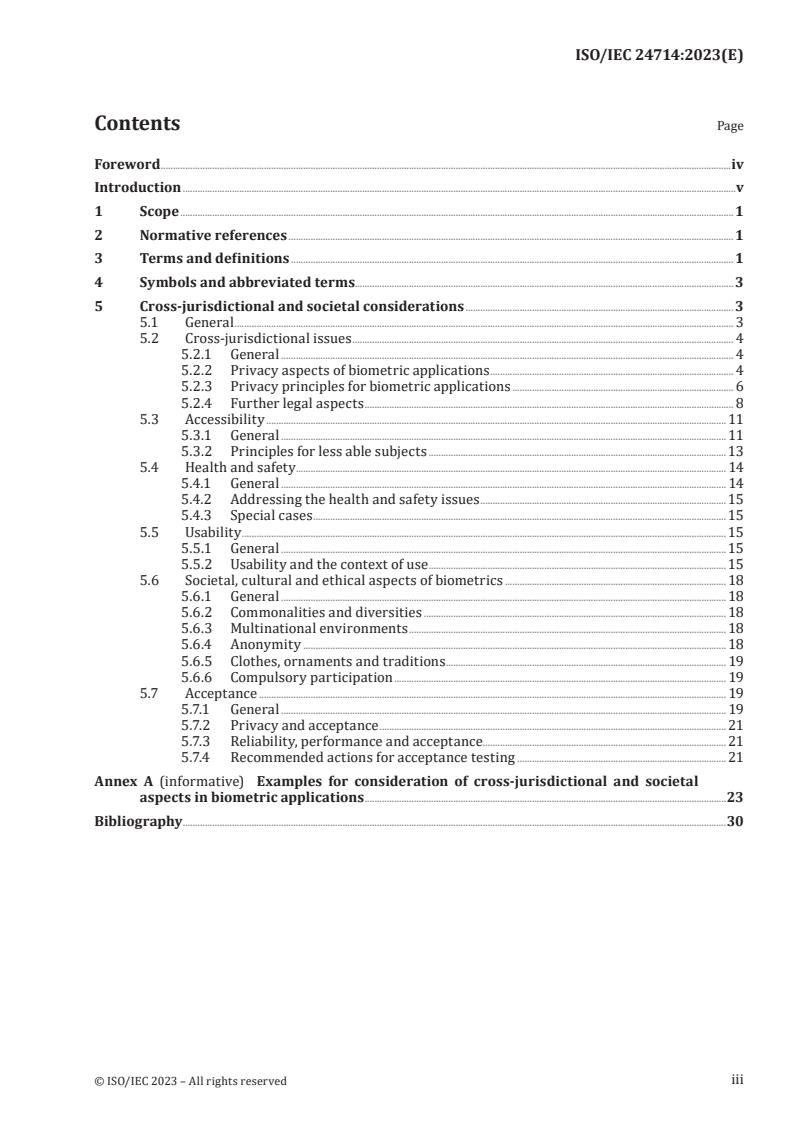
Contents Page
Foreword .iv
Introduction .v
1 Scope . 1
2 Normative references . 1
3 Terms and definitions . 1
4 Symbols and abbreviated terms.3
5 Cross-jurisdictional and societal considerations . 3
5.1 General . 3
5.2 Cross-jurisdictional issues . 4
5.2.1 General . 4
5.2.2 Privacy aspects of biometric applications . 4
5.2.3 Privacy principles for biometric applications . 6
5.2.4 Further legal aspects . 8
5.3 Accessibility . 11
5.3.1 General . 11
5.3.2 Principles for less able subjects . 13
5.4 Health and safety . . 14
5.4.1 General . 14
5.4.2 Addressing the health and safety issues . 15
5.4.3 Special cases . 15
5.5 Usability . 15
5.5.1 General .15
5.5.2 Usability and the context of use . 15
5.6 Societal, cultural and ethical aspects of biometrics . 18
5.6.1 General . 18
5.6.2 Commonalities and diversities . 18
5.6.3 Multinational environments . 18
5.6.4 Anonymity . 18
5.6.5 Clothes, ornaments and traditions . 19
5.6.6 Compulsory participation . 19
5.7 Acceptance . 19
5.7.1 General . 19
5.7.2 Privacy and acceptance . 21
5.7.3 Reliability, performance and acceptance. 21
5.7.4 Recommended actions for acceptance testing . 21
Annex A (informative) Examples for consideration of cross-jurisdictional and societal
aspects in biometric applications .23
Bibliography .30
iii
© ISO/IEC 2023 – All rights reserved
Foreword
ISO (the International Organization for Standardization) and IEC (the International Electrotechnical
Commission) form the specialized system for worldwide standardization. National bodies that are
members of ISO or IEC participate in the development of International Standards through technical
committees established by the respective organization to deal with particular fields of technical
activity. ISO and IEC technical committees collaborate in fields of mutual interest. Other international
organizations, governmental and non-governmental, in liaison with ISO and IEC, also take part in the
work.
The procedures used to develop this document and those intended for its further maintenance
are described in the ISO/IEC Directives, Part 1. In particular, the different approval criteria
needed for the different types of document should be noted. This document was drafted in
accordance with the editorial rules of the ISO/IEC Directives, Part 2 (see www.iso.org/directives or
www.iec.ch/members_experts/refdocs).
ISO and IEC draw attention to the possibility that the implementation of this document may involve the
use of (a) patent(s). ISO and IEC take no position concerning the evidence, validity or applicability of
any claimed patent rights in respect thereof. As of the date of publication of this document, ISO and IEC
had not received notice of (a) patent(s) which may be required to implement this document. However,
implementers are cautioned that this may not represent the latest information, which may be obtained
from the patent database available at www.iso.org/patents and https://patents.iec.ch. ISO and IEC shall
not be held responsible for identifying any or all such patent rights.
Any trade name used in this document is information given for the convenience of users and does not
constitute an endorsement.
For an explanation of the voluntary nature of standards, the meaning of ISO specific terms and
expressions related to conformity assessment, as well as information about ISO's adherence to
the World Trade Organization (WTO) principles in the Technical Barriers to Trade (TBT) see
www.iso.org/iso/foreword.html. In the IEC, see www.iec.ch/understanding-standards.
This document was prepared by Joint Technical Committee ISO/IEC JTC 1, Information technology,
Subcommittee SC 37, Biometrics.
This first edition of ISO/IEC 24714 cancels and replaces ISO/IEC TR 24714-1:2008, which has been
technically revised.
The main changes are as follows:
— addition of privacy by design and privacy by default principles;
— addition of examples.
Any feedback or questions on this document should be directed to the user’s national standards
body. A complete listing of these bodies can be found at www.iso.org/members.html and
www.iec.ch/national-committees.
iv
© ISO/IEC 2023 – All rights reserved
Introduction
This document provides support for the further development of ISO/IEC biometric International
Standards in the context of cross-jurisdictional and societal applications of biometrics, including
standardization of both existing and future technologies.
Specifically, this document offers guidance on the design of systems that use biometric technologies to
capture, process and record biometric information:
— with regard to societal norms and legal requirements of jurisdictional domains (within and among
various levels of jurisdictions);
— pertaining to privacy/data protection of an identifiable individual;
— with respect to an individual’s ability to access and use these systems and the information they
contain;
— with regard to health and safety issues pertaining to an individual when systems are utilized to
capture biometric data.
In this document, biometric data are considered to be personally identifiable information (PII).
Examples of the benefits to be gained by following the recommendations and guidelines in this
document are:
— enhanced acceptance of systems using biometrics by subjects;
— improved public perception and understanding of well-designed systems;
— smoother introduction and operation of these systems;
— potential long-term cost reduction (whole life costs);
— increased awareness of the range of accessibility-related issues;
— adoption of commonly approved good privacy practice.
The primary stakeholders are identified as:
— operators – those who use the results of the biometric data,;
— developers of technical standards;
— subjects – those who provide a sample of their biometric data;
— writers of system specifications, system architects and IT designers;
— public policy makers.
v
© ISO/IEC 2023 – All rights reserved
INTERNATIONAL STANDARD ISO/IEC 24714:2023(E)
Biometrics — Cross-jurisdictional and societal aspects of
biometrics — General guidance
1 Scope
This document gives general guidance for the stages in the life cycle of a system’s biometric and
associated elements. This covers the following:
— the capture and design of initial requirements, including legal frameworks;
— development and deployment;
— operations, including enrolment and subsequent usage;
— interrelationships with other systems;
— related data storage and security of data;
— data updates and maintenance;
— training and awareness;
— system evaluation and audit;
— controlled system expiration.
The areas addressed are limited to the design and implementation of biometric technologies with
respect to the following:
— legal and societal constraints on the use of biometric data;
— accessibility for the widest population;
— health and safety, addressing the concerns of users regarding direct potential hazards as well as the
possibility of the misuse of inferred data from biometric information.
This document is intended for planners, implementers and system operators of biometric applications.
Specification and assessment of government policy are not within the scope of this document. However,
this document is intended to be beneficial to public authorities when deploying biometric systems.
2 Normative references
The following documents are referred to in the text in such a way that some or all of their content
constitutes requirements of this document. For dated references, only the edition cited applies. For
undated references, the latest edition of the referenced document (including any amendments) applies.
ISO/IEC 2382-37, Information technology — Vocabulary — Part 37: Biometrics
3 Terms and definitions
For the purposes of this document, the terms and definitions given in ISO/IEC 2382-37 and the following
apply.
© ISO/IEC 2023 – All rights reserved
ISO and IEC maintain terminology databases for use in standardization at the following addresses:
— ISO Online browsing platform: available at https:// www .iso .org/ obp
— IEC Electropedia: available at https:// www .electropedia .org/
3.1
accessibility
extent to which products, systems, services, environments and facilities can be used by people from a
population with the widest range of user needs, characteristics and capabilities to achieve identified
goals in identified contexts of use
Note 1 to entry: Context of use includes direct use or use supported by assistive technologies.
[1]
[SOURCE: ISO 9241-112:2017, 3.15 ]
3.2
data subject
subject
individual whose individualized biometric data is within the biometric system
Note 1 to entry: The data subject is the data principal of PII.
[SOURCE: ISO/IEC 2382-37:2022, 37.07.05, modified — The original term "biometric data subject" has
been changed to "data subject" and Note 1 to entry has been replaced.]
3.3
function creep
expansion of a project, mission, or system’s function beyond its original goals
Note 1 to entry: Function creep is the result of the intended or unintended change or extension to the functions of
a system, which occur as small incremental stages, and can lead to significant changes to the function.
3.4
proportionality
balance between the interests of an individual and the interests of an organisation
3.5
usability
extent to which a system, product or service can be used by specified users to achieve specified goals
with effectiveness, efficiency and satisfaction in a specified context of use
Note 1 to entry: The “specified” users, goals and context of use refer to the particular combination of users, goals
and context of use for which usability is being considered.
Note 2 to entry: The word “usability” is also used as a qualifier to refer to the design knowledge, competencies,
activities and design attributes that contribute to usability, such as usability expertise, usability professional,
usability engineering, usability method, usability evaluation, usability heuristic.
[2]
[SOURCE: ISO 9241-11:2018, 3.1.1 ]
3.6
personally identifiable information
PII
any information that a) can be used to identify the PII principal to whom such information relates, or b)
is or might be directly or indirectly linked to a PII principal
Note 1 to entry: To determine whether a PII principal is identifiable, account should be taken of all the means
which can reasonably be used by the privacy stakeholder holding the data, or by any other party, to identify that
natural person.
Note 2 to entry: In this document the PII principal is the data subject.
© ISO/IEC 2023 – All rights reserved
[3]
[SOURCE: ISO/IEC 29100:2011, 2.9 .]
4 Symbols and abbreviated terms
API application programming interface
DPIA data protection impact assessment
DPO data protection officer
FRR false reject rate
FAR false accept rate
GDPR general data protection regulation
HTTP hypertext transfer protocol
ICT information and communication technology
IT information technology
PET privacy enhancing technology
PIN personal identification number
REST representational state transfer
NOTE REST is an architectural style that defines a set of constraints and properties based on
HTTP.
UCD user-centred design
UI user interface
5 Cross-jurisdictional and societal considerations
5.1 General
This document provides generic recommendations that are not specific to technologies or applications
and that can affect all biometrics.
This clause begins by providing principles, guidelines and considerations for the design and
implementation of biometric applications in three major areas:
1) cross-jurisdictional issues related to privacy and protection of personal information (see 5.2);
2) accessibility (see 5.3); and
3) an examination of health and safety issues when using biometric applications that can affect design
and implementation considerations (see 5.4).
It considers usability and highlights conditions of the physical environment that can affect the operation
and usability of a biometric application (see 5.5), societal, cultural and ethical aspects of biometrics
(see 5.6) and acceptance of the use of biometric applications (see 5.7).
Two use cases are provided in Annex A as practical illustrations.
© ISO/IEC 2023 – All rights reserved
5.2 Cross-jurisdictional issues
5.2.1 General
The developer of a biometric application should take into account a number of issues that relate to
specific jurisdictional requirements, which can differ between jurisdictions, not all of which are within
the scope of this document. The list of issues which have not been examined in detail in this document
includes:
— anti-discriminatory laws;
— disclosure laws;
— redress mechanisms;
— contractual issues;
— provision of biometric data to parties other than the data holder;
— provisions for law enforcement agencies for access to biometric and associated information;
— opt-in and opt-out rights and associated requirements for fall-back processes;
— specific data retention conditions (including period of time and security standards);
— evidentiary requirements for use of biometric data in a court of law;
— specific instances where biometrics are required by organizations or governments (e.g. for secure
access to military facilities and critical infrastructure);
— applicability of legal domains in use of biometrics on the internet;
— border control laws.
5.2.2 Privacy aspects of biometric applications
With the proliferation of biometric applications worldwide, the aspect of privacy gains importance. As
a result, it is necessary to understand what the objectives of data protection law and policy intend. It is
necessary that the applicable law and policy protect data subjects and their biometric data and personal
rights. Using a biometric application means using PII; thus, existing privacy laws apply. Depending on
how a system is deployed, biometric technology can compromise or protect a data subject’s privacy.
The possibility of protection is especially valid in view of the special properties of biometrics, which
are linked uniquely to the subject for their lifetime, unlike PINs and passwords, which are indirectly
and weakly linked to a person. By using a biometric key, other types of PII can be better protected
from theft and misuse than by traditional means. Biometrics can therefore be both an object and a tool
in the different aspects of this discussion. In all applications, the principle of proportionality should
be applied. That means that biometric data used should be adequate, relevant and non-excessive with
regard to the purposes for which they are collected and further processed.
Biometrics can be considered in the context of PETs. PETs are a coherent system of ICT measures that
protect privacy by eliminating or reducing PII or by preventing unauthorised, unnecessary and/or
undesired processing of PII; all without losing the functionality of the data system.
NOTE 1 Processing in this context includes any operation or set of operations which is performed upon PII,
whether or not by automatic means, such as collection, recording, organization, storage, adaptation or alteration,
retrieval, consultation, use, disclosure by transmission, dissemination or otherwise making available, alignment
or combination, blocking, erasure or destruction.
The principle of PET applies to biometrics seen from two standpoints:
— as an object of the principle, the implementation and application of biometrics should follow a
comprehensive and correct privacy regime in order to be privacy enhancing;
© ISO/IEC 2023 – All rights reserved
— as a tool in the meaning of PET, biometrics itself can be a privacy enhancing method.
For instance, biometrics can improve the verification process compared with a traditional process
where a subject has to provide information through requested evidentiary documents which can
reveal considerable personal information. The use of biometrics can simply be putting a fingerprint on
a sensor without revealing any additional personal information (name, address, date of birth, etc.) to
the person who is checking the entitlement of the identified person (given that there has been a proper
registration process beforehand). Moreover, the use of biometrics enables the subject to bind a device
(such as a smart phone) to their identity. The advantage is that, although a device can have more than
one user, the biometrics bind the use to a single specific identity. Subjects can use pseudo-identities by
varying the biometrics provided.
The following are some generally accepted rules of PETs.
— At the planning stage, assess whether or not biometrics should be used or another less intrusive
method substituted
— Use no PII or as little as necessary.
— Use encryption if using PII.
— Destroy raw data as soon as possible.
— Anonymize PII wherever possible.
— Do not use central databases where not required.
— Give subjects control over their PII.
— Use a means of evaluation and certification to verify that an application delivers a guarantee of an
appropriate level of trust.
[4]
NOTE 2 See also ISO/IEC 24745 .
[14]
In relation to privacy, Article 17 of the International Covenant on Civil and Political Rights stresses
that no one’s privacy, family, home or correspondence should be subjected to arbitrary or unlawful
interference, nor should their honour and reputation be unlawfully attacked.
Privacy is one of the most significant issues confronting not only the biometrics industry, but also any
organization which gathers personal information. The potential for shared access to information and
multiple uses of biometric databases raises specific concerns. However, many statements on privacy
fail to capture the nuances across various biometric deployments. Certain types of biometrics engender
a greater perception of privacy invasion while others have little influence on privacy concerns. PII is the
first step to establishing personal identity and it is at this point where many crimes of identity occur.
Although there are many issues associated with submitting biometric data, it should be reinforced
that identification will have already been established through other identity documents such as birth
certificates. Therefore, many people might consider biometric techniques to be far less invasive than
being asked, sometimes face to face, questions relating to their personal history, details of residence
and information about other members of their family, such as a mother’s maiden name. In this context,
biometric technology is simply another means for identification.
The increasing number of implementations and discussions about the use of biometrics raises questions
about the technology’s impact on privacy in applications generally available and widely used by the
public, in the workplace and at home. Key aspects of privacy issues relate to either the data subject
or the organization. From the data subject’s perspective, issues relate to collection, choice, use and
security of information and anonymity of the individual. From an organizational perspective, issues
include the manner and purpose of collection, solicitation, storage and security of information, access
to records, relevance and the limits on use and disclosure of collected data.
Other privacy issues relate to concerns that include stigmatization and reputational or financial
damage. An example of stigmatization in some communities has been the association of fingerprints
with criminal activity. However, fingerprinting is now also becoming associated with the more positive
© ISO/IEC 2023 – All rights reserved
identification of the law-abiding citizen as a holder of electronic ID documents, a cardholder, or club
member. Any concerns can be exacerbated by the possibility that a person’s biometric can be “spoofed”.
Further privacy issues relate to function creep, or the misuse of information, and tracking or aggregation
of data. In relation to function creep, using data for a secondary purpose can appear worthwhile;
however, socio-cultural and legal issues can arise when individuals are not informed of this secondary
purpose for which their information will be used, and have not given consent for this to take place.
“Tracking” can refer to a specific form of function creep where biometric data is used in combination
with additional data such as spending or travel details to track the actions of individuals. Covert use of
biometrics without legal authorization will impinge on individuals’ privacy.
In addition to the analysis of cross-jurisdictional issues relating to privacy listed in 5.2.3, a number of
other considerations should be taken account of, including:
— issues relating to the linking of biometric data to other information;
— transition states, e.g. the ability to give consent changes:
— migration from a minority to a majority age,
— change in mental capacity (e.g. Alzheimer’s disease),
— death of a subject,
— revocation procedures;
— notification to anonymously enrolled data subjects of any changes in the uses of a biometric.
The system data protection officer, or equivalent, should take part in the planning and implementation
of all biometric applications. They should also drive the development and implementation of the
biometric privacy policy and ensure conformance to that policy. Where there is no data protection
officer, there should be a person in charge of implementing the system who is able to deal with IT
security and privacy issues when they occur.
If recognized national consumer associations have published recommendations on biometrics that
seem to be applicable to a specific biometric implementation, a system operator should consider them
where appropriate.
5.2.3 Privacy principles for biometric applications
There are a number of key privacy-enhancing principles that should be considered by organizations
implementing a biometric application. These principles, which are listed below, build upon the
reference documents listed in the Bibliography. They should be considered and applied in the context of
jurisdictional laws and regulations.
1) Transparency
There should be a general policy of openness about the use of biometric data, which should include
the purposes for which the data is to be used and the point of contact responsible for its use. Any
subsequent changes should be made known to data subjects.
2) Consent
Biometric data should be collected, stored, used, disclosed and retained with the knowledge and
consent of data subject, except where local laws have exemptions to this principle.
3) Preference for opt-in
Where feasible and practical, opt-out or opt-in procedures should be made available to the data
subject. In general, opt-in is the preferred option.
© ISO/IEC 2023 – All rights reserved
4) Limitation of purpose
The purpose(s) of a biometric application should be available for data subjects to read prior to their
use of it. The biometric data processing should be limited to the stated purpose.
NOTE In some countries the principle of necessity is used. This requires that for use of a particular
methodology or technology, especially emerging technology, it be demonstrated that its use is required
and that the purpose cannot be achieved by any other methodology and/or technology that is accepted as
providing adequate protection of individuals privacy.
5) Limitation of collection
The collection of biometric data should be limited to the minimum required to achieve the stated
purpose(s).
6) Limitation of period of retention
The biometric data should be kept only for the period of time necessary for the specified purposes.
Procedures should be specified for secure removal of data that is beyond its retention period.
7) Adherence to performance criteria
The system operator should ensure the correct configuration, function and stability of a biometric
application according to its specification. This is so that system operation, or any system
malfunction, does not result in unauthorized access, use, modification and disclosure of biometric
data.
8) Access rights of the data subject
The data subject should be given reasonable access to verify the correctness of the biometric data
and to have incorrect data amended.
9) Protection of the data
Biometric applications should be designed so that biometric data, including in back-ups or archive,
is protected against unauthorized access, use, modification, deletion, disclosure and retention.
10) Secure audit
The biometric application should be designed to permit a secure audit of the use of biometric data
[5]
including its deletion or removal from the biometric application (see ISO/IEC 27002 ).
11) Data transfer between jurisdictions
The system operator should take reasonable steps to ensure that biometric data that is disclosed
to an external party, including in another jurisdiction, is adequately protected. This may be done
through contractual arrangements or a Memorandum of Understanding. Model contracts for the
transfer of personal data can be used even though this might not be a legal requirement in the
jurisdictions in which the external party operates.
12) Significant automated decisions
Where biometric applications are used to make significant and fully automated decisions about
individuals, a mechanism to request the intervention of a person should be provided. Individuals
should be notified of such automated decisions.
13) Accountability
A person within the system operator’s organization should be accountable for conformance with
the relevant law and these principles.
© ISO/IEC 2023 – All rights reserved
14) Accuracy of biometric data
Biometric information should be as accurate, complete and up-to-date as is necessary for the
purposes for which it is to be used.
15) Anonymization of data
Release of biometric data for academic, statistical or testing purposes should be considered and
controlled carefully. Links to other personal information should be removed where they could lead
to identification of an individual.
16) Privacy by design
Organizations need to consider privacy at the initial design stages and throughout the complete
development process of new products, processes or services that involve processing biometric data
PII.
17) Privacy by default
When a system or service includes choices for the individual on how much PII they share with
others, the default settings should be the most privacy-friendly ones.
5.2.4 Further legal aspects
5.2.4.1 General
Although this document is not intended to deal in detail with legal issues such as contractual or
evidentiary aspects, some general statements on legal value and potential consequences of using
biometric applications can be of benefit for its readers.
In some countries, a number of regulations exist that apply to the operation of biometric applications
and the management of biometric data. Subclause 5.2.4 gives an overview of legal considerations, other
than those related to privacy. Examples of detailed regulations applicable in specific countries are
reported in the Bibliography.
5.2.4.2 Biometrics in authentication infrastructures
There is a need to facilitate electronic transactions between parties and, to achieve this, many countries
have introduced electronic transaction regulations.
While hand-written signatures are widely accepted in the legal context, this normally relies on human
signature recognition. For electronic transaction scenarios biometric data can be used on its own or in
combination with a PIN or a password. When multiple factors are used in combination, this is referred
to as multi-factor authentication.
Three-factor authentication can involve something that a subject possesses, something they are or
something they know in any combination. Two factors are sufficient for most commercial applications.
In this context, biometrics characteristics in combination with security token or credential can be
seen as the equivalence of a hand-written signature. If the use of biometrics can realize the traditional
functions of the hand-written signature, a legal transaction and the binding of it to a person can be
ensured and therefore a similar legal binding force can be achieved.
Where both the captured and reference biometric data samples are needed to realize equivalent
legal validity in transactions to that of a traditional hand-written signature, this requires that, in
all cases, both systems employed are able to deliver strong security and a reliable audit trail (see
[5]
ISO/IEC 27002 ).
The use of biometric characteristics alone in electronic transactions can be deemed by some authorities
not to confer the same legal validity as a hand-written signature. In these cases, biometric characteristics
and digital signatures should be in a complementary relationship. Therefore, in this context, the use
© ISO/IEC 2023 – All rights reserved
of biometric characteristics needs to be considered as one module in a public key infrastructure and
subject to the legal requirements of that infrastructure.
5.2.4.3 Biometric methods and legal proof
The evidential value of an electronic transaction can be maximized if one or more biometric credentials
are used to prevent unauthorized issue of a legal declaration.
An appropriate level of security can enhance the evidential integrity: of the binding of the digital
signature to the individual, and in the non-repudiation of the document or transaction.
Any legal challenges will best be addressed by demonstrating the reliability of the system which was
used. Although the assessment of the court will differ between jurisdictions, the performance and the
overall security of the biometric application will be the most significant aspect in the case.
It should be considered that recognition of a biometric data sample rarely performs perfect matching
of characteristics in practical applications. It is therefore difficult to make reliable statements on
the recognition quality of a specific system at a defined point in time. This contrasts with a PIN or a
password where the match is one hundred percent true or false, but presents the risk that it can have
been used by one who is not entitled to use it.
A system secured by biometric credentials is subject to similar security breaches as a system protected
by PINs or passwords. Naive faith in technology can result in a higher degree of confidence in a biometric
application’s security than is justified. It is therefore essential to determine the degree of security in
[5]
the total system (see ISO/IEC 27002 ).
5.2.4.4 Performance of biometric applications and liability
Biometric applications are subject not only to technical malfunction but also to reduced performance as
a result of user behaviour (including operators and subjects), deliberate or accidental, or as a result of
aged biometric data samples. The failure to protect and secure biometric data can incur legal liability. It
is important to consider the consequences and liability issues associated with such failures in the legal
context.
[6]
NOTE ISO/IEC 21472 deals with user interaction influence in biometric application performance.
5.2.4.5 Standard terms of business
Liability can be dealt with in statutory provisions and also in contracts. Businesses often use pre-
worded contract terms that, as a rule, add to the statutory provisions. In many countries, there are
existing laws of standard terms of business, containing rules for whether such terms have become part
of a contract, whether clauses are invalid, and entitle third parties (such as consumer associations) in
certain circumstances to file a court claim aimed at obtaining a judgement holding a clause invalid.
Generally, what is often needed, is a clear and understandable wording; in other words, the subject
should be able to find and familiarize themselves with certain mandatory information, without
difficulty.
It is desirable to establish consumer-friendly terms in order to build trust in a biometric application.
Subjects are unlikely to use a biometric application for their convenience if they are disadvantaged by
having the legal burden of proving whether or how they used the system in the event of a disputed
match.
For instance, if the risk of malfunction of the biometric application prevents the subject’s access to the
protected area, standard terms of business should not shift the responsibility to the subject.
An exclusion of liability for system malfunctions following data subject interaction is also usually not
permitted, or at least not desirable, in terms and conditions of business. Biometric applications are
vulnerable to unauthorized use and malfunctions. Besides intentional manipulations by attacks on the
system and general technical problems, a certain number of potential erroneous acceptances are always
© ISO/IEC 2023 – All rights reserved
to be expected to occur. The subject is neither able to affect nor to control these technical aspects since
these aspects are in the operator’s sphere alone.
5.2.4.6 Non-discrimination
Since biometric systems use physical or behavioural information, individuals can be deterred from
using them if they are unable to present the required characteristic or cannot do so in such a manner
as to achieve successful verification. Examples are represented by missing fingers, inability to speak,
inability to control eye movement. Considering the increasing use of biometrics, this is likely to become
a problem for affected subjects especially when biometrics are required to access important services.
In many countries, legislation exists to minimize direct or indirect discrimination with regard to, for
example, disability, sex, age and ethnicity. Biometric systems should be designed so that the differential
[7]
impacts (see ISO/IEC TR 22116 ) are minimized. To avoid discrimination against individuals who
are unable or do not consent to use a particular biometric application, provisions should be made
for alternative methods of identity verification that are similarly secure and usable as the biometric
method.
5.2.4.7 Biometrics in the workplace
In several countries, specific regulations need to be taken into account when biometric technology is
used for physical or logical access control in a working environment. The workplace requires special
consideration since the employee’s ability to refuse consent is constrained by their dependence on
employment. In order to protect the rights of the employees, in particular with regard to their privacy,
it often makes sense to involve a workers’ association, a works council, or equivalent, in order to
negotiate sensible use and management of the biometric data. When employment ceases or in a job
application that requires a biometric data sample to be submitted, the biometric data should be deleted
as soon as possible.
5.2.4.8 Aspects of criminal law
5.2.4.8.1 Altering data and unauthorized computer access
Under many criminal laws there is a prohibition of altering electronic data without authorization and
it is also not legal to access a computer of another person without appropriate entitlement. The specific
cases under which legal sanctions are applicable depend on the national regulations.
5.2.4.8.2 Forgery or theft of biometric data
A spoofing attack on a system by copying or theft of biometric characteristics can be subject to criminal
law in various jurisdictions. There can be a need to establish specific regulations in this regard in order
to protect the wellbeing and life of subjects. Technical measures are being developed to ensure that the
biometric data is not tampered with, by testing the liveness of biometric characteristics, for example.
Systems should therefore provide such a test, a verification that the biometric data sample is provided
by a natural person, and include measures against “replay” or re-presentation of a sample. These
features can mitigate subjects’ concerns over theft of physical biometric characteristics and should be
implemented where possible.
[8]
The ISO/IEC 30107 series on biometric presentation attack detection establishes a framework through
which presentation attack events can be specified and detected so that they can be categorized, detailed
and communicated for subsequent biometric system decision-making and performance assessment
activities. It also establishes data formats to be used and principles and methods for performance
assessment of presentation attack detection algorithms or mechanisms.
© ISO/IEC 2023 – All rights reserved
5.3 Accessibility
5.3.1 General
A biometric application should be easily accessible to all subjects and should not disadvantage any
subject. Accessibility of a biometric application is dependent on specifics of the subjects using the
system and on its usability, including the physical environment (see 5.5.2). For subjects that c
...