


ISO 16844-7:2004
(Main)Road vehicles — Tachograph systems — Part 7: Parameters
Road vehicles — Tachograph systems — Part 7: Parameters
ISO 16844-7:2004 specifies the parameters used in the interchange of digital information between a road vehicle's tachograph system and vehicle units or a diagnostic tester, or within the tachograph system itself. The parameters are applicable for real time communication and/or diagnostic services.
Véhicules routiers — Systèmes tachygraphes — Partie 7: Paramètres
General Information
- Status
- Withdrawn
- Publication Date
- 16-Aug-2004
- Withdrawal Date
- 16-Aug-2004
- Technical Committee
- ISO/TC 22/SC 31 - Data communication
- Drafting Committee
- ISO/TC 22/SC 31/WG 4 - Network applications
- Current Stage
- 9599 - Withdrawal of International Standard
- Start Date
- 13-Jan-2015
- Completion Date
- 12-Feb-2026
Relations
- Effective Date
- 04-Sep-2010
Get Certified
Connect with accredited certification bodies for this standard

TÜV Rheinland
TÜV Rheinland is a leading international provider of technical services.

TÜV SÜD
TÜV SÜD is a trusted partner of choice for safety, security and sustainability solutions.

AIAG (Automotive Industry Action Group)
American automotive industry standards and training.
Sponsored listings
Frequently Asked Questions
ISO 16844-7:2004 is a standard published by the International Organization for Standardization (ISO). Its full title is "Road vehicles — Tachograph systems — Part 7: Parameters". This standard covers: ISO 16844-7:2004 specifies the parameters used in the interchange of digital information between a road vehicle's tachograph system and vehicle units or a diagnostic tester, or within the tachograph system itself. The parameters are applicable for real time communication and/or diagnostic services.
ISO 16844-7:2004 specifies the parameters used in the interchange of digital information between a road vehicle's tachograph system and vehicle units or a diagnostic tester, or within the tachograph system itself. The parameters are applicable for real time communication and/or diagnostic services.
ISO 16844-7:2004 is classified under the following ICS (International Classification for Standards) categories: 43.040.10 - Electrical and electronic equipment. The ICS classification helps identify the subject area and facilitates finding related standards.
ISO 16844-7:2004 has the following relationships with other standards: It is inter standard links to ISO 16844-7:2015. Understanding these relationships helps ensure you are using the most current and applicable version of the standard.
ISO 16844-7:2004 is available in PDF format for immediate download after purchase. The document can be added to your cart and obtained through the secure checkout process. Digital delivery ensures instant access to the complete standard document.
Standards Content (Sample)
INTERNATIONAL ISO
STANDARD 16844-7
First edition
2004-08-15
Road vehicles — Tachograph systems —
Part 7:
Parameters
Véhicules routiers — Systèmes de tachygraphes —
Partie 7: Paramètres
Reference number
©
ISO 2004
PDF disclaimer
This PDF file may contain embedded typefaces. In accordance with Adobe's licensing policy, this file may be printed or viewed but
shall not be edited unless the typefaces which are embedded are licensed to and installed on the computer performing the editing. In
downloading this file, parties accept therein the responsibility of not infringing Adobe's licensing policy. The ISO Central Secretariat
accepts no liability in this area.
Adobe is a trademark of Adobe Systems Incorporated.
Details of the software products used to create this PDF file can be found in the General Info relative to the file; the PDF-creation
parameters were optimized for printing. Every care has been taken to ensure that the file is suitable for use by ISO member bodies. In
the unlikely event that a problem relating to it is found, please inform the Central Secretariat at the address given below.
© ISO 2004
All rights reserved. Unless otherwise specified, no part of this publication may be reproduced or utilized in any form or by any means,
electronic or mechanical, including photocopying and microfilm, without permission in writing from either ISO at the address below or
ISO's member body in the country of the requester.
ISO copyright office
Case postale 56 • CH-1211 Geneva 20
Tel. + 41 22 749 01 11
Fax + 41 22 749 09 47
E-mail copyright@iso.org
Web www.iso.org
Published in Switzerland
ii © ISO 2004 – All rights reserved
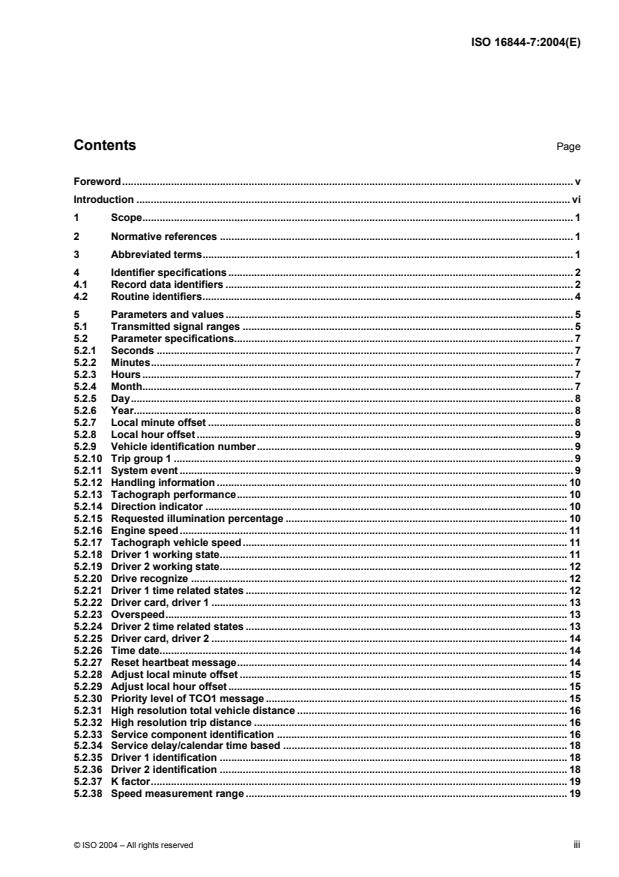
Contents Page
Foreword. v
Introduction . vi
1 Scope. 1
2 Normative references. 1
3 Abbreviated terms. 1
4 Identifier specifications. 2
4.1 Record data identifiers . 2
4.2 Routine identifiers. 4
5 Parameters and values. 5
5.1 Transmitted signal ranges. 5
5.2 Parameter specifications. 7
5.2.1 Seconds. 7
5.2.2 Minutes. 7
5.2.3 Hours. 7
5.2.4 Month. 7
5.2.5 Day. 8
5.2.6 Year. 8
5.2.7 Local minute offset . 8
5.2.8 Local hour offset . 9
5.2.9 Vehicle identification number. 9
5.2.10 Trip group 1 . 9
5.2.11 System event. 9
5.2.12 Handling information. 10
5.2.13 Tachograph performance. 10
5.2.14 Direction indicator. 10
5.2.15 Requested illumination percentage . 10
5.2.16 Engine speed. 11
5.2.17 Tachograph vehicle speed. 11
5.2.18 Driver 1 working state. 11
5.2.19 Driver 2 working state. 12
5.2.20 Drive recognize. 12
5.2.21 Driver 1 time related states . 12
5.2.22 Driver card, driver 1 . 13
5.2.23 Overspeed. 13
5.2.24 Driver 2 time related states . 13
5.2.25 Driver card, driver 2 . 14
5.2.26 Time date. 14
5.2.27 Reset heartbeat message. 14
5.2.28 Adjust local minute offset . 15
5.2.29 Adjust local hour offset. 15
5.2.30 Priority level of TCO1 message . 15
5.2.31 High resolution total vehicle distance . 16
5.2.32 High resolution trip distance . 16
5.2.33 Service component identification . 16
5.2.34 Service delay/calendar time based . 18
5.2.35 Driver 1 identification . 18
5.2.36 Driver 2 identification . 18
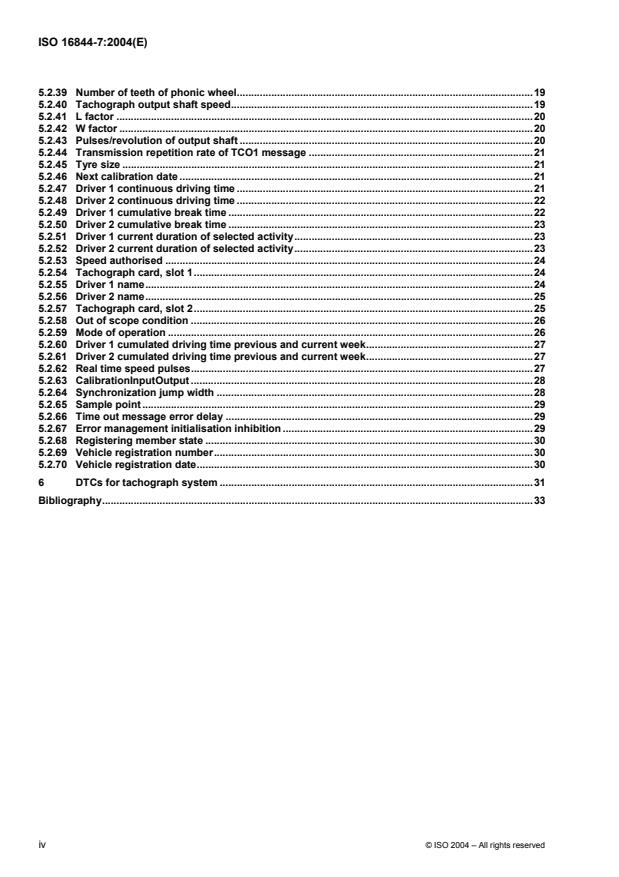
5.2.37 K factor. 19
5.2.38 Speed measurement range. 19
5.2.39 Number of teeth of phonic wheel.19
5.2.40 Tachograph output shaft speed.19
5.2.41 L factor.20
5.2.42 W factor.20
5.2.43 Pulses/revolution of output shaft .20
5.2.44 Transmission repetition rate of TCO1 message .21
5.2.45 Tyre size.21
5.2.46 Next calibration date .21
5.2.47 Driver 1 continuous driving time .21
5.2.48 Driver 2 continuous driving time .22
5.2.49 Driver 1 cumulative break time .22
5.2.50 Driver 2 cumulative break time .23
5.2.51 Driver 1 current duration of selected activity.23
5.2.52 Driver 2 current duration of selected activity.23
5.2.53 Speed authorised.24
5.2.54 Tachograph card, slot 1.24
5.2.55 Driver 1 name.24
5.2.56 Driver 2 name.25
5.2.57 Tachograph card, slot 2.25
5.2.58 Out of scope condition .26
5.2.59 Mode of operation .26
5.2.60 Driver 1 cumulated driving time previous and current week.27
5.2.61 Driver 2 cumulated driving time previous and current week.27
5.2.62 Real time speed pulses.27
5.2.63 CalibrationInputOutput.28
5.2.64 Synchronization jump width .28
5.2.65 Sample point.29
5.2.66 Time out message error delay .29
5.2.67 Error management initialisation inhibition .29
5.2.68 Registering member state .30
5.2.69 Vehicle registration number.30
5.2.70 Vehicle registration date.30
6 DTCs for tachograph system .31
Bibliography.33
iv © ISO 2004 – All rights reserved
Foreword
ISO (the International Organization for Standardization) is a worldwide federation of national standards bodies
(ISO member bodies). The work of preparing International Standards is normally carried out through ISO
technical committees. Each member body interested in a subject for which a technical committee has been
established has the right to be represented on that committee. International organizations, governmental and
non-governmental, in liaison with ISO, also take part in the work. ISO collaborates closely with the
International Electrotechnical Commission (IEC) on all matters of electrotechnical standardization.
International Standards are drafted in accordance with the rules given in the ISO/IEC Directives, Part 2.
The main task of technical committees is to prepare International Standards. Draft International Standards
adopted by the technical committees are circulated to the member bodies for voting. Publication as an
International Standard requires approval by at least 75 % of the member bodies casting a vote.
Attention is drawn to the possibility that some of the elements of this document may be the subject of patent
rights. ISO shall not be held responsible for identifying any or all such patent rights.
ISO 16844-7 was prepared by Technical Committee ISO/TC 22, Road vehicles, Subcommittee SC 3,
Electrical and electronic equipment.
ISO 16844 consists of the following parts, under the general title Road vehicles — Tachograph systems:
— Part 1: Electrical connectors
— Part 2: Recording unit, electrical interface
— Part 3: Motion sensor interface
— Part 4: CAN interface
— Part 5: Secured CAN interface
— Part 6: Diagnostics
— Part 7: Parameters
Introduction
ISO 16844 supports and facilitates the communication between electronic units and a tachograph; the
[1]
tachograph being based upon Council Regulations (EEC) No. 3820/85 and No. 3821/85 and their
amendments Council Regulation (EEC) No. 2135/98 and Commission Regulation (EC) No. 1360/2002 (see
Clause 2).
Its purpose is to ensure the compatibility of tachographs from various tachograph manufacturers.
The basis of the digital tachograph concept is a recording unit (RU) that stores data related to the activities of
the drivers of a vehicle on which it is installed. When the RU is in normal operational status, the data stored in
its memory are made accessible to various entities such as drivers, authorities, workshops and transport
companies in a variety of ways: they may be displayed on a screen, printed by a printing device or
downloaded to an external device. Access to stored data is controlled by a smart card inserted in the
tachograph.
In order to prevent manipulation of the tachograph system, the speed signal sender (motion sensor) is
provided with an encrypted data link.
A typical tachograph system is shown in Figure 1.
Key
1 positive supply 3 speed signal, real time
2 battery minus 4 data signal in/out
Figure 1 — Typical tachograph system
vi © ISO 2004 – All rights reserved
INTERNATIONAL STANDARD ISO 16844-7:2004(E)
Road vehicles — Tachograph systems —
Part 7:
Parameters
1 Scope
This part of ISO 16844 specifies the parameters used in the interchange of digital information between a road
vehicle's tachograph system and vehicle units or a diagnostic tester, or within the tachograph system itself.
The parameters are applicable for real time communication and/or diagnostic services.
2 Normative references
The following referenced documents are indispensable for the application of this document. For dated
references, only the edition cited applies. For undated references, the latest edition of the referenced
document (including any amendments) applies.
ISO/IEC 8859 (all parts), Information technology — 8-bit single-byte coded graphic character sets
ISO 14230-3, Road vehicles — Diagnostic systems — Keyword Protocol 2000 — Part 3: Application layer
ISO 16844-4, Road Vehicles — Tachograph systems — Part 4: CAN interface
ISO 16844-6, Road Vehicles — Tachograph systems — Part 6: Diagnostics
Council Regulation (EEC) No. 3821/85 of 20 December 1985 on recording equipment in road transport
Commission Regulation (EC) No. 1360/2002 of 13 June 2002 adapting for the seventh time to technical
progress Council Regulation (EEC) No. 3821/85 on recording equipment in road transport
Council Regulation (EEC) No. 2135/98 of 24 September 1998 amending Regulation (EEC) No. 3821/85 on
recording equipment in road transport and Directive 88/599/EEC concerning the application of Council
Regulations (EEC) No. 3820/85 and (EEC) No. 3821/85
Council Directive 92/23/EEC relating to tyres for motor vehicles and their trailers and to their fitting
3 Abbreviated terms
CAN controller area network
Cvt. convention
DTC diagnostic trouble code
ECU electronic control unit
KBD keyboard
M mandatory
N/A not applicable
R accessible in reading using diagnostic services
1)
RDI record data identifier
RMS registering member state
R/W accessible in reading and writing, using diagnostic services
SJW resynchronisation jump width
Tq time quantum
U user option
UTC universal time co-ordinated
VIN vehicle identification number
VRN vehicle registration number
“Tachograph regulation” used throughout this part of ISO 16844 refers to Council Regulation (EEC)
No. 1360/2002, Annex 1B.
4 Identifier specifications
4.1 Record data identifiers
The record data identifiers used in the diagnostic services specified in ISO 16844-6 shall be in accordance
with Table 1.
Table 1 — Record data identifiers
Hex Identifier description Cvt. Simplified R or R/W
mnemonic
F187 VehicleManufacturerSparePartNumber U VMSPN R/W
F188 VehicleManufacturerECUSoftwareNumber U VMECUSWN R/W
F189 VehicleManufacturerECUSoftwareVersionNumber U VMECUSWVN R/W
F18A SystemSupplierIdentifier M SSID R
M
F18B ECUManufacturingDate ECUMD R
F18C ECUSerialNumber M ECUSN R
F190 VehicleIdentificationNumber M VIN R/W
F191 VehicleManufacturerECUHardwareNumber M VMECUHWN R/W
M
F192 SystemSupplierECUHardwareNumber SSECUHWN R
F193 SystemSupplierECUHardwareVersionNumber M SSECUHWVN R
F194 SystemSupplierECUSoftwareNumber M SSECUSWN R
1) RecordDataIdentifier with 262144 values available and, for instance, used in ReadDataByIdentifier,
WriteDataByIdentifier InputOutputControlByIdentifier services.
2 © ISO 2004 – All rights reserved
Table 1 (continued)
Hex Identifier description Cvt. Simplified R or R/W
mnemonic
F195 SystemSupplierECUSoftwareVersionNumber M SSECUSWVN R
F196 ExhaustRegulationOrTypeApprovalNumber M EROTAN R
F197 SystemNameOrEngineType U SNOET R/W
F198 RepairShopCodeOrTesterSerialNumber U RSCOTSN R/W
F199 ProgrammingDate U PD R/W
F19A CalibrationRepairShopCodeOrCalibrationEquipementSerialNumber M CRSCOCESN R/W
F19B CalibrationDate M CD R/W
M
F19C CalibrationEquipmentSWNumber CESWN R/W
F19D ECUInstallationDate M EID R/W
F19E ODXFileIdentifier M OFID R/W
F900-F9FF Reserved for tachograph systems M — —
M
F902 TachographVehicleSpeed TVS R
F903 Driver1WorkingState M D1WS R
F904 Driver2WorkingState M D2WS R
F905 DriveRecognize M DR R
M
F906 Driver1TimeRelatedStates D1TRS R
F907 DriverCardDriver1 M DCD1 R
F908 OverSpeed M OS R
F909 Driver2TimeRelatedStates M D2TRS R
M
F90A DriverCardDriver2 DCD2 R
F90B TimeDate M TD R/W
F90C ResetHeartbeatMessage M RHM R/W
F90D AdjustLocalMinuteOffset M ALMO R/W
M
F90E AdjustLocalHourOffset ALHO R/W
F90F PriorityLevelOfTCO1Message M PLOTM R/W
F912 HighResolutionTotalVehicleDistance M HRTVD R/W
F913 HighResolutionTripDistance M HRTD R/W
M
F914 ServiceComponentIdentification SCI R
F915 ServiceDelayCalendarTimeBased M SDCTB R
F916 Driver1Identification M D1I R
F917 Driver2Identification M D2I R
M
F918 KFactor KF R/W
F919 SpeedMeasurementRange M SMR R
F91A NumberOfTeethOnPhonicWheel U NOTOPW R/W
F91B TachographOutputShaftSpeed M TOSS R
M
F91C LFactorTyreCircumference LFTC R/W
F91D WVehicleCharacteristicFactor M WVCF R/W
Table 1 (continued)
Hex Identifier description Cvt. Simplified R or R/W
mnemonic
F91E PulsesPerRevolutionOfOutputShaft M PPROOS R/W
F91F SecurityViolation M SV R
F920 TransmissionRepetitionRateOfTCO1Message M TRROTM R/W
M
F921 TyreSize TS R/W
F922 NextCalibrationDate M NCD R/W
F923 Driver1ContinuousDrivingTime M D1CDT R
F924 Driver2ContinuousDrivingTime M D2CDT R
M
F925 Driver1CumulativeBreakTime D1CBT R
F926 Driver2CumulativeBreakTime M D2CBT R
F927 Driver1Current DurationOfSelectedActivity M D1CDOSA R
F928 Driver2Current DurationOfSelectedActivity M D2CDOSA R
M
F92C SpeedAuthorised SA R/W
F930 TachographCardSlot1 M TCS1 R
F931 Driver1Name M D1N R
F932 Driver2Name M D2N R
M
F933 TachographCardSlot2 TCS2 R
F936 OutOfScopeCondition M OOSC R
F937 ModeOfOperation M MOO R
F938 Driver1CumulatedDrivingTimePreviousAndCurrentWeek M D1CDTPACW R
M
F939 Driver2CumulatedDrivingTimePreviousAndCurrentWeek D2CDTPACW R
F940 RealTimeSpeedPulses M RTSP R/W
F95A EngineSpeed U ES R/W
F960 CalibrationInputOutput M CIO R/W
M
F979 SynchronizationJumpWidth SJW R/W
F97A SamplePoint M SP R/W
F97B TimeOutMessageErrorDelay M TOMED R/W
F97C ErrorManagementInitialisationInhibition M EMII R/W
M
F97D RegisteringMemberState RMS R/W
F97E VehicleRegistrationNumber M VRN R/W
F97F VehicleRegistrationDate M VRD R/W
4.2 Routine identifiers
The routine identifiers used in the diagnostic services specified in ISO 16844-6 shall be in accordance with
Table 2.
4 © ISO 2004 – All rights reserved
Table 2 — Routine identifiers
Hex Routine identifier Cvt. Simplified mnemonic
M
014F MotionSensorVehicleUnitPairing MSVUP
M
0150 DisplayTest DT
0151 LCDNegativeModeTest M LNMT
0152 PrinterTest M PT
0153 HardwareTest M HT
M
0154 CarderReaderTest CRT
0155 Reserved by document U RBD
0156 ButtonTestLoop M BTL
5 Parameters and values
5.1 Transmitted signal ranges
For the ranges used to determine the validity of a transmitted signal, see Table 3.
For the ranges used to denote the state of a discrete parameter, see Table 4.
For the ranges used to denote the state of a control mode command, see Table 5.
The values of the error indicator range provide a means for a module to immediately indicate that valid
parameter data are currently not available due to error in the sensor, sub-system or module.
The values in the not available range provide a means for a module to transmit a message which contains a
parameter not available or not supported in the module. The values in the not requested range provide a
means for a device to transmit a command message and identify those parameters where no response is
expected from the receiving device.
If a component failure prevents the transmission of valid data of a parameter, the error indicator as specified in
Tables 3 and 4 shall be used instead of the parameter data. However, the error indicator shall not be used if
the measured or calculated data have yielded a value but exceed the specified parameter range. Instead, the
data shall be transmitted using the appropriate minimum or maximum parameter value.
When a specified parameter of this part of ISO 16844 is transmitted using diagnostic services, padding bits
shall be added to increase its length to the next integer number of bytes in the case where its length is not an
integer number of bytes. This padding shall be made by setting the relevant most significant bits to zero.
EXAMPLE Driver1WorkingStates, RDI F903 , 3 bit length: when this parameter value is 010, it is transmitted as
one byte of the value of 02 .
Table 3 — Transmitted signal ranges
Range name 1 byte 2 bytes 4 bytes ASCII
0 to 250 0 to 64 255 0 to 4 211 081 215 1 to 254
Valid signal
00 to FA 0000 to FAFF 00000000 to FAFFFFFF 01
16 16 16 16 16 16 16
to FE
251 64 256 to 64 511 4 211 081 216 to 4 227 858 431 none
Parameter specific indicator
FB FB00 to FBFF FBxxxxxx
16 16 16 16
252 to 253 64 512 to 65 023 4 227 858 432 to 4 261 412 863 none
Reserved range for future indicator
FC to FC00 to FDFF FC000000 to FDFFFFFF
16 16 16 16 16
bits
FD
254 65 024 to 65 279 4 261 412 864 to 4 278 190 079 0
Error indicator
FE FExx FExxxxxx 00
16 16 16
255 65 280 to 65 535 4 278 190 080 to 4 294 967 294 255
Not available or not requested
FF FFxx FFxxxxxx FF
16 16 16 16
Table 4 — Transmitted values of discrete parameters (measured)
Range name Transmitted value
Disabled (off, passive, etc.) 00
Enabled (on, active, etc.) 01
Error indicator 10
Not available or not installed 11
Table 5 — Transmitted values of control commands (status)
Range name Transmitted value
Command to disable function (turn off, etc.) 00
Command to enable function (turn on, etc.) 01
Reserved 10
Don't care/take no action (leave function as is) 11
The data type may be either status or measured.
Status specifies the present state of a multi-state parameter or function as a result of action taken by the
transmitting node. This action is the result of a calculation which uses local and/or network measured
and/or status information.
Measured data convey the current value of a parameter as measured or observed by the transmitting
node to determine the condition of the specified parameter.
6 © ISO 2004 – All rights reserved
5.2 Parameter specifications
5.2.1 Seconds
The UTC parameter part Seconds shall provide
data length 1 byte
resolution 0,25 s/bit gain, 0 s offset
operating range 0 to 59,75 s
type measured
The RDI is not used. The parameter part Seconds may be addressed through RDI attached to Time/Date.
5.2.2 Minutes
The UTC parameter part Minutes shall provide
data length: 1 byte
resolution: 1 min/bit gain, 0 min offset
operating range: 0 to 59 min
type: measured
The RDI is not used. The parameter part Minutes may be addressed through RDI attached to Time/Date.
5.2.3 Hours
The UTC parameter part Hours shall provide
data length: 1 byte
resolution: 1 h/bit gain, 0 h offset
operating range: 0 to 23 h
type: measured
The RDI is not used. The parameter part Hours may be addressed through RDI attached to Time/Date.
5.2.4 Month
The UTC parameter part Month shall provide
data length: 1 byte
resolution: 1 month/bit gain, 0 month offset
operating range: 1 to 12 months
type: measured
The RDI is not used. The parameter part Month may be addressed through RDI attached to Time/Date.
NOTE A value of 0 for the month is null. The value 1 identifies January; 2 identifies February; etc.
5.2.5 Day
The UTC parameter part Day shall provide
data length: 1 byte
resolution: 0,25 day/bit gain, 0 day offset
operating range: 0,25 to 31,75 days
type: measured
The RDI is not used. The parameter part Day may be addressed through RDI attached to Time/Date.
NOTE 1 A value of 0 for the date is null. The values 1, 2, 3, and 4 are used to identify the first day of the month, while 5,
6, 7, and 8 identify the second day of the month, etc.
NOTE 2 This parameter does not influence or change the hours parameter above.
5.2.6 Year
The UTC parameter part Year shall provide
data length: 1 byte
resolution: 1 year/bit gain, +1985 year offset
operating range: 1985 to 2235 year
type: measured
The RDI is not used. The parameter part Year may be addressed through RDI attached to Time/Date.
NOTE A value of 0 for the year identifies the year 1985; a value of 1 identifies 1986; etc.
5.2.7 Local minute offset
The parameter LocalMinuteOffset shall provide
data length: 1 byte
resolution: 1 min/bit gain, −125 min offset
operating range: −59 to +59 min;
type: measured
The RDI is not used. The parameter part Local Minute Offset may be addressed through RDI attached to
Time/Date.
NOTE 1 For the recording unit, it represents an offset from UTC set by the driver.
NOTE 2 European legislation restricts the full range of use in tachographs. Only three (3) fixed values, 0, +30 min and
–30 min, are used.
8 © ISO 2004 – All rights reserved
5.2.8 Local hour offset
The parameter LocalHourOffset shall provide
data length: 1 byte
resolution: 1 h/bit gain, −125 h offset
operating range: −23 to +23 h
type: measured
The RDI is not used. The parameter part Local Hour Offset may be addressed through RDI attached to
Time/Date.
NOTE For the recording unit, it represents an offset from UTC set by the driver.
5.2.9 Vehicle identification number
The parameter VehicleIdentificationNumber as assigned by the vehicle manufacturer shall provide
data length: variable — up to 200 characters
resolution: ASCII
operating range: ASCII
type: measured
RDI (hex): F190
access: R/W
In this application, the VIN-length shall be 17 characters.
NOTE The ASCII character “*” is reserved as a delimiter.
5.2.10 Trip group 1
The parameter TripGroup1 is a command signal used only to reset trip distance.
00 take no action
01 reset
Type: status
5.2.11 System event
The parameter SystemEvent indicates an occurred tachograph event. This parameter shall be set true when a
tachograph event (over-speed, continuous driving time exceeded, maintenance due, etc.) has occurred.
This parameter shall be used to drive a tachograph visual warning signal to the driver, as follows.
00 no tachograph event
01 tachograph event
Type: status
RDI is not used.
5.2.12 Handling information
The parameter HandlingInformation shall indicate that handling information is present, as follows. Information
may include “no printer paper”, “no driver card”, etc.
00 no handling information
01 handling information
Type: status
RDI is not used.
5.2.13 Tachograph performance
The parameter TachographPerformance shall be set while the tachograph is performing the auto test and
indicate as follows.
00 normal performance
01 performance analysis
Type: status
RDI is not used.
5.2.14 Direction indicator
The parameter DirectionIndicator shall indicate the direction of the vehicle motion (if any), as follows.
00 forward
01 reverse
Type: measured
RDI is not used.
5.2.15 Requested illumination percentage
The parameter RequestIlluminationPercentage which shall provide
data length: 1 byte
resolution: 0,4 % bit gain, 0 % offset
data range: 0 to 100 %
type: measured
RDI is not used.
10 © ISO 2004 – All rights reserved
5.2.16 Engine speed
The parameter EngineSpeed shall provide the actual engine speed which is calculated over a minimum
crankshaft angle of 720 degrees divided by the number of cylinders, and shall provide
data length: 2 bytes
resolution: 0,125 r/min per bit gain, 0 r/min offset (upper byte resolution = 32 r/min per bit)
data range: 0 to 8031,875 r/min
type: measured
RDI (hex): F95A
access: R/W
5.2.17 Tachograph vehicle speed
The parameter TachographVehicleSpeed shall be the current speed of the vehicle measured by the
tachograph and shall provide
data length: 2 bytes
resolution: 1/256 km/h/bit gain, 0 km/h offset
upper byte resolution = 1,0 km/h/bit;
operating range: 0 to 250,996 km/h
type: measured
RDI (hex): F902
access: R
5.2.18 Driver 1 working state
The parameter Driver1WorkingState shall indicate the state of work of driver 1, i.e. activity currently selected
on the recording unit for the driver, as follows.
000 break/rest
001 availability
010 work
011 driving
100-101 reserved
Type: measured
RDI (hex): F903
Access: R
5.2.19 Driver 2 working state
The parameter Driver2WorkingState shall indicate the state of work of driver 2, i.e. activity currently selected
on the recording unit for the co-driver, as follows.
000 break/rest
001 availability
010 work
011-101 reserved
Type: measured
RDI (hex): F904
Access: R
5.2.20 Drive recognize
The parameter DriverRecognize indicates whether or not motion of the vehicle is detected. Vehicle motion
shall be indicated when more than one (1) pulse per second (imp/s) is detected by the recording unit from the
motion sensor for at least five (5) seconds, as follows.
00 vehicle motion not detected
01 vehicle motion detected
Type: measured
RDI (hex): F905
Access: R
5.2.21 Driver 1 time related states
The parameter Driver1TimeRelatedStates shall be used to indicate if driver 1 approaches/exceeds working
time limits, (or other limits), as follows. Only the values 0001 and 0010 are required (mandatory). Limit #3 to
limit #6 are optional warnings according to the tachograph regulation. If they are implemented, the format is as
given here.
0000 no time-related warning detected
0001 limit #1: 15 min before 4 1/2 h
0010 limit #2: 4 1/2 h reached (continuous driving time exceeded)
0011 limit #3: 15 minutes before optional warning 1
0100 limit #4: optional warning 1 reached
0101 limit #5: 15 min before optional warning 2
0110 limit #6: optional warning 2 reached
0111–1100 reserved
1101 other
Type: measured
12 © ISO 2004 – All rights reserved
RDI (hex): F906
Access: R
5.2.22 Driver card, driver 1
The parameter DriverCardDriver 1 shall be used to indicate the presence of the driver card of driver 1, i.e. that
the card is placed in the driver slot of the recording unit, as follows. If another card is inserted (workshop,
control or company card), the parameter driver card, driver 1, is equal to 00 (driver card not present).
00 driver card not present
01 driver card present
Type: measured
RDI (hex): F907
Access: R
5.2.23 Overspeed
The parameter Overspeed shall be used to indicate that the current vehicle speed has exceeded the
authorised speed of the vehicle during a period of more than 60 s, as follows.
00 no overspeed
01 overspeed
Type: measured
RDI (hex): F908
Access: R
5.2.24 Driver 2 time related states
The parameter Driver2TimeRelatedStates shall be used to indicate that driver 2 (co-driver)
approaches/exceeds working time limits, or other limits, as follows.
0000 no time related warning detected
0001 reserved
0010 reserved
0011 limit #3: 15 min before optional warning 1
0100 limit #4: optional warning 1 reached
0101 limit #5: 15 min before optional warning 2
0110 limit #6: optional warning 2 reached
0111–1100 reserved
1101 other
Type measured
RDI (hex): F909
Access: R
5.2.25 Driver card, driver 2
The parameter DriverCardDriver2 shall be used to indicate the presence of the driver card of driver 2, i.e. that
the card is placed in co-driver slot of the recording unit, as follows. If another card is inserted (workshop,
control or company card), the parameter driver card, driver 2, is equal to 00 (driver card not present).
00 driver card not present
01 driver card present
Type: measured
RDI (hex): F90A
Access: R
5.2.26 Time date
The parameter group TimeDate shall be transmitted from the recording unit, i.e. all parameters shall be
supported, as follows.
Byte: 1: seconds (see 5.2.1)
2: minutes (see 5.2.2)
3: hours (see 5.2.3)
4: months (see 5.2.4)
5: days (see 5.2.5)
6: years (see 5.2.6)
7: local minute offset (5.2.7)
8: local hour offset (see 5.2.8)
RDI (hex): F90B
Access: R/W
5.2.27 Reset heartbeat message
The parameter ResetHeartbeatMessage shall be used to indicate if the reset heartbeat message is used, as
follows.
00 disabled (the reset heartbeat message is not used by the recording unit)
01 enabled (the reset heartbeat message is used by the recording unit)
Type: status
RDI (hex) F90C
Access R/W
14 © ISO 2004 – All rights reserved
5.2.28 Adjust local minute offset
The parameter AdjustLocalMinuteOffset shall be used to set the local offset in minutes from UTC, which
influences the local minute offset only, and shall provide
data length: 1 byte
resolution: 1 min/bit gain, −125 min offset
operating range: −59 to +59 min
type: measured
RDI (hex): F90D
access: R/W
NOTE European legislation restricts the full range of use in tachographs. Only three (3) fixed values, 0, +30 min and
–30 min, are used.
5.2.29 Adjust local hour offset
The parameter AdjustLocalHourOffset shall be used to set the local offset in hours from UTC which influences
local hour offset only, and shall provide
data length: 1 byte
resolution: 1 h/bit gain, −125 h offset
operating range: −23 to +23 h
type: measured
RDI (hex): F90E
access: R/W
5.2.30 Priority level of TCO1 message
The parameter PriorityLevelOfTCO1Message shall be specified by end of line programming, and shall provide
data length: 3 bits
000 highest priority
001 priority 1
010 priority 2
011 priority 3, default value
100 priority 4
101 priority 5
110 priority 6
111 lowest
type: status
RDI (hex): F90F
access: R/W
5.2.31 High resolution total vehicle distance
The parameter HighResolutionTotalVehicleDistance shall indicate accumulated distance travelled by the
vehicle during its operation, and shall provide
data length: 4 bytes
resolution: 5 m/bit gain, 0 m offset
operating range: 0 to +21 055 406 km
type: measured
RDI (hex): F912
access: R/W
5.2.32 High resolution trip distance
The parameter HighResolutionTripDistance shall indicate travelled distance during all or part of a journey, and
shall provide
data length: 4 bytes
resolution: 5 m/bit gain, 0 m offset
operating range: 0 to +21 055 406 km
type: measured
RDI (hex): F913
access: R/W
5.2.33 Service component identification
The parameter ServiceComponentIdentification shall identify the component having the nearest time until the
next service inspection (see Table 6), and shall provide
service inspection: periodic inspection for the recording unit; card expiry date for the driver cards
data length: 1 byte
resolution: 1 component ID/bit
operating range: 0 to 250
type: measured
RDI (hex): F914
access: R
16 © ISO 2004 – All rights reserved
Table 6 — Service component identification
Identification Component
0 Service check for entire vehicle
1 Brake lining; left front axle
2 Brake lining; right front axle
3 Brake lining; left rear axle
4 Brake lining; right rear axle
5 Clutch lining
6–15 Not defined
16 Regulated general check for entire vehicle
17 Brake system special check
18 In-between check
19 Check trip recorder
20 Check exhaust gas
21 Check vehicle speed limiter
22–31 Not defined
32 Engine oil — engine No. 1
33 Engine oil — engine No. 2
34 Not defined
35 Steering oil
36 Not defined
37 Transmission oil — transmission No. 1
38 Transmission oil — transmission No. 2
39 Not defined
40 Intermediate transmission oil
41 Not defined
42 Front axle oil
43 Rear axle oil
44-47 Not defined
48 Tires
49 Engine air filter
50 Engine oil filter
51–60 Not defined
61 Tachograph
62 Driver card 1
63 Driver card 2
64–239 Not defined
240–249 Manufacturer specific
250–251 Reserved
252 Reset all components
253 No action to be taken
254 Error
255 Component identification not available
5.2.34 Service delay/calendar time based
The parameter ServiceDelay/CalendarTimeBased shall be the time in weeks until the next vehicle service
inspection is required. A negative value shall be transmitted if the service inspection has been passed. The
component that requires service shall be identified by the service component identification.
This time is computed as the difference between the week when service inspection is required and the current
week. For the purpose of this computation, week means the period between 00:00 hours UTC on Monday and
24:00 UTC on Sunday. This parameter shall provide
data length: 1 byte
resolution: 1 week/bit gain, −125 weeks offset
operating range: −125 to +125 weeks
type: measured
RDI (hex): F915
access: R
5.2.35 Driver 1 identification
The parameter Driver1Identification shall be used to obtain the driver 1 identity from a driver card inserted in
the recording unit, and shall contain three (3) bytes for the issuing member state of the driver card, and
sixteen (16) bytes for the card number (see the tachograph regulation, Appendix 1: Nation Alpha and Card
Number format), and shall provide
data length: 19 bytes ASCII
type: measured
byte: 1–3 issuing member state
4–19 card number
RDI (hex): F916
access: R
5.2.36 Driver 2 identification
The parameter Driver2Identification shall be used to obtain the driver 2 identity from a driver card inserted in
the recording unit, and shall contain three (3) bytes for the issuing member state of the driver card, and
sixt
...
Questions, Comments and Discussion
Ask us and Technical Secretary will try to provide an answer. You can facilitate discussion about the standard in here.
Loading comments...