

ISO 23945-2:2026
(Main)Test methods for sprayed concrete — Part 2: Sampling fresh and hardened concrete
- Abstract
This document specifies a method for obtaining samples of fresh or hardened sprayed concrete or mortar in laboratory or in situ, depending on the property to be measured and its associated test method. This document does not purport to address all of the safety concerns, if any, associated with its use.
- Status
- Published
- Publication Date
- 26-Oct-2026
- Technical Committee
- ISO/TC 71/SC 1 - Test methods for concrete
- Drafting Committee
- ISO/TC 71/SC 1 - Test methods for concrete
- Current Stage
- 6060 - International Standard published
- Start Date
- 27-Oct-2026
- Completion Date
- 27-Oct-2026

ISO 23945-2:2026 is an International Standard published by ISO for sampling fresh and hardened sprayed concrete. It specifies how to obtain samples of sprayed concrete or mortar in the laboratory or in situ, depending on the property being measured and the associated test method.
What does ISO 23945-2:2026 specify?
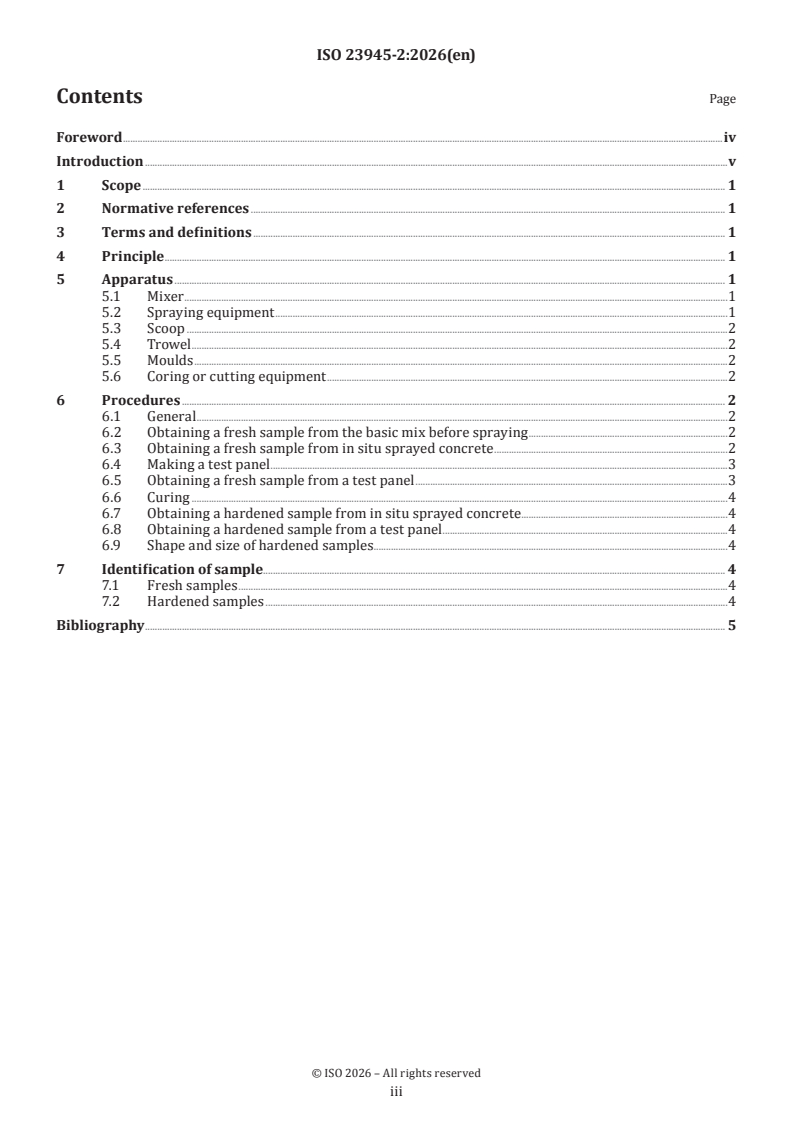
ISO 23945-2:2026 covers the method for taking samples of fresh or hardened sprayed concrete or mortar from either an in situ element or a test panel. The document is organized into clauses on scope, normative references, terms and definitions, principle, apparatus, procedures, and identification of sample, followed by a bibliography.
In practice, the standard is about getting a sample that matches the test purpose. That matters because sprayed concrete taken from the mixer, from the structure, or from a panel can behave differently after spraying and curing.
What are the key requirements of ISO 23945-2:2026?
ISO 23945-2:2026 focuses on controlling where the sample comes from, how it is taken, and how it is identified so that the test result can be linked back to the work.
Clause 4, Principle - A fresh or hardened sample is extracted from an in situ element or from a test panel. For the reader, this means the sampling location has to match the property under test.
Clause 5.1 to 5.2, Apparatus - The mixer shall conform to ISO 18650-1, and the spraying equipment shall spray stably and continuously. If an accelerator is used, the dosage device shall keep the accelerator content within the specified range. In practice, the equipment must not introduce variability into the sample.
Clause 5.5 to 5.6, Moulds and cutting equipment - Moulds shall be rigid, non-water-absorbing, and large enough for the intended sampling method; the panel thickness and dimensions depend on hand spraying, robot spraying, and the test to be carried out. Coring or cutting equipment shall be suitable for the required sample dimensions. This matters because the panel has to survive spraying and still yield usable specimens.
Clause 6.2 to 6.5, Fresh sampling and test panels - Fresh concrete may be taken from the basic mix before spraying, from in situ sprayed material before initial set, or from a test panel before initial set. The test panel is sprayed under conditions that match the actual work as closely as possible, including angle, distance, layer thickness, and equipment settings. This helps the sample represent the sprayed material rather than a different process condition.
Clause 6.6 to 6.8, Curing and hardened sampling - Panels are protected against moisture loss, then cured at 20 °C ± 5 °C and at least 95 % relative humidity; hardened samples from panels are cored or sawn, and hardened in situ samples are obtained in accordance with ISO 1920-6. For testing, the curing history has to be controlled because it affects strength and other measured properties.
Clause 6.9 and Clause 7, Size and identification - The shape and size of hardened samples shall meet the requirements of the relevant test method standard, and both fresh and hardened samples are marked with mix, location, specimen orientation, date, and operator. In practice, this gives traceability from the test result back to the sprayed concrete work.
Who uses ISO 23945-2:2026?
ISO 23945-2:2026 is used by people who sample sprayed concrete for quality control, testing, and assessment of sprayed work. The introduction points to use in tunnelling and mining ground support, as well as repairs, restoration, new construction, and other sprayed concrete applications.
Typical users include testing laboratories, site engineers, quality managers, and contractors who need repeatable sampling from fresh material, test panels, or hardened in situ concrete. The document is especially relevant when the test result depends on how and where the sample is taken.
Which standards are used with ISO 23945-2:2026?
ISO 23945-2:2026 cites two normative references:
- ISO 1920-6 - used for sampling, preparing, and testing concrete cores, and referenced for hardened samples taken from in situ sprayed concrete.
- ISO 18650-1 - used for concrete mixer requirements, which supports the sampling of the basic mix before spraying.
The foreword also says ISO 23945-2:2026 is intended for use with other parts of the ISO 23945 series, which provide requirements tied to the specified quality level and the execution method for sprayed concrete.
What does the ISO 23945-2:2026 document contain?
ISO 23945-2:2026 contains the procedure for fresh and hardened sampling, with separate routes for basic mix sampling, in situ sampling, test panels, and panel curing. It also includes the apparatus needed for sampling and for making panels, such as mixers, spraying equipment, scoops, trowels, moulds, and coring or cutting equipment.
The document includes Figure 1 for the spraying method and Figure 2 for the defective zone in a test panel. Those figures support practical work on panel preparation and on avoiding material that should not be used for test specimens.
It also sets out how to identify samples with waterproof marking and what information to record for traceability. That makes the document useful for laboratory preparation, site sampling, and reporting of sprayed concrete test specimens.
Get Certified
Connect with accredited certification bodies for this standard

DIBt (Deutsches Institut für Bautechnik)
German Institute for Building Technology.

DIN CERTCO
DIN Group product certification.

Aboma Certification B.V.
Specialized in construction, metal, and transport sectors.
Sponsored listings
Frequently Asked Questions
ISO 23945-2:2026 is a standard published by the International Organization for Standardization (ISO). Its full title is "Test methods for sprayed concrete — Part 2: Sampling fresh and hardened concrete". This standard covers: This document specifies a method for obtaining samples of fresh or hardened sprayed concrete or mortar in laboratory or in situ, depending on the property to be measured and its associated test method. This document does not purport to address all of the safety concerns, if any, associated with its use.
This document specifies a method for obtaining samples of fresh or hardened sprayed concrete or mortar in laboratory or in situ, depending on the property to be measured and its associated test method. This document does not purport to address all of the safety concerns, if any, associated with its use.
ISO 23945-2:2026 is classified under the following ICS (International Classification for Standards) categories: 91.100.30 - Concrete and concrete products. The ICS classification helps identify the subject area and facilitates finding related standards.
ISO 23945-2:2026 is available in PDF format for immediate download after purchase. The document can be added to your cart and obtained through the secure checkout process. Digital delivery ensures instant access to the complete standard document.
Standards Content (Sample)
International
Standard
ISO 23945-2
First edition
Test methods for sprayed
2026-10
concrete —
Part 2:
Sampling fresh and hardened
concrete
Reference number
© ISO 2026
All rights reserved.
This ISO publication is protected by copyright and is owned by ISO and/or its licensors.
The content of this ISO publication is provided under licence, not sold. Use is subject to the applicable licence terms issued by ISO,
an ISO member body, or an authorized third-party distributor.
Except as required for implementation or expressly permitted by a separate licence, no part of this ISO publication may be
reproduced, distributed, modified, used, or made available in any form or by any means – electronic or mechanical, including
photocopying, scanning, recording, or posting on internal or external digital platforms.
Any use beyond the scope of the granted rights is prohibited and may result in legal action.
ISO copyright office
CP 401 • CH-1214 Vernier, Geneva
Phone: +41 22 749 01 11
Email: copyright@iso.org
Website: www.iso.org
Published in Switzerland
ii
Contents Page
Foreword .iv
Introduction .v
1 Scope . 1
2 Normative references . 1
3 Terms and definitions . 1
4 Principle . 1
5 Apparatus . 1
5.1 Mixer .1
5.2 Spraying equipment .1
5.3 Scoop .2
5.4 Trowel .2
5.5 Moulds .2
5.6 Coring or cutting equipment .2
6 Procedures . 2
6.1 General .2
6.2 Obtaining a fresh sample from the basic mix before spraying .2
6.3 Obtaining a fresh sample from in situ sprayed concrete .2
6.4 Making a test panel .3
6.5 Obtaining a fresh sample from a test panel .3
6.6 Curing .4
6.7 Obtaining a hardened sample from in situ sprayed concrete.4
6.8 Obtaining a hardened sample from a test panel .4
6.9 Shape and size of hardened samples . .4
7 Identification of sample. 4
7.1 Fresh samples .4
7.2 Hardened samples .4
Bibliography . 5
iii
Foreword
ISO (the International Organization for Standardization) is a worldwide federation of national standards
bodies (ISO member bodies). The work of preparing International Standards is normally carried out through
ISO technical committees. Each member body interested in a subject for which a technical committee
has been established has the right to be represented on that committee. International organizations,
governmental and non-governmental, in liaison with ISO, also take part in the work. ISO collaborates closely
with the International Electrotechnical Commission (IEC) on all matters of electrotechnical standardization.
The procedures used to develop this document and those intended for its further maintenance are described
in the ISO/IEC Directives, Part 1. In particular, the different approval criteria needed for the different types
of ISO documents should be noted. This document was drafted in accordance with the editorial rules of the
ISO/IEC Directives, Part 2 (see www.iso.org/directives).
ISO draws attention to the possibility that the implementation of this document may involve the use of (a)
patent(s). ISO takes no position concerning the evidence, validity or applicability of any claimed patent
rights in respect thereof. As of the date of publication of this document, ISO had not received notice of (a)
patent(s) which may be required to implement this document. However, implementers are cautioned that
this may not represent the latest information, which may be obtained from the patent database available at
www.iso.org/patents. ISO shall not be held responsible for identifying any or all such patent rights.
Any trade name used in this document is information given for the convenience of users and does not
constitute an endorsement.
For an explanation of the voluntary nature of standards, the meaning of ISO specific terms and expressions
related to conformity assessment, as well as information about ISO's adherence to the World Trade
Organization (WTO) principles in the Technical Barriers to Trade (TBT), see www.iso.org/iso/foreword.html.
This document was prepared by Technical Committee ISO/TC 71, Concrete, reinforced concrete and pre-
stressed concrete, Subcommittee SC1, Test methods for concrete.
A list of all parts in the ISO 23945 series can be found on the ISO website.
Any feedback or questions on this document should be directed to the user’s national standards body. A
complete listing of these bodies can be found at www.iso.org/members.html.
iv
Introduction
Sprayed concrete is widely used for the stabilization of structures in a very short time and for concrete
applications without using moulds. In addition to being ideal for ground support in tunnelling and mining,
sprayed concrete is also used in repairs, restoration, new constructions and many other fields.
The requirements for properties, test methods, standards and specifications for the spray forming process
of concrete are different from those of cast forming concrete. This document is intended to provide a
normative test method for sprayed concrete.
This document is applied under various climati
...