

ISO 23945-2
(Main)Test methods for sprayed concrete — Part 2: Sampling fresh and hardened concrete
- Abstract
This document specifies a method for obtaining samples of fresh or hardened sprayed concrete or mortar from the basic mix and in-situ, for preparing test panels and for testing specimens sawed or cored from the panels depending on the property to be measured and its associated test method.
- Status
- Not Published
- Technical Committee
- ISO/TC 71/SC 1 - Test methods for concrete
- Drafting Committee
- ISO/TC 71/SC 1 - Test methods for concrete
- Current Stage
- 6000 - International Standard under publication
- Start Date
- 10-Sep-2026
- Completion Date
- 10-Oct-2026
Buy Documents

ISO/PRF 23945-2 - Test methods for sprayed concrete — Part 2: Sampling fresh and hardened concrete
REDLINE ISO/PRF 23945-2 - Test methods for sprayed concrete — Part 2: Sampling fresh and hardened concrete
ISO 23945-2 is an International Standard from ISO for sampling fresh or hardened sprayed concrete or mortar. It specifies how to obtain samples from the basic mix or from in-situ material, how to prepare test panels, and how to take specimens sawed or cored from those panels for the related property test. It is aimed at people who need representative samples for quality control and test preparation in sprayed concrete work.
What does ISO 23945-2 specify?
ISO 23945-2 specifies a sampling method for sprayed concrete or mortar in laboratory conditions or in-situ. The document supports the choice of the right sample type and location for the property to be measured, so the sample matches the associated test method.
The standard is organized into clauses 1 to 7:
- Scope
- Normative references
- Terms and definitions
- Principle
- Apparatus
- Procedures
- Identification of sample
A bibliography is also included.
What are the key requirements of ISO 23945-2?
Sampling has to match the test purpose
ISO 23945-2 says the sample may come from the basic mix before spraying, from in-situ sprayed material, or from a test panel. In practice, this means the person taking the sample has to choose the location and sample form that best fits the property being checked, because sprayed material can vary with where and how it was applied.
The apparatus has specific requirements
ISO 23945-2 requires a mixer that conforms to ISO 18650-1, spraying equipment that can spray stably and continuously, and a dosage device that keeps accelerator content within the required range when an accelerator is used. Scoops and trowels have to be non-absorbent and resistant to cement paste. Moulds have to be rigid, non-water-absorbing, and large enough for the spraying method and the intended specimens; the document gives minimum panel sizes for hand spraying and robot spraying, plus minimum thickness values for ordinary and impermeability testing.
Fresh samples are taken in controlled ways
ISO 23945-2 says a fresh sample from the basic mix is taken from a stationary or truck mixer in several increments and combined into a homogeneous sample. A fresh sample from in-situ sprayed concrete is cut with a trowel before initial set. Fresh samples from a test panel are also taken before initial set and must not include the defective zone. In practice, this is about getting material that still represents the sprayed concrete accurately and has not been altered by setting or rebound.
Test panels have to reproduce the real spraying conditions
ISO 23945-2 requires the moulds for a test panel to be positioned close to vertical, unless another orientation is specified, and sprayed with the same equipment, technique, layer thickness per pass, and spraying distance as the work being represented. The nozzle angle, spraying distance, air pressure, and layer sequence are controlled, and the first mix is used as a dummy. The panel then has to be protected against moisture loss and left in place for a defined period. For the reader, this means the panel is not just a sample holder - it is intended to mimic the actual sprayed application.
Curing and hardened sampling are defined separately
ISO 23945-2 requires initial panel curing in the mould under cover or in a moist room for 24 h, then curing at 20 °C ± 5 °C and at least 95 % relative humidity for at least 7 days. Hardened samples from in-situ sprayed concrete are taken according to ISO 1920-6. Hardened samples from a test panel are cored or sawn, kept under controlled moisture and temperature, and taken to the test age no more than 2 h before testing.
Identification is part of the method
ISO 23945-2 requires fresh and hardened samples, and the test panel itself where relevant, to be marked with waterproof ink or paint for mix, location, specimen orientation, date, and operator. This matters because sprayed concrete testing often depends on where the sample came from and how it was oriented.
Who uses ISO 23945-2?
ISO 23945-2 is used by laboratories, contractors, quality managers, inspectors, and project engineers who sample sprayed concrete for testing. It is relevant in tunnelling and mining ground support, as well as repairs, restoration, new construction, and other sprayed concrete applications. The standard helps the people responsible for quality control decide where to sample, how to prepare panels, and how to identify specimens for later testing.
Which standards are used with ISO 23945-2?
| Standard | Contribution |
|---|---|
| ISO 18650-1 | Sets the requirements for the concrete mixer used when preparing the basic mix before spraying. |
| ISO 1920-6 | Provides the method for sampling, preparing, and testing concrete cores when hardened samples are taken from in-situ sprayed concrete. |
ISO 23945-2 is also intended for use with other parts of the ISO 23945 series, which set requirements linked to the quality level and execution of sprayed concrete.
What does the ISO 23945-2 document contain?
ISO 23945-2 contains the apparatus requirements, including mixer, spraying equipment, scoop, trowel, moulds, and coring or cutting equipment. It gives step-by-step procedures for fresh sampling, test panel preparation, curing, hardened sampling, and sample identification.
The document also includes Figure 1 for the spraying arrangement and Figure 2 for the defective zone to avoid when sampling from a panel. These figures support day-to-day test preparation and help users take specimens from the correct location.
Buy Documents
ISO/PRF 23945-2 - Test methods for sprayed concrete — Part 2: Sampling fresh and hardened concrete
REDLINE ISO/PRF 23945-2 - Test methods for sprayed concrete — Part 2: Sampling fresh and hardened concrete
Get Certified
Connect with accredited certification bodies for this standard

DIBt (Deutsches Institut für Bautechnik)
German Institute for Building Technology.
DIN CERTCO
DIN Group product certification.

Aboma Certification B.V.
Specialized in construction, metal, and transport sectors.
Sponsored listings
Frequently Asked Questions
ISO 23945-2 is a draft published by the International Organization for Standardization (ISO). Its full title is "Test methods for sprayed concrete — Part 2: Sampling fresh and hardened concrete". This standard covers: This document specifies a method for obtaining samples of fresh or hardened sprayed concrete or mortar from the basic mix and in-situ, for preparing test panels and for testing specimens sawed or cored from the panels depending on the property to be measured and its associated test method.
This document specifies a method for obtaining samples of fresh or hardened sprayed concrete or mortar from the basic mix and in-situ, for preparing test panels and for testing specimens sawed or cored from the panels depending on the property to be measured and its associated test method.
ISO 23945-2 is classified under the following ICS (International Classification for Standards) categories: 91.100.30 - Concrete and concrete products. The ICS classification helps identify the subject area and facilitates finding related standards.
ISO 23945-2 is available in PDF format for immediate download after purchase. The document can be added to your cart and obtained through the secure checkout process. Digital delivery ensures instant access to the complete standard document.
Standards Content (Sample)
International
Standard
First edition
Test methods for sprayed
concrete —
Part 2:
Sampling fresh and hardened
concrete
PROOF/ÉPREUVE
Reference number
© ISO 2026
All rights reserved. Unless otherwise specified, or required in the context of its implementation, no part of this publication may
be reproduced or utilized otherwise in any form or by any means, electronic or mechanical, including photocopying, or posting on
the internet or an intranet, without prior written permission. Permission can be requested from either ISO at the address below
or ISO’s member body in the country of the requester.
ISO copyright office
CP 401 • Ch. de Blandonnet 8
CH-1214 Vernier, Geneva
Phone: +41 22 749 01 11
Email: copyright@iso.org
Website: www.iso.org
Published in Switzerland
PROOF/ÉPREUVE
ii
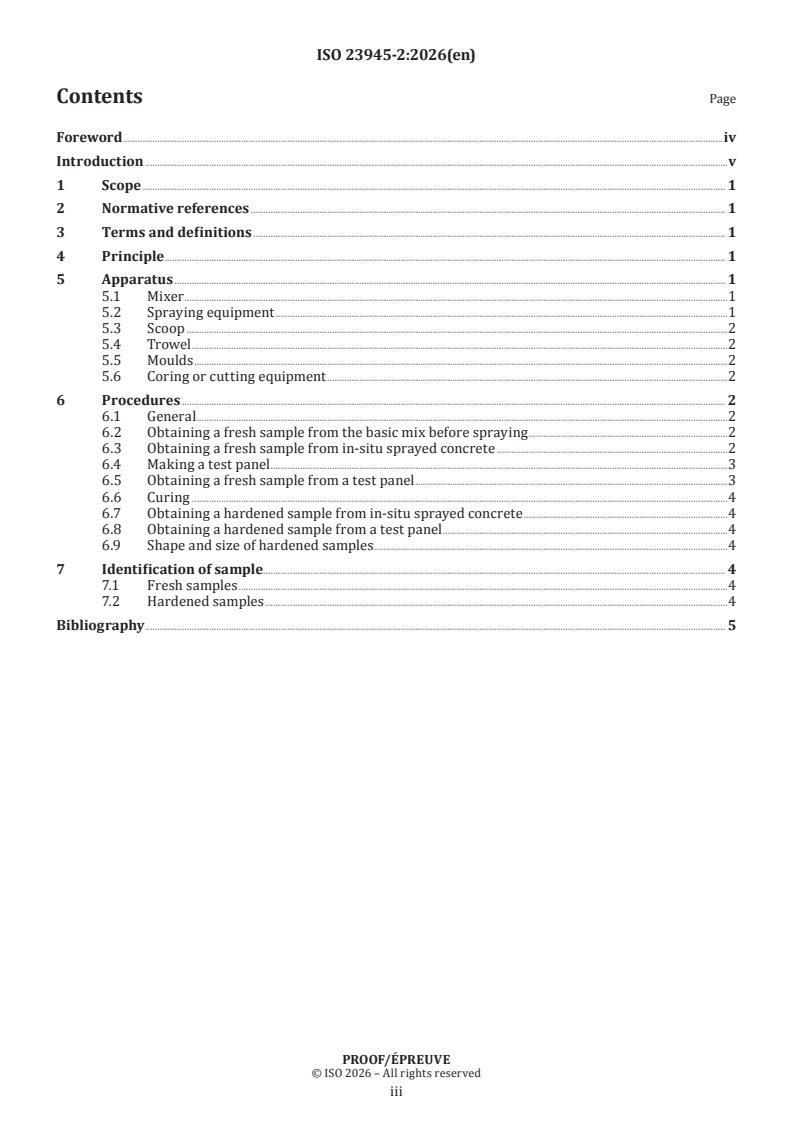
Contents Page
Foreword .iv
Introduction .v
1 Scope . 1
2 Normative references . 1
3 Terms and definitions . 1
4 Principle . 1
5 Apparatus . 1
5.1 Mixer .1
5.2 Spraying equipment .1
5.3 Scoop .2
5.4 Trowel .2
5.5 Moulds .2
5.6 Coring or cutting equipment .2
6 Procedures . 2
6.1 General .2
6.2 Obtaining a fresh sample from the basic mix before spraying .2
6.3 Obtaining a fresh sample from in-situ sprayed concrete .2
6.4 Making a test panel .3
6.5 Obtaining a fresh sample from a test panel .3
6.6 Curing .4
6.7 Obtaining a hardened sample from in-situ sprayed concrete .4
6.8 Obtaining a hardened sample from a test panel .4
6.9 Shape and size of hardened samples . .4
7 Identification of sample. 4
7.1 Fresh samples .4
7.2 Hardened samples .4
Bibliography . 5
PROOF/ÉPREUVE
iii
Foreword
ISO (the International Organization for Standardization) is a worldwide federation of national standards
bodies (ISO member bodies). The work of preparing International Standards is normally carried out through
ISO technical committees. Each member body interested in a subject for which a technical committee
has been established has the right to be represented on that committee. International organizations,
governmental and non-governmental, in liaison with ISO, also take part in the work. ISO collaborates closely
with the International Electrotechnical Commission (IEC) on all matters of electrotechnical standardization.
The procedures used to develop this document and those intended for its further maintenance are described
in the ISO/IEC Directives, Part 1. In particular, the different approval criteria needed for the different types
of ISO documents should be noted. This document was drafted in accordance with the editorial rules of the
ISO/IEC Directives, Part 2 (see www.iso.org/directives).
ISO draws attention to the possibility that the implementation of this document may involve the use of (a)
patent(s). ISO takes no position concerning the evidence, validity or applicability of any claimed patent
rights in respect thereof. As of the date of publication of this document, ISO had not received notice of (a)
patent(s) which may be required to implement this document. However, implementers are cautioned that
this may not represent the latest information, which may be obtained from the patent database available at
www.iso.org/patents. ISO shall not be held responsible for identifying any or all such patent rights.
Any trade name used in this document is information given for the convenience of users and does not
constitute an endorsement.
For an explanation of the voluntary nature of standards, the meaning of ISO specific terms and expressions
related to conformity assessment, as well as information about ISO's adherence to the World Trade
Organization (WTO) principles in the Technical Barriers to Trade (TBT), see www.iso.org/iso/foreword.html.
This document was prepared by Technical Committee ISO/TC 71, Concrete, reinforced concrete and pre-
stressed concrete, Subcommittee SC1, Test methods for concrete.
A list of all parts in the ISO 23945 series can be found on the ISO website.
Any feedback or questions on this document should be directed to the user’s national standards body. A
complete listing of these bodies can be found at www.iso.org/members.html.
PROOF/ÉPREUVE
iv
Introduction
Sprayed concrete is widely used for the stabilization of structures in a very short time and for concrete
applications without using moulds. In addition to being ideal for ground support in tunnelling and mining,
sprayed concrete is also used in repairs, restoration, new constructions and many other fields.
The requirements for properties, test methods, standards and specifications for the spray forming process
of concrete are different from those of cast forming concrete. This document is intended to provide a
normative test method for sprayed concrete.
This document is applied under various climatic and geographical conditions, various levels of protection
and under different established regional traditions and experiences. Consequently, this document
...
Ge The document has been reviewed by an ISO Please use the file named “Word with
Style Definition: Normal: Font: (Default) Cambria,
editor. trackchanges”, from ISO CS available on ISO
(Asian) Japanese, Space After: 12 pt, Line spacing: At
Projects as a basis for any further drafting
least 12 pt
Ed ~ Use 'to' instead of ~, here and throughout the Adopted
Style Definition: Heading 1: Font: (Default) Cambria,
document.
13 pt, (Asian) Japanese, (Other) Dutch (Netherlands),
Graphic not language neutral.
Ed Figure 1 AdoptLefte, dInd ent: Left: 0 cm, First line: 0 cm, Space Before:
13.5 pt, After: 12 pt, Line spacing: Exactly 13.5 pt,
Applies to figures 1 and 2.
Outline numbered + Level: 1 + Numbering Style: 1, 2, 3,
… + Start at: 1 + Alignment: Left + Aligned at: 0 cm +
Indent at: 0.76 cm, Don't hyphenate, Tab stops: 0.71
cm, Left + 0.99 cm, Left
ISO/CS requires graphics that are language
Style Definition: Heading 2: Font: (Default) Cambria,
neutral to facilitate translation of the
12 pt, Bold, (Asian) Japanese, (Other) Dutch
document. There is an exception for
(Netherlands), Left, Indent: Left: 0 cm, First line: 0 cm,
flowcharts and organigrams.
Space Before: 3 pt, After: 12 pt, Line spacing: Exactly
12.5 pt, Outline numbered + Level: 2 + Numbering
Style: 1, 2, 3, … + Start at: 1 + Alignment: Left + Aligned
at: 0 cm + Indent at: 1.02 cm, Don't hyphenate, Tab
When appropriate, any language should be stops: 0.95 cm, Left + 1.23 cm, Left
removed from the graphic, and replaced
Style Definition: Heading 3: Font: (Default) Cambria,
with a key reference number, with the
Bold, (Asian) Japanese, (Other) Dutch (Netherlands),
language text moved to the key.
Left, Indent: Left: 0 cm, First line: 0 cm, Space Before:
3 pt, After: 12 pt, Line spacing: Exactly 11.5 pt, Outline
numbered + Level: 3 + Numbering Style: 1, 2, 3, … +
Start at: 1 + Alignment: Left + Aligned at: 0 cm +
Remove all language text from the figure Indent at: 1.27 cm, Don't hyphenate, Tab stops: 1.55
and replace it with key references. Add the
Style Definition: Heading 4: Font: (Default) Cambria,
language text for each item in the figure
Bold, (Asian) Japanese, (Other) Dutch (Netherlands),
key in the document.
Left, Indent: Left: 0 cm, First line: 0 cm, Space Before:
3 pt, After: 12 pt, Line spacing: Exactly 11.5 pt, Outline
numbered + Level: 4 + Numbering Style: 1, 2, 3, … +
Start at: 1 + Alignment: Left + Aligned at: 0 cm +
Please contact Jay Last ( last@iso.org ) if
Indent at: 1.52 cm, Don't hyphenate, Tab stops: 1.66
you have any graphics related questions. cm, Left + 2.01 cm, Left + 2.4 cm, Left
Style Definition: Hyperlink: Font color: Hyperlink
Style Definition: Header: Font: (Default) Cambria,
ISO/PRF 23945-2
(Asian) Japanese, Left, Space After: 30 pt, Tab stops: 8
cm, Centered + 16 cm, Right + Not at 8.5 cm + 17 cm
ISO/TC 71/SC 1
Style Definition: Footer: Font: (Default) Cambria,
(Asian) Japanese, Space Before: 18 pt, After: 6 pt, Tab
Secretariat: SII
stops: 8 cm, Centered + 16 cm, Right + Not at 8.5 cm
Style Definition: Footnote Text: Font: (Default)
Date: 2026-08-03
Style Definition: Footnote Reference: Font: Cambria
Style Definition: Comment Text
Style Definition: Balloon Text
Style Definition: ISO_MB
Style Definition: ISO_Clause
Test methods for sprayed concrete —
Style Definition: ISO_Paragraph
Style Definition: ISO_Comm_Type
Style Definition: ISO_Comments
Style Definition: ISO_Change
Style Definition: ISO_Secret_Observations
Part 2:
Sampling fresh and hardened concrete
PROOF
ISO/PRF 23945-2:2026(en)
All rights reserved. Unless otherwise specified, or required in the context of its implementation, no part of this publication
may be reproduced or utilized otherwise in any form or by any means, electronic or mechanical, including photocopying,
or posting on the internet or an intranet, without prior written permission. Permission can be requested from either ISO
at the address below or ISO’s member body in the country of the requester.
ISO copyright office
CP 401 • Ch. de Blandonnet 8
CH-1214 Vernier, Geneva
Phone: + 41 22 749 01 11
E-mail: copyright@iso.org
Website: www.iso.org
Published in Switzerland
iii
ISO/PRF 23945-2:2026(en)
Contents
Foreword . v
Introduction . vi
1 Scope . 1
2 Normative references . 1
3 Terms and definitions . 1
4 Principle . 1
5 Apparatus . 2
5.1 Mixer . 2
5.2 Spraying equipment . 2
5.3 Scoop . 2
5.4 Trowel . 2
5.5 Moulds . 2
5.6 Coring or cutting equipment . 2
6 Procedures . 2
6.1 General . 2
6.2 Obtaining a fresh sample from the basic mix before spraying . 3
6.3 Obtaining a fresh sample from in-situ sprayed concrete . 3
6.4 Making a test panel. 3
6.5 Obtaining a fresh sample from a test panel . 4
6.6 Curing . 6
6.7 Obtaining a hardened sample from in-situ sprayed concrete . 6
6.8 Obtaining a hardened sample from a test panel . 6
6.9 Shape and size of hardened samples . 6
7 Identification of sample . 6
7.1 Fresh samples . 6
7.2 Hardened samples . 6
Bibliography . 7
iv
ISO/PRF 23945-2:2026(en)
Foreword
ISO (the International Organization for Standardization) is a worldwide federation of national standards
bodies (ISO member bodies). The work of preparing International Standards is normally carried out through
ISO technical committees. Each member body interested in a subject for which a technical committee has been
established has the right to be represented on that committee. International organizations, governmental and
non-governmental, in liaison with ISO, also take part in the work. ISO collaborates closely with the
International Electrotechnical Commission (IEC) on all matters of electrotechnical standardization.
The procedures used to develop this document and those intended for its further maintenance are described
in the ISO/IEC Directives, Part 1. In particular, the different approval criteria needed for the different types of
ISO documents should be noted. This document was drafted in accordance with the editorial rules of the
ISO/IEC Directives, Part 2 (see www.iso.org/directives).
ISO draws attention to the possibility that the implementation of this document may involve the use of (a)
patent(s). ISO takes no position concerning the evidence, validity or applicability of any claimed patent rights
in respect thereof. As of the date of publication of this document, ISO had not received notice of (a) patent(s)
which may be required to implement this document. However, implementers are cautioned that this may not
represent the latest information, which may be obtained from the patent database available at
www.iso.org/patents. ISO shall not be held responsible for identifying any or all such patent rights.
Any trade name used in this document is information given for the convenience of users and does not
constitute an endorsement.
For an explanation of the voluntary nature of standards, the meaning of ISO specific terms and expressions
related to conformity assessment, as well as information about ISO's adherence to the World Trade
Organization (WTO) principles in the Technical Barriers to Trade (TBT), see www.iso.org/iso/foreword.html.
This document was prepared by Technical Committee ISO/TC 71, Concrete, reinforced concrete and pre-
stressed concrete, Subcommittee SC1, Test methods for concrete.
A list of all parts in the ISO 23945 series can be found on the ISO website.
Any feedback or questions on this document should be directed to the user’s national standards body. A
complete listing of these bodies can be found at www.iso.org/members.html.
v
ISO/PRF 23945-2:2026(en)
Introduction
Sprayed concrete is widely used for the stabilization of structures in a very short time and for concrete
applications without using moulds. In addition to being ideal for ground support in tunnelling and mining,
sprayed concrete is also used in repairs, restoration, new constructions and many other fields.
The requirements for properties, test methods, standards and specifications for the spray forming process of
concrete are different from those of cast forming concrete. This document is intended to provide a normative
test method for sprayed concrete.
This document is applied under various climatic and geographical conditions, various levels of protection and
under different established regional traditions and experiences. Consequently, this document includes
conditions for tests covering standard, tropical and subtropical region environments.
This document is intended for use with other parts of the ISO 23945 series which provide requirements
associated with the level of quality specified and the methods to be employed for the execution of sprayed
concrete.
vi
ments and secretariat observations Date: 2025-12-22 Document: ISO/DIS 23945-2 Project:
ause/ Paragraph/ Type of Comments Proposed change Observations of the
bclause Figure/ comment secretariat
Table/
.g. 3.1)
(e.g. Table 1)
ISO/PRF 23945-2:2026(en)
Formatted: Font: 11 pt, Bold
Format
...