

ISO 5810:1982
(Main)Starches and derived products — Determination of chloride content — Potentiometric method
General Information
- Abstract
A solution or suspension of the sample is titrated with a standard volumetric silver nitrate solution. The method is not applied to cationic starches and amyloids soluble when cold.
- Status
- Published
- Publication Date
- 30-Nov-1982
- Technical Committee
- ISO/TC 93 - Starch (including derivatives and by-products)
- Drafting Committee
- ISO/TC 93 - Starch (including derivatives and by-products)
- Current Stage
- 9060 - Close of review
- Completion Date
- 02-Sep-2031
Buy Documents
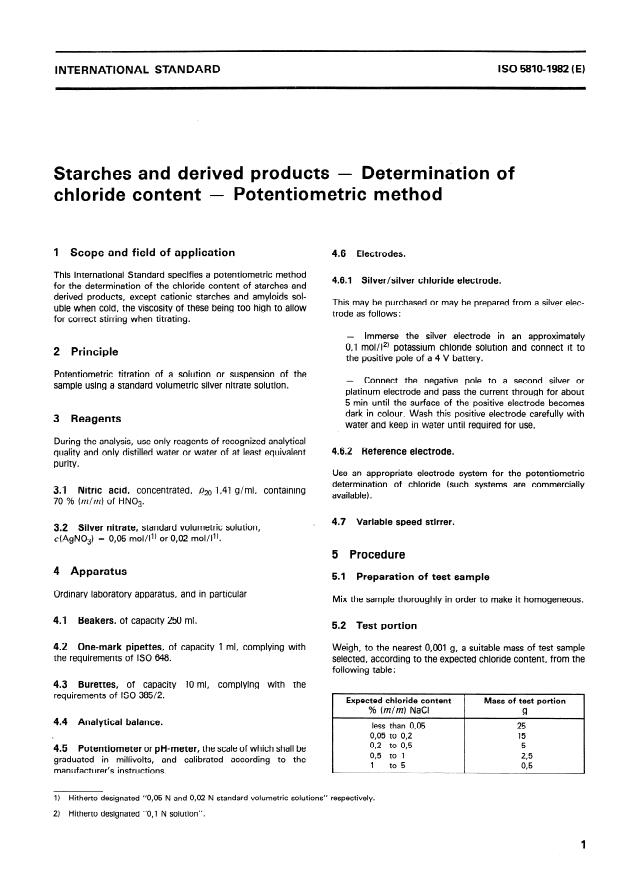

ISO 5810:1982 - Starches and derived products -- Determination of chloride content -- Potentiometric method
ISO 5810:1982 - Starches and derived products — Determination of chloride content — Potentiometric method/1/1982
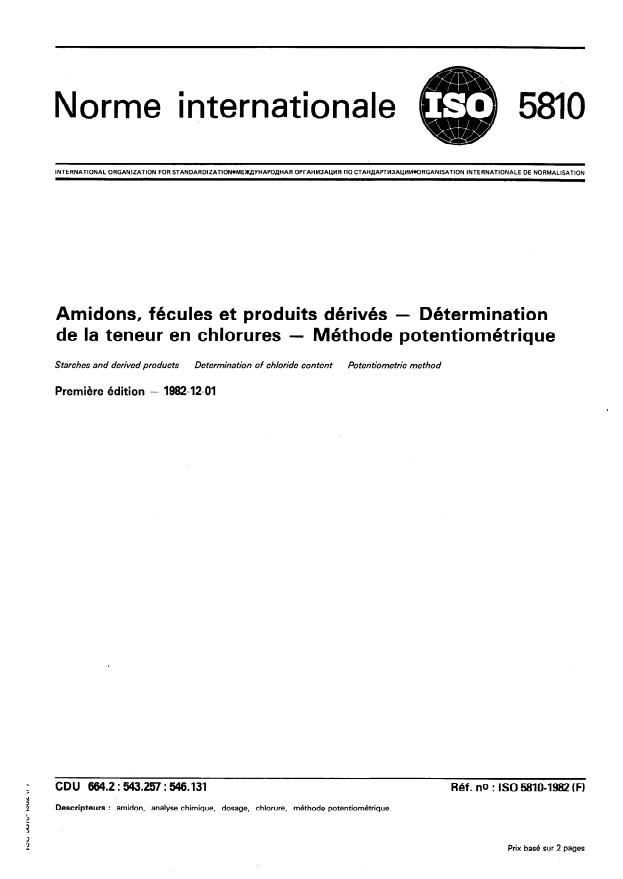

ISO 5810:1982 - Amidons, fécules et produits dérivés -- Détermination de la teneur en chlorures -- Méthode potentiométrique

ISO 5810:1982 - Amidons, fécules et produits dérivés -- Détermination de la teneur en chlorures -- Méthode potentiométrique
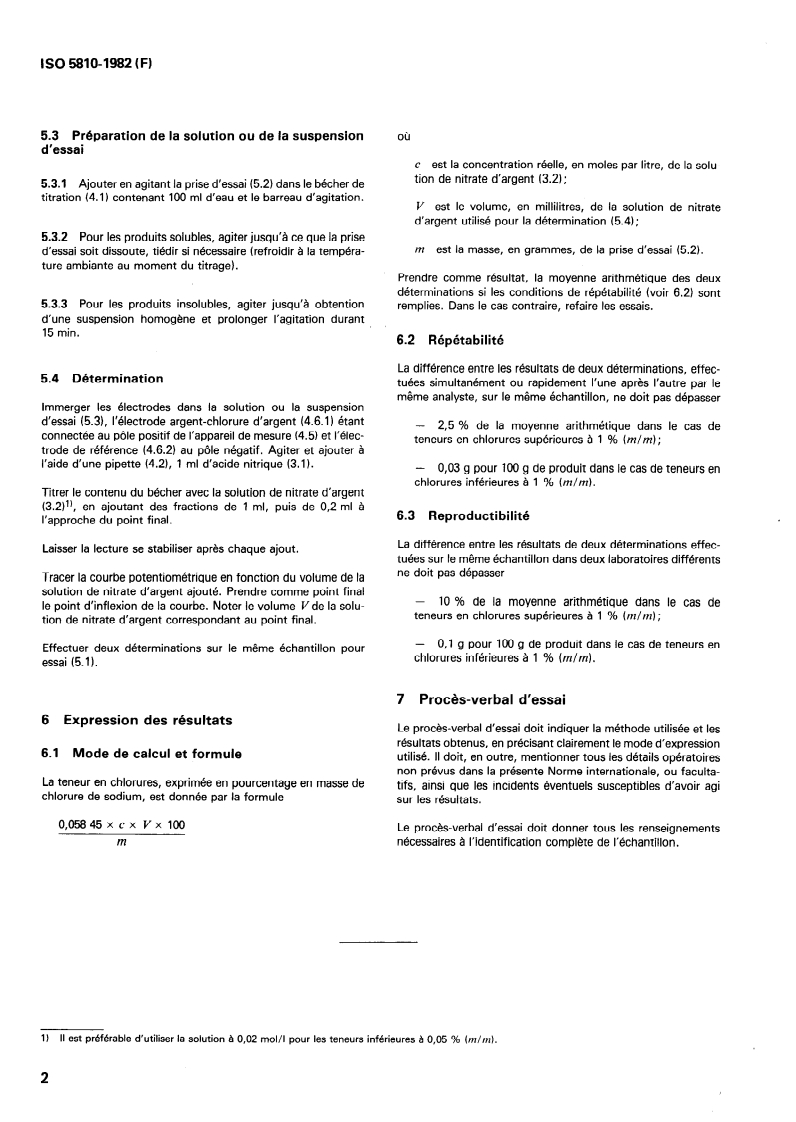
ISO 5810:1982 - Amidons, fécules et produits dérivés — Détermination de la teneur en chlorures — Méthode potentiométrique/1/1982
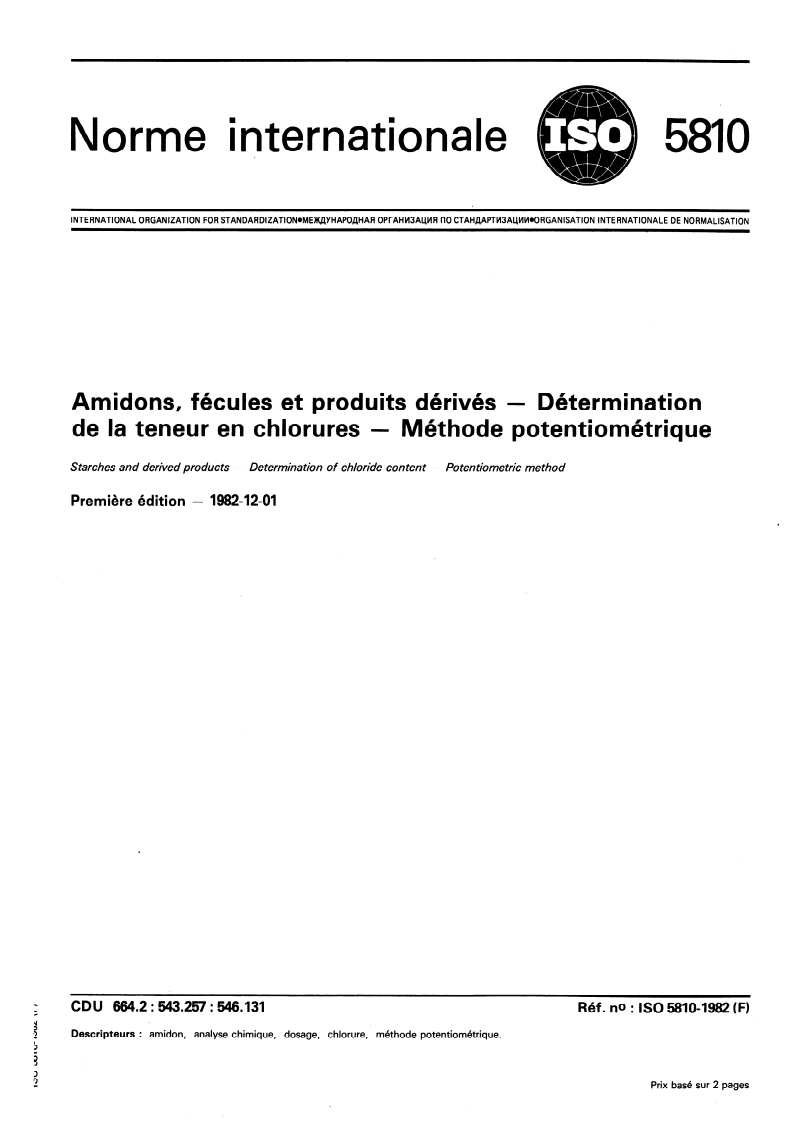
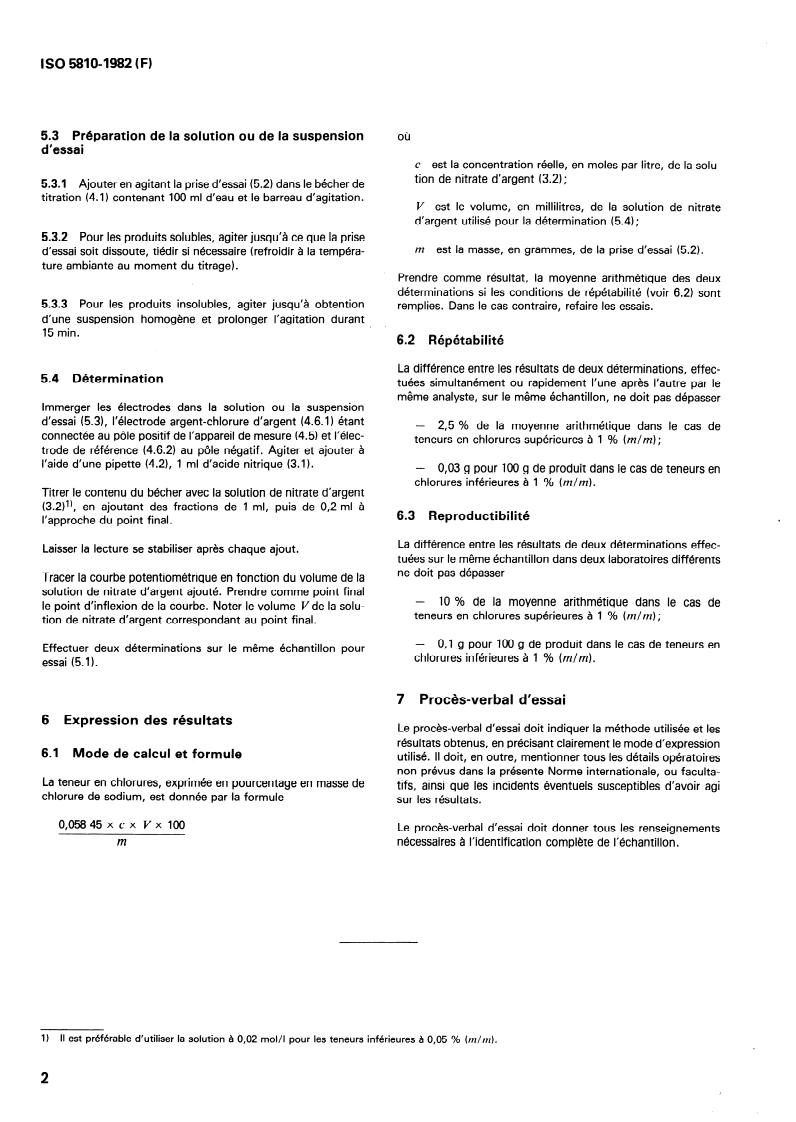
ISO 5810:1982 - Amidons, fécules et produits dérivés — Détermination de la teneur en chlorures — Méthode potentiométrique/1/1982
Overview
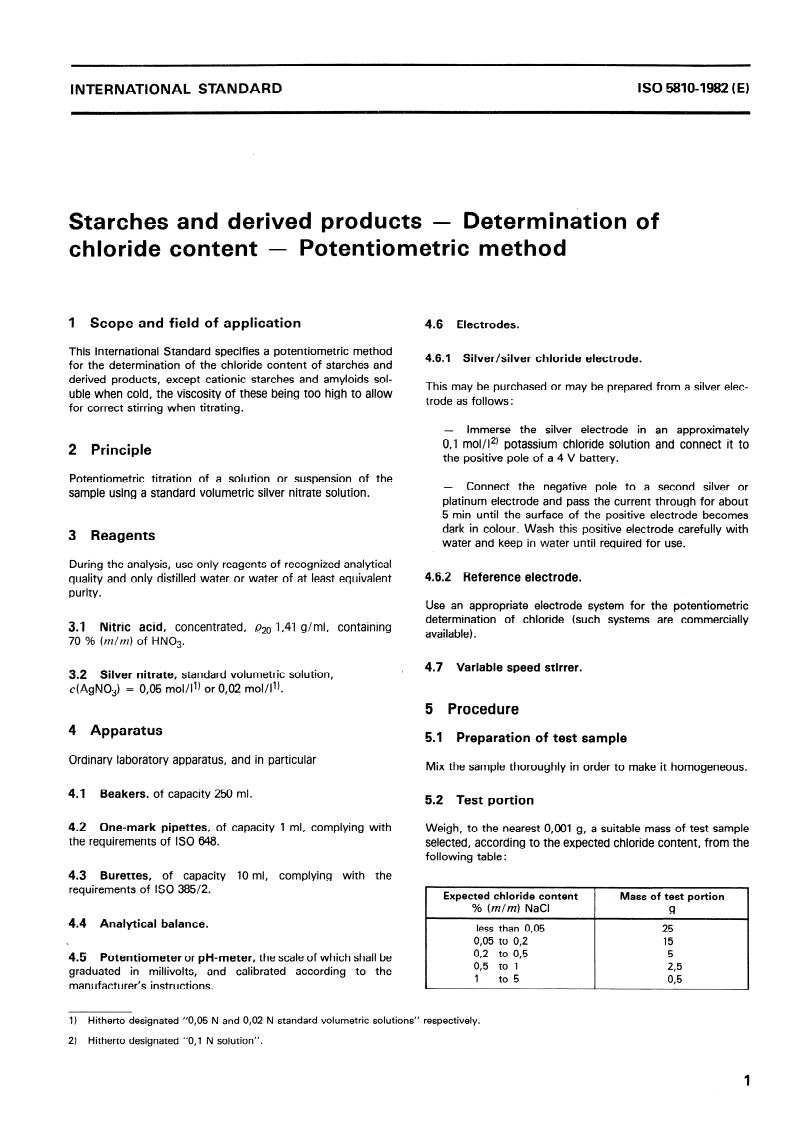
ISO 5810:1982 specifies a potentiometric titration method for determining the chloride content of starches and derived products. The method uses a standard volumetric silver nitrate (AgNO3) solution and potentiometric end‑point detection. It is not applicable to cationic starches or amyloids that are soluble when cold (their high viscosity prevents correct stirring). The result is reported as sodium chloride (NaCl) percentage by mass.
Key topics and technical requirements
- Principle: Potentiometric titration of a solution or suspension of the sample with standard AgNO3; end‑point is the inflection point of the potentiometric curve.
- Reagents: Concentrated nitric acid (HNO3) and standard volumetric silver nitrate solution (typical concentrations 0.05 mol·L–1 or 0.02 mol·L–1).
- Electrodes and instrumentation:
- Silver/silver chloride indicator electrode (can be prepared or purchased).
- Suitable reference electrode.
- Potentiometer or pH‑meter with millivolt scale and calibration.
- Variable‑speed stirrer to ensure homogeneous suspension.
- Apparatus: Standard laboratory glassware (beakers, 1 mL pipettes complying with ISO 648, 10 mL burettes complying with ISO 385/2), analytical balance.
- Sample preparation and test portions: Samples must be homogenized. Test portion mass is chosen by expected chloride content:
- < 0.05% NaCl → 25 g
- 0.05–0.2% → 15 g
- 0.2–0.5% → 5 g
- 0.5–1% → 2.5 g
- 1–5% → 0.5 g
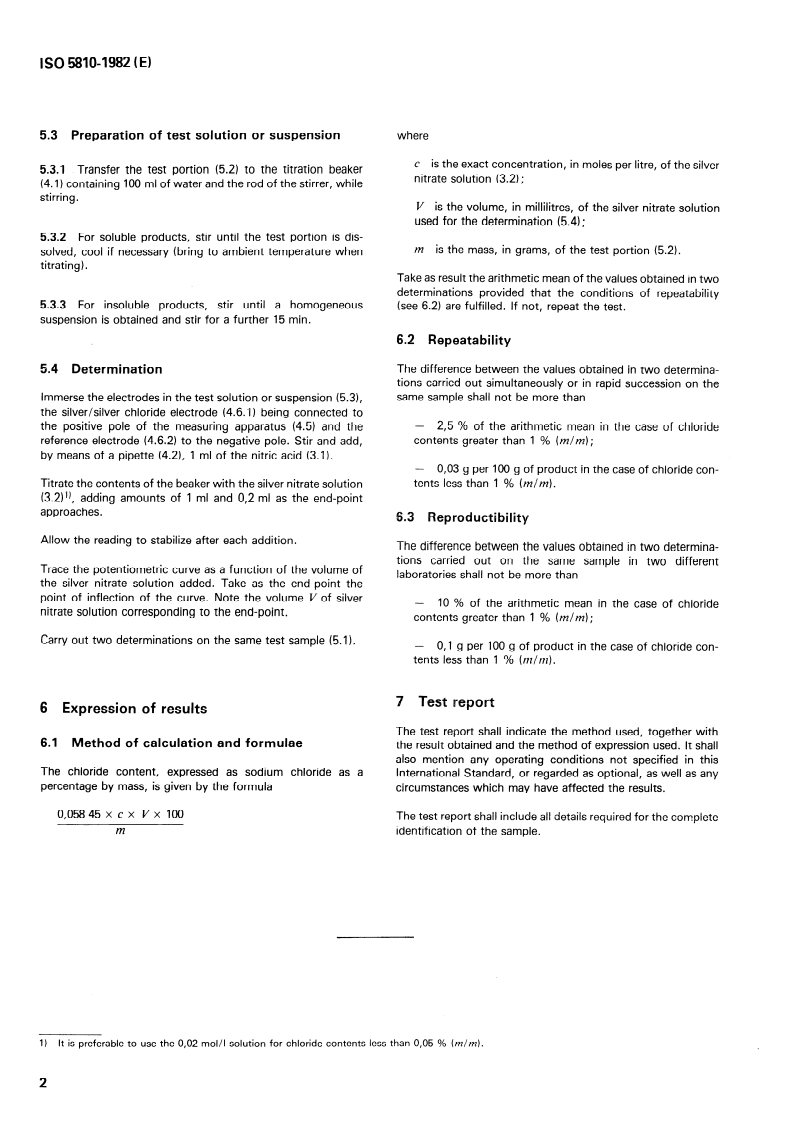
- Titration procedure: Immerse electrodes, add 1 mL HNO3, titrate with AgNO3 adding larger then smaller aliquots as the end‑point approaches. Record volume V at inflection point.
- Calculation: Chloride as NaCl (mass %) is calculated using the formula provided in the standard:
- % NaCl = (0.05845 × c × V × 100) / m
- where c = AgNO3 concentration (mol·L–1), V = volume of AgNO3 at end‑point (mL), m = test portion mass (g).
- Performance:
- Repeatability and reproducibility limits are specified (e.g., repeatability differences and inter‑laboratory reproducibility tolerances; 0.02 mol·L–1 solution recommended for very low chloride).
Applications and users
- Quality control in starch production and processing (native and modified starches, derivatives).
- Analytical and food chemistry laboratories verifying chloride/salt content in raw materials and finished products.
- Suppliers, contract testing labs, and regulatory bodies needing a standardized chloride assay for compliance, specification, or labeling.
- Research groups studying starch composition and functional properties.
Related standards
- References to laboratory glassware standards cited in the method: ISO 648 (pipettes) and ISO 385/2 (burettes).
- Developed by ISO/TC 93 (Starch) - consult other ISO/TC 93 documents for complementary methods and specifications.
Keywords: ISO 5810:1982, chloride determination, starches, potentiometric titration, silver nitrate titration, analytical method, NaCl content, starch quality control.
Relations
- Effective Date
- 06-Jun-2022
Buy Documents
ISO 5810:1982 - Starches and derived products -- Determination of chloride content -- Potentiometric method
ISO 5810:1982 - Starches and derived products — Determination of chloride content — Potentiometric method/1/1982
ISO 5810:1982 - Amidons, fécules et produits dérivés -- Détermination de la teneur en chlorures -- Méthode potentiométrique
ISO 5810:1982 - Amidons, fécules et produits dérivés -- Détermination de la teneur en chlorures -- Méthode potentiométrique
ISO 5810:1982 - Amidons, fécules et produits dérivés — Détermination de la teneur en chlorures — Méthode potentiométrique/1/1982
ISO 5810:1982 - Amidons, fécules et produits dérivés — Détermination de la teneur en chlorures — Méthode potentiométrique/1/1982
Get Certified
Connect with accredited certification bodies for this standard

BSI Group
BSI (British Standards Institution) is the business standards company that helps organizations make excellence a habit.

Bureau Veritas
Bureau Veritas is a world leader in laboratory testing, inspection and certification services.

DNV
DNV is an independent assurance and risk management provider.
Sponsored listings
Frequently Asked Questions
ISO 5810:1982 is a standard published by the International Organization for Standardization (ISO). Its full title is "Starches and derived products — Determination of chloride content — Potentiometric method". This standard covers: A solution or suspension of the sample is titrated with a standard volumetric silver nitrate solution. The method is not applied to cationic starches and amyloids soluble when cold.
A solution or suspension of the sample is titrated with a standard volumetric silver nitrate solution. The method is not applied to cationic starches and amyloids soluble when cold.
ISO 5810:1982 is classified under the following ICS (International Classification for Standards) categories: 67.180.20 - Starch and derived products. The ICS classification helps identify the subject area and facilitates finding related standards.
ISO 5810:1982 has the following relationships with other standards: It is inter standard links to ISO 877:1994. Understanding these relationships helps ensure you are using the most current and applicable version of the standard.
ISO 5810:1982 is available in PDF format for immediate download after purchase. The document can be added to your cart and obtained through the secure checkout process. Digital delivery ensures instant access to the complete standard document.
Standards Content (Sample)
Internatio.nal Standard
INTERNATIONAL ORGANIZATION FOR STANDARDIZATIONWE~YHAPOC\HAR OPH-bl3AUMfI fl0 CTAH~PTM3A~W~RGANISATION INTERNATIONALE DE NORMALISATION
Starches and derived products - Determination of
chloride content - Potentiometric method
Determination de Ia teneur en Chlorures - Methode potentiombtrique
Amidons, fkcules et produits d&=iv& -
First edition - 1982-12-01
Ref. No. ISO 58104982 (E)
UDC 664.2 : 543.257 : 546.131
determination of content, chlorides, potentiometric analysis.
Descriptors : starches, Chemical analysis,
Price based on 2 pages
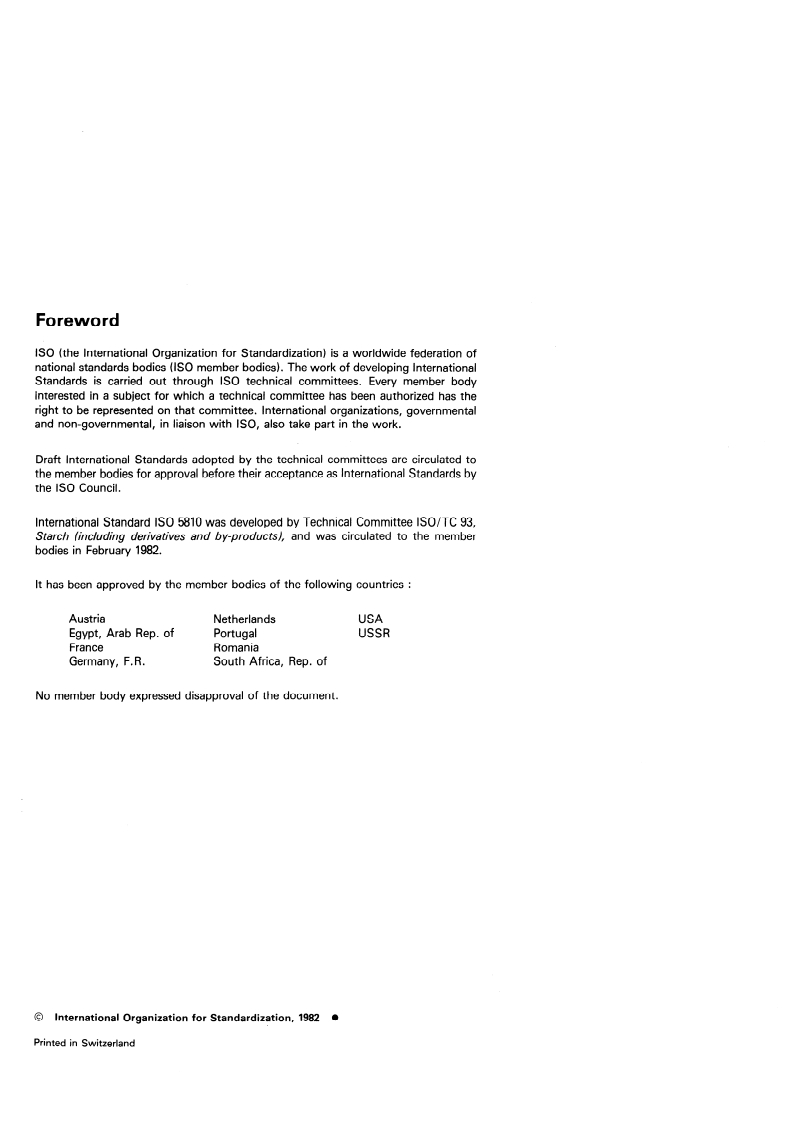
Foreword
ISO (the International Organization for Standardization) is a worldwide federation of
national Standards bodies (ISO member bedies). The work of developing International
Standards is carried out through ISO technical committees. Every member body
interested in a subject for which a technical committee has been authorized has the
right to be represented on that committee. International organizations, governmental
and non-governmental, in liaison with ISO, also take part in the work.
Draft International Standards adopted by the technical committees are circulated to
the member bodies for approval before their acceptance as International Standards by
the ISO Council.
International Standard ISO 5810 was developed by Technical Committee ISO/TC 93,
Starch (incfuding derivatives and by-products), and was circulated to the member
bodies in February 1982.
lt has been approved by the member bodies of the following countries :
Austria Netherlands USA
Egypt, Arab Rep. of Portugal USSR
France
Romania
Germany, F. R. South Africa, Rep. of
No member body expressed disapproval of the document.
International Organization for Standardization, 1982
Printed in Switzerland
ISO 5810-1982 (E)
INTERNATIONAL STANDARD
Starches and derived products - Determination of
Potentiometric method
chloride content -
Scope and field sf application
1 4.6 Electrodes.
This International Standard specifies a potentiometric method
4.6.1 Silver/silver chloride electrode.
for the determination of the chloride content of starches and
derived products, except cationic starches and amyloids sol-
This may be purchased or may be prepared from a silver elec-
uble when cold, the viscosity of these being too high to allow
trode as follows:
for correct stirring when titrating.
- Immerse the silver electrode in an approximately
0,l mol/12) potassium chloride Solution and connect it to
2 Principle
the positive pole of a 4 V battery.
Potentiometric titration of a Solution or Suspension of the
- Connect the negative pole to a second silver or
Sample using a Standard volumetric silver nitrate Solution.
platinum electrode and pass the current through for about
5 min until the surface of the positive electrode becomes
dark in colour. Wash this positive electrode carefully with
3 Reagents
water and keep in water until required for use.
During the analysis, use onfy reagents of recognized analytical
4.62 Reference electrode.
quality and only distilled water or water of at least equivalent
purity.
Use an appropriate electrode System for the potentiometric
determination of chloride (such Systems are commercially
3.1 Nitrit acid, concentrated, ,920 ‘?,4l g/ml, containing
available).
70 % fmlm) of HNO,.
4.7 Variable Speed stirrer.
3.2 Silwer nitrate, Standard volumetric Solution,
c(AgN03) = O,O5 mol/ll) or Q,O2 mol/lt).
5 Procedure
4 Apparatus
5.1 Preparation of test Sample
Ordinary laboratory apparatus, and in particular
Mix the Sample thoroughly in Order to make it homogeneous.
4.1 Beakers, of capacity 25Q ml.
5.2 Test Portion
4.2 One-mark pipettes, of capacity 1 ml, complying with
Weigh, to the nearest 0,001 g, a suitable mass of test Sam
...
Internatio.nal Standard
INTERNATIONAL ORGANIZATION FOR STANDARDIZATIONWE~YHAPOC\HAR OPH-bl3AUMfI fl0 CTAH~PTM3A~W~RGANISATION INTERNATIONALE DE NORMALISATION
Starches and derived products - Determination of
chloride content - Potentiometric method
Determination de Ia teneur en Chlorures - Methode potentiombtrique
Amidons, fkcules et produits d&=iv& -
First edition - 1982-12-01
Ref. No. ISO 58104982 (E)
UDC 664.2 : 543.257 : 546.131
determination of content, chlorides, potentiometric analysis.
Descriptors : starches, Chemical analysis,
Price based on 2 pages
Foreword
ISO (the International Organization for Standardization) is a worldwide federation of
national Standards bodies (ISO member bedies). The work of developing International
Standards is carried out through ISO technical committees. Every member body
interested in a subject for which a technical committee has been authorized has the
right to be represented on that committee. International organizations, governmental
and non-governmental, in liaison with ISO, also take part in the work.
Draft International Standards adopted by the technical committees are circulated to
the member bodies for approval before their acceptance as International Standards by
the ISO Council.
International Standard ISO 5810 was developed by Technical Committee ISO/TC 93,
Starch (incfuding derivatives and by-products), and was circulated to the member
bodies in February 1982.
lt has been approved by the member bodies of the following countries :
Austria Netherlands USA
Egypt, Arab Rep. of Portugal USSR
France
Romania
Germany, F. R. South Africa, Rep. of
No member body expressed disapproval of the document.
International Organization for Standardization, 1982
Printed in Switzerland
ISO 5810-1982 (E)
INTERNATIONAL STANDARD
Starches and derived products - Determination of
Potentiometric method
chloride content -
Scope and field sf application
1 4.6 Electrodes.
This International Standard specifies a potentiometric method
4.6.1 Silver/silver chloride electrode.
for the determination of the chloride content of starches and
derived products, except cationic starches and amyloids sol-
This may be purchased or may be prepared from a silver elec-
uble when cold, the viscosity of these being too high to allow
trode as follows:
for correct stirring when titrating.
- Immerse the silver electrode in an approximately
0,l mol/12) potassium chloride Solution and connect it to
2 Principle
the positive pole of a 4 V battery.
Potentiometric titration of a Solution or Suspension of the
- Connect the negative pole to a second silver or
Sample using a Standard volumetric silver nitrate Solution.
platinum electrode and pass the current through for about
5 min until the surface of the positive electrode becomes
dark in colour. Wash this positive electrode carefully with
3 Reagents
water and keep in water until required for use.
During the analysis, use onfy reagents of recognized analytical
4.62 Reference electrode.
quality and only distilled water or water of at least equivalent
purity.
Use an appropriate electrode System for the potentiometric
determination of chloride (such Systems are commercially
3.1 Nitrit acid, concentrated, ,920 ‘?,4l g/ml, containing
available).
70 % fmlm) of HNO,.
4.7 Variable Speed stirrer.
3.2 Silwer nitrate, Standard volumetric Solution,
c(AgN03) = O,O5 mol/ll) or Q,O2 mol/lt).
5 Procedure
4 Apparatus
5.1 Preparation of test Sample
Ordinary laboratory apparatus, and in particular
Mix the Sample thoroughly in Order to make it homogeneous.
4.1 Beakers, of capacity 25Q ml.
5.2 Test Portion
4.2 One-mark pipettes, of capacity 1 ml, complying with
Weigh, to the nearest 0,001 g, a suitable mass of test Sam
...
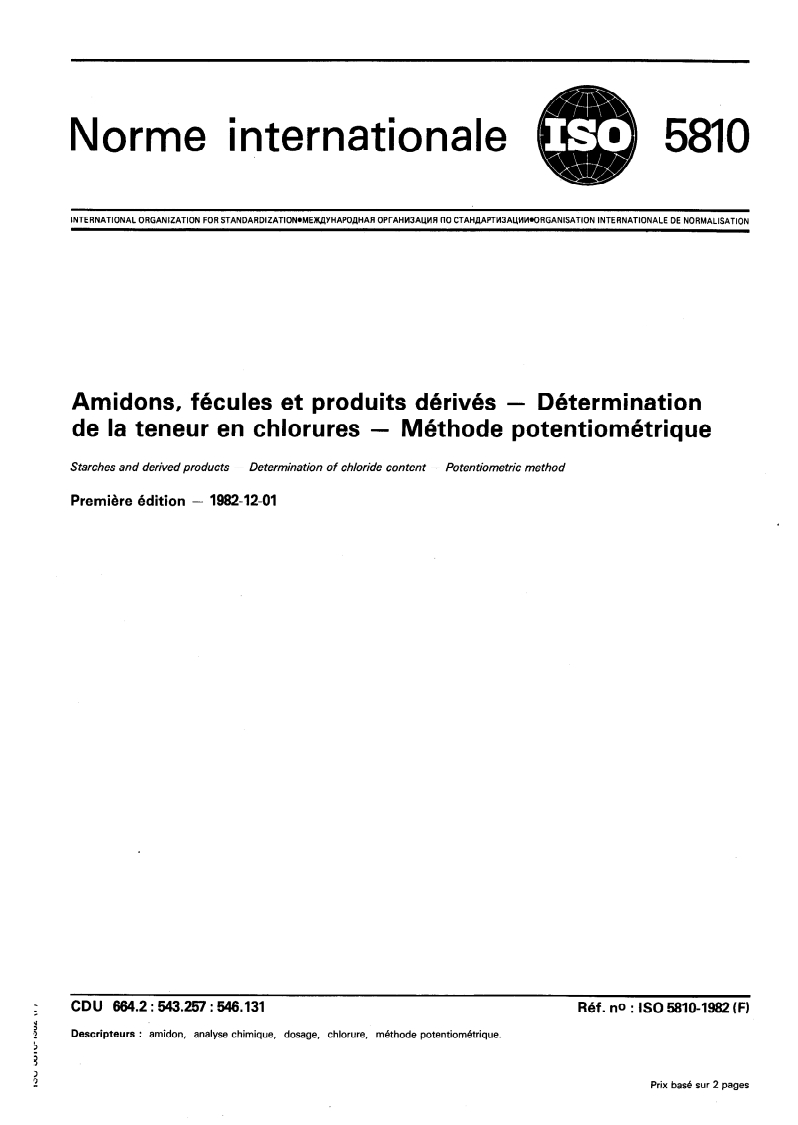
Norme internationale
INTERNATIONAL ORGANIZATION FOR STANDARDIZATION.ME~YHAPO~HAR OPrAHM3A~MR fl0 CTAH~APTH3Al.WWORGANISATION INTERNATIONALE DE NORMALISATION
Amidons, fécules et produits dérivés - Détermination
- Méthode potentiométrique
de la teneur en chlorures
Po ten tiome trie me thod
De termina tion of chloride content -
Starches and derived products -
Première édition - 1982-12-01
z
Réf. no : ISO 58104982 (FI
CDU 664.2 : 543.257 : 546.131
;
Descripteurs : amidon, analyse chimique, dosage, chlorure, méthode potentiométrique.
Prix basé sur 2 pages
Page blanche
Page blanche
ISO 58104982 (FI
5.3 Préparation de la solution ou de la suspension où
d’essai
c est la concentration réelle, en moles par litre, de la solu-
tion de nitrate d’argent (3.2);
5.3.1 Ajouter en agitant la prise d’essai (5.2) dans le bécher de
titration (4.1) contenant 100 ml d’eau et le barreau d’agitation.
V est le volume, en millilitres, de la solution de nitrate
d’argent utilisé pour la détermination (5.4);
5.3.2 Pour les produits solubles, agiter jusqu’à ce que la prise
m est la masse, en grammes, de la prise d’essai (5.2).
d’essai soit dissoute, tiédir si nécessaire (refroidir à la tempéra-
ture ambiante au moment du titrage).
Prendre comme résultat, la moyenne arithmétique des deux
déterminations si les conditions de répétabilité (voir 6.2) sont
5.3.3 Pour les produits insolubles, agiter jusqu’à obtention remplies. Dans le cas contraire, refaire les essais.
d’une suspension homogène et prolonger l’agitation durant
I I
15 min.
6.2 Répétabilité
La différence entre les résultats de deux déterminations, effec-
5.4 Détermination
tuées simultanément ou rapidement l’une après l’autre par le
même analyste, sur le même échantillon, ne doit pas dépasser
Immerger les électrodes dans la solution ou la suspension
d’essai (5.3), l’électrode argent-chlorure d’argent (4.6.1) étant
- 2,5 % de la moye
...
Norme internationale
INTERNATIONAL ORGANIZATION FOR STANDARDIZATION.ME~YHAPO~HAR OPrAHM3A~MR fl0 CTAH~APTH3Al.WWORGANISATION INTERNATIONALE DE NORMALISATION
Amidons, fécules et produits dérivés - Détermination
- Méthode potentiométrique
de la teneur en chlorures
Po ten tiome trie me thod
De termina tion of chloride content -
Starches and derived products -
Première édition - 1982-12-01
z
Réf. no : ISO 58104982 (FI
CDU 664.2 : 543.257 : 546.131
;
Descripteurs : amidon, analyse chimique, dosage, chlorure, méthode potentiométrique.
Prix basé sur 2 pages
Page blanche
Page blanche
ISO 58104982 (FI
5.3 Préparation de la solution ou de la suspension où
d’essai
c est la concentration réelle, en moles par litre, de la solu-
tion de nitrate d’argent (3.2);
5.3.1 Ajouter en agitant la prise d’essai (5.2) dans le bécher de
titration (4.1) contenant 100 ml d’eau et le barreau d’agitation.
V est le volume, en millilitres, de la solution de nitrate
d’argent utilisé pour la détermination (5.4);
5.3.2 Pour les produits solubles, agiter jusqu’à ce que la prise
m est la masse, en grammes, de la prise d’essai (5.2).
d’essai soit dissoute, tiédir si nécessaire (refroidir à la tempéra-
ture ambiante au moment du titrage).
Prendre comme résultat, la moyenne arithmétique des deux
déterminations si les conditions de répétabilité (voir 6.2) sont
5.3.3 Pour les produits insolubles, agiter jusqu’à obtention remplies. Dans le cas contraire, refaire les essais.
d’une suspension homogène et prolonger l’agitation durant
I I
15 min.
6.2 Répétabilité
La différence entre les résultats de deux déterminations, effec-
5.4 Détermination
tuées simultanément ou rapidement l’une après l’autre par le
même analyste, sur le même échantillon, ne doit pas dépasser
Immerger les électrodes dans la solution ou la suspension
d’essai (5.3), l’électrode argent-chlorure d’argent (4.6.1) étant
- 2,5 % de la moye
...
Norme internationale
INTERNATIONAL ORGANIZATION FOR STANDARDIZATION.ME~YHAPO~HAR OPrAHM3A~MR fl0 CTAH~APTH3Al.WWORGANISATION INTERNATIONALE DE NORMALISATION
Amidons, fécules et produits dérivés - Détermination
- Méthode potentiométrique
de la teneur en chlorures
Po ten tiome trie me thod
De termina tion of chloride content -
Starches and derived products -
Première édition - 1982-12-01
z
Réf. no : ISO 58104982 (FI
CDU 664.2 : 543.257 : 546.131
;
Descripteurs : amidon, analyse chimique, dosage, chlorure, méthode potentiométrique.
Prix basé sur 2 pages
Page blanche
Page blanche
ISO 58104982 (FI
5.3 Préparation de la solution ou de la suspension où
d’essai
c est la concentration réelle, en moles par litre, de la solu-
tion de nitrate d’argent (3.2);
5.3.1 Ajouter en agitant la prise d’essai (5.2) dans le bécher de
titration (4.1) contenant 100 ml d’eau et le barreau d’agitation.
V est le volume, en millilitres, de la solution de nitrate
d’argent utilisé pour la détermination (5.4);
5.3.2 Pour les produits solubles, agiter jusqu’à ce que la prise
m est la masse, en grammes, de la prise d’essai (5.2).
d’essai soit dissoute, tiédir si nécessaire (refroidir à la tempéra-
ture ambiante au moment du titrage).
Prendre comme résultat, la moyenne arithmétique des deux
déterminations si les conditions de répétabilité (voir 6.2) sont
5.3.3 Pour les produits insolubles, agiter jusqu’à obtention remplies. Dans le cas contraire, refaire les essais.
d’une suspension homogène et prolonger l’agitation durant
I I
15 min.
6.2 Répétabilité
La différence entre les résultats de deux déterminations, effec-
5.4 Détermination
tuées simultanément ou rapidement l’une après l’autre par le
même analyste, sur le même échantillon, ne doit pas dépasser
Immerger les électrodes dans la solution ou la suspension
d’essai (5.3), l’électrode argent-chlorure d’argent (4.6.1) étant
- 2,5 % de la moye
...
Norme internationale
INTERNATIONAL ORGANIZATION FOR STANDARDIZATION.ME~YHAPO~HAR OPrAHM3A~MR fl0 CTAH~APTH3Al.WWORGANISATION INTERNATIONALE DE NORMALISATION
Amidons, fécules et produits dérivés - Détermination
- Méthode potentiométrique
de la teneur en chlorures
Po ten tiome trie me thod
De termina tion of chloride content -
Starches and derived products -
Première édition - 1982-12-01
z
Réf. no : ISO 58104982 (FI
CDU 664.2 : 543.257 : 546.131
;
Descripteurs : amidon, analyse chimique, dosage, chlorure, méthode potentiométrique.
Prix basé sur 2 pages
Page blanche
Page blanche
ISO 58104982 (FI
5.3 Préparation de la solution ou de la suspension où
d’essai
c est la concentration réelle, en moles par litre, de la solu-
tion de nitrate d’argent (3.2);
5.3.1 Ajouter en agitant la prise d’essai (5.2) dans le bécher de
titration (4.1) contenant 100 ml d’eau et le barreau d’agitation.
V est le volume, en millilitres, de la solution de nitrate
d’argent utilisé pour la détermination (5.4);
5.3.2 Pour les produits solubles, agiter jusqu’à ce que la prise
m est la masse, en grammes, de la prise d’essai (5.2).
d’essai soit dissoute, tiédir si nécessaire (refroidir à la tempéra-
ture ambiante au moment du titrage).
Prendre comme résultat, la moyenne arithmétique des deux
déterminations si les conditions de répétabilité (voir 6.2) sont
5.3.3 Pour les produits insolubles, agiter jusqu’à obtention remplies. Dans le cas contraire, refaire les essais.
d’une suspension homogène et prolonger l’agitation durant
I I
15 min.
6.2 Répétabilité
La différence entre les résultats de deux déterminations, effec-
5.4 Détermination
tuées simultanément ou rapidement l’une après l’autre par le
même analyste, sur le même échantillon, ne doit pas dépasser
Immerger les électrodes dans la solution ou la suspension
d’essai (5.3), l’électrode argent-chlorure d’argent (4.6.1) étant
- 2,5 % de la moye
...