


ISO/IEC 19500-3:2012
(Main)Information technology — Object Management Group — Common Object Request Broker Architecture (CORBA) — Part 3: Components
Information technology — Object Management Group — Common Object Request Broker Architecture (CORBA) — Part 3: Components
ISO/IEC 19500-3:2012 defines the syntax and semantics of a component model, based on CORBA IDL, and a corresponding meta-model, a language to describe the structure and state of component implementations, and a corresponding meta-model, a programming model for constructing component implementations, a runtime environment for component implementations, interaction between components and Enterprise Java Beans, meta-data for describing component-based applications, and interfaces for their deployment, and a lightweight subset of the component model, programming model and runtime environment.
Technologies de l'information — OMG (Object Management Group) — CORBA (Common Object Request Broker Architecture) — Partie 3: Composants
General Information
- Status
- Published
- Publication Date
- 19-Apr-2012
- Technical Committee
- ISO/IEC JTC 1 - Information technology
- Drafting Committee
- ISO/IEC JTC 1 - Information technology
- Current Stage
- 9093 - International Standard confirmed
- Start Date
- 13-Feb-2025
- Completion Date
- 12-Feb-2026
Overview
ISO/IEC 19500-3:2012 specifies the CORBA Component Model (CCM) - a component architecture built on CORBA IDL. The standard defines the syntax and semantics for components and their meta-models, a Component Implementation Framework (CIF), a Component Implementation Definition Language (CIDL), a container programming and runtime model, metadata for deployment, and a lightweight profile. It also covers integration and interoperability with Enterprise JavaBeans (EJB) and provides interface-repository and CIF metamodels for tool support and automation.
Key Topics and Requirements
- Component model and meta-models: formal definitions of components, ports, facets, receptacles, events, homes, component identity and configuration.
- CORBA IDL mapping: how component constructs map to CORBA IDL and equivalent interfaces.
- CIDL and CIF: languages and metamodels for describing component implementations, structure, persistence and artifacts.
- Container programming model: container APIs, server and client programming models, lifecycle management, transactions, security, events, and persistence semantics.
- Home and lifecycle semantics: homes, home finders, primary key declarations, and lifecycle operations for entity and session components.
- Integration with EJB: mapping rules and interoperability requirements for CORBA components and Enterprise JavaBeans.
- Interface Repository & Metadata: metamodels (MOF/XMI/IDL) for interface descriptions and deployment metadata to enable tooling and reflection.
- Lightweight CCM profile: a scoped subset that excludes heavier features (e.g., persistence, introspection) for constrained environments.
- Conformance criteria: points and requirements for implementations, including optional and mandatory features.
Applications and Practical Value
- Enterprise distributed systems: building modular, reusable business components that interoperate across heterogeneous CORBA-based environments.
- Middleware and integration: bridging CORBA components with EJB systems to support mixed middleware deployments.
- Tooling and code generation: using CIF and interface metamodels for model-driven development, automated code generation, and deployment tools.
- Runtime platforms: implementing containers that manage component lifecycle, transactions, security and eventing per the CCM programming model.
- Lightweight deployments: employing the lightweight profile for constrained servers or legacy modernization where full CCM features aren’t required.
Who Should Use This Standard
- Middleware architects and platform vendors implementing CORBA containers and runtime environments.
- Enterprise architects integrating CORBA-based components with Java/EJB systems.
- Tooling vendors creating IDL/CIDL-based code generators, interface repositories, and deployment tools.
- Developers maintaining or modernizing legacy CORBA component-based applications.
Related Standards
- Other parts of the ISO/IEC 19500 series and core CORBA specifications (for overall ORB architecture and IDL norms).
- OMG specifications for CORBA Component Model, Interface Repository, and model-driven tooling (as referenced by ISO/IEC 19500-3:2012).
Get Certified
Connect with accredited certification bodies for this standard

BSI Group
BSI (British Standards Institution) is the business standards company that helps organizations make excellence a habit.

BSCIC Certifications Pvt. Ltd.
Established 2006, accredited by NABCB, JAS-ANZ, EIAC, IAS. CDSCO Notified Body.

Intertek India Pvt. Ltd.
Delivers Assurance, Testing, Inspection & Certification since 1993 with 26 labs and 32 offices.
Sponsored listings
Frequently Asked Questions
ISO/IEC 19500-3:2012 is a standard published by the International Organization for Standardization (ISO). Its full title is "Information technology — Object Management Group — Common Object Request Broker Architecture (CORBA) — Part 3: Components". This standard covers: ISO/IEC 19500-3:2012 defines the syntax and semantics of a component model, based on CORBA IDL, and a corresponding meta-model, a language to describe the structure and state of component implementations, and a corresponding meta-model, a programming model for constructing component implementations, a runtime environment for component implementations, interaction between components and Enterprise Java Beans, meta-data for describing component-based applications, and interfaces for their deployment, and a lightweight subset of the component model, programming model and runtime environment.
ISO/IEC 19500-3:2012 defines the syntax and semantics of a component model, based on CORBA IDL, and a corresponding meta-model, a language to describe the structure and state of component implementations, and a corresponding meta-model, a programming model for constructing component implementations, a runtime environment for component implementations, interaction between components and Enterprise Java Beans, meta-data for describing component-based applications, and interfaces for their deployment, and a lightweight subset of the component model, programming model and runtime environment.
ISO/IEC 19500-3:2012 is classified under the following ICS (International Classification for Standards) categories: 35.080 - Software. The ICS classification helps identify the subject area and facilitates finding related standards.
ISO/IEC 19500-3:2012 is available in PDF format for immediate download after purchase. The document can be added to your cart and obtained through the secure checkout process. Digital delivery ensures instant access to the complete standard document.
Standards Content (Sample)
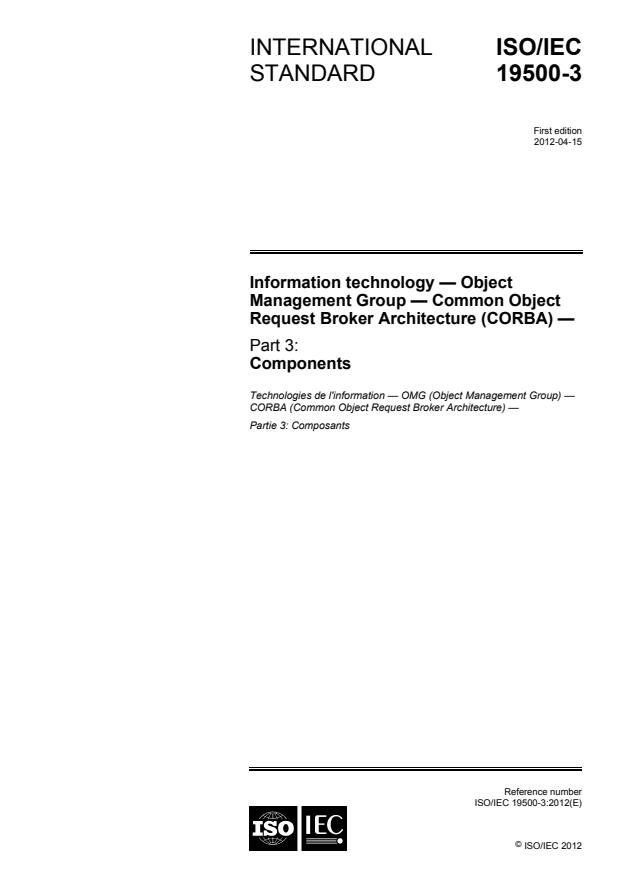
INTERNATIONAL ISO/IEC
STANDARD 19500-3
First edition
2012-04-15
Information technology — Object
Management Group — Common Object
Request Broker Architecture (CORBA) —
Part 3:
Components
Technologies de l'information — OMG (Object Management Group) —
CORBA (Common Object Request Broker Architecture) —
Partie 3: Composants
Reference number
©
ISO/IEC 2012
© ISO/IEC 2012
All rights reserved. Unless otherwise specified, no part of this publication may be reproduced or utilized in any form or by any means,
electronic or mechanical, including photocopying and microfilm, without permission in writing from either ISO at the address below or
ISO's member body in the country of the requester.
ISO copyright office
Case postale 56 CH-1211 Geneva 20
Tel. + 41 22 749 01 11
Fax + 41 22 749 09 47
E-mail copyright@iso.org
Web www.iso.org
Published in Switzerland
ii © ISO/IEC 2012 – All rights reserved
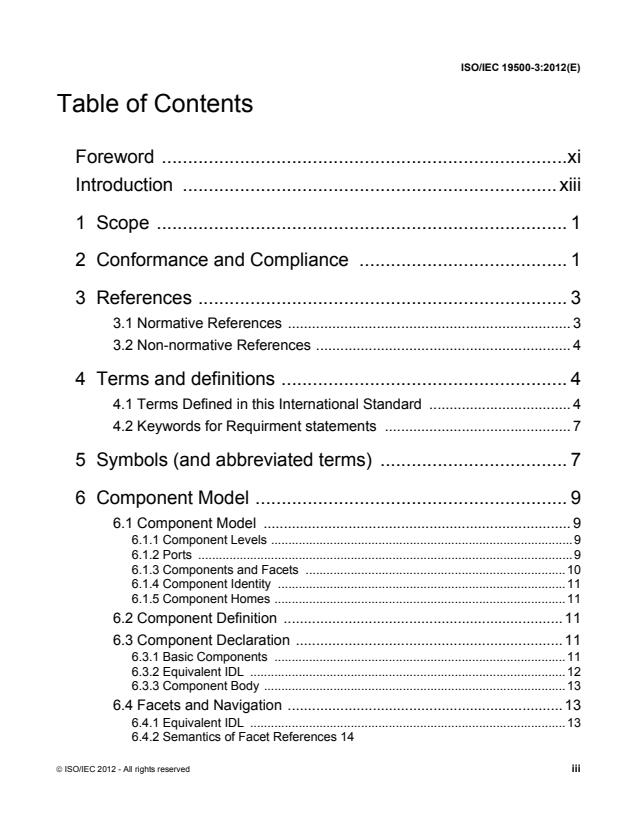
Table of Contents
Foreword .xi
Introduction .xiii
1 Scope . 1
2 Conformance and Compliance . 1
3 References . 3
3.1 Normative References . 3
3.2 Non-normative References . 4
4 Terms and definitions . 4
4.1 Terms Defined in this International Standard . 4
4.2 Keywords for Requirment statements . 7
5 Symbols (and abbreviated terms) . 7
6 Component Model . 9
6.1 Component Model . 9
6.1.1 Component Levels .9
6.1.2 Ports .9
6.1.3 Components and Facets .10
6.1.4 Component Identity .11
6.1.5 Component Homes .11
6.2 Component Definition . 11
6.3 Component Declaration . 11
6.3.1 Basic Components .11
6.3.2 Equivalent IDL .12
6.3.3 Component Body .13
6.4 Facets and Navigation . 13
6.4.1 Equivalent IDL .13
6.4.2 Semantics of Facet References 14
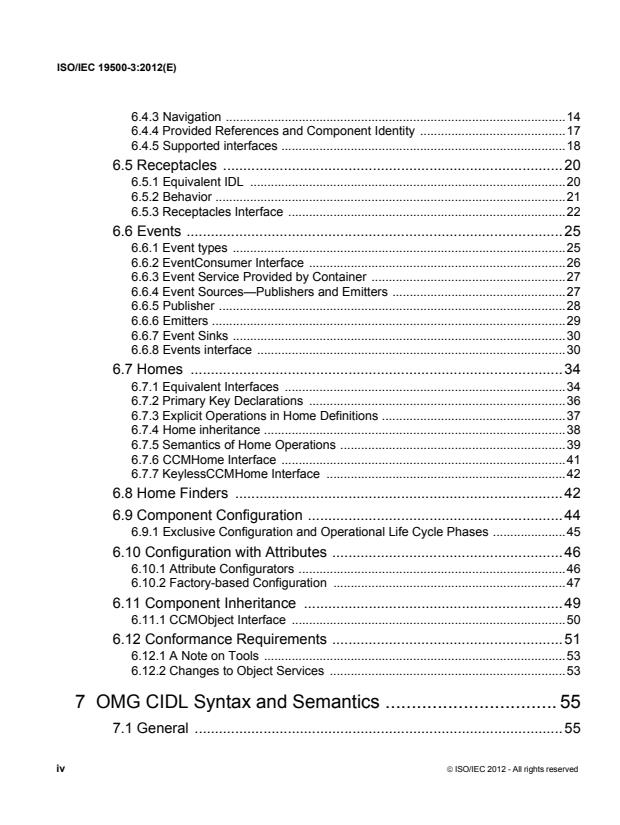
© ISO/IEC 2012 - All rights reserved iii
6.4.3 Navigation .14
6.4.4 Provided References and Component Identity .17
6.4.5 Supported interfaces .18
6.5 Receptacles .20
6.5.1 Equivalent IDL .20
6.5.2 Behavior .21
6.5.3 Receptacles Interface .22
6.6 Events .25
6.6.1 Event types .25
6.6.2 EventConsumer Interface .26
6.6.3 Event Service Provided by Container .27
6.6.4 Event Sources—Publishers and Emitters .27
6.6.5 Publisher .28
6.6.6 Emitters .29
6.6.7 Event Sinks .30
6.6.8 Events interface .30
6.7 Homes .34
6.7.1 Equivalent Interfaces .34
6.7.2 Primary Key Declarations .36
6.7.3 Explicit Operations in Home Definitions .37
6.7.4 Home inheritance .38
6.7.5 Semantics of Home Operations .39
6.7.6 CCMHome Interface .41
6.7.7 KeylessCCMHome Interface .42
6.8 Home Finders .42
6.9 Component Configuration .44
6.9.1 Exclusive Configuration and Operational Life Cycle Phases .45
6.10 Configuration with Attributes .46
6.10.1 Attribute Configurators .46
6.10.2 Factory-based Configuration .47
6.11 Component Inheritance .49
6.11.1 CCMObject Interface .50
6.12 Conformance Requirements .51
6.12.1 A Note on Tools .53
6.12.2 Changes to Object Services .53
7 OMG CIDL Syntax and Semantics . 55
7.1 General .55
iv © ISO/IEC 2012 - All rights reserved
7.2 Lexical Conventions . 55
7.2.1 Keywords .56
7.3 OMG CIDL Grammar . 56
7.4 OMG CIDL Specification . 58
7.5 Composition Definition . 58
7.5.1 Life Cycle Category and Constraints .59
7.6 Home Executor Definition . 59
7.7 Home Implementation Declaration . 60
7.8 Storage Home Binding . 61
7.9 Home Persistence Declaration . 61
7.10 Executor Definition . 61
7.11 Segment Definition . 62
7.12 Segment Persistence Declaration . 62
7.13 Facet Declaration . 63
7.14 Feature Delegation Specification . 63
7.15 Abstract Storage Home Delegation Specification .64
7.16 Executor Delegation Specification . 65
7.17 Abstract Spec Declaration . 66
7.18 Proxy Home Declaration . 66
8 CCM Implementation Framework . 67
8.1 Introduction . 67
8.2 Component Implementation Framework (CIF) Architecture . 67
8.2.1 Component Implementation Definition Language (CIDL) .67
8.2.2 Component persistence and behavior .67
8.2.3 Implementing a CORBA Component .67
8.2.4 Behavioral elements: Executors .68
8.2.5 Unit of implementation : Composition .68
8.2.6 Composition structure .69
8.2.7 Compositions with Managed Storage .75
8.2.8 Relationship between Home Executor and Abstract Storage Home .77
8.2.9 Executor Definition .89
8.2.10 Proxy Homes .96
8.2.11 Component Object References .97
© ISO/IEC 2012 - All rights reserved v
8.3 Language Mapping .99
8.3.1 Overview .99
8.3.2 Common Interfaces .100
8.3.3 Mapping Rules .101
9 The Container Programming Model . 109
9.1 General .109
9.2 Introduction .109
9.2.1 External API Types .110
9.2.2 Container API Type .111
9.2.3 CORBA Usage Model .111
9.2.4 Component Categories .111
9.3 The Server Programming Environment .112
9.3.1 Component Containers .112
9.3.2 CORBA Usage Model .113
9.3.3 Component Factories .114
9.3.4 Component Activation .114
9.3.5 Servant Lifetime Management .114
9.3.6 Transactions .115
9.3.7 Security .117
9.3.8 Events .117
9.3.9 Persistence .118
9.3.10 Application Operation Invocation .119
9.3.11 Component Implementations .120
9.3.12 Component Levels .120
9.3.13 Component Categories .120
9.4 Server Programming Interfaces - Basic Components .124
9.4.1 Component Interfaces .124
9.4.2 Interfaces Common to both Container API Types .125
9.4.3 Interfaces Supported by the Session Container API Type .130
9.4.4 Interfaces Supported by the Entity Container API Type .132
9.5 Server Programming Interfaces - Extended Components .134
9.5.1 Interfaces Common to both Container API Types .134
9.5.2 Interfaces Supported by the Session Container API Type .136
9.5.3 Interfaces Supported by the Entity Container API Type .138
9.6 The Client Programming Model .144
9.6.1 Component-aware Clients .144
9.6.2 Component-unaware Clients .148
vi © ISO/IEC 2012 - All rights reserved
10 Integrating with Enterprise JavaBeans . 151
10.1 Introduction . 151
10.2 Enterprise JavaBeans Compatibility Objectives and
Requirements . 152
10.3 CORBA Component Views for EJBs . 153
10.3.1 Mapping of EJB to Component IDL definitions .153
10.3.2 Translation of CORBA Component requests into EJB requests .157
10.3.3 Interoperability of the View .158
10.3.4 CORBA Component view Example .160
10.4 EJB views for CORBA Components . 162
10.4.1 Mapping of Component IDL to Enterprise JavaBeans specifications .162
10.4.2 Translation of EJB requests into CORBA Component Requests .164
10.4.3 Interoperability of the View .166
10.4.4 Example .168
10.5 Compliance with the Interoperability of Integration Views .169
10.6 Comparing CCM and EJB . 169
10.6.1 The Home Interfaces .170
10.6.2 The Component Interfaces .171
10.6.3 The Callback Interfaces .173
10.6.4 The Context Interfaces .174
10.6.5 The Transaction Interfaces .175
10.6.6 The Metadata Interfaces .176
11 Interface Repository Metamodel . 177
11.1 Introduction . 177
11.1.1 BaseIDL Package .177
11.1.2 ComponentIDL Package .188
11.2 Conformance Criteria . 196
11.2.1 Conformance Points .197
11.3 MOF DTDs and IDL for the Interface Repository Metamodel . 197
11.3.1 XMI DTD .197
11.3.2 IDL for the BaseIDL Package .222
11.3.3 IDL for the ComponentIDL Package .244
12 CIF Metamodel . 263
12.1 CIF Package . 263
12.2 Classes and Associations . 263
© ISO/IEC 2012 - All rights reserved vii
12.2.1 ComponentImplDef .264
12.2.2 SegmentDef .265
12.2.3 ArtifactDef .265
12.2.4 Policy .265
12.2.5 HomeImplDef .266
12.3 Conformance Criteria .267
12.3.1 Conformance Points .267
12.4 MOF DTDs and IDL for the CIF Metamodel .267
12.4.1 XMI DTD .268
12.4.2 IDL for the CIF Package .268
13 Lightweight CCM Profile . 275
13.1 Summary .275
13.2 Changes associated with excluding support for persistence .276
13.3 Changes associated with excluding support for introspection,
navigation and type-specific operations redundant with generic
operations .278
13.4 Changes associated with excluding support for segmentation .279
13.5 Changes associated with excluding support for transactions .280
13.6 Changes associated with excluding support for security .280
13.7 Changes associated with excluding support for configurators .281
13.8 Changes associated with excluding support for proxy homes .281
13.9 Changes associated with excluding support for home finders .281
13.10 Changes adding additional restrictions to the extended model
not represented by exclusions above .282
14 Deployment PSM for CCM . 283
14.1 Overview .283
14.2 Definition of Meta-Concepts .284
14.2.1 Component .284
14.2.2 ImplementationArtifact .285
14.2.3 PackageI .285
14.3 PIM to PSM for CCM Transformation .285
14.3.1 ComponentInterfaceDescription .285
viii © ISO/IEC 2012 - All rights reserved
14.3.2 PlanSubcomponentPortEndpoint .286
14.3.3 Application .286
14.3.4 RepositoryManager .287
14.3.5 SatisfierProperty .287
14.4 PSM for CCM to PSM for CCM for IDL Transformation .287
14.4.1 Generic Transformation Rules .287
14.4.2 Special Transformation Rules .289
14.4.3 Mapping to IDL .290
14.5 PSM for CCM to PSM for CCM for XML Transformation . 290
14.5.1 Generic Transformation Rules .290
14.5.2 Special Transformation Rules .291
14.5.3 Transformation Exceptions and Extensions .295
14.5.4 Interpretation of Relative References .296
14.5.5 Mapping to XML .297
14.6 Miscellaneous . 297
14.6.1 Entry Points .297
14.6.2 Homes .298
14.6.3 Valuetype Factories .298
14.6.4 Discovery and Initialization .298
14.6.5 Location .299
14.6.6 Segmentation .299
14.7 Migration Issues . 300
14.7.1 Component Implementations .300
14.7.2 Component and Assembly Packages and Metadata .300
14.7.3 Component Deployment Systems .300
14.8 Metadata Vocabulary . 301
14.8.1 Implementation Selection Requirements .301
14.8.2 Monolithic Implementation Resource Requirements .301
15 Deployment IDL for CCM . 303
16 XML Schema for CCM . 317
Annex A - Legal Information . 337
© ISO/IEC 2012 - All rights reserved ix
x © ISO/IEC 2012 - All rights reserved
Foreword
ISO (the International Organization for Standardization) is a worldwide federation of national standards bodies (ISO
member bodies). The work of preparing International Standards is normally carried out through ISO technical
committees. Each member body interested in a subject for which a technical committee has been established has the right
to be represented on that committee. International organizations, governmental and non-governmental, in liaison with
ISO, also take part in the work. ISO collaborates closely with the International Electrotechnical Commission (IEC) on all
matters of electrotechnical standardization.
International Standards are drafted in accordance with the rules given in the ISO/IEC Directives, Part 2.
The main task of technical committees is to prepare International Standards. Draft International Standards adopted by the
technical committees are circulated to the member bodies for voting. Publication as an International Standard requires
approval by at least 75 % of the member bodies casting a vote.
Attention is drawn to the possibility that some of the elements of this document may be the subject of patent rights. ISO
shall not be held responsible for identifying any or all such patent rights.
ISO/IEC 19500-3 was prepared by Technical Committee ISO/IEC JTC1, Information technology, in collaboration with the
Object Management Group (OMG), following the submission and processing as a Publicly Available Specification (PAS)
of the OMG Common Object Request Broker Architecture (CORBA) specification Part 3 Version 3.1 CORBA
Components.
ISO/IEC 19500-3 is related to:
• ITU-T Recommendation X.902 (1995) | ISO/IEC 10746-2:1996, Information Technology - Open Distributed
Processing - Reference Model: Foundations
• ITU-T Recommendation X.903 (1995) | ISO/IEC 10746-3:1996, Information Technology - Open Distributed
Processing - Reference Model: Architecture
• ITU-T Recommendation X.920 (1997) | ISO/IEC 14750:1997, Information Technology - Open Distributed
Processing - Interface Definition Language
• ISO/IEC 19500-2, Information Technology - Open Distributed Processing - CORBA Specification Part 1:
CORBA Interfaces
• ISO/IEC 19500-3, Information Technology - Open Distributed Processing - CORBA Specification Part 2:
CORBA Interoperability
ISO/IEC 19500 consists of the following parts, under the general title Information technology - Open distributed
processing - CORBA specification:
• Part 1: CORBA Interfaces
• Part 2: CORBA Interoperability
• Part 3: CORBA Components
© ISO/IEC 2012 - All rights reserved xi
It is the common core of the CORBA specification. Optional parts of CORBA, such as mappings to particular
programming languages, Real-time CORBA extensions, and the minimum CORBA profile for embedded systems are
documented in the other specifications that together comprise the complete CORBA specification. Please visit the
CORBA download page at http://www.omg.org/technology/documents/corba_spec_catalog.htm to find the complete
CORBA specification set.
Apart from this Foreword, the text of this International Standard is identical with that for the OMG specification for
CORBA, v3.1.1, Part 3.
xii © ISO/IEC 2012 - All rights reserved
ISO/IEC 19500-3:2012(E)
Introduction
The rapid growth of distributed processing has led to a need for a coordinating framework for this standardization and
ITU-T Recommendations X.901-904 | ISO/IEC 10746, the Reference Model of Open Distributed Processing (RM-ODP)
provides such a framework. It defines an architecture within which support of distribution, interoperability and portability
can be integrated.
RM-ODP Part 2 (ISO/IEC 10746-2) defines the foundational concepts and modeling framework for describing distributed
systems. The scopes and objectives of the RM-ODP Part 2 and the UML, while related, are not the same and, in a number
of cases, the RM-ODP Part 2 and the UML specification use the same term for concepts which are related but not
identical (e.g., interface). Nevertheless, a specification using the Part 2 modeling concepts can be expressed using UML
with appropriate extensions (using stereotypes, tags, and constraints).
RM-ODP Part 3 (ISO/IEC 10746-3) specifies a generic architecture of open distributed systems, expressed using the
foundational concepts and framework defined in Part 2. Given the relation between UML as a modeling language and Part
3 of the RM-ODP standard, it is easy to show that UML is suitable as a notation for the individual viewpoint
specifications defined by the RM-ODP.
This part of ISO/IEC 19500 (CORBA Components) is a standard for the technology specification of an ODP system. It
defines a technology to provide the infrastructure required to support functional distribution of an ODP system, specifying
functions required to manage physical distribution, communications, processing and storage, and the roles of different
technology objects in supporting those functions.
Context of CORBA
The key to understanding the structure of the CORBA architecture is the Reference Model, which consists of the
following components:
• Object Request Broker, which enables objects to transparently make and receive requests and responses in a
distributed environment. It is the foundation for building applications from distributed objects and for
interoperability between applications in hetero- and homogeneous environments. The architecture and
specifications of the Object Request Broker are described in this manual.
• Object Services, a collection of services (interfaces and objects) that support basic functions for using and
implementing objects. Services are necessary to construct any distributed application and are always independent
of application domains. For example, the Life Cycle Service defines conventions for creating, deleting, copying,
and moving objects; it does not dictate how the objects are implemented in an application. Specifications for
Object Services are contained in CORBAservices: Common Object Services Specification.
• Common Facilities, a collection of services that many applications may share, but which are not as fundamental
as the Object Services. For instance, a system management or electronic mail facility could be classified as a
common facility. Information about Common Facilities will be contained in CORBAfacilities: Common
Facilities Architecture.
• Application Objects, which are products of a single vendor on in-house development group that controls their
interfaces. Application Objects correspond to the traditional notion of applications, so they are not standardized
by OMG. Instead, Application Objects constitute the uppermost layer of the Reference Model.
© ISO/IEC 2012 - All rights reserved xiii
The Object Request Broker, then, is the core of the Reference Model. It is like a telephone exchange, providing the basic
mechanism for making and receiving calls. Combined with the Object Services, it ensures meaningful communication
between CORBA-compliant applications.
The architecture and specifications described in this standard are aimed at software designers and developers who want to
produce applications that comply with OMG specifications for the Object Request Broker (ORB), or this standard (ISO/
IEC 19500). The benefit of compliance is, in general, to be able to produce interoperable applications that are based on
distributed, interoperating objects. The ORB provides the mechanisms by which objects transparently make requests and
receive responses. Hence, the ORB provides interoperability between applications on different machines in heterogeneous
distributed environments and seamlessly interconnects multiple object systems.
This Part of this International Standard includes a non-normative annex.
xiv © ISO/IEC 2012 - All rights reserved
INTERNATIONAL STANDARD ISO/IEC 19500-3:2012(E)
Information technology - Object Management Group
Common Object Request Broker Architecture (CORBA), Components
1Scope
This part of ISO/IEC 19500 defines:
• The syntax and semantics of a component model (see Clause 6, ’Component Model’), based on CORBA IDL, and a
corresponding meta-model (see Clause 11, ’Interface Repository Metamodel’).
• A language to describe the structure and state of component implementations (see Clause 7, ’OMG CIDL Syntax and
Semantics’), and a corresponding meta-model (see Clause 12, ’CIF Metamodel’).
• A programming model for constructing component implementations (see Clause 8, ’CCM Implementation
Framework’).
• A runtime environment for component implementations (see Clause 9, ’The Container Programming Model’).
• Interaction between components and Enterprise Java Beans (see Clause 10, ’Integrating with Enterprise JavaBeans’).
• Meta-data for describing component-based applications, and interfaces for their deployment (see Clause 14,
’Deployment PSM for CCM’).
• A lightweight subset of the component model, programming model and runtime environment (see Clause 13,
’Lightweight CCM Profile’).
2 Conformance and Compliance
The following conformance points are defined:
1. A CORBA COS vendor shall provide the relevant changes to the Lifecycle, Transaction, and Security Services
identified in “Changes to Object Services” on page 53.
2. A CORBA Component vendor shall provide a conforming implementation of the Basic Level of CORBA Compo-
nents. A Lightweight CORBA Component vendor shall provide a conforming implementation of the Lightweight
CCM Profile as specified in item 8 below.
3. A CORBA Component vendor may provide a conforming implementation of the Extended Level of CORBA Compo-
nents.
4. To be conformant at the Basic level a non-Java product shall implement (at a minimum) the following:
• the IDL extensions and generation rules to support the client and server side component model for basic level
components.
• CIDL. The multiple segment feature of CIDL (“Segment Definition” on page 62) need not be supported for basic
components.
• a container for hosting basic level CORBA components.
© ISO/IEC 2012 - All rights reserved 1
• the XML deployment descriptors and associated zip files for basic components.
Such implementations shall work on a CORBA ORB as defined in #1 above.
5. To be conformant at the Basic level a Java product shall implement (at a minimum):
• EJB1.1, including support for the EJB 1.1 XML DTD.
• the java to IDL mapping, also known as RMI/IIOP.
• EJB to IDL mapping as defined in “Translation of CORBA Component requests into EJB requests” on page 157.
Such implementations shall work in a CORBA interoperable environment, including interoperable support for IIOP
CORBA transactions, and CORBA security.
6. To be conformant at the extended level, a product shall implement (at a minimum) the requirements needed to
achieve Basic PLUS:
• IDL extensions to support the client and server side component model for extended level components.
• A container for hosting extended level CORBA components.
• The XML deployment descriptors and associated zip files for basic and enhanced level components in the format
defined in “Deployment PSM for CCM” on page 283.
Such implementations shall work on a CORBA ORB as defined in #1 above.
7. The Lightweight CCM profile is a conformance point based on the extended model as defined above. “Lightweight
CCM Profile” on page 275 defines the specific parts of this CCM specification that are impacted and the normative
specific subsetting of CCM. In summary, the following general capabilities (and associated machinery) are excluded
from the extended model to define this conformance point:
• Persistence (only session and service components are supported)
• Introspection
• Navigation
• Redundancies, preferring generic over specific
• Segmentation (not allowed for session or service components)
• Transactions
• Security
• Configurators
• Proxy homes
• Home finders
• CIDL
• POA related mandates
8. A CORBA Component vendor may optionally support EJB clients interacting with CORBA Components, by imple-
menting the IDL to EJB mapping as defined in “Translation of EJB requests into CORBA Component Requests” on
page 164.
2 © ISO/IEC 2012 - All rights reserved
3 References
3.1 Normative References
[CORBA] Object Management Group, “Common Object Request Broker Architecture,” version 3.0.3, OMG
document number formal/04-03-01. Available from
http://www.omg.org/cgi-bin/doc?formal/04-03-01
[D+C] Object Management Group, “Deployment and Configuration of Component-based Distributed
Applications Specification,” version 1.1. OMG document number ptc/05-01-07. Available from
http://www.omg.org/cgi-bin/doc?ptc/05-01-07
[EJB] Java Community Process, "Enterprise JavaBeans Specification - Version 1.1" (with errata), June 8,
2000. Available from
http://jcp.org/aboutJava/communityprocess/maintenance/jsr905
[HTTP] R. Fielding, J. Gettys, J. Mogul, H. Frystyk, L. Masinter, P. Leach, T. Berners-Lee, RFC 2616:
“Hypertext Transfer Protocol -- HTTP/1.1.” June 1999. Available from
http://www.ietf.org/rfc/rfc2616.txt
[INS] Object Management Group, “Naming Service Specification,” version 1.1. February 2001. OMG
document number formal/01-02-65. Available from
http://www.omg.org/cgi-bin/doc?formal/01-02-65
[JIDL] Object Management Group, “Java™ to IDL Language Mapping Specification,” version 1.3.
September 2003. OMG document number formal/03-09-04. Available from
http://www.omg.org/cgi-bin/doc?formal/03-09-04
[MDA] Object Management Group, "MDA Guide - Version 1.0.1" Available from
http://www.omg.org/cgi-bin/doc?omg/03-06-01
[MOF1] ISO/IEC 19503:2005 Information technology -- XML Metadata Interchange (XMI)
[PSS] Object Management Group, “Persistent State Service,” version 2.0. September 2002. OMG document
number formal/02-09-06. Available from
http://www.omg.org/cgi-bin/doc?formal/02-09-06
[RFC2119] IETF RFC2119, "Key words for use in RFCs to Indicate Requirement Levels", S. Bradner, March
1997. Available from
http://ietf.org/rfc/rfc2119
[SSS] Object Management Group, “Security Service Specification,” version 1.8. March 2002. OMG
document number formal/02-03-11. Available from
http://www.omg.org/cgi-bin/doc?formal/02-03-11
[TSS] Object Management Group, “Transaction Service Specification,” version 1.4. September 2003. OMG
document number formal/03-09-02. Available from
http://www.omg.org/cgi-bin/doc?formal/03-09-02
© ISO/IEC 2012 - All rights reserved 3
[UML1] /IEC 19501:2005 Information technology - Unified Modeling Language (UML)
[UPC] Object Management Group, “UML™ Profile for CORBA™ Specification,” version 1.0. Adopted
specification. April 2002. OMG document number formal/02-04-01. Available from
http://www.omg.org/cgi-bin/doc?formal/02-04-01
[URI] T. Berners-Lee, R. Fielding, L. Masinter, RFC 2396: “Uniform Resource Identifiers (URI): Generic
Syntax.” August 1998, available from http://www.ietf.org/rfc/rfc2396.txt
[XMI] ISO/IEC 19503:2005 Information technology -- XML Metadata Interchange (XMI)
[XML] World Wide Web Consortium (W3C), “Extensible Markup Language (XML),” version 1.0 (second
edition). W3C Recommendation, October 6, 2000. Available from
http://www.w3.org/TR/REC-xml
[XSD] World Wide Web Consortium (W3C), “XML Schema Part 1: Structures.” W3C Recommendation,
May 2, 2001. Available from http://www.w3.org/TR/xmlschema-1/
World Wide Web Consortium (W3C), “XML Schema Part 2: Datatypes.” W3C Recommendation,
May 2, 2001. Available from http://www.w3.org/2001/xmlschema-2/
3.2 Non-normative References
[LCS] Object Management Group, “Life Cycle Service Specification,” version 1.2. September 2002. OMG
document number formal/02-09-01. Available from
http://www.omg.org/cgi-bin/doc?formal/02-09-01
[NSS] Object Management Group, “Notification Service Specification,” version 1.1.October 2004. OMG
document number formal/04-10-11. Available from
http://www.omg.org/cgi-bin/doc?formal/04-10-11
4 Terms and definitions
4.1 Terms Defined in this International Standard
Basic Component
A basic component is not allowed to inherit from other components, offer facets, receptacles, event sources or sinks. A
basic component may only offer attributes.
Component
A specific, named collection of features that can be described by an IDL component definition or a corresponding
structure in an Interface Repository.
4 © ISO/IEC 2012 - All rights reserved
Component Home
A meta-type that acts as a manager for instances of a specified component type. Component home interfaces provide
operations to manage component life cycles, and optionally, to manage associations between component instances and
primary key values.
Component-aware Client
A client that is defined using the IDL extensions in the component model.
Composition
Denotes both the set of artifacts that constitute the unit of component implementation, and the definition of this aggregate
entity.
Consumer
An event sink.
Container
Containers provide the run-time execution environment for CORBA component implementations A container is a
framework for integrating transactions, security, events and persistence into a component’s behavior at runtime.
Emitter
An event source that can be connected to at most one consumer.
Entity Component
A CORBA component with persistent state, identity which is architecturally visible to clients through a primary key, and
behavior, which may be transactional.
Equivalent IDL
The client mappings; that is, mappings of the externally-visible component features for component declarations, or home
features for home declarations. Implicitly defined by a component definition in IDL.
Equivalent Interface
The interface that manifests the component’s or home’s surface features to clients, allowing clients to navigate among the
component’s facets, and to connect to the component’s ports, as defined by the component’s or home’s equivalent IDL.
Event Sink
A named connection point into which events of a specified type may be pushed.
Event Source
A named connection point that emits events of a specified type to one or more interested event consumers, or to an event
channel.
Executor
The programming artifact(s) that supply the behavior of a component or a component home.
Extended Component
Extended components may offer any type of port.
© ISO/IEC 2012 - All rights reserved 5
Facet
A distinct named interface provided by the component for client interaction. The primary vehicle through which a
component exposes its functional application behavior to clients during normal execution.
Home
A home definition describes an interface for managing instances of a specified component type. A home definition
implicitly defines an equivalent interface, which can be described in terms of IDL. A home may be associated with a
primary key specification.
Monolithic Executor
An executor consisting of a single artifact.
Multiplex Receptacle
A specialization of a receptacle that allows multiple simultaneous connections.
Primary Key
Primary key values uniquely identify component instances within the scope of the home that manages them.
Port
A surface feature through which clients and other elements of an application environment may interact with a component.
The component model supports four basic kinds of ports: facets, receptacles, event sources,
...
Questions, Comments and Discussion
Ask us and Technical Secretary will try to provide an answer. You can facilitate discussion about the standard in here.
Loading comments...