


ISO/IEC 10995:2008
(Main)Information technology — Digitally recorded media for information interchange and storage — Test method for the estimation of the archival lifetime of optical media
Information technology — Digitally recorded media for information interchange and storage — Test method for the estimation of the archival lifetime of optical media
ISO/IEC 10995:2008 specifies an accelerated aging test method for estimating the life expectancy for the retrievability of information stored on recordable or rewritable optical disks. This test includes details on the following formats: DVD-R/-RW/-RAM, +R/+RW. It may be applied to additional optical disk formats with the appropriate specification substitutions and may be updated by committee in the future as required. ISO/IEC 10995:2008 includes the following: stress conditions; assumptions; ambient conditions: controlled storage condition, e.g. 25 °C and 50% RH, using Eyring model, uncontrolled storage condition, e.g. 30 °C and 80% RH, using Arrhenius model; evaluation system description; specimen preparation; data acquisition procedure; data interpretation. The methodology includes only the effects of temperature (T) and relative humidity (RH). It does not attempt to model degradation due to complex failure mechanism kinetics, nor does it test for exposure to light, corrosive gases, contaminants, handling, and variations in playback subsystems. Disks exposed to these additional sources of stress or higher levels of T and RH are expected to experience shorter usable lifetimes.
Technologies de l'information — Supports enregistrés numériquement pour l'échange et le stockage d'information — Méthode d'essai pour l'estimation de la durée de vie d'archivage des supports optiques
General Information
- Status
- Withdrawn
- Publication Date
- 31-Mar-2008
- Withdrawal Date
- 31-Mar-2008
- Current Stage
- 9599 - Withdrawal of International Standard
- Start Date
- 17-Jun-2011
- Completion Date
- 12-Feb-2026
Relations
- Effective Date
- 26-Jul-2010
Get Certified
Connect with accredited certification bodies for this standard

BSI Group
BSI (British Standards Institution) is the business standards company that helps organizations make excellence a habit.

NYCE
Mexican standards and certification body.
Sponsored listings
Frequently Asked Questions
ISO/IEC 10995:2008 is a standard published by the International Organization for Standardization (ISO). Its full title is "Information technology — Digitally recorded media for information interchange and storage — Test method for the estimation of the archival lifetime of optical media". This standard covers: ISO/IEC 10995:2008 specifies an accelerated aging test method for estimating the life expectancy for the retrievability of information stored on recordable or rewritable optical disks. This test includes details on the following formats: DVD-R/-RW/-RAM, +R/+RW. It may be applied to additional optical disk formats with the appropriate specification substitutions and may be updated by committee in the future as required. ISO/IEC 10995:2008 includes the following: stress conditions; assumptions; ambient conditions: controlled storage condition, e.g. 25 °C and 50% RH, using Eyring model, uncontrolled storage condition, e.g. 30 °C and 80% RH, using Arrhenius model; evaluation system description; specimen preparation; data acquisition procedure; data interpretation. The methodology includes only the effects of temperature (T) and relative humidity (RH). It does not attempt to model degradation due to complex failure mechanism kinetics, nor does it test for exposure to light, corrosive gases, contaminants, handling, and variations in playback subsystems. Disks exposed to these additional sources of stress or higher levels of T and RH are expected to experience shorter usable lifetimes.
ISO/IEC 10995:2008 specifies an accelerated aging test method for estimating the life expectancy for the retrievability of information stored on recordable or rewritable optical disks. This test includes details on the following formats: DVD-R/-RW/-RAM, +R/+RW. It may be applied to additional optical disk formats with the appropriate specification substitutions and may be updated by committee in the future as required. ISO/IEC 10995:2008 includes the following: stress conditions; assumptions; ambient conditions: controlled storage condition, e.g. 25 °C and 50% RH, using Eyring model, uncontrolled storage condition, e.g. 30 °C and 80% RH, using Arrhenius model; evaluation system description; specimen preparation; data acquisition procedure; data interpretation. The methodology includes only the effects of temperature (T) and relative humidity (RH). It does not attempt to model degradation due to complex failure mechanism kinetics, nor does it test for exposure to light, corrosive gases, contaminants, handling, and variations in playback subsystems. Disks exposed to these additional sources of stress or higher levels of T and RH are expected to experience shorter usable lifetimes.
ISO/IEC 10995:2008 is classified under the following ICS (International Classification for Standards) categories: 35.220.30 - Optical storage devices. The ICS classification helps identify the subject area and facilitates finding related standards.
ISO/IEC 10995:2008 has the following relationships with other standards: It is inter standard links to ISO/IEC 10995:2011. Understanding these relationships helps ensure you are using the most current and applicable version of the standard.
ISO/IEC 10995:2008 is available in PDF format for immediate download after purchase. The document can be added to your cart and obtained through the secure checkout process. Digital delivery ensures instant access to the complete standard document.
Standards Content (Sample)
INTERNATIONAL ISO/IEC
STANDARD 10995
First edition
2008-04-15
Information technology — Digitally
recorded media for information
interchange and storage — Test method
for the estimation of the archival lifetime
of optical media
Technologies de l'information — Supports enregistrés numériquement
pour l'échange et le stockage d'information — Méthode d'essai pour
l'estimation de la durée de vie d'archivage des supports optiques
Reference number
©
ISO/IEC 2008
PDF disclaimer
This PDF file may contain embedded typefaces. In accordance with Adobe's licensing policy, this file may be printed or viewed but
shall not be edited unless the typefaces which are embedded are licensed to and installed on the computer performing the editing. In
downloading this file, parties accept therein the responsibility of not infringing Adobe's licensing policy. The ISO Central Secretariat
accepts no liability in this area.
Adobe is a trademark of Adobe Systems Incorporated.
Details of the software products used to create this PDF file can be found in the General Info relative to the file; the PDF-creation
parameters were optimized for printing. Every care has been taken to ensure that the file is suitable for use by ISO member bodies. In
the unlikely event that a problem relating to it is found, please inform the Central Secretariat at the address given below.
© ISO/IEC 2008
All rights reserved. Unless otherwise specified, no part of this publication may be reproduced or utilized in any form or by any means,
electronic or mechanical, including photocopying and microfilm, without permission in writing from either ISO at the address below or
ISO's member body in the country of the requester.
ISO copyright office
Case postale 56 • CH-1211 Geneva 20
Tel. + 41 22 749 01 11
Fax + 41 22 749 09 47
E-mail copyright@iso.org
Web www.iso.org
Published in Switzerland
ii © ISO/IEC 2008 – All rights reserved
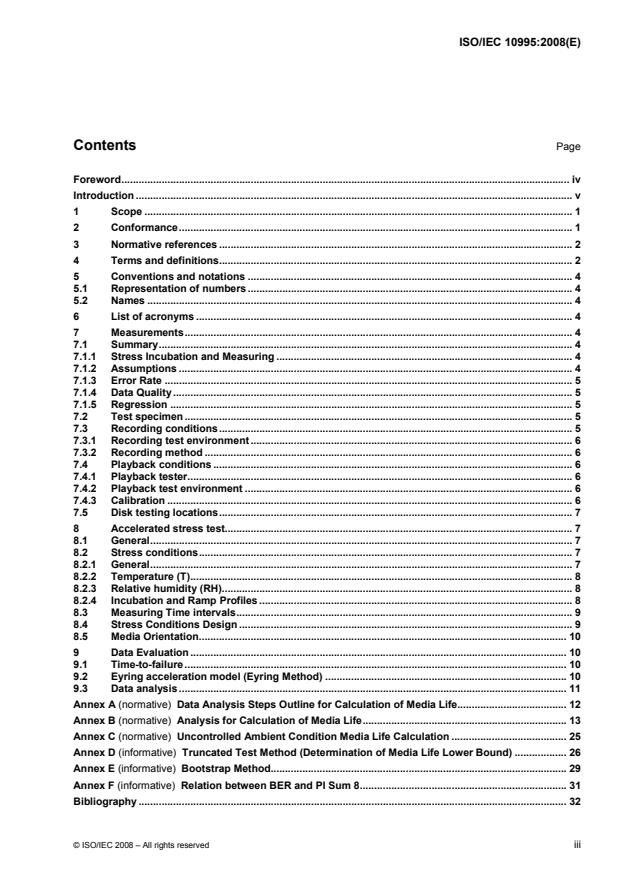
Contents Page
Foreword. iv
Introduction . v
1 Scope . 1
2 Conformance. 1
3 Normative references . 2
4 Terms and definitions. 2
5 Conventions and notations . 4
5.1 Representation of numbers . 4
5.2 Names . 4
6 List of acronyms . 4
7 Measurements. 4
7.1 Summary. 4
7.1.1 Stress Incubation and Measuring . 4
7.1.2 Assumptions . 4
7.1.3 Error Rate . 5
7.1.4 Data Quality . 5
7.1.5 Regression . 5
7.2 Test specimen . 5
7.3 Recording conditions. 5
7.3.1 Recording test environment . 6
7.3.2 Recording method . 6
7.4 Playback conditions . 6
7.4.1 Playback tester. 6
7.4.2 Playback test environment . 6
7.4.3 Calibration . 6
7.5 Disk testing locations. 7
8 Accelerated stress test. 7
8.1 General. 7
8.2 Stress conditions. 7
8.2.1 General. 7
8.2.2 Temperature (T). 8
8.2.3 Relative humidity (RH). 8
8.2.4 Incubation and Ramp Profiles . 8
8.3 Measuring Time intervals. 9
8.4 Stress Conditions Design . 9
8.5 Media Orientation. 10
9 Data Evaluation . 10
9.1 Time-to-failure . 10
9.2 Eyring acceleration model (Eyring Method) . 10
9.3 Data analysis . 11
Annex A (normative) Data Analysis Steps Outline for Calculation of Media Life. 12
Annex B (normative) Analysis for Calculation of Media Life. 13
Annex C (normative) Uncontrolled Ambient Condition Media Life Calculation . 25
Annex D (informative) Truncated Test Method (Determination of Media Life Lower Bound) . 26
Annex E (informative) Bootstrap Method. 29
Annex F (informative) Relation between BER and PI Sum 8. 31
Bibliography . 32
© ISO/IEC 2008 – All rights reserved iii
Foreword
ISO (the International Organization for Standardization) and IEC (the International Electrotechnical
Commission) form the specialized system for worldwide standardization. National bodies that are members of
ISO or IEC participate in the development of International Standards through technical committees
established by the respective organization to deal with particular fields of technical activity. ISO and IEC
technical committees collaborate in fields of mutual interest. Other international organizations, governmental
and non-governmental, in liaison with ISO and IEC, also take part in the work. In the field of information
technology, ISO and IEC have established a joint technical committee, ISO/IEC JTC 1.
International Standards are drafted in accordance with the rules given in the ISO/IEC Directives, Part 2.
The main task of the joint technical committee is to prepare International Standards. Draft International
Standards adopted by the joint technical committee are circulated to national bodies for voting. Publication as
an International Standard requires approval by at least 75 % of the national bodies casting a vote.
Attention is drawn to the possibility that some of the elements of this document may be the subject of patent
rights. ISO and IEC shall not be held responsible for identifying any or all such patent rights.
ISO/IEC 10995 was prepared by Ecma International (as ECMA-379) and was adopted, under a special “fast-
track procedure”, by Joint Technical Committee ISO/IEC JTC 1, Information technology, in parallel with its
approval by national bodies of ISO and IEC.
iv © ISO/IEC 2008 – All rights reserved
Introduction
Markets and industry have developed the common understanding that the property referred to as the archival
life of data recorded to optical media plays an increasingly important role for the intended applications. The
existing standard test methodologies for recordable media include magneto-optical media and recordable
compact disk systems. It was agreed that the project represented by this International Standard be
undertaken in order to provide a methodology that includes the testing of newer, currently available products.
The Optical Storage Technology Association (OSTA) initiated work on this subject and developed the initial
drafts. Following that development, the project was moved to Ecma International TC 31 for further
development and finalization. OSTA and Ecma wish to thank the members and organizations in NIST, CDs21
Solutions, and DCAj for their support of the development of this International Standard.
© ISO/IEC 2008 – All rights reserved v
INTERNATIONAL STANDARD ISO/IEC 10995:2008(E)
Information technology — Digitally recorded media for
information interchange and storage — Test method for the
estimation of the archival lifetime of optical media
1 Scope
This International Standard specifies an accelerated aging test method for estimating the life expectancy for
the retrievability of information stored on recordable or rewritable optical disks.
This test includes details on the following formats: DVD-R/-RW/-RAM, +R/+RW. It may be applied to
additional optical disk formats with the appropriate specification substitutions and may be updated by
committee in the future as required.
This International Standard includes the following:
⎯ stress conditions;
⎯ assumptions;
⎯ ambient conditions:
⎯ controlled storage condition, e.g. 25 °C and 50 % RH, using the Eyring model,
⎯ uncontrolled storage condition, e.g. 30 °C and 80 % RH, using the Arrhenius model;
⎯ evaluation system description;
⎯ specimen preparation;
⎯ data acquisition procedure;
⎯ data interpretation.
The methodology includes only the effects of temperature (T) and relative humidity (RH). It does not attempt
to model degradation due to complex failure mechanism kinetics, nor does it test for exposure to light,
corrosive gases, contaminants, handling, and variations in playback subsystems. Disks exposed to these
additional sources of stress or higher levels of T and RH are expected to experience shorter usable lifetimes.
2 Conformance
Media tested by this methodology shall conform to all normative references specific to that media format.
© ISO/IEC 2008 – All rights reserved 1
3 Normative references
The following referenced documents are indispensable for the application of this document. For dated
references, only the edition cited applies. For undated references, the latest edition of the referenced
document (including any amendments) applies.
ISO/IEC 16448:2002, Information technology — 120 mm DVD — Read-only disk
ISO/IEC 16449:2002, Information technology — 80 mm DVD — Read-only disk
ISO/IEC 17341:2006, Information technology — Data Interchange on 120 mm and 80 mm Optical Disk using
+RW Format – Capacity: 4,7 Gbytes and 1,46 Gbytes per Side (Recording speed up to 4X)
ISO/IEC 17342:2004, Information technology — 80 mm (1,46 Gbytes per side) and 120 mm (4,70 Gbytes per
side) DVD re-recordable disk (DVD-RW)
ISO/IEC 17344:2006, Information technology — Data Interchange on 120 mm and 80 mm Optical Disk using
+R Format – Capacity: 4,7 Gbytes and 1,46 Gbytes per Side (Recording speed up to 16X)
ISO/IEC 17592:2004, Information technology — 120 mm (4,7 Gbytes per side) and 80 mm (1,46 Gbytes per
side) DVD rewritable disk (DVD-RAM)
ISO/IEC 23912:2005, Information technology — 80 mm (1,46 Gbytes per side) and 120 mm (4,70 Gbytes per
side) DVD Recordable Disk (DVD-R)
ISO/IEC 25434:2007, Information technology — Data interchange on 120 mm and 80 mm optical disk using
+R DL format — Capacity: 8,55 Gbytes and 2,66 Gbytes per side (recording speed up to 8x)
ISO/IEC 26925:2006, Information technology — Digital storage media for information interchange — Data
Interchange on 120 mm and 80 mm Optical Disk using +RW HS Format — Capacity: 4,7 Gbytes and 1,46
Gbytes per Side (Recording speed 8X)
ISO/IEC 29642:2007, Information technology — Data Interchange on 120 mm and 80 mm optical disk using
+RW DL format – Capacity: 8,55 Gbytes and 2,66 Gbytes per side (recording speed 2,4x)
4 Terms and definitions
For the purposes of this document, the following terms and definitions apply.
4.1
archival
ability of a medium or system to maintain the retrievability of recorded information for a specified extended
period of years
4.2
Arrhenius method
accelerated aging model based on the effects of temperature
4.3
baseline
initial test analysis measurements (e.g. initial error rate) after recording and before exposure to a stress
condition; measurement at stress time t=0 hours
2 © ISO/IEC 2008 – All rights reserved
4.4
bootstrap method
statistical method for estimating the sampling distribution by re-sampling with replacement from the original
sample
NOTE See Annex E.
4.5
Eyring Method
accelerated aging model based on the effects of temperature and relative humidity
4.6
error rate
rate of errors on the sample disk measured before error correction is applied
4.7
incubation
process of enclosing and maintaining controlled test sample environments
4.8
life expectancy
LE
length of time estimation that information is predicted to be retrievable in a system while in a specified
environmental condition
4.9
maximum error rate
maximum of the error rate measured anywhere in one of the relevant areas on the disk
NOTE 1 For DVD-R/RW and +R/+RW this is the Maximum PI Sum 8.
NOTE 2 For DVD-RAM this is the Maximum BER.
4.10
retrievability
ability to recover physical information as recorded
4.11
stress
temperature and relative humidity variables to which the sample is exposed for the duration of test incubation
intervals
4.12
system
combination of hardware, software, storage medium and documentation used to record, retrieve and
reproduce information
4.13
uncorrectable error
error in the playback data that was not corrected by the error correcting decoders
NOTE For DVD-R/RW, +R/+RW, and DVD-RAM, this is an error that is uncorrected by the Reed-Solomon product
code defined in ISO/IEC 16448 for DVD ROM systems.
© ISO/IEC 2008 – All rights reserved 3
5 Conventions and notations
5.1 Representation of numbers
A measured value is rounded off to the least significant digit of the corresponding specified value. For instance,
it implies that a specified value of 1,26 with a positive tolerance of + 0,01 and a negative tolerance of - 0,02
allows a range of measured values from 1,235 to 1,275.
5.2 Names
The names of entities, e.g. specific tracks, fields, zones, etc. are given a capital initial.
6 List of acronyms
BER byte error rate
LCL lower confidence limit
LE life expectancy
PI parity (of the) inner (code)
7 Measurements
7.1 Summary
7.1.1 Stress Incubation and Measuring
A sampling of disks will be measured at 4 stress conditions plus a control disk at room ambient condition. A
minimum number of 20 disks will be included as a group for each stress condition as shown in Table 2.
Each stress condition’s total time will be divided into interval time periods. Each disk in each group of disks will
have their initial error rates measured before their exposure to stress conditions. Thereafter, each disk will be
measured for their error rates after each stress condition incubation time interval. The control disk will also be
measured following each incubation time interval.
7.1.2 Assumptions
This Standard makes the following assumptions for applicability of media to be tested:
⎯ specimen life distribution is appropriately modelled by a statistical distribution,
⎯ the Eyring model can be used to model acceleration with the two stresses involved (temperature and
relative humidity),
⎯ the dominant failure mechanism acting at the usage condition is the same as that at the accelerated
conditions,
⎯ the compatibility of the disk and drive combination will affect the disk’s initial recording quality and the
resulting archival test outcome,
⎯ a hardware and software system needed to read the disk will be available at the time the retrievability of
the information is attempted,
⎯ the recorded format will be recognizable and interpretable by reading software.
4 © ISO/IEC 2008 – All rights reserved
7.1.3 Error Rate
Of all specimen media the Error rate shall be measured in the disk testing locations as defined in 6.5. For
each sample the Maximum error rate shall be determined.
Each DVD-R/RW, +R/+RW disk will have their maximum PI Sum 8 (Max PI-8) determined.
Each DVD-RAM disk will have its maximum byte error rate (Max BER) determined.
Other disk formats not referenced in this document will have the maximum of their defined error rates
determined.
Data collected at each time interval for each individual disk are then used to determine the estimated lifetime
for that disk at that stress condition.
7.1.3.1 PI Sum 8
Per ISO/IEC 16448:2002, a row in an ECC block that has at least 1 byte in error constitutes a PI error. PI Sum
8 is measured over 8 ECC blocks. In any 8 consecutive ECC blocks the total number of PI errors, also called
PI Sum 8, before error correction shall not exceed 280.
7.1.3.2 BER
The number of erroneous symbols shall be measured at any consecutive 32 ECC blocks in the first pass of
the decoder before correction. The BER is the number of erroneous symbols divided by the total number of
symbols included in the 32 consecutive ECC blocks. The maximum value of the BER measured over the area
-3
specified in 6.5 shall not exceed 10 . (See Annex F).
7.1.4 Data Quality
Data quality is checked by plotting the median rank of the estimated time to failure values with a best fit line
for each stress condition. The lines are then checked for reasonable parallelism.
7.1.5 Regression
The time-to-failure values at each stress condition are then regressed to find a histogram of the time-to-failure
values at ambient condition using the bootstrap method.
The mean lifetimes are regressed against temperature and relative humidity according to an Eyring
acceleration model.
7.2 Test specimen
The disk sample set shall represent the construction, materials, manufacturing process, quality and variation
of the final process output.
Consideration shall be made to shelf life. Disks with longer shelf time before recording and testing may impact
test results. Shelf time shall be representative of normal usage shelf time.
7.3 Recording conditions
Before entering media into accelerated aging tests, they shall be recorded as optimally as is practicable,
according to the descriptions given in the related standard. OPC (optimum power control) during writing
process shall serve as the method to achieve recorded media minimum error rates. It is generally understood
that optimally recorded media will yield the longest predicted life results. Media is deemed acceptable for entry
into the aging tests when its error rate and all other media parametric specifications are found to be within its
respective standard’s specification limits.
© ISO/IEC 2008 – All rights reserved 5
Recording hardware is at the discretion of the recording party. It may be either commercial drive-based or
specialty recording tester based. It shall be capable of producing recordings that meet all specifications.
The maximum recording speed shall be at the media’s highest rated speed and this speed shall be reported.
7.3.1 Recording test environment
When performing the recordings, the air immediately surrounding the media shall have the following
properties:
temperature: 23 °C to 35 °C
relative humidity: 45 % to 55 %
atmospheric pressure: 60 kPa to 106 kPa
No condensation on the disk shall occur. Before testing the disk shall be conditioned in this environment for
48 h minimum. It is recommended that before testing the entrance surface is cleaned according to the
instructions of the manufacturer of the disk.
7.3.2 Recording method
Specimen disks shall be recorded at a single session and finalized.
7.4 Playback conditions
7.4.1 Playback tester
All media shall be read by the playback tester as specified in each of the medium’s standard and at their
specified test conditions.
Specimen media shall be read as described in the format standards identified in Clause 3.
7.4.2 Playback test environment
When measuring the error rates, the air immediately surrounding the disk shall have the following properties:
temperature: 23 °C to 35 °C
relative humidity: 45 % to 55 %
atmospheric pressure: 60 kPa to 106 kPa
Unless otherwise stated, all tests and measurements shall be made in this test environment.
7.4.3 Calibration
The test equipment shall be calibrated as prescribed by its manufacturer using calibration disks approved by
said manufacturer and as needed before disk testing.
A control disk shall be maintained at ambient conditions and its error rate measured at the same time the
stressed disks are measured initially and after each stress interval.
The mean and standard deviation of the control disk shall be established by collecting at least five
measurements. Should any individual error rate reading differ from the mean by more than three times the
standard deviation, the problem shall be corrected and all data collected since the last valid control point shall
be re-measured.
6 © ISO/IEC 2008 – All rights reserved
7.5 Disk testing locations
Testing locations shall be a minimum of three bands spaced evenly from inner, middle and outer radius
locations on the disk as indicated in Table 1. The total testing area shall represent a minimum of 5 % of the
disk. Each of the three test bands shall have more than 750(2EEh) ECC Blocks for 80 mm disks, and
2 400(960h) ECC Blocks for 120 mm disks.
Table 1 - Nominal radii of the three test bands
DVD-R/RW, +R/+RW disk
DVD-RAM disk
(Single Layer / Dual Layer)
80 mm 120 mm 80 mm 120 mm
Band 1 25,0 25,0 24,1-25,0 24,1-25,0
Band 2 30,0 40,0 29,8-30,8 39,4-40,4
Band 3 35,0 55,0 34,6-35,6 54,9-55,8
8 Accelerated stress test
8.1 General
Information properly recorded on an archival quality optical disk should have a life expectancy exceeding a
predetermined number of years. Accelerated aging studies are used in order to conclude that a life
expectancy exceeds the predetermined minimum number of years. This test plan is intended to provide the
information necessary to satisfactorily evaluate the particular optical disk system including proposed archival
quality optical disks.
8.2 Stress conditions
8.2.1 General
Stress conditions for this test method are increases in temperature and relative humidity. The stress
conditions are used to accelerate the chemical reaction rate from what would occur normally at ambient or
usage conditions. The chemical reaction is considered degradation in desired material property that eventually
leads to disk failure.
Four stress conditions and the minimum number of specimens for those stress conditions that shall be used
are shown in Table 2. Additional specimens and conditions may be used if desired for improved precision.
The total time for each stress condition as given in Table 2 is divided into four equal incubation durations. The
temperature and relative humidity during each incubation cycle shall be controlled as depicted in Table 3 and
Figure 1. After each cycle of incubation all specimens shall be measured.
Table 2 - Stress conditions for use with the Eyring Method
Test cell Test stress condition Number of Incubation Total time Intermediate Min equilibration
number (inc) specimens duration RH duration
Temp (°C) %RH hours hours %RH hours
1a 85 85 20 250 1 000 30 7
2a 85 70 20 250 1 000 30 6
3a 65 85 20 500 2 000 35 9
4a 70 75 30 625 2 500 33 11
© ISO/IEC 2008 – All rights reserved 7
8.2.2 Temperature (T)
The temperature levels chosen for this test plan are based on the following:
− there shall be no change of phase within the test system over the test-temperature range. This restricts
the temperature to greater than 0 °C and less than 100 °C,
− the temperature shall not be so high that plastic deformation occurs anywhere within the disk structure.
The typical substrate material for media is polycarbonate (glass transition temperature ~150 °C). The glass
transition temperature of other layers may be lower. Experience with high-temperature testing of DVDs and
+R/+RW disks indicates that an upper limit of 85 °C is practical for most applications.
8.2.3 Relative humidity (RH)
Experience indicates that 85 % RH is the generally accepted upper limit for control within most accelerated
test cells.
8.2.4 Incubation and Ramp Profiles
The relative humidity transition (ramp) profile is intended to avoid moisture condensation within the substrate,
minimize substantial moisture gradients in the substrate and to end at ramp down completion with the
substrate equilibrated to ambient condition. This is accomplished by varying the moisture content of the
chamber only at the stress incubation temperature, and allowing sufficient time for equilibration during ramp-
down based on the diffusion coefficient of water in polycarbonate.
Table 3 - T and RH transition (ramp) profile for each incubation cycle
Process step Temperature Relative humidity Duration
°C % hours
Start at T at RH —
amb amb
T, RH ramp to T to RH 1,5 ± 0,5
inc int
RH ramp at T to RH 1,5 ± 0,5
inc inc
Incubation at T at RH See Table 2
inc inc
RH ramp at T to RH 1,5 ± 0,5
inc int
Equilibration at T at RH See Table 2
inc int
T, RH ramp to T to RH 1,5 ± 0,5
amb amb
end at T at RH —
amb amb
amb = room ambient T or RH (T or RH )
amb amb
inc = stress incubation T or RH (T or RH )
inc inc
int = intermediate relative humidity (RH ) that at T supports the same equilibrium
int inc
moisture absorption in polycarbonate as that supported at T and RH
amb amb
8 © ISO/IEC 2008 – All rights reserved
Relative Humidity (%) (RH)
Process step
T,RH RH Incubation RH Equilibration T,RH
Ramp Ramp Ramp Ramp
Temp.
RH
End
Start
Time (Hour)
Figure 1 - Graph of typical transition (ramp) profile
8.3 Measuring Time intervals
For data collection, PI Sum 8 (DVD–R, DVD–RW, +R, +RW), or BER (DVD-RAM) measurements for each
disk will occur: 1) before disk exposure to any stress condition to determine its baseline measurement and
2) after each cycle of incubation. The length of time for intervals is dependant on the severity of the stress
condition.
Using each disk's regression equation, the failure time for each disk shall then be computed for the stress
condition it was exposed to.
8.4 Stress Conditions Design
Table 2 specifies the temperatures, relative humidities, time intervals, minimum total test time, and minimum
number of specimens for each stress condition. A separate group of specimens is used for each stress
condition.
All temperatures may deviate ±2 °C of the target temperature; all relative humidities may deviate ±3 % RH of
the target relative humidity.
The intermediate relative humidity (RH ) in Table 2 is calculated assuming 25 °C and 50 % RH ambient
int
conditions. If the ambient is different, the intermediate relative humidity to be used is calculated using the
equation:
0,24+ 0,0037×T
amb
RH = ×RH
int amb
0,24+ 0,0037×T
inc
where
T and T are respectively the ambient and incubation temperature in units of °C;
amb inc
RH is the ambient relative humidity;
amb
RH is the intermediate relative humidity.
int
The stress conditions tabulated in Tables 2 and 3 offer sufficient combinations of temperature and relative
humidity to satisfy the mathematical requirements of the Eyring model to demonstrate linearity of either Max
PI Sum 8, or Max BER or their logs respectively, versus time, and to produce a satisfactory confidence level to
make a meaningful conclusion.
© ISO/IEC 2008 – All rights reserved 9
Temperature (℃)
8.5 Media Orientation
Media subjected to this test method shall be maintained in a vertical position with a minimum of 2 mm
separation between disks to allow air flow between disks and to minimize deposition of debris on disk surfaces
which could negatively influence the error rate measurements.
9 Data Evaluation
9.1 Time-to-failure
All disks subjected to stress conditions shall have their time-to-failure calculated at the stress condition they
have been subjected to. Failure criteria values are: Max PI Sum 8 exceeding 280 for DVD-R/RW, +R/+RW,
-3
and Max BER exceeding 10 for DVD-RAM.
Material degradation manifests itself as data errors in the disk, providing a relationship between disk errors
and material degradation. The chemical changes are generally expected to cause test data to have a
distribution that follows an exponential function over time. Therefore, test data values of: PI Sum 8 or BER as
a function of time are expected to exhibit an exponential distribution.
The best function fitting an error trend can be found by regression of the test data against time, for example,
with a least squares fit. The time-to-failure per disk type can be calculated using the error trend function and
the failure criteria.
9.2 Eyring acceleration model (Eyring Method)
Using the Eyring model, the following equation is derived from the laws of thermodynamics and can be used
to handle the two critical stresses of temperature and relative humidity.
aH∆/(kT B+×C/T)RH
tA= Te e
where
t is the time to failure;
A is the pre-exponential time constant;
a
T is the pre-exponential temperature factor;
∆H is the activation energy per molecule;
-23
k is the Boltzmann's constant (1,3807 × 10 J/molecule degree K);
T is the temperature (in Kelvin);
B, C is the RH exponential constants;
RH is the relative humidity.
For the temperature range used in this test method, “a” and “C” shall be set to zero. The Eyring model
equation then reduces to the following:
∆H /kT B×RH
tA= e e , or
∆H
ln(t)= ln(A)+ +B×RH
kT
10 © ISO/IEC 2008 – All rights reserved
9.3 Data analysis
Data Analysis is contained in the following Annexes:
Annex A: Data Analysis Steps Outline for Calculation of Media Life
Annex B: Analysis for Calculation of Media Life
Annex C: Uncontrolled Ambient Condition Media Life Calculation
Annex D: Truncated Test Method (Determination of Media Life Lower Bound)
Annex E: Bootstrap Method
© ISO/IEC 2008 – All rights reserved 11
Annex A
(normative)
Data Analysis Steps Outline for Calculation of Media Life
The following is an outline of steps to estimate the life expectancy value, as a function of ambient temperature
and relative humidity, and used to determine if a disk will or will not exceed a life expectancy of X-years.
1. For each specimen, compute (via linear regression), the predicted time-to-failure.
2. (Steps 2 and 3 are for data quality check)
For each stress condition, determine the median rank of each specimen, and plot the median rank
versus time-to-failure on a lognormal graph.
3. Verify that the plots for all stress conditions are reasonably parallel to one another. Note: In the case
where the plots are not determined to be reasonably parallel, 6.1.2 Assumptions shall be checked.
4. Using the reduced Eyring equation, carry out a least squares fit to the log failure times across all
specimens and stress conditions.
5. Employ bootstrapping, using the residuals from the fit in step 4, to generate a simulation sample of
1 000 predicted times-to-failure at ambient condition.
6. For the ambient condition, plot a histogram of these 1 000 predicted times-to-failure.
7. For the ambient condition, compute the estimated 5 % point of the 1 000 predicted times-to-failure.
12 © ISO/IEC 2008 – All rights reserved
Annex B
(normative)
Analysis for Calculation of Media Life
Step 1
Determine the time-to-failure for each specimen at the stress applied following the procedure as described
below. Error rates to be measured are as defined in 6.1.3:
For DVD-R/RW, +R/+RW: PI Sum 8
For DVD-RAM: BER
Use the initial error rate measured prior to accelerated aging plus the error rates measured after each
specified accelerated aging incubation interval.
For each specimen a linear regression is performed with the ln (measured error rates), as the dependent
variable and time as the independent variable. The time-to-failure of the specimen is calculated from the slope
and intercept of the regression as the time at which the specimen would have a Max PI Sum 8 of 280, or a
-3
Max BER of 10 .
For example data, a purely hypothetical data set was generated. These values were completely fabricated for
this assumption. The data is offered solely as an example of the mathematical methodology used in this test
procedure.
Table B.1 - Estimated time to failure for example data
Group 1a 85°C/85%RH
Hours
Hours to
Disc #
0 250 500 750 1 000 Failure
A1 16 78 116 278 445 788
A2 25 64 134 342 532 743
A3 26 94 190 335 642 685
A4 26 111 247 343 718 647
A5 27 89 185 246 466 762
A6 21 111 207 567 896 607
A7 26 121 274 589 781 588
A8 31 108 223 315 745 654
A9 24 118 285 723 754 578
A10 12 85 178 312 988 669
A11 28 111 167 312 771 671
A12 24 136 267 444 719 614
A13 35 76 265 567 610 626
A14 19 53 112 278 534 778
A15 28 88 158 308 654 704
A16 27 68 120 263 432 807
A17 18 87 176 302 558 723
A18 26 109 238 421 641 645
A19 26 111 253 378 638 649
A20 31 91 206 367 728 656
© ISO/IEC 2008 – All rights reserved 13
Group 2a 85°C/70%RH
Hours
Hours to
Disc #
0 250 500 750 1 000 Failure
B1 10 20 67 112 156 1 117
B2 8 20 47 84 188 1 118
B3 12 26 72 185 421 880
B4 20 43 120 166 219 999
B5 32 45 76 103 267 1 126
B6 21 37 104 222 368 870
B7 21 30 89 155 221 1 035
B8 22 26 72 125 267 1 043
B9 25 46 124 182 224 994
B10 17 38 67 179 378 911
B11 28 58 88 120 268 1 065
B12 8 15 36 144 189 1 059
B13 10 27 89 175 385 880
B14 23 54 111 148 221 1 037
B15 28 39 125 172 278 959
B16 25 53 88 130 188 1 149
B17 20 43 75 166 256 999
B18 22 26 50 172 229 1 058
B19 13 38 78 124 189 1 078
B20 10 19 28 121 268 1 046
Group 3a 65°C/85%RH
Hours
Hours to
Disc #
0 500 1 000 1 500 2 000 failure
C1 14 23 58 112 278 2 057
C2 10 17 55 165 263 1 948
C3 11 56 88 138 189 2 078
C4 18 28 78 117 243 2 106
C5 17 45 78 143 189 2 167
C6 10 14 45 154 231 2 031
C7 31 53 111 156 211 2 151
C8 29 54 106 154 218 2 128
C9 22 32 65 89 126 2 799
C10 29 36 78 145 188 2 297
C11 21 38 89 148 227 2 075
C12 24 45 68 134 211 2 236
C13 28 57 78 132 190 2 352
C14 19 47 61 117 150 2 486
C15 25 65 89 184 256 1 972
C16 10 18 57 113 178 2 189
C17 21 34 45 98 121 2 845
C18 12 20 34 112 176 2 308
C19 28 56 108 176 243 2 001
C20 29 36 57 143 238 2 207
14 © ISO/IEC 2008 – All rights reserved
Group 4a 70°C/75%RH
Hours
Hours to
Disc #
0 625 1 250 1 875 2 500 failure
D1 25 34 64 92 167 3 240
D2 25 93 134 154 211 2 596
D3 7 23 97 103 178 2 615
D4 10 20 56 89 155 2 920
D5 5 20 78 132 187 2 496
D6 5 15 52 112 167 2 644
D7 22 34 67 132 188 2 851
D8 12 17 56 78 108 3 318
D9 22 34 67 132 189 2 847
D10 23 27 54 121 152 3 129
D11 11 20 41 87 115 3 249
D12 15 18 43 88 118 3 343
D13 19 21 38 82 135 3 435
D14 18 22 86 178 245 2 456
D15 22 26 73 145 252 2 582
D16 18 18 29 66 127 3 649
D17 22 26 93 145 178 2 761
D18 18 27 56 88 134 3 316
D19 11 32 44 97 143 3 051
D20 12 56 66 124 249 2 550
D21 14 34 54 77 112 3 500
D22 20 23 25 50 181 3 593
D23 11 16 27 54 160 3 275
D24 17 24 25 58 108 4 034
D25 11 25 22 62 130 3 488
D26 17 24 25 70 123 3 707
D27 21 39 63 78 163 3 304
D28 20 28 45 111 243 2 787
D29 15 21 38 65 134 3 453
D30 10 34 54 96 176 2 841
Step 2
For each stress condition, specimens are ordered by increasing time-to-failure values.
The median rank of the specimens is calculated using the estimate (i −0,5)/n, where i is the time-to-failure
order and n is the total number of specimens at the stress condition.
The data can be plotted in different ways. If lognormal graph paper is employed, the data is plotted with
time-to-failure on the abscissa and median rank on the ordinate.
NOTE On most lognormal graph paper, the actual ordinate scale is the probability of failure; the median rank is
converted to the probability of failure by multiplying by 100.
If linear axes are desired, the data can be linearized by plotting the critical value for the normal cumulative
distribution of the median rank on the ordinate and the natural logarithm of the time-to-failure on the abscissa.
The critical value for the normal cumulative distribution of the median rank is the value of t for which F (t) (the
cumulative distribution function) equals the median rank.
© ISO/IEC 2008 – All rights reserved 15
Table B.2 - Median rank and the critical value for estimated time to failure
Group 1a 85°C/85%RH
ascending Hours ascending median critical
Hours to
Disc #
0 250 500 750 1 000 Failure(H) ln(H) rank value
order number
1 A9 24 118 285 723 754 578 6,3596 0,025 -1,960
2 A7 26 121 274 589 781 588 6,3767 0,075 -1,440
3 A6 21 111 207 567 896 607 6,4085 0,125 -1,150
4 A12 24 136 267 444 719 614 6,4200 0,175 -0,935
5 A13 35 76 265 567 610 626 6,4394 0,225 -0,755
6 A18 26 109 238 421 641 645 6,4693 0,275 -0,598
7 A4 26 111 247 343 718 647 6,4723 0,325 -0,454
8 A19 26 111 253 378 638 649 6,4754 0,375 -0,319
9 A8 31 108 223 315 745 654 6,4831 0,425 -0,189
10 A20 31 91 206 367 728 656 6,4862 0,475 -0,063
11 A10 12 85 178 312 988 669 6,5058 0,525 0,063
12 A11 28 111 167 312 771 671 6,5088 0,575 0,189
13 A3 26 94 190 335 642 685 6,5294 0,625 0,319
14 A15 28 88 158 308 654 704 6,5568 0,675 0,454
15 A17 18 87 176 302 558 723 6,5834 0,725 0,598
16 A2 25 64 134 342 532 743 6,6107 0,775 0,755
17 A5 27 89 185 246 466 762 6,6359 0,825 0,935
18 A14 19 53 112 278 534 778 6,6567 0,875 1,150
19 A1 16 78 116 278 445 788 6,6695 0,925 1,440
20 A16 27 68 120 263 432 807 6,6933 0,975 1,960
median 663 6,4960
Group 2a 85°C/70%RH
order Hours ascending median critical
Hours to
Disc #
number 0 250 500 750 1 000 Failure(H) ln(H) rank value
1 B6 21 37 104 222 368 870 6,7685 0,025 -1,960
2 B3 12 26 72 185 421 880 6,7799 0,075 -1,440
3 B13 10 27 89 175 385 880 6,7799 0,125 -1,150
4 B10 17 38 67 179 378 911 6,8145 0,175 -0,935
5 B15 28 39 125 172 278 959 6,8659 0,225 -0,755
6 B9 25 46 124 182 224 994 6,9017 0,275 -0,598
7 B4 20 43 120 166 219 999 6,9068 0,325 -0,454
8 B17 20 43 75 166 256 999 6,9068 0,375 -0,319
9 B7 21 30 89 155 221 1 035 6,9422 0,425 -0,189
10 B14 23 54 111 148 221 1 037 6,9441 0,475 -0,063
11 B8 22 26 72 125 267 1 043 6,9499 0,525 0,063
12 B20 10 19 28 121 268 1 046 6,9527 0,575 0,189
13 B18 22 26 50 172 229 1 058 6,9641 0,625 0,319
14 B12 8 15 36 144 189 1 059 6,9651 0,675 0,454
15 B11 28 58 88 120 268 1 065 6,9707 0,725 0,598
16 B19 13 38 78 124 189 1 078 6,9829 0,775 0,755
17 B1 10 20 67 112 156 1 117 7,0184 0,825 0,935
18 B2 8 20 47 84 188 1 118 7,0193 0,875 1,150
19 B5 32 45 76 103 267 1 126 7,0264 0,925 1,440
20 B16 25 53 88 130 188 1 149 7,0466 0,975 1,960
median 1 040 6,9470
16 © ISO/IEC 2008 – All rights reserved
Group 3a 65°C/85%RH
order Hours ascending median critical
Hours to
Disc #
number 0 500 1 000 1 500 2 000 failure(H) ln(H) rank value
1 C2 10 17 55 165 263 1 948 7,5746 0,025 -1,960
2 C15 25 65 89 184 256 1 972 7,5868 0,075 -1,440
3 C19 28 56 108 176 243 2 001 7,6014 0,125 -1,150
4 C6 10 14 45 154 231 2 031 7,6163 0,175 -0,935
5 C1 14 23 58 112 278 2 057 7,6290 0,225 -0,755
6 C11 21 38 89 148 227 2 075 7,6377 0,275 -0,598
7 C3 11 56 88 138 189 2 078 7,6392 0,325 -0,454
8 C4 18 28 78 117 243 2 106 7,6525 0,375 -0,319
9 C8 29 54 106 154 218 2 128 7,6629 0,425 -0,189
10 C7 31 53 111 156 211 2 151 7,6737 0,475 -0,063
11 C5 17 45 78 143 189 2 167 7,6811 0,525 0,063
12 C16 10 18 57 113 178 2 189 7,6912 0,575 0,189
13 C20 29 36 57 143 238 2 207 7,6994 0,625 0,319
14 C12 24 45 68 134 211 2 236 7,7124 0,675 0,454
15 C10 29 36 78 145 188 2 297 7,7394 0,725 0,598
16 C18 12 20 34 112 176 2 308 7,7441 0,775 0,755
17 C13 28 57 78 132 190 2 352 7,7630 0,825 0,935
18 C14 19 47 61 117 150 2 486 7,8184 0,875 1,150
19 C9 22 32 65 89 126 2 799 7,9370 0,925 1,440
20 C17 21 34 45 98 121 2 845 7,9533
...
Questions, Comments and Discussion
Ask us and Technical Secretary will try to provide an answer. You can facilitate discussion about the standard in here.
Loading comments...