

ISO/TS 12812-5:2017
(Main)Core banking — Mobile financial services — Part 5: Mobile payments to businesses
General Information
- Abstract
ISO/TS 12812-5:2017 focuses on mechanisms by which a person ("consumer", "payer" or "business") uses a mobile device to initiate a payment to a business entity ("merchant" or "payee"). Such a payment may use the traditional merchant point of interaction (POI) system, where the manner of settling the payment follows well-established merchant services paradigms. Additionally, there are other ways for a consumer to make a payment to a merchant, using the mobile device to initiate, authorize and process transactions outside of traditional payment networks using secure payment instruments. Accordingly, this document supports both "push" and "pull" payments (i.e. transactions that are pushed or transmitted from a mobile device into a POI or pulled or received into a mobile device or POI), which are initiated and/or confirmed by a consumer to purchase goods and or services, including proximate payments, remote secure server payments, as well as mobile payments that leverage other technologies [e.g. cloud computing, quick response ("QR") codes, biometrics, geo-location and other methods to authenticate and authorize the transaction]. One of the most important aspects of the MFS environment is mobile payments to businesses. There are many ways a consumer, or a business as a consumer, can make a payment to a merchant. ISO 12812 provides a comprehensive standard for using the mechanisms involved in mobilizing the transfer of funds regardless of who is involved in the process. This document is intended to be used by potential implementers of mobile retail payment solutions, while ISO 12812-4 is intended for potential implementers of solutions for mobile payments to persons. NOTE ISO 12812‑1:2017, 5.4 explains the differences in the use of these terms. As such, the ISO 12812 (all parts) seeks to support all possible technologies and is not designed to highlight or endorse specific technologies in the competitive marketplace. Although this document deals with mobile payments made by a consumer or a business acting as a consumer, which transactions are subject to a variety of consumer protection requirements, in terms of the relationship to the MFSP, the consumer (or business) is the customer of the MFSP. Nevertheless, this document will use the term "consumer."
- Status
- Published
- Publication Date
- 27-Mar-2017
- Technical Committee
- ISO/TC 68/SC 9 - Information exchange for financial services
- Drafting Committee
- ISO/TC 68/SC 9 - Information exchange for financial services
- Current Stage
- 9093 - International Standard confirmed
- Start Date
- 29-Jul-2025
- Completion Date
- 29-Aug-2026
Overview
ISO/TS 12812-5:2017 - Core banking: Mobile financial services - Part 5: Mobile payments to businesses defines a technical framework for how a person uses a mobile device to initiate payments to a merchant. It covers both traditional merchant point-of-interaction (POI) scenarios and non‑traditional flows that use mobile devices to initiate, authorize and process transactions outside legacy payment networks. The specification supports push and pull payments, proximate and remote payments, and modern enablers such as QR codes, cloud services, biometrics, and geo‑location. The document is intended for implementers of mobile retail payment solutions and complements other parts of the ISO 12812 series.
Key topics and technical requirements
ISO/TS 12812-5 addresses the full technical and operational stack needed for mobile payments to businesses, including:
- Device, network and application selection requirements - guidance on selecting appropriate endpoints and connectivity models for reliable payment initiation.
- Security requirements - principles for authentication, authorization and risk management in mobile payments (including proximate and remote scenarios).
- Logging and receipt requirements - transactional logging, receipt formats and audit trails to support dispute resolution and regulatory compliance.
- Notice and data privacy requirements - consumer notification, privacy protections and handling of personally identifiable information.
- Types of mobile payments - proximate (contactless/NFC) and remote (server‑mediated) payments, plus alternative channels such as QR‑based, SMS, mobile airtime, and mobile wallets.
- Payment instruments - supported instruments include direct debit, credit transfer, payment cards, stored value accounts (SVA), and mobile bill accounts.
- Use cases and risk controls - detailed proximate and remote use cases, user verification methods (UVMs), interoperability models, and dispute/redress procedures.
- Implementation neutrality - the standard does not endorse specific vendors or technologies; it promotes interoperability and references existing message standards (e.g., ISO 8583, ISO 20022).
Applications
ISO/TS 12812-5 is practical for:
- Designing and deploying mobile point‑of‑sale (mPOS) and contactless merchant systems.
- Building mobile wallet solutions and secure remote payment servers.
- Integrating QR, biometric or geo‑location authentication into payment flows.
- Implementing compliance, logging, receipt and dispute resolution processes for mobile retail payments.
Who should use this standard
- Banks and mobile financial service providers (MFSPs)
- Payment processors, acquirers, POS and mPOS vendors
- Mobile network operators and trusted service managers
- Fintech developers, system integrators and regulators seeking interoperable, secure mobile retail payment solutions
Related standards
- ISO 12812‑1 (General framework)
- ISO/TS 12812‑2 (Security)
- Payment messaging standards such as ISO 8583 and ISO 20022
Using ISO/TS 12812-5 helps organizations implement secure, interoperable mobile payment systems that meet consumer protection and regulatory expectations while remaining technology‑agnostic.
Relations
- Consolidated By
ISO 18593:2018 - Microbiology of the food chain — Horizontal methods for surface sampling - Effective Date
- 06-Jun-2022
Get Certified
Connect with accredited certification bodies for this standard

Great Wall Tianjin Quality Assurance Center
Established 1993, first batch to receive national accreditation with IAF recognition.
Hong Kong Quality Assurance Agency (HKQAA)
Hong Kong's leading certification body.

Innovative Quality Certifications Pvt. Ltd. (IQCPL)
Known for integrity, providing ethical & impartial Assessment & Certification. CMMI Institute Partner.
Sponsored listings
Frequently Asked Questions
ISO/TS 12812-5:2017 is a technical specification published by the International Organization for Standardization (ISO). Its full title is "Core banking — Mobile financial services — Part 5: Mobile payments to businesses". This standard covers: ISO/TS 12812-5:2017 focuses on mechanisms by which a person ("consumer", "payer" or "business") uses a mobile device to initiate a payment to a business entity ("merchant" or "payee"). Such a payment may use the traditional merchant point of interaction (POI) system, where the manner of settling the payment follows well-established merchant services paradigms. Additionally, there are other ways for a consumer to make a payment to a merchant, using the mobile device to initiate, authorize and process transactions outside of traditional payment networks using secure payment instruments. Accordingly, this document supports both "push" and "pull" payments (i.e. transactions that are pushed or transmitted from a mobile device into a POI or pulled or received into a mobile device or POI), which are initiated and/or confirmed by a consumer to purchase goods and or services, including proximate payments, remote secure server payments, as well as mobile payments that leverage other technologies [e.g. cloud computing, quick response ("QR") codes, biometrics, geo-location and other methods to authenticate and authorize the transaction]. One of the most important aspects of the MFS environment is mobile payments to businesses. There are many ways a consumer, or a business as a consumer, can make a payment to a merchant. ISO 12812 provides a comprehensive standard for using the mechanisms involved in mobilizing the transfer of funds regardless of who is involved in the process. This document is intended to be used by potential implementers of mobile retail payment solutions, while ISO 12812-4 is intended for potential implementers of solutions for mobile payments to persons. NOTE ISO 12812‑1:2017, 5.4 explains the differences in the use of these terms. As such, the ISO 12812 (all parts) seeks to support all possible technologies and is not designed to highlight or endorse specific technologies in the competitive marketplace. Although this document deals with mobile payments made by a consumer or a business acting as a consumer, which transactions are subject to a variety of consumer protection requirements, in terms of the relationship to the MFSP, the consumer (or business) is the customer of the MFSP. Nevertheless, this document will use the term "consumer."
ISO/TS 12812-5:2017 focuses on mechanisms by which a person ("consumer", "payer" or "business") uses a mobile device to initiate a payment to a business entity ("merchant" or "payee"). Such a payment may use the traditional merchant point of interaction (POI) system, where the manner of settling the payment follows well-established merchant services paradigms. Additionally, there are other ways for a consumer to make a payment to a merchant, using the mobile device to initiate, authorize and process transactions outside of traditional payment networks using secure payment instruments. Accordingly, this document supports both "push" and "pull" payments (i.e. transactions that are pushed or transmitted from a mobile device into a POI or pulled or received into a mobile device or POI), which are initiated and/or confirmed by a consumer to purchase goods and or services, including proximate payments, remote secure server payments, as well as mobile payments that leverage other technologies [e.g. cloud computing, quick response ("QR") codes, biometrics, geo-location and other methods to authenticate and authorize the transaction]. One of the most important aspects of the MFS environment is mobile payments to businesses. There are many ways a consumer, or a business as a consumer, can make a payment to a merchant. ISO 12812 provides a comprehensive standard for using the mechanisms involved in mobilizing the transfer of funds regardless of who is involved in the process. This document is intended to be used by potential implementers of mobile retail payment solutions, while ISO 12812-4 is intended for potential implementers of solutions for mobile payments to persons. NOTE ISO 12812‑1:2017, 5.4 explains the differences in the use of these terms. As such, the ISO 12812 (all parts) seeks to support all possible technologies and is not designed to highlight or endorse specific technologies in the competitive marketplace. Although this document deals with mobile payments made by a consumer or a business acting as a consumer, which transactions are subject to a variety of consumer protection requirements, in terms of the relationship to the MFSP, the consumer (or business) is the customer of the MFSP. Nevertheless, this document will use the term "consumer."
ISO/TS 12812-5:2017 is classified under the following ICS (International Classification for Standards) categories: 03.060 - Finances. Banking. Monetary systems. Insurance. The ICS classification helps identify the subject area and facilitates finding related standards.
ISO/TS 12812-5:2017 has the following relationships with other standards: It is inter standard links to ISO 18593:2018. Understanding these relationships helps ensure you are using the most current and applicable version of the standard.
ISO/TS 12812-5:2017 is available in PDF format for immediate download after purchase. The document can be added to your cart and obtained through the secure checkout process. Digital delivery ensures instant access to the complete standard document.
Standards Content (Sample)
TECHNICAL ISO/TS
SPECIFICATION 12812-5
First edition
2017-03
Core banking — Mobile financial
services —
Part 5:
Mobile payments to businesses
Opérations bancaires de base — Services financiers mobiles —
Partie 5: Paiements mobiles à entreprises
Reference number
©
ISO 2017
© ISO 2017, Published in Switzerland
All rights reserved. Unless otherwise specified, no part of this publication may be reproduced or utilized otherwise in any form
or by any means, electronic or mechanical, including photocopying, or posting on the internet or an intranet, without prior
written permission. Permission can be requested from either ISO at the address below or ISO’s member body in the country of
the requester.
ISO copyright office
Ch. de Blandonnet 8 • CP 401
CH-1214 Vernier, Geneva, Switzerland
Tel. +41 22 749 01 11
Fax +41 22 749 09 47
copyright@iso.org
www.iso.org
ii © ISO 2017 – All rights reserved
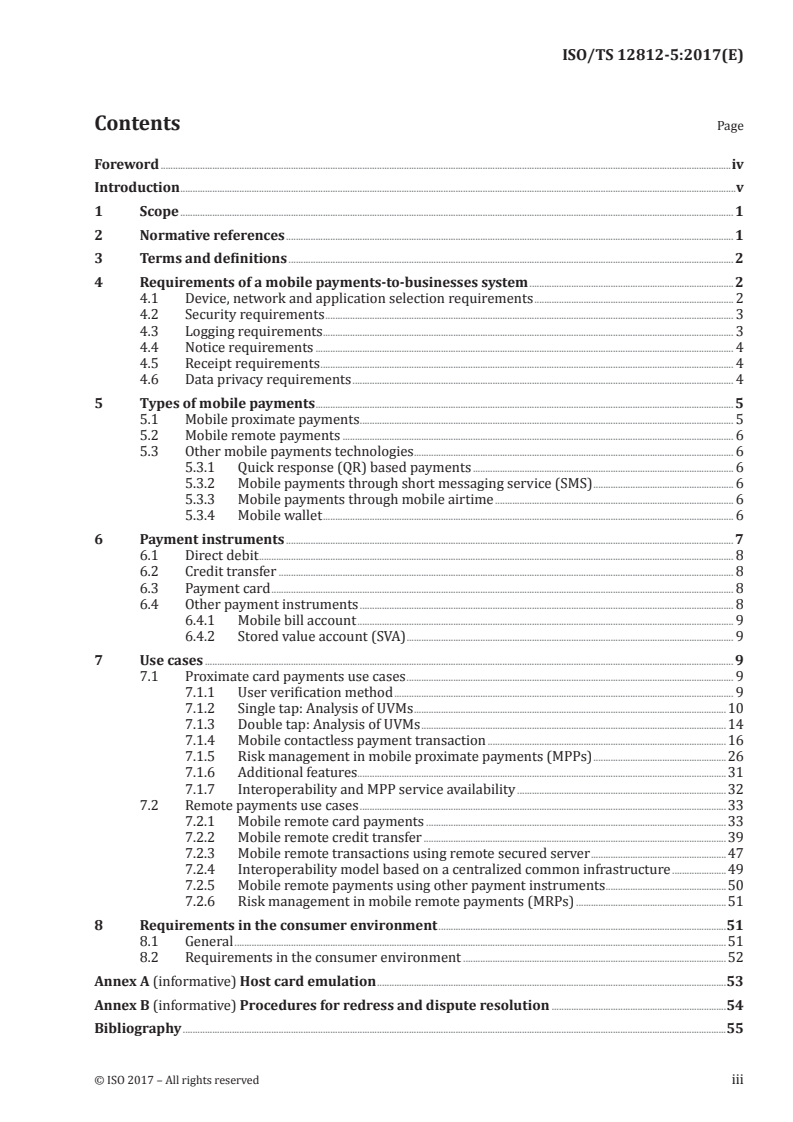
Contents Page
Foreword .iv
Introduction .v
1 Scope . 1
2 Normative references . 1
3 Terms and definitions . 2
4 Requirements of a mobile payments-to-businesses system . 2
4.1 Device, network and application selection requirements . 2
4.2 Security requirements . 3
4.3 Logging requirements . 3
4.4 Notice requirements . 4
4.5 Receipt requirements . 4
4.6 Data privacy requirements . 4
5 Types of mobile payments . 5
5.1 Mobile proximate payments . 5
5.2 Mobile remote payments . 6
5.3 Other mobile payments technologies . 6
5.3.1 Quick response (QR) based payments . 6
5.3.2 Mobile payments through short messaging service (SMS) . 6
5.3.3 Mobile payments through mobile airtime . 6
5.3.4 Mobile wallet . 6
6 Payment instruments . 7
6.1 Direct debit . 8
6.2 Credit transfer . 8
6.3 Payment card . 8
6.4 Other payment instruments . 8
6.4.1 Mobile bill account . 9
6.4.2 Stored value account (SVA) . 9
7 Use cases . 9
7.1 Proximate card payments use cases . 9
7.1.1 User verification method . 9
7.1.2 Single tap: Analysis of UVMs .10
7.1.3 Double tap: Analysis of UVMs .14
7.1.4 Mobile contactless payment transaction .16
7.1.5 Risk management in mobile proximate payments (MPPs) .26
7.1.6 Additional features . . .31
7.1.7 Interoperability and MPP service availability .32
7.2 Remote payments use cases .33
7.2.1 Mobile remote card payments .33
7.2.2 Mobile remote credit transfer .39
7.2.3 Mobile remote transactions using remote secured server .47
7.2.4 Interoperability model based on a centralized common infrastructure .49
7.2.5 Mobile remote payments using other payment instruments .50
7.2.6 Risk management in mobile remote payments (MRPs) .51
8 Requirements in the consumer environment .51
8.1 General .51
8.2 Requirements in the consumer environment .52
Annex A (informative) Host card emulation .53
Annex B (informative) Procedures for redress and dispute resolution .54
Bibliography .55
Foreword
ISO (the International Organization for Standardization) is a worldwide federation of national standards
bodies (ISO member bodies). The work of preparing International Standards is normally carried out
through ISO technical committees. Each member body interested in a subject for which a technical
committee has been established has the right to be represented on that committee. International
organizations, governmental and non-governmental, in liaison with ISO, also take part in the work.
ISO collaborates closely with the International Electrotechnical Commission (IEC) on all matters of
electrotechnical standardization.
The procedures used to develop this document and those intended for its further maintenance are
described in the ISO/IEC Directives, Part 1. In particular the different approval criteria needed for the
different types of ISO documents should be noted. This document was drafted in accordance with the
editorial rules of the ISO/IEC Directives, Part 2 (see www .iso .org/ directives).
Attention is drawn to the possibility that some of the elements of this document may be the subject of
patent rights. ISO shall not be held responsible for identifying any or all such patent rights. Details of
any patent rights identified during the development of the document will be in the Introduction and/or
on the ISO list of patent declarations received (see www .iso .org/ patents).
Any trade name used in this document is information given for the convenience of users and does not
constitute an endorsement.
For an explanation on the voluntary nature of standards, the meaning of ISO specific terms and
expressions related to conformity assessment, as well as information about ISO’s adherence to the
World Trade Organization (WTO) principles in the Technical Barriers to Trade (TBT) see the following
URL: w w w . i s o .org/ iso/ foreword .html.
This document was prepared by Technical Committee ISO/TC 68, Financial services, Subcommittee SC 7,
Core banking.
A list of all the parts in the ISO 12812 series can be found on the ISO website.
iv © ISO 2017 – All rights reserved
Introduction
The use of mobile devices to conduct financial services is occurring following the steady rise of the
number of customers using the Internet for these services. As an evolving market, mobile financial
services (MFSs) are being developed and implemented on various bases throughout different regions
of the world and also among the various providers of such MFSs (MFSPs). Given these conditions,
then, the purpose of this document is to facilitate and promote interoperability, security and quality
of MFSs, while providing an environment where all stakeholders can benefit from the evolution, and
MFSPs remain as commercially free and competitive as possible to design their own implementations
in pursuing their own business strategies.
The intentions of this document are:
a) to advance interoperability of MFSs globally by building an international vision of this environment
and by defining requirements based on a common terminology and basic principles for the design
and operation of MFSs (see ISO 12812-1:2017, Clause 5);
b) to define technical components and their interfaces, as well as roles that may be performed by
different MFSPs (e.g. financial institutions, mobile network operators, trusted service managers).
These components and their interfaces, as well as roles, are defined according to identified use
cases, although future use cases may be considered during the maintenance of the standard;
c) to identify existing standards on which MFSs should be based, as well as possible gaps.
Standardization effort in this area is beneficial for a sound development of the MFSs market as it will:
— facilitate and promote interoperability between the different components or functions developing
and/or providing MFSs (see ISO 12812-1:2017, 4.3 and 4.4), including consideration of the impact
of new components and/or interfaces created by the introduction of a mobile device into the
payment chain;
— build a secure environment so that payers and payees (see ISO/TS 12812-4) and consumers and
merchants (this document) can trust MFSs and allow the MFSPs to manage their risks;
— promote consumer protection mechanisms, including fair contract terms, rules on transparency of
charges, clarification of liability, and procedures for complaints and dispute resolution;
— enable the consumer to choose from different providers of devices or MFSs, including the possibility
to contract with several MFSPs for services on the same device;
— enable the consumer to transfer MFSs from one device to another one (portability);
— promote a consistent consumer experience among various MFSs and MFSPs, with easy-to-use
interfaces.
To achieve these objectives, each part of the ISO 12812 will specify the necessary technical mechanisms
and, when relevant, refer to existing standards in the area of each part.
The ISO 12812 (all parts) provides a framework flexible enough to accommodate new mobile device
technologies, as well as to allow various business models, while enabling compliance with applicable
national regulations (e.g. data privacy, protection of personally-identifiable data, consumer protection,
anti-money laundering and prevention of financial crime) (see ISO 12812-1:2017, 6.3.4).
It is not the intention of the ISO 12812 (all parts) to duplicate or to seek to replace any existing standard
in the area of MFSs (e.g. communication protocols, mobile devices). It is also not the intention of the
ISO 12812 (all parts) to drive technology to any specific application or to restrict the development of
future technologies or solutions. The ISO 12812 (all parts) does not define messages and data elements
to be exchanged at the interfaces between the different components or actors of the system; instead
identified messages and data elements are already specified (e.g. ISO 8583, ISO 20022) and are
referenced by the standard. Mobile devices have communication capabilities that are sufficient for
exchanging transaction data conforming to appropriate ISO standards (e.g. ISO 8583, ISO 20022), as
well as delivering the required transaction authorization information to the POS via other formats (e.g.
bar codes, SMS).
The ISO 12812 (all parts) recognizes the need for unbanked or under-banked consumers to access MFSs.
It also recognizes that these services may be provided by MFSPs who are not financial institutions
according to the applicable regulation(s).
NOTE For this document, the terms and definitions from ISO 12812-1 apply; where a term is abbreviated in
this document, the abbreviation is associated with the initial use of the term.
Figures 7, 8, 9, 10, 11, 12, 13, 14, 15, 16 and 18 or part thereof are courtesy of the European Payments
Council.
vi © ISO 2017 – All rights reserved
TECHNICAL SPECIFICATION ISO/TS 12812-5:2017(E)
Core banking — Mobile financial services —
Part 5:
Mobile payments to businesses
1 Scope
This document focuses on mechanisms by which a person (“consumer”, “payer” or “business”) uses
a mobile device to initiate a payment to a business entity (“merchant” or “payee”). Such a payment
may use the traditional merchant point of interaction (POI) system, where the manner of settling the
payment follows well-established merchant services paradigms. Additionally, there are other ways
for a consumer to make a payment to a merchant, using the mobile device to initiate, authorize and
process transactions outside of traditional payment networks using secure payment instruments.
Accordingly, this document supports both “push” and “pull” payments (i.e. transactions that are pushed
or transmitted from a mobile device into a POI or pulled or received into a mobile device or POI), which
are initiated and/or confirmed by a consumer to purchase goods and or services, including proximate
payments, remote secure server payments, as well as mobile payments that leverage other technologies
[e.g. cloud computing, quick response (“QR”) codes, biometrics, geo-location and other methods to
authenticate and authorize the transaction].
One of the most important aspects of the MFS environment is mobile payments to businesses.
There are many ways a consumer, or a business as a consumer, can make a payment to a merchant.
ISO 12812 provides a comprehensive standard for using the mechanisms involved in mobilizing the
transfer of funds regardless of who is involved in the process. This document is intended to be used by
potential implementers of mobile retail payment solutions, while ISO 12812-4 is intended for potential
implementers of solutions for mobile payments to persons.
NOTE ISO 12812-1:2017, 5.4 explains the differences in the use of these terms. As such, the ISO 12812 (all
parts) seeks to support all possible technologies and is not designed to highlight or endorse specific technologies
in the competitive marketplace.
Although this document deals with mobile payments made by a consumer or a business acting as a
consumer, which transactions are subject to a variety of consumer protection requirements, in terms of
the relationship to the MFSP, the consumer (or business) is the customer of the MFSP. Nevertheless, this
document will use the term “consumer.”
2 Normative references
The following documents are referred to in the text in such a way that some or all of their content
constitutes requirements of this document. For dated references, only the edition cited applies. For
undated references, the latest edition of the referenced document (including any amendments) applies.
ISO 12812-1, Core banking — Mobile financial services — Part 1: General framework
ISO/TS 12812-2, Core banking — Mobile financial services — Part 2: Security and data protection for
mobile financial services
ISO/TS 12812-3, Core banking — Mobile financial services — Part 3: Financial application lifecycle
management
ISO/IEC 18004, Information technology — Automatic identification and data capture techniques — QR
Code 2005 bar code symbology specification
ISO/IEC 18092, Information technology — Telecommunications and information exchange between
systems — Near Field Communication — Interface and Protocol (NFCIP-1)
ISO/IEC 21481, Information technology — Telecommunications and information exchange between
systems — Near Field Communication Interface and Protocol −2 (NFCIP-2)
3 Terms and definitions
For the purposes of this document, the terms and definitions given in ISO 12812-1 apply.
ISO and IEC maintain terminological databases for use in standardization at the following addresses:
— IEC Electropedia: available at http:// www .electropedia .org/
— ISO Online browsing platform: available at http:// www .iso .org/ obp
4 Requirements of a mobile payments-to-businesses system
This clause identifies a set of requirements that are common to the mobilization of any payment,
regardless of whether such a transfer of funds represents a payment to a person or to a business,
or whether it is a mobile proximate payment or a mobile remote payment. In other words, these
requirements apply regardless of the nature of the parties involved in the transaction and whether
those parties are physically present at the same or different locations.
NOTE Many of these essential requirements also are contained in ISO/TS 12812-4, although there are
nuances in how they operate when the payment is to a person as compared with a payments-to-businesses
system, which has its own set of operating rules and technical specifications developed by the MFSP.
4.1 Device, network and application selection requirements
4.1.1 An MFSP shall document its compatibility requirements for each MFS it offers with a mobile
device and permits a consumer (i.e. payer) to select a compatible mobile device and compatible MFS
application(s) for his/her use.
4.1.2 To the extent that an MFS imposes specific requirements on a mobile network operator (MNO),
the MFSP shall document those requirements and determine which MNOs support the MFS. An MFSP
shall permit a consumer to select an MNO that supports the required mobile communications services
for the MFS.
4.1.3 An MFSP shall permit a consumer to select or pre-configure (e.g. for low value transactions) the
appropriate mobile application(s) and/or payment instrument(s), including a mobile wallet, for handling
any particular mobile payment transaction(s).
4.1.4 An MFSP shall ensure that when a mobile wallet is used for mobile payments to a business, it
shall be capable of providing, at a minimum, the following functionality:
— an interface to register personal and payment instruments data (on the mobile device);
— a data repository to store the data (on the mobile device or a secured server);
— an interface allowing the consumer to select the payment instrument;
— an interface allowing the consumer to use the selected payment instrument (can be one interface
managing all payment means or different interfaces for different means);
— an interface for managing and updating stored data (e.g. update, cancellation).
2 © ISO 2017 – All rights reserved
4.1.5 An MFSP shall provide a statement of account activity to the consumer, in a manner appropriate
for the circumstances (e.g. mailing periodic paper statement, download file, online account).
NOTE In cases of billing accounts where the consumer has an obligation for regular payments, due dates can
be displayed on the mobile device by use of pop-up warnings (e.g. information regarding consequences of non-
payment).
4.2 Security requirements
4.2.1 A mobile device used for MFSs shall be able to store or provide access to applications within
an appropriate secure environment (e.g. using supplementary software, SE, TEE) in accordance with
ISO/TS 12812-2.
4.2.2 An application, as well as any associated credentials, resident on the mobile device or accessed
through a mobile device, shall be managed in conformance with the requirements and/or guidance
provided in ISO/TS 12812-3.
4.2.3 A mobile device shall be able to authenticate a consumer using a user verification method (UVM)
established by the MFSP as suitable for the particular application.
NOTE For implementation of authentication mechanisms, refer to ISO/TS 12812-2.
4.2.4 A mobile device shall be equipped with a display and a keyboard (physical or virtual) and other
equipment (e.g. a biometrics capture device) if needed, enabling the activation/selection of the payment
instrument and the confirmation of the transaction by the payer using trusted paths.
4.2.5 A mobile device shall possess the capability to secure the communications channel used for the
mobile payment transaction in a manner that has been determined to be sufficient by the MFSP.
4.2.6 A mobile device should enable the consumer to access a mutual authentication gateway for
exchanging the mobile payment transaction. If the application does not provide mutual authentication,
the MFSP should take alternative security measures in order to protect the communication channel
against security attacks (e.g. man-in-the-middle, malware and viruses).
4.2.7 The MFSP shall ensure that, in establishing any mobile codes or similar authentication credential
(see ISO 12812-1), any use it allows of a bank-issued PIN shall be done in conformance with the
requirements of ISO 9564; a non-bank issued PIN/mobile code does not need to conform to these
requirements.
4.3 Logging requirements
4.3.1 An MFSP shall provide the means for a consumer to view the details of each mobile payment
transaction. The transaction log shall, at a minimum, display the last 10 transactions handled by an
application or the recent transactions completed over the past 30-day period whichever provides the
most information. When specifically requested by the customer and where it is possible and feasible, the
MFSP shall make available additional information to supplement the immediately available information
log of the transaction(s) under reasonable terms.
4.3.2 The transaction log should make available to a consumer the following data:
— transaction date;
— transaction time;
— transaction amount(s);
— transaction currency code(s);
— transaction type;
— payee/payer information (e.g. name/device ID and location);
— transaction verification/integrity information (e.g. token, cryptogram).
4.4 Notice requirements
4.4.1 An MFSP shall notify a consumer that a payment has been authorized, approved and/or
completed (see 4.4.4 for notice delivery methods).
4.4.2 The customer’s MFSP, or in some cases the merchant’s MFSP, shall inform the merchant about the
status of a payment (e.g. that a payment has been received into the merchant’s account).
4.4.3 An MFSP shall notify the merchant about the ability to access the funds that were transferred
into its account.
4.4.4 An MFSP shall accomplish the notice required by this subclause through an appropriate method
of communication (e.g. through pop-up notice in the application, by text, by email, by paper statement).
NOTE Such notices and related communications can include value-added services (e.g. on-demand payment
verification services, fully electronic long-term transaction records, special records for visually impaired users).
4.5 Receipt requirements
4.5.1 A POI that is capable of printing a paper transaction receipt shall provide the consumer with a
printed receipt upon request.
4.5.2 A POI that is capable of transmitting an electronic receipt (e.g. via email, text messaging or other
means) shall provide the consumer with an electronic receipt upon request.
4.5.3 A POI that knows in advance that it cannot provide a transaction receipt should inform the
consumer, to the extent it is physically capable of doing so, that no receipt can be printed or electronically
transmitted and offer the consumer the choice to continue or to cancel the transaction.
In certain low-value transaction environments (e.g. toll roads, subways), it may not be feasible for the
system to provide a receipt or to enable the consumer to cancel the transaction.
4.5.4 An MFSP shall notify a consumer about the legal status of different forms of transaction record
required by the jurisdiction where the MFS is being used.
4.6 Data privacy requirements
4.6.1 An MFSP shall ensure that each MFS it offers conforms to the data protection laws and
regulations of each jurisdiction in which the application is designed to operate (see related information
in ISO/TS 12812-2:2017, 14.1) In the furtherance of this requirement, an MFSP should conduct a privacy
impact assessment (see ISO/TS 12812-2:2017, 14.3).
4.6.2 An MFSP shall conform to the requirements and recommendations contained in ISO/TS 12812-
2:2017, 14.2.
4.6.3 An MFSP shall ensure that parties involved in the processing of the mobile payment document
and implement a security policy that addresses information security and acceptable uses.
4 © ISO 2017 – All rights reserved
4.6.4 An MFSP shall ensure that third parties involve in the processing of mobile payments provide
the appropriate legal notice to the consumer and/or the merchant that the execution of a transfer across
borders entails transmission of the appropriate personal information according to their respective
jurisdictions.
5 Types of mobile payments
In general terms, there are two major categories of mobile payments to a business: (1) proximate
payments and (2) remote payments. Existing payment instruments may either be used in a proximate
or remote manner, whether the technology employed is contactless or some other mobile payment
technology, such as the QR-based mobile payments, mobile payments through mobile airtime, secured
server-based payment authorizations, etc. (see ISO 12812-1:2017, 7.2, 7.3 and Annex C). All types of
mobile payments rely on an application that either resides on the mobile device or is accessed through
the mobile device. This clause identifies and describes such payment types as part of specific guidance
and use cases.
In some implementations of mobile payments, the actual sensitive transaction data (e.g. the PAN) is
replaced by a payment token, a temporary surrogate which may also possess same data structure as
the original data. Tokens may also be used as a mechanism to handle the post-authorization storage of
sensitive data for security purposes.
5.1 Mobile proximate payments
Mobile proximate payments to a business (MPPs) are consumer payments to a merchant that are made
using a mobile device where both parties are in the same location. Such transactions, for example, may
be initiated by placing the device very close to the merchant’s POI equipment (i.e. in proximity to the
reader) or by using a mobile payment app while the mobile device is located at the merchant retail
location. These payments may rely on NFC technology (see ISO 12812-1); other methods are bluetooth
and wireless (see IEEE 802.11). Although this document does not relate exclusively to NFC as the only
possible technology for proximate payments, the document cites NFC uses cases as one illustration of
this payment type, including the use of NFC operations in host card emulation mode (see Annex A). This
approach permits potential implementers to better understand the issues faced by the current mobile
payments ecosystem. Other technologies or methods are available for initiating a mobile payment
transaction (see 5.2 to 5.3).
NFC technology has been included in some mobile devices. Although there are many ways to configure
NFC communication protocols for various uses, a mobile device using NFC that conforms to this
document shall follow ISO/IEC 18092 and ISO/IEC 21481 for communicating with the merchant POI
device. When a mobile device communicates according to these standards, it is capable of exchanging
the necessary transaction data to the POI so that a transaction is processed in a manner consistent with
the processing of debit and credit cards in a card-emulation mode (e.g. ISO 8583, ISO 20022). Because
use of the NFC protocol enables transactions to be processed quickly by bringing the mobile device
in proximity to the POI (“touching”, “waving” or “tapping” are terms that have been applied to this
process), the result is an effective transaction processing and a streamlined user experience. It should
be noted that in other MPPs, the payment might not be made in card-emulation mode and may require
a different set of parameters for the transaction (e.g. bar codes, secured server-based transactions with
or without the use of a token). In these latter situations, the mobile device is capable of exchanging
transaction data in appropriate formats (e.g. bar codes).
MPP transactions require a secure environment that is capable of protecting all sensitive transaction
and personally-identifiable data, as well as mitigating the risks usually handled by online risk
management. Such secure environment shall conform to the requirements of ISO/TS 12812-2, and may
take a variety of forms, including a supplementary software component (“security controls”), a secured
server, a UICC (a SIM-based SE), an embedded SE or a microSD card. The MPP shall also conform to the
requirements of 4.2 and 4.6. Additionally, in some NFC-based transactions, certain sensitive operations
are directly performed within an SE on the mobile device (e.g. data encryption, transaction validation
when the payment amount value is above a certain threshold amount).
5.2 Mobile remote payments
Mobile remote payments to a business (MRPs) are non-face-to-face or online transactions, made using
a mobile communications network or Internet browser, independent of the business location, where a
consumer initiates a payment or transfer of monetary value that may or may not be card-based (e.g.
payment account, scrip, electronic money) in exchange for goods or services being acquired from a
merchant or other business entity. In a remote application on the mobile device, the most security-
oriented operations are consumer authentication/transaction validation and authorization of the
transaction.
Although it is acknowledged that some MRP transactions are made with purchasing cards and
business/corporate cards, these transactions are nevertheless initiated and authorized in the same
way as consumer card transactions; thus, there is no need to develop distinct use cases for such
scenarios. Similarly, all MRPs shall employ a secure environment to protect all sensitive transaction
and personally-identifiable data by conforming to the requirements of 4.2 and 4.6.
5.3 Other mobile payments technologies
Although other mobile payments technologies may be either mobile proximate or mobile remote
payments, those technologies are significantly different from traditional card network or NFC mobile
payments. Several mobile payments are discussed in this subclause, based on the use of non-payment
network transaction processing or on the use of traditional payment networks in non-traditional ways
(e.g. quick response, short messaging service, mobile airtime and wallet).
5.3.1 Quick response (QR) based payments
These are mobile payments which are initiated by a consumer using a QR code conforming to the
requirements of ISO/IEC 18004. In some instances, the QR code is used through an application to obtain
a traditional card payment authorization; in other situations, the QR code is used through an application
to authenticate the consumer and provide the consumer with access to a payment instrument. QR codes
may be displayed either on the screen of the mobile device or at the POI.
5.3.2 Mobile payments through short messaging service (SMS)
These mobile payments, or components of a payment transaction, are made through the use of an SMS
text message. The text message may be used to confirm payment information, account information or
consumer authentication sometimes through the use of a token. SMS does not use any data encryption.
This type of mobile payment is used in some parts of the world (e.g. Asia, Africa and United States) and
may be used to transfer funds (both in payments to persons and payments to businesses environments).
5.3.3 Mobile payments through mobile airtime
This type of mobile payment is currently used in various parts of the world, especially in developing
markets. Mobile airtime is often used to supplant a lack of banking infrastructure and to afford access
to MFSs through specific applications enabling non-banked persons to gain access to financial services.
A general scenario for the mobile payment through mobile airtime enables a consumer to pay for the
goods or services using his/her mobile airtime units billed by the consumer’s/customer’s MNO, either
as a pre-paid or as a post-paid monthly contractual plan. Settlement requires a business relationship
between the MNO/MFSP and individual merchants.
5.3.4 Mobile wallet
A “mobile wallet” refers to use of a mobile device as a surrogate for a physical wallet. All relevant financial
information (e.g. bank or non-bank issued account numbers, credit-card numbers) may be stored either
on the actual mobile device or remotely (see ISO 12812-1); a consumer shall have the mobile device
present for the transaction to occur and be able to perform all the necessary authentications required
by the MFSP. Payments may be made using NFC technology embedded in the mobile device in card
6 © ISO 2017 – All rights reserved
emulation mode; the device is waved over (tapped or touched to or passed over) a contact point-of-sale
terminal at a retail business location for payment. Other technologies for mobile wallet applications are
located remotely or cloud-based (i.e. using a secured server), where the application is accessed by the
customer using the browser on the mobile device.
For a mobile wallet payment, the consumer launches an application that has been installed or
downloaded to his/her mobile device, or accessed through the mobile Internet browser, when prompted
to make a payment at a POS or remotely. The application on the device interfaces with the application
that is preloaded with the consumer’s account/payment information. The transaction is processed via
a third-party MFSP/processor or merchant acquirer and settled over the respective payment network
(e.g. credit, debit, ACH, prepaid, other).
A consumer then selects the desired form of payment (e.g. mobile money, card-based payment, secured
server-based payment, including QR) from the various applications that have been previously loaded
into the mobile device (or stored separately in the wallet in the mobile device), or which the consumer
has arranged to access through the Internet browser. The selected app/applet then instructs the SE or
the cloud provider to provide account information associated with that application accessible through
his or her mobile device. In an NFC situation, when the consumer “taps” his/her mobile device on the POI,
the device’s NFC chipset enters a “secure card emulation mode”, which is one of three operating modes
supported by active chips. The NFC chipset then accesses the SE for the consumer-selected account
information. The NFC chipset transmits payment information to the awaiting payment terminal, where
it is then communicated to the card processing network. In all cases, the payment transaction is then
recorded in the consumer’s mobile device wallet application.
6 Payment instruments
From an “open” MFS program point of view, existing payment instruments available for use can be
divided into the following three categories: direct debit, credit transfer (either bank or non-bank
accounts) and card-based (e.g. credit, debit, stored-value).
NOTE All payment instruments discussed in this clause are existing forms of payment instrument that are
not unique to the mobile payment environment (see ISO 12812-1:2017, Annex C).
From the other perspective, there are “closed” MFSs that use the same standard payment instruments,
but are not interoperable with the open program options, unless two or more MFSPs contractually
agree to cooperate and share their programs, which results in making them essentially “open” as
between the participating MFSPs (see ISO/TS 12812-4, which encourages such agreements). Another
form of payment instrument is the mobile wallet, which can function as its own payment instrument
(i.e. mobile money) or be a container of any of the above payment instruments.
In the world of payment processing, the role of the data formats and messages used to exchange
information between merchants, merchant acquirers and MFSPs can be compared with the role of
language in communication between people. Every payment program contains a set of operating rules
and technical standards for the execution of payment transactions established by a MFSP, which rules
shall be followed by others who are part of or participating in the payment program. These rules can be
regarded as instruction manuals which provide a common understanding on how to move funds (e.g.
from account A to account B).
As discussed in 5.1, if the mobile device is exchanging transaction data to the POI so that a transaction
is processed in a manner consistent with the processing of debit and credit cards in a card-emulation
mode (e.g. ISO 8583, ISO 20022), the mobile device possesses the capability of handling the exchange
of card transaction data. In the case of credit transfer or direct debit payment programs, some data
formats/messages are based on ISO 20022, the data repository standard that covers numerous types
of transaction messages in universal mark-up language (e.g. XML) for use in the financial supply chain,
designed to enable communication between parties across all financial markets. For example, in the
case of the European Union, the SEPA credit transfer (SCT) and SEPA direct debit data formats are
based on ISO 20022. However, in the United States and elsewhere, these payments may require data
and messages based on ISO 8583, or are transfers based on the NACHA Operating Rules governing the
US ACH Network (hereafter collectively referred to as “credit transfers”). For card-based payments,
ISO 8583 and ISO 20022 specify the data/messages by which these transactions are authorized between
a merchant, acquirer and card issuer. In the case of the United States, numerous card processing
networks exist, some are open-loop systems (e.g. VisaNet, BankNet), closed-loop systems (e.g. American
Express, Discover, individual stored value card systems). In Europe, the SEPA Cards Framework enables
a consistent customer experience when making or accepting euro payments and cash withdrawals.
NOTE Open-loop systems are also referred to as “inter-MFS provider collaborative models” and closed-loop
systems are also known as “centric models” (see ISO 12812-1:2017, Annex B).
This document leverages existing standards when defining procedures for mobile payments to a
business. For each type of payment (e.g. a mobile proximate payment in a “brick and mortar” location,
online purchases), this document identifies and describes interoperable, open systems using one or
more standardized payments instruments (e.g. bank or non-bank account credit transfer, direct debit
and credit, debit cards or prepaid cards).
NOTE Payment instruments are defined in ISO 12812-1; all references to that term in this document are
consistent.
6.1 Direct debit
A direct debit program is based on the following concept: “I request money from someone else, with
their prior approval, and credit it to myself.” The payer (consumer) and the payee (business or merchant)
shall each hold an account with an MFSP (which may be a different MFSP for the payer and for the payee),
unless the transaction is really a credit transfer (see 6.2). The direct debit payment instrument allows
a business to collect funds from a consumer’s account, provided that the business obtains a digitally
signed au
...