

ISO/IEC 19566-6:2019/Amd 2:2025
(Amendment)Information technologies — JPEG systems — Part 6: JPEG 360 — Amendment 2: Revision to the equirectangular projection constraints
General Information
- Abstract
- Status
- Withdrawn
- Publication Date
- 26-Mar-2025
- Current Stage
- 9599 - Withdrawal of International Standard
- Start Date
- 03-Feb-2026
- Completion Date
- 29-Aug-2026


Overview
ISO/IEC 19566-6:2019/Amd 2:2025 is an important amendment to the international standard governing JPEG 360 imaging technology. This standard, developed by the Joint Technical Committee ISO/IEC JTC 1, focuses on JPEG systems used for 360-degree image capture and display. The 2025 Amendment 2 updates the constraints related to the equirectangular projection model-a fundamental format for representing spherical imagery in 360-degree photography and video.
The revised constraints enhance the accuracy and interoperability of 360-degree images projected onto a two-dimensional plane. By refining mathematical expressions and metadata schema descriptors, this amendment supports more precise image encoding, improved stereoscopic formats, and better metadata handling for immersive media applications.
Key Topics
- Equirectangular Projection Revision: The amendment replaces key mathematical definitions in the projection constraints, such as the correction from
y = sinφ · sinθtoy = sinφ · cosθ, ensuring more accurate coordinate mapping in spherical image projections. - Angle Constraints: Updates to inequality conditions governing angles ϕ (phi) and θ (theta) define valid ranges for compass heading and elevation in spherical projections, improving robustness in image rendering.
- Metadata Schema Enhancements:
- Removal of the deprecated “CompassTheta” entry.
- Addition of a new “Stereoscopic Format” metadata descriptor supporting formats like ‘side-by-side’, ‘top-bottom’, and ‘extended’, crucial for 3D 360-degree image applications.
- XMP Expression Updates: Changes to XMP packet identifiers for image metadata ensure compliance with the latest standards for embedded metadata within JPEG 360 files.
- MediaType Standardization: Standardized metadata declarations require specifying the media type as
image/jpeg, promoting consistency and easier media handling. - Required Metadata Values: Amendments emphasize mandatory metadata values, improving metadata completeness and compatibility across implementations.
Applications
The ISO/IEC 19566-6:2019/Amd 2:2025 standard is instrumental for industries and technologies working with immersive media that relies on spherical imaging:
- 360-Degree Photography and Videography: Photographers and content creators can utilize updated projection constraints for higher fidelity panoramic images and videos.
- Virtual Reality (VR) and Augmented Reality (AR): Developers creating VR and AR applications benefit from improved stereoscopic support and metadata standards for seamless 3D immersive experiences.
- Media Streaming and Broadcasting: Enhanced metadata and projection accuracy facilitate better streaming quality and device compatibility for 360-degree live broadcasts.
- Image Processing Software: Software vendors can implement these updates to offer improved tools for editing, encoding, and decoding equirectangular 360-degree images.
- Geospatial and Mapping Services: Accurate angle and projection constraints support better integration of 360-degree imagery in mapping and geospatial visualization platforms.
Related Standards
- ISO/IEC 19566 Series: The broader JPEG Systems family including standards covering various JPEG-related technologies such as codestreams, metadata, and extensions for immersive media.
- ISO/IEC JTC 1/SC 29: The subcommittee responsible for coding audio, picture, multimedia, and hypermedia information, under which this standard falls.
- JPEG XR and JPEG XS Standards: Complementary JPEG standards offering advanced image compression technologies that may integrate with 360-degree imaging workflows.
- XMP (Extensible Metadata Platform): W3C-related metadata standard referenced in this amendment for embedding metadata within images, critical for interoperability in multimedia applications.
By implementing the revisions in ISO/IEC 19566-6:2019/Amd 2:2025, organizations and developers enhance the precision, usability, and compatibility of JPEG 360 technology-ensuring immersive media continues to evolve with reliable international standards.
Relations
- Effective Date
- 27-Jan-2024
- Effective Date
- 08-Feb-2025
Get Certified
Connect with accredited certification bodies for this standard

BSI Group
BSI (British Standards Institution) is the business standards company that helps organizations make excellence a habit.

NYCE
Mexican standards and certification body.
Sponsored listings
Frequently Asked Questions
ISO/IEC 19566-6:2019/Amd 2:2025 is a standard published by the International Organization for Standardization (ISO). Its full title is "Information technologies — JPEG systems — Part 6: JPEG 360 — Amendment 2: Revision to the equirectangular projection constraints". This standard covers: Information technologies — JPEG systems — Part 6: JPEG 360 — Amendment 2: Revision to the equirectangular projection constraints
Information technologies — JPEG systems — Part 6: JPEG 360 — Amendment 2: Revision to the equirectangular projection constraints
ISO/IEC 19566-6:2019/Amd 2:2025 is classified under the following ICS (International Classification for Standards) categories: 35.040.30 - Coding of graphical and photographical information. The ICS classification helps identify the subject area and facilitates finding related standards.
ISO/IEC 19566-6:2019/Amd 2:2025 has the following relationships with other standards: It is inter standard links to ISO/IEC 19566-6:2019, ISO/IEC 19566-6:2026. Understanding these relationships helps ensure you are using the most current and applicable version of the standard.
ISO/IEC 19566-6:2019/Amd 2:2025 is available in PDF format for immediate download after purchase. The document can be added to your cart and obtained through the secure checkout process. Digital delivery ensures instant access to the complete standard document.
Standards Content (Sample)
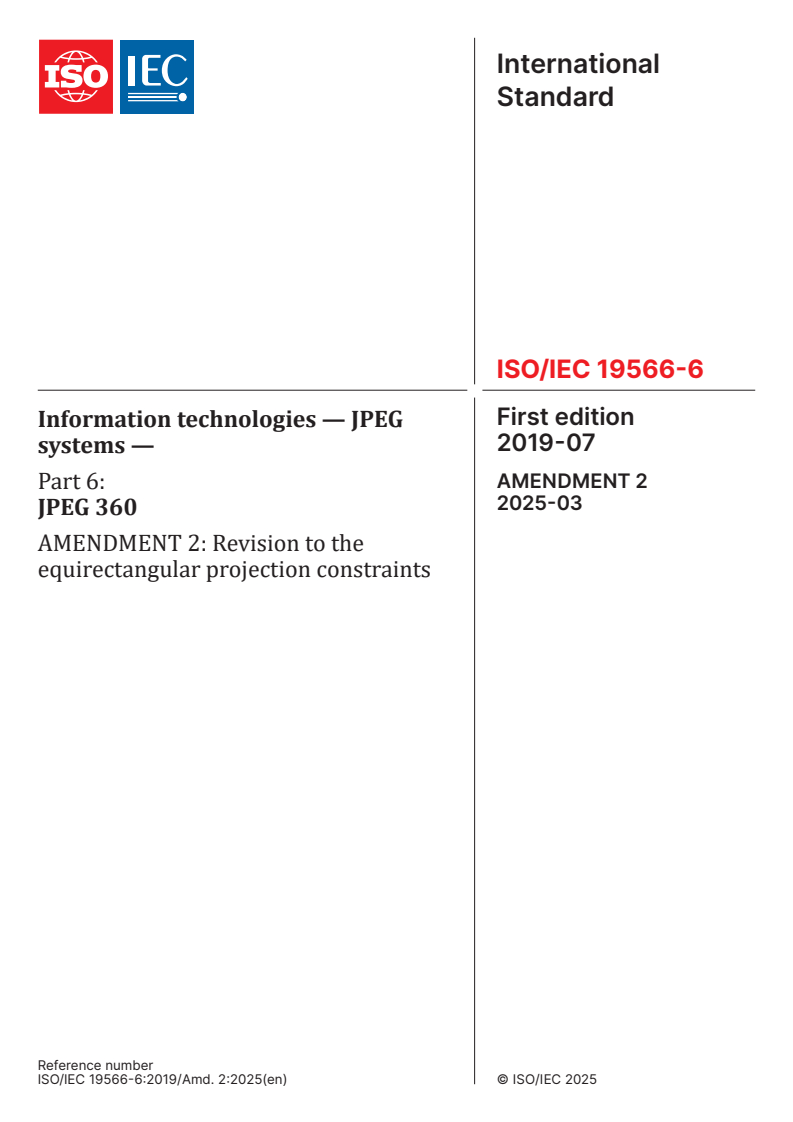
International
Standard
ISO/IEC 19566-6
First edition
Information technologies — JPEG
2019-07
systems —
AMENDMENT 2
Part 6:
2025-03
JPEG 360
AMENDMENT 2: Revision to the
equirectangular projection constraints
Reference number
ISO/IEC 19566-6:2019/Amd. 2:2025(en) © ISO/IEC 2025
ISO/IEC 19566-6:2019/Amd. 2:2025(en)
© ISO/IEC 2025
All rights reserved. Unless otherwise specified, or required in the context of its implementation, no part of this publication may
be reproduced or utilized otherwise in any form or by any means, electronic or mechanical, including photocopying, or posting on
the internet or an intranet, without prior written permission. Permission can be requested from either ISO at the address below
or ISO’s member body in the country of the requester.
ISO copyright office
CP 401 • Ch. de Blandonnet 8
CH-1214 Vernier, Geneva
Phone: +41 22 749 01 11
Email: copyright@iso.org
Website: www.iso.org
Published in Switzerland
© ISO/IEC 2025 – All rights reserved
ii
ISO/IEC 19566-6:2019/Amd. 2:2025(en)
Foreword
ISO (the International Organization for Standardization) and IEC (the International Electrotechnical
Commission) form the specialized system for worldwide standardization. National bodies that are
members of ISO or IEC participate in the development of International Standards through technical
committees established by the respective organization to deal with particular fields of technical activity.
ISO and IEC technical committees collaborate in fields of mutual interest. Other international organizations,
governmental and non-governmental, in liaison with ISO and IEC, also take part in the work.
The procedures used to develop this document and those intended for its further maintenance are described
in the ISO/IEC Directives, Part 1. In particular, the different approval criteria needed for the different types
of document should be noted. This document was drafted in accordance with the editorial rules of the ISO/
IEC Directives, Part 2 (see www.iso.org/directives or www.iec.ch/members_experts/refdocs).
ISO and IEC draw attention to the possibility that the implementation of this document may involve the
use of (a) patent(s). ISO and IEC take no position concerning the evidence, validity or applicability of any
claimed patent rights in respect thereof. As of the date of publication of this document, ISO and IEC had not
received notice of (a) patent(s) which may be required to implement this document. However, implementers
are cautioned that this may not represent the latest information, which may be obtained from the patent
database available at www.iso.org/patents and https://patents.iec.ch. ISO and IEC shall not be held
responsible for identifying any or all such patent rights.
Any trade name used in this document is information given for the convenience of users and does not
constitute an endorsement.
For an explanation of the voluntary nature of standards, the meaning of ISO specific terms and expressions
related to conformity assessment, as well as information about ISO's adherence to the World Trade
Organization (WTO) principles i
...