


ISO/IEC 15476-4:2005
(Main)Information technology — CDIF semantic metamodel — Part 4: Data models
Information technology — CDIF semantic metamodel — Part 4: Data models
ISO/IEC 15476-4:2005 explains the Data models subject area. The CDIF semantic metamodel is used to ensure that the information held by tools communicating using CDIF is transferred with an agreed meaning. It covers the information required to express Entity-Relationship-Attribute Modelling and Logical Database Design concepts. ISO/IEC 15476-4:2005 is intended to be used by anyone wishing to understand and/or use CDIF. It provides a definition of a single subject area of the CDIF semantic metamodel. It is suitable for: Those evaluating CDIF, Those who wish to understand the principles and concepts of a CDIF transfer, and Those developing importers and exporters.
Technologies de l'information — Métamodèle sémantique CDIF — Partie 4: Modèles de données
General Information
- Status
- Published
- Publication Date
- 11-Dec-2005
- Technical Committee
- ISO/IEC JTC 1/SC 7 - Software and systems engineering
- Drafting Committee
- ISO/IEC JTC 1/SC 7/WG 19 - Techniques for Specifying IT Systems
- Current Stage
- 9093 - International Standard confirmed
- Start Date
- 03-Jan-2019
- Completion Date
- 12-Feb-2026
Relations
- Consolidated By
ISO 17225-1:2014 - Solid biofuels — Fuel specifications and classes — Part 1: General requirements - Effective Date
- 06-Jun-2022
Overview
ISO/IEC 15476-4:2005 - Information technology - CDIF semantic metamodel - Part 4: Data models - defines the Data models subject area of the CDIF semantic metamodel. Its purpose is to ensure that information exchanged between tools using CDIF (CASE/Design Interchange Format) is transferred with an agreed semantic meaning, covering the vocabulary and structure needed to express Entity‑Relationship‑Attribute modelling and logical database design concepts.
Key topics and technical requirements
This part of the CDIF semantic metamodel describes the building blocks and rules needed for interoperable data-model exchange. Key technical topics include:
- Meta‑entities and meta‑relationships: Formal definitions for objects such as Entity, Attribute, Relationship, Role, CandidateKey, ForeignKey, AccessPath, DataModel, Cluster, Projection, and related constructs.
- Diagrams and notation: Conventions for diagramming data models and representing keys, roles and relationships.
- Cardinalities and roles: Definition of outer/inner cardinalities, multi‑player roles, role constraints and how roles participate in relationships.
- Supertypes/subtypes and inheritance: Coverage, exclusivity, orthogonality and inheritance semantics for subtype sets, including refinement of inherited characteristics.
- Integrity and access: Referential integrity, keys and access paths, candidate keys, foreign keys and access mechanisms.
- Subsets, clusters and projections: Mechanisms to express subsets, logical clusters and projections of attributes and entities.
- Conformance requirements: Clauses for input conformance, output conformance and round‑trip conformance to guide implementers of importers/exporters and validators.
Applications and who should use it
ISO/IEC 15476-4:2005 is practical for organizations and professionals that need reliable model interchange and semantic consistency:
- Tool vendors and integrators building CDIF importers, exporters and conversion tools.
- Data architects and database designers needing a standard representation for ER/A modelling and logical database design.
- Systems integrators and software engineers coordinating model-driven workflows across heterogeneous CASE tools.
- Evaluators and standards teams assessing CDIF support and interoperability requirements.
Practical uses include exchanging logical data models between modeling tools, documenting database design semantics for migration, and automating model transformations while preserving meaning.
Related standards
- Part of the CDIF family (see ISO/IEC CDIF series). Normative references in this document include ISO/IEC 15474‑1 and ISO/IEC 13238‑1. Implementers should consult the broader CDIF standards set for end‑to‑end tool interoperability.
Keywords: ISO/IEC 15476-4:2005, CDIF semantic metamodel, data models, Entity-Relationship-Attribute, logical database design, CDIF interchange, model conformance, importers and exporters.
Get Certified
Connect with accredited certification bodies for this standard

BSI Group
BSI (British Standards Institution) is the business standards company that helps organizations make excellence a habit.

BSCIC Certifications Pvt. Ltd.
Established 2006, accredited by NABCB, JAS-ANZ, EIAC, IAS. CDSCO Notified Body.

Intertek India Pvt. Ltd.
Delivers Assurance, Testing, Inspection & Certification since 1993 with 26 labs and 32 offices.
Sponsored listings
Frequently Asked Questions
ISO/IEC 15476-4:2005 is a standard published by the International Organization for Standardization (ISO). Its full title is "Information technology — CDIF semantic metamodel — Part 4: Data models". This standard covers: ISO/IEC 15476-4:2005 explains the Data models subject area. The CDIF semantic metamodel is used to ensure that the information held by tools communicating using CDIF is transferred with an agreed meaning. It covers the information required to express Entity-Relationship-Attribute Modelling and Logical Database Design concepts. ISO/IEC 15476-4:2005 is intended to be used by anyone wishing to understand and/or use CDIF. It provides a definition of a single subject area of the CDIF semantic metamodel. It is suitable for: Those evaluating CDIF, Those who wish to understand the principles and concepts of a CDIF transfer, and Those developing importers and exporters.
ISO/IEC 15476-4:2005 explains the Data models subject area. The CDIF semantic metamodel is used to ensure that the information held by tools communicating using CDIF is transferred with an agreed meaning. It covers the information required to express Entity-Relationship-Attribute Modelling and Logical Database Design concepts. ISO/IEC 15476-4:2005 is intended to be used by anyone wishing to understand and/or use CDIF. It provides a definition of a single subject area of the CDIF semantic metamodel. It is suitable for: Those evaluating CDIF, Those who wish to understand the principles and concepts of a CDIF transfer, and Those developing importers and exporters.
ISO/IEC 15476-4:2005 is classified under the following ICS (International Classification for Standards) categories: 35.080 - Software. The ICS classification helps identify the subject area and facilitates finding related standards.
ISO/IEC 15476-4:2005 has the following relationships with other standards: It is inter standard links to ISO 17225-1:2014. Understanding these relationships helps ensure you are using the most current and applicable version of the standard.
ISO/IEC 15476-4:2005 is available in PDF format for immediate download after purchase. The document can be added to your cart and obtained through the secure checkout process. Digital delivery ensures instant access to the complete standard document.
Standards Content (Sample)
INTERNATIONAL ISO/IEC
STANDARD 15476-4
First edition
2005-12-15
Information technology — CDIF semantic
metamodel —
Part 4:
Data models
Technologies de l'information — Métamodèle sémantique CDIF —
Partie 4: Modèles de données
Reference number
©
ISO/IEC 2005
PDF disclaimer
This PDF file may contain embedded typefaces. In accordance with Adobe's licensing policy, this file may be printed or viewed but
shall not be edited unless the typefaces which are embedded are licensed to and installed on the computer performing the editing. In
downloading this file, parties accept therein the responsibility of not infringing Adobe's licensing policy. The ISO Central Secretariat
accepts no liability in this area.
Adobe is a trademark of Adobe Systems Incorporated.
Details of the software products used to create this PDF file can be found in the General Info relative to the file; the PDF-creation
parameters were optimized for printing. Every care has been taken to ensure that the file is suitable for use by ISO member bodies. In
the unlikely event that a problem relating to it is found, please inform the Central Secretariat at the address given below.
© ISO/IEC 2005
All rights reserved. Unless otherwise specified, no part of this publication may be reproduced or utilized in any form or by any means,
electronic or mechanical, including photocopying and microfilm, without permission in writing from either ISO at the address below or
ISO's member body in the country of the requester.
ISO copyright office
Case postale 56 • CH-1211 Geneva 20
Tel. + 41 22 749 01 11
Fax + 41 22 749 09 47
E-mail copyright@iso.org
Web www.iso.org
Published in Switzerland
ii © ISO/IEC 2005 – All rights reserved
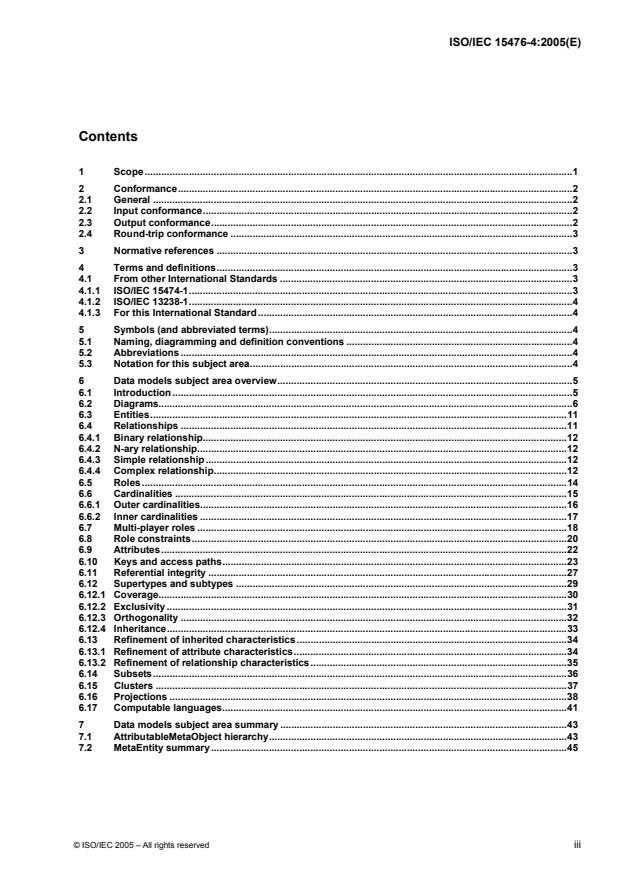
Contents
1 Scope.1
2 Conformance.2
2.1 General.2
2.2 Input conformance.2
2.3 Output conformance.2
2.4 Round-trip conformance.3
3 Normative references.3
4 Terms and definitions.3
4.1 From other International Standards .3
4.1.1 ISO/IEC 15474-1.3
4.1.2 ISO/IEC 13238-1.4
4.1.3 For this International Standard .4
5 Symbols (and abbreviated terms).4
5.1 Naming, diagramming and definition conventions .4
5.2 Abbreviations.4
5.3 Notation for this subject area.4
6 Data models subject area overview.5
6.1 Introduction.5
6.2 Diagrams.6
6.3 Entities.11
6.4 Relationships.11
6.4.1 Binary relationship.12
6.4.2 N-ary relationship.12
6.4.3 Simple relationship.12
6.4.4 Complex relationship.12
6.5 Roles.14
6.6 Cardinalities.15
6.6.1 Outer cardinalities.16
6.6.2 Inner cardinalities.17
6.7 Multi-player roles.18
6.8 Role constraints.20
6.9 Attributes.22
6.10 Keys and access paths.23
6.11 Referential integrity.27
6.12 Supertypes and subtypes.29
6.12.1 Coverage.30
6.12.2 Exclusivity.31
6.12.3 Orthogonality.32
6.12.4 Inheritance.33
6.13 Refinement of inherited characteristics.34
6.13.1 Refinement of attribute characteristics.34
6.13.2 Refinement of relationship characteristics.35
6.14 Subsets.36
6.15 Clusters.37
6.16 Projections.38
6.17 Computable languages.41
7 Data models subject area summary .43
7.1 AttributableMetaObject hierarchy.43
7.2 MetaEntity summary.45
© ISO/IEC 2005 – All rights reserved iii
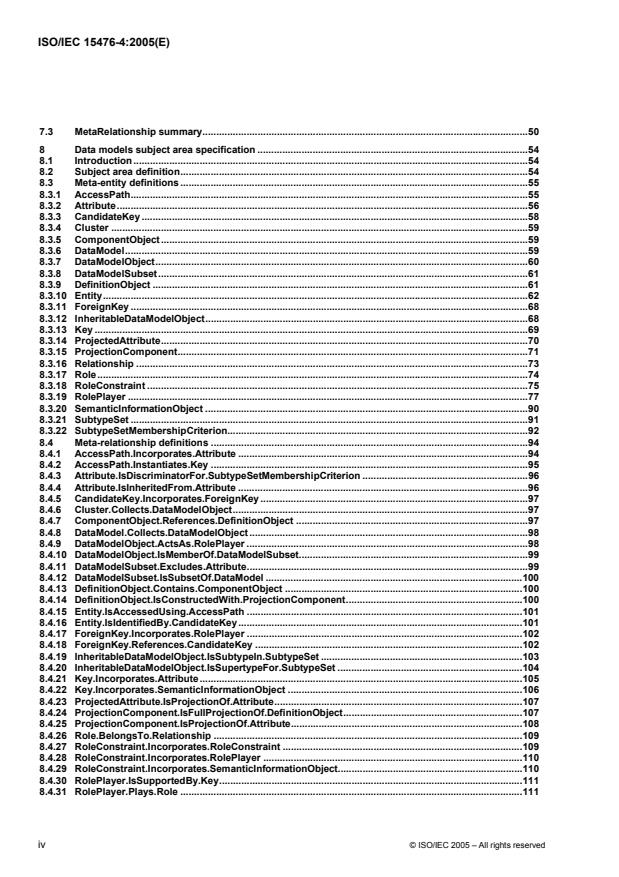
7.3 MetaRelationship summary.50
8 Data models subject area specification .54
8.1 Introduction.54
8.2 Subject area definition.54
8.3 Meta-entity definitions.55
8.3.1 AccessPath.55
8.3.2 Attribute.56
8.3.3 CandidateKey.58
8.3.4 Cluster.59
8.3.5 ComponentObject.59
8.3.6 DataModel.59
8.3.7 DataModelObject.60
8.3.8 DataModelSubset.61
8.3.9 DefinitionObject.61
8.3.10 Entity.62
8.3.11 ForeignKey.68
8.3.12 InheritableDataModelObject.68
8.3.13 Key.69
8.3.14 ProjectedAttribute.70
8.3.15 ProjectionComponent.71
8.3.16 Relationship.73
8.3.17 Role.74
8.3.18 RoleConstraint.75
8.3.19 RolePlayer.77
8.3.20 SemanticInformationObject.90
8.3.21 SubtypeSet.91
8.3.22 SubtypeSetMembershipCriterion.92
8.4 Meta-relationship definitions.94
8.4.1 AccessPath.Incorporates.Attribute.94
8.4.2 AccessPath.Instantiates.Key.95
8.4.3 Attribute.IsDiscriminatorFor.SubtypeSetMembershipCriterion .96
8.4.4 Attribute.IsInheritedFrom.Attribute .96
8.4.5 CandidateKey.Incorporates.ForeignKey.97
8.4.6 Cluster.Collects.DataModelObject.97
8.4.7 ComponentObject.References.DefinitionObject .97
8.4.8 DataModel.Collects.DataModelObject.98
8.4.9 DataModelObject.ActsAs.RolePlayer.98
8.4.10 DataModelObject.IsMemberOf.DataModelSubset.99
8.4.11 DataModelSubset.Excludes.Attribute.99
8.4.12 DataModelSubset.IsSubsetOf.DataModel .100
8.4.13 DefinitionObject.Contains.ComponentObject .100
8.4.14 DefinitionObject.IsConstructedWith.ProjectionComponent.100
8.4.15 Entity.IsAccessedUsing.AccessPath.101
8.4.16 Entity.IsIdentifiedBy.CandidateKey.101
8.4.17 ForeignKey.Incorporates.RolePlayer.102
8.4.18 ForeignKey.References.CandidateKey.102
8.4.19 InheritableDataModelObject.IsSubtypeIn.SubtypeSet .103
8.4.20 InheritableDataModelObject.IsSupertypeFor.SubtypeSet .104
8.4.21 Key.Incorporates.Attribute.105
8.4.22 Key.Incorporates.SemanticInformationObject .106
8.4.23 ProjectedAttribute.IsProjectionOf.Attribute.107
8.4.24 ProjectionComponent.IsFullProjectionOf.DefinitionObject.107
8.4.25 ProjectionComponent.IsProjectionOf.Attribute.108
8.4.26 Role.BelongsTo.Relationship.109
8.4.27 RoleConstraint.Incorporates.RoleConstraint.109
8.4.28 RoleConstraint.Incorporates.RolePlayer.110
8.4.29 RoleConstraint.Incorporates.SemanticInformationObject.110
8.4.30 RolePlayer.IsSupportedBy.Key.111
8.4.31 RolePlayer.Plays.Role.111
iv © ISO/IEC 2005 – All rights reserved
8.4.32 RolePlayer.Refines.RolePlayer.112
8.4.33 RolePlayer.RefinesForSubtype.DataModelObject.112
8.4.34 SubtypeSet.Specifies.SubtypeSetMembershipCriterion.113
8.4.35 SubtypeSetMembershipCriterion.Selects.InheritableDataModelObject.113
Table of Illustrations
Figure 1 − CDIF family of International Standards . 1
Figure 2 − Diagrammatic Conventions - Keys. 5
Figure 3 − Data Models subject area overview . 6
Figure 4 − Partitioning/View mechanisms . 7
Figure 5 − Keys and AccessPath. 8
Figure 6 − Roles, RolePlayers and RoleConstraints . 9
Figure 7 − Connection between Data Models and Common subject areas. 10
Figure 8 − Connection between Data Models and Data Definition subject areas . 11
Figure 9 − Binary Relationship. 12
Figure 10 − Ternary Relationship. 12
Figure 11 − Complex Binary Relationship . 13
Figure 12 − Instance Diagram showing a Complex Relationship . 14
Figure 13 − Roles . 14
Figure 14 − Reflexive or Recursive Relationship. 15
Figure 15 − Examples of Types of Binary Relationships . 16
Figure 16 − Outer Cardinalities . 16
Figure 17 − Inner Cardinalities. 17
Figure 18 − Inner Cardinalities and Attributed Binary Relationships.18
Figure 19 − Multi-player Roles and Heterogeneous Collections. 19
Figure 20 − Multi-player Roles and Common Outer Cardinality . 20
Figure 21 − Role Constraint Network . 21
Figure 22 − Constraints on Role Participation. 21
Figure 23 − Instance Diagram showing Role Constraints. 22
Figure 24 − Attributed Relationships, Roles and RolePlayers . 23
Figure 25 − Foreign Keys. 24
© ISO/IEC 2005 – All rights reserved v
Figure 26 − RolePlayer as a component of a ForeignKey. 25
Figure 27 − Key support of RolePlayer . 26
Figure 28 − Key support for RolePlayer in a Reflexive Relationship . 27
Figure 29 − Subtype Set Discriminator. 30
Figure 30 − Abstract Supertype . 31
Figure 31 − Concrete Supertype . 31
Figure 32 − Non-exclusive Subtype Set. 32
Figure 33 − Orthogonal Subtype Sets. 32
Figure 34 − Instance Diagram showing Orthogonal Subtype Sets . 33
Figure 35 − Overlapping Subtype Sets . 33
Figure 36 − Inheritance . 34
Figure 37 − Refinement of Cardinalities . 35
Figure 38 − Instance Diagram showing refinement of Cardinalities. 36
Figure 39 − Subsets. 37
Figure 40 − Clusters. 38
Figure 41 − Instance Diagram showing Simple Projection . 39
Figure 42 − Instance Diagram showing Complex Projection . 40
Figure 43 − Instance Diagram showing Attribute Renaming . 41
vi © ISO/IEC 2005 – All rights reserved
Foreword
ISO (the International Organization for Standardization) and IEC (the International Electrotechnical
Commission) form the specialized system for worldwide standardization. National bodies that are members of
ISO or IEC participate in the development of International Standards through technical committees
established by the respective organization to deal with particular fields of technical activity. ISO and IEC
technical committees collaborate in fields of mutual interest. Other international organizations, governmental
and non-governmental, in liaison with ISO and IEC, also take part in the work. In the field of information
technology, ISO and IEC have established a joint technical committee, ISO/IEC JTC 1.
International Standards are drafted in accordance with the rules given in the ISO/IEC Directives, Part 2.
The main task of the joint technical committee is to prepare International Standards. Draft International
Standards adopted by the joint technical committee are circulated to national bodies for voting. Publication as
an International Standard requires approval by at least 75 % of the national bodies casting a vote.
Attention is drawn to the possibility that some of the elements of this document may be the subject of patent
rights. ISO and IEC shall not be held responsible for identifying any or all such patent rights.
ISO/IEC 15476-4 was prepared by Joint Technical Committee ISO/IEC JTC 1, Information technology,
Subcommittee SC 7, Software and system engineering.
ISO/IEC 15476 consists of the following parts, under the general title Information technology — CDIF
semantic metamodel:
— Part 1: Foundation
— Part 2: Common
— Part 3: Data definitions
— Part 4: Data models
— Part 5: Data flow models
— Part 6: State/event models
© ISO/IEC 2005 – All rights reserved vii
Introduction
This International Standard will assist the vendors and users of modelling tools and meta-data repositories in
developing mechanisms for interchanging information. This International Standard specifies an element of a family
of related International Standards. When used together, these International Standards specify a mechanism for
transferring information between tools.
ISO/IEC 15474-1:2002, Information technology - CDIF framework - Part 1: Overview and ISO/IEC 15474-2:2002,
Information technology - CDIF framework - Part 2: Modelling and extensibility should be read first when initially
exploring CDIF. The first explains the overall CDIF architecture and how the family of standards fits together. The
second explains the scope, and modelling approach in CDIF. The CDIF meta-metamodel and extensibility
mechanism are also defined in that document.
This International Standard explains the Data models subject area. The CDIF semantic metamodel is used to
ensure that the information held by tools communicating using CDIF is transferred with an agreed meaning. It
covers the information required to express Entity-Relationship-Attribute Modelling and Logical Database Design
concepts.
This International Standard has been developed with the wide support and participation of vendors, users,
academia and government involved in or familiar with the CASE industry, its products and the general requirements
associated with interchanging information between these products.
This document is organized into the following Clauses.
⎯ Clause 1 to 5 are prescribed ISO/IEC Clauses;
⎯ Clause 6: Subject area overview:
This Clause gives an overview of the coverage of this subject area.
⎯ Clause 7: Subject area summary:
This Clause gives an overview of the content of this subject area.
⎯ Clause 8: Subject area specification:
This Clause gives the formal specification of all the objects defined in the subject area, and the formal
reference to those used, but not defined in the subject area.
This document is intended to be used by anyone wishing to understand and/or use CDIF. This document provides
a definition of a single subject area of the CDIF semantic metamodel. It is suitable for:
⎯ Those evaluating CDIF;
⎯ Those who wish to understand the principles and concepts of a CDIF transfer; and
⎯ Those developing importers and exporters.
This document, ISO/IEC 15474-1:2002, Information technology - CDIF framework - Part 1: Overview, and the
framework document ISO/IEC 15474-2:2002, Information technology - CDIF framework - Part 2: Modelling and
extensibility, should be read first when initially exploring CDIF and before attempting to read other documents in the
CDIF family of standards.
viii © ISO/IEC 2005 – All rights reserved
While there are no specific prerequisites for reading this document, it will be helpful for the reader to have familiarity
with the following:
⎯ Entity-Relationship-Attribute modelling;
⎯ Modelling (CASE) tools;
⎯ Information repositories;
⎯ Data dictionaries;
⎯ Multiple meta-layer modelling.
© ISO/IEC 2005 – All rights reserved ix
INTERNATIONAL STANDARD
Information technology — CDIF semantic metamodel —
Part 4:
Data models
1 Scope
The CDIF family of International Standards is primarily designed to be used as a description of a mechanism for
transferring information between modelling tools. It facilitates a successful transfer when the authors of the
importing and exporting tools have nothing in common except an agreement to conform to CDIF. The language that
is defined for the transfer format also has applicability as a general language for import/export from repositories.
The CDIF semantic metamodel defined for CASE also has applicability as the basis of standard definitions for use
in repositories.
The International Standards which form the complete family of CDIF standards are documented in ISO/IEC 15474-1.
These International Standards cover the overall framework, the transfer format and the CDIF semantic metamodel.
15474 CDIF Framework
Part 1 : Overview Part 2 : Modeling and Extensibility
15476 CDIF Semantic Metamodel 15475 CDIF Transfer Format
Part 1 : Foundation
Part 1 : General rules for
syntaxes and encodings
Part 2 : Common
Part 3 : Data definitions
Part 2 : Syntax SYNTAX.1
Part 4 : Data models
Part 3 : Encoding ENCODING.1
Part 5 : Data flow models
Part 6 : State/event models
Part n : .
Part n : .
Figure 1 − CDIF family of International Standards
The diagram in Figure 1 depicts the various International Standards that comprise the CDIF family of standards.
The shaded box depicts this Standard and its position in the CDIF family of standards.
© ISO/IEC 2005 – All rights reserved 1
This International Standard defines the portion of the CDIF semantic metamodel that supports general Data
Modelling. This includes Entity-Relationship-Attribute Modelling as well as Logical Database Design.
2 Conformance
2.1 General
A product is fully standards conformant to a CDIF subject area standard if and only if it is input-conformant, output-
conformant and round-trip conformant to each and every MetaEntity, MetaRelationship, MetaAttribute, and
AttributableMetaObject which is defined and/or used in that standard, and it is also CDIF architecture conformant. A
product may be partially input-conformant, and/or partially output-conformant, and/or partially round-trip conformant
to a CDIF subject area standard.
2.2 Input conformance
Input conformance for a specific MetaEntity, MetaRelationship, MetaAttribute, or AttributableMetaObject (short:
CollectableMetaObject) is determined by applying the following test:
A set of meta-data containing all meanings and structures standardized by a CDIF subject area is imported by the
product under test. Then the meta-data which has arrived in the product is examined. The following options exist
for the relation between the input (CDIF) meta-data and the imported (product) meta-data:
For a specific CollectableMetaObject:
1 The product is input conformant if each instance of the specific CollectableMetaObject has arrived in the product
without change of meaning or structure. If the CollectableMetaObject is a meta-entity or meta-relationship, its
structural relationships to other CollectableMetaObjects have been preserved. If the CollectableMetaObject is a
meta-attribute, the value of the meta-attribute has been preserved.
2 The product is input morphing conformant if each instance of the specific CollectableMetaObject has arrived in
the product, but with some changes in meaning or structure. If the CollectableMetaObject is a meta-attribute,
the value(s) for some instances of the meta-attribute have changed.
3 The product is not input conformant for that CollectableMetaObject if neither of the previous tests is satisfied.
2.3 Output conformance
Output conformance for a specific CollectableMetaObject is determined by applying the following test:
For the product being tested, a set of meta-data that includes all possible meanings and structures representable in
that product is exported. Then the meta-data that has been exported is examined. The following options exist for
the relation between the product's meta-data and the exported (CDIF) meta-data:
For a specific CollectableMetaObject:
1 The product is output conformant if all of the meaning and structure for the specific CollectableMetaObject has
been represented as meta-data in the product and has been exported as one or more instances of that
CollectableMetaObject. If the CollectableMetaObject is a meta-attribute, the correct value of the meta-attribute
has been exported.
2 The product is output morphing conformant if each instance of meta-data in the product that has the same
meaning and structure as the CollectableMetaObject has been exported, but some instances have been
exported as a different CollectableMetaObject or some of the meaning and structure has been changed.
3 If the product does not represent the meaning and structure associated with the CollectableMetaObject, output
conformance for that CollectableMetaObject is not applicable to the product.
2 © ISO/IEC 2005 — All rights reserved
4 In all other cases, the product is not output conformant for that CollectableMetaObject.
2.4 Round-trip conformance
Round-trip conformance for a specific CollectableMetaObject is determined by applying the following test:
A set of meta-data containing all meanings and structures standardized by a CDIF subject area is imported by the
product under test. Then the meta-data is exported again. The following options exist for the relation between the
input meta-data and the output meta-data:
For a specific CollectableMetaObject:
1 The product is round-trip conformant if the meaning and structure of each instance of the CollectableMetaObject
is preserved without changes during the round-trip. For a vendor to claim round-trip conformance, it is also
necessary for the tool to be able to perform create, read, update, and delete operations on the imported
(product) meta-data corresponding to the instances of the CollectableMetaObject.
2 The product is round-trip morphing conformant if each instance of the input CollectableMetaObject is preserved,
but with some changes in meaning and/or structure. If the CollectableMetaObject is a meta-entity or meta-
relationship, some of its instances' structural relationships to other CollectableMetaObjects have changed, or
some instances have been transformed into other CollectableMetaObjects, or instances of other
CollectableMetaObjects have been transformed into instances of the CollectableMetaObject. If the
CollectableMetaObject is a meta-attribute, the values of some instances of the meta-attribute have changed or
the domain of the meta-attribute has changed.
3 In all other cases, the product is not round-trip conformant for that CollectableMetaObject.
3 Normative references
The following referenced documents are indispensable for the application of this document. For dated references,
only the edition cited applies. For undated references, the latest edition of the referenced document (including any
amendments) applies.
ISO/IEC 15474-1, Information technology — CDIF framework — Part 1: Overview
ISO/IEC 15474-2, Information technology — CDIF framework — Part 2: Modelling and extensibility
ISO/IEC 15476-1, Information technology — CDIF semantic metamodel — Part 1: Foundation
ISO/IEC 15476-2, Information technology — CDIF semantic metamodel — Part 2: Common
ISO/IEC 15476-3, Information technology — CDIF semantic metamodel — Part 3: Data definitions
4 Terms and definitions
For the purposes of this document, the following definitions apply. Unless otherwise noted, the definitions are
specific to this International Standard.
4.1 From other International Standards
4.1.1 ISO/IEC 15474-1
This part of ISO/IEC 15476 makes use of the following terms defined in ISO/IEC 15474-1:
© ISO/IEC 2005 — All rights reserved 3
CDIF
CDIF family of standards
CDIF semantic metamodel
CDIF meta-metamodel
CDIF transfer
Instance
Meta-attribute
Meta-entity
Metamodel
Meta-object
Meta-relationship
Model
Subject area
Transfer
Transfer format
4.1.2 ISO/IEC 13238-1
This part of ISO/IEC 15476 makes use of the following terms from ISO/IEC 13238-1:
Exporter
Importer
4.1.3 For this International Standard
For the purpose of this part of ISO/IEC 15476 new terms are defined when introduced. Double quotes are used to
introduce new terms (e.g., "model layer")
5 Symbols (and abbreviated terms)
5.1 Naming, diagramming and definition conventions
Conventions for naming, diagramming, describing and defining meta-objects can be found in Clause 7 of the
framework document (ISO/IEC 15474-2:2002, Information technology - CDIF framework - Part 2: Modelling and
extensibility).
5.2 Abbreviations
The following abbreviation is used in this International Standard:
CDIF CASE Data Interchange Format (originally)
5.3 Notation for this subject area
The instance diagrams appearing in Clause 6 use various techniques to depict relationships. Relationships are
shown as lines and arrow-heads, or as diamonds. Keys and key components are shown as in Figure 2.
4 © ISO/IEC 2005 — All rights reserved
Foreign Key
Primary Key
Order
Order_Key
Cust_FKey
CustomerNo
OrderNo
Key Components
Figure 2 − Diagrammatic Conventions - Keys
Solid keys are primary keys; clear keys are foreign keys and indented items are key components. For example,
Figure 2 reads, "Orders have a primary key called Order_Key that consists of a foreign key called Cust_FKey and
an attribute OrderNo. Cust_FKey consists of a single attribute called CustomerNo."
6 Data models subject area overview
6.1 Introduction
The Data Models subject area addresses the major forms of entity-relationship-attribute modelling and logical
database design. This subject area is technique independent but offers broad coverage, striving for a superset of
the concepts represented in various techniques.
The following sub-clauses explain the major concepts supported in this subject area.
© ISO/IEC 2005 — All rights reserved 5
6.2 Diagrams
DataModel
0:N
Incorporates
Collects
0:N 0:N
Role DataModel
Constraint Object
0:N
0:N 0:1
Incorporates
ActsAs
0:N
0:N
InheritableData
RolePlayer
ModelObject
1:N 0:1
Contains
0:1
Entity Relationship
Contains
0:1 1:1
Contains
BelongsTo
0:N 2:N
0:N
Attribute Role
0:N 0:N Contains 0:1
0:N 0:N 0:1
IsInheritedFrom
Plays
Figure 3 − Data Models subject area overview
6 © ISO/IEC 2005 — All rights reserved
1:1 0:N
DataModel
DataModel
IsSubsetOf
Subset
0:N 0:N IsInheritedFrom
0:N
Collects
0:N
0:N
Excludes
Attribute
0:N
0:N
IsDiscriminatorFor
SubtypeSet
1:1
0:N 0:N
Specifies
IsMemberOf
0:N
0:N
0:N 0:N
DataModel
Object
0:N Selects
SubtypeSet
MembershipCriterion
0:N
Collects
0:N 1:1
1:N IsSubtypeIn
InheritableData
Cluster
ModelObject
1:1 IsSupertypeFor
Entity Relationship
Figure 4 − Partitioning/View mechanisms
© ISO/IEC 2005 — All rights reserved 7
IsAccessedUsing
Entity
1:1
1:1
0:1
Contains
Attribute
0:N
0:N 0:N
IsIdentifiedBy
Incorporates
Incorporates
0:N 0:N
0:N
Key Instantiates AccessPath
0:1 0:1
0:N
CandidateKey ForeignKey
1:1 0:N
0:N 0:N
References
Incorporates
Figure 5 − Keys and AccessPath
8 © ISO/IEC 2005 — All rights reserved
ActsAs 0:1
DataModel
0:N
Object
Collects 0:N
0:N
InheritableData
Cluster
ModelObject
Incorporates
0:N 0:N
Relationship Entity
Role
Constraint
1:1 1:1
0:N
IsIdentifiedBy
RefinesForSubtype
Incorporates
Refines
BelongsTo
0:N 0:1 2:N
0:N
0:1
Plays
RolePlayer Role
1:N 0:1
0:N
0:1 0:N
IsSupportedBy
Key
0:1
Incorporates
ForeignKey CandidateKey
0:1
0:N
Figure 6 − Roles, RolePlayers and RoleConstraints
© ISO/IEC 2005 — All rights reserved 9
Attribute
0:N
0:N
0:N
Semantic
InformationObject
Incorporates
Incorporates
Incorporates
0:N 0:N 0:N
0:N
Role
Key
Constraint
0:N 0:N Incorporates
Candidate
Incorporates
ForeignKey
Key
0:N
0:1 0:N 0:N
RolePlayer
Incorporates Incorporates
0:1
Figure 7 − Connection between Data Models and Common subject areas
10 © ISO/IEC 2005 — All rights reserved
Component
0:N References
Object
Contains
0:N
IsProjectionOf
1:N 0:N
Projection
Attribute
Component
0:N
0:N 0:N
Is
IsFull
Constructed
ProjectionOf
IsProjectionOf
With
1:1 1:1
Projected Definition
0:1
Attribute Object
0:N
0:1
Entity Relationship DataType
Cluster Role RolePlayer
Figure 8 − Connection between Data Models and Data Definition subject areas
6.3 Entities
The concept of an "Entity," or object to be modeled, is represented directly by the meta-entity called Entity. A
relational "Table" is also represented by Entity. A Table is
...
Questions, Comments and Discussion
Ask us and Technical Secretary will try to provide an answer. You can facilitate discussion about the standard in here.
Loading comments...