

ISO/CIE 15469
(Main)Spatial distribution of daylight — CIE standard general sky
General Information
- Abstract
ISO 15469:2004 defines a set of outdoor daylight conditions linking sunlight and skylight for theoretical and practical purposes.
- Status
- Not Published
- Technical Committee
- CIE - International Commission on Illumination
- Drafting Committee
- CIE - International Commission on Illumination
- Current Stage
- 6000 - International Standard under publication
- Start Date
- 02-Dec-2025
- Completion Date
- 29-Aug-2026
Buy Documents
ISO/CIE FDIS 15469 - Spatial distribution of daylight — CIE standard general sky Released:9/22/2025
REDLINE ISO/CIE FDIS 15469 - Spatial distribution of daylight — CIE standard general sky Released:9/22/2025
ISO/CIE 15469 - Spatial distribution of daylight — CIE standard general sky/22/2025
REDLINE ISO/CIE 15469 - Spatial distribution of daylight — CIE standard general sky/22/2025
Overview
ISO/CIE 15469 - Spatial distribution of daylight (CIE Standard General Sky) defines a standardized family of sky luminance distributions linking sunlight and skylight for both theoretical analysis and practical daylighting calculations. The document specifies relative sky luminance models (ratios to zenith luminance) that cover conditions from heavily overcast skies to cloudless clear skies, and incorporates the CIE Standard Clear and Overcast skies as special cases of the General Sky.
Key topics
- Relative sky luminance distribution: Sky element luminance is expressed as a ratio to the zenith luminance, allowing conversion to absolute luminance using zenith luminance or horizontal illuminance.
- Two-component model: Luminance at any sky point is the product of a scattering indicatrix f(χ) (dependence on angular distance χ from the sun) and a luminance gradation φ(Z) (dependence on zenith angle Z), normalized to zenith values.
- Analytical formulae: The standard gives explicit formulations for f(χ) and φ(Z) and a normalization for φ(0); it also retains the traditional overcast sky formula (L(γ)/Lz_oc = (1 + 2 sin γ) / 3) for compatibility with legacy calculations.
- Standard parameters and sky types: Fifteen standard relative luminance distributions are defined by parameter groups (a–e) covering six gradation groups and six indicatrix groups. These allow consistent classification and selection of sky types for simulations.
- Symmetry and smoothness: Distributions are symmetrical about the solar meridian and described by continuous smooth functions suitable for cloudless and homogeneously clouded conditions.
- Normative references and scope: Includes references to CIE S 017 (ILV) and ISO 80000‑7 for quantities and units; prepared by CIE TC 3-15 in cooperation with ISO/TC 274.
Applications
- Daylighting simulation and design (architectural lighting, fenestration analysis)
- Classification of measured sky luminance data for climatology and site assessments
- Input models for lighting simulation software and performance-based compliance tools
- Urban and façade design where sky luminance influences visual comfort and solar gains
- Research in atmospheric optics, daylight availability and energy modeling
Who uses it
- Lighting and daylighting designers, architects, façade engineers
- Building simulation and energy-modeling professionals
- Researchers in daylighting, meteorology and environmental design
- Developers of lighting and daylight simulation tools
Related standards
- CIE S 017 - International Lighting Vocabulary (terminology)
- ISO 80000‑7 - Quantities and units for light and radiation
- CIE 215:2014 - Guidance on applying CIE sky classifications (referenced for selection and application)
- CIE S 003 (S 011) - Earlier CIE Overcast and Clear sky formulations (integrated/retained in the General Sky)
Keywords: ISO/CIE 15469, CIE Standard General Sky, sky luminance distribution, daylighting design, scattering indicatrix, luminance gradation, zenith luminance, overcast sky, clear sky.
Relations
- Effective Date
- 10-Aug-2024
Buy Documents
ISO/CIE FDIS 15469 - Spatial distribution of daylight — CIE standard general sky Released:9/22/2025
REDLINE ISO/CIE FDIS 15469 - Spatial distribution of daylight — CIE standard general sky Released:9/22/2025
ISO/CIE 15469 - Spatial distribution of daylight — CIE standard general sky/22/2025
REDLINE ISO/CIE 15469 - Spatial distribution of daylight — CIE standard general sky/22/2025
Get Certified
Connect with accredited certification bodies for this standard

BSMI (Bureau of Standards, Metrology and Inspection)
Taiwan's standards and inspection authority.
Sponsored listings
Frequently Asked Questions
ISO/CIE 15469 is a draft published by the International Organization for Standardization (ISO). Its full title is "Spatial distribution of daylight — CIE standard general sky". This standard covers: ISO 15469:2004 defines a set of outdoor daylight conditions linking sunlight and skylight for theoretical and practical purposes.
ISO 15469:2004 defines a set of outdoor daylight conditions linking sunlight and skylight for theoretical and practical purposes.
ISO/CIE 15469 is classified under the following ICS (International Classification for Standards) categories: 17.180.20 - Colours and measurement of light. The ICS classification helps identify the subject area and facilitates finding related standards.
ISO/CIE 15469 has the following relationships with other standards: It is inter standard links to ISO 15469:2004. Understanding these relationships helps ensure you are using the most current and applicable version of the standard.
ISO/CIE 15469 is available in PDF format for immediate download after purchase. The document can be added to your cart and obtained through the secure checkout process. Digital delivery ensures instant access to the complete standard document.
Standards Content (Sample)
FINAL DRAFT
International
Standard
ISO/CIE FDIS
CIE
Spatial distribution of daylight —
Secretariat: CIE
CIE standard general sky
Voting begins on:
Répartition spatiale de la lumière du jour — Ciel général 2025-10-06
normalisé CIE
Voting terminates on:
2025-12-01
Member bodies are requested to consult relevant national interests in ISO/TC
274 before casting their ballot to the e-Balloting application.
RECIPIENTS OF THIS DRAFT ARE INVITED TO SUBMIT,
WITH THEIR COMMENTS, NOTIFICATION OF ANY
RELEVANT PATENT RIGHTS OF WHICH THEY ARE AWARE
AND TO PROVIDE SUPPOR TING DOCUMENTATION.
IN ADDITION TO THEIR EVALUATION AS
BEING ACCEPTABLE FOR INDUSTRIAL, TECHNO
LOGICAL, COMMERCIAL AND USER PURPOSES, DRAFT
INTERNATIONAL STANDARDS MAY ON OCCASION HAVE
TO BE CONSIDERED IN THE LIGHT OF THEIR POTENTIAL
TO BECOME STAN DARDS TO WHICH REFERENCE MAY BE
MADE IN NATIONAL REGULATIONS.
Reference number
ISO/CIE FDIS 15469:2025(en) © ISO/CIE 2025
FINAL DRAFT
ISO/CIE FDIS 15469:2025(en)
International
Standard
ISO/CIE FDIS
CIE
Spatial distribution of daylight —
Secretariat: CIE
CIE standard general sky
Voting begins on:
Répartition spatiale de la lumière du jour — Ciel général
normalisé CIE
Voting terminates on:
Member bodies are requested to consult relevant national interests in ISO/TC
274 before casting their ballot to the e-Balloting application.
RECIPIENTS OF THIS DRAFT ARE INVITED TO SUBMIT,
WITH THEIR COMMENTS, NOTIFICATION OF ANY
RELEVANT PATENT RIGHTS OF WHICH THEY ARE AWARE
© ISO/CIE 2025
AND TO PROVIDE SUPPOR TING DOCUMENTATION.
All rights reserved. Unless otherwise specified, or required in the context of its implementation, no part of this publication may
IN ADDITION TO THEIR EVALUATION AS
be reproduced or utilized otherwise in any form or by any means, electronic or mechanical, including photocopying, or posting on
BEING ACCEPTABLE FOR INDUSTRIAL, TECHNO
LOGICAL, COMMERCIAL AND USER PURPOSES, DRAFT
the internet or an intranet, without prior written permission. Permission can be requested from either ISO at the address below
INTERNATIONAL STANDARDS MAY ON OCCASION HAVE
or ISO’s member body in the country of the requester
TO BE CONSIDERED IN THE LIGHT OF THEIR POTENTIAL
ISO copyright office CIE Central Bureau TO BECOME STAN DARDS TO WHICH REFERENCE MAY BE
MADE IN NATIONAL REGULATIONS.
CP 401 • Ch. de Blandonnet 8 Babenbergerstraße 9/9A • A-1010 Vienna
CH-1214 Vernier, Geneva
Phone: +41 22 749 01 11 Phone: +43 1 714 3187
Fax: +41 22 749 09 47
Email: copyright@iso.org Email: ciecb@cie.co.at
Website: www.iso.org Website: www.cie.co.at
Published in Switzerland Reference number
ISO/CIE FDIS 15469:2025(en) © ISO/CIE 2025
© ISO/CIE 2025 – All rights reserved
ii
ISO/CIE FDIS 15469:2025(en)
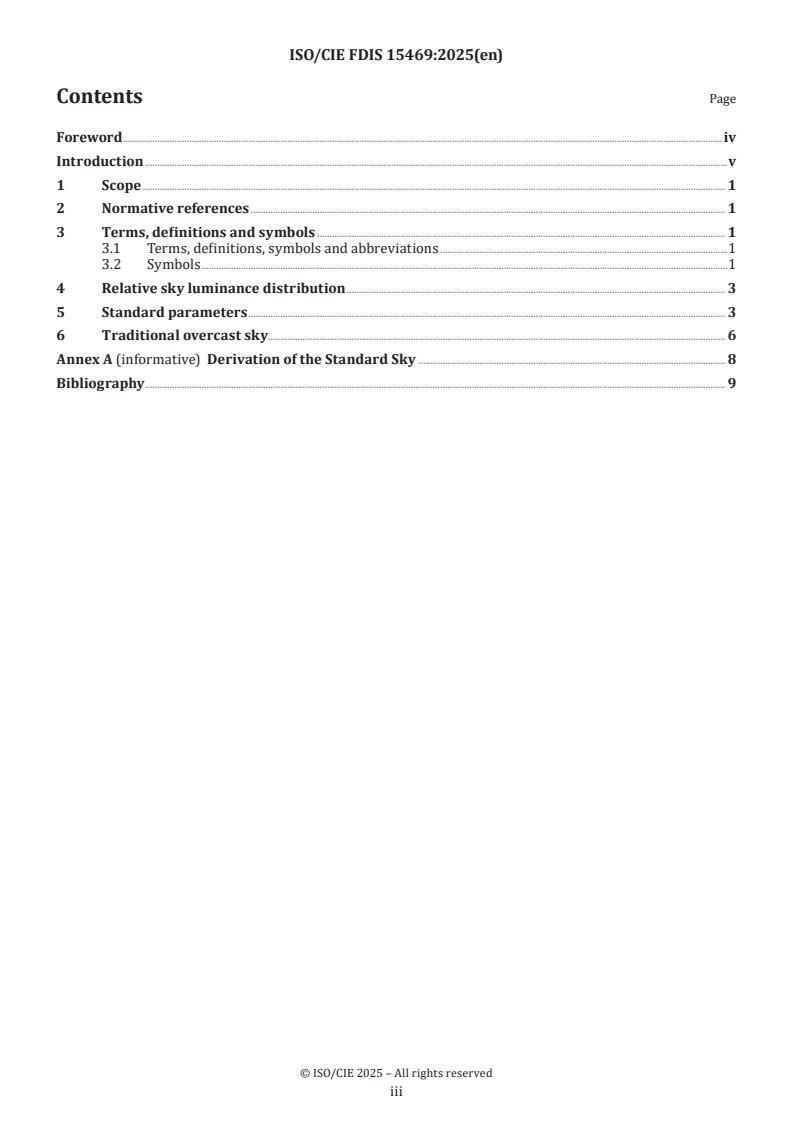
Contents Page
Foreword .iv
Introduction .v
1 Scope . 1
2 Normative references . 1
3 Terms, definitions and symbols . 1
3.1 Terms, definitions, symbols and abbreviations .1
3.2 Symbols .1
4 Relative sky luminance distribution . 3
5 Standard parameters . 3
6 Traditional overcast sky. 6
Annex A (informative) Derivation of the Standard Sky . 8
Bibliography . 9
© ISO/CIE 2025 – All rights reserved
iii
ISO/CIE FDIS 15469:2025(en)
Foreword
ISO (the International Organization for Standardization) is a worldwide federation of national standards
bodies (ISO member bodies). The work of preparing International Standards is normally carried out through
ISO technical committees. Each member body interested in a subject for which a technical committee
has been established has the right to be represented on that committee. International organizations,
governmental and non-governmental, in liaison with ISO, also take part in the work. ISO collaborates closely
with the International Electrotechnical Commission (IEC) on all matters of electrotechnical standardization.
The procedures used to develop this document and those intended for its further maintenance are described
in the ISO/IEC Directives, Part 1. In particular, the different approval criteria needed for the different types
of ISO documents should be noted. This document was drafted in accordance with the editorial rules of the
ISO/IEC Directives, Part 2 (see www.iso.org/directives).
ISO draws attention to the possibility that the implementation of this document may involve the use of (a)
patent(s). ISO takes no position concerning the evidence, validity or applicability of any claimed patent
rights in respect thereof. As of the date of publication of this document, ISO had not received notice of (a)
patent(s) which may be required to implement this document. However, implementers are cautioned that
this may not represent the latest information, which may be obtained from the patent database available at
www.iso.org/patents. ISO shall not be held responsible for identifying any or all such patent rights.
Any trade name used in this document is information given for the convenience of users and does not
constitute an endorsement.
For an explanation of the voluntary nature of standards, the meaning of ISO specific terms and expressions
related to conformity assessment, as well as information about ISO's adherence to the World Trade
Organization (WTO) principles in the Technical Barriers to Trade (TBT), see www.iso.org/iso/foreword.html.
This document was prepared by International Commission on Illumination (CIE), in cooperation with
Technical Committee ISO/TC 274, Light and lighting.
This first edition of ISO/CIE 15469 cancels and replaces the second edition of ISO 15469:2004, which has
been technically revised.
The main changes are as follows:
— this document replaces CIE S 011:2003;
— normative references updated;
— Clause 3 updated;
— text added to Clauses 5 and 7;
— keys written for Figures 1, 2, 3 and 4;
— Bibliography updated;
— minor editorial changes.
Any feedback or questions on this document should be directed to the user’s national standards body. A
complete listing of these bodies can be found at www.iso.org/members.html.
© ISO/CIE 2025 – All rights reserved
iv
ISO/CIE FDIS 15469:2025(en)
Introduction
The luminance distribution of the sky depends on weather and climate, and it changes during the course of
a day with the position of the sun. This document lists a set of luminance distributions which model the sky
under a wide range of conditions, from the heavily overcast sky to cloudless weather. It is intended for two
purposes:
a) to be a universal basis for the classification of measured sky luminance distributions;
b) to give a method for calculating sky luminance in daylighting design procedures.
This document defines relative luminance distributions: the luminance of the sky at any point is given as a
function of the zenith luminance. For daylighting calculation purposes, it may be used with values of zenith
luminance or of horizontal illuminance to obtain absolute luminance distributions.
This document incorporates both the CIE Standard Clear Sky and the CIE Standard Overcast Sky, which are
treated as particular cases of the General Sky. The Overcast Sky is retained as a separate formula because
there are many calculation procedures that embody the mathematical formulation of this particular
distribution.
© ISO/CIE 2025 – All rights reserved
v
FINAL DRAFT International Standard ISO/CIE FDIS 15469:2025(en)
Spatial distribution of daylight — CIE standard general sky
1 Scope
This document specifies a set of outdoor daylight conditions linking sunlight and skylight for theoretical and
practical purposes.
The luminance distributions given have the following characteristics.
a) They are symmetrical about the solar meridian and are functions of the angular distance, Z , between
s
the sun and the zenith.
b) They are defined by smooth continuous functions. Such distributions are typical of cloudless skies and
of those where the cloud cover is homogeneous. They provide an approximation to skies of broken cloud
that is sufficiently accurate for many practical daylight calculation purposes.
c) The relative luminance at any point in the sky depends on the angle, χ, between that sky element and the
sun, and on the angle, Z, between the sky element and the zenith. It is given in terms of two functions:
the relative scattering indicatrix, f(χ), and the luminance gradation between horizon and zenith, φ(Z).
NOTE See Annex A for the derivation of the CIE Standard General Sky.
2 Normative references
The following documents are referred to in the text in such a way that some or all of their content constitutes
requirements of this document. For dated references, only the edition cited applies. For undated references,
the latest edition of the referenced document (including any amendments) applies.
...
2025-07-30
ISO/CIE FDIS 15469:2025(en)
CIE
Secretariat: CIE
Date:
Spatial distribution of daylight — CIE standard general sky
Répartition spatiale de la lumière du jour — Ciel général normalisé CIE
FDIS stage
ISO #####-#:####(X/CIE FDIS 15469:2025(en)
© ISO/CIE 2025
All rights reserved. Unless otherwise specified, or required in the context of its implementation, no part of this publication
may be reproduced or utilized otherwise in any form or by any means, electronic or mechanical, including photocopying,
or posting on the internet or an intranet, without prior written permission. Permission can be requested from either ISO
at the address below or ISO’s member body in the country of the requester.
ISO copyright office
CP 401 • Ch. de Blandonnet 8
CH-1214 Vernier, Geneva
Phone: + 41 22 749 01 11
EmailE-mail: copyright@iso.org
Website: www.iso.orgwww.iso.org
Published in Switzerland
ii © ISO #### /CIE 2025 – All rights reserved
ii
ISO/CIE FDIS 15469:2025(en)
Contents
Foreword . iv
Introduction . vi
1 Scope . 1
2 Normative references . 1
3 Terms, definitions and symbols . 1
4 Relative sky luminance distribution . 3
5 Standard parameters . 5
6 Traditional overcast sky . 8
Annex A (informative) Derivation of the Standard Sky . 11
Bibliography . 12
Foreword . iv
Introduction . v
1 Scope . 1
2 Normative references . 1
3 Terms, definitions and symbols . 1
3.1 Terms, definitions, symbols and abbreviations . 1
3.2 Symbols . 2
4 The relative sky luminance distribution . 3
5 Standard parameters . 4
6 The traditional overcast sky . 7
Annex A (informative) Derivation of the Standard Sky . 10
Bibliography . 11
© ISO /CIE 2025 – All rights reserved
iii
ISO #####-#:####(X/CIE FDIS 15469:2025(en)
Foreword
ISO (the International Organization for Standardization) is a worldwide federation of national standards
bodies (ISO member bodies). The work of preparing International Standards is normally carried out through
ISO technical committees. Each member body interested in a subject for which a technical committee has been
established has the right to be represented on that committee. International organizations, governmental and
non-governmental, in liaison with ISO, also take part in the work. ISO collaborates closely with the
International Electrotechnical Commission (IEC) on all matters of electrotechnical standardization.
The procedures used to develop this document and those intended for its further maintenance are described
in the ISO/IEC Directives, Part 1. In particular, the different approval criteria needed for the different types of
ISO documents should be noted. This document was drafted in accordance with the editorial rules of the
ISO/IEC Directives, Part 2 (see www.iso.org/directives).
Field Code Changed
ISO draws attention to the possibility that the implementation of this document may involve the use of (a)
patent(s). ISO takes no position concerning the evidence, validity or applicability of any claimed patent rights
in respect thereof. As of the date of publication of this document, ISO had not received notice of (a) patent(s)
which may be required to implement this document. However, implementers are cautioned that this may not
represent the latest information, which may be obtained from the patent database available at
www.iso.org/patents.www.iso.org/patents. ISO shall not be held responsible for identifying any or all such
patent rights.
Any trade name used in this document is information given for the convenience of users and does not
constitute an endorsement.
For an explanation of the voluntary nature of standards, the meaning of ISO specific terms and expressions
related to conformity assessment, as well as information about ISO's adherence to the World Trade
Organization (WTO) principles in the Technical Barriers to Trade (TBT), see www.iso.org/iso/foreword.html.
Field Code Changed
This document was prepared by International Commission on Illumination (CIE) Technical Committee 3-15,
Spatial Distribution of Daylight,), in cooperation with Technical Committee ISO/TC 274, Light and lighting.
This first edition of ISO/CIE 15469 cancels and replaces the second edition of ISO 15469:2004/CIE S 011:2003,
which has been technically revised.
The main changes are as follows:
— — this document replaces CIE S 011:2003;
— normative references updated;
— — Clause 3 updated;
— — 3 updated;
— text added to Clauses 55 and 7;
— — keys written for Figures 1, 2, 3 and 4;
— — keys written for Figures 1, 2, 3 and 4;
— Bibliography updated;
— — minor editorial changes.
iv © ISO #### /CIE 2025 – All rights reserved
iv
ISO/CIE FDIS 15469:2025(en)
Any feedback or questions on this document should be directed to the user’s national standards body. A
complete listing of these bodies can be found at www.iso.org/members.htmlwww.iso.org/members.html.
© ISO /CIE 2025 – All rights reserved
v
ISO #####-#:####(X/CIE FDIS 15469:2025(en)
Introduction
The luminance distribution of the sky depends on weather and climate, and it changes during the course of a
day with the position of the sun. This document lists a set of luminance distributions which model the sky
under a wide range of conditions, from the heavily overcast sky to cloudless weather. It is intended for two
purposes:
a) a) to be a universal basis for the classification of measured sky luminance distributions;
b) b) to give a method for calculating sky luminance in daylighting design procedures.
This document defines relative luminance distributions: the luminance of the sky at any point is given as a
function of the zenith luminance. For daylighting calculation purposes, it may be used with values of zenith
luminance or of horizontal illuminance to obtain absolute luminance distributions.
This document incorporates both the CIE Standard Clear Sky and the CIE Standard Overcast Sky, which are
treated as particular cases of the General Sky. The Overcast Sky is retained as a separate formula because there
are many calculation procedures that embody the mathematical formulation of this particular distribution.
vi © ISO #### /CIE 2025 – All rights reserved
vi
ISO/CIE FDIS 15469:2025(en)
Spatial distribution of daylight — CIE standard general sky
1 Scope
This document specifies a set of outdoor daylight conditions linking sunlight and skylight for theoretical and
practical purposes.
The luminance distributions given have the following characteristics.
a) a) They are symmetrical about the solar meridian and are functions of the angular distance, Z ,
s
between the sun and the zenith.
b) b) They are defined by smooth continuous functions. Such distributions are typical of cloudless
skies and of those where the cloud cover is homogeneous. They provide an approximation to skies of
broken cloud that is sufficiently accurate for many practical daylight calculation purposes.
c) c) The relative luminance at any point in the sky depends on the angle, χ, between that sky
element and the sun, and on the angle, Z, between the sky element and the zenith. It is given in terms of
two functions: the relative scattering indicatrix, f(χ), and the luminance gradation between horizon and
zenith, φ(Z).
NOTE See Annex AAnnex A for the derivation of the CIE Standard General Sky.
2 Normative references
The following documents are referred to in the text in such a way that some or all of their content constitutes
requirements of this document. For dated references, only the edition cited applies. For undated references,
the latest edition of the referenced document (including any amendments) applies.
CIE S 017, ILV: International Lighting Vocabulary
ISO 80000--7, Quantities and units — Part 7: Light and radiation
3 Terms, definitions and symbols
3.1 Terms, definitions, symbols and abbreviations
No terms and definitions are listed in this document.
ISO and IEC maintain terminology databases for use in standardization at the following addresses:
— — ISO Online browsing platform: available at https://www.iso.org/obphttps://www.iso.org/obp
— — IEC Electropedia: available at https://www.electropedia.org/https://www.electropedia.org/
CIE maintains a terminology database for use in standardization at the following address:
— — ILV: International Lighting Vocabulary: available at https://cie.co.at/e-ilvhttps://cie.co.at/e-ilv
© ISO /CIE 2025 – All rights reserved
ISO/CIE FDIS 15469:2025(en)
3.2 Symbols
For the purposes of this document, the following symbols apply. For quantities and units, CIE S 017 and ISO
80000-7 shall apply.
a, b luminance gradation parameters
α azimuth of a sky element (clockwise from north) [rad]
α azimuth of the sun (clockwise from north) [rad]
s
c, d, e scattering indicatrix parameters
χ shortest angular distance between
...
FINAL DRAFT
International
Standard
ISO/CIE FDIS
CIE
Spatial distribution of daylight —
Secretariat: CIE
CIE standard general sky
Voting begins on:
Répartition spatiale de la lumière du jour — Ciel général 2025-10-06
normalisé CIE
Voting terminates on:
2025-12-01
Member bodies are requested to consult relevant national interests in ISO/TC
274 before casting their ballot to the e-Balloting application.
RECIPIENTS OF THIS DRAFT ARE INVITED TO SUBMIT,
WITH THEIR COMMENTS, NOTIFICATION OF ANY
RELEVANT PATENT RIGHTS OF WHICH THEY ARE AWARE
AND TO PROVIDE SUPPOR TING DOCUMENTATION.
IN ADDITION TO THEIR EVALUATION AS
BEING ACCEPTABLE FOR INDUSTRIAL, TECHNO
LOGICAL, COMMERCIAL AND USER PURPOSES, DRAFT
INTERNATIONAL STANDARDS MAY ON OCCASION HAVE
TO BE CONSIDERED IN THE LIGHT OF THEIR POTENTIAL
TO BECOME STAN DARDS TO WHICH REFERENCE MAY BE
MADE IN NATIONAL REGULATIONS.
Reference number
ISO/CIE FDIS 15469:2025(en) © ISO/CIE 2025
FINAL DRAFT
ISO/CIE FDIS 15469:2025(en)
International
Standard
ISO/CIE FDIS
CIE
Spatial distribution of daylight —
Secretariat: CIE
CIE standard general sky
Voting begins on:
Répartition spatiale de la lumière du jour — Ciel général
normalisé CIE
Voting terminates on:
Member bodies are requested to consult relevant national interests in ISO/TC
274 before casting their ballot to the e-Balloting application.
RECIPIENTS OF THIS DRAFT ARE INVITED TO SUBMIT,
WITH THEIR COMMENTS, NOTIFICATION OF ANY
RELEVANT PATENT RIGHTS OF WHICH THEY ARE AWARE
© ISO/CIE 2025
AND TO PROVIDE SUPPOR TING DOCUMENTATION.
All rights reserved. Unless otherwise specified, or required in the context of its implementation, no part of this publication may
IN ADDITION TO THEIR EVALUATION AS
be reproduced or utilized otherwise in any form or by any means, electronic or mechanical, including photocopying, or posting on
BEING ACCEPTABLE FOR INDUSTRIAL, TECHNO
LOGICAL, COMMERCIAL AND USER PURPOSES, DRAFT
the internet or an intranet, without prior written permission. Permission can be requested from either ISO at the address below
INTERNATIONAL STANDARDS MAY ON OCCASION HAVE
or ISO’s member body in the country of the requester
TO BE CONSIDERED IN THE LIGHT OF THEIR POTENTIAL
ISO copyright office CIE Central Bureau TO BECOME STAN DARDS TO WHICH REFERENCE MAY BE
MADE IN NATIONAL REGULATIONS.
CP 401 • Ch. de Blandonnet 8 Babenbergerstraße 9/9A • A-1010 Vienna
CH-1214 Vernier, Geneva
Phone: +41 22 749 01 11 Phone: +43 1 714 3187
Fax: +41 22 749 09 47
Email: copyright@iso.org Email: ciecb@cie.co.at
Website: www.iso.org Website: www.cie.co.at
Published in Switzerland Reference number
ISO/CIE FDIS 15469:2025(en) © ISO/CIE 2025
© ISO/CIE 2025 – All rights reserved
ii
ISO/CIE FDIS 15469:2025(en)
Contents Page
Foreword .iv
Introduction .v
1 Scope . 1
2 Normative references . 1
3 Terms, definitions and symbols . 1
3.1 Terms, definitions, symbols and abbreviations .1
3.2 Symbols .1
4 Relative sky luminance distribution . 3
5 Standard parameters . 3
6 Traditional overcast sky. 6
Annex A (informative) Derivation of the Standard Sky . 8
Bibliography . 9
© ISO/CIE 2025 – All rights reserved
iii
ISO/CIE FDIS 15469:2025(en)
Foreword
ISO (the International Organization for Standardization) is a worldwide federation of national standards
bodies (ISO member bodies). The work of preparing International Standards is normally carried out through
ISO technical committees. Each member body interested in a subject for which a technical committee
has been established has the right to be represented on that committee. International organizations,
governmental and non-governmental, in liaison with ISO, also take part in the work. ISO collaborates closely
with the International Electrotechnical Commission (IEC) on all matters of electrotechnical standardization.
The procedures used to develop this document and those intended for its further maintenance are described
in the ISO/IEC Directives, Part 1. In particular, the different approval criteria needed for the different types
of ISO documents should be noted. This document was drafted in accordance with the editorial rules of the
ISO/IEC Directives, Part 2 (see www.iso.org/directives).
ISO draws attention to the possibility that the implementation of this document may involve the use of (a)
patent(s). ISO takes no position concerning the evidence, validity or applicability of any claimed patent
rights in respect thereof. As of the date of publication of this document, ISO had not received notice of (a)
patent(s) which may be required to implement this document. However, implementers are cautioned that
this may not represent the latest information, which may be obtained from the patent database available at
www.iso.org/patents. ISO shall not be held responsible for identifying any or all such patent rights.
Any trade name used in this document is information given for the convenience of users and does not
constitute an endorsement.
For an explanation of the voluntary nature of standards, the meaning of ISO specific terms and expressions
related to conformity assessment, as well as information about ISO's adherence to the World Trade
Organization (WTO) principles in the Technical Barriers to Trade (TBT), see www.iso.org/iso/foreword.html.
This document was prepared by International Commission on Illumination (CIE), in cooperation with
Technical Committee ISO/TC 274, Light and lighting.
This first edition of ISO/CIE 15469 cancels and replaces the second edition of ISO 15469:2004, which has
been technically revised.
The main changes are as follows:
— this document replaces CIE S 011:2003;
— normative references updated;
— Clause 3 updated;
— text added to Clauses 5 and 7;
— keys written for Figures 1, 2, 3 and 4;
— Bibliography updated;
— minor editorial changes.
Any feedback or questions on this document should be directed to the user’s national standards body. A
complete listing of these bodies can be found at www.iso.org/members.html.
© ISO/CIE 2025 – All rights reserved
iv
ISO/CIE FDIS 15469:2025(en)
Introduction
The luminance distribution of the sky depends on weather and climate, and it changes during the course of
a day with the position of the sun. This document lists a set of luminance distributions which model the sky
under a wide range of conditions, from the heavily overcast sky to cloudless weather. It is intended for two
purposes:
a) to be a universal basis for the classification of measured sky luminance distributions;
b) to give a method for calculating sky luminance in daylighting design procedures.
This document defines relative luminance distributions: the luminance of the sky at any point is given as a
function of the zenith luminance. For daylighting calculation purposes, it may be used with values of zenith
luminance or of horizontal illuminance to obtain absolute luminance distributions.
This document incorporates both the CIE Standard Clear Sky and the CIE Standard Overcast Sky, which are
treated as particular cases of the General Sky. The Overcast Sky is retained as a separate formula because
there are many calculation procedures that embody the mathematical formulation of this particular
distribution.
© ISO/CIE 2025 – All rights reserved
v
FINAL DRAFT International Standard ISO/CIE FDIS 15469:2025(en)
Spatial distribution of daylight — CIE standard general sky
1 Scope
This document specifies a set of outdoor daylight conditions linking sunlight and skylight for theoretical and
practical purposes.
The luminance distributions given have the following characteristics.
a) They are symmetrical about the solar meridian and are functions of the angular distance, Z , between
s
the sun and the zenith.
b) They are defined by smooth continuous functions. Such distributions are typical of cloudless skies and
of those where the cloud cover is homogeneous. They provide an approximation to skies of broken cloud
that is sufficiently accurate for many practical daylight calculation purposes.
c) The relative luminance at any point in the sky depends on the angle, χ, between that sky element and the
sun, and on the angle, Z, between the sky element and the zenith. It is given in terms of two functions:
the relative scattering indicatrix, f(χ), and the luminance gradation between horizon and zenith, φ(Z).
NOTE See Annex A for the derivation of the CIE Standard General Sky.
2 Normative references
The following documents are referred to in the text in such a way that some or all of their content constitutes
requirements of this document. For dated references, only the edition cited applies. For undated references,
the latest edition of the referenced document (including any amendments) applies.
...
2025-07-30
ISO/CIE FDIS 15469:2025(en)
CIE
Secretariat: CIE
Date:
Spatial distribution of daylight — CIE standard general sky
Répartition spatiale de la lumière du jour — Ciel général normalisé CIE
FDIS stage
ISO #####-#:####(X/CIE FDIS 15469:2025(en)
© ISO/CIE 2025
All rights reserved. Unless otherwise specified, or required in the context of its implementation, no part of this publication
may be reproduced or utilized otherwise in any form or by any means, electronic or mechanical, including photocopying,
or posting on the internet or an intranet, without prior written permission. Permission can be requested from either ISO
at the address below or ISO’s member body in the country of the requester.
ISO copyright office
CP 401 • Ch. de Blandonnet 8
CH-1214 Vernier, Geneva
Phone: + 41 22 749 01 11
EmailE-mail: copyright@iso.org
Website: www.iso.orgwww.iso.org
Published in Switzerland
ii © ISO #### /CIE 2025 – All rights reserved
ii
ISO/CIE FDIS 15469:2025(en)
Contents
Foreword . iv
Introduction . vi
1 Scope . 1
2 Normative references . 1
3 Terms, definitions and symbols . 1
4 Relative sky luminance distribution . 3
5 Standard parameters . 5
6 Traditional overcast sky . 8
Annex A (informative) Derivation of the Standard Sky . 11
Bibliography . 12
Foreword . iv
Introduction . v
1 Scope . 1
2 Normative references . 1
3 Terms, definitions and symbols . 1
3.1 Terms, definitions, symbols and abbreviations . 1
3.2 Symbols . 2
4 The relative sky luminance distribution . 3
5 Standard parameters . 4
6 The traditional overcast sky . 7
Annex A (informative) Derivation of the Standard Sky . 10
Bibliography . 11
© ISO /CIE 2025 – All rights reserved
iii
ISO #####-#:####(X/CIE FDIS 15469:2025(en)
Foreword
ISO (the International Organization for Standardization) is a worldwide federation of national standards
bodies (ISO member bodies). The work of preparing International Standards is normally carried out through
ISO technical committees. Each member body interested in a subject for which a technical committee has been
established has the right to be represented on that committee. International organizations, governmental and
non-governmental, in liaison with ISO, also take part in the work. ISO collaborates closely with the
International Electrotechnical Commission (IEC) on all matters of electrotechnical standardization.
The procedures used to develop this document and those intended for its further maintenance are described
in the ISO/IEC Directives, Part 1. In particular, the different approval criteria needed for the different types of
ISO documents should be noted. This document was drafted in accordance with the editorial rules of the
ISO/IEC Directives, Part 2 (see www.iso.org/directives).
Field Code Changed
ISO draws attention to the possibility that the implementation of this document may involve the use of (a)
patent(s). ISO takes no position concerning the evidence, validity or applicability of any claimed patent rights
in respect thereof. As of the date of publication of this document, ISO had not received notice of (a) patent(s)
which may be required to implement this document. However, implementers are cautioned that this may not
represent the latest information, which may be obtained from the patent database available at
www.iso.org/patents.www.iso.org/patents. ISO shall not be held responsible for identifying any or all such
patent rights.
Any trade name used in this document is information given for the convenience of users and does not
constitute an endorsement.
For an explanation of the voluntary nature of standards, the meaning of ISO specific terms and expressions
related to conformity assessment, as well as information about ISO's adherence to the World Trade
Organization (WTO) principles in the Technical Barriers to Trade (TBT), see www.iso.org/iso/foreword.html.
Field Code Changed
This document was prepared by International Commission on Illumination (CIE) Technical Committee 3-15,
Spatial Distribution of Daylight,), in cooperation with Technical Committee ISO/TC 274, Light and lighting.
This first edition of ISO/CIE 15469 cancels and replaces the second edition of ISO 15469:2004/CIE S 011:2003,
which has been technically revised.
The main changes are as follows:
— — this document replaces CIE S 011:2003;
— normative references updated;
— — Clause 3 updated;
— — 3 updated;
— text added to Clauses 55 and 7;
— — keys written for Figures 1, 2, 3 and 4;
— — keys written for Figures 1, 2, 3 and 4;
— Bibliography updated;
— — minor editorial changes.
iv © ISO #### /CIE 2025 – All rights reserved
iv
ISO/CIE FDIS 15469:2025(en)
Any feedback or questions on this document should be directed to the user’s national standards body. A
complete listing of these bodies can be found at www.iso.org/members.htmlwww.iso.org/members.html.
© ISO /CIE 2025 – All rights reserved
v
ISO #####-#:####(X/CIE FDIS 15469:2025(en)
Introduction
The luminance distribution of the sky depends on weather and climate, and it changes during the course of a
day with the position of the sun. This document lists a set of luminance distributions which model the sky
under a wide range of conditions, from the heavily overcast sky to cloudless weather. It is intended for two
purposes:
a) a) to be a universal basis for the classification of measured sky luminance distributions;
b) b) to give a method for calculating sky luminance in daylighting design procedures.
This document defines relative luminance distributions: the luminance of the sky at any point is given as a
function of the zenith luminance. For daylighting calculation purposes, it may be used with values of zenith
luminance or of horizontal illuminance to obtain absolute luminance distributions.
This document incorporates both the CIE Standard Clear Sky and the CIE Standard Overcast Sky, which are
treated as particular cases of the General Sky. The Overcast Sky is retained as a separate formula because there
are many calculation procedures that embody the mathematical formulation of this particular distribution.
vi © ISO #### /CIE 2025 – All rights reserved
vi
ISO/CIE FDIS 15469:2025(en)
Spatial distribution of daylight — CIE standard general sky
1 Scope
This document specifies a set of outdoor daylight conditions linking sunlight and skylight for theoretical and
practical purposes.
The luminance distributions given have the following characteristics.
a) a) They are symmetrical about the solar meridian and are functions of the angular distance, Z ,
s
between the sun and the zenith.
b) b) They are defined by smooth continuous functions. Such distributions are typical of cloudless
skies and of those where the cloud cover is homogeneous. They provide an approximation to skies of
broken cloud that is sufficiently accurate for many practical daylight calculation purposes.
c) c) The relative luminance at any point in the sky depends on the angle, χ, between that sky
element and the sun, and on the angle, Z, between the sky element and the zenith. It is given in terms of
two functions: the relative scattering indicatrix, f(χ), and the luminance gradation between horizon and
zenith, φ(Z).
NOTE See Annex AAnnex A for the derivation of the CIE Standard General Sky.
2 Normative references
The following documents are referred to in the text in such a way that some or all of their content constitutes
requirements of this document. For dated references, only the edition cited applies. For undated references,
the latest edition of the referenced document (including any amendments) applies.
CIE S 017, ILV: International Lighting Vocabulary
ISO 80000--7, Quantities and units — Part 7: Light and radiation
3 Terms, definitions and symbols
3.1 Terms, definitions, symbols and abbreviations
No terms and definitions are listed in this document.
ISO and IEC maintain terminology databases for use in standardization at the following addresses:
— — ISO Online browsing platform: available at https://www.iso.org/obphttps://www.iso.org/obp
— — IEC Electropedia: available at https://www.electropedia.org/https://www.electropedia.org/
CIE maintains a terminology database for use in standardization at the following address:
— — ILV: International Lighting Vocabulary: available at https://cie.co.at/e-ilvhttps://cie.co.at/e-ilv
© ISO /CIE 2025 – All rights reserved
ISO/CIE FDIS 15469:2025(en)
3.2 Symbols
For the purposes of this document, the following symbols apply. For quantities and units, CIE S 017 and ISO
80000-7 shall apply.
a, b luminance gradation parameters
α azimuth of a sky element (clockwise from north) [rad]
α azimuth of the sun (clockwise from north) [rad]
s
c, d, e scattering indicatrix parameters
χ shortest angular distance between
...