

ISO/DTS 25309
(Main)Space systems — Requirements for space science payloads re-flight
- Abstract
This document specifies technical procedures and work items for space science payloads that support the unknown and uncertain space scientific exploration to perform a re-flight mission, designed to stimulate the output of space scientific research, reduce potential risks, and ensure safety and reliability. This document establishes a set of requirements for re-flight space science payloads in three phases: (1) re-flight design and validation phase (Phase A), (2) engineering implementation and verification phase (Phase B), and (3) re-flight evaluation and release phase (Phase C). Oriented by the philosophy of inherently unknown and uncertainty in space scientific research, the procedures and items defined in this document will be performed through a three-phase iterative strategy of “Phases A/B/C” to balance scientific goals, configuration status, environmental profile, and the re-flight mission. This document is applicable to the re-flight space science payload’s ground segment. Spacecraft that integrate re-flight space science payloads could be a retrievable satellite, space lab, space station, or space probe.
- Status
- Not Published
- Technical Committee
- ISO/TC 20/SC 14 - Space systems and operations
- Drafting Committee
- ISO/TC 20/SC 14/WG 1 - Design engineering and production
- Current Stage
- 5020 - Proof sent to secretariat or FDIS ballot initiated: 8 weeks - 50 Approval
- Start Date
- 09-Nov-2026
- Due Date
- 09-Nov-2026
- Completion Date
- 09-Nov-2026
Buy Documents
ISO/DTS 25309 - Space systems — Requirements for space science payloads re-flight

REDLINE ISO/DTS 25309 - Space systems — Requirements for space science payloads re-flight
ISO/DTS 25309 is an ISO draft technical specification for space systems. It specifies technical procedures and work items for assessing, preparing, verifying, evaluating and releasing space science payloads for a subsequent re-flight mission. The document is aimed at payloads with previous flight experience, including payloads in inherited, refurbished or improved states, and it applies to the ground segment that supports re-flight preparation.
What does ISO/DTS 25309 specify?
ISO/DTS 25309 specifies the scope of re-flight preparation for space science payloads and organizes the work into three steps: design and validation, engineering implementation and verification, and evaluation and release. It focuses on the payload side of a re-flight mission, not on re-flight of launch vehicles or spacecraft platforms as complete systems.
The document is structured as follows:
| Part | What it covers |
|---|---|
| Clause 1 | Scope of the requirements for re-flight payloads |
| Clause 2 | Normative references used by the document |
| Clause 3 | Terms and definitions |
| Clause 4 | The three-step re-flight technical procedure and work items |
| Clause 5 | Requirements for design and validation |
| Clause 6 | Requirements for implementation and verification |
| Clause 7 | Requirements for evaluation and release |
| Annex A | Informative checklist for re-flight evaluation and release |
Clause 4 also includes a work item matrix that shows how the required activities vary for inherited, refurbished and improved payload states. Annex A is informative and gives checklist material for release review.
What are the key requirements of ISO/DTS 25309?
ISO/DTS 25309 requires a controlled, stepwise process for deciding whether a space science payload can be flown again. The practical purpose is to keep scientific reuse, configuration control, verification evidence and safety review tied together before release.
1) Define and approve the re-flight work plan before implementation
Clause 4.1 requires the applicable work items for each re-flight payload to be identified, documented and approved by the responsible authority before work begins. The organization responsible for each work item must also be defined.
In practice, this means the project cannot treat re-flight as an informal reuse decision. It needs an agreed plan, named responsibilities and controlled milestones.
2) Use the three-step re-flight process
Clause 4 divides the work into:
- re-flight design and validation
- engineering implementation and verification
- re-flight evaluation and release
This structure matters because it keeps the mission decision, the physical changes, and the final release review separate but linked. It also aligns the re-flight work with project phase thinking in ISO 14300-1.
3) Base the re-flight decision on mission, environment and success criteria
Clause 5.1 requires mission profile analysis over the full life cycle, including launch preparation, operation and, where applicable, return, recovery, storage and transportation. It also requires environmental profile analysis using historical or similar mission data, and the definition of scientific goals, engineering objectives and mission success criteria.
In practice, the team must compare the intended re-flight mission with earlier missions and decide what counts as success for that specific payload and mission.
4) Validate the inherited configuration before reuse
Clause 5.2 requires safety, reliability, mission applicability and feasibility to be evaluated before a payload is accepted for re-flight. The payload must be inspected, differences from the mission requirements compared, and the payload classified as inherited, refurbished, improved or unacceptable for re-flight.
This is important because the document treats previous flight experience as evidence, not as automatic approval. The payload has to be checked against its current condition and the intended mission.
5) Control hazards, risks and configuration changes
Clause 5.2.1 requires hazard identification and risk assessment in line with ISO 14620-1 and ISO 17666. Clause 5.3 requires comparison of inherited and intended configurations to identify differences in function, performance, interfaces, safety, reliability and environmental suitability.
Clause 5.3.2 and 5.3.3 show what this means in practice:
- structural and interface differences must be analyzed
- software and hardware changes may be needed
- safety and reliability issues must be updated
- replacement parts, contamination risks and environmental changes must be assessed
This matters because re-flight often depends on a mix of unchanged hardware, refurbished items and targeted improvements.
6) Verify the implemented configuration by the relevant technical domain
Clause 6 requires verification of interface changes, function and performance improvements, component or material refurbishment, software updates, environmental testing and safety assessment. Interface control follows ISO 17689, and verification methods for functions and performance may include testing, analysis, demonstration or inspection, with guidance from ISO 19683.
In practice, the payload has to prove that the modified configuration still fits the intended flight platform and still meets mission needs.
7) Use environmental tests and safety checks to confirm readiness
Clause 6.5 requires environmental test verification to confirm suitability for the intended mission profile without unnecessary overstress. The document points to mechanical, vacuum and thermal, electromagnetic compatibility (EMC) and radiation-related verification, with ISO 15864 as guidance for general environmental test methods.
Clause 6.6 requires safety assessment and verification to confirm that hazards are controlled or accepted, that critical safety items remain effective, and, for crewed platforms, that crew health and medical safety effects are addressed.
8) Close the work items and issue release only after review
Clause 7 requires closure of all work items, submission of the product data packet, review of anomalies and close-out reports, and a final release review. Release is based on closure status, verification results, safety assessment results, safety certification records, residual risk acceptance and mission applicability.
For users, this means the final release is evidence-based and documented, not just a management decision.
What terms does ISO/DTS 25309 define?
- Re-flight - the reuse of a space science payload for a subsequent flight mission, typically after the vehicle or payload has returned to Earth.
- Re-flight of space science payloads - the reuse of a space science payload with previous flight experience for a subsequent space science mission.
- Re-flight space science payload / re-flight payload - a space science payload intended for re-flight, including scientific instruments, devices, experiment units, samples or support equipment.
- Inherited state - a state where the configuration stays unchanged from the qualified design baseline, including function, performance, structure, materials, software and interfaces.
- Refurbished state - a state where life-limited, obsolete or unavailable items are replaced by equivalent or approved substitutes without changing the primary function or performance.
- Improved state - a state where the main function and performance stay the same, while secondary functions, interfaces or software are modified, added or removed.
- Unacceptable for re-flight - a state where the payload does not meet minimum safety, reliability, functional, performance or mission applicability criteria for the intended mission.
- Product data packet - the collection of product-related information accumulated through development, production, verification, operation and recovery.
Who uses ISO/DTS 25309?
ISO/DTS 25309 is used by space agencies, research organizations and commercial entities that prepare payloads for later missions. It is also relevant to payload designers, systems engineers, verification teams, safety and risk managers, configuration managers and the responsible authority that approves release.
The document is especially relevant when a re-flight payload will fly on retrievable satellites, space laboratories, space stations or space probes. It is used for mission analysis, configuration change control, test planning, safety review and release decisions.
Which standards are used with ISO/DTS 25309?
Clause 2 names the following normative references:
- ISO 14300-1 - used for project structuring and for aligning the re-flight steps with project phase thinking.
- ISO 14620-1 - used for system safety requirements and hazard/risk assessment.
- ISO 17666 - used for the risk management process.
- ISO 17689 - used for interface control documents between ground systems, ground support equipment and launch vehicle with payload.
- ISO 19683 - used for design qualification and acceptance tests of small spacecraft and units, and for verification methods.
- ISO 23135 - used for verification programme and management process.
The body of the document also cites:
- ISO 10007 - for configuration management guidance.
- ISO 15864 - for general test methods for spacecraft, subsystems and units.
What does the ISO/DTS 25309 document contain?
ISO/DTS 25309 contains a flowchart of the three-step re-flight procedure and a work item matrix that shows which activities are necessary, optional or exempted for inherited, refurbished and improved payload states. It also contains detailed requirements for mission analysis, configuration validation, configuration change analysis, implementation, verification, safety assessment and release review.
Annex A provides an informative checklist for re-flight evaluation and release. Its tables cover safety, functional and performance, consistency, environmental tests and ergonomics, and Table A.6 gives a sample checklist form for recording methods, reference documents, requirements, results and the final release conclusion.
The document is built for planning, testing, review and release control. Its main practical value is to help teams decide what evidence is needed to justify re-flight of a space science payload and to document that decision in a controlled way.
Buy Documents
ISO/DTS 25309 - Space systems — Requirements for space science payloads re-flight
REDLINE ISO/DTS 25309 - Space systems — Requirements for space science payloads re-flight
Get Certified
Connect with accredited certification bodies for this standard

BUREAU VERITAS Certification Germany
Bureau Veritas certification in Germany.

Element Materials Technology
Materials testing and product certification.

AQMS Ltd.
AQMS provides ISO certification to SMEs across the UK.
Sponsored listings
Frequently Asked Questions
ISO/DTS 25309 is a draft published by the International Organization for Standardization (ISO). Its full title is "Space systems — Requirements for space science payloads re-flight". This standard covers: This document specifies technical procedures and work items for space science payloads that support the unknown and uncertain space scientific exploration to perform a re-flight mission, designed to stimulate the output of space scientific research, reduce potential risks, and ensure safety and reliability. This document establishes a set of requirements for re-flight space science payloads in three phases: (1) re-flight design and validation phase (Phase A), (2) engineering implementation and verification phase (Phase B), and (3) re-flight evaluation and release phase (Phase C). Oriented by the philosophy of inherently unknown and uncertainty in space scientific research, the procedures and items defined in this document will be performed through a three-phase iterative strategy of “Phases A/B/C” to balance scientific goals, configuration status, environmental profile, and the re-flight mission. This document is applicable to the re-flight space science payload’s ground segment. Spacecraft that integrate re-flight space science payloads could be a retrievable satellite, space lab, space station, or space probe.
This document specifies technical procedures and work items for space science payloads that support the unknown and uncertain space scientific exploration to perform a re-flight mission, designed to stimulate the output of space scientific research, reduce potential risks, and ensure safety and reliability. This document establishes a set of requirements for re-flight space science payloads in three phases: (1) re-flight design and validation phase (Phase A), (2) engineering implementation and verification phase (Phase B), and (3) re-flight evaluation and release phase (Phase C). Oriented by the philosophy of inherently unknown and uncertainty in space scientific research, the procedures and items defined in this document will be performed through a three-phase iterative strategy of “Phases A/B/C” to balance scientific goals, configuration status, environmental profile, and the re-flight mission. This document is applicable to the re-flight space science payload’s ground segment. Spacecraft that integrate re-flight space science payloads could be a retrievable satellite, space lab, space station, or space probe.
ISO/DTS 25309 is classified under the following ICS (International Classification for Standards) categories: 49.140 - Space systems and operations. The ICS classification helps identify the subject area and facilitates finding related standards.
ISO/DTS 25309 is available in PDF format for immediate download after purchase. The document can be added to your cart and obtained through the secure checkout process. Digital delivery ensures instant access to the complete standard document.
Standards Content (Sample)
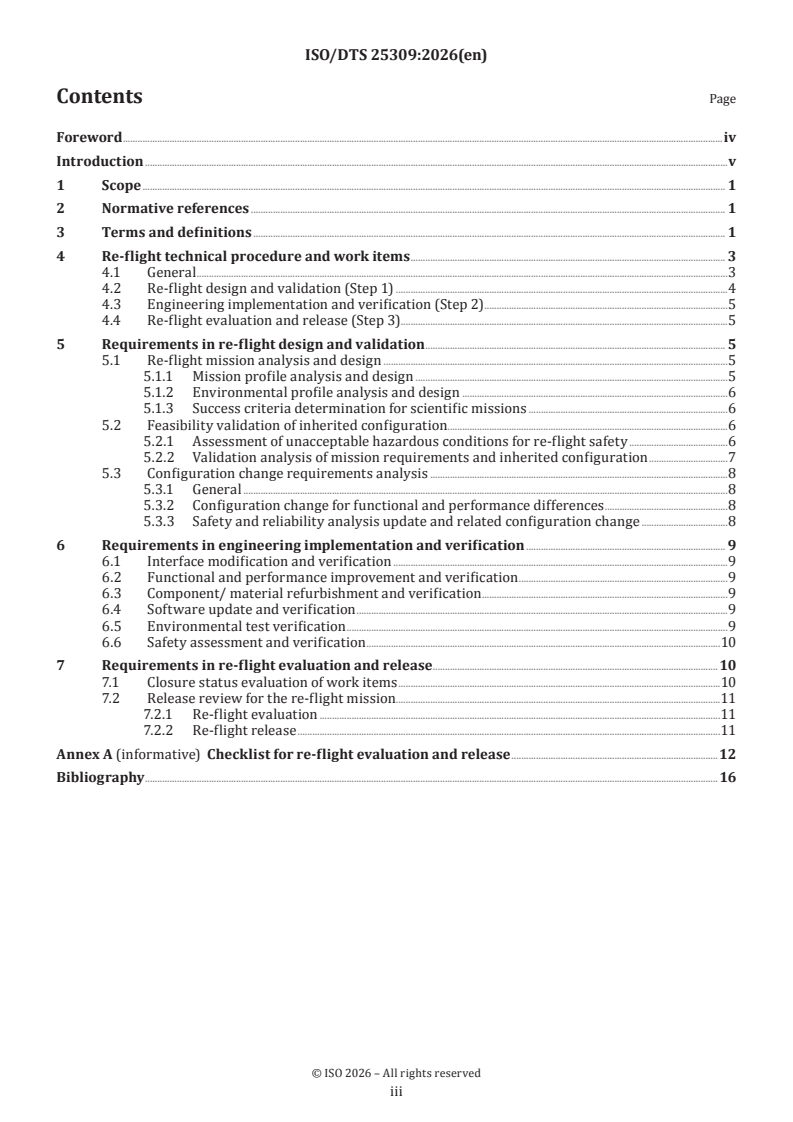
Contents
- Introduction
- 1 Scope
- 2 Normative references
- 3 Terms and definitions
- 3.1 re-flight
- 3.2 re-flight of space science payloads
- 3.3 re-flight space science payload
- 3.4 inherited state
- 3.5 refurbished state
- 3.6 improved state
- 3.7 unacceptable for re-flight
- 3.8 inherited configuration
- 3.9 intended configuration
- 3.10 product data packet
- 4 Re-flight technical procedure and work items
- 4.1 General
- 2. Engineering imple-
- 3. Re-flight evaluation
- 4.2 Re-flight design and validation (Step 1)
- 4.3 Engineering implementation and verification (Step 2)
- 4.4 Re-flight evaluation and release (Step 3)
- 5 Requirements in re-flight design and validation
- 5.1 Re-flight mission analysis and design
- 5.2 Feasibility validation of inherited configuration
- 5.3 Configuration change requirements analysis
- 6 Requirements in engineering implementation and verification
- 6.1 Interface modification and verification
- 6.2 Functional and performance improvement and verification
- 6.3 Component/ material refurbishment and verification
- 6.4 Software update and verification
- 6.5 Environmental test verification
- 6.6 Safety assessment and verification
- 7 Requirements in re-flight evaluation and release
- 7.1 Closure status evaluation of work items
- 7.2 Release review for the re-flight mission
- Annex A
- Bibliography
Introduction
With the development of space activities, mission duration, mission frequency and the diversity of space science experiments have increased. Space agencies, research organizations, and commercial entities are seeking approaches to improve mission continuity and development efficiency while maintaining safety and reliability. Under these conditions, the re-flight of space science payloads is increasingly considered for subsequent space science missions.
The re-flight of space science payloads can provide several benefits. First, space science research is often conducted over long periods and through multiple mission stages. Re-flight can help maintain continuity of experimental conditions and support comparison of scientific data across missions. Second, some scientific investigations require repeated experiments, iterative refinement, or reproduction of experimental conditions. Re-flight can support these needs when the payload configuration and mission conditions remain suitable. Third, re-flight can reduce repeated design, manufacturing, verification and validation effort by utilising an inherited configuration and previous flight experience. Fourth, re-flight can shorten preparation time for subsequent missions, allowing the required assessment, refurbishment, improvement, and verification activities to be completed within the applicable project constraints. The technical feasibility of re-flight is supported by several factors. Some space science payloads use generic, modular, or series-based designs, which can facilitate adaptation to subsequent missions. Previous flight experience, including ground test records, flight operation records, anomaly records, and environmental exposure data, can provide evidence for assessing the intended re-flight mission. Development and production activities can also be streamlined when inherited design data, manufacturing records, and verification evidence remain applicable. In addition, some components, materials, and units can retain sufficient residual life after previous flight use, provided that degradation, ageing, contamination, damage, and configuration changes are properly assessed.
However, re-flight can introduce additional technical and safety risks. These risks can arise from differences between the previous mission and the intended re-flight mission, including mission duration, environmental profile, operating conditions, spacecraft interfaces, scientific objectives, configuration status, storage and transportation conditions, and residual life. Such differences can affect safety, reliability, performance, compatibility, and mission applicability of the payload. Therefore, re-flight requires systematic assessment, verification, and release before the payload is used for a subsequent mission. This document provides requirements, technical procedures and work items for assessing and preparing space science payloads for re-flight. These requirements are based on previous flight experience, differences between previous and intended missions, inherited and intended configurations, configuration control, verification evidence and release review. They can be tailored according to the payload category, configuration status, mission profile, environmental profile, risk acceptance criteria and applicable project requirements.
This document addresses pre-release activities for a re-flight mission, including mission and environmental profile analysis, feasibility validation of the inherited configuration, configuration change analysis, engineering implementation, verification, safety assessment and release evaluation. Interface-related activities involving the spacecraft platform, launch vehicle, ground support equipment or crewed flight platform are addressed only where they affect the re-flight payload.
FINAL DRAFT Technical Specification ISO/DTS 25309:2026(en) Space systems — Requirements for space science payloads reflight
1 Scope
This document specifies requirements, technical procedures and work items for the assessment, preparation, verification, evaluation and release of space science payloads intended for re-flight missions. This document applies to space science payloads with previous flight experience intended for reuse in subsequent space science missions, including payloads in inherited, refurbished, or improved states. This document applies to payloads accommodated on spacecraft, including, but not limited to, retrievable satellites, space laboratories, space stations and space probes. It does not apply to the re-flight of launch vehicles or spacecraft platforms as complete systems.
2 Normative references
The following documents are referred to in the text in such a way that some or all of their content constitutes requirements of this document. For dated references, only the edition cited applies. For undated references, the latest edition of the referenced document (including any amendments) applies. ISO 14620-1, Space systems — Safety requirements — Part 1: System safety ISO 17666, Space systems — Programme management — Risk management ISO 17689, Space systems — Interface control documents between ground systems, ground support equipment and launch vehicle with payload
3 Terms and definitions
For the purposes of this document, the following terms and definitions apply. ISO and IEC maintain terminological databases for use in standardization at the following addresses:
- IEC Electropedia: available at https:// www .electropedia .org/
- ISO Online browsing platform: available at https:// www .iso .org/ obp
3.1 re-flight
reuse of a space science payload for a subsequent flight mission Note 1 to entry: Re-flight typically occurs after the vehicle or payload has returned to Earth.
3.2 re-flight of space science payloads
reuse of a space science payload with previous flight experience for a subsequent space science mission Note 1 to entry: During re-flight, continuity of experimental conditions can support the comparison of scientific data across missions.
ISO/DTS 25309:2026(en)
3.3 re-flight space science payload
re-flight payload space science payload intended for re-flight Note 1 to entry: A re-flight space science payload can include scientific instruments, devices, experiment units, samples or support equipment accommodated on a spacecraft for space science investigation. Note 2 to entry: Depending on the result of the re-flight feasibility assessment, a re-flight space science payload can be categorized as being in an inherited state, a refurbished state, or an improved state, or as unacceptable for re-flight.
3.4 inherited state
state in which the configuration of a re-flight payload remains unchanged with respect to its qualified design baseline, including function, performance, structure, materials, software and interfaces Note 1 to entry: The physical condition, residual life and previous environmental exposure of a payload in the inherited state are subject to assessment for the intended re-flight mission.
3.5 refurbished state
state in which life-limited, obsolete, or unavailable components or materials are replaced by equivalent or approved substitute items without changing the primary function or performance of the re-flight payload
3.6 improved state
state in which the intended primary function and performance of the re-flight payload remains unchanged, while secondary functions, performance characteristics, interfaces, or software are modified, added or removed Note 1 to entry: Improvements can include mechanical, electrical, thermal, communication, software or operational modification.
3.7 unacceptable for re-flight
state in which a payload does not meet the minimum safety, reliability, functional, performance or mission applicability criteria for the intended re-flight mission Note 1 to entry: Such a state can result from conditions including, but not limited to:
a) severe structural or material damage; b) degradation of primary function or performance; c) safety-critical abnormalities; d) mission-affecting failures; e) infeasibility of refurbishment, improvement or verification; f) accumulated operating time or environmental exposure exceeding the qualified limit or available residual life.
3.8 inherited configuration
configuration of a re-flight payload that maintains the design and functional characteristics of its qualified design baseline Note 1 to entry: An inherited configuration can be supported by previous design data, manufacturing records, verification evidence, flight operation records and configuration change records.
3.9 intended configuration
configuration of a re-flight payload planned for a specific re-flight mission
ISO/DTS 25309:2026(en)
3.10 product data packet
collection of product-related information generated and maintained throughout development, production, verification, operation and recovery, where applicable Note 1 to entry: Such information can include design records, process documentation, manufacturing data, inspection and test results, assembly records, delivery documentation, operation records, anomaly records and recovery records.
4 Re-flight technical procedure and work items
4.1 General
The objective of establishing the re-flight technical procedure is to define the technical activities and work items needed to assess the suitability of a space science payload for the intended re-flight mission and to control associated risks. The re-flight technical procedure is divided into three sequential steps: (1) re-flight design and validation, (2) engineering implementation and verification, and (3) re-flight evaluation and release. For each re-flight payload, the applicable work items for each step shall be identified, documented and approved by the responsible authority before implementation. The organization responsible for each applicable work item shall be defined, as detailed in 4.2 to 4.4. Key milestones within each step shall be controlled.
For alignment with the project phase principles defined in ISO 14300-1, the re-flight technical steps are correlated with the relevant project phases. The re-flight design and validation step corresponds to the mission analysis phase (Phase 0), the feasibility phase (Phase A) and, where applicable, the definition phase (Phase B). The engineering implementation and verification step corresponds to the development phase (Phase C) and production phase (Phase D). The re-flight evaluation and release step corresponds to the acceptance process within the production phase (Phase D).
The flowchart of the re-flight technical procedures is illustrated in Figure 1. Figure 1 — Re-flight technical procedure
ISO/DTS 25309:2026(en) Table 1 — Work item matrix for re-flight space science payloads Inherited state Refurbished state Improved state Work items for re-flight for re-flight for re-flight Re-flight mission analysis and
design Re-flight design and Feasibility validation of inher-
validation (Step 1) ited configuration Configuration change require-
ments analysis Interface modification and Exempted ∆ √ verification Functional and performance
improvement and verification Component/material replace- Exempted ∆ √
2. Engineering imple-
ment and verification mentation and verifica- Software update and verification (Step 2) Exempted Exempted ∆ tion Environmental test verifica-
tion Safety assessment and verifi-
cation Closure status evaluation of
work items
3. Re-flight evaluation
and release (Step 3) Release review for the re-
flight mission Key:
√: necessary item.
Δ: optional item to be determined according to mission-specific conditions, configuration changes, previous flight experience, previous environmental exposure, residual life assessment or risk assessment results. NOTE: Exempted: work item not applicable to the corresponding re-flight state unless required by mission-specific conditions or by the responsible authority.
The re-flight work item matrix provided in Table 1 summarises work items applicable to space science payloads in different re-flight states. It provides general guidance for selecting preliminary work items. For payloads in the inherited state, the configuration remains unchanged. For payloads in a refurbished or improved state, the configuration is modified. Accordingly, the applicability of work items differs among inherited, refurbished and improved states. The applicability of work items at different system levels shall be tailored according to the specific conditions of the re-flight payload and mission.
4.2 Re-flight design and validation (Step 1)
The re-flight design and validation shall include the following:
a) Re-flight mission analysis and design. Analysis and design shall be performed based on the space science payload’s previous flight experience, intended re-flight mission profile, life profile, and environmental profile. The results shall support re-flight feasibility decision-making and identify any additional design requirements.
b) Feasibility validation of inherited configuration. The safety, reliability, mission applicability and feasibility of the re-flight payload shall be evaluated. The status of the re-flight payload shall be inspected, and differences between the inherited configuration and re-flight mission requirements shall be compared. The re-flight status shall be classified as one of the following: inherited state, refurbished state, improved state, or unacceptable for re-flight status. Configuration change items requiring improvement or optimisation shall be confirmed.
ISO/DTS 25309:2026(en) c) Configuration change requirements analysis. Based on the re-flight mission requirements, safety assessment results and inherited configuration status, differences between the inherited configuration and the intended re-flight mission shall be identified. The effects of these differences on function, performance, interfaces, safety, reliability and environmental suitability shall be analysed. Configuration change requirements shall be defined where necessary.
The results of these activities shall serve as the basis for proceeding to the engineering implementation and verification step.
4.3 Engineering implementation and verification (Step 2)
Refurbishment or improvement activities shall be conducted for re-flight payloads requiring configuration changes. The implemented configuration shall be verified against the specified interface, functional, performance, environmental, and safety requirements applicable to the re-flight mission. Configuration changes to hardware and software during engineering implementation shall be controlled. All quality issues arising from the configuration change process shall be subject to closed-loop control. In particular, verification coverage analysis and inspection shall be conducted for applicable verification items. The engineering implementation and verification shall include the following:
a) Interface modification and verification.
b) Functional and performance improvement and verification.
c) Component/material refurbishment and verification.
d) Software update and verification.
e) Environmental test verification.
...
Contents
- Introduction
- 1 Scope
- 2 Normative references
- 3 Terms and definitions
- 4 Re-flight technical procedure and work items
- 4.1 General
- 2. Engineering
- 3. Re-flight evaluation Closure status evaluation of
- 4.2 Re-flight design and validation (Step 1)
- 4.3 Engineering implementation and verification (Step 2)
- 4.4 Re-flight evaluation and release (Step 3)
- 5 Requirements in re-flight design and validation
- 5.1 Re-flight mission analysis and design
- 5.2 Feasibility validation of inherited configuration
- 5.3 Configuration change requirements analysis
- 6 Requirements in engineering implementation and verification
- 6.1 Interface modification and verification
- 6.2 Functional and performance improvement and verification
- 6.3 Component/ material refurbishment and verification
- 6.4 Software update and verification
- 6.5 Environmental test verification
- 6.6 Safety assessment and verification
- 7 Requirements in re-flight evaluation and release
- 7.1 Closure status evaluation of work items
- 7.2 Release review for the re-flight mission
- Annex A
- Bibliography
Introduction
With the development of space activities, mission duration, mission frequency and the diversity of space science experiments have increased. Space agencies, research organizations, and commercial entities are seeking approaches to improve mission continuity and development efficiency while maintaining safety and reliability. Under these conditions, the re-flight of space science payloads is increasingly considered for subsequent space science missions.
The re-flight of space science payloads can provide several benefits. First, space science research is often conducted over long periods and through multiple mission stages. Re-flight can help maintain continuity of experimental conditions and support comparison of scientific data across missions. Second, some scientific investigations require repeated experiments, iterative refinement, or reproduction of experimental conditions. Re-flight can support these needs when the payload configuration and mission conditions remain suitable. Third, re-flight can reduce repeated design, manufacturing, verification and validation effort by utilising an inherited configuration and previous flight experience. Fourth, re-flight can shorten preparation time for subsequent missions, allowing the required assessment, refurbishment, improvement, and verification activities to be completed within the applicable project constraints. The technical feasibility of re-flight is supported by several factors. Some space science payloads use generic, modular, or series-based designs, which can facilitate adaptation to subsequent missions. Previous flight experience, including ground test records, flight operation records, anomaly records, and environmental exposure data, can provide evidence for assessing the intended re-flight mission. Development and production activities can also be streamlined when inherited design data, manufacturing records, and verification evidence remain applicable. In addition, some components, materials, and units can retain sufficient residual life after previous flight use, provided that degradation, ageing, contamination, damage, and configuration changes are properly assessed.
However, re-flight can introduce additional technical and safety risks. These risks can arise from differences between the previous mission and the intended re-flight mission, including mission duration, environmental profile, operating conditions, spacecraft interfaces, scientific objectives, configuration status, storage and transportation conditions, and residual life. Such differences can affect safety, reliability, performance, compatibility, and mission applicability of the payload. Therefore, re-flight requires systematic assessment, verification, and release before the payload is used for a subsequent mission. This document provides requirements, technical procedures and work items for assessing and preparing space science payloads for re-flight. These requirements are based on previous flight experience, differences between previous and intended missions, inherited and intended configurations, configuration control, verification evidence and release review. They can be tailored according to the payload category, configuration status, mission profile, environmental profile, risk acceptance criteria and applicable project requirements. This document addresses pre-release activities for a re-flight mission, including mission and environmental profile analysis, feasibility validation of the inherited configuration, configuration change analysis, engineering implementation, verification, safety assessment and release evaluation. Interface-related activities involving the spacecraft platform, launch vehicle, ground support equipment or crewed flight platform are addressed only where they affect the re-flight payload.
ISO #####-#:####(X/DTS 25309:(en) Space systems - requirements — Requirements for re-flight of space science payloads re-flight
1 Scope
This document specifies requirements, technical procedures and work items for the assessment, preparation, verification, evaluation and release of space science payloads intended for re-flight missions. This document applies to space science payloads with previous flight experience intended for reuse in subsequent space science missions, including payloads in inherited, refurbished, or improved states. This document addresses pre-release activities for a re-flight mission, including mission and environmental profile analysis, feasibility validation of the inherited configuration, configuration change analysis, engineering implementation, verification, safety assessment and release evaluation. This document applies to payloads accommodated on spacecraft, including, but not limited to, retrievable satellites, space laboratories, space stations and space probes. It does not apply to the re-flight of launch vehicles or spacecraft platforms as complete systems. Interface-related activities involving the spacecraft platform, launch vehicle, ground support equipment or crewed flight platform are addressed only where they affect the re-flight payload.
2 Normative references
The following documents are referred to in the text in such a way that some or all of their content constitutes requirements of this document. For dated references, only the edition cited applies. For undated references, the latest edition of the referenced document (including any amendments) applies. ISO 14300-1, Space systems — Programme management — Part 1: Structuring of a project ISO ISO 14620-1, Space systems — Safety requirements — Part 1: System safety ISO 17666, Space systems — Programme management — Risk management ISO 17689, Space systems — Interface control documents between ground systems, ground support equipment and launch vehicle with payload ISO 19683, Space systems — Design qualification and acceptance tests of small spacecraft and units ISO 23135, Space systems — Verification programme and management process
3 Terms and definitions
For the purposes of this document, the following terms and definitions apply. ISO and IEC maintain terminological databases for use in standardization at the following addresses:
- — IEC Electropedia: available at https://www.electropedia.org/
- — ISO Online browsing platform: available at https://www.iso.org/obp 3.1 3.1 re-flight reuse of a space science payload for a subsequent flight mission
ISO #####-#:####(X/DTS 25309:(en) Note 1 to entry: Re-flight typically occurs after the vehicle or payload has returned to Earth. 3.2 3.2 re-flight of space science payloads reuse of a space science payload with previous flight experience for a subsequent space science mission Note 1 to entry: During re-flight, continuity of experimental conditions can support the comparison of scientific data across missions.
3.3 3.3 re-flight space science payload re-flight payload space science payload intended for re-flight Note 1 to entry: A re-flight space science payload can include scientific instruments, devices, experiment units, samples or support equipment accommodated on a spacecraft for space science investigation. Note 2 to entry: Depending on the result of the re-flight feasibility assessment, a re-flight space science payload can be categorisedcategorized as being in an inherited state, a refurbished state, or an improved state, or as unacceptable for re-flight.
3.4 3.4 inherited state state in which the configuration of a re-flight payload remains unchanged with respect to its qualified design baseline, including function, performance, structure, materials, software and interfaces. Note 1 to entry: The physical condition, residual life and previous environmental exposure of a payload in the inherited state are subject to assessment for the intended re-flight mission. 3.5 3.5 refurbished state state in which life-limited, obsolete, or unavailable components or materials are replaced by equivalent or approved substitute items without changing the primary function or performance of the re-flight payload 3.6 3.6 improved state state in which the intended primary function and performance of the re-flight payload remains unchanged, while secondary functions, performance characteristics, interfaces, or software are modified, added or removed Note 1 to entry: Improvements can include mechanical, electrical, thermal, communication, software or operational modification.
3.7 3.7 unacceptable for re-flight state in which a payload does not meet the minimum safety, reliability, functional, performance or mission applicability criteria for the intended re-flight mission Note 1 to entry: Such a state can result from conditions including, but not limited to:
a) a) severe structural or material damage; b) b) degradation of primary function or performance; c) c) safety-critical abnormalities; d) d) mission-affecting failures;
ISO #####-#:####(X/DTS 25309:(en) e) e) infeasibility of refurbishment, improvement or verification; f) f) accumulated operating time or environmental exposure exceeding the qualified limit or available residual life. 3.8 3.8 inherited configuration configuration of a re-flight payload that maintains the design and functional characteristics of its qualified design baseline Note 1 to entry: An inherited configuration can be supported by previous design data, manufacturing records, verification evidence, flight operation records and configuration change records. 3.9 3.9 intended configuration configuration of a re-flight payload planned for a specific re-flight mission 3.10 3.10 product data packet collection of product-related information generated and maintained throughout development, production, verification, operation and recovery, where applicable Note 1 to entry: Such information can include design records, process documentation, manufacturing data, inspection and test results, assembly records, delivery documentation, operation records, anomaly records and recovery records.
4 Re-flight technical procedure and work items
4.1 General
The objective of establishing the re-flight technical procedure is to define the technical activities and work items needed to assess the suitability of a space science payload for the intended re-flight mission and to control associated risks. The re-flight technical procedure is divided into three sequential steps: (1) re-flight design and validation, (2) engineering implementation and verification, and (3) re-flight evaluation and release. For each re-flight payload, the applicable work items for each step shall be identified, documented and approved by the responsible authority before implementation. The organization responsible for each applicable work item shall be defined, as detailed in 4.24.2 to 4.44.4. . Key milestones within each step shall be controlled.
For alignment with the project phase principles defined in ISO 14300-1, the re-flight technical steps are correlated with the relevant project phases. The re-flight design and validation step corresponds to the mission analysis phase (Phase 0), the feasibility phase (Phase A) and, where applicable, the definition phase (Phase B). The engineering implementation and verification step corresponds to the development phase (Phase C) and production phase (Phase D). The re-flight evaluation and release step corresponds to the acceptance process within the production phase (Phase D).
The flowchart of the re-flight technical procedures is illustrated in Figure 1Figure 1..
ISO #####-#:####(X/DTS 25309:(en)
Figure 1 — Re-flight technical procedure Table 1 — Work item matrix for re-flight space science payloads Inherited Refurbished Improved state Work items state for restate for re-flight for re-flight flight Re-flight mission analysis and
design Re-flight design and Feasibility validation of
validation (Step 1) inherited configuration Configuration change
requirements analysis Interface modification and Exempted ∆ √ verification Functional and performance improvement and ∆ ∆ √ verification Component/material
2. Engineering
Exempted ∆ √ replacement and verification implementation and verification (Step 2) Software update and Exempted Exempted ∆ verification Environmental test
verification Safety assessment and
verification
3. Re-flight evaluation Closure status evaluation of
and release (Step 3) work items
ISO #####-#:####(X/DTS 25309:(en) Inherited Refurbished Improved state Work items state for re-
state for re-flight for re-flight flight Release review for the re-
flight mission NOTE Key:
√: necessary item.
Δ: optional item to be determined according to mission-specific conditions, configuration changes, previous flight experience, previous environmental exposure, residual life assessment or risk assessment results. NOTE: Exempted: work item not applicable to the corresponding re-flight state unless required by mission-specific conditions or by the responsible authority.
The re-flight work item matrix provided in Table 1Table 1 summarises work items applicable to space science payloads in different re-flight states. It provides general guidance for selecting preliminary work items. For payloads in the inherited state, the configuration remains unchanged. For payloads in a refurbished or improved state, the configuration is modified. Accordingly, the applicability of work items differs among inherited, refurbished and improved states. The applicability of work items at different system levels shall be tailored according to the specific conditions of the re-flight payload and mission.
4.2 Re-flight design and validation (Step 1)
The re-flight design and validation shall include the following:
a) Re-flight mission analysis and design. Analysis and design shall be performed based on the space science payload’s previous flight experience, intended re-flight mission profile, life profile, and environmental profile. The results shall support re-flight feasibility decision-making and identify any additional design requirements.
b) Feasibility validation of inherited configuration. The safety, reliability, mission applicability and feasibility of the re-flight payload shall be evaluated. The status of the re-flight payload shall be inspected, and differences between the inherited configuration and re-flight mission requirements shall be compared. The re-flight status shall be classified as one of the following: inherited state, refurbished state, improved state, or unacceptable for re-flight status. Configuration change items requiring improvement or optimisation shall be confirmed.
c) Configuration change requirements analysis. Based on the re-flight mission requirements, safety assessment results and inherited configuration status, differences between the inherited configuration and the intended re-flight mission shall be identified. The effects of these differences on function, performance, interfaces, safety, reliability and environmental suitability shall be analysed. Configuration change requirements shall be defined where necessary.
The results of these activities shall serve as the basis for proceeding to the engineering implementation and verification step.
4.3 Engineering implementation and verification (Step 2)
Refurbishment or improvement activities shall be conducted for re-flight payloads requiring configuration changes. The implemented configuration shall be verified against the specified interface, functional, performance, environmental, and safety requirements applicable to the re-flight mission.
...